What Hardness Number to Program Into a Water Softener
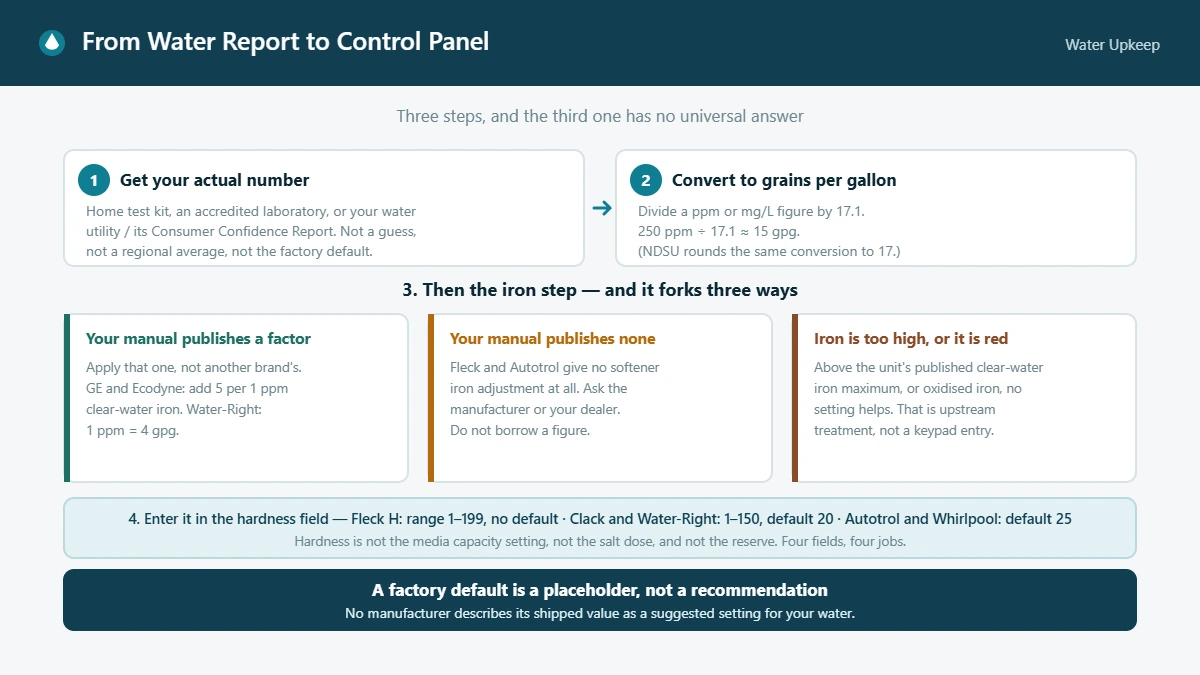
The number a water softener wants is your water’s actual hardness in grains per gallon — not a class, not a guess, and not the number the unit shipped with. If your test or your utility reports hardness in ppm or mg/L, divide by 17.1 to get grains per gallon. Then apply whatever iron adjustment your own manual publishes, because manufacturers do not agree on that adjustment and two of the most widely fitted control valves in American homes publish none at all.
Setting the number higher than your real hardness does not make the water softer. Minnesota’s health department puts the consequence plainly: “Make sure the softener is set to the hardness of your water supply. If the hardness is set too high, the softener will cost more to operate and waste water, costing you extra money.”
Before you can set anything: three things you need
| What you need | In what unit | Where it comes from | If you do not have it |
|---|---|---|---|
| Feedwater hardness | Grains per gallon — convert from ppm or mg/L by dividing by 17.1 | Home test kit; an accredited laboratory; your water utility or its annual Consumer Confidence Report | Stop and get the number. Do not use the factory default and do not use a regional average. |
| Clear-water (ferrous) iron | ppm, which is the same as mg/L | The same test or laboratory — or ask the utility for it at the same time as the hardness figure | Only needed if your manual publishes an iron adjustment. If it publishes none, do not borrow one. |
| Your own control valve’s manual | — | The manufacturer | Stop. The parameter name, the accepted range, the iron rule if any, and any salt-type adjustment all differ by valve. |
| Not needed here: media capacity in grains | grains | Set at purchase | A different parameter entirely — see what size water softener you need. |
| Not needed here: salt dose, reserve, regeneration schedule | lb, %, time of day | Manual or installer | Different parameters again — see how often a softener should regenerate. |
Your hardness number, and the three places to get it
Minnesota Department of Health names three routes: a home test kit, an independent accredited laboratory, or — if you are on a community system — contacting the utility directly for hardness information. UNL Extension names the same three, and is specific about the free one: “The CCR may include information about the hardness level of the water delivered. You can also contact the water supplier and ask for this information.” For a private supply, UNL notes that “Most water testing laboratories offer hardness tests for a fee” and that “a variety of water hardness test kits and dip strips are available for purchase.”
If you are on municipal water, the utility route is not a fallback — it is usually free, immediate, and more precise than a dip strip. The procedure for taking your own reading is in how to test water hardness.
Your iron number — and only clear-water iron counts
Ask for it at the same time. Morton’s support documentation instructs city-water customers to “call your local water supplier and ask for both Hardness and Clear Water Iron values,” and tells well owners to “take a sample of your water to a treatment facility to have it tested.” (The identical text appears under the EcoPure brand; it is one manufacturer’s position published twice, not two independent sources, and we treat it as one.)
The qualifier matters. Penn State Extension explains why: “Although colorless, reduced iron will be removed by the unit, red-oxidized iron (iron that has been exposed to air or chlorine) will clog the resin.” Clear-water iron is the kind a softener can exchange out. Red iron is a particle, and no setting on the control head addresses it.
Your manual, because the next step is brand-specific
This is the part most guidance skips. The accepted range, the default, the parameter’s name and the iron rule are all different from valve to valve, and there is no generic answer that is correct on all of them. Two minutes with your own manual saves you from applying another brand’s arithmetic to your machine.
Getting the units right: 17.1
What the control valve is asking for
Every softener control manual we opened asks for the same quantity, in the same unit, under a slightly different name:
- Pentair Fleck 5600SXT, parameter H, Feedwater Hardness: “Enter the feedwater hardness in grains per unit volume for softener systems, or 1 for filter systems.” Range: 1–199. No default is published.
- Clack WS1 / WS1.25, Step 2I: “Set the amount of hardness in grains of hardness as calcium carbonate per gallon using ▼ or ▲. The default is 20 but ranges from 1 – 150 in one-grain increments.”
- Water-Right Impression Plus and Evolve: “Set the amount of hardness in grains per gallon (default 20)… The allowable range is from 1 to 150 in 1 grain increments.”
- Pentair Autotrol 740/760 and 742/762: “Enter inlet water hardness at installation site.” Default 25 grains.
- Ecodyne / Whirlpool WHES30 and WHES33: “Press the PROGRAM button once again to display a flashing ’25’ and the word ‘HARDNESS’. Press the UP or DOWN buttons to set your water’s hardness number.”
- GE GXSF27E / GXSF31E: “Press UP or DOWN button to set your water hardness number in the display,” in grains per gallon.
Note the ranges and defaults, because they are not the same: 1–199 with no default on the Fleck, 1–150 with a default of 20 on Clack and Water-Right, 25 on Autotrol and on the Whirlpool display. A default is a placeholder, not a recommendation. None of these manufacturers describes its shipped value as a suggested setting, and a unit still sitting on 20 or 25 is almost certainly not set to your water.
Converting ppm or mg/L to grains per gallon
One grain per gallon equals 17.1 mg/L, and mg/L and ppm are the same thing in water. WQA states it and ties it to the standards: “One grain is equal to 17.1 ppm of hardness expressed as calcium carbonate,” and, separately, “Soft water is defined by American National Standards NSF/ANSI 44 and NSF/ANSI 330 as water containing <1 grain of hardness per gallon (or <17.1 mg/L hardness).” Purdue Extension prints the arithmetic in the other direction: “gpg x 17.1 = ppm.” Montana State: “Hardness can be reported in milligrams per liter (mg/L), parts per million (ppm) which is equivalent to mg/L, or grains per gallon (1 grain = 17.1 mg/L).”
Morton’s support documentation gives the direction you actually need, with a worked example: “If your hardness number reported in PPM or MG/L, divide that number by 17.1 to convert to GPG.” Its example: 250 ppm ÷ 17.1 = approximately 15 gpg.
Why NDSU says 17 and everyone else says 17.1
NDSU Extension publishes the conversion rounded: “One gpg is equal to 17 ppm or 17 mg/l.” WQA, Purdue, Montana State and the manufacturers all use 17.1. The difference is under one percent and disappears entirely on a control that only accepts whole grains — 250 ÷ 17 is 14.7 and 250 ÷ 17.1 is 14.6, and both round to 15.
We use 17.1, because it is what WQA publishes and it is the figure tied to the NSF/ANSI definition of soft water. We are flagging NDSU’s 17 rather than quietly ignoring it, because you will meet both numbers and it is better to know that the sources round differently than to wonder which one is wrong.
What happens if you type a ppm figure into a grains field
Put the published ranges next to the arithmetic and the answer is visible without anyone having to assert it. Suppose your report says 250 ppm. Divided by 17.1, that is about 15 gpg. Type 250 instead and you are outside the accepted range on the Clack, the Water-Right and — well past 199 — the Fleck. On a valve that accepts it, you have entered a value roughly sixteen times your actual hardness, and every capacity calculation the control makes from that point is built on it.
The reverse error is harmless by comparison: a reader with 15 gpg who enters 15 is simply correct. The unit mistake only runs one way, and it runs badly.
Iron: the adjustment nobody agrees on
This is the part of the question that has no general answer, and the honest thing to do is show you why rather than pick a number for you.
| Manufacturer / control | What it publishes | Exact wording |
|---|---|---|
| Pentair Fleck 5600SXT | Nothing. Iron goes to a separate filter | “If piping is clogged with iron, a separate iron filter unit should be installed ahead of the water softener.” |
| Pentair Autotrol 740/760, 742/762 | Nothing for softeners. An instruction for iron filters only | “Set your hardness to the level of ppm iron in your water.” (filter application) |
| Clack WS1 / WS1.25 | The concept, no number | “The grains per gallon can be increased if soluble iron needs to be reduced.” |
| GE GXSF27E/31E, GXSH40V/45V | +5 per 1 ppm clear-water iron | “increase the hardness setting by 5 for each 1 ppm of clear water iron” |
| Ecodyne (Whirlpool WHES30/33) | +5 per 1 ppm ferrous iron, with a worked example | “add 5 grains to the hardness setting for every 1 ppm of Ferrous (clear water) iron” |
| Water-Right (Impression Plus, Evolve, CareSoft) | 1 ppm = 4 gpg | “increase the grains per gallon if soluble iron is present (1 ppm = 4 gpg)” |
| Every independent source we opened — WQA, NSF, EPA, Minnesota DOH, UNL, NDSU, Penn State, Purdue, Montana State | None. Ceilings and fouling mechanisms only | UNL: “Excess iron (above 5 ppm)…can reduce the effectiveness”; NDSU: “greater than 10 ppm…may need a dedicated iron removal system” |
Why there is no universal figure
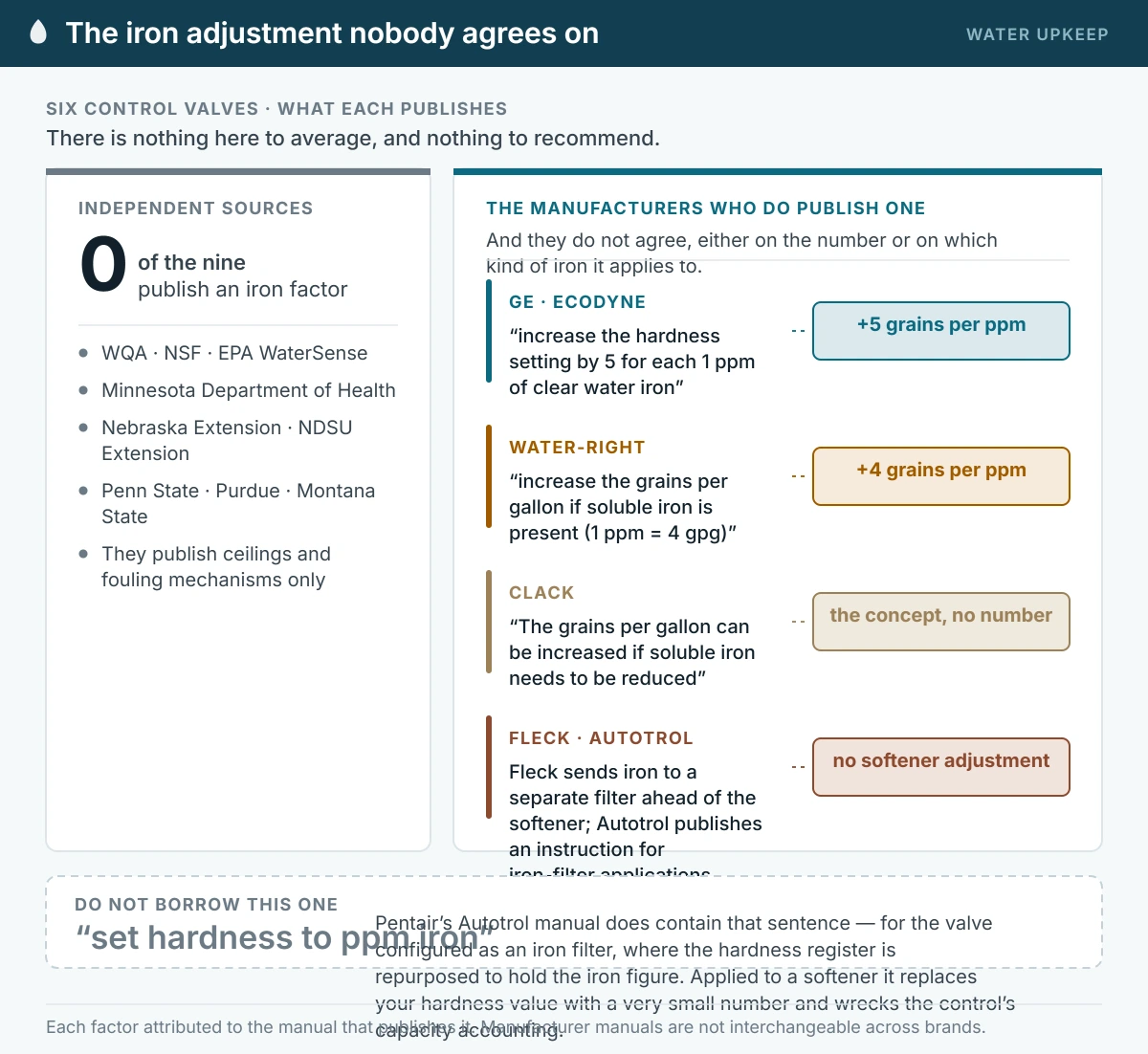
Read that table as a whole. No independent body publishes an iron compensation factor at all. The manufacturers who do publish one disagree — four grains per ppm from Water-Right, five from GE and from Ecodyne — and they qualify it differently: “clear water iron,” “ferrous (clear water) iron,” “soluble iron,” and Water-Right’s additional condition “if a resin media is used.” Two of the most common control valves in American homes, Fleck and Autotrol, publish no softener iron adjustment whatsoever.
So there is nothing for us to average and nothing to recommend. Use the factor in your own manual. If your manual publishes none and your water contains iron, that is a question for the manufacturer or your dealer — not for a number borrowed from a different brand’s document.
Where a hardness setting stops helping
Increasing the hardness number does not turn a softener into an iron filter, and every source that touches iron says so in its own way. Ecodyne publishes per-model clear-water iron maxima — 8 ppm on the WHES30, 9 ppm on the WHES33. UNL states that softeners “may also remove as much as 5-10 ppm” and that “Concentrations of iron and manganese greater than the softener’s removal rating may require pretreatment.” NDSU sets its ceiling at 10 ppm and says supplies above it “may need a dedicated iron removal system.” Penn State adds that oxidized iron clogs the resin regardless, and that “Filtration prior to softening insures that oxidized iron is not processed in the softener.”
Above your unit’s published maximum, or where the iron is red rather than clear, the answer is upstream treatment: how to remove iron from well water. If the resin has already been fouled, that is a different repair — see when softener resin needs replacing.
Do not borrow the Autotrol iron-filter instruction
This one circulates on forums with its context stripped off, so it is worth naming. Pentair’s Autotrol 740/760 manual does contain the sentence “Set your hardness to the level of ppm iron in your water. If you have 3 ppm of iron, set the 760 control to ‘3’.” That instruction is for the valve configured as an iron filter, where the hardness register is being repurposed to hold the iron figure. Applied to a softener it would replace your hardness value with a very small number and wreck the control’s capacity accounting.
Potassium chloride: one manufacturer’s extra 25%
Morton’s support documentation instructs that if you use potassium chloride instead of sodium chloride, you “add an additional 25% to the final hardness programming.” The same text appears under EcoPure — again, one manufacturer position published under two brands.
No independent source publishes a potassium-chloride adjustment, and no other manual we opened mentions one. Tier 1 sources confirm only that potassium chloride is an available alternative: UNL notes it “can be more costly and more difficult to obtain than sodium chloride”; Montana State says “Traditionally sodium has been used in water softeners but potassium is also available.” So treat the 25% as an example of the kind of brand-specific adjustment you will only find in your own manual — not as a general rule, and not something to apply to a Fleck, Clack, Autotrol or Water-Right valve. Salt type itself is covered in water softener maintenance.
What the hardness setting is not
It is not the capacity setting
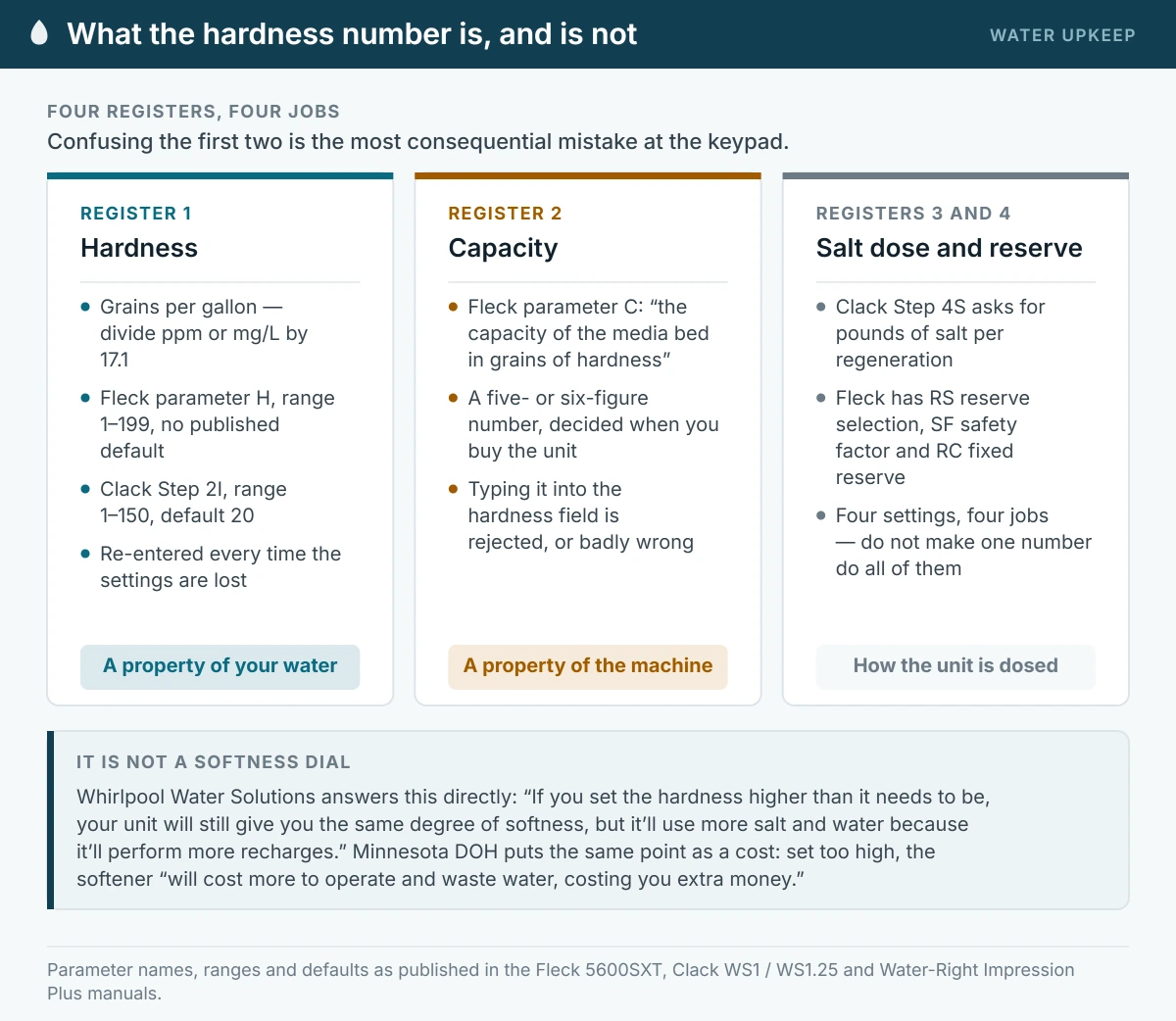
These are two different numbers in two different registers, and confusing them is the most consequential mistake at the keypad. Hardness is a property of your water supply — Fleck’s H, Clack’s Step 2I. Capacity is a property of the machine: Fleck’s C, described as “the treatment capacity of the system media. Enter the capacity of the media bed in grains of hardness when configuring a softener system.” That is a five- or six-figure number, and a reader who types it into a field whose range is 1–199 or 1–150 will either be rejected or badly wrong.
The firmware keeps them apart because it divides one by the other. Capacity is decided when you buy the unit — what size water softener you need. Hardness is decided by your water, and re-entered every time the settings are lost.
It is not a salt setting or a reserve setting
Those are separate parameters again. Clack’s Step 4S asks for pounds of salt per regeneration. Fleck has an RS parameter for reserve selection, an SF safety factor described as “what percentage of the system capacity will be held as a reserve,” and an RC fixed reserve capacity. Four settings, four jobs. Do not try to make one number do all of them, and do not change the other three while you are in there for the hardness value.
It is not a softness dial
This is the question the search results are full of, and one manufacturer answers it directly. Whirlpool Water Solutions: “If you set the hardness higher than it needs to be, your unit will still give you the same degree of softness, but it’ll use more salt and water because it’ll perform more recharges.” And: “Setting the hardness number higher than necessary reduces the efficiency of your softener.” The same page notes that “Your unit uses the hardness setting to determine how often it needs to recharge.”
Which is the whole point. The setting tells the control how fast your water uses up the resin bed’s capacity. Overstate it and the control thinks the bed is exhausted sooner than it is, so it regenerates sooner than it needs to — same water at the tap, more salt and more water down the drain.
Where the interval question goes
If entering the correct number changes how often your unit recharges and you want to know whether the new interval is reasonable, that is a separate question with its own arithmetic — see how often a water softener should regenerate. How long a single regeneration takes once it starts is its own article too. We deliberately do not publish interval figures here, because there is exactly one place they should live.
Why the exact number matters
Minnesota DOH gives the cost side: a setting that is too high means the softener “will cost more to operate and waste water, costing you extra money.” That is a state health department stating both the instruction and the penalty, and it is the reason the answer here is “your real number” rather than “round up to be safe.”
Efficiency has a defined meaning in this context, and it is about salt and water rather than softness. EPA WaterSense: “The NSF/ANSI 44 Residential Cation Exchange Water Softeners standard includes a voluntary efficiency rating that requires softeners to use 5.0 gallons of water or less per 1,000 grains of hardness removed.” EPA also notes that “Water softeners that use demand-initiated regeneration are more efficient than water softeners that function based on a fixed schedule” — and a demand-initiated control is precisely the kind that depends on the hardness number being right.
There is a second consequence worth knowing about. Softening trades hardness ions for sodium at a published rate — NDSU: “For every grain of hardness removed from water, about 8 mg/1 (ppm) of sodium is added”; UNL gives the same rate. That is a rate, never a total: it depends on how much hardness is actually removed, which is a property of your water and not of the number you type. Minnesota DOH notes that a softener using sodium chloride increases the sodium in the water you drink at home, and names potassium chloride as an alternative. Any question about what that means for a particular person goes to your health department or a clinician, not to us.
A note on certification
NSF/ANSI 44 is the residential cation exchange softener standard. NSF describes its scope as covering “Reduction of hardness and specific contaminants from a known quality source,” material safety, structural integrity, pressure drop, “Softening capacity and rinse effectiveness,” “Accuracy of the brine system,” and “Accuracy of information provided to end users.” The claims actually searchable in the certification listing under that standard are barium reduction, efficiency rated hardness reduction, and radium 226/228 reduction. A correctly formed certification statement names the standard and the claim — Water-Right’s own wording is a good model: “certified by WQA against NSF/ANSI Standard 44 for the reduction of hardness.” A bare “NSF certified” tells you nothing.
About those hardness charts
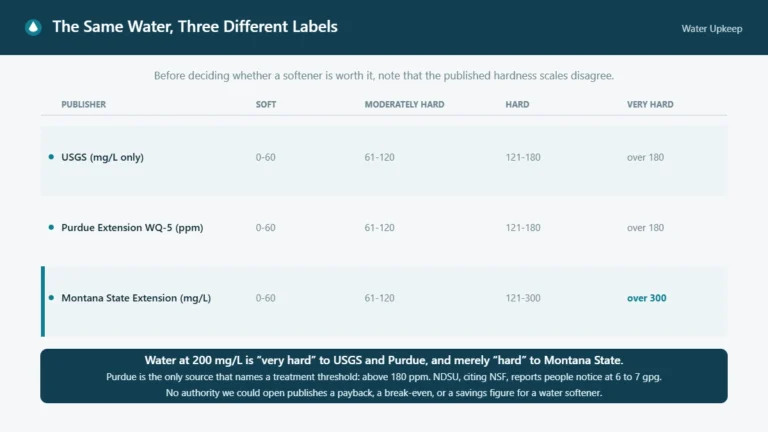
You will find a “water hardness scale” on a great many pages, presented as though there is one. There is not. Five organizations publish five different treatments of the same question, and we are printing them side by side rather than merging them into a house scale.
| Publisher | Soft | Slightly hard | Moderately hard | Hard | Very hard |
|---|---|---|---|---|---|
| NDSU Extension (WQ1031) | under 17 mg/L (under 1.0 gpg) | 17–60 (1.0–3.5) | 61–120 (3.5–7.0) | 121–180 (7.0–10.5) | over 180 (over 10.5) |
| UNL Extension (G1491) | 0–17 (0–1.0) | 17–60 (1.0–3.5) | 60–120 (3.5–7.0) | 120–180 (7.0–10.5) | 180+ (10.5+) |
| Purdue Extension (WQ-5) | 0–60 ppm | — | 61–120 | 121–180 | over 180 |
| Montana State Extension | 0–60 mg/L | — | 61–120 | 121–300 | over 300 |
| Minnesota Dept of Health | No scale at all. One threshold: above “7 grains per gallon or 120 mg/L” you “might need a water softener” | ||||
| WQA (citing NSF/ANSI 44 and 330) | Defines only “soft”: under 1 gpg, or under 17.1 mg/L | ||||
Two extension services use five classes starting at 17 mg/L. Purdue uses four starting at 60. Montana State also uses four but puts “very hard” above 300 rather than 180 — a genuinely different scale, not a rounding difference. Purdue recommends softening above 180 ppm; Minnesota says a softener may be needed above 120 mg/L. WQA and the standards define only the bottom of the range.
None of this matters for the setting. The control valve does not want a class, it wants a measured number in grains per gallon. The classes are useful for the different question of whether to soften at all — which is its own decision, and covered from the definitional side in the difference between hard and soft water. A hardness number is also not a TDS reading, which is a distinction people get wrong in both directions — see TDS in water.
Where to stop
Programming a hardness value is button-pressing. There is no plumbing work, no electrical work, no permit and no depressurising involved, and readers arriving from our installation articles can leave those cautions behind. What is worth saying is where the task ends.
- You do not have a hardness number. Stop and get one — kit, laboratory or utility. Do not guess, do not use a regional average, do not leave the factory default. Start at how to test water hardness.
- Your manual publishes no iron instruction and your water contains iron. Stop and contact the manufacturer or your dealer. Do not borrow another brand’s factor. This is the most important stop on the page.
- Iron is above your unit’s published maximum, or the iron is red rather than clear. No setting fixes that. Go to iron removal and, if the bed is already fouled, resin replacement.
- You cannot find the parameter, or the panel will not accept the value. That is a fault, not a setting — see softener troubleshooting, then the manufacturer.
- You want to change capacity, salt dose, reserve or the regeneration schedule. Different parameters, different articles: sizing and regeneration frequency.
- The supply is a private well with any microbiological question. A softener, in its own manufacturer’s words, “is not intended to be used for treating water that is microbiologically unsafe or of unknown quality without adequate disinfection.” Go to coliform in well water and to your state or local health authority. No setting is relevant.
- Any health question — sodium, potassium, drinking softened water, infants. Your health department or a clinician, not this page.
One more practical note: write your settings down. Fleck warns that “Power interruptions longer than 8 hours may cause the controller to lose the time setting,” and Morton’s support material notes that a softener out of service for an extended period may need reprogramming because its internal memory cannot hold settings indefinitely. A photograph of the panel and a note of the hardness value in a drawer will save you re-deriving all of this in three years.
Frequently asked questions
What hardness number should I put in my water softener?
Your water’s measured hardness in grains per gallon, plus whatever iron adjustment your own manual publishes. There is no generic figure, and anyone offering one does not know your water. Get the number from a test kit, an accredited laboratory or your utility; convert it if it is reported in ppm or mg/L; check your manual for an iron rule; enter it.
My water report says 250 ppm — what do I enter?
Divide by 17.1. Morton’s own worked example uses exactly that figure: “250 ppm / 17.1 = approx 15 gpg Hardness.” Then add your manual’s iron compensation if it publishes one and you have clear-water iron. Do not type 250 — it is outside the accepted range on several common valves and roughly sixteen times your actual hardness on any valve that accepts it.
Should I add anything to the hardness number for iron?
Only what your own manual says. GE and Ecodyne publish five grains per ppm of clear-water iron. Water-Right publishes four. Clack says the value “can be increased if soluble iron needs to be reduced” without giving a figure. Fleck and Autotrol publish nothing for softeners at all. No independent body publishes a factor. There is nothing to average here, so use your manual or ask the manufacturer.
Will setting the hardness higher give me softer water?
No. Whirlpool Water Solutions answers this one directly: “If you set the hardness higher than it needs to be, your unit will still give you the same degree of softness, but it’ll use more salt and water because it’ll perform more recharges.” Minnesota DOH puts the same point as a cost: too high and the softener “will cost more to operate and waste water.”
What is the difference between the hardness setting and the grain capacity?
Hardness describes your water and lives in a field that accepts 1–199 on a Fleck or 1–150 on a Clack. Capacity describes the resin bed and is a five- or six-figure grain number set when the unit was bought. The control divides one by the other to work out when to regenerate. They are stored separately because they are different quantities in different units of different things.
My softener is set to 20 or 25 out of the box — is that fine?
Almost certainly not, and no manufacturer claims it is. Clack and Water-Right ship at 20, Autotrol and the Whirlpool display at 25, and Fleck publishes no default at all — which tells you what those numbers are. They are placeholders that let the unit boot, not estimates of your water.
Does using potassium chloride change the setting?
On one manufacturer’s units, yes: Morton and EcoPure instruct adding a further 25% to the final hardness programming when using potassium chloride. That is one company’s published position, no independent source publishes a potassium adjustment, and no other manual we opened mentions one. Check yours.
I lost my settings after a power cut — what do I re-enter?
The same hardness figure you derived the first time, since your water has not changed. Fleck notes that outages over eight hours can cost the controller its time setting; Morton warns that an extended out-of-service period may require reprogramming. If you do not have the old number written down, go back to the utility or the laboratory report rather than guessing.
Sources and Standards
- Minnesota Department of Health — Home Water Softening (setting the softener to your water, the cost of setting it too high, and where to get a hardness figure)
- US EPA WaterSense — Water Softeners (Indoor Features), EPA-832-F-23-016, July 2023 (the NSF/ANSI 44 voluntary efficiency rating)
- Water Quality Association — Ion Exchange Fact Sheet (17.1 ppm per grain)
- Water Quality Association — Scale Deposits (the NSF/ANSI 44 and 330 definition of soft water)
- NSF International — NSF/ANSI 44 technical requirements, and the certified drinking water treatment units listing
- Purdue Extension — WQ-5, Interpreting Water Test Reports (the conversion, the four-class scale, and the health statement)
- Montana State University Extension — Interpreting Your Water Test Results: Hardness
- NDSU Extension — Water Softening (Ion Exchange), WQ1031 (the five-class scale, the 17 ppm rounding, iron ceilings, the sodium rate)
- University of Nebraska–Lincoln Extension — G1274, Drinking Water: Hard Water (the CCR and utility route)
- University of Nebraska–Lincoln Extension — G1491, Drinking Water Treatment: Water Softening (iron ceilings, the five-class scale, potassium chloride)
- Penn State Extension — Water Softening (clear versus oxidized iron, pre-filtration)
- Pentair — Fleck 5600SXT service manual (parameters H, C, RS, SF, RC; the separate iron filter instruction; the power-interruption note)
- Pentair — Autotrol 740/760 with 255/268 manual (inlet hardness, the 25-grain default, and the iron-filter instruction)
- Clack Corporation — Water Specialist WS1 and WS1.25 manual (Step 2I hardness, the soluble-iron note, Step 4S salt)
- Water-Right — Impression Plus Series manual (the 1 ppm = 4 gpg factor and the certification wording)
- Water-Right — Evolve Series manual
- Ecodyne Water Systems — Whirlpool WHES30 and WHES33 manual (the hardness step, the +5 iron factor and the per-model clear-water iron maxima)
- Whirlpool Water Solutions support — Will a higher hardness setting give me softer water?
- GE Appliances — GXSF27E and GXSF31E owner’s manual (the +5 per ppm clear-water iron instruction)
- Morton Water Softeners support — Hardness Level Programming (the conversion worked example, the iron factor, and the potassium chloride adjustment)
- Hellenbrand — ProMate EcoMax consumer manual (the microbiological-safety statement)
Manufacturer manuals are cited as the published position of that manufacturer for its own equipment, and are not interchangeable across brands. Where manufacturers disagree — as they do on the iron adjustment — we publish the disagreement rather than resolving it. Certification references name both the standard and the specific claim. Water Upkeep owns no equipment and tests no water.
Last reviewed September 8, 2026.