What Is the Difference Between Hard and Soft Water?
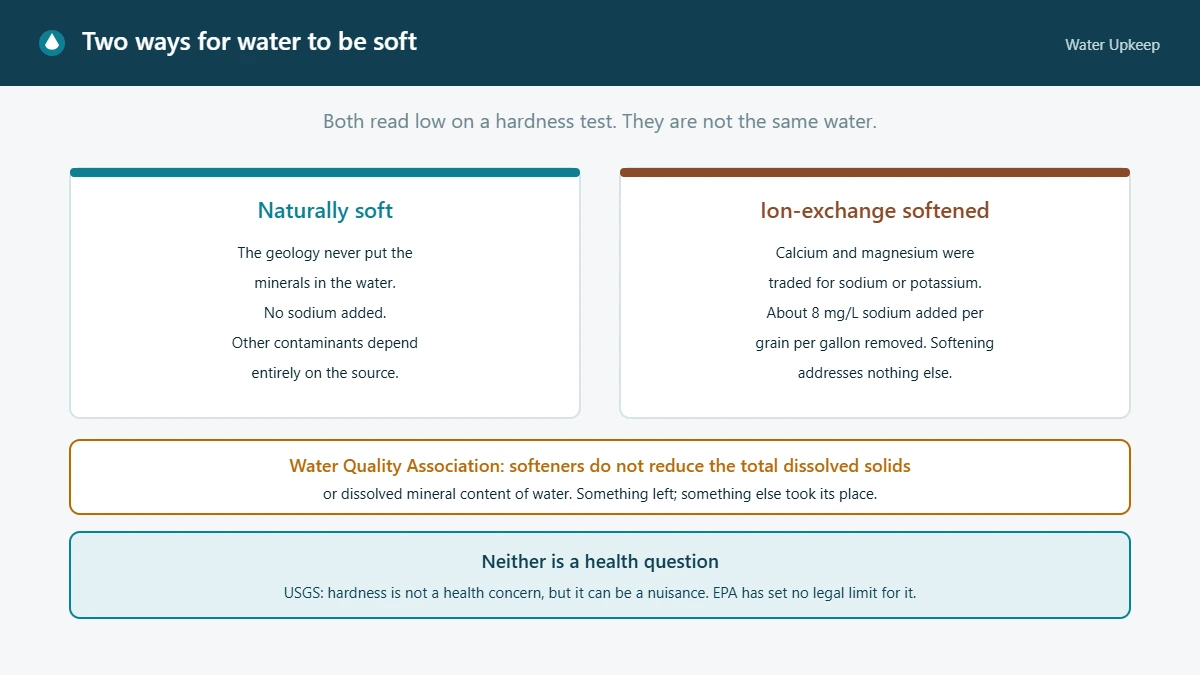
Hard water carries dissolved calcium and magnesium; soft water does not carry much of either. That is the whole difference, and everything else follows from it — the scale in your kettle, the soap that will not lather, the film on your glassware. What most explanations leave out is that there are two quite different ways for water to be soft. Water that is naturally soft never picked up the minerals. Water softened by a machine had them swapped out for sodium. Both read low on a hardness test. They are not the same water.
What hardness is
USGS: water hardness is generally the amount of dissolved calcium and magnesium in water. The Water Quality Association adds the convention — hardness is usually expressed in grains per gallon, or parts per million, as calcium carbonate equivalent, which is why a result comes back as a calcium carbonate number even though calcium carbonate is not what was measured.
It comes from the ground. As water moves through soil and rock it dissolves small amounts of naturally occurring minerals and carries them into the groundwater supply. Virginia Cooperative Extension is more specific: these ions are naturally dissolved into groundwater as it comes into contact with soluble limestone and other rocks and minerals.
Which is why hardness is geographic. USGS notes hard water was prevalent in the east-central and western United States, reflecting the distribution of carbonate aquifers and aquifers with relatively high concentrations of dissolved solids. If you have moved and your soap suddenly behaves differently, that is the reason.
The number, and the two scales
One grain per gallon equals 17.1 mg/L. The Water Quality Association ties that to a standard: soft water is defined by NSF/ANSI 44 and NSF/ANSI 330 as water containing less than 1 grain of hardness per gallon, or under 17.1 mg/L. Penn State rounds it to approximately 17.
The classification bands are where sources diverge, and it is worth seeing both.
| USGS (four bands) | Virginia Tech and Penn State (five bands) |
|---|---|
| Soft: 0 to 60 mg/L | Soft: under 1.0 gpg (under 17.1 mg/L) |
| — | Slightly hard: 1.0 to 3.5 gpg (17.1 to 60 mg/L) |
| Moderately hard: 61 to 120 mg/L | Moderately hard: 3.5 to 7.0 gpg (60 to 120 mg/L) |
| Hard: 121 to 180 mg/L | Hard: 7.0 to 10.5 gpg (120 to 180 mg/L) |
| Very hard: over 180 mg/L | Very hard: over 10.5 gpg (over 180 mg/L) |
The breakpoints at 120 and 180 mg/L are the same. What differs is the bottom: USGS calls everything under 60 mg/L soft, while the extension services reserve “soft” for under one grain and insert a slightly-hard band. Water at 40 mg/L is soft to USGS and slightly hard to Virginia Tech. Same water, different label, depending on whose table you are reading. Our guide to testing water hardness covers how to get the number in the first place.
What hard water does
Two things, and both are chemistry rather than opinion.
It reacts with soap. USGS describes soap reacting with calcium to form soap scum, so more soap or detergent is needed, with visible residue left on dishes and glassware. The Water Quality Association describes hardness preventing soap from lathering by causing an insoluble curdy precipitate. Virginia Cooperative Extension lists reduced sudsing and cleaning action, and buildup of soap scum on hair, skin and laundry.
It forms scale when heated. USGS: when hard water is heated, solid deposits of calcium carbonate form, reducing equipment life, raising the cost of heating water, lowering the efficiency of electric water heaters and clogging pipes — water pipes can gradually close up, lowering pressure. Virginia Cooperative Extension notes mineral scaling in water heaters can increase heating costs by reducing efficiency.
Soft water inverts both. Soap lathers readily and rinses without curd, and there is no scale to deposit. That is the appeal, and it is a real one.
Naturally soft is not the same as softened
This is the part that gets skipped, and it is the most useful thing on the page.
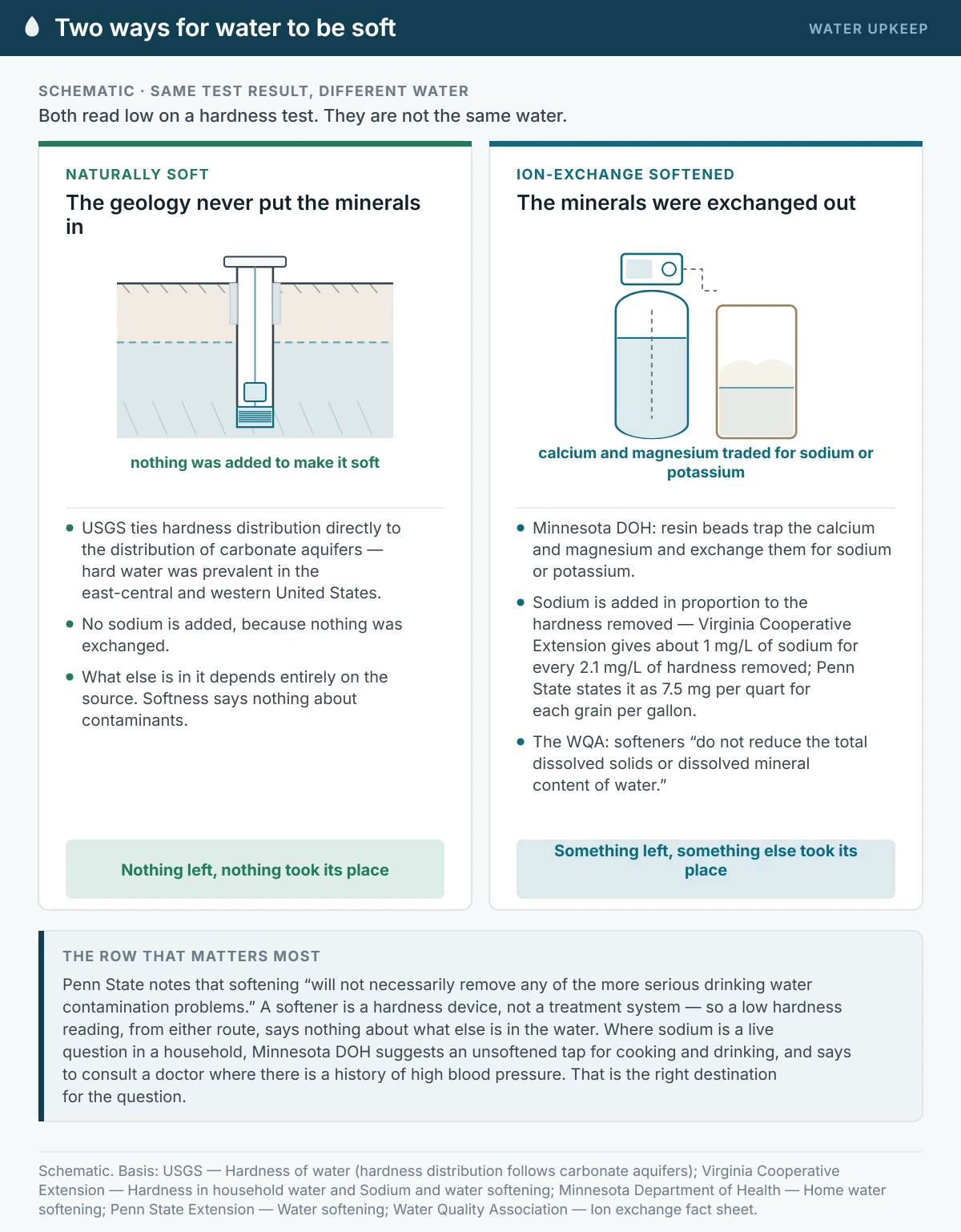
Naturally soft water is soft because the rock it travelled through did not put much calcium or magnesium into it. USGS ties hardness distribution directly to the distribution of carbonate aquifers. Nothing was added to make it soft.
Softened water is soft because the calcium and magnesium were traded away. Virginia Cooperative Extension: an ion exchange water softener replaces calcium and magnesium ions with sodium or, less commonly, potassium ions. The Minnesota Department of Health: resin beads inside the softener trap the calcium and magnesium and exchange them for sodium or potassium. Penn State: the resin releases its sodium ions and readily trades them for the calcium and magnesium ions.
The Water Quality Association makes the consequence explicit: softeners do not reduce the total dissolved solids or dissolved mineral content of water. Something left, something else took its place.
| Naturally soft | Ion-exchange softened | |
|---|---|---|
| Why it is soft | The geology never put the minerals in | The minerals were exchanged out |
| Sodium added | None from the softening process | In proportion to the hardness removed |
| Other contaminants | Depends entirely on the source | Unchanged — softening does not address them |
That last row matters. Penn State notes softening will not necessarily remove any of the more serious drinking water contamination problems. A softener is a hardness device, not a treatment system.
How much sodium, and the rate that matters
The addition is proportional to what is removed, so the right way to express it is a rate rather than a total. Virginia Cooperative Extension gives it as about 1 mg/L of sodium added for every 2.1 mg/L of hardness removed — which, since one grain per gallon is 17.1 mg/L of hardness, works out at roughly 8 mg/L of sodium for every grain per gallon removed. Penn State states the same relationship in different units: 7.5 milligrams per quart for each grain per gallon of hardness removed.
So the total depends entirely on how hard your water was to begin with, which is why no single number can be quoted. Harder incoming water means more sodium in the softened output.
Two pieces of context from allowed sources, with no advice attached. Virginia Cooperative Extension notes EPA has issued guidance that sodium in drinking water not exceed 20 mg/L for people who are on low sodium diets, and that the average estimated sodium intake for Americans aged two or older is 3,400 mg per day. The Minnesota Department of Health suggests creating an unsoftened tap for cooking and drinking, and says that if you or someone in your home has a history of high blood pressure, consult a doctor about drinking softened water. That is the right destination for the question.
Potassium chloride is the usual alternative regenerant, and Virginia Cooperative Extension pairs the suggestion with its own caveat: excess potassium in drinking water can also present health risks to certain segments of the population. It is a swap, not a free upgrade.
Is either one a health issue?
Hardness is not. USGS: hardness is not a health concern, but it can be a nuisance. Its FAQ explains why there is no rule — EPA has not set a legal limit or standard for hardness in water because the constituents that contribute to hardness are not toxic, that is, they do not cause harmful health effects. Virginia Cooperative Extension: consuming hard water does not present a health risk, though it may cause aesthetic or nuisance problems, and there are no EPA public drinking water standards for hard water.
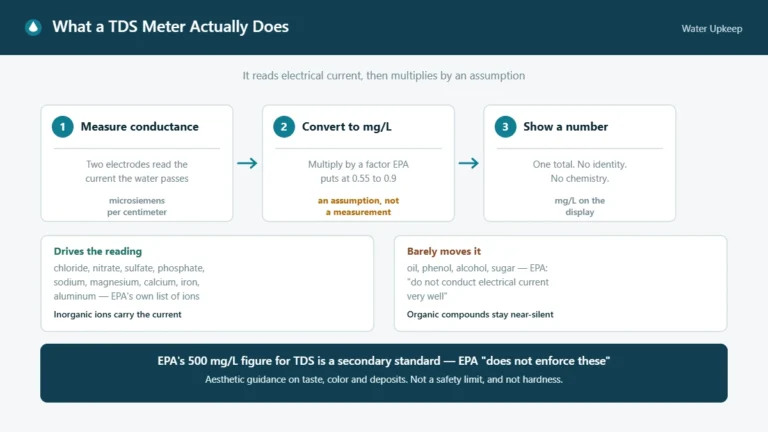
Hardness does appear indirectly on EPA’s secondary standards table, which covers 15 contaminants EPA does not enforce. Total dissolved solids sits there at 500 mg/L, with its noticeable effects listed as hardness, deposits, coloured water, staining and salty taste. Corrosivity is on the same table, with the standard given as non-corrosive, and EPA notes scale is a mineral deposit building up inside hot water pipes, boilers and heat exchangers, restricting or blocking flow.
The corrosivity question
You will see it claimed that soft water corrodes pipes. The allowed-source version is narrower and worth quoting precisely. Penn State Extension lists the factors determining corrosivity as pH, calcium concentration, hardness, dissolved solids content and temperature, and states that water that is soft and acidic, below pH 7.0, tends to be more corrosive.
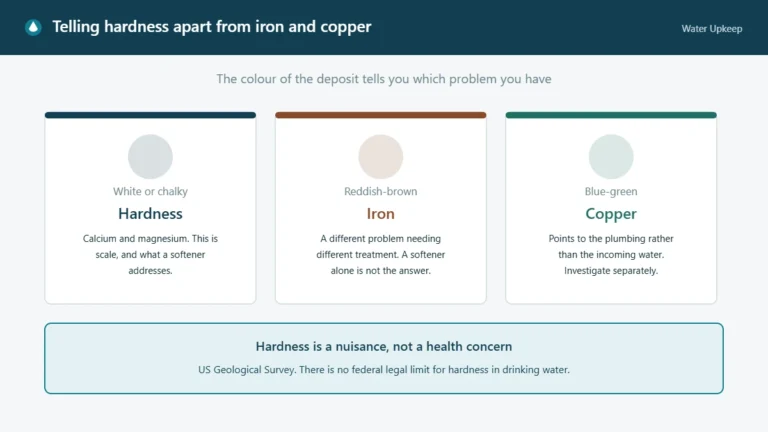
Note the conjunction. Softness alone is not stated to be corrosive. Where corrosive water does occur, Penn State describes the consequences: it can dissolve high concentrations of copper from pipes and fixtures, causing bluish-green stains and a metallic taste especially after water has sat in contact with pipes overnight, and it can also dissolve lead from solders joining copper pipes or occasionally from lead pipes. Our guide to making water taste better covers the flushing habit that addresses the taste side of that.
When the difference actually calls for a decision
Virginia Cooperative Extension gives the threshold: hardness below 7.0 grains per gallon or 120 mg/L generally does not require treatment, and treatment is only necessary when the hardness level is causing a problem for the homeowner.
That is a better decision rule than a label. If your glassware is clear, your kettle is clean and your soap lathers, the number on the report is a fact rather than a problem. If it is not, our guide to treating hard water sets out the options, and how water softeners work covers what actually happens inside the tank.
When to call a professional
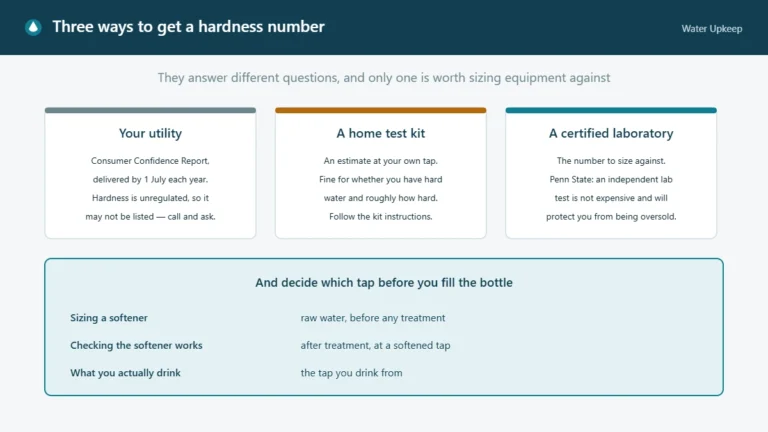
- You are on a private well and have never had an independent hardness number.
- Someone in the household is on a sodium-restricted diet or has a history of high blood pressure — Minnesota’s advice is to consult a doctor about drinking softened water.
- You have bluish-green staining or a metallic taste, which points at corrosive water rather than hard water.
- Scale is forming quickly despite an installed softener.
- You are being told hard water is a health risk. It is not, and that is a reason to be careful about what else you are being told.
More on establishing what is in your water in our water testing hub.
Sources and standards
- US Geological Survey — Hardness of water and Water hardness FAQ
- Virginia Cooperative Extension, Virginia Tech — Hardness in household water and Sodium and water softening
- Penn State Extension — Water softening and Corrosive water problems
- Minnesota Department of Health — Home water softening
- US Environmental Protection Agency — Secondary drinking water standards
- Water Quality Association — Scale deposits and Ion exchange fact sheet
Last reviewed September 8, 2026.