How Do Water Softeners Work?
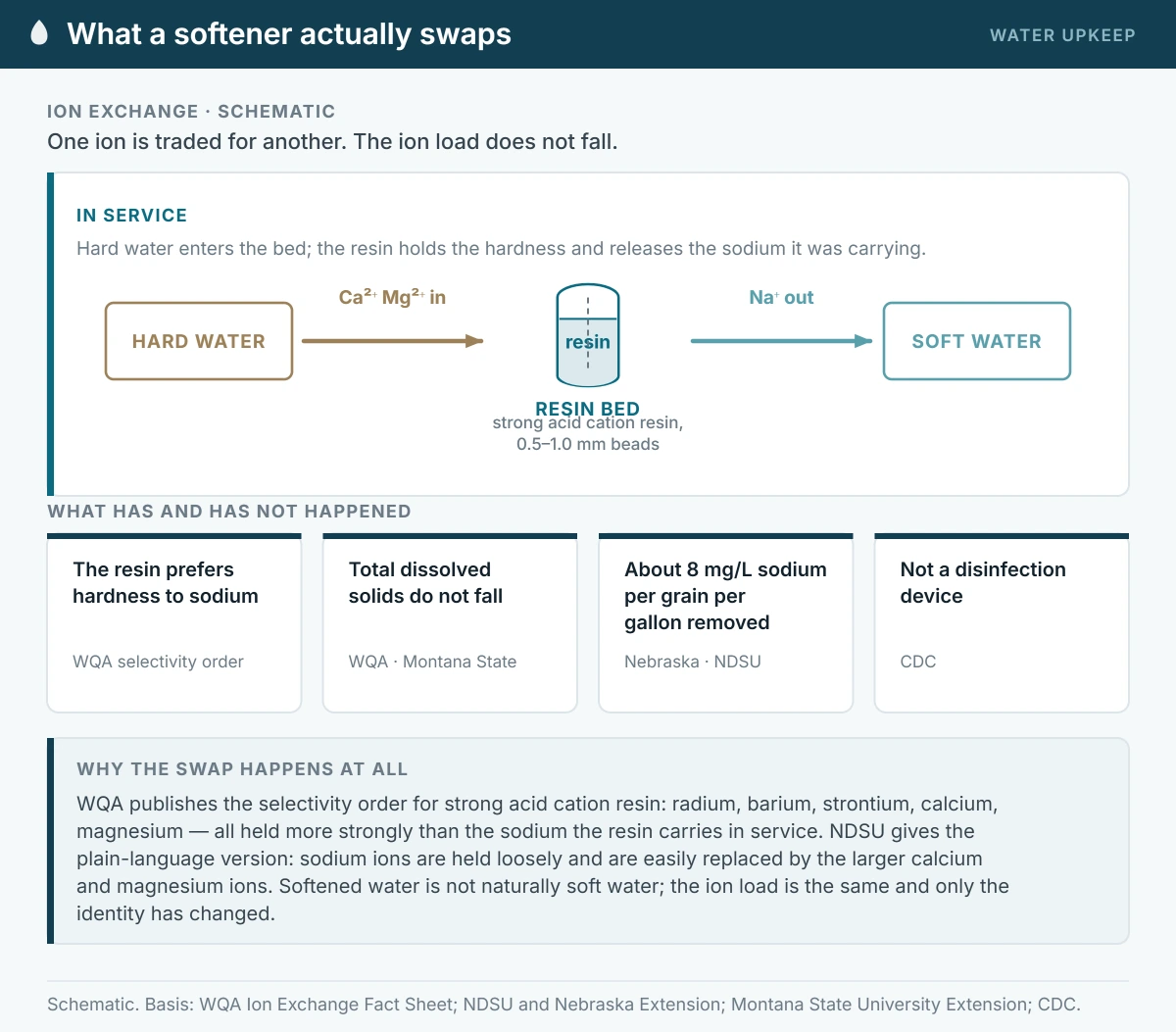
A water softener is a tank of plastic beads that trades one kind of ion for another. Hard water carries calcium and magnesium; the beads are loaded with sodium; as water passes through, the calcium and magnesium stick to the beads and the sodium is released in their place. When the beads run out of sodium, the unit flushes itself with strong brine to reload them and sends the calcium and magnesium down the drain. That is the whole mechanism. The part most people never hear is that the same machine has several different capacities depending on how much salt you tell it to use — which is why a bare “30,000 grain” number on a spec sheet means very little on its own.
What the resin actually is
University of Nebraska–Lincoln Extension describes the medium as microporous exchange resin, usually sulfonated polystyrene beads supersaturated with sodium. The Water Quality Association gives the specification: strong acid cation resin, plastic beads made from polystyrene or acrylic, 0.5 to 1.0 mm in diameter, carrying sulfonic acid functional groups.
Each of those sulfonic acid sites holds a positively charged ion. In service they hold sodium. The exchange happens because the resin does not treat all ions equally.
Why the swap happens at all
The Water Quality Association publishes the selectivity order for strong acid cation resin: radium, barium, strontium, calcium, magnesium — all above sodium. The resin simply prefers the doubly charged hardness ions to the singly charged sodium it is carrying. NDSU Extension gives the plain-language version: sodium ions are held loosely and are easily replaced by the larger calcium and magnesium ions.
So water entering the tank loses its calcium and magnesium to the beads, and leaves carrying sodium instead. Note what has and has not happened. WQA and Montana State University Extension both point out that softening does not reduce total dissolved solids — it exchanges which ions are present. Softened water is not the same thing as naturally soft water, which is low in dissolved ions to begin with. The ion load is the same; the identity has changed.
The regeneration cycle
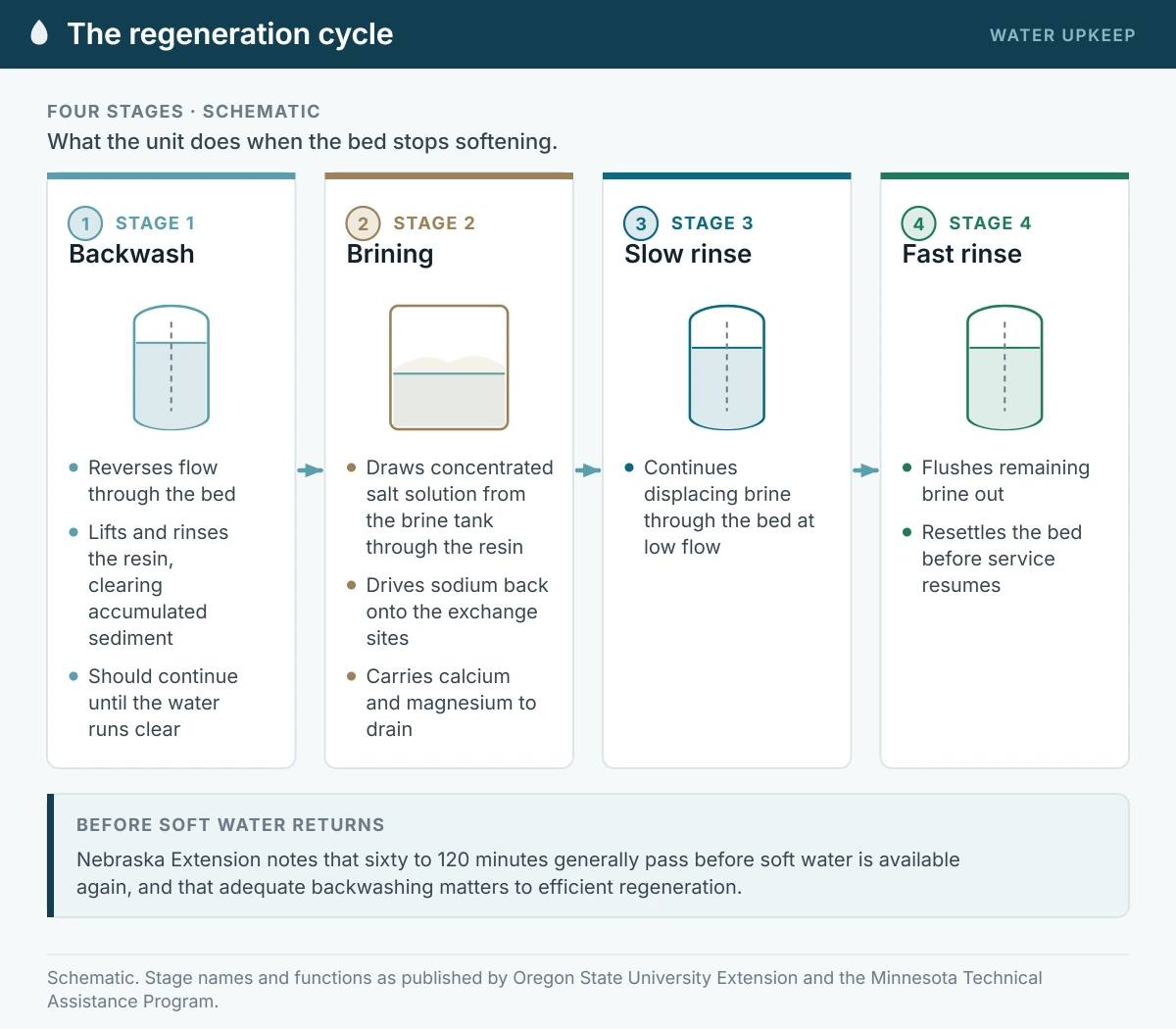
Eventually every exchange site is holding calcium or magnesium and the bed stops softening. Regeneration reloads it. Oregon State University Extension and the Minnesota Technical Assistance Program both name the same sequence:
| Stage | What it does |
|---|---|
| Backwash | Reverses flow through the bed to lift and rinse the resin, clearing accumulated sediment. It should continue until the water runs clear |
| Brining | Draws concentrated salt solution from the brine tank through the resin, driving sodium back onto the exchange sites and carrying calcium and magnesium to drain |
| Slow rinse | Continues displacing brine through the bed at low flow |
| Fast rinse | Flushes remaining brine out and resettles the bed before service resumes |
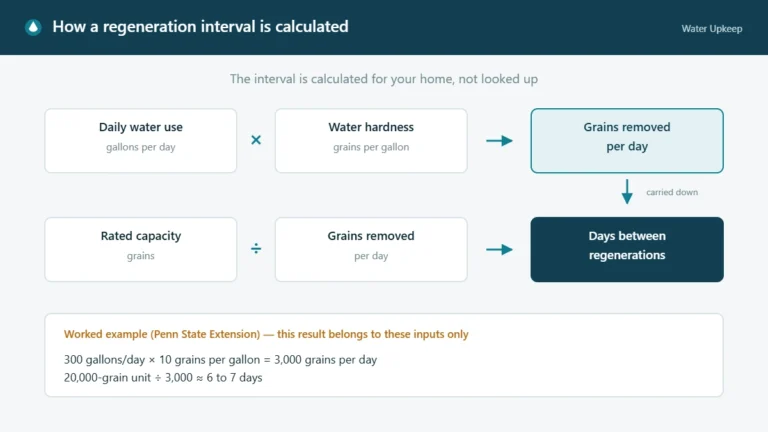
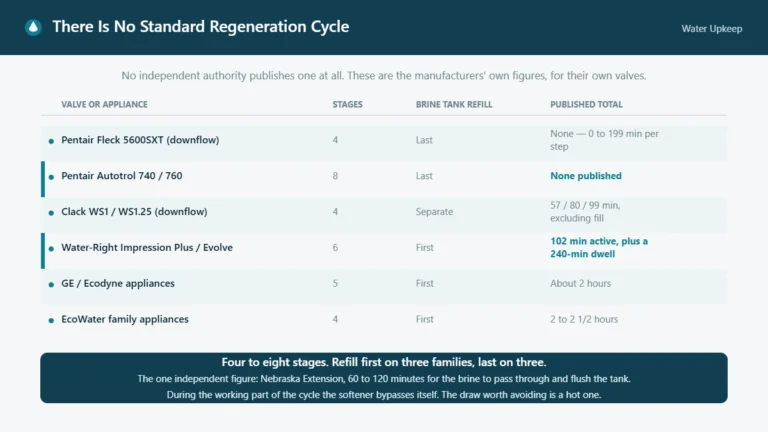
Nebraska Extension notes that sixty to 120 minutes generally pass before soft water is available again, and that adequate backwashing matters to efficient regeneration. Our guide to how often a softener should regenerate covers what decides the timing.
The thing spec sheets do not tell you
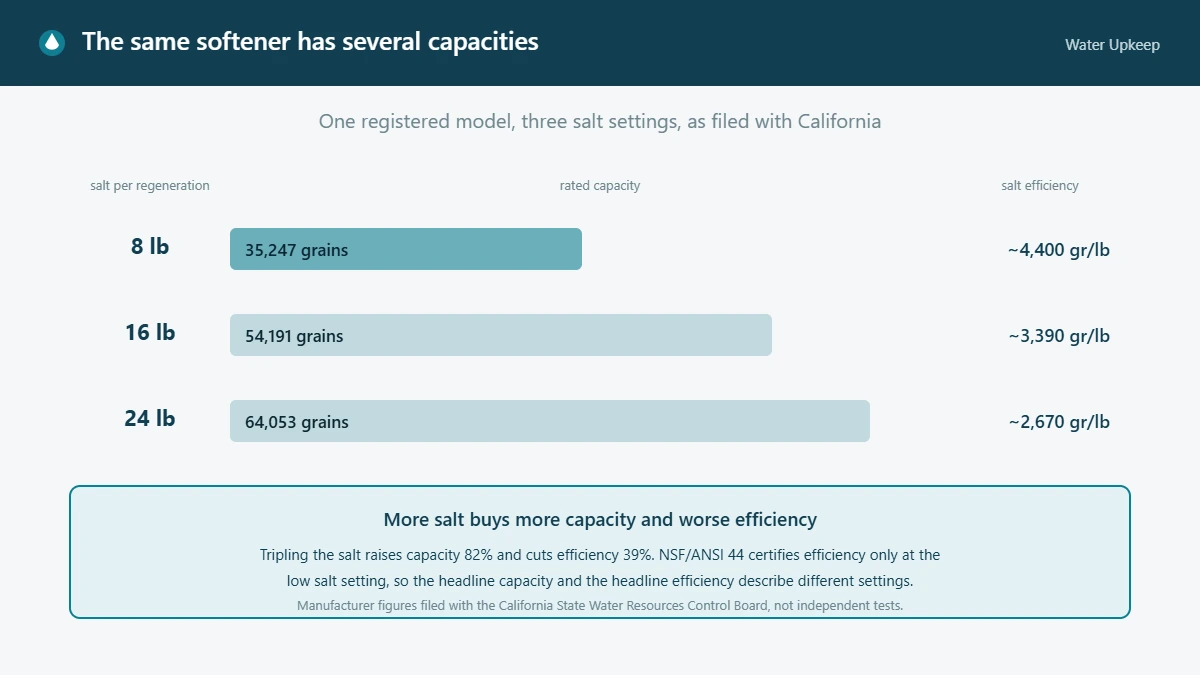
A softener does not have one capacity. EPA states it directly: the salt dosage setting, in pounds of salt, corresponds to a rated capacity, with higher salt dosage settings corresponding to higher capacities.
How much difference this makes is visible in the performance data sheets manufacturers file with the California State Water Resources Control Board. Here is one registered residential model, at the three salt settings its maker filed for it:
| Salt per regeneration | Rated capacity | Grains per pound of salt |
|---|---|---|
| 8.0 lb | 35,247 grains | about 4,400 |
| 16.0 lb | 54,191 grains | about 3,390 |
| 24.0 lb | 64,053 grains | about 2,670 |
Tripling the salt raises the capacity by 82 per cent and cuts salt efficiency by 39 per cent. A second model from the same filing shows the same shape: 28,109 grains at 6 lb, 41,587 at 12 lb, 45,831 at 18 lb — efficiency falling from about 4,690 to about 2,550 grains per pound. These are figures the manufacturers submitted to the state as part of device registration, not independent tests, but the pattern is the point rather than the particular product.
One line on those data sheets makes the consequence explicit: efficiency is only certified at the low salt dosage and maximum service flow rate, determined in accordance with NSF/ANSI 44. So the impressive capacity number and the impressive efficiency number on the same brochure usually describe different settings of the same machine, and you cannot have both at once.
What efficient looks like
Salt efficiency is grains of hardness removed per pound of salt. NSF/ANSI 44’s voluntary efficiency rating requires not less than 3,350 grains per pound; California law sets 4,000; the Water Quality Association recommends setting all softeners to 4,000, with regeneration using no more than five gallons of water per 1,000 grains. WQA also gives the real-world spread: efficiently operated softeners remove 3,000 to 4,000 grains per pound, while inefficient ones manage less than 1,000.
Control type is the other lever. The University of Minnesota Water Resources Center reports that demand-initiated regeneration uses 26 to 60 per cent less salt than time-clock control, twin-tank arrangements up to 30 per cent less than single-tank, and counter-current regeneration up to 40 to 50 per cent less than co-current.
There is no WaterSense label for water softeners, incidentally. EPA explored one and decided not to proceed, citing unresolved stakeholder concerns about the effect of softener discharge on wastewater treatment. NSF/ANSI 44 is the certification that exists.
Sodium, and potassium as the alternative
Because the exchange is one-for-one by charge, the sodium added is proportional to the hardness removed. Nebraska and NDSU Extension both give about 8 mg/L of sodium for each grain per gallon of hardness removed — so water at 10 grains per gallon comes out with roughly 80 mg/L of sodium. Penn State gives 7.5 milligrams per quart per grain per gallon, which is the same figure in different units. Connecticut’s Department of Public Health uses 100 mg/L as a reference level when testing softened water.
Anyone on a sodium-restricted diet should raise this with their physician or state health department rather than with a salesperson. It is also the usual reason for the configuration below.
Potassium chloride can be used instead of sodium chloride. WQA notes it requires a 13 to 15 per cent higher concentration for regeneration; NDSU says about 10 per cent more; Nebraska adds that it can be more costly and harder to obtain, and that it adheres more strongly to the resin, potentially requiring larger quantities. EPA’s guidance on either salt is the same: use sodium or potassium pellets made specifically for softeners, and avoid rock salt, road salt and table salt.
What a softener does not do
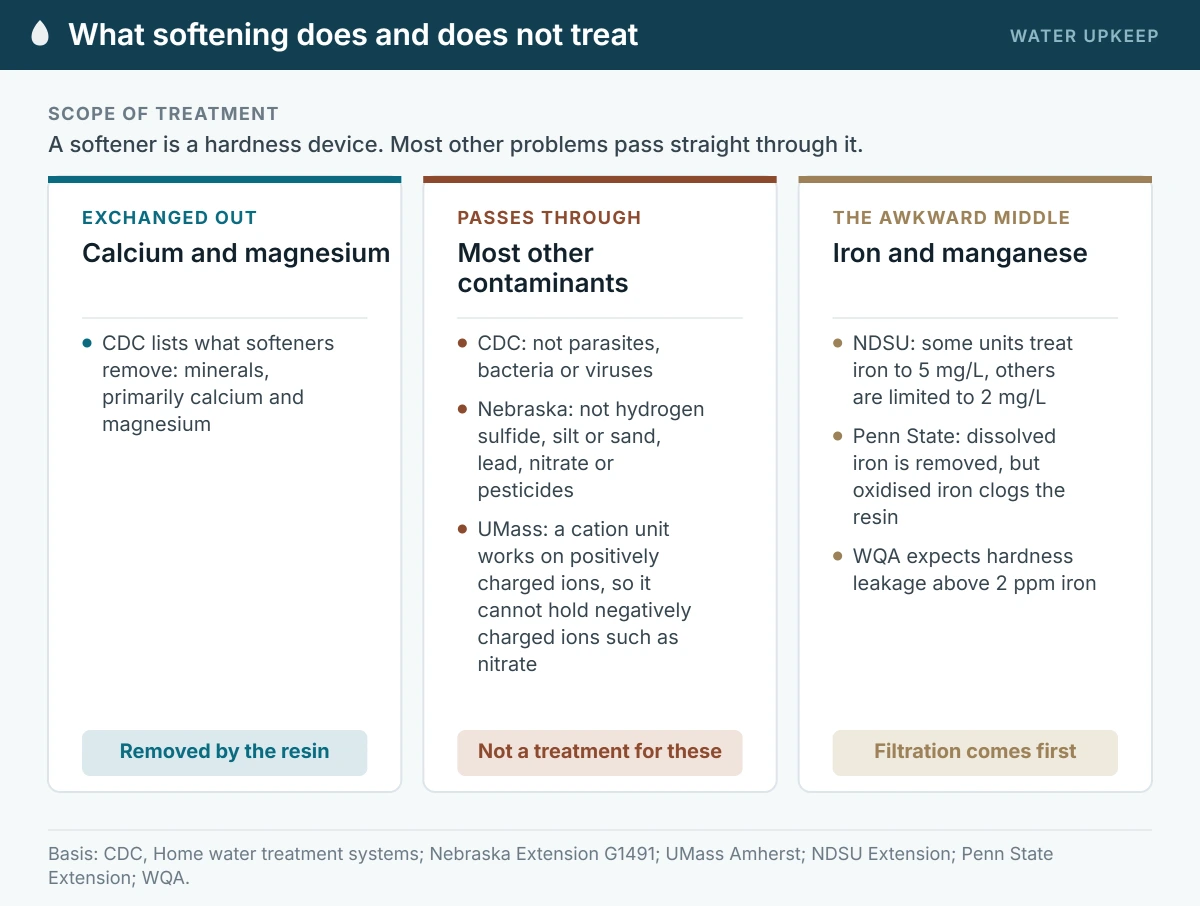
CDC lists what water softeners remove — minerals, primarily calcium and magnesium — and what they do not: parasites, bacteria and viruses. A softener is not a disinfection device and never has been.
Nebraska Extension extends the list: softening does not remove bacteria, hydrogen sulfide, silt or sand, lead, nitrate, pesticides, and many other organic and inorganic compounds. UMass Amherst explains the reason for one class of those: a cation unit works on positively charged ions, so it is not effective against negatively charged ions such as nitrate, which require anion exchange. EPA’s own summary is short — softeners are not needed in all homes and do not typically treat for other water contaminants.
Iron and manganese are the awkward middle case. NDSU notes some softeners can treat water with iron up to 5 mg/L while others are limited to 2 mg/L, and that suspended insoluble iron or manganese will be filtered out on the resin and plug it. Penn State draws the distinction that matters: colourless, dissolved iron is removed by the unit, but red oxidised iron — iron already exposed to air or chlorine — clogs the resin, so filtration should come first. WQA sets a conservative practical ceiling, expecting hardness leakage above 2 ppm iron. What that fouling does over time is covered in how long water softeners last.
Why parts of the house are usually bypassed
Softening every drop is neither necessary nor desirable. EPA suggests activating the bypass valve when watering the lawn, washing the car, filling a pool or using water for anything that does not require softening. Oregon State Extension is blunter: soften only the hot and cold water used for cooking or for cleaning with soap or detergent, and always bypass outside sprinklers, because grass and flowers cannot take the increased sodium.
A cold water line to the kitchen tap that bypasses the softener is a standard configuration, described by both Nebraska and Montana State Extension. It is worth knowing whether your house has one before you assume every tap is softened.
Where the brine goes
EPA puts water use at 20 to 70 gallons per regeneration, with some larger systems using up to 200, and annualises it at 25 gallons or more per day — 150 to 200 gallons a week, 7,800 to 10,400 a year. Extension sources give a rounder figure of about 50 gallons per cycle. Rhode Island DEM frames it as one to three regenerations a week producing 40 to 150 gallons of brine.
That discharge carries excess chloride, sodium and potassium ions. Rhode Island DEM notes brine can disrupt the settling of solids in a septic tank and reduce the volume available for solids separation, and that flow-regulated softeners generally produce less backwash brine than timer-regulated systems. Rules differ: Rhode Island’s own regulations contain no prohibition, but the state notes that Massachusetts and Connecticut prohibit brine discharge to septic systems. Minnesota’s health department warns against discharging within 50 to 100 feet of wells and requires drain-line air gaps. Some municipalities go further — Minnesota Pollution Control Agency documents local ordinances requiring minimum salt efficiencies of 3,350 or 4,000 grains per pound.
If you are on a septic system, or in a sewer district with chloride limits, this is a real constraint and worth checking before buying.
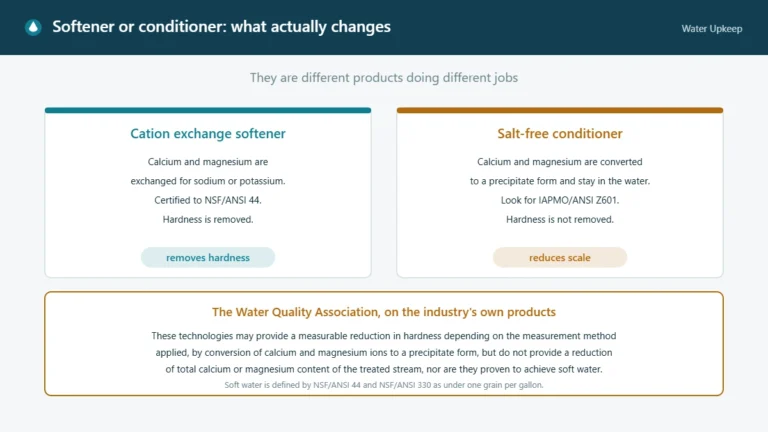
Salt-free conditioners are a different thing entirely
Template-assisted crystallisation is the main salt-free technology with real documentation behind it. The Minnesota Technical Assistance Program describes it: hard water passes through polymeric beads acting as catalytic nucleation sites, ions fall into those sites and grow into microscopic crystals which are released back into the water. The key sentence is theirs: hardness is not removed but transformed — converted from an ionic aqueous state to a solid crystalline state. Limitations noted include ineffectiveness on standing water systems and media replacement every three to four years.
The California State Water Resources Control Board evaluated the alternatives and found TAC achieved greater than 88 per cent scale reduction, the best of the technologies tested; electromagnetic and electrically induced precipitation devices reduced scale by approximately 50 per cent. That is a scale-prevention result, not hardness removal — your water still contains the calcium and magnesium. Nebraska Extension notes separately that physical water treatment technologies do not remove hardness. There is a separate certification standard, IAPMO/ANSI Z601, for scale reduction devices, which EPA lists alongside NSF/ANSI 44.
When to call a professional
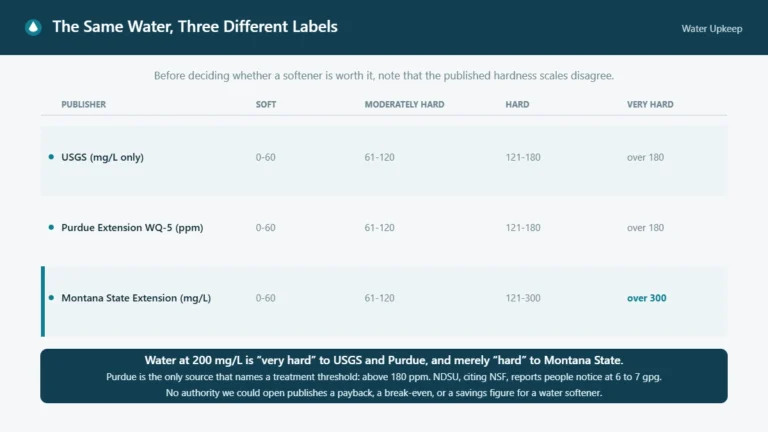
- You do not know your hardness number in grains per gallon, or your iron level. Both drive the whole design. Start with how to tell if you have hard water.
- A quote gives a grain capacity without naming the salt setting it applies to. Ask which setting, and what the efficiency is at that setting.
- You are on a septic system, or your municipality restricts brine discharge or sets a minimum salt efficiency.
- Iron, manganese or hydrogen sulfide are present, which usually means pre-treatment ahead of the softener.
- Someone in the household is on a sodium-restricted diet — that is a conversation for a physician, and potassium chloride or a bypassed drinking tap may be the answer.
Sizing is the next question, and our guide to what size softener you need sets out the arithmetic. More in our water softeners hub.
Sources and standards
- University of Nebraska–Lincoln Extension — Water softening (ion exchange) and Drinking water: hard water
- Water Quality Association — Ion exchange fact sheet, Getting smart with softeners and Softener brine disposal to septic systems
- North Dakota State University Extension — Water softening (ion exchange) and Iron and manganese removal
- Oregon State University Extension Service — Solving hard water problems, EC 1178
- Minnesota Technical Assistance Program, University of Minnesota — Chloride elution study procedure and Non-salt conditioning alternatives
- University of Minnesota Water Resources Center — Residential softening
- US Environmental Protection Agency — Notification of intent, water softeners, Water softener guide, Cation exchange water softeners and Guide to selecting water treatment systems
- California State Water Resources Control Board — Performance data sheet 14-3058, Performance data sheet 14-3057, Performance data sheet 14-3035 and Evaluation of alternatives to domestic ion exchange water softeners
- Centers for Disease Control and Prevention — Home water treatment systems
- UMass Amherst Center for Agriculture, Food and the Environment — Ion exchange treatment of drinking water supplies
- Montana State University Extension Water Quality — Hardness
- Penn State Extension — Water softening
- Rhode Island Department of Environmental Management — Water softener backwash brine best practices
- Minnesota Pollution Control Agency — Guide to developing a local water softener rebate program
- Connecticut Department of Public Health — Ion exchange treatment of private drinking water systems
- NSF — NSF/ANSI 44 technical requirements
Last reviewed September 8, 2026.