How to Remove Chlorine From Water
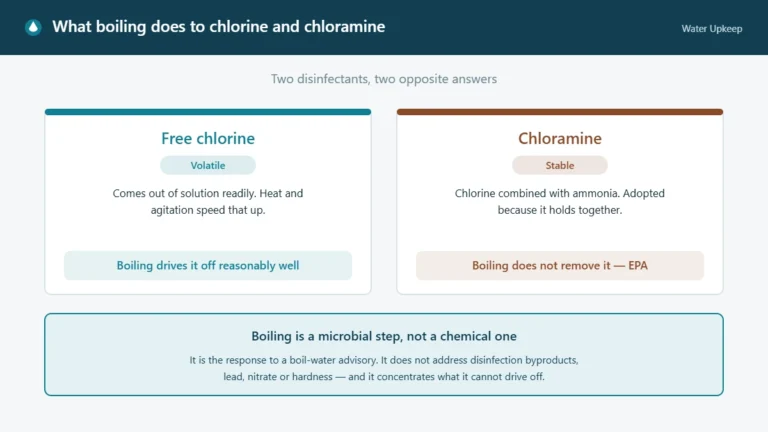
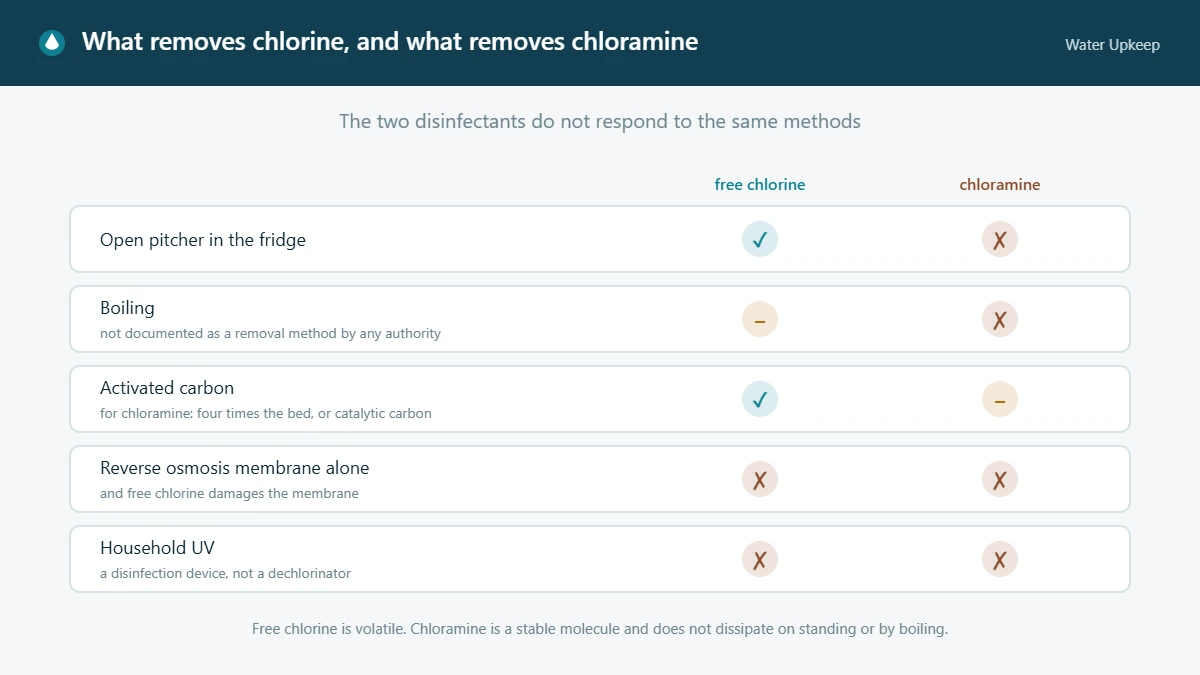
Everything depends on which disinfectant your utility uses, and the two answers are opposite. Free chlorine is volatile: leave water in an open pitcher in the fridge and it goes away on its own. Chloramine is a stable molecule that does not dissipate on standing and does not dissipate by boiling, and the reverse osmosis membrane you might expect to catch it does not. So the first step is not buying anything — it is finding out which one is in your water. After that, one technology does almost all the useful work, and the difference between the two disinfectants is a matter of how long the water has to sit in it.
Find out which one you have
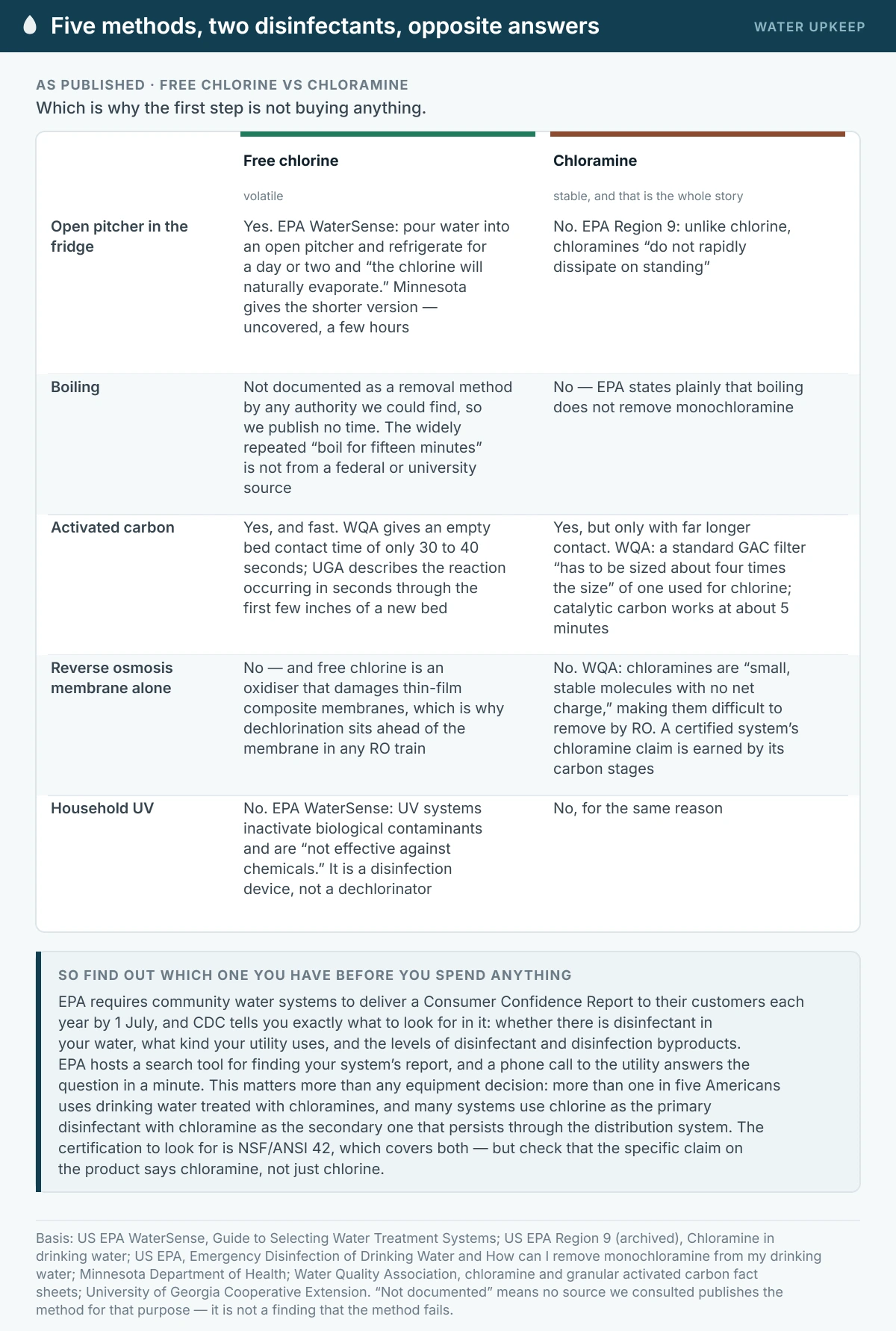
EPA requires community water systems to deliver a Consumer Confidence Report to their customers each year by 1 July. CDC tells you exactly what to look for in it: whether there is disinfectant in your water, what kind your utility uses, and the levels of disinfectant and disinfection byproducts. EPA hosts a search tool for finding your system’s report. If you cannot find it, a phone call to the utility will answer the question in a minute.
This matters more than any equipment decision on this page. More than one in five Americans uses drinking water treated with chloramines, and many systems use chlorine as the primary disinfectant and chloramine as the secondary one that persists through the distribution system.
Why they behave differently
Both are added so that water stays microbiologically safe on its way to your tap. CDC explains why utilities moved: chlorine gets used up quickly, and sometimes there is not enough left to keep killing germs by the time water reaches the tap. Chloramine — chlorine combined with ammonia, specifically monochloramine in drinking water — holds together. EPA notes it provides longer-lasting disinfection as water moves through pipes, and that some systems switched to it to meet disinfection byproduct requirements.
Stability is exactly what makes it hard to remove. An archived EPA Region 9 page states the consequence plainly: unlike chlorine, chloramines do not rapidly dissipate on standing, and neither do they dissipate by boiling.
What actually works
| Method | Free chlorine | Chloramine |
|---|---|---|
| Open pitcher in the fridge | Yes — evaporates naturally over hours to a day or two | No |
| Boiling | Not documented as a removal method by any authority we could find | No |
| Activated carbon | Yes — a fast reaction, seconds of contact | Yes, but only with far longer contact, or catalytic carbon |
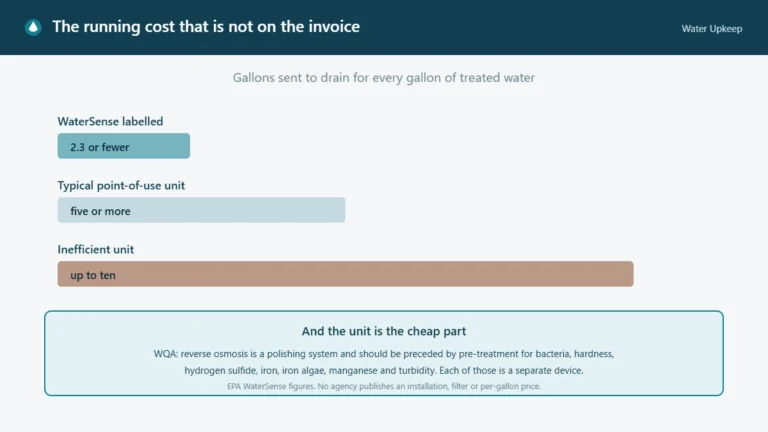
| Reverse osmosis membrane alone | No — and free chlorine damages the membrane | No |
| Household UV | No — it is a disinfection device, not a dechlorinator | No |
The free chlorine case
EPA’s WaterSense guide gives the cheapest answer there is: pour water into an open pitcher and put it in the refrigerator for a day or two, and the chlorine will naturally evaporate. Minnesota Department of Health gives the shorter version — a pitcher in the fridge, uncovered, for a few hours.
Agitation helps by the same mechanism; EPA recommends pouring water between clean containers several times to improve the flat taste of boiled water, which is aeration. Boiling is a different matter. No government, university or standards-body source we consulted states that boiling removes free chlorine or gives a time for it, so the widely repeated “boil for fifteen minutes” figure is not something we will state as fact. What EPA does say about boiling is that it is sufficient to kill pathogenic bacteria, viruses and protozoa, and that it will not destroy other contaminants such as heavy metals, salts and most other chemicals. We cover this from the other direction in does boiling water remove chlorine.
Carbon, and why contact time is the whole story
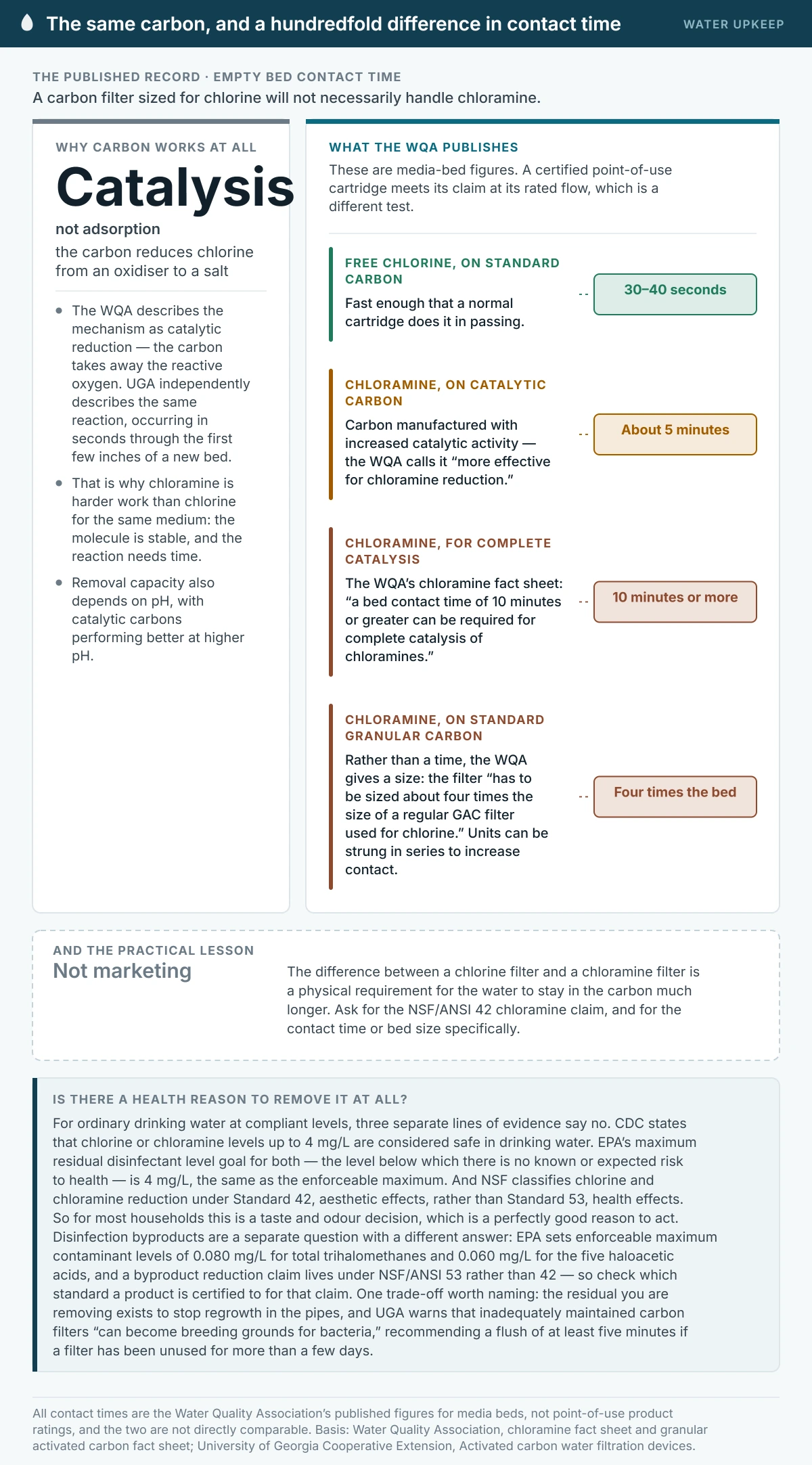
Activated carbon does not simply adsorb chlorine the way it adsorbs a taste compound. The Water Quality Association describes the mechanism as catalytic reduction: the carbon reduces chlorine from an oxidiser to a salt by taking away the reactive oxygen. It is fast — WQA gives an empty bed contact time of only 30 to 40 seconds for free chlorine. University of Georgia Extension independently describes the same reaction, occurring in seconds as water flows through the first few inches of a new carbon bed.
Chloramine is where the arithmetic changes. WQA states that removing it on standard granular activated carbon requires a filter about four times the size of one used for chlorine, and that units can be strung in series to increase contact time. Catalytic carbon — carbon manufactured with increased catalytic activity — is more effective, with contact times of about five minutes; WQA’s chloramine fact sheet notes a bed contact time of ten minutes or greater can be required for complete catalysis. Removal capacity also depends on pH, with catalytic carbons performing better at higher pH.
That is the practical lesson. A carbon filter sized for chlorine will not necessarily handle chloramine, and the difference is not marketing — it is a physical requirement for the water to stay in the carbon much longer.
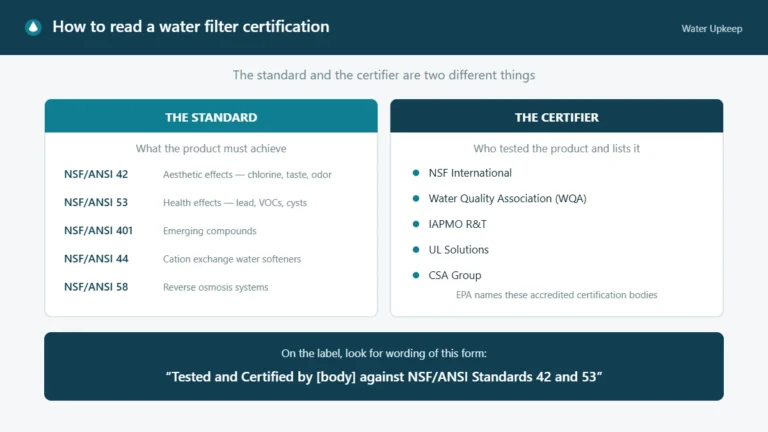
The certification to look for is NSF/ANSI 42, which covers aesthetic effects including both chlorine and chloramine. WQA points buyers to the same standard for chloramine reduction, and EPA’s WaterSense guide points to it for chlorine. Check that the specific claim on the product says chloramine, not just chlorine.
The reverse osmosis confusion
You will see reverse osmosis systems listed as effective against chloramine, and you will also see it stated that reverse osmosis does not remove chloramine. Both are true, and the resolution is worth understanding before you spend money.
The membrane itself does not. WQA states that chloramines are small, stable molecules with no net charge, making them difficult to remove by distillation, reverse osmosis and ion exchange resins — and that the most effective non-chemical method for removing chloramines is activated carbon.
But a residential reverse osmosis system is not just a membrane. University of Missouri Extension describes the usual arrangement: a mechanical filter removes sediment that would clog the membrane, the reverse osmosis unit sits next, and an activated carbon filter then removes some organic compounds passing through — carbon filters being the stage used to remove residual chlorine and to address tastes and odours. So a certified reverse osmosis system may well carry a chloramine claim, and it earns it through its carbon stages, not its membrane.
There is a second reason carbon sits ahead of the membrane. Free chlorine is an oxidiser and damages thin-film composite membranes; a Bureau of Reclamation pilot recorded membranes losing salt rejection to below 97 per cent from chlorine damage. That is a municipal-scale study rather than a household one, but the mechanism is the same, and it explains why dechlorination is a normal part of any reverse osmosis train.
What UV does not do
EPA’s WaterSense guide is unambiguous: ultraviolet systems inactivate biological contaminants such as bacteria, viruses and protozoa, and are not effective against chemicals. The applicable standard is NSF/ANSI 55. Drinking water UV doses are low — EPA’s UV toolkit gives 1.5 to 22 mJ/cm² for Giardia and Cryptosporidium and 39 to 186 mJ/cm² for viruses — orders of magnitude below the conditions used in municipal advanced oxidation processes. A household UV lamp is a disinfection device. Do not buy one to remove chlorine.
Chemical dechlorination
EPA’s dechlorination fact sheet — written for wastewater discharge rather than household drinking water — describes the chemical agents used: sulfur dioxide, sodium sulfite, sodium bisulfite, sodium metabisulfite and sodium thiosulfate. Those sulfite agents react with both free and combined forms of chlorine, so they work on chloramine as well. Hydrogen peroxide is rarely used because it is dangerous to handle. The same document notes carbon adsorption is also an effective dechlorination method.
These are the chemistries behind the products sold for aquariums and homebrewing. We are not publishing doses. Nothing in the allowed sources gives household drinking water dosing guidance, and the aquarium products come with their own instructions written for that purpose.
Is there a health reason to remove it?
For ordinary drinking water at compliant levels, no — and three separate lines of evidence say the same thing. CDC states that chlorine or chloramine levels up to 4 mg/L are considered safe in drinking water. EPA’s maximum residual disinfectant level goal for both, the level below which there is no known or expected risk to health, is 4 mg/L — the same as the enforceable maximum residual disinfectant level. And NSF classifies chlorine and chloramine reduction under Standard 42, aesthetic effects, not Standard 53, health effects.
EPA’s regulation table does list health effects for these disinfectants — eye and nose irritation and stomach discomfort for chlorine, with anaemia added for chloramines. Those describe long-term exposure above the maximum residual disinfectant level, not water at compliant levels. Compliance itself is assessed as a running annual average of the previous four calendar quarters.
So for most households this is a taste and odour decision. That is a perfectly good reason to act, and our guide to making water taste better covers the rest of the taste picture.
The genuinely different cases
Fish. EPA states that chlorine and monochloramine must be neutralised or removed if used in aquariums, because they directly enter fish bloodstreams through the gills and prevent the growth of the beneficial bacteria a healthy tank needs. WQA adds the mechanism: chloramines denature haemoglobin and cause haemolytic anaemia. CDC extends this to aquatic animals, reptiles and amphibians.
Dialysis. Chlorine and monochloramine must be removed before water is used in kidney dialysis machines, because that water comes into direct contact with blood. EPA is equally clear about the other half of it: dialysis patients can safely drink chlorinated or chloraminated water. This is a clinical engineering requirement handled by the dialysis facility, not a consumer purchasing decision — anyone with a question about home dialysis water should raise it with their care team.
Rubber fittings. The archived EPA Region 9 page notes chloramines react with certain rubber hoses and gaskets, such as those on washing machines and water heaters, and that black or greasy particles may appear as those materials degrade.
Byproducts are a separate question
Disinfection byproducts are not the same thing as the disinfectant, and they are regulated differently. EPA sets enforceable maximum contaminant levels of 0.080 mg/L for total trihalomethanes and 0.060 mg/L for the five haloacetic acids, with cancer risk among the stated health effects. Those are primary standards, not aesthetic guidelines.
Carbon does address them — WQA notes granular activated carbon effectively removes common disinfection byproducts, and UGA Extension lists trihalomethanes among what activated carbon removes. That is a health-effects claim, which lives under NSF/ANSI 53 rather than 42, so check which standard a product is certified to for that claim. Minnesota Department of Health also notes chloramination may form lower levels of regulated byproducts than chlorine but, depending on source water, has the potential to form others.
Whole house or one tap
Minnesota Department of Health frames the choice by exposure route: an under-sink filter treats only drinking and cooking water from that tap, and will not protect against inhaling a chemical while showering or bathing or absorbing it through the skin, whereas a whole-house system treats all water travelling to any fixture.
For disinfection byproducts specifically, those other routes are not trivial: EPA-funded research predicted vapour-phase inhalation contributing more than 10 per cent of the ingestion dose during a shower, and dermal absorption of trihalomethanes and haloacetonitriles exceeding 30 per cent of the ingestion dose from a ten-minute shower.
Whichever you choose, maintenance is not optional. UGA Extension warns that inadequately maintained carbon filters can become breeding grounds for bacteria, recommends flushing for at least five minutes if a filter has been unused for more than a few days, and replacing cartridges when taste or odour problems reappear. The residual you are removing exists to stop regrowth in the pipes; removing it at the tap and then storing the water is a trade-off, not a straight upgrade.
When to call a professional
- You are on chloramine and are being sold a standard carbon filter. Ask for the NSF/ANSI 42 chloramine claim and the contact time or bed size specifically.
- You want whole-house treatment. Sizing a carbon bed for chloramine at household flow rates is a design problem, not a purchase.
- Anyone in the household needs water for a medical purpose. Route that to the care team.
- Your utility has recently changed disinfectant and you are seeing black particles from hoses or gaskets.
- You are being told a device removes chloramine by reverse osmosis. Ask which stage carries the claim.
Our guide to what filtered water means covers how the certifications fit together. More in our drinking water hub.
Sources and standards
- Centers for Disease Control and Prevention — Water disinfection with chlorine and chloramine
- US Environmental Protection Agency — National primary drinking water regulations, Chloramines in drinking water, Consumer Confidence Reports, Emergency disinfection of drinking water, Guide to selecting water treatment systems, UV disinfection toolkit, Wastewater technology fact sheet: dechlorination and Common health questions related to monochloramine
- US Environmental Protection Agency, Region 9 (archived) — Chloramine in drinking water
- Water Quality Association — Chloramine fact sheet and Granular activated carbon fact sheet
- University of Georgia Cooperative Extension — Activated carbon water filtration devices
- University of Missouri Extension — Reverse osmosis for home treatment
- US Bureau of Reclamation — Desalination and Water Purification Research Report 106
- Minnesota Department of Health — Granular activated carbon and Chlorination of drinking water
- NSF — NSF/ANSI 42, 53 and 401
Last reviewed September 9, 2026.