How Often to Change a Refrigerator Water Filter
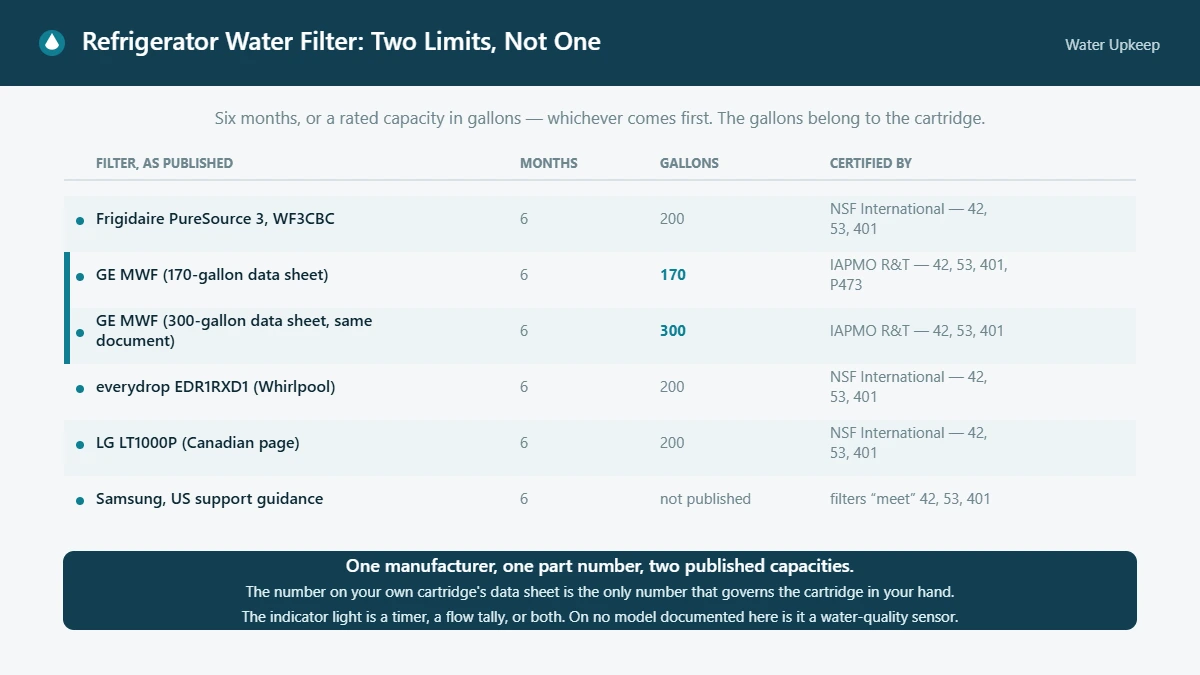
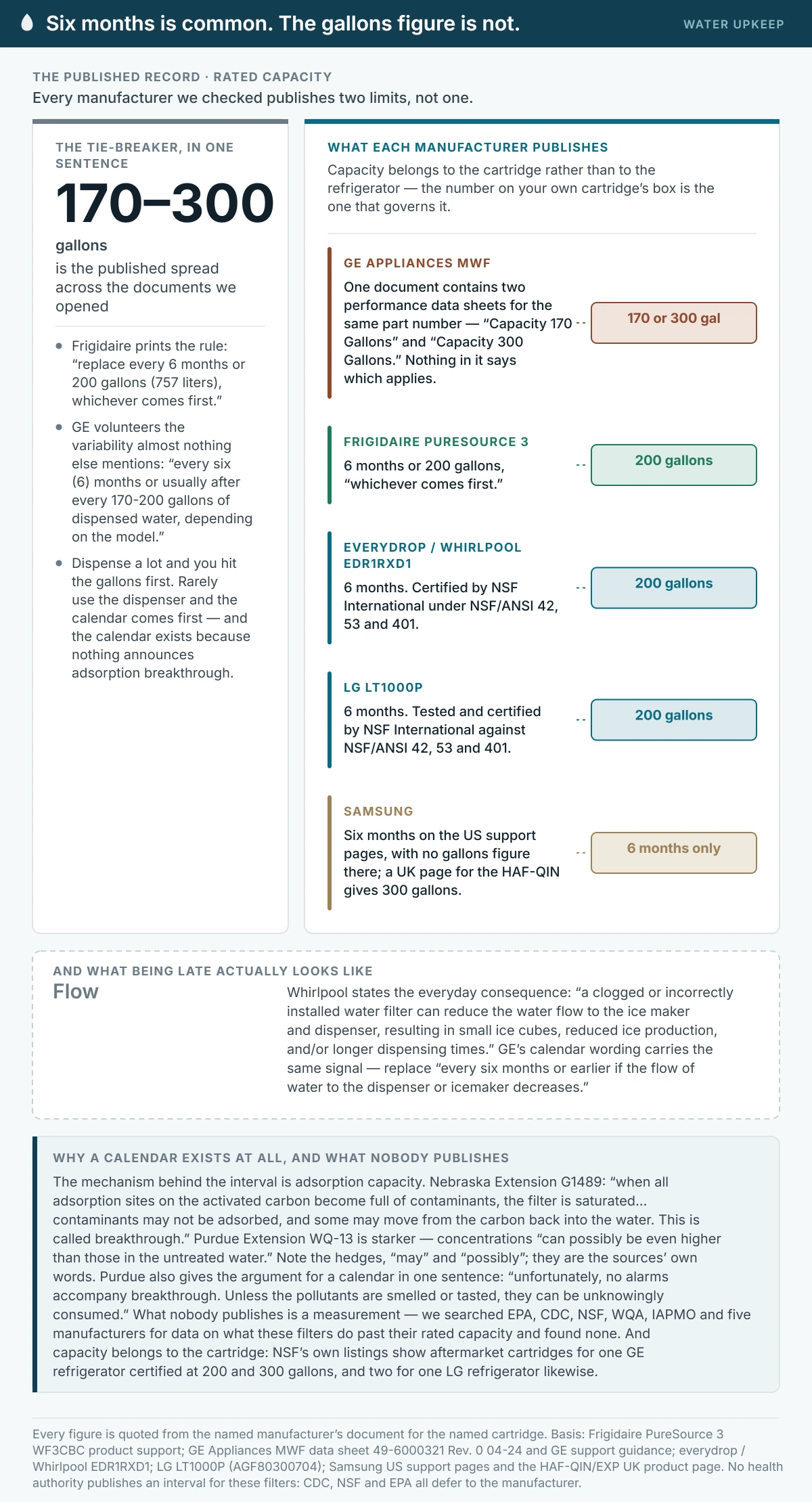
Every manufacturer we checked publishes two limits, not one — a calendar interval and a rated capacity in gallons — and Frigidaire prints the tie-breaker in a single sentence: “replace every 6 months or 200 gallons (757 liters), whichever comes first.” Six months is the common calendar figure. The gallons figure is not common at all: it belongs to the cartridge rather than to the refrigerator, it ranges from 170 to 300 across the documents we opened, and in one case a single manufacturer prints two different capacities for the same part number.
No health authority publishes an interval for these filters. CDC’s instruction is to follow the manufacturer’s recommendations, and CDC is also clear about what you are maintaining: pitcher and refrigerator carbon filters are mainly about taste and smell, not safety.
The short answer, and why it has two halves
The calendar limit. Six months is what Frigidaire, GE, Whirlpool, LG and Samsung all publish for the models we looked at. GE’s wording adds the reason a calendar exists at all: replace “every six months or earlier if the flow of water to the dispenser or icemaker decreases.”
The capacity limit. This is where the answers separate. GE’s general support guidance says “every six (6) months or usually after every 170-200 gallons of dispensed water, depending on the model” — the manufacturer volunteering the variability that almost nothing written about this mentions.
“Whichever comes first.” That phrase, from Frigidaire’s own product page, is the whole answer. If you dispense a lot of water you will hit the gallons before the months. If you rarely use the dispenser, the calendar comes first — and the calendar exists for a reason we get to below.
Rated capacity by named model
| Manufacturer and model | Months | Gallons | Certification, as published |
|---|---|---|---|
| Frigidaire PureSource 3, WF3CBC | 6 | 200, “whichever comes first” | “Tested and certified by NSF International against NSF/ANSI Standards 42, 53 and 401” |
| GE Appliances MWF (170-gallon data sheet) | 6 | 170 | Certified by IAPMO R&T against NSF/ANSI 42, 53, 401, NSF P473 and CSA B483.1 |
| GE Appliances MWF (300-gallon data sheet, same document) | 6 | 300 | “System certified by IAPMO R&T against NSF/ANSI Standard 42, 53, and 401” |
| GE Appliances, general support guidance | 6 | 170–200, “depending on the model” | — |
| everydrop (Whirlpool) EDR1RXD1 | 6 | 200 | “Filters certified by NSF International under NSF/ANSI Standards 42, 53, and 401” |
| LG LT1000P (AGF80300704, Canadian page) | 6 | 200 | “Tested and certified by NSF International against NSF/ANSI Standard 42, 53, 401” |
| Samsung, US support guidance | 6 | Not published on the US support pages we opened | Filters “meet NSF/ANSI standards 42, 53, and 401” |
| Samsung HAF-QIN/EXP (UK product page) | — | 300 | “NSF 42”, “NSF 53” |
Two things in that table are worth stopping on.
GE prints two different capacities for the same part number. Its MWF document (49-6000321 Rev. 0 04-24) contains two performance data sheets, one headed “MODEL – MWF Capacity 170 Gallons” and one headed “MODEL – MWF Capacity 300 Gallons.” We are not going to explain which one applies to you, because nothing in that document does. The practical conclusion is the useful one: the number on your own cartridge’s box or data sheet is the only number that governs the cartridge in your hand.
Some manufacturers publish only months. Samsung’s US support pages give a six-month interval and no gallons figure; a Samsung UK product page for the HAF-QIN gives 300 gallons. Those are different markets and different documents, and we are not merging them into one row. Similarly, GE’s own XWFE product pages carry no capacity, no interval, no standard and no certifier at all — which is worth knowing if you are shopping from a product page rather than a data sheet.
Capacity belongs to the cartridge, not to the refrigerator
NSF’s own certified product listings make this concrete. These are aftermarket cartridges, listed by their certifier, and cartridges built for the same refrigerator carry different certified service cycles.
| Listed product (aftermarket) | Service cycle | Flow rate | Standards listed |
|---|---|---|---|
| Aqua Crest EFF-6023S AQU-FQSVF-D | 300 gallons | 0.5 gpm | 42, 53, 401 with individual reduction claims listed |
| Fil Fresh FFRWRPWFE | 200 gallons | 0.528 gpm | 42: chlorine reduction |
| Maxblue EFF-6019S MB-RPWFE-P | 300 gallons | 0.5 gpm | 42, 53 and 401 as listed |
| EFF-6046S (LT1000P-compatible) | 200 gallons | 0.5 gpm | 42, 53, 401 as listed |
Two cartridges for the same GE refrigerator, certified at 200 and 300 gallons. Two for the same LG refrigerator, likewise. We are showing these only to make that point; nothing here is a comparison of aftermarket against original parts on quality, price or performance, and we make no such comparison.
What the indicator light actually measures
Three manufacturers, three descriptions, and none of them is a water-quality sensor.
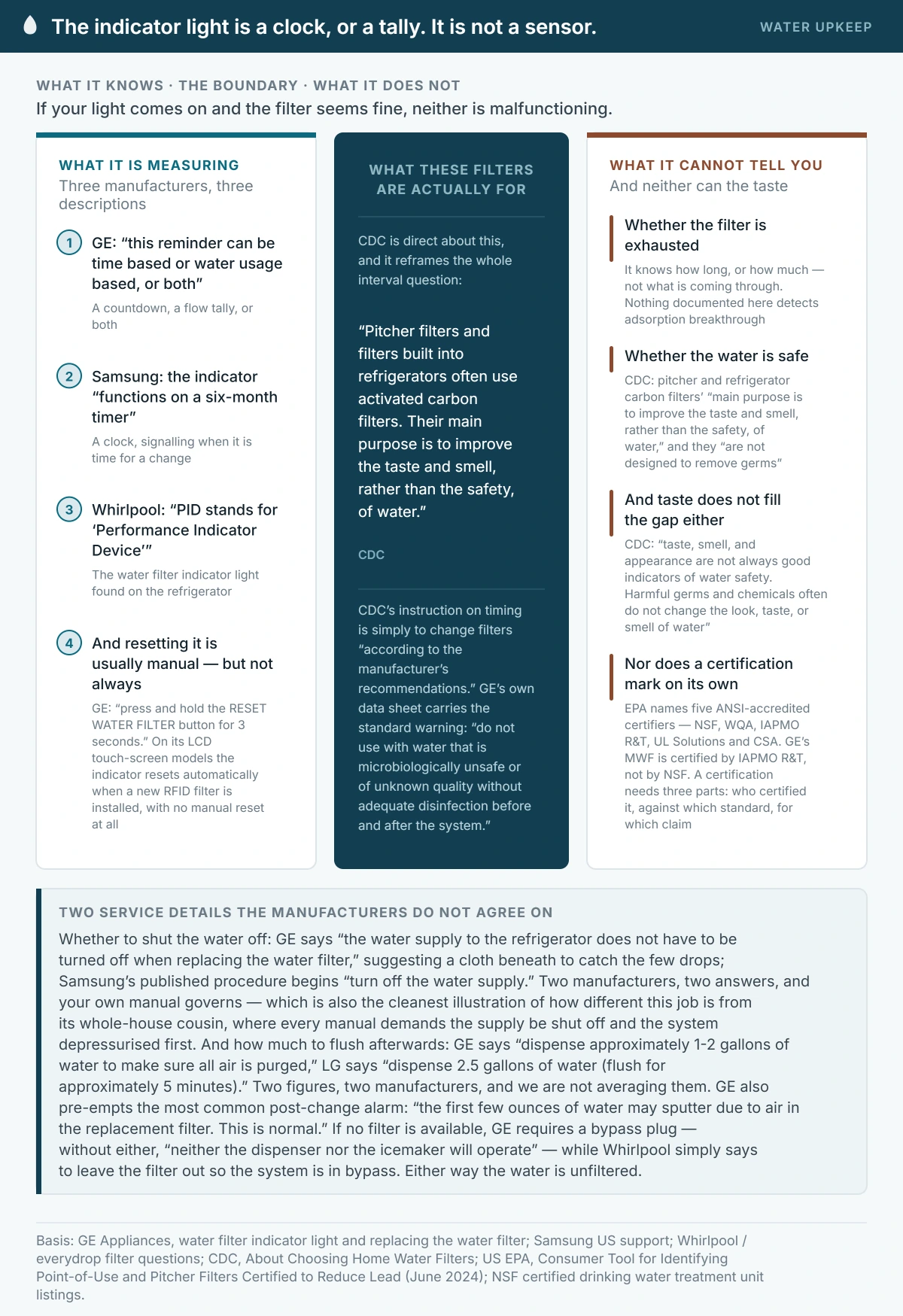
- GE: “this reminder can be time based or water usage based, or both.”
- Samsung: the indicator “functions on a six-month timer, signaling when it’s time for a filter change.”
- Whirlpool: “PID stands for ‘Performance Indicator Device’ or the water filter indicator light found on the refrigerator.”
So: a countdown, a flow tally, or both. Nothing documented here can tell whether the filter is exhausted. It knows how long, or how much — not what is coming through. If your light comes on and the filter feels fine, or the filter is clearly past its gallons and the light is dark, neither situation is a malfunction; the light was never measuring what you assumed it was measuring.
Resetting it is a manual act on most models — GE’s instruction is to “press and hold the RESET WATER FILTER button for 3 seconds until the red light goes off” — but not all. GE also notes that models with an LCD touch screen “will automatically reset the Replace Water Filter indicator when a new RFID filter is installed,” and that on those there is no manual reset at all.
What happens if you are late
The documented everyday answer is flow. Whirlpool states it plainly: “a clogged or incorrectly installed water filter can reduce the water flow to the ice maker and dispenser, resulting in small ice cubes, reduced ice production, and/or longer dispensing times.” That is the manufacturer’s own consequence, and it is the one most people actually experience.
The mechanism behind the calendar is adsorption capacity, and two university extension publications describe it. Nebraska Extension G1489: “when all adsorption sites on the activated carbon become full of contaminants, the filter is saturated and has reached its capacity. At this point, contaminants may not be adsorbed, and some may move from the carbon back into the water. This is called breakthrough.” Purdue Extension WQ-13 puts it more starkly: “eventually, the surface of the AC becomes filled with adsorbed pollutants, and no further treatment occurs,” and “contaminant concentrations in the treated water can possibly be even higher than those in the untreated water.”
Note the hedges in both — “may,” “possibly.” They are the sources’ own words and we are keeping them.
Purdue also supplies the single best explanation of why an interval exists at all: “unfortunately, no alarms accompany breakthrough. Unless the pollutants are smelled or tasted, they can be unknowingly consumed.” That is the argument for a calendar in one sentence. Nothing tells you when adsorption has stopped, so you replace on a schedule instead.
What nobody publishes is a measurement. We searched EPA, CDC, NSF, WQA, IAPMO and five manufacturers for data on what a refrigerator filter actually does past its rated capacity, and found none. So there is no figure here for how much worse it gets, or when — because there is no such figure to report.
One more limit on that discussion, from NSF’s own certified listings, which carry this footnote: “claims of capacity or rated service cycle are not applicable for mechanical filtration.” Breakthrough is a property of adsorption — the carbon half of the filter’s job. It does not describe what a mechanical particulate filter does when it fills up; that one simply clogs, which is Whirlpool’s flow consequence.
What a refrigerator filter is actually for
CDC is direct about this, and it reframes the whole interval question:
Most home water filters — like pitcher or fridge filters — are not designed to remove germs from your water… Pitcher filters and filters built into refrigerators often use activated carbon filters. Their main purpose is to improve the taste and smell, rather than the safety, of water.
CDC’s instruction on timing is simply to change filters “according to the manufacturer’s recommendations,” which is exactly what the rest of this page documents. And it adds a caution worth carrying: “taste, smell, and appearance are not always good indicators of water safety. Harmful germs and chemicals often do not change the look, taste, or smell of water.” So the fact that your water tastes fine tells you nothing about whether the filter is doing its job — and nothing about whether the water is safe.
GE’s own data sheet carries the standard manufacturer warning: “do not use with water that is microbiologically unsafe or of unknown quality without adequate disinfection before and after the system.”
Reading the certification properly
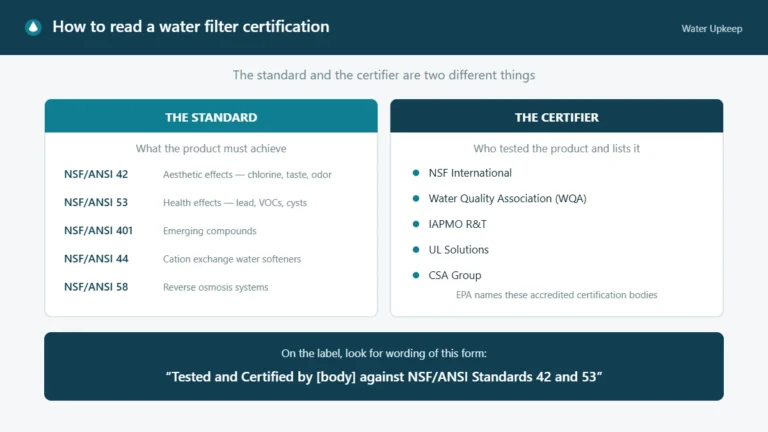
“NSF certified” on its own does not mean anything useful, and in at least one case it is not even the right phrase. EPA’s consumer guidance names five ANSI-accredited third-party certification bodies — NSF, WQA, IAPMO R&T, UL Solutions and CSA — each with its own registered certification mark. GE’s MWF is certified by IAPMO R&T, not by NSF.
A certification is only meaningful with three pieces attached: who certified it, against which standard, and for which specific claim. NSF/ANSI 42 covers aesthetic effects such as chlorine, taste and odor. NSF/ANSI 53 covers health effects such as cyst, lead and mercury reduction. NSF/ANSI 401 covers emerging compounds. A filter certified to 42 for chlorine reduction is not certified for lead, and a listing that shows one claim does not imply the others.
Watch the verb, too. Some manufacturer pages say a filter is “certified by NSF International”; others say it is “tested according to NSF/ANSI Standards” or that filters “meet” them. Those are different claims and we have quoted each source’s own wording above rather than flattening them.
Changing it: the parts that differ by manufacturer
Do you have to shut the water off?
| Source | What it says |
|---|---|
| GE Appliances support | “The water supply to the refrigerator does not have to be turned off when replacing the water filter.” Its mitigation: “place a cloth beneath the filter to catch the few drops of water that may fall when the filter is removed.” |
| Samsung US support | “Turn off the water supply” — step one of its published procedure. |
Two manufacturers, two answers, and your own manual governs. This is also the cleanest illustration of how different this job is from its whole-house cousin: on a point-of-entry housing, every manual we read demands that the supply be shut off and the system depressurized before anything is opened. See how to change a whole house water filter for that one.
Flushing afterwards
GE: “continue to dispense approximately 1-2 gallons of water to make sure all air is purged from the system.” LG, for the LT1000P: “dispense 2.5 gallons of water (flush for approximately 5 minutes) to remove trapped air and contaminants from the system.” Two figures, two manufacturers, and we are not averaging them.
GE also pre-empts the most common post-change alarm: “the first few ounces of water may sputter due to air in the replacement filter. This is normal.”
No filter available today?
Two manufacturers publish two different mechanisms. GE: “you must use the filter bypass plug when a replacement filter is not available. If a filter is not in place and the filter bypass plug is not engaged, neither the dispenser nor the icemaker will operate.” Whirlpool: “if the filter is clogged and you cannot immediately replace it, leave the filter out so that the water system is in bypass mode.”
In bypass the water is unfiltered. Given CDC’s framing — that these filters are mainly about taste and smell rather than safety — that is a taste question rather than a safety one for most households, and we are not making a safety claim in either direction.
What this is not
- Not a whole house filter. Different device, different plumbing, different rules — how to change a whole house water filter.
- Not a disinfection step. CDC says these filters are not designed to remove germs, and GE’s own data sheet says not to use it on water that is microbiologically unsafe or of unknown quality. If that is your question, start with your utility’s report or a certified laboratory — see water testing — and your local health department.
- Not a reverse osmosis system. Different technology, different service intervals, covered in reverse osmosis filter replacement.
- Not something a TDS meter can assess. A carbon filter is not designed to reduce dissolved solids, so a meter reading before and after tells you little about whether it is working — see what TDS in water actually means.
Frequently asked questions
How often should I really change my refrigerator water filter?
Whichever comes first: your cartridge’s rated capacity in gallons, or the calendar interval — six months across every manufacturer we checked. The gallons figure is model-specific and runs from 170 to 300 in the documents we opened, so read your own. No health authority publishes an interval; CDC, NSF and EPA all defer to the manufacturer.
What happens if I don’t change it?
The documented consequence is flow: Whirlpool lists small ice cubes, reduced ice production and slower dispensing. Beyond that, two extension publications describe adsorption breakthrough — the carbon runs out of sites and contaminants “may” move back into the water — and Purdue notes that no alarms accompany it. Nobody publishes measured performance past capacity, so we cannot tell you how much worse it gets or how fast.
Does the filter light know when the filter is used up?
No. On the models documented here it is a six-month timer, a flow tally, or both. It is not a water-quality sensor and cannot detect breakthrough.
Is it safe to drink water from an old filter?
That is not a question we can answer, and here is why rather than a dodge: CDC says these filters are not designed to remove germs and are mainly for taste and smell, and it also says taste, smell and appearance are not reliable indicators of safety. So the filter’s age does not settle it and neither does how the water tastes. If the safety of your water is the actual question, start with your utility’s annual report or a certified laboratory test, and take any health concern to your local health department.
Do I have to turn the water off to change it?
GE says no and suggests a cloth under the filter for the few drops that fall. Samsung’s published procedure starts by turning the supply off. Follow your own manual.
Can I run the fridge without a filter?
GE requires a bypass plug — without either a filter or the plug, the dispenser and icemaker will not operate. Whirlpool’s guidance is simply to leave the filter out so the system is in bypass. Either way the water is unfiltered.
Why is the water sputtering after a filter change?
Air in the new cartridge. GE says the first few ounces may sputter and that this is normal, and both GE and LG have you dispense water afterwards to purge it.
Sources and standards
- CDC — About Choosing Home Water Filters
- NSF — Home Water Treatment System Selection and the certified drinking water treatment unit listings
- US EPA — Consumer Tool for Identifying Point-of-Use and Pitcher Filters Certified to Reduce Lead (June 2024) and the WaterSense Guide to Selecting Water Treatment Systems
- University of Nebraska–Lincoln Extension — G1489, Drinking Water Treatment: Activated Carbon Filtration
- Purdue Extension — WQ-13, Home Water Treatment Using Activated Carbon
- Water Quality Association — Granular Activated Carbon fact sheet
- GE Appliances (manufacturer documentation) — MWF filter data sheet 49-6000321, replacing the water filter and water filter indicator light
- Whirlpool and everydrop (manufacturer documentation) — when to change the water filter, everydrop filter questions and the EDR1RXD1 product page
- LG (manufacturer documentation) — LT1000P refrigerator water filter (Canadian page)
- Samsung (manufacturer documentation) — how to replace the water filter and routine refrigerator maintenance
- Frigidaire (manufacturer documentation) — PureSource 3 WF3CBC product support (Canadian Owner Centre)
Last reviewed September 9, 2026.