Does Reverse Osmosis Remove Chloramine?
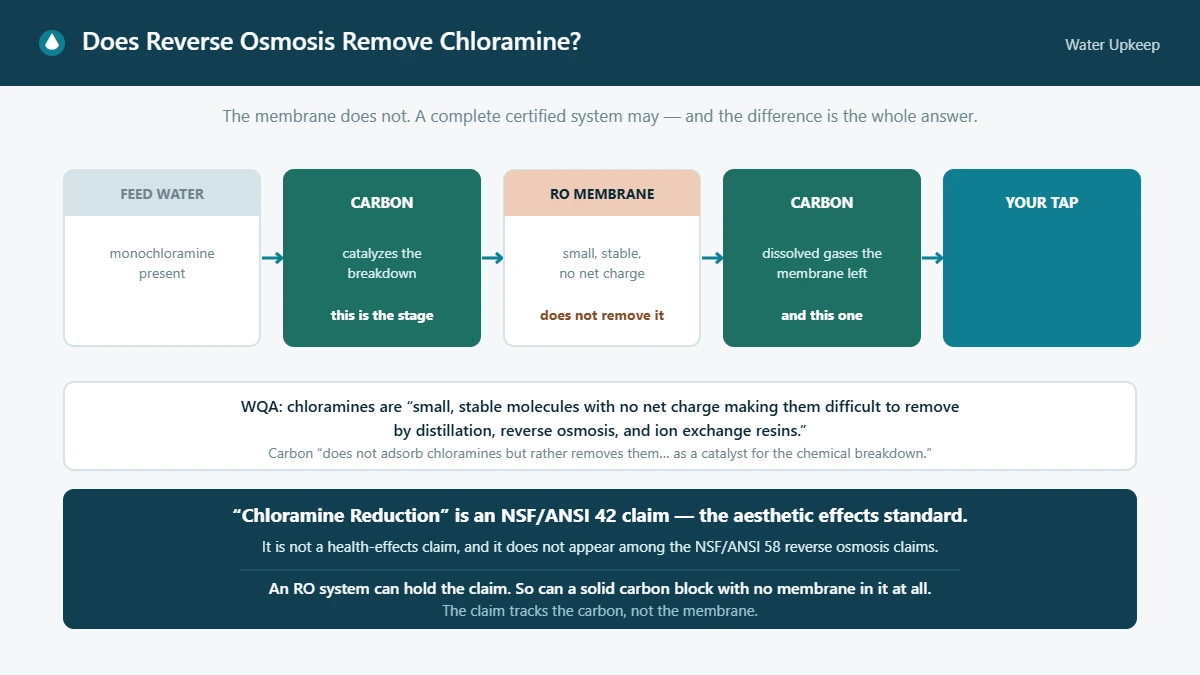
The short answer is the membrane does not, but a complete certified system may — and the difference between those two statements is the whole subject.
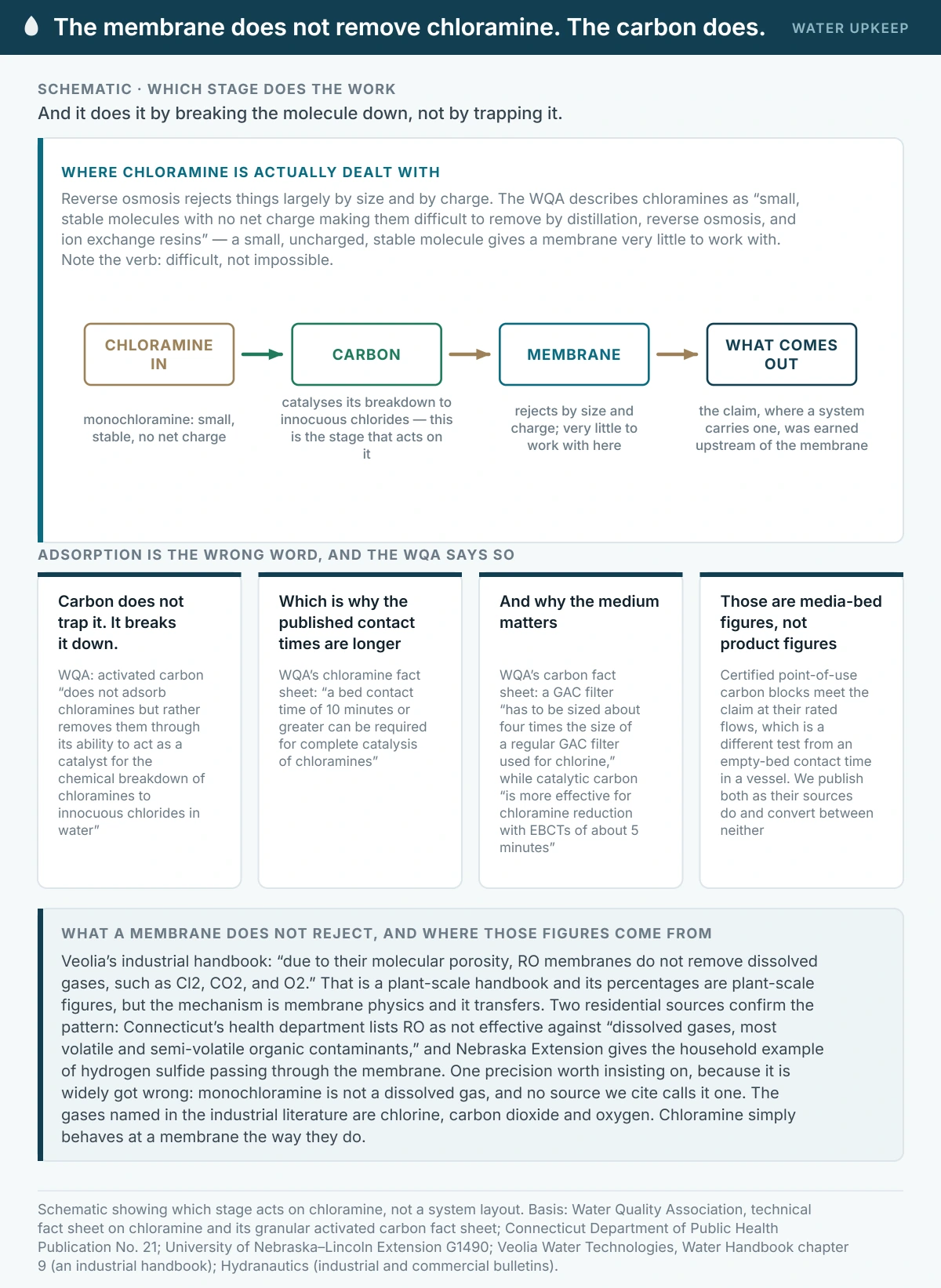
Monochloramine is, in the Water Quality Association’s words, a “small, stable” molecule “with no net charge,” which makes it “difficult to remove by distillation, reverse osmosis, and ion exchange resins.” The thing in an RO system that actually deals with it is the activated carbon stage, and Connecticut’s health department says so directly about residential systems: the carbon filter “removes the organic materials and any dissolved gases not treated by the RO membrane.”
So when you see a reverse osmosis system carrying a certified chloramine reduction claim — and some do — the claim belongs to the system, and specifically to its carbon. It does not belong to the membrane.
Why it gets through the membrane
Start with what a membrane does not reject at all. Veolia’s industrial water handbook: “typically, 95% of dissolved salts are reduced from the brine. All particulates are removed. However, due to their molecular porosity, RO membranes do not remove dissolved gases, such as Cl2, CO2, and O2.” That is a plant-scale handbook, and its percentages are plant-scale figures — but the mechanism is membrane physics and it transfers.
The membrane manufacturers say the same about their own products. Hydranautics, writing about chlorine dioxide: being gaseous, it “will not be rejected by the membrane and will thus pass into the permeate.”
Two independent sources confirm the pattern for residential systems. Connecticut’s health department lists what RO is “not effective against: dissolved gases, most volatile and semi-volatile organic contaminants including some pesticides and solvents.” Nebraska Extension gives a household example: contaminants not removed “include dissolved gases such as hydrogen sulfide, a common nuisance contaminant with characteristic rotten egg odor, which passes through the RO membrane.”
A precision worth insisting on
Monochloramine is not a dissolved gas, and no source we cite calls it one. Veolia’s list is chlorine, carbon dioxide and oxygen; chloramine is not on it. What WQA says is that chloramines are “small, stable molecules with no net charge” — and that is why they behave at a membrane the way the dissolved gases do. Reverse osmosis rejects things largely by size and by charge. A small, uncharged, stable molecule gives the membrane very little to work with.
Note WQA’s verb too. It is “difficult to remove,” not “cannot be removed.” That hedge is doing real work, and it is what makes the certification finding below compatible with the physics above.
For context on where the molecule comes from, WQA describes chloramination as “the addition of anhydrous or aqueous ammonia (NH3) before or after the addition of chlorine (HOCl) to produce monochloramine (NH2Cl).” Culligan’s own owner’s guide concedes the practical consequence: “chloramines have a stronger taste and are more difficult to remove than chlorine.”
What actually removes it: carbon, by catalysis
This is the most commonly mangled fact in this whole subject, and WQA states it precisely:
The most effective nonchemical method for removing chloramines is by activated carbon (C*). Activated carbon does not adsorb chloramines but rather removes them through its ability to act as a catalyst for the chemical breakdown of chloramines to innocuous chlorides in water.
Carbon does not trap chloramine the way it traps an organic compound. It breaks it down. That distinction explains why chloramine is harder work for carbon than chlorine is, and why the published contact times are longer.
WQA publishes two figures in two documents, and they describe different media and different endpoints, so we are keeping them separate:
- WQA’s chloramine fact sheet: “a bed contact time of 10 minutes or greater can be required for complete catalysis of chloramines.”
- WQA’s granular activated carbon fact sheet: “the deactivation of chloramine can be accomplished with GAC but the filter has to be sized about four times the size of a regular GAC filter used for chlorine,” while “catalytic carbon, which has an oxidizing capability is more effective for chloramine reduction with EBCTs of about 5 minutes.”
WQA also notes that “fine mesh sizes of activated carbon remove chloramines more efficiently since they have greater surface areas,” and that “new types of activated carbons have been developed with increased catalytic activity that is especially effective at the removal of chloramines.”
Those are media-bed figures, not point-of-use product figures, and the two are not directly comparable — certified point-of-use carbon blocks meet the chloramine claim at their rated flows, which is a different test from an empty-bed contact time in a vessel. We are publishing both as their sources publish them and not converting between them.
The certification, and what it does and does not mean
Here is where the answer stops being simple, and where a flat “no, RO doesn’t remove chloramine” would be wrong.
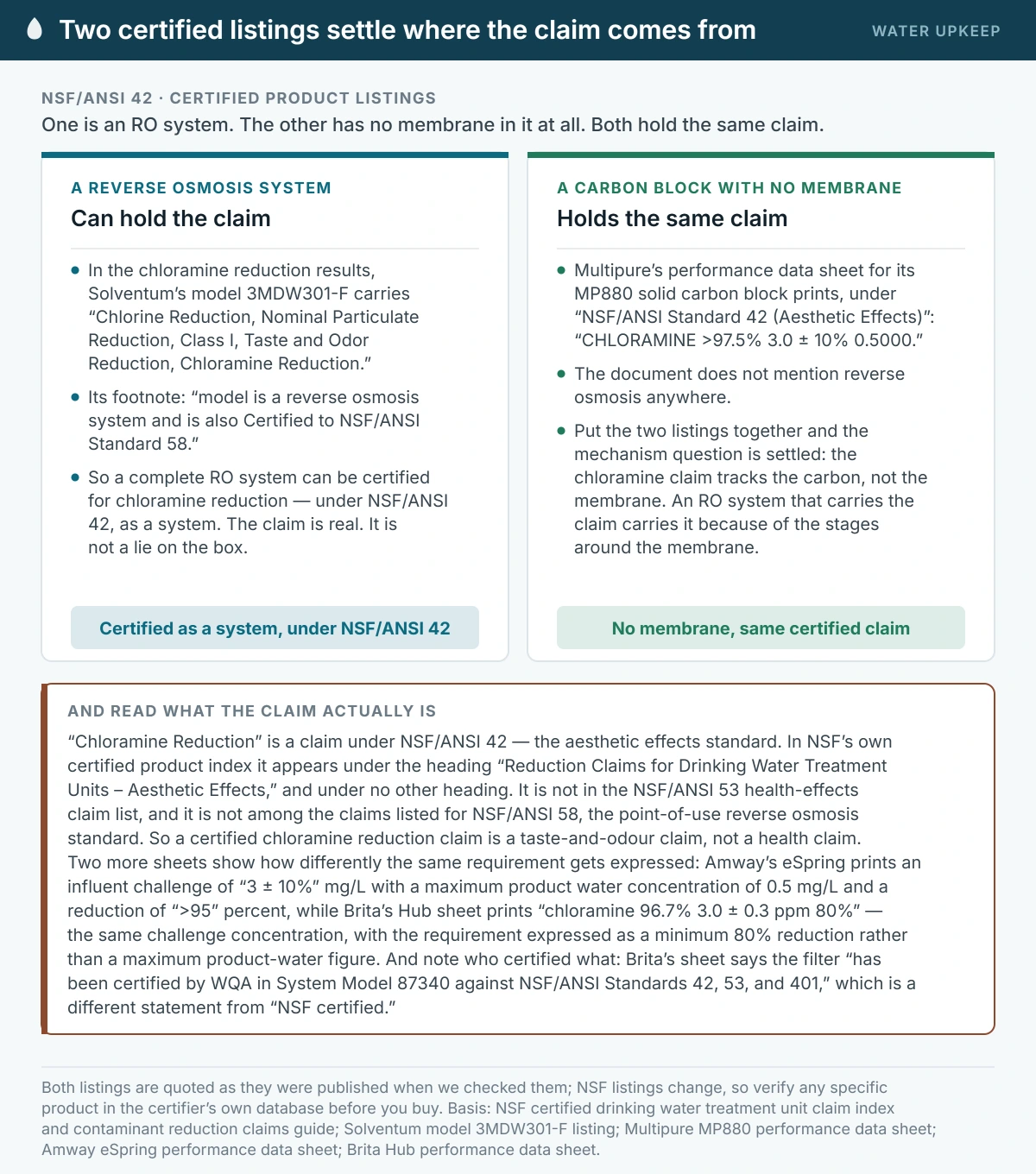
“Chloramine Reduction” is a claim under NSF/ANSI 42 — and NSF/ANSI 42 is the aesthetic effects standard. In NSF’s own certified product index the claim appears under the heading “Reduction Claims for Drinking Water Treatment Units – Aesthetic Effects,” and under no other heading. It does not appear in the NSF/ANSI 53 health-effects claim list, and it is not among the claims NSF lists for NSF/ANSI 58, the point-of-use reverse osmosis standard.
That means a certified chloramine reduction claim is a taste-and-odor claim, not a health claim. Read it as what it is.
Two findings in NSF’s own listings settle the mechanism question between them.
| What the listing shows | What it proves |
|---|---|
| An RO system can hold the claim. In the chloramine reduction results, Solventum’s model 3MDW301-F carries “Chlorine Reduction, Nominal Particulate Reduction, Class I, Taste and Odor Reduction, Chloramine Reduction,” with a footnote reading “model is a reverse osmosis system and is also Certified to NSF/ANSI Standard 58.” | A complete RO system can be certified for chloramine reduction — under NSF/ANSI 42, as a system. |
| A system with no membrane at all can hold the same claim. Multipure’s performance data sheet for its MP880 solid carbon block prints, under “NSF/ANSI Standard 42 (Aesthetic Effects)”: “CHLORAMINE >97.5% 3.0 ± 10% 0.5000”. The document does not mention reverse osmosis anywhere. | The chloramine claim tracks the carbon, not the membrane. |
Put the two together and the answer is complete. The membrane is not what handles chloramine; the carbon is. An RO system that carries the claim carries it because of the stages around the membrane.
Two more certified sheets show what the test looks like, and how differently the requirement gets expressed. Amway’s eSpring sheet prints an influent challenge of “3 ± 10%” mg/L with a maximum product water concentration of 0.5 mg/L and a reduction of “>95” percent, certified by NSF International and WQA. Brita’s performance data sheet for the Hub system prints “chloramine 96.7% 3.0 ± 0.3 ppm 80%” — the same 3 mg/L challenge, but with the requirement expressed as a minimum 80% reduction rather than as a maximum product-water figure. Those are two different expressions of the requirement, and we are publishing each as its own sheet prints it rather than converting between them.
Note also who certified what. Brita’s sheet says the filter “has been certified by WQA in System Model 87340 against NSF/ANSI Standards 42, 53, and 401.” That is certified by WQA against NSF/ANSI standards — not “NSF certified,” which is a different statement. More on that product line in do Brita filters work.
NSF listings change. What is described here is what the listings showed when we checked them; verify any specific product in the certifier’s own database before you buy.
Does chloramine damage the membrane?
This is a separate question from removal, and the manufacturers’ documentation is asymmetric in an interesting way.
DuPont publishes a free chlorine tolerance of “< 0.1 ppm” for its FilmTec TW30-1812-50HR residential element, and states that “the presence of free chlorine and other oxidizing agents will cause premature membrane failure.” Its dedicated chlorination and dechlorination technical document defines chloramine — “formed from the reaction of chlorine with ammonia compounds present in the water,” with “a germicidal effect, albeit lower than that of chlorine” — and then publishes no chloramine tolerance, no chloramine warning and no chloramine pretreatment instruction. We are stating that as an observation about that named document, not inferring that DuPont considers chloramine harmless.
Hydranautics publishes both figures, and the gap is large. On free chlorine: “at no time should there be a Free Chlorine residual in RO feed water. Even very low levels of chlorine in the feed stream will result in irreparable oxidation damage of the membrane.” On chloramine: its CPA membranes have “an estimated chloramine tolerance from 50,000 to 200,000 ppm-hours before a noticeable increase in salt passage occurs.” Its current service bulletin adds a scoped exception: “at no time should there be a Free Chlorine or oxidant residual in the feed water. Except in wastewater applications where chloramines are used and allowed up to a concentration of 5 ppm.”
Every one of those Hydranautics figures is an industrial and commercial figure, from bulletins addressing systems measured in tens of gallons per minute. A residential under-sink system produces tens of gallons per day. The qualitative direction transfers — chloramine is a far slower oxidant on polyamide than free chlorine is — but the numbers do not, and we are not converting them into a membrane lifespan for your house.
Nebraska Extension gives the residential version without numbers: “if the feed water is chlorinated and a TFC membrane is used, an AC prefilter is needed to remove chlorine from the water. TFC membranes deteriorate in chlorinated water.”
Two numbers that look comparable and are not
This contrast proves the article’s point better than any argument.
- DuPont’s membrane element: free chlorine tolerance less than 0.1 ppm.
- Ecodyne’s complete WHAROS5 system: feed water maximum chlorine 2.0 ppm.
A twentyfold difference between an element limit and a system limit — because the system has carbon in front of the membrane, doing chemical work before the membrane ever sees the water. Ecodyne’s manual publishes no chloramine limit at all.
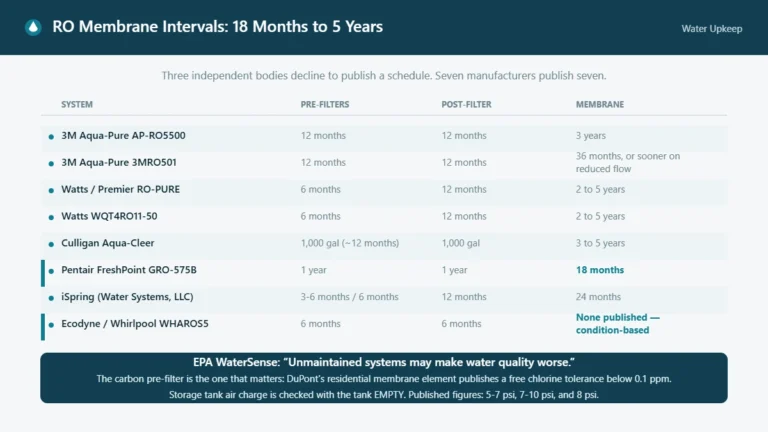
Which is also why the carbon pre-filter is the service item that matters most on an RO system — see reverse osmosis filter replacement, where the published intervals for that stage are set out by manufacturer.
So what should you actually do?
- Find out whether your utility uses chloramine at all. WQA notes that “more communities are switching from chlorine to chloramine… as a means of reducing the tendency for chlorine to form THMs.” Your utility’s annual report says which it uses, and EPA’s maximum residual disinfectant level for chloramine is 4.0 mg/L.
- Read the certification, not the technology. “It’s an RO system” tells you nothing about chloramine. A certified NSF/ANSI 42 chloramine reduction claim, from a named certifier, on your specific model, tells you something.
- Understand what that claim is. NSF/ANSI 42 is the aesthetic effects standard. The claim is about taste and odor.
- Keep the carbon fresh. It is the stage doing the work, on this and on protecting the membrane.
For the broader question of removing chlorine and chloramine from household water, including methods that have nothing to do with RO, see how to remove chlorine from water. And note one thing that does not work: WQA records that unlike chlorine, chloramine does not dissipate quickly on standing.
One health note, quoted rather than interpreted: WQA records that chloramines “can cause hemolytic anemia when present in dialysis process water,” and that they pose risks to fish. Those are specific applications — dialysis water treatment and aquariums — with their own requirements, and neither is a household drinking-water question. If either applies to you, the people to ask are your dialysis provider or your veterinarian, not a water site.
Frequently asked questions
Does reverse osmosis remove chloramine?
The membrane does not. WQA describes chloramines as “small, stable molecules with no net charge making them difficult to remove by distillation, reverse osmosis, and ion exchange resins.” A complete RO system may carry a certified chloramine reduction claim — and when it does, the claim is earned by the carbon stages, under NSF/ANSI 42.
Is chloramine a dissolved gas?
No, and no source we cite calls it one. It is a small, stable, uncharged molecule, which is why it behaves at a membrane much as dissolved gases do. The gases named in the industrial literature are chlorine, carbon dioxide and oxygen.
What does remove chloramine?
Activated carbon, by catalysis rather than adsorption — WQA’s phrasing is that carbon “does not adsorb chloramines but rather removes them through its ability to act as a catalyst for the chemical breakdown of chloramines to innocuous chlorides in water.” Catalytic carbon is more effective than plain granular carbon for this.
My RO system says it reduces chloramine. Is that a lie?
No. Systems do carry that claim, and NSF’s own listing includes at least one product that is both an RO system certified to NSF/ANSI 58 and certified for chloramine reduction under NSF/ANSI 42. The claim is real; it just does not belong to the membrane. A carbon block with no membrane in it can hold the same claim.
Is a chloramine reduction claim a health claim?
No. It sits under NSF/ANSI 42, which is the aesthetic effects standard, and appears under no other heading in NSF’s claim index. Chloramine reduction is not among the claims listed for NSF/ANSI 53, the health effects standard, or for NSF/ANSI 58.
Will chloramine ruin my RO membrane?
The documentation is asymmetric. DuPont publishes a free chlorine tolerance below 0.1 ppm for its residential element and publishes no chloramine tolerance at all, even in its dedicated chlorination document. Hydranautics publishes a chloramine tolerance for its industrial membranes that is orders of magnitude higher than its free chlorine tolerance. Those are industrial figures and do not convert to a residential expectation. What all of them agree on is keeping oxidants off the membrane — which is the carbon pre-filter’s job.
Sources and standards
- Water Quality Association — technical fact sheet: chloramine and the granular activated carbon fact sheet
- NSF — certified drinking water treatment unit claim index, the contaminant reduction claims guide and NSF/ANSI 58
- Connecticut Department of Public Health — Publication No. 21, Reverse Osmosis Treatment of Private Drinking Water Systems
- University of Nebraska–Lincoln Extension — G1490, Drinking Water Treatment: Reverse Osmosis
- Veolia Water Technologies (industrial handbook) — Water Handbook, chapter 9: membrane systems
- Hydranautics (manufacturer documentation) — TAB115, TAB 111, chemical pretreatment for RO and NF and TSB105.16 — all industrial and commercial in scope
- DuPont (manufacturer documentation) — FilmTec TW30-1812-50HR element data sheet and the chlorination and dechlorination technical manual excerpt
- Ecodyne / Whirlpool (manufacturer documentation) — WHAROS5 manual
- Culligan (manufacturer documentation) — Aqua-Cleer Advanced Drinking Water Systems owner’s guide
- Multipure (manufacturer documentation) — MP880 performance data sheet
- Brita (manufacturer documentation) — Brita Hub performance data sheet
Last reviewed September 18, 2026.