
A water softener removes the calcium and magnesium that cause hard water. If you are seeing white scale on taps and kettles, spotting on glassware, soap that will not lather, or water heaters and dishwashers failing early, hardness is usually the cause. This section covers how softeners work, how to size one correctly, what they cost to buy and run, and how to keep one working.
What this section covers
- How ion exchange softening works, and what salt-free conditioners actually do
- Sizing: grains per gallon, household demand and grain capacity
- Purchase, installation and five-year running costs
- Salt types, resin life and regeneration settings
- Brand and valve comparisons, including specification and certification differences
- Troubleshooting: salt not being used, brine tank problems, hard water returning
Do you actually need a softener?
Start with a hardness number, not a guess. Municipal customers can find hardness in their annual Consumer Confidence Report; private well owners need a test. Once you have a figure in grains per gallon (gpg) or parts per million (ppm), the decision is usually straightforward:
- Under about 3 gpg – softening is rarely worth the purchase and running cost.
- 3 to 7 gpg – a judgement call. Scale builds slowly; many households live with it.
- Over about 7 gpg – softening usually pays back through appliance life, heating efficiency and reduced cleaning.
- Hardness plus iron, staining or odour – a softener alone will not solve it. See Well Water.
- Hardness plus taste or chlorine complaints – softening does not address either. See Whole-House Filtration and Drinking Water.
If you do not have a hardness figure yet, start at Water Testing.
Common questions
Does a water softener make water safe to drink?
No. Softening exchanges hardness minerals for sodium or potassium; it is not a purification process and it does not remove bacteria, lead, nitrates or most chemical contaminants. Treat softening and drinking-water treatment as separate jobs.
Do salt-free conditioners soften water?
Not in the technical sense. Template-assisted crystallisation and similar technologies change how hardness minerals behave so they are less likely to form hard scale, but the hardness remains in the water. They can reduce scale; they will not produce the slippery feel or the cleaning benefits of ion exchange.
How long does a softener last?
The resin bed typically lasts eight to ten years on municipal water and less where iron or chlorine is present. Control valves commonly outlast the resin. Replacing resin is usually far cheaper than replacing the system.
Will a softener add a lot of sodium to my water?
The amount added is proportional to hardness. Anyone advised to restrict sodium for medical reasons should discuss it with their physician, and can use potassium chloride instead or keep an unsoftened tap for drinking.
Articles in this section
-
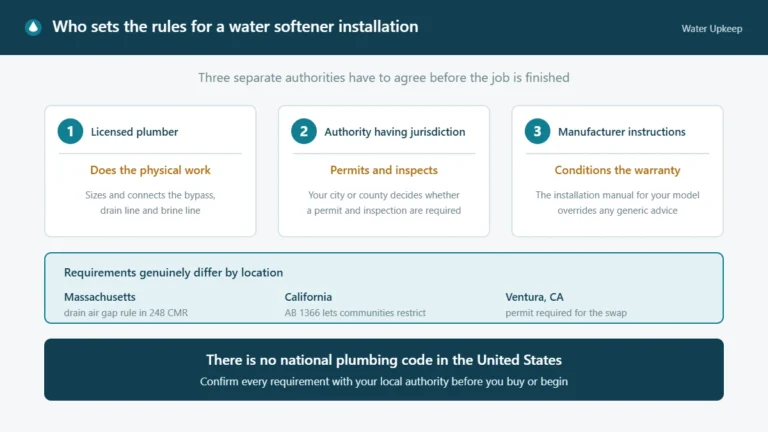
How to Install a Water Softener
Read article →: How to Install a Water SoftenerTwo things make this regulated work: the drain line air gap that prevents a cross-connection, and the fact that some jurisdictions do not permit the appliance…
-
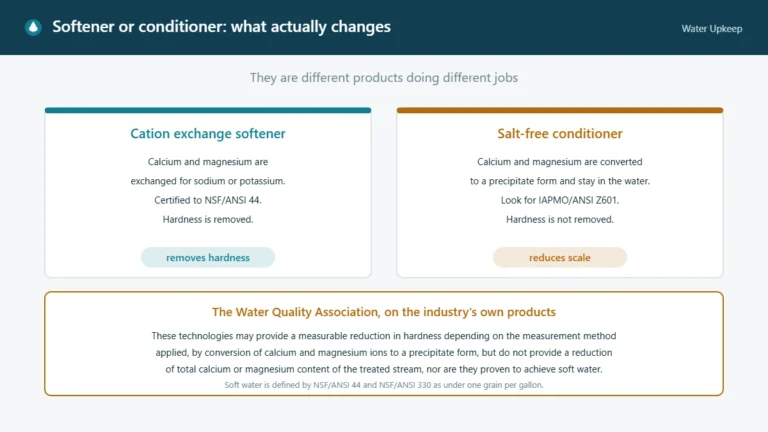
What Is a Salt Free Water Softener?
Read article →: What Is a Salt Free Water Softener?It is not a softener. The industry’s own trade body says these devices do not reduce calcium or magnesium content. Here is what they actually do,…
-
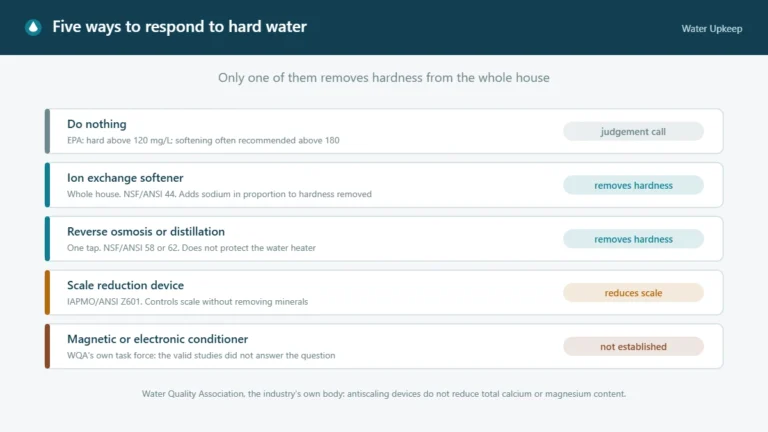
How to Treat Hard Water
Read article →: How to Treat Hard WaterOne technology removes hardness from the whole house. The rest reduce scale, treat a single tap, or have never been shown to do anything. Here is…
-
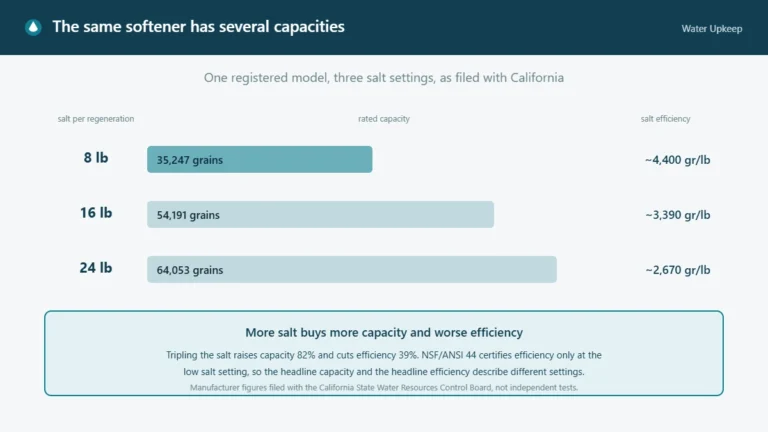
How Do Water Softeners Work?
Read article →: How Do Water Softeners Work?Ion exchange, step by step — and the thing spec sheets leave out: the same softener has several different capacities depending on how much salt it…
-
What Size Water Softener Do I Need?
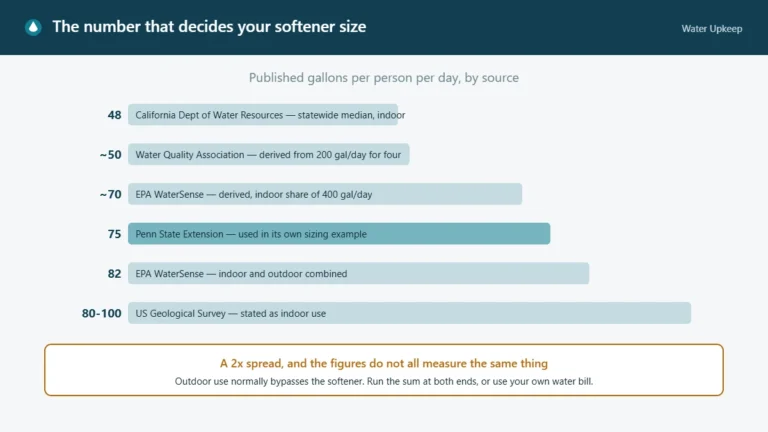
Read article →: What Size Water Softener Do I Need?Softener size is arithmetic, not a chart. Here is the calculation, the disputed number at the centre of it, and why no authority publishes a family-size…
-
How Long Do Water Softeners Last?
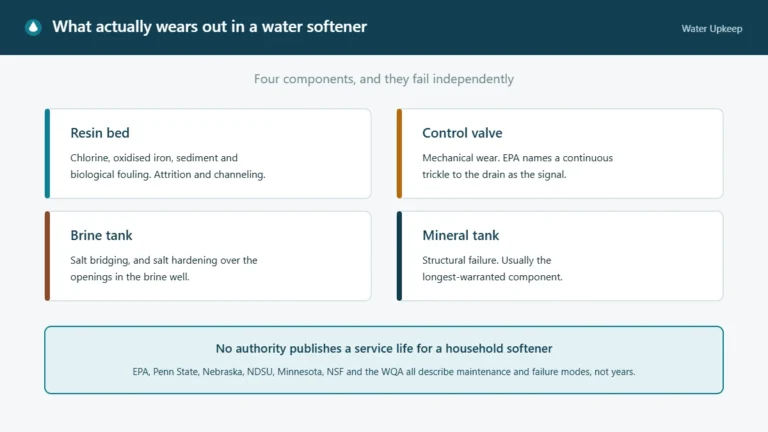
Read article →: How Long Do Water Softeners Last?No authority publishes a service life for a household water softener. Here is what actually wears out, what damages the resin, and what manufacturers put in…
-
What Hardness Number to Program Into a Water Softener
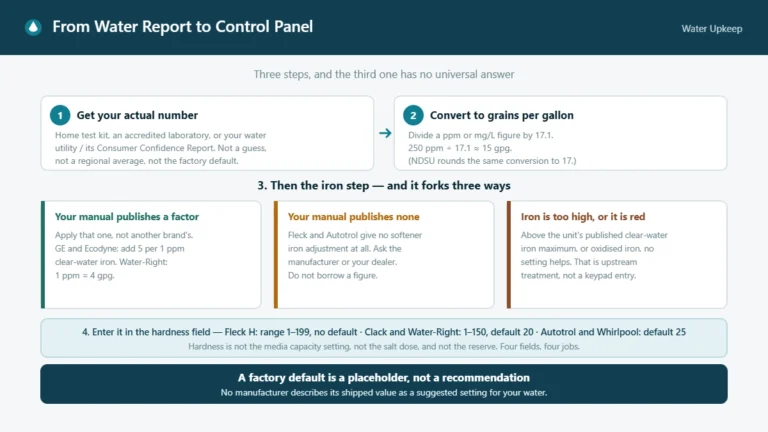
Read article →: What Hardness Number to Program Into a Water SoftenerEnter your water’s measured hardness in grains per gallon — divide a ppm figure by 17.1 — then apply only the iron adjustment your own manual…
-
How to Remove Hard Water Stains
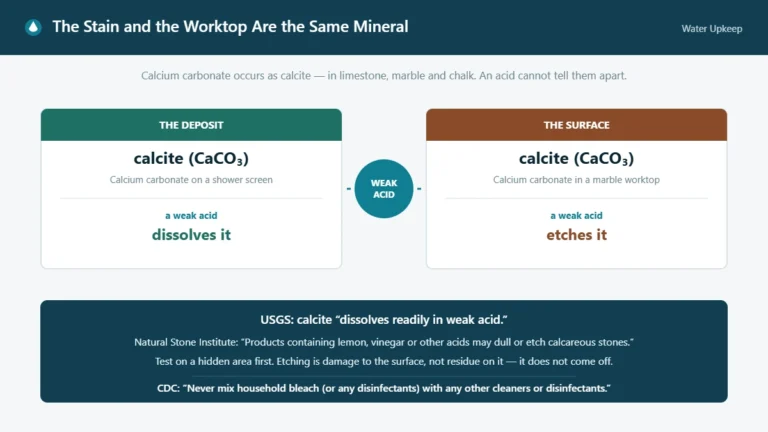
Read article →: How to Remove Hard Water StainsThe deposit is calcium carbonate — the same mineral as marble. A mild acid dissolves it, which is exactly why it damages some surfaces. What to…
-
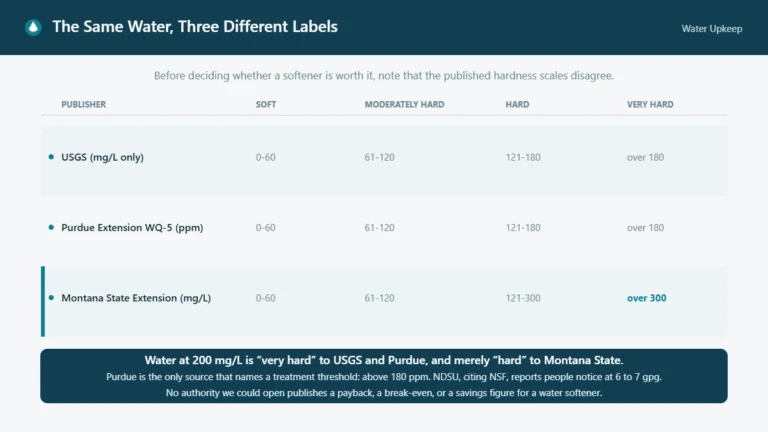
Are Water Softeners Worth It?
Read article →: Are Water Softeners Worth It?No authority publishes a payback figure for a water softener. Here is what they do publish: the hardness thresholds, what softening delivers, the running costs in…
-
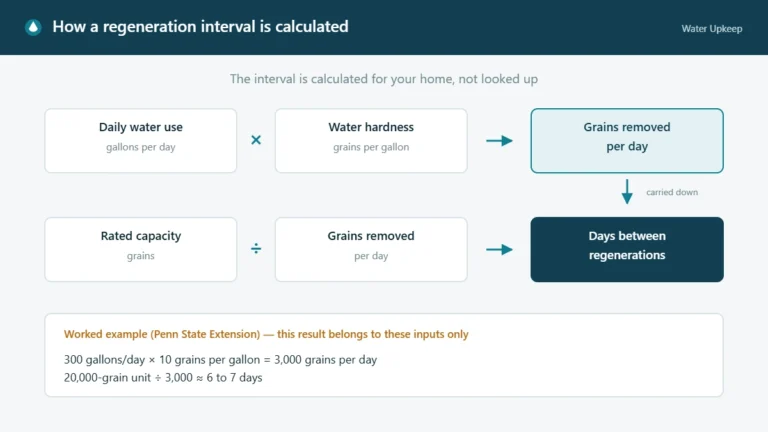
How Often Should a Water Softener Regenerate?
Read article →: How Often Should a Water Softener Regenerate?There is no standard schedule. Regeneration frequency is calculated from your hardness, water use and rated capacity. Here is how to work out yours.
-
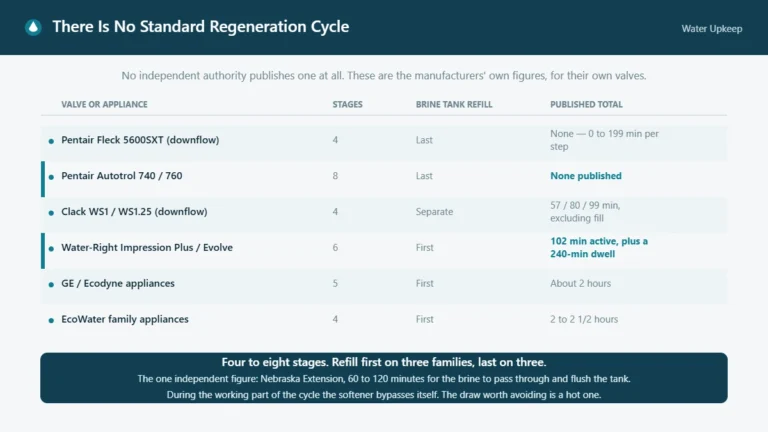
How Long Water Softener Regeneration Takes
Read article →: How Long Water Softener Regeneration TakesNo independent authority publishes a regeneration cycle at all, and the manufacturers disagree — four to eight stages, refill first or last. Here is every published…
-
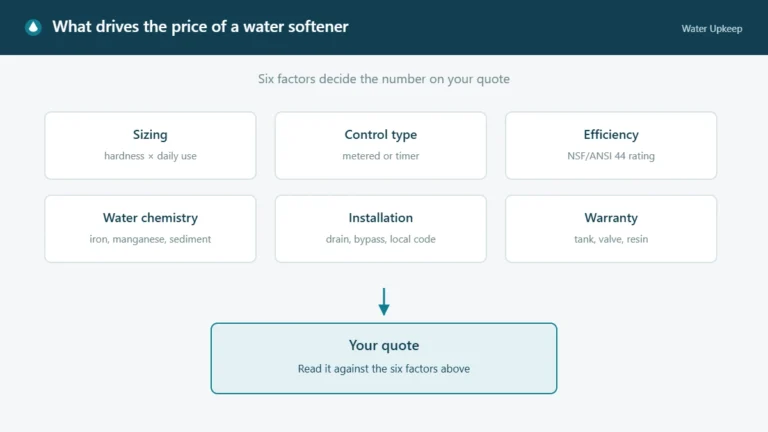
How Much Is a Water Softener? What Actually Drives the Price
Read article →: How Much Is a Water Softener? What Actually Drives the PriceThere is no single price for a water softener. Here is what actually drives the number on your quote, and how to read one properly.
Related sections
Last reviewed September 6, 2026.