How to Remove Hard Water Stains
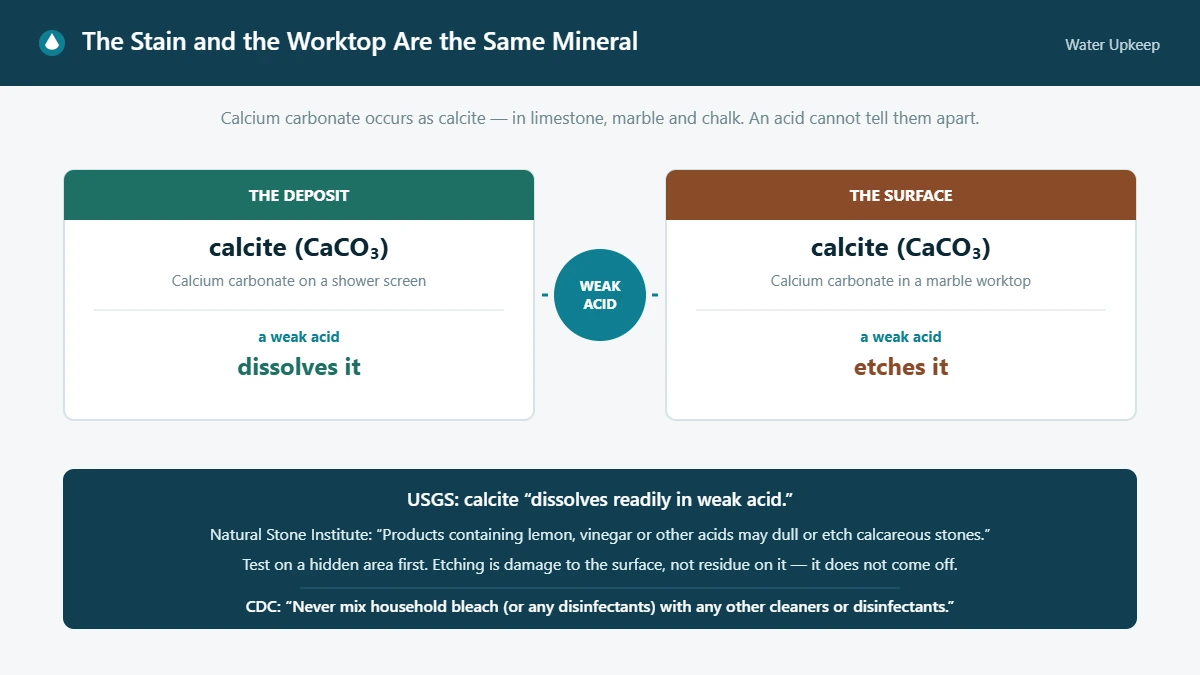
The white film is calcium carbonate — the same mineral as limestone and marble — left behind when hard water evaporates on a surface. A mild acid dissolves it, which is why acidic cleaners work on it. That is also the catch. USGS notes that calcite “dissolves readily in weak acid,” so the same product that clears your shower screen will etch a marble worktop. Check what the surface is made of first, never mix products, and know that the deposit comes back until something changes about the water.
Read this first: two rules that come before any method
Never mix cleaning products
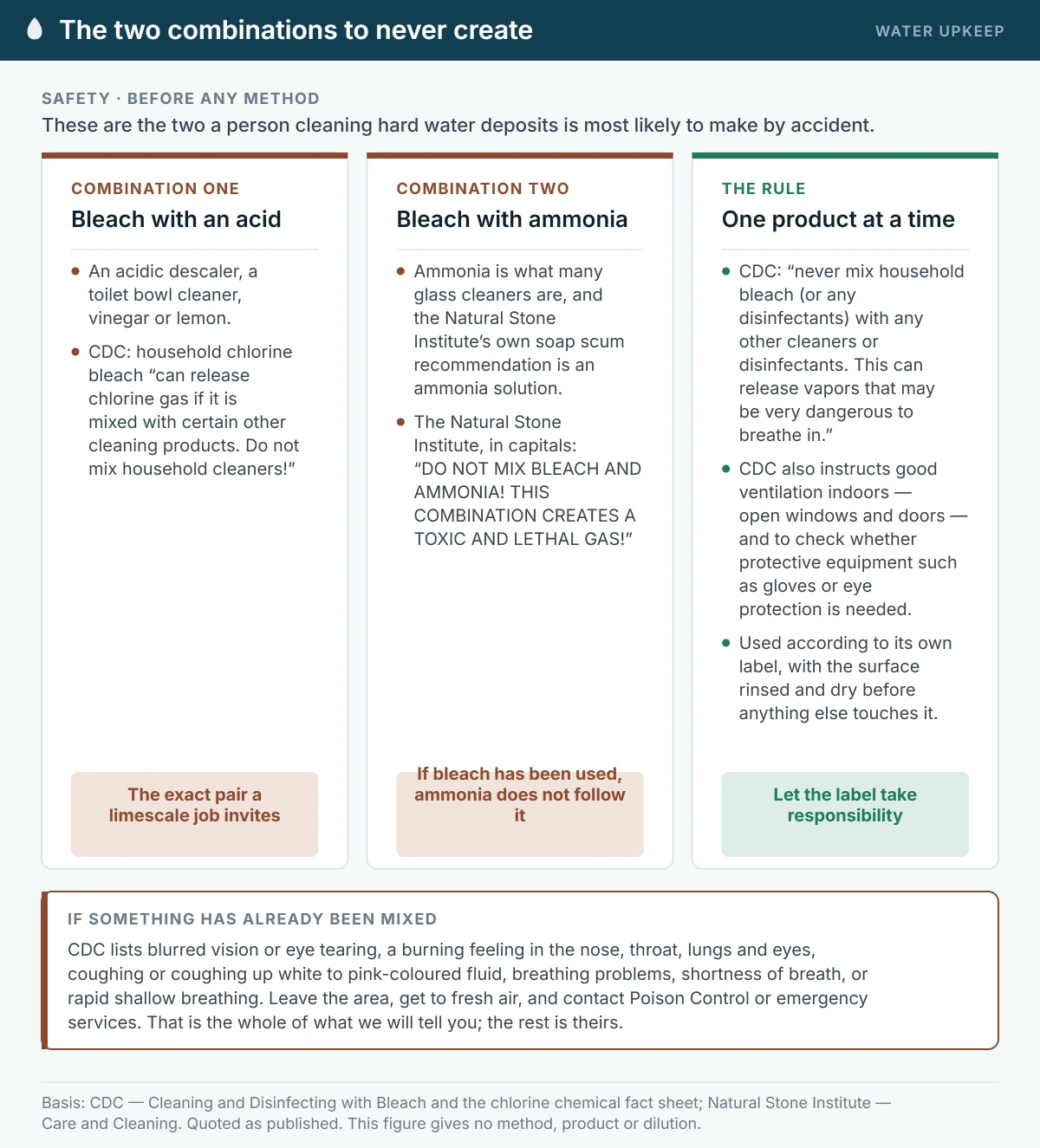
CDC states it without qualification: “never mix household bleach (or any disinfectants) with any other cleaners or disinfectants. This can release vapors that may be very dangerous to breathe in.” On its chlorine fact sheet it names the mechanism: “household chlorine bleach can release chlorine gas if it is mixed with certain other cleaning products. Do not mix household cleaners!” The incompatibility list on that page includes ammonia.
The Natural Stone Institute puts it in a cleaning context, in capitals:
DO NOT MIX BLEACH AND AMMONIA! THIS COMBINATION CREATES A TOXIC AND LETHAL GAS!
Two combinations matter most to anyone cleaning hard water deposits, because they are the two easiest to create by accident: bleach with an acid — an acidic descaler, a toilet bowl cleaner, vinegar, lemon — and bleach with ammonia, which is what many glass cleaners are. One product at a time, used according to its own label, with the surface rinsed and dry before anything else touches it.
CDC’s other two instructions for working with bleach: “make sure you have good ventilation while using bleach products indoors (for example, open windows and doors to allow fresh air to enter),” and “check to see if you need to wear any protective equipment, such as gloves or eye protection.” Many acidic descalers and rust removers carry their own protective equipment instructions on the label — read them.
If something has already been mixed and you are feeling it — CDC lists blurred vision or eye tearing, a burning feeling in the nose, throat, lungs and eyes, coughing or coughing up white to pink-colored fluid, breathing problems, shortness of breath, or rapid shallow breathing — leave the area, get to fresh air, and contact Poison Control or emergency services. That is the whole of what we will tell you; the rest is theirs.
The method depends on the surface
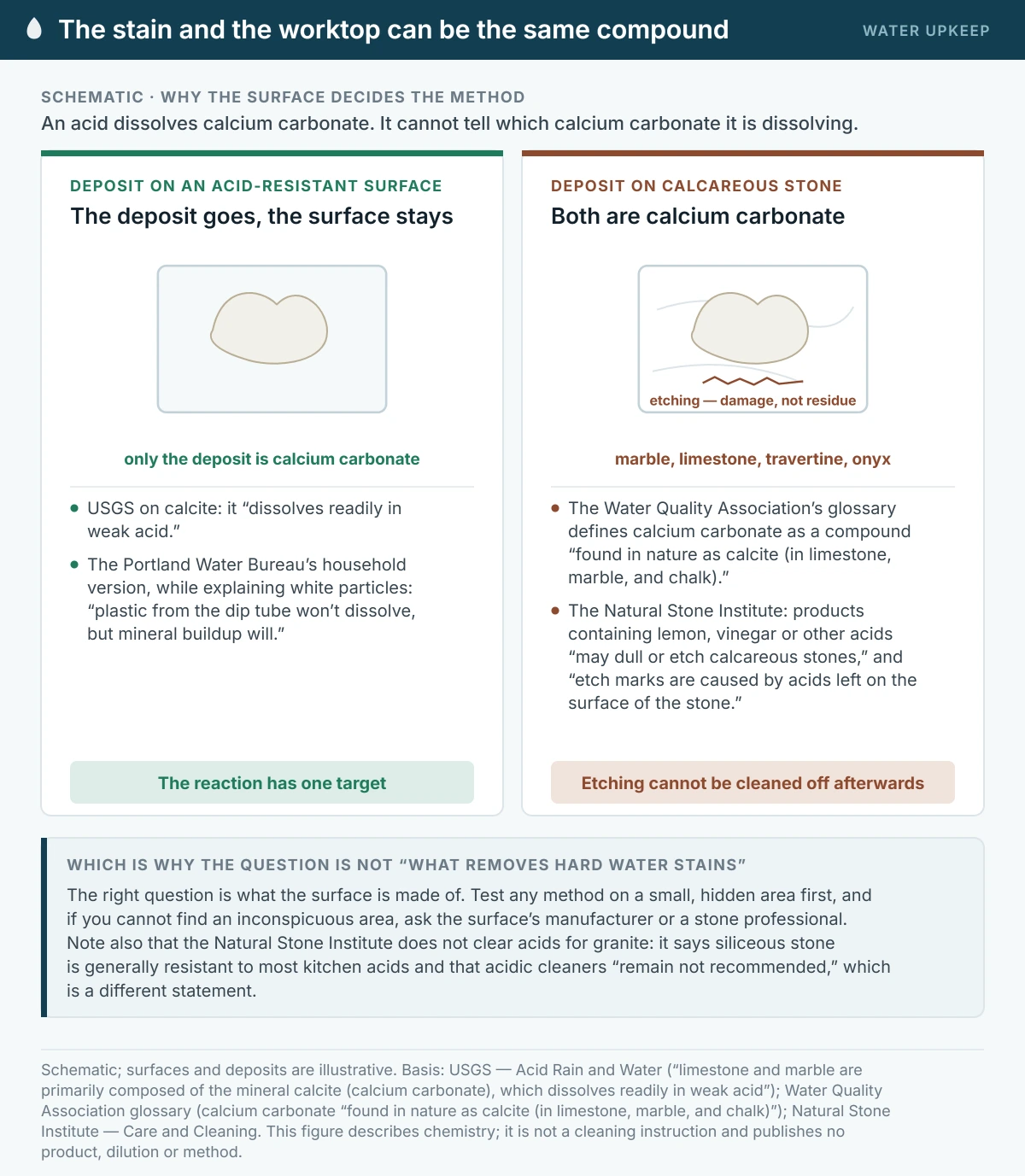
Here is the principle the whole article turns on, and it is fully sourced. USGS on calcite: it “dissolves readily in weak acid.” The Water Quality Association’s own glossary defines calcium carbonate as a compound “found in nature as calcite (in limestone, marble, and chalk).”
The stain and the marble vanity are the same compound. An acid cannot tell them apart. That is the entire warning, and it is why “what works on hard water stains” is the wrong question — the right question is “what is this surface.”
Test any method on a small, hidden area first. Etching and dulling are damage to the surface itself rather than a residue sitting on it, so they cannot be cleaned off afterward. The Natural Stone Institute’s own language makes the point: “etch marks are caused by acids left on the surface of the stone”; where paint strippers have etched stone, “re-polishing may be necessary”; and for deep-seated rust, “the stone may be permanently stained.” If you cannot find an inconspicuous area, stop and ask the surface’s manufacturer or a stone professional.
What the deposit actually is
Hardness, per USGS, is “the amount of dissolved calcium and magnesium in the water.” When that water is heated or simply evaporates, “solid deposits of calcium carbonate can form” — USGS notes that this scale “can reduce the life of equipment, raise the costs of heating the water, lower the efficiency of electric water heaters, and clog pipes.”
WQA’s glossary defines scale as “the deposit formed on the surfaces of water heater tubes, boiler tubes, and other equipment by the precipitation of soluble salts in water,” and notes that dissolved calcium and magnesium salts “are primarily responsible for most scaling in pipes and water heaters.” In a house it shows up on “sinks, tubs, faucets & appliances” and as “mineral deposits on dishes and glassware.”
Scale is not soap scum
They look similar on a shower screen and they are different substances. USGS: “in hard water, soap reacts with the calcium… to form ‘soap scum’.” WQA describes hard water causing “the development of an insoluble curdy precipitate” and “extra work to remove soap curd on bathtubs & shower stalls.”
Same underlying cause — calcium in the water — but different chemistry, and the Natural Stone Institute treats them as separate problems with separate remedies. For hard water spots and rings on stone its entry is “buff with dry 0000 steel wool.” For soap scum it recommends “a non-acidic soap scum remover or a solution of ammonia and water.” One acidic approach does not handle both, and anyone telling you otherwise is guessing.
Why mild acids work
USGS, describing acid rain on buildings and statues rather than housework: “limestone and marble are primarily composed of the mineral calcite (calcium carbonate), which dissolves readily in weak acid,” and “when sulfurous, sulfuric, and nitric acids in acid rainfall react with the calcite in marble and limestone, the calcite dissolves.” What that produces, in USGS’s words, is “roughened surfaces, removal of material, and loss of carved details.”
That is the mechanism, and the context is worth stating plainly: USGS is not endorsing a cleaning method. It is describing what weak acids do to calcium carbonate. The chemistry transfers to your shower screen and to your worktop equally, which is exactly the point.
The Portland Water Bureau puts the household version in one sentence, in the course of explaining how to identify white particles: “plastic from the dip tube won’t dissolve, but mineral buildup will.” Mineral buildup goes into vinegar and comes out gone.
What this page does not publish, and why
No dilutions, no ratios, no soak times, no recipes, no “equal parts” anything. Two reasons, both honest. First, none of the authorities we would cite publishes those figures for cleaning limescale — not USGS, EPA, CDC, WQA or the Natural Stone Institute. Second, combining products is where people actually get hurt, and a page full of homemade mixtures is a page that eventually produces a bad one. Use one product, follow its own label, and let the manufacturer of the product take responsibility for their own instructions.
Surface safety: what an acid will damage
This table records what named sources say about surfaces. Where a row says to check the manufacturer’s care instructions, that is because no authoritative source we could open covers that surface — not because it is safe. Test any method on a small, hidden area first.
| Surface | Acidic approach | What the source actually says | Source |
|---|---|---|---|
| Marble, limestone, travertine, onyx and other calcareous stone | No | “Products containing lemon, vinegar or other acids may dull or etch calcareous stones.” Calcium carbonate “is sensitive to acidic solutions so mild, non-acidic cleaners are recommended.” | Natural Stone Institute |
| Granite and other siliceous stone | Not recommended | Generally resistant to most kitchen acids, but acidic cleaners “remain not recommended” because of potential trace acid-sensitive minerals | Natural Stone Institute |
| Stone — hard water spots specifically | — | “Buff with dry 0000 steel wool.” | Natural Stone Institute |
| Stone — any abrasive | Caution | “Scouring powders or creams often contain abrasives that may scratch certain stones.” | Natural Stone Institute |
| Stone — rust removers | A distinct hazard class | Many “contain trace levels of hydrofluoric acid (HF). This acid attacks silicates in addition to other minerals.” | Natural Stone Institute |
| Stone — repeated ammonia | Caution | Ammonia solutions “may eventually dull the surface of some stone types.” | Natural Stone Institute |
| Metal and painted surfaces generally | Caution | “The acidic particles corrode metal and cause paint and stone to deteriorate more quickly.” (EPA is describing acid rain, not cleaning) | US EPA |
| Plated and coated tap finishes, enamel, acrylic, glass, quartz composite, laminate | Unverified | No authoritative source could be opened. Check the care instructions supplied with the fixture or surface | — |
| Plastic | — | Plastic does not dissolve in vinegar; mineral buildup does. (Portland is describing loose particles in a container, not a surface method) | Portland Water Bureau |
Two things in that table are easy to misread. The Natural Stone Institute does not clear acids for granite — it says siliceous stones are generally resistant and that acidic cleaners remain not recommended, which is a different statement. And the blank row is a genuine gap: we tried six manufacturer care pages for faucet finishes and could not open any of them, so we are telling you that rather than filling it in.
Rust removers deserve a separate warning. The Natural Stone Institute notes that many “contain trace levels of hydrofluoric acid.” We are not going to give you handling guidance for that — it is beyond what belongs in a consumer cleaning article. Read the label, and treat those products as a different category from a bottle of white vinegar.
Soap scum is a different job
If the film is greasy or streaky rather than crusty and white, it is likely the reaction product of soap and calcium rather than mineral scale. The Natural Stone Institute’s recommendation for stone is “a non-acidic soap scum remover or a solution of ammonia and water” — and we are not reproducing its proportion, for the reasons above. Note the word non-acidic: this is one of the cases where reaching for the vinegar is not just ineffective but actively the wrong instinct.
And note again what the mixing rule means here: if you have used bleach on that surface, ammonia does not follow it.
When it comes back — and it will
Cleaning is cosmetic. The deposit forms every time hard water evaporates on a surface, so removing it resets a clock rather than solving anything. WQA makes the structural point: hardness “affects fixtures and appliances found throughout the entire home or business,” which is why treatment has to address “water for the whole house or building rather than just at a specific faucet.”
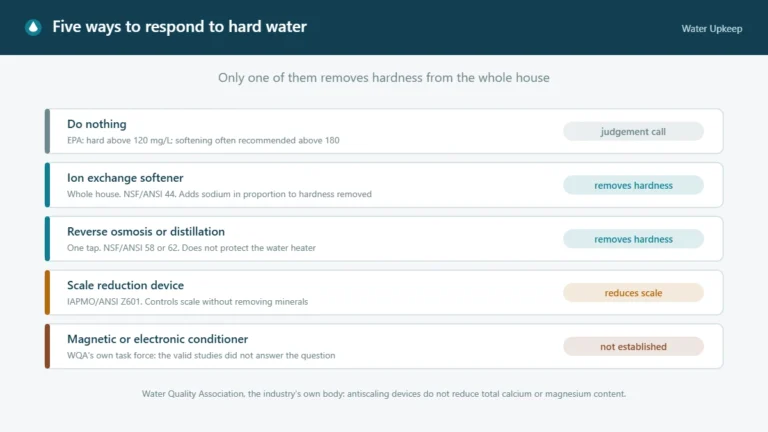
If you would rather not do this every fortnight, the question is what to do about the water, and it belongs elsewhere: how to treat hard water for the options, and are water softeners worth it for whether the answer is worth the money. If you are not yet sure hardness is what you are dealing with, start at how to tell if you have hard water.
In between, the only thing that reduces how often you clean is reducing how often hard water dries on the surface — squeegeeing a screen after a shower, wiping a sink down. Those are habits, not treatments, and we have no efficacy figure for them because nobody publishes one.
One related case that is not this article’s: white flakes or particles floating in the water rather than deposited on a surface. That has several possible causes and is covered in why your tap water looks cloudy.
Frequently asked questions
What actually dissolves hard water stains?
A mild acid. The deposit is calcium carbonate, and USGS notes that calcite “dissolves readily in weak acid.” What you must not do is assume that means every acidic product is safe on every surface — the same reaction that clears the deposit etches marble and, per EPA, acidic particles “corrode metal and cause paint and stone to deteriorate more quickly.”
Can I use vinegar on a marble or granite countertop?
On marble, no — the Natural Stone Institute says products containing lemon, vinegar or other acids “may dull or etch calcareous stones.” On granite, its position is more nuanced than the internet’s: siliceous stone is generally resistant to kitchen acids, but acidic cleaners “remain not recommended.” Etching is damage rather than residue, so it does not come off afterward.
Why won’t you give me a vinegar-to-water ratio?
Because none of the authorities we cite publishes one for cleaning limescale, and because recipes are how people end up combining products. Use one product at a time and follow its own label.
Is the white film hard water or soap scum?
They are different substances with the same underlying cause. Scale is precipitated calcium carbonate; soap scum is what USGS describes as soap reacting with calcium, and what WQA calls “an insoluble curdy precipitate.” The Natural Stone Institute gives them separate remedies, and the soap scum one is explicitly non-acidic.
Can I mix bleach with vinegar to make it work better?
No. CDC: “never mix household bleach (or any disinfectants) with any other cleaners or disinfectants,” and household bleach “can release chlorine gas if it is mixed with certain other cleaning products.” Bleach and an acid, and bleach and ammonia, are the two combinations a person cleaning hard water deposits is most likely to create.
Will the stains stop coming back if I keep cleaning?
No. The deposit re-forms every time hard water evaporates on the surface. Cleaning manages the symptom; only changing the water changes the outcome.
Sources and standards
- USGS — Hardness of Water and Acid Rain and Water
- US EPA — Effects of Acid Rain
- CDC — Cleaning and Disinfecting with Bleach and the chlorine chemical fact sheet
- Natural Stone Institute — Care and Cleaning and Stain Removal
- Water Quality Association — Scale Deposits and the glossary of terms
- Portland Water Bureau — Discolored water troubleshooting
- Purdue Extension WQ-5 — Water Softening
Last reviewed September 8, 2026.