How Often Should a Water Softener Regenerate?
There is no standard regeneration schedule, and any figure offered without knowing your water and your household is guesswork. Regeneration frequency is calculated, not looked up. It depends on how hard your water is, how much water you use, how much capacity your softener is rated for, and how the unit decides that capacity has run out. This guide shows you how to work out the interval for your own home, and what to check if the one you have looks wrong.
Why there is no standard schedule
A softener regenerates when its resin has removed as much hardness as it can hold. How quickly that happens is a function of two variables that differ enormously between households: the hardness of the incoming water, and the volume of water passing through it.
A couple in a small apartment on moderately hard water and a family of six on very hard well water can own identical softeners and need completely different intervals. That is why we do not publish a general figure — a number that is right for one of those homes is wrong for the other.
How do you work out the interval for your home?
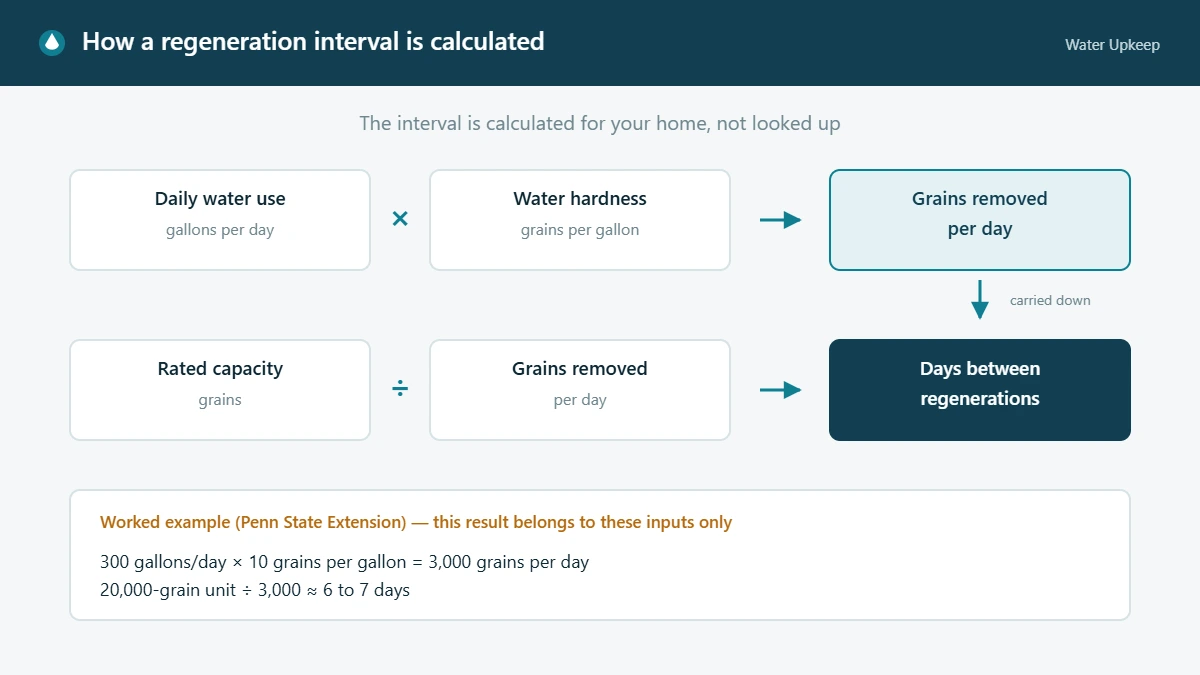
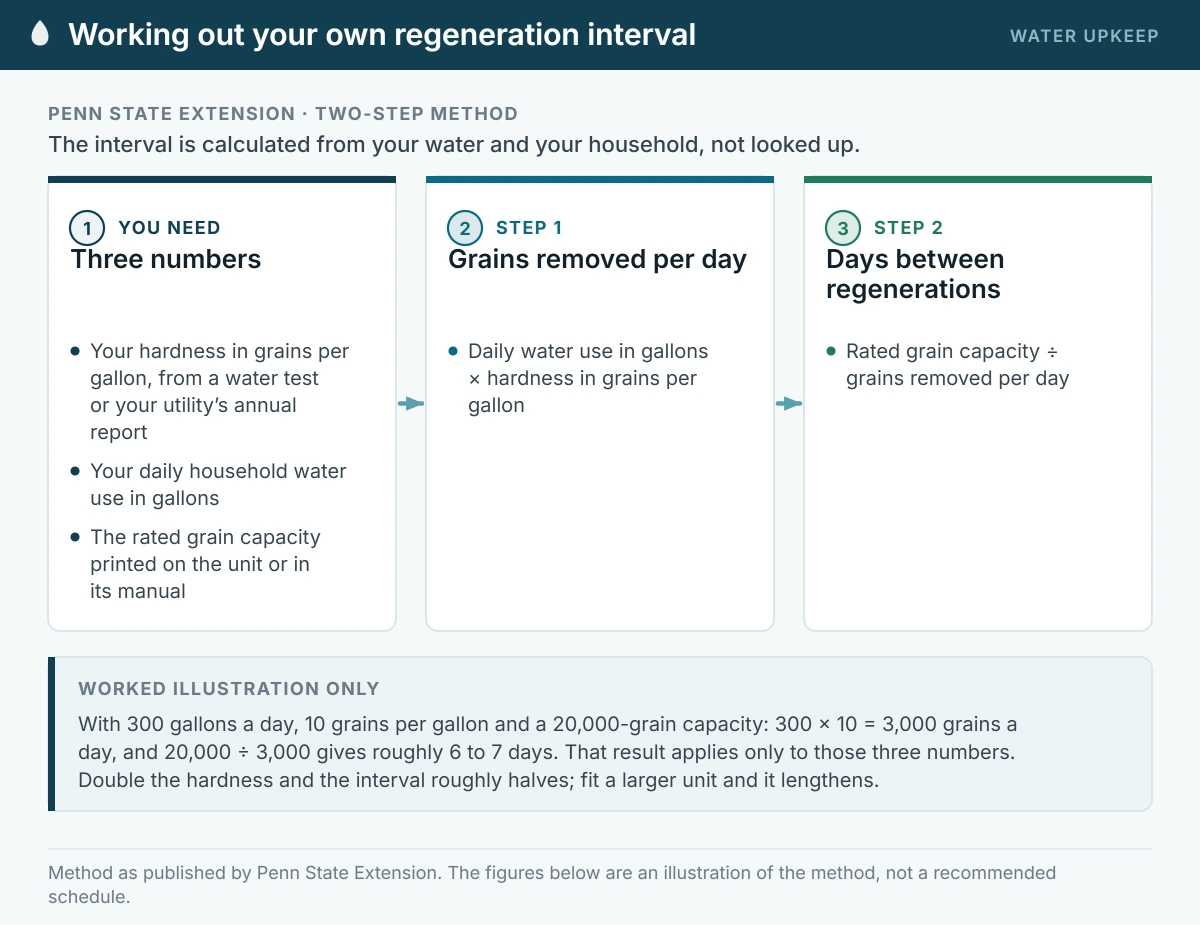
Penn State Extension sets out the calculation in two steps.
- Grains removed per day = your daily household water use in gallons × your water hardness in grains per gallon.
- Days between regenerations = your softener’s rated grain capacity ÷ grains removed per day.
You need three numbers to run it: your hardness (from a water test or your utility’s annual water quality report), your daily water use, and the rated capacity printed on the unit or in its manual.
A worked example
This is an illustration of the method using one specific set of inputs. It is not a recommended schedule, and the result below applies only to these three numbers.
| Daily household water use | 300 gallons |
| Water hardness | 10 grains per gallon |
| Softener rated capacity | 20,000 grains |
| Grains removed per day | 300 × 10 = 3,000 |
| Days between regenerations | 20,000 ÷ 3,000 ≈ 6 to 7 days |
Change any one of those inputs and the answer moves. Double the hardness and the interval roughly halves. Fit a larger unit and it lengthens. Run the numbers for your own home rather than borrowing this result.
The four ways a softener decides to regenerate
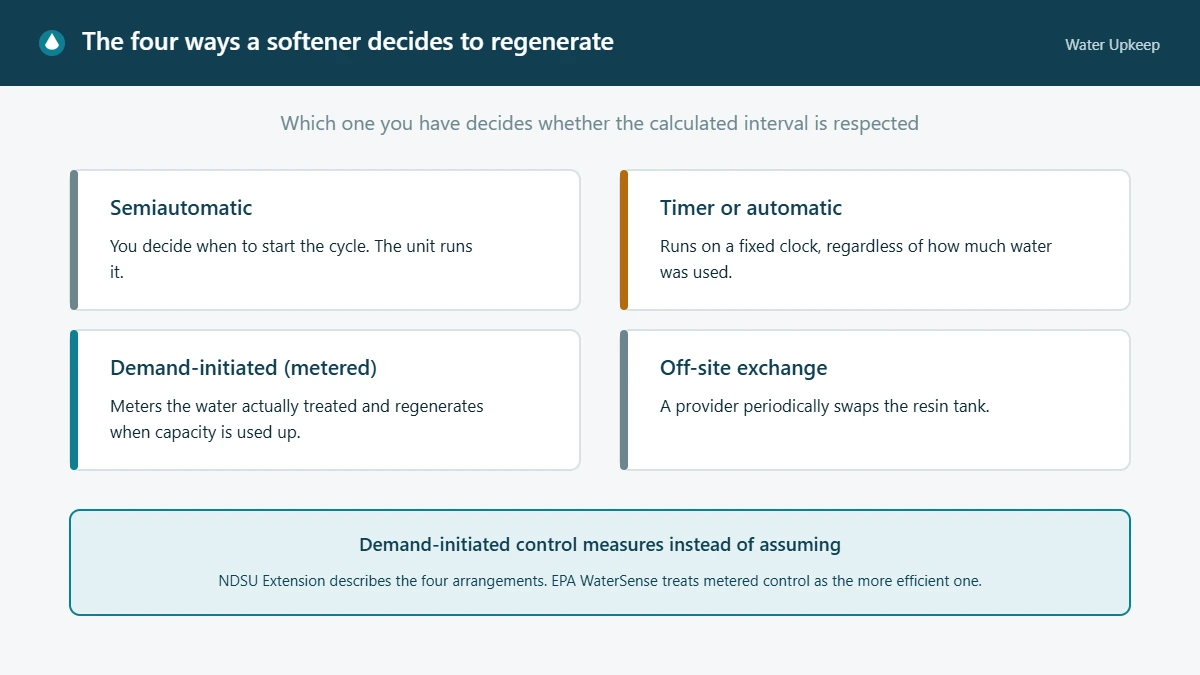
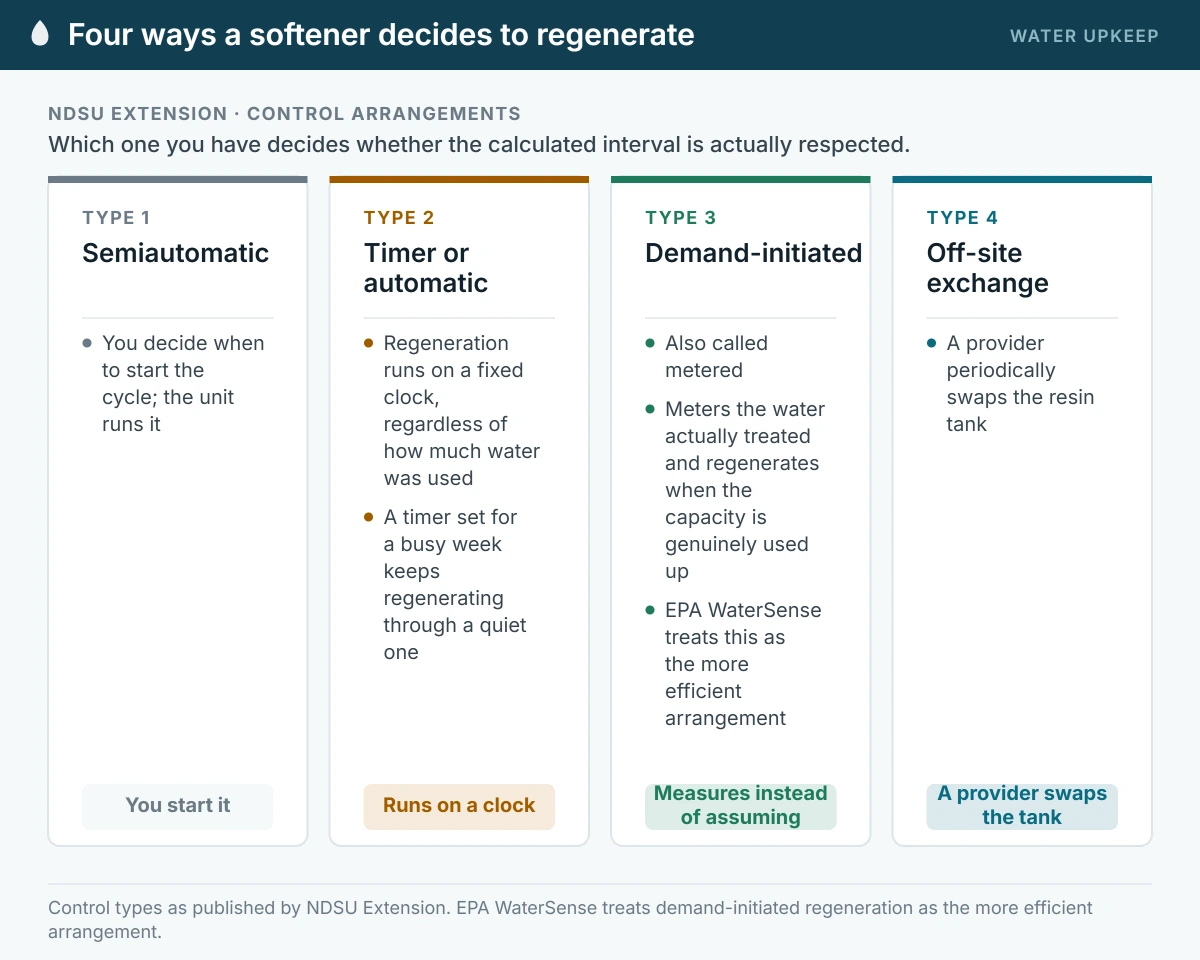
NDSU Extension describes four control arrangements, and which one you have determines whether the calculated interval is actually respected.
- Semiautomatic — you decide when to start the cycle; the unit runs it.
- Timer or automatic — regeneration runs on a fixed clock, regardless of how much water was used.
- Demand-initiated regeneration (DIR), also called metered — the unit meters the water actually treated and regenerates when the capacity is genuinely used up.
- Off-site exchange service — a provider periodically swaps the resin tank.
The distinction matters most when your usage is uneven. A timer set for a busy week keeps regenerating through a quiet one, spending salt and water on capacity nobody used. Demand-initiated control measures instead of assuming, and EPA’s WaterSense programme treats it as the more efficient arrangement for that reason.
Salt and water efficiency under NSF/ANSI 44
Each regeneration consumes salt and water, so the interval is really a question about running cost as well as performance. There is a published benchmark for this. Under NSF/ANSI 44, a softener carrying an efficiency rating must remove at least 3,350 grains of hardness per pound of salt, and use no more than 5.0 gallons of water per 1,000 grains of hardness removed.
Water used per regeneration typically falls in the range of 20 to 70 gallons, and can reach around 200 gallons on large systems. It is a range rather than a single figure because it depends on the unit and how it is set.
How salt dose changes the trade-off
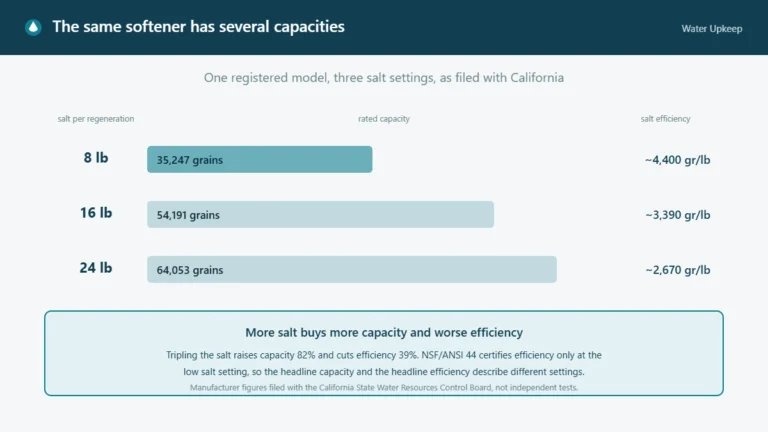
Salt dose is an adjustable setting, and it pulls in two directions at once. A higher dose recharges more of the resin, giving more capacity from each regeneration and therefore a longer interval. But it does so at a worse grains-per-pound efficiency — you get more capacity for more salt, not for free.
A lower dose is more salt-efficient per grain removed, but yields less capacity per cycle and so regenerates more often. Neither setting is universally correct; it is a choice about what you would rather spend.
Signs the interval needs attention
- Hard-water signs returning between regenerations — scale, soap not lathering, spotting on glassware. This can mean the interval is too long, or that the unit is undersized for the household.
- Salt running down unusually fast — worth checking the interval and the salt dose setting.
- Standing water in the brine tank — can indicate the unit needs service rather than a settings change.
If the symptoms are returning and the calculation says the interval should be fine, the more likely explanation is that the hardness figure the unit was set up with is wrong. Our water testing guide covers establishing it properly.
When to call a professional
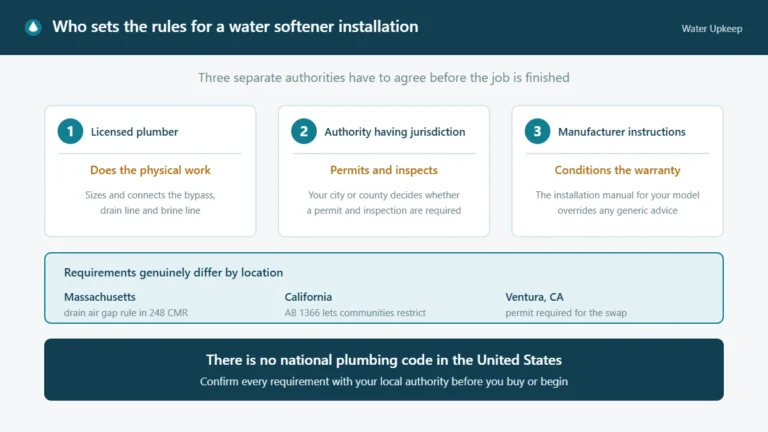
Brine discharge from a softener must meet local plumbing code, and some jurisdictions place restrictions on it. If your unit is still under warranty, changing its settings is normally a dealer or technician task rather than an owner one — worth checking before you adjust anything yourself. Our maintenance and repair guide covers where that line usually falls, and our water softeners guide explains how the equipment works.
Sources and standards
- Penn State Extension — Water Softening. The regeneration interval calculation and the worked example inputs.
- US EPA WaterSense — Water Softeners technical sheet. NSF/ANSI 44 efficiency figures and demand-initiated regeneration.
- NDSU Extension — Water Softening (Ion Exchange). The four control types and system operation.
- NSF International — Standards for Water Treatment Systems. What certification to a standard covers.
Water Upkeep does not sell or install water treatment equipment and does not conduct product testing. Every figure above is drawn from the published sources listed.
Last reviewed September 18, 2026.