
Everything else on this site depends on knowing what is in your water. Testing is cheap relative to the equipment it prevents you buying by mistake, and it is the only way to specify treatment properly.
What this section covers
- Hardness testing and the difference between grains per gallon and parts per million
- Total dissolved solids and what a TDS meter can and cannot tell you
- Certified laboratory panels versus home test strips
- Reading a municipal Consumer Confidence Report
- Lead, PFAS, nitrates, arsenic, manganese, chlorine and chloramine
- NSF/ANSI 42, 44, 53, 58 and 401 explained in plain English
Municipal supply or private well?
If you are on a municipal supply, your utility publishes an annual Consumer Confidence Report showing what was detected and at what level. That report is free, specific to your system, and the correct starting point. It will not tell you what happened to the water between the treatment plant and your tap, which is why lead testing at the tap is still worthwhile in older housing.
If you are on a private well, nobody is testing for you. See Well Water.
Test strips versus laboratory panels
Strips are useful for one job: getting a rough hardness or chlorine number quickly so you can size equipment. They are not reliable for health-related contaminants. Where the question is lead, nitrate, arsenic, bacteria or PFAS, a certified laboratory panel with a chain of custody is the only sensible answer.
Important
Water Upkeep reports regulatory limits and certification facts. We do not interpret results medically and we do not advise on health risk. If a result exceeds an EPA maximum contaminant level, contact your state or local health department.
Common questions
What does a TDS meter actually measure?
The total concentration of dissolved solids, expressed in parts per million. It is a useful way to check whether a reverse osmosis membrane is still working. It tells you nothing about which solids are present, so it cannot detect lead, bacteria or PFAS.
How do I convert hardness units?
One grain per gallon is approximately 17.1 parts per million as calcium carbonate. Laboratories usually report ppm; softener sizing usually uses gpg.
How much does a proper water test cost?
Basic mail-in panels covering the common well parameters typically run from around one hundred dollars; broader panels including metals and PFAS cost several times that. Many county health departments offer low-cost bacteria testing.
Articles in this section
-
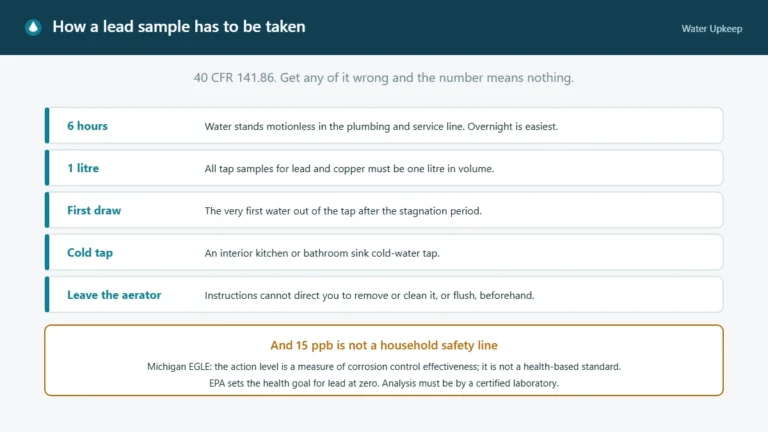
How to Test for Lead in Water
Read article →: How to Test for Lead in WaterSix hours of stagnation, a one-litre first draw, a certified laboratory. And the 15 ppb figure everyone quotes is a system compliance trigger, not a household…
-
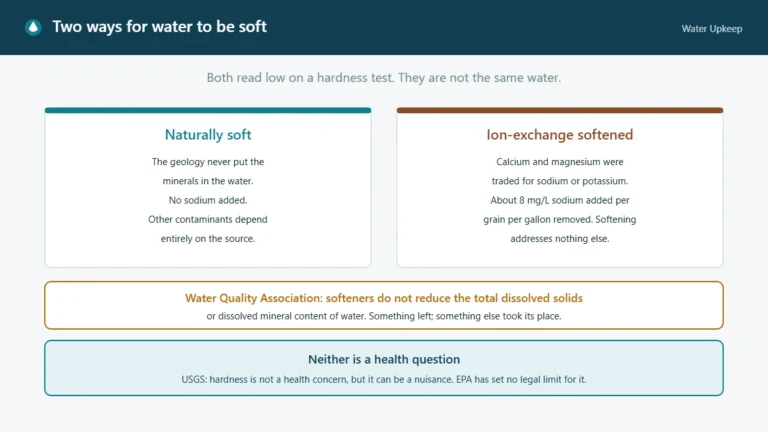
What Is the Difference Between Hard and Soft Water?
Read article →: What Is the Difference Between Hard and Soft Water?Hard water carries dissolved calcium and magnesium. But there are two very different ways for water to be soft, and only one of them adds sodium…
-
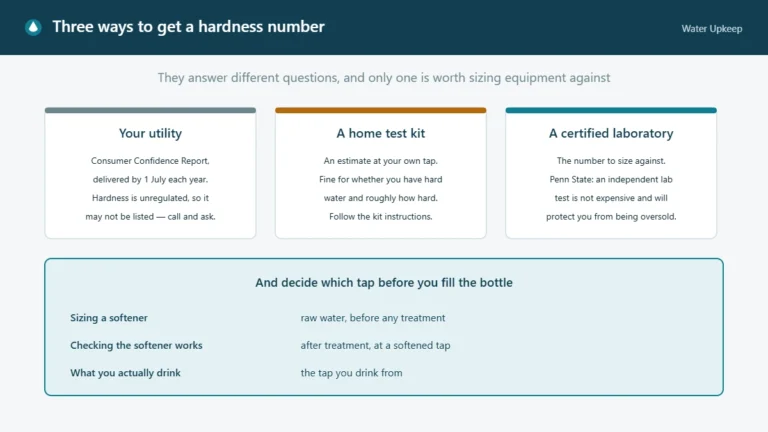
How to Test Water Hardness
Read article →: How to Test Water HardnessThree routes to a hardness number, what each is good for, where to take the sample, and how to read a result in grains per gallon…
-
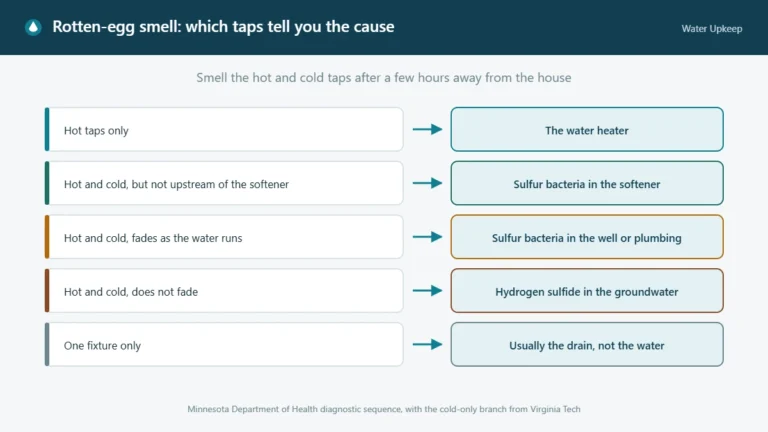
Why Does My Water Smell Like Rotten Eggs?
Read article →: Why Does My Water Smell Like Rotten Eggs?The smell is hydrogen sulfide. Which taps carry it — hot, cold, one fixture — tells you whether the cause is your water heater, your well,…
-
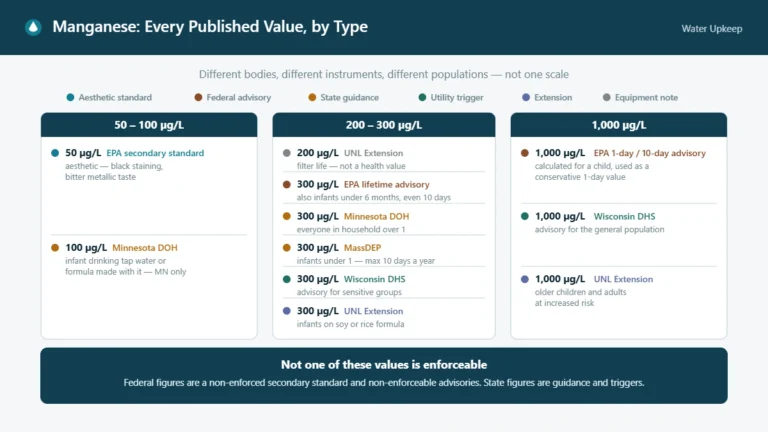
Manganese in Drinking Water: What Each Number Actually Is
Read article →: Manganese in Drinking Water: What Each Number Actually IsManganese carries two different kinds of number: an aesthetic standard EPA does not enforce, and health advisories that four states interpret four different ways. Every value,…
-
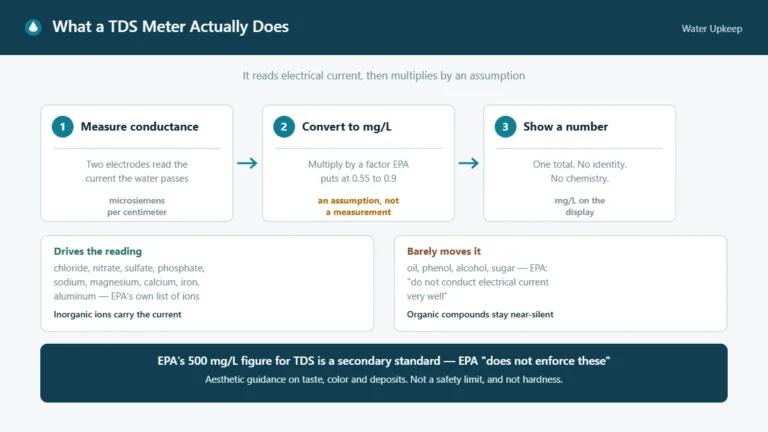
TDS in Water: What the Number Actually Means
Read article →: TDS in Water: What the Number Actually MeansA TDS meter measures how well water conducts electricity, then multiplies by a factor EPA calls empirically determined. Here is what that number can and cannot…
-
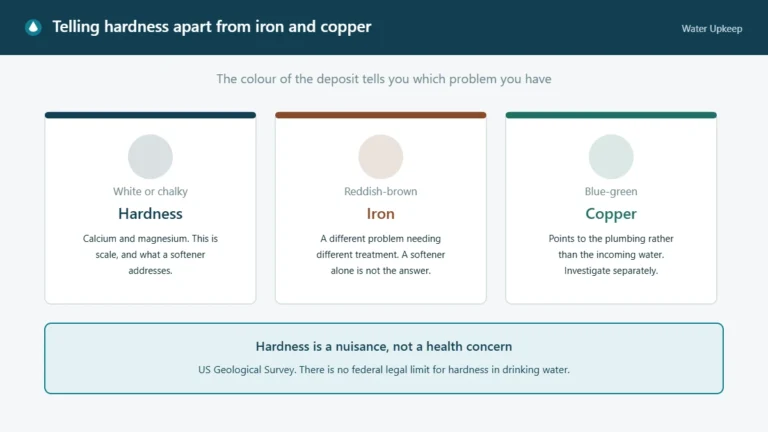
How to Tell If You Have Hard Water
Read article →: How to Tell If You Have Hard WaterYou cannot see hard water, only what it leaves behind. The signs worth trusting, how to tell scale from iron staining, and how to get a…
Related sections
Last reviewed September 6, 2026.