Why Does My Water Smell Like Rotten Eggs?
The smell is hydrogen sulfide, and the useful question is not what it is but where it is getting in. There are four common answers — the water heater, the well or the plumbing, the water softener, and the drain itself — and you can tell them apart in about five minutes without buying anything. The test is simply which taps smell, hot or cold, and whether the smell fades once the water has been running. Get that right first, because the four causes have four different fixes and the expensive one is rarely the answer.
The test that narrows it down
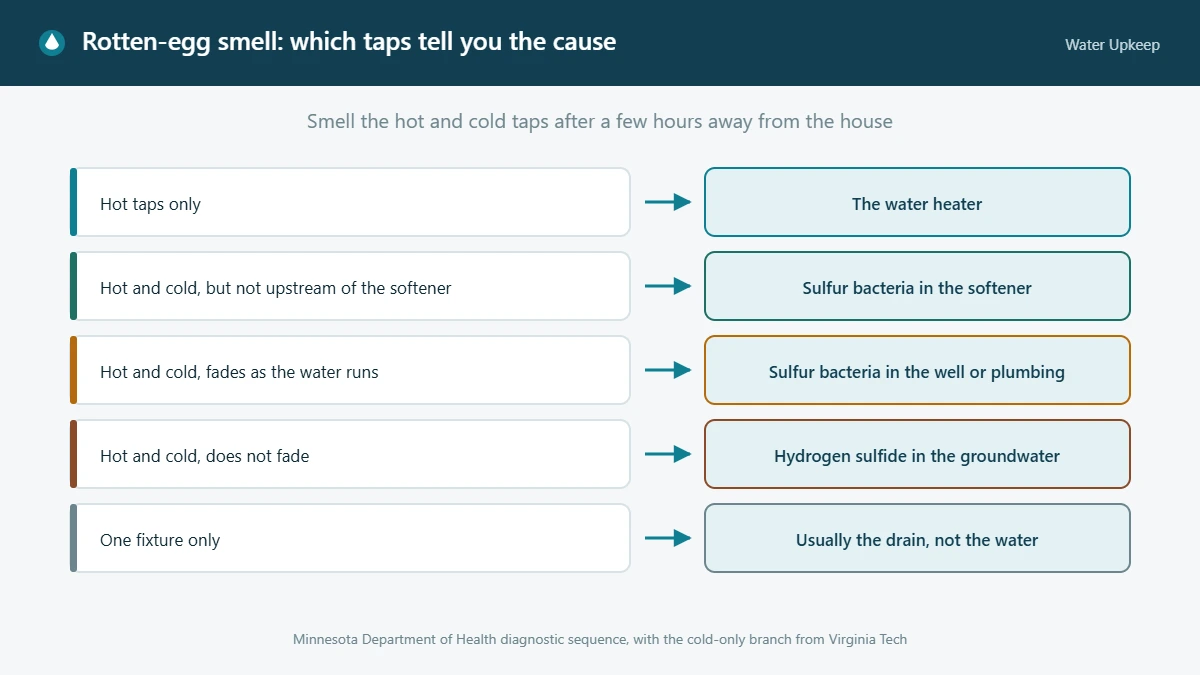
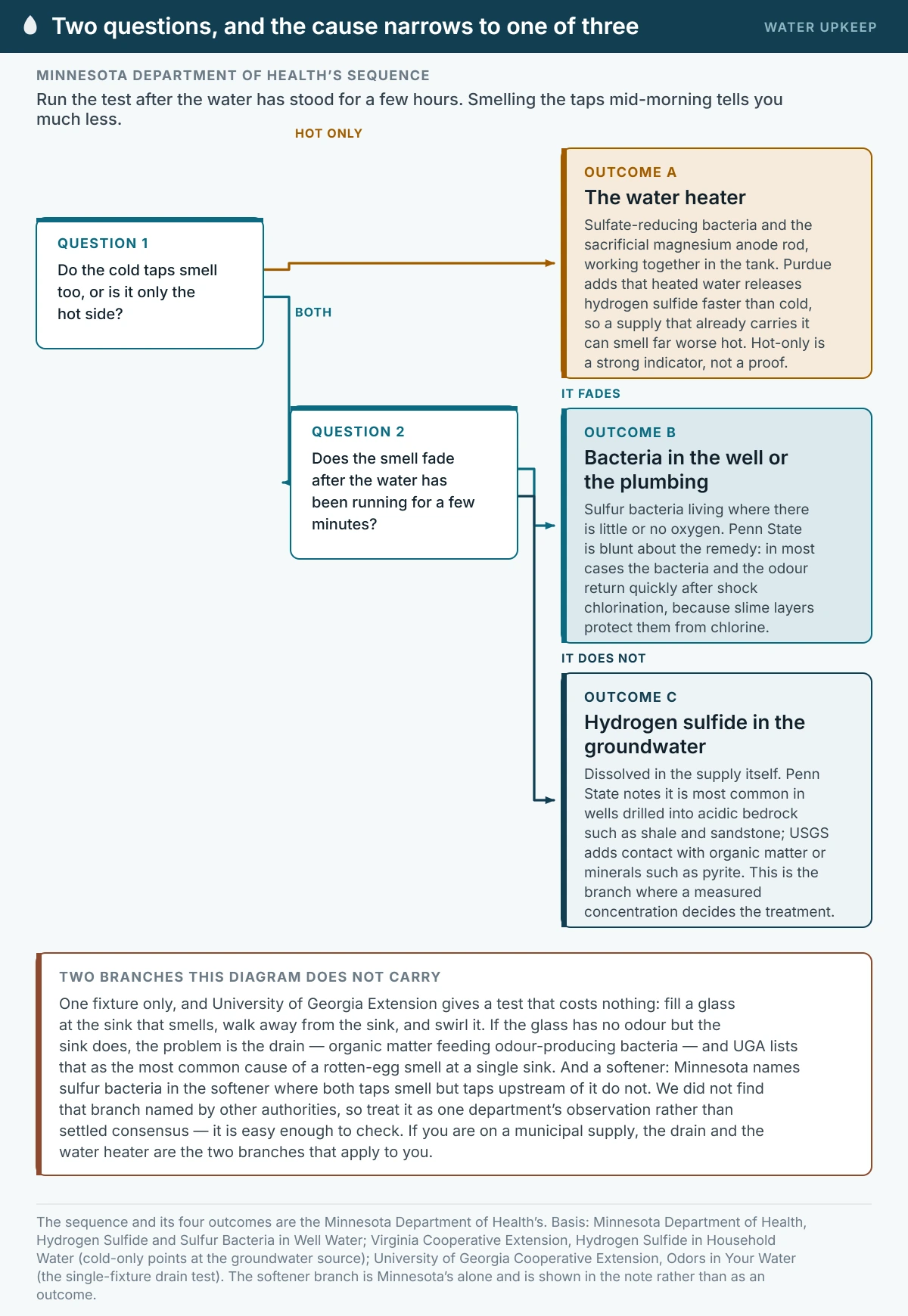
The Minnesota Department of Health publishes the sequence. After you have been away from the house for a few hours, smell the water from the hot and the cold taps and note which ones carry the odour.
| What you find | What it points to |
|---|---|
| Hot taps only, cold taps clean | The water heater |
| Both hot and cold, but not at taps upstream of the softener | Sulfur bacteria in the water softener |
| Both hot and cold, and the smell fades after the water runs a few minutes | Sulfur bacteria in the well or the plumbing |
| Both hot and cold, and the smell does not fade | Hydrogen sulfide dissolved in the groundwater itself |
| One fixture only | Usually the drain, not the water |
Virginia Cooperative Extension frames the same thing from the other direction: cold water only points to hydrogen sulfide arriving from the groundwater source; both hot and cold means it is in the supply. The water softener branch comes from Minnesota specifically, and we did not find it named by other authorities — treat it as one department’s observation rather than settled consensus, though it is easy enough to check.
One fixture only? Check the drain first
University of Georgia Extension gives a test that costs nothing. Fill a glass at the sink that smells, walk away from the sink, and swirl the water in the glass a few times. If the glass has no odour but the sink does, the problem is the drain — organic matter accumulating there feeds odour-producing bacteria, and UGA lists this as the most common cause of a rotten-egg smell at a single sink.
If you are on a municipal supply, this and the water heater are the two branches that apply to you. The well, softener and chlorination sections below are written for private well owners.
Hot water only: what is happening in the tank
A storage water heater contains a sacrificial magnesium anode rod, which corrodes preferentially so the tank lining does not. Penn State Extension explains the chemistry: the magnesium rod can chemically reduce sulfates to form hydrogen sulfide. Wisconsin’s Department of Natural Resources adds the biological half — sulfate-reducing bacteria live where there is little or no oxygen and convert sulfur compounds into hydrogen sulfide, and the corroding rod feeds them.
Heat makes it worse independently of any of that. Purdue Extension notes heated water releases hydrogen sulfide gas more quickly than cold, which is why the hot tap can smell strongly while the cold one seems fine.
Replace the anode rod. Do not remove it
This is the one part of the article where getting it wrong costs real money. Pulling the anode rod out does stop the reaction, and you will find it recommended. Penn State states the consequence plainly: removal could cause increased corrosion and reduced life of the water heater, and will likely void the manufacturer’s warranty. The Minnesota Department of Health says removal may significantly decrease the life of the heater. Wisconsin DNR says the same, noting the effect is worse with softened water.
The fix is to swap the alloy, not delete the part. Penn State, Minnesota and Virginia Tech all point to an aluminium rod, which should eliminate the odour while keeping corrosion protection. Wisconsin DNR points to zinc instead, and is careful about the claim: a zinc rod will not totally eliminate sulfate-reducing bacteria but can greatly reduce them. University of Georgia Extension says aluminium or zinc, with one caveat — if the water temperature is maintained above 150 °F, use only an aluminium rod — and recommends a licensed plumber does the work.
Virginia Tech adds the step everyone skips: check with the water heater manufacturer before making the change, so the warranty is not affected.
You will also see it claimed that aluminium rods leach aluminium into drinking water. We could not find that stated by any government, university or standards-body source consulted for this article.
Disinfecting the heater, and the burn risk that comes with it
Wisconsin DNR describes a heat treatment: sulfur bacteria die above 140 °F, so raising the heater to 160 °F for eight hours and then draining the tank can clear them. The tank must have a functioning pressure relief valve, and the department’s own instruction is to warn everyone in the house and reduce the setting afterwards to prevent accidental scalding.
That warning is not boilerplate. The Consumer Product Safety Commission recommends a standing heater setting of 120 °F, and gives the reason: at 150 °F a third-degree burn can occur in about two seconds, at 140 °F in about six seconds, while at 120 °F it takes a five-minute exposure. The majority of injuries and deaths from tap water scalds are to elderly people and children under five. A temporary, supervised disinfection at 160 °F is not the same thing as leaving the thermostat there, and this is a job worth handing to a plumber if anyone vulnerable lives in the house.
Where it comes from in a well
Hydrogen sulfide occurs naturally in groundwater as a consequence of sulfur-reducing bacteria, and Penn State notes the problem is most common in wells drilled into acidic bedrock such as shale and sandstone. The US Geological Survey adds the other route: water coming into contact with organic matter, or with minerals such as pyrite. Purdue lists wells near coal or oil fields, and sewage pollution of shallow or poorly constructed wells, among the sources.
That last one is the reason a well owner should not treat the smell as purely cosmetic and move on. UGA notes a well-sourced rotten-egg smell can indicate septic contamination. Test for coliform bacteria rather than assuming. Our guide to what well water is and who is responsible for it covers why nobody is doing that testing for you.
Is it a health problem?
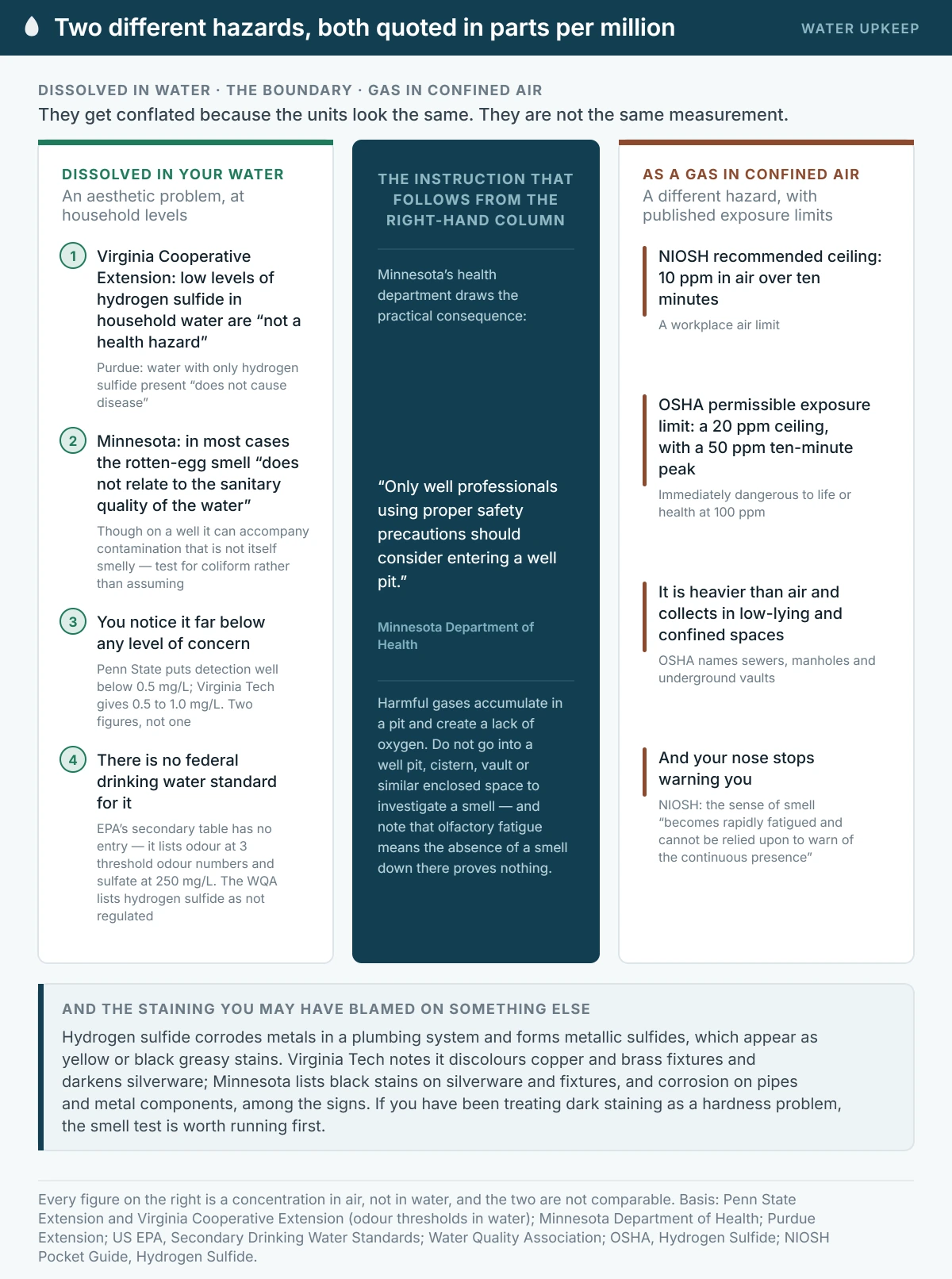
At household levels in water, three authorities say no. Virginia Cooperative Extension: the presence of low levels of hydrogen sulfide in household water is not a health hazard. Minnesota Department of Health: in most cases the rotten egg smell does not relate to the sanitary quality of the water. Purdue Extension: water with only hydrogen sulfide present does not cause disease.
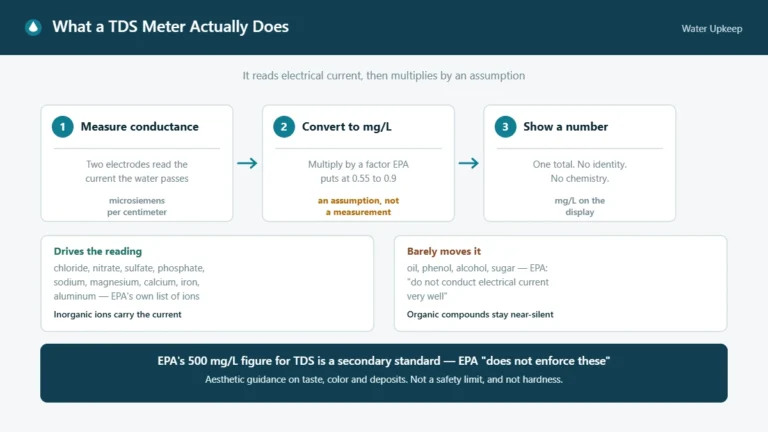
There is no federal drinking water standard for hydrogen sulfide. EPA’s secondary standards table contains no entry for it — it lists odour at 3 threshold odour numbers, with “rotten-egg, musty or chemical smell” as the noticeable effect, and sulfate at 250 mg/L. Those secondary standards are non-enforceable aesthetic guidelines rather than health limits. The Water Quality Association lists hydrogen sulfide in its contaminant table as not regulated.
The one number worth knowing is the odour threshold, because it explains why the problem announces itself so early. Penn State puts detection well below 0.5 mg/L; Virginia Tech gives 0.5 to 1.0 mg/L. Penn State’s framing is the useful one: the gas is poisonous and flammable, but the human nose detects it well before it causes health concerns in water.
Where it does become a safety question
Hydrogen sulfide as a gas in confined air is a different hazard from hydrogen sulfide dissolved in your water, and the two get conflated because both are quoted in parts per million. Every figure in this section is a concentration in air, not in water.
OSHA notes the gas is heavier than air, travels along the ground and builds up in low-lying areas and confined spaces such as sewers, manholes and underground vaults. It also notes olfactory fatigue: after a while at low concentrations, or quickly at high ones, you stop being able to smell it. NIOSH sets a recommended ceiling of 10 ppm in air over ten minutes; OSHA’s permissible exposure limit is a 20 ppm ceiling with a 50 ppm ten-minute peak, and the immediately dangerous to life or health level is 100 ppm. NIOSH states directly that the sense of smell becomes rapidly fatigued and cannot be relied on to warn of continuous presence.
The practical consequence: do not go into a well pit, cistern, vault or similar enclosed space to investigate. The Minnesota Department of Health is explicit that only well professionals using proper safety precautions should consider entering a well pit, and notes that harmful gases accumulate there and create a lack of oxygen.
Treatment, matched to concentration
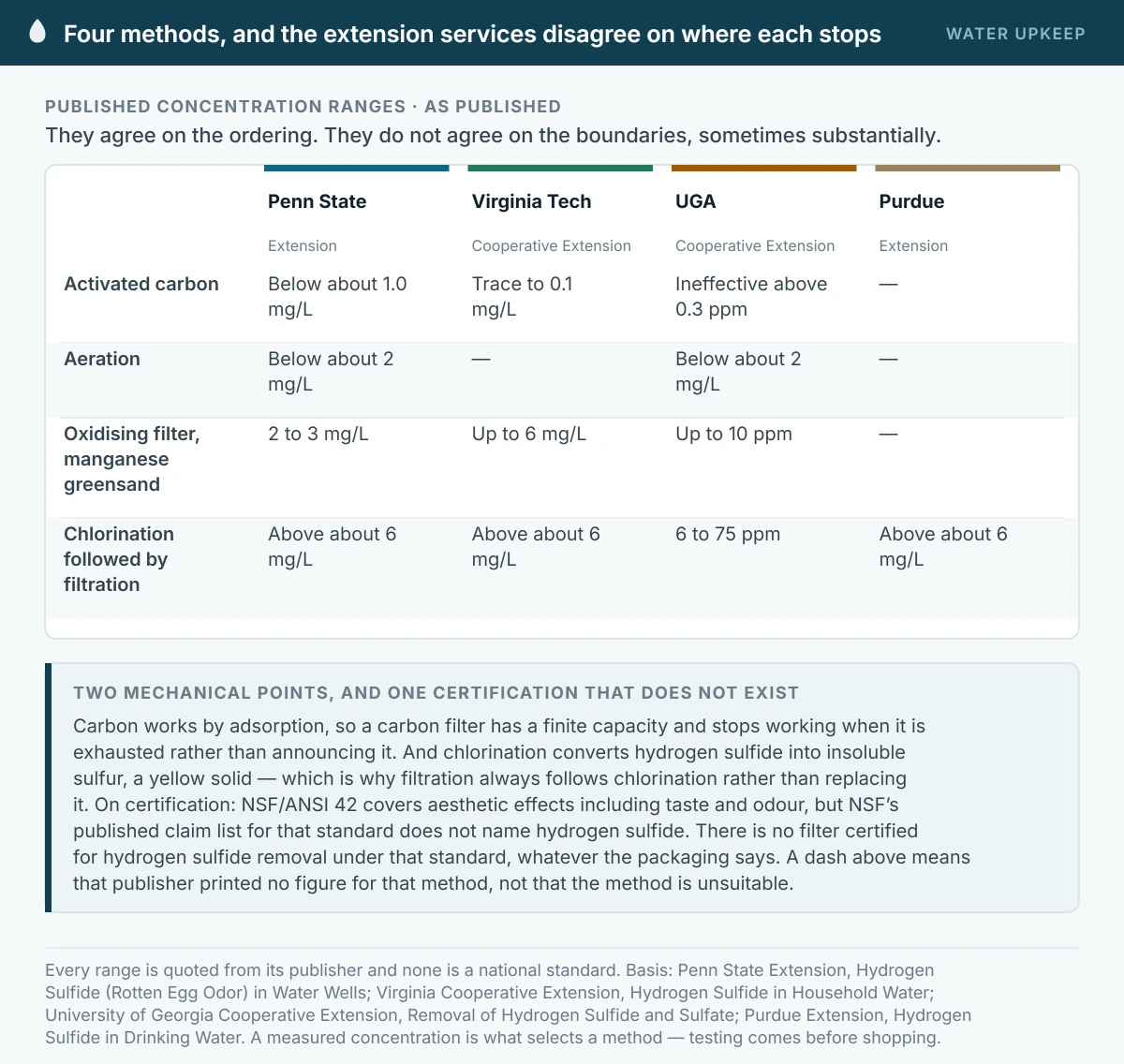
Which technology fits depends on how much hydrogen sulfide is actually in the water, which is why testing comes before shopping. The extension services agree on the ordering and disagree on the boundaries, sometimes substantially.
| Method | Concentration range, by source |
|---|---|
| Activated carbon | Trace to 0.1 mg/L (Virginia Tech); ineffective above 0.3 ppm (UGA); below about 1.0 mg/L (Penn State) |
| Aeration | Below about 2 mg/L (Penn State and UGA agree) |
| Oxidising filter, manganese greensand | 2 to 3 mg/L (Penn State); up to 6 mg/L (Virginia Tech); up to 10 ppm (UGA) |
| Chlorination followed by filtration | Above about 6 mg/L (Penn State, Virginia Tech and Purdue agree; UGA gives 6 to 75 ppm) |
Two mechanical points. Carbon works by adsorption, so a carbon filter has a finite capacity and stops working when it is exhausted rather than announcing it. And chlorination converts hydrogen sulfide into insoluble sulfur, a yellow solid, which is why filtration always follows chlorination rather than replacing it.
NSF/ANSI 42 covers aesthetic effects including taste and odour, but NSF’s published claim list for that standard does not name hydrogen sulfide. There is no such thing as a filter certified for hydrogen sulfide removal under that standard, whatever the packaging says.
Shock chlorination, and why it often does not hold
Pouring a chlorine solution into the well to kill bacteria is the standard response to a bacterial cause, and Penn State is blunt about the result: in most cases, sulfur-reducing bacteria and hydrogen sulfide odour return quickly after shock chlorination. Virginia Tech says the same — control may only be temporary and routine repetition may be needed.
Penn State explains why, and gives a stopping rule. Slime layers formed by iron and sulfur bacteria protect them from chlorine, so complete removal can be impossible. Frequent shock chlorination can damage a private water system, and if it is needed more often than every six months, other control options should be explored rather than repeating it.
We are deliberately not publishing a dose. State health departments give materially different procedures — Minnesota specifies 50 to 200 ppm in the recirculating water with an explicit instruction not to exceed 200 ppm and a contact time of at least two hours, Pennsylvania DEP gives 100 to 150 ppm and at least four hours, and Wisconsin DNR’s bleach-per-100-gallons recipe with 24 hours of contact is an order of magnitude stronger before dilution. Follow your own state health department’s procedure. Whichever you use, Minnesota’s safety instructions apply: never mix bleach with other chemicals, keep the area around the well well ventilated, and retest two to four weeks afterwards because bacteria can regrow.
The staining you may have blamed on something else
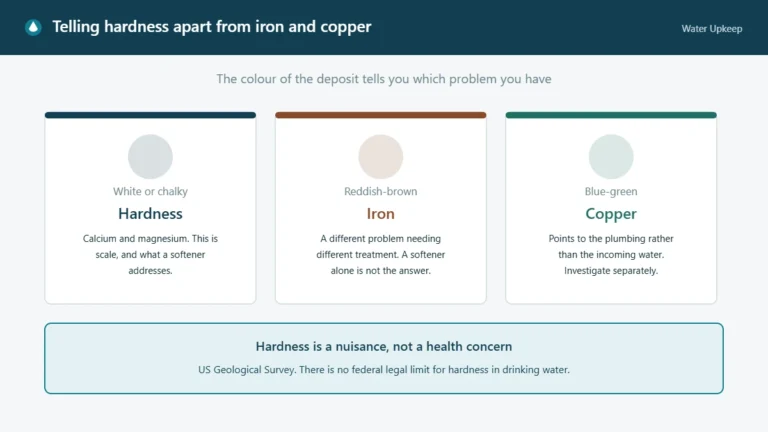
Hydrogen sulfide corrodes metals in a plumbing system and forms metallic sulfides, which show up as yellow or black greasy stains on fixtures or inside pipes. Virginia Tech notes it discolours copper and brass fixtures and darkens silverware; Minnesota lists black stains on silverware and fixtures, and corrosion on pipes and metal components, among the signs. If you have been treating dark staining as a hardness problem, the smell test is worth running — our guide to telling hardness apart from other staining covers the colours.
When to call a professional
- You are on a well and have not tested for coliform bacteria — the odour can accompany contamination that is not itself smelly.
- The anode rod needs changing. UGA recommends a licensed plumber, and the manufacturer should be consulted first about the warranty.
- You are considering the 160 °F heater disinfection and there are young children or elderly people in the house.
- Shock chlorination has been needed more than twice in a year.
- Anyone suggests you open or enter a well pit. That is professional work with proper precautions, not a homeowner job.
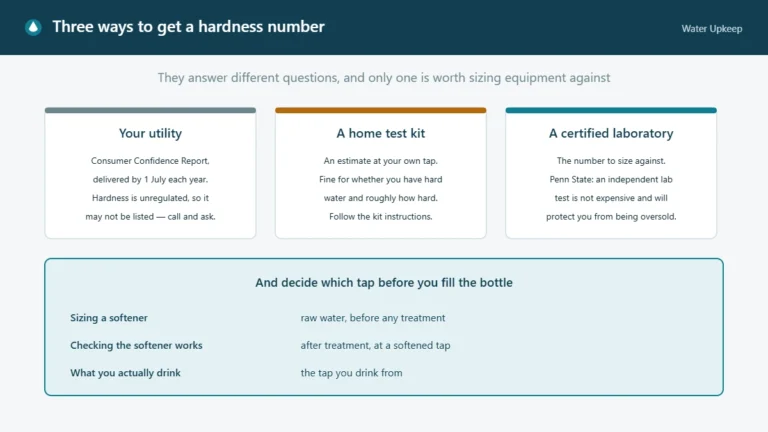
- You are being quoted for treatment equipment without a measured hydrogen sulfide concentration. Get the number first; the technologies do not overlap much.
More on establishing what is actually in your water in our water testing hub.
Sources and standards
- Minnesota Department of Health — Hydrogen sulfide and sulfur bacteria in well water and Well disinfection
- Penn State Extension — Hydrogen sulfide (rotten egg odor) in water wells and Iron and sulfur bacteria
- Virginia Cooperative Extension, Virginia Tech — Hydrogen sulfide in household water
- Wisconsin Department of Natural Resources — Sulfur and sulfate-reducing bacteria
- University of Georgia Cooperative Extension — Odors in your water and Removal of hydrogen sulfide and sulfate
- Purdue University Extension — Hydrogen sulfide in drinking water
- US Geological Survey — Causes of earthy or rotten-egg odour in water
- US Environmental Protection Agency — Secondary drinking water standards
- Occupational Safety and Health Administration — Hydrogen sulfide (air exposure)
- NIOSH — Pocket guide: hydrogen sulfide (air exposure)
- US Consumer Product Safety Commission — Tap water scalds
- Pennsylvania Department of Environmental Protection — Disinfection of home wells and springs
- NSF — NSF/ANSI 42, 53 and 401
- Water Quality Association — Taste and odour in drinking water
Last reviewed September 18, 2026.