Annual Well Maintenance: What Actually Needs Checking
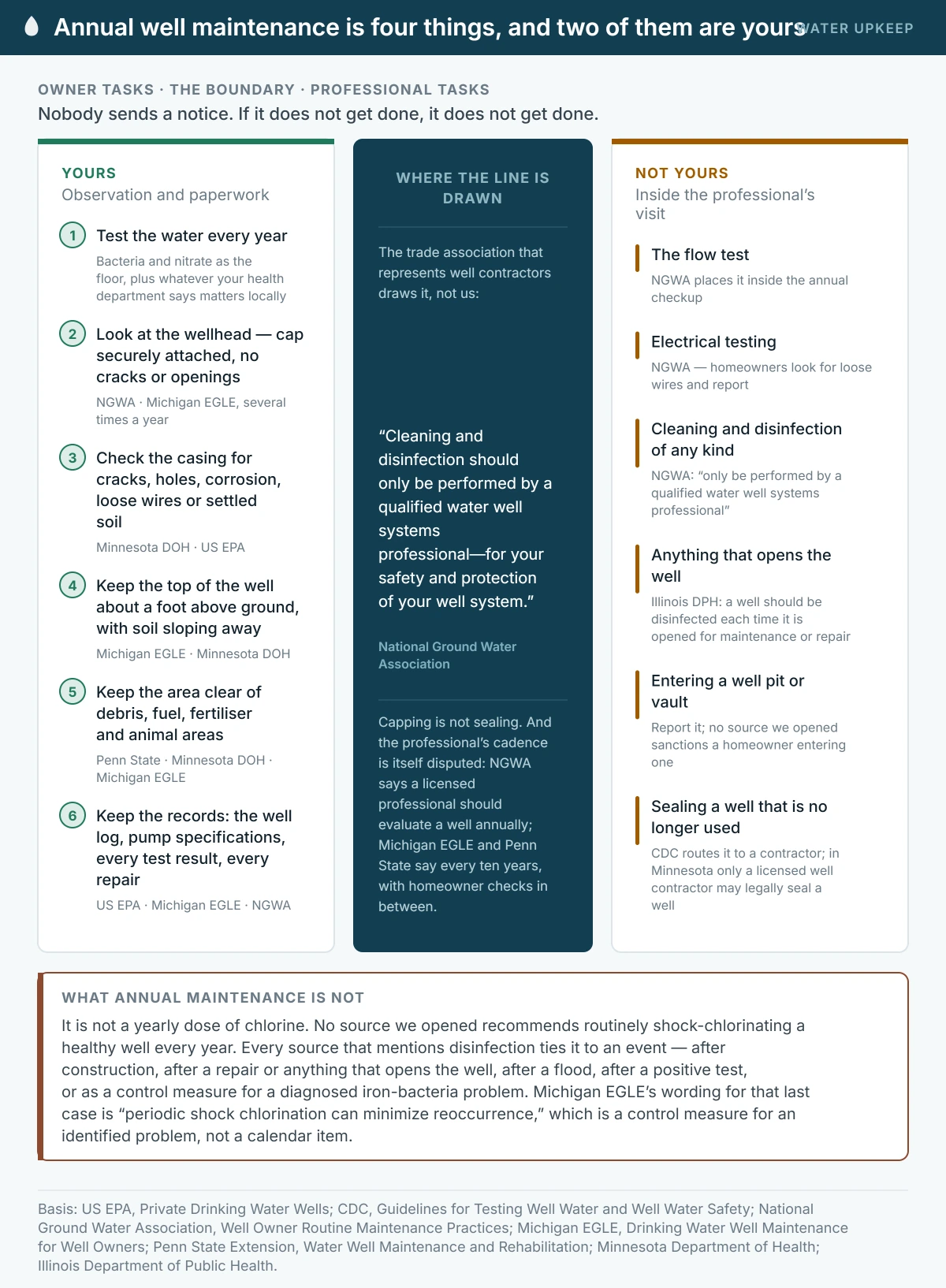
Annual well maintenance is four things, and only two of them are yours.
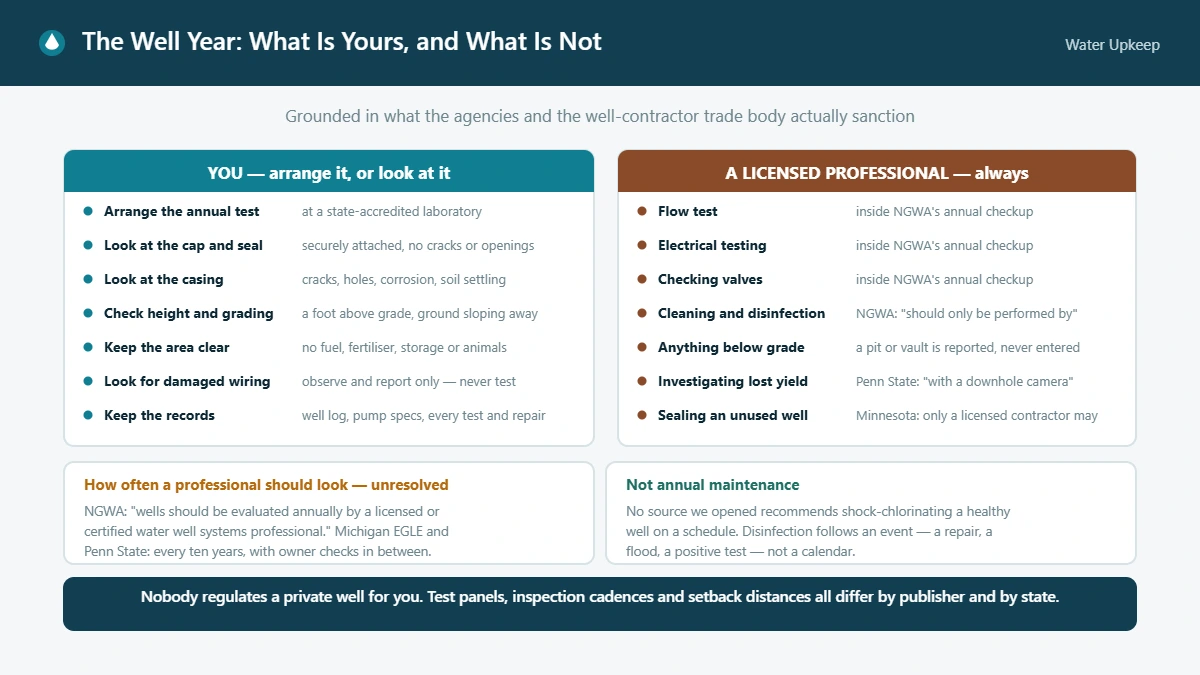
Test the water every year — though CDC, EPA, Michigan, Penn State, Minnesota and Texas each publish a different panel, so the honest version is a floor of bacteria and nitrate plus whatever your health department says matters locally. Look at the wellhead — Michigan’s environmental regulator says several times a year, for cracks and openings, with the top of the well about a foot above ground and the soil sloping away. Keep your records — the well log, the pump specifications, every test result, every repair. And hand the rest to a professional: the trade association that represents well contractors puts the flow test and the electrical test inside a professional’s annual visit, and says cleaning and disinfection should only be done by one.
What annual maintenance is not is a yearly dose of chlorine. Every source we opened ties disinfection to an event — a repair, a flood, a positive test — never to a calendar. This page sits in our well water hub; if you need the mechanism rather than the schedule, start with how a well works.
Nobody else is doing this
It is worth being blunt about the starting position, because it explains why this article exists at all. EPA: “The quality and safety of drinking water from private domestic wells are not regulated by the Federal Government under the Safe Drinking Water Act nor by most state governments and laws,” and “Private well owners are responsible for delivering safe drinking water to their households.” CDC puts the same thing in the second person: “As a water well owner, you are responsible for testing your well to make sure the water is safe to drink.”
USGS gives the scale: “More than 43 million people—about 15 percent of the U.S. population—rely on domestic (private) wells,” and their water quality is “not regulated by the Federal Safe Drinking Water Act or, in most cases, by state laws.” Virginia Cooperative Extension adds the maintenance half of it — owners “are responsible for the maintenance of their water systems, for monitoring the quality of their drinking water, and for taking appropriate steps to address problems should they arise.”
Nobody sends a notice. Nobody publishes an annual report for your well. If it does not get done, it does not get done.
The annual water test — and why the panels disagree
The four-item federal floor
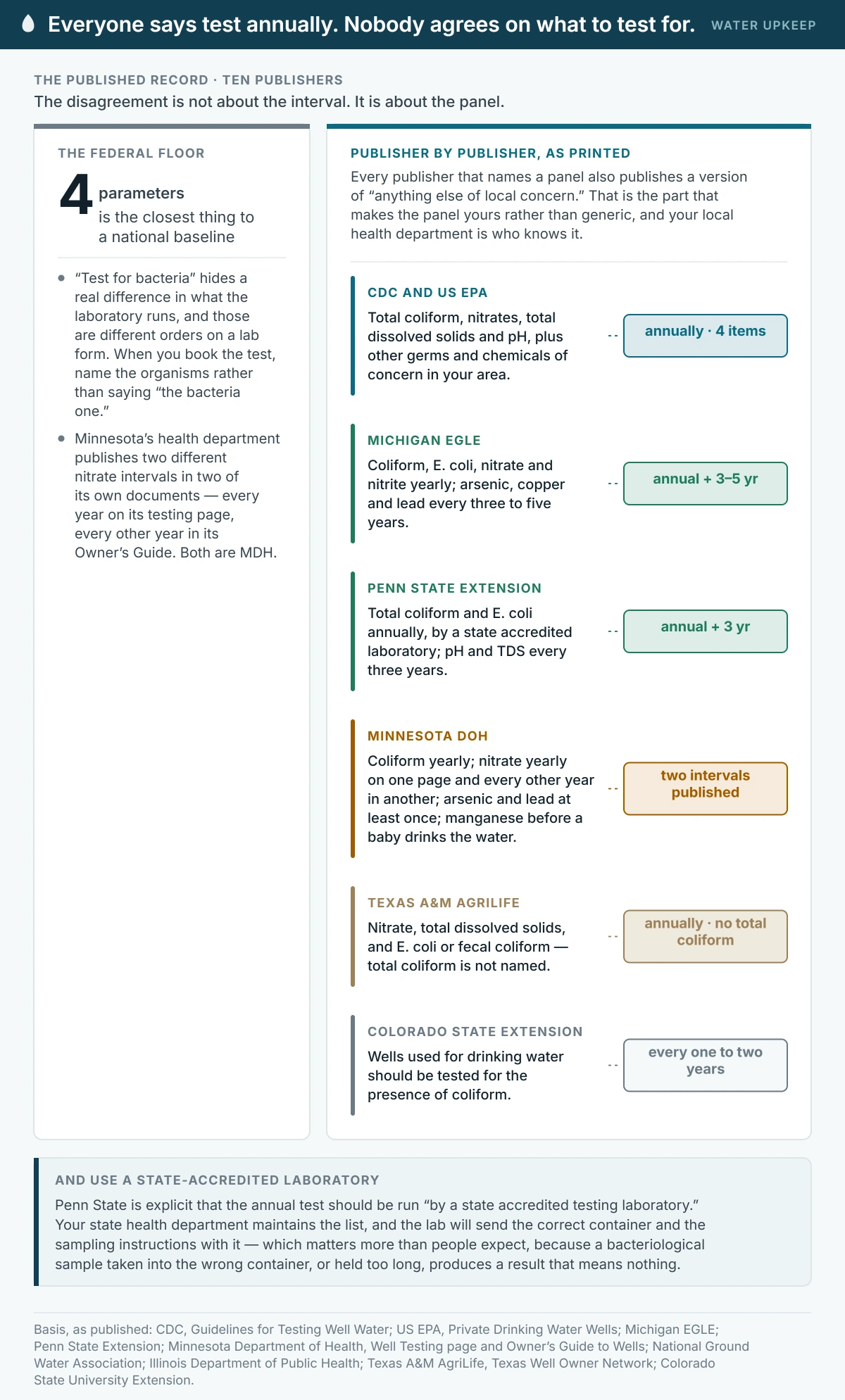
CDC: “Test your well water at least once every year for total coliform bacteria, nitrates, total dissolved solids, and pH level,” plus “Other germs and chemicals of concern in your area.” EPA says the same four: “Test your private well annually for total coliform bacteria, nitrates, total dissolved solids, and pH levels.”
That is the closest thing to a national baseline that exists. What happens to it once you move to state and university guidance is more interesting.
What each publisher actually recommends
| Publisher | Published panel and interval |
|---|---|
| CDC | Total coliform, nitrates, total dissolved solids, pH — “at least once every year,” plus “Other germs and chemicals of concern in your area” |
| US EPA | The same four, annually |
| Michigan EGLE | “Every year for coliform bacteria, E. coli, nitrate, and nitrite”; “Every three to five years for arsenic, copper, and lead” |
| Penn State Extension | “well water should be tested annually for total coliform bacteria and E. coli bacteria by a state accredited testing laboratory,” plus pH and TDS every three years |
| Minnesota DOH (Well Testing page) | Coliform every year; nitrate every year; arsenic at least once; lead at least once; manganese “at least once before a baby drinks the water” |
| Minnesota DOH (Owner’s Guide to Wells) | “Coliform Bacteria (every year), Nitrate (every other year), Arsenic (at least once)” |
| NGWA | “a water quality test for coliform and anaerobic bacteria, nitrates, and anything else of local concern,” as part of the annual checkup |
| Illinois DPH | “Annual testing of the well should be performed to assure the well is providing a safe supply of water.” |
| Texas A&M AgriLife (Texas Well Owner Network) | “have the water tested every year for nitrate, total dissolved solids (TDS), and E. coli or fecal coliform” — total coliform not named |
| Colorado State Extension | “Wells used for drinking water should be tested for the presence of coliform every one to two years.” |
Two things in that table are worth pointing at rather than smoothing over.
Minnesota’s health department publishes two different nitrate intervals in two of its own documents — every year on its well testing page, every other year in its Owner’s Guide. Both are MDH. We are not picking one for you; if you are in Minnesota, the interval you follow should come from whichever of those documents your county health department points you at.
“Test for bacteria” hides a real difference in what the laboratory runs. CDC and EPA name total coliform. Penn State names total coliform and E. coli. Texas names E. coli or fecal coliform, and does not name total coliform at all. Michigan names coliform, E. coli, nitrate and nitrite. Those are different orders on a lab form. When you book the test, name the organisms rather than saying “the bacteria one.”
“Anything else of local concern”
Every source that publishes a panel also publishes a version of this sentence. CDC: “Other germs and chemicals of concern in your area.” NGWA: “anything else of local concern.” Penn State ties it to nearby land uses. Michigan EGLE lists a wide standard set for local concerns.
This is the part that makes the panel yours rather than generic. The national list is a floor; what sits on top of it depends on your geology, your neighbors’ land use, and what your county has historically found in wells near you. Your local health department knows that and will tell you. If a specific contaminant is already on your mind, our water testing hub covers what each test actually measures.
Use a state-accredited laboratory
Penn State is explicit that the annual test should be run “by a state accredited testing laboratory.” That is the standard to hold to. Your state health department maintains the list of accredited labs, and a lab will send you the correct container and the sampling instructions with it — which matters more than people expect, because a bacteriological sample taken into the wrong container, or held too long, produces a result that means nothing.
One note on timing, and it belongs to one state only. New York’s health department says: “Late spring or early summer are the best times to test your well, since coliform contamination is most likely to show up during wet weather.” That is New York’s recommendation and we are not generalising it, but the reasoning — sample when contamination is most likely to show, not when it is least likely — travels.
If it comes back positive
This article stops there. CDC’s instruction is to contact your local health or environmental department, and EPA adds that you should “have your well re-tested to confirm the contaminant’s presence and concentrations.” What a positive result means and what happens next is a positive coliform test on your well — that article, your health department, and a licensed contractor, in that order.
The look-at-it list: what a homeowner can check
Everything in this section is an observation. None of it involves opening, entering, testing or dismantling anything, and that limit is not our caution — it is where the sources themselves stop.
The cap and the seal — inspect, never open
NGWA’s instruction is to “Check the condition of the cap and any seals present, that it is securely attached, and that it will keep out insects and rodents.” Michigan EGLE says to check the wellhead and cap “several times a year” for “cracks or openings.”
Note what neither of them says: take it off. Every cap instruction we found is an inspection instruction. A cap that is loose, cracked, missing or not sealing is a finding, and the finding goes to a contractor. Illinois DPH supplies the reason it matters — every new, modified or reconstructed well “should be disinfected before being used and again each time it is opened for maintenance or repair.” Opening a well is an event with a consequence attached, and that consequence belongs to somebody licensed.
The casing
Minnesota DOH’s homeowner checklist names what to look for: “Any cracks or holes in well casing, corrosion, loose wires, or soil settling?” EPA’s version is to “Periodically inspect exposed parts of the well for problems,” including cracking, corrosion and seal damage.
New York’s health department explains why this list is the right list, from the contamination side: “A defective well is often the cause when coliform bacteria are found in well water.” The defects it names are missing or defective well caps, cracks in the casing admitting unfiltered water, unsealed wells lacking grout, and wellheads sitting below ground in flood-prone frost pits. Those four things are, between them, most of what a homeowner can usefully spot.
Height above grade, and grading away
Michigan EGLE: “Keep the top of your wellhead 12 inches above the ground. Slope the ground away to help keep water from ponding near the wellhead.” Minnesota DOH says the same thing in its own units: “Keep top of well at least 1-foot above ground.”
Ponded water beside a wellhead is surface water sitting against the one place surface water is not supposed to get in. If your grading has changed — a new patio, a regraded lawn, a settled trench — this is worth a look even outside your normal cadence.
The area around the well
Penn State: “Be sure the area within 100 feet around the well is clear of debris or items that might pollute the water supply.” Minnesota DOH: “Keep well area clear of debris.” Michigan EGLE adds keeping buildings at least three feet from the wellhead, animal areas at least fifty, and avoiding planting trees or shrubs near the well.
In practice this is the check that most often finds something, because yards accumulate. A fuel can, a bag of fertiliser, a woodpile, a new shrub, a dog run that crept closer over three summers.
Visible wiring — look and report only
Minnesota’s checklist has you look for “loose wires.” That is the whole of the homeowner electrical task, and it is deliberate. NGWA places electrical testing inside the annual checkup performed by a licensed or certified water well systems professional. That is the profession itself drawing the line, and we are not going to redraw it.
So: observe and report. Damaged or hanging wiring, a corroded or open control box, a conduit pulled loose. Do not open an enclosure, do not test, do not reset, do not pull a pump. Where you see an electrical problem, that goes to a licensed electrician or the well contractor, depending on what your state requires.
Below-grade wellheads and pits: report, do not enter
This one is a hard stop and we want to be clear about why. No source we opened sanctions a homeowner entering a well pit or vault. That is a verified absence, not a quoted rule — but it sits alongside New York DOH naming a wellhead “positioned below ground in flood-prone frost pits” as one of the defects associated with bacterial contamination.
A pit is a problem to report, not a space to work in. If your wellhead is below grade in a pit or vault, that is a condition for a licensed well contractor and your local health department. We are not giving an entry procedure, ventilation advice, or an “if you must” caveat, because a caveat is an instruction.
How often to look
Four sources, four cadences, and no reason to pretend otherwise. Michigan EGLE: several times a year. Penn State: “Water wells should also be inspected annually for obvious signs of damage or contamination.” EPA: “Periodically inspect exposed parts of the well” — EPA specifies annual testing but not annual inspection. Minnesota DOH: “Inspect your well regularly.”
Michigan’s is the most demanding and the most practical, and if you want a rule of thumb that no source will contradict, looking at your wellhead when the seasons change costs nothing.
Setbacks: the numbers that are not yours to generalise
Every article on this subject wants to give you a distance. We are going to give you seven publishers’ distances instead, because they do not agree, and because in some states the number is law rather than advice.
| Publisher | Kind of figure | Published distances |
|---|---|---|
| Minnesota DOH (Minnesota Rules ch. 4725) | Legal requirement | Septic tank 50 ft; buried sewer of approved materials, tested, 20 ft; absorption area up to 10,000 gpd 50 ft; buried petroleum tank 56–1,100 gal 50 ft; unroofed feedlot of 300+ animal units 100 ft |
| Wisconsin DNR (NR 812 Table A, wells built after 1 July 2020) | Code requirement | Onsite wastewater treatment component — septic tank, aerobic unit, filter — 25 ft; dispersal component under 12,000 gpd 50 ft; buried sanitary building sewer 8 ft; any unlisted potential contaminant source, minimum 8 ft |
| Texas A&M AgriLife | Recommendation | 50 ft from any septic tank, cistern, property boundary or non-potable well; 100 ft from a septic drain field; 150 ft from any shelter or yard for pets or livestock; 250 ft from a liquid waste disposal system or manure stack |
| CDC | Recommendation | 50 ft from septic tanks; 100 ft from petroleum tanks; 100 ft from where fertilizer is stored or handled |
| NGWA | Recommendation | “Maintain at least 50 feet between the well and any kennels, pastures, feeding areas, or livestock operations.” |
| Michigan EGLE | Recommendation | Buildings at least 3 ft from the wellhead; animal areas at least 50 ft; avoid planting trees or shrubs near the well |
| Penn State Extension | Clear-zone recommendation | “the area within 100 feet around the well is clear of debris or items that might pollute the water supply” |
Look at the septic-tank row twice. Minnesota requires 50 feet. Wisconsin requires 25. Two neighboring states, one contaminant source, a two-to-one difference, and both figures are in force. That is the proof that no setback can honestly be published as a general rule.
In some states this is law, and it applies to what you build
Minnesota DOH states it directly: “Minnesota Statutes, section 103I.205, subdivision 6, prohibits constructing, placing, or installing an actual or potential contaminant source from a well that is less than the minimum distance prescribed by rule.” Wisconsin’s homeowner guidance document carries a disclaimer that it is guidance only, while the administrative rule behind it, NR 812.08, is mandatory.
The practical consequence is the part people miss. These distances do not only govern where a well may be drilled. They govern what you may build near a well you already have. A shed, a kennel, a fuel tank, a replacement septic system, a new drain field — check your own state’s rule before you site it, not after. That is a phone call to your state well program or county health department, and it is free.
The behavioral version
Since we cannot give you a number, here is the part that holds everywhere: do not store, mix or handle fuel, fertiliser, pesticide or solvent near the wellhead. Keep animals and animal areas away from it. Do not park equipment over it. And check your own state’s required distances before anything permanent goes in.
Records: the file that makes every future decision cheaper
Three sources name three different things to keep, and the union of them is a short list worth assembling once.
- EPA: “Keep accurate records of well maintenance, such as disinfection or sediment removal.”
- Michigan EGLE: retain the well record — location, depth, pumping rate, completion date, and pump specifications.
- NGWA: “Maintain records of any well logs… Ask your well contractor to provide these records for you.”
That last clause is the useful one: if you do not have the well log, your contractor may, and in many states a copy is on file with the state well program. It is worth chasing once. The log tells a future contractor how deep the well is, what it was cased with and how it was completed — which is the difference between diagnosing a yield problem and guessing at one. It also matters when you sell, and when you are deciding whether a treatment system is worth installing at all.
Add to it every test result with its date, and every repair with what was done. Ten years of annual coliform results is a far more useful document than any single one of them.
What is not annual maintenance
Shock chlorination is an event response
This is the article’s sharpest correction, and it goes against a lot of what ranks for this query. No source we opened recommends routinely shock-chlorinating a healthy well every year.
Every source that mentions disinfection ties it to an event. Illinois DPH: every new, modified or reconstructed well “should be disinfected before being used and again each time it is opened for maintenance or repair.” Michigan EGLE, for a diagnosed iron-bacteria problem specifically: “Periodic shock chlorination can minimize reoccurrence” — a control measure for an identified problem, not a calendar item. Minnesota DOH describes it as a remedy that may need repeating: “It is not unusual to disinfect a water system multiple times to eliminate total coliform if it has been growing in the system for an extended period of time,” and adds that “it is important to retest your water between two to four weeks after disinfection.”
NGWA goes further on who does it: “Cleaning and disinfection should only be performed by a qualified water well systems professional—for your safety and protection of your well system.”
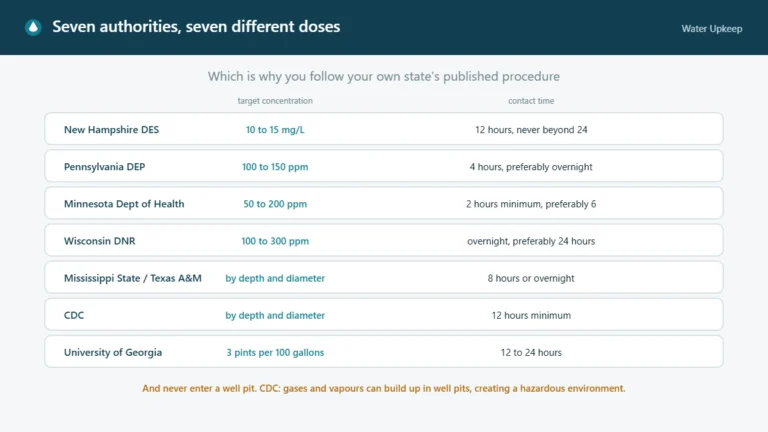
We publish no dose, concentration or contact time here. If disinfection is genuinely indicated — after a repair, after a flood, after a positive test — that is how to shock a well, and in several states it is contractor work regardless.
Recurring iron bacteria is a diagnosed problem
Michigan EGLE is candid about the outlook: with iron bacteria, “well owners should try to control rather than completely ‘cure’ the problem.” It also notes something that catches people out: “A special water analysis is needed to confirm the presence of iron bacteria. A standard water test for detecting coliform bacteria is not sufficient.” Wisconsin DNR lists the consequences — odors, corrosion of plumbing equipment, reduction of well yields, and increased infestations of other bacteria.
That is a treatment decision rather than a maintenance item, and it belongs in how to remove iron from well water. A rotten-egg smell is a different diagnosis again — see why your water smells like rotten eggs.
Treatment equipment has its own schedule
If you have a softener, a whole-house filter, a UV system or an RO unit, none of them is on the well’s schedule and none of them should be folded into it. Those are softener maintenance, whole-house filter changes, and the rest of our maintenance and repair hub. If your annual test opens a treatment question for the first time, well water filtration systems takes it test-first.
When to call a professional
The sources disagree about how often, and it is a real disagreement
NGWA: “At a minimum, wells should be evaluated annually by a licensed or certified water well systems professional.” Its annual checkup contains “a flow test, visual inspection, a water quality test for coliform and anaerobic bacteria, nitrates, and anything else of local concern, checking valves, electrical testing.”
Michigan EGLE: “Have a registered well driller inspect the well system every 10 years or as needed” — with homeowner visual checks several times a year in between. Penn State takes the same shape: professional inspection every ten years, homeowner inspection annually.
Annually versus every ten years is not a rounding difference. These are two different models of the same task — one where a professional carries the whole job, one where the homeowner carries the routine and the professional is called at intervals and on symptoms. Both are published by credible bodies and we are not merging them into “have it inspected every X years.” Which model suits you depends on your well’s age, its history, and whether anything has been going wrong.
What they are called depends on your state
There is no national title, and searching for the wrong one wastes a morning. Michigan: registered well driller. Minnesota: licensed well contractor. Wisconsin: Licensed Well Driller or Pump Installer. Illinois: well and pump contractor. CDC uses well water contractor. NGWA uses licensed or certified water well systems professional. Your state well program publishes the list of who holds the credential locally.
The triggers
- Any physical defect found at the wellhead. Michigan EGLE: “If you find problems, contact a registered well driller.”
- Cleaning or disinfection of any kind. NGWA restricts it to a qualified professional; Michigan routes it to a registered well driller.
- Disinfection after construction, repair or pump work. Illinois puts that responsibility on the well and pump contractor.
- Loss of yield or performance. Penn State: a professional water well contractor, “preferably with a downhole camera.”
- A wellhead below grade, in a pit or vault. Report; do not enter.
- Anything electrical beyond looking.
- Sealing an unused well. See below.
Losing capacity: Penn State’s 25%
Penn State publishes the one hard number in this whole subject: “Generally, a decrease of 25% or more in well yield indicates that rehabilitation is in order.” The measure behind it is specific capacity, which Penn State defines as “the pumping rate (gallons per minute) divided by the drawdown.”
Read the definition and you can see why measuring it is not a homeowner job: it requires a controlled pumping rate and a measured drawdown in the well. NGWA puts the flow test inside the professional’s annual checkup for the same reason. What a homeowner notices is the symptom — pressure falling off, the pump running longer, running out during a shower — and that observation is what triggers the call. Penn State also names corrosion of metal casing as a factor that limits a well’s life, and publishes no figure for how long that takes; nor does anyone else we opened.
Retiring an unused well
An old well left on a property is an open path from the surface into the aquifer, and it is an obligation rather than an option. CDC: “If you are no longer using your well, you must retire it by filling and properly sealing it,” and to do that, “Look for a well water systems contractor with the expertise and equipment to properly plug and seal the well you want to retire.” Minnesota is blunter: “Only a licensed well contractor can legally seal wells.”
We are naming the obligation and describing no method, because in at least one state doing it yourself is not lawful and everywhere else it is work that has to be done right the first time. Capping it is not sealing it.
Frequently asked questions
How often should I test my well water?
Annually is the broad answer — CDC, EPA, Michigan EGLE, Penn State, Minnesota DOH, Illinois DPH and Texas A&M all say every year, with Colorado State the outlier at every one to two years for coliform. The disagreement is not about the interval, it is about the panel. Bacteria and nitrate appear on every list; TDS and pH appear on CDC’s and EPA’s annually and Penn State’s every three years; arsenic, copper and lead appear on Michigan’s three-to-five-year cycle and Minnesota’s “at least once.” Take the four-item federal floor and ask your health department what to add.
Do I need to shock-chlorinate my well every year?
No source we opened recommends it. Disinfection is tied to events in every document: after construction, after a repair or anything that opens the well, after a flood, after a positive test, or as a control measure for a diagnosed iron-bacteria problem. NGWA restricts cleaning and disinfection to a qualified professional outright. If you have a reason to disinfect, that is how to shock a well.
How far does my well have to be from my septic tank?
We are not giving you a number, and the reason is in the table above: Minnesota’s rules require 50 feet and Wisconsin’s require 25 for the same component. CDC and Texas A&M recommend 50; Wisconsin’s code sets a different distance again for the dispersal field than for the tank. In several states these are legally enforceable requirements that govern what you build near an existing well. Call your state well program or county health department before you site anything.
Can I take the cap off to look inside?
No source we opened tells a homeowner to do that, and one supplies a reason not to: Illinois DPH says a well should be disinfected “each time it is opened for maintenance or repair.” Opening a well creates an obligation. Inspect the cap — securely attached, no cracks or openings, sealing against insects and rodents — and if something is wrong with it, that is a call to a contractor.
My wellhead is in a pit in the yard. What do I do?
Report it, and do not go in. New York DOH names a wellhead “positioned below ground in flood-prone frost pits” among the defects associated with coliform contamination, and no source we opened sanctions a homeowner entering a pit or vault. Contact a licensed well contractor and your local health department. This is one of the few situations in home maintenance where the correct action is entirely a phone call.
How do I know if my well is losing capacity?
You notice the symptoms; a professional measures the number. Penn State’s threshold is “a decrease of 25% or more in well yield,” measured as specific capacity — pumping rate divided by drawdown — which needs a controlled test. What you notice is pressure dropping, the pump running longer or more often, or running short during heavy use. That observation is the trigger for the call, not the measurement.
What records should I keep?
Three sources name three different sets, so keep the union: the well log and well record (location, depth, pumping rate, completion date, pump specifications — Michigan EGLE and NGWA), records of maintenance such as disinfection or sediment removal (EPA), and every water test result with its date. NGWA’s practical note is the one to act on first: ask your well contractor to provide the records if you do not have them.
I stopped using an old well on the property. Can I just cap it?
No. CDC: “If you are no longer using your well, you must retire it by filling and properly sealing it,” and it routes that work to a contractor with the right equipment. In Minnesota, “Only a licensed well contractor can legally seal wells.” Capping is not sealing, and an unsealed disused well is a direct route from the surface to the aquifer that serves your active one.
Sources and Standards
- US Environmental Protection Agency — Private Drinking Water Wells, Protect Your Home’s Water, and Learn About Private Water Wells
- Centers for Disease Control and Prevention — Guidelines for Testing Well Water and Well Water Safety
- US Geological Survey — Domestic (Private) Supply Wells
- National Ground Water Association — Well Owner Routine Maintenance Practices (the annual checkup contents, and the restriction of cleaning and disinfection to a qualified professional)
- Michigan Department of Environment, Great Lakes, and Energy — Drinking Water Well Maintenance for Well Owners and Iron Bacteria in Wells
- Penn State Extension — Water Well Maintenance and Rehabilitation, updated 29 May 2025 (the 25% yield threshold and specific capacity)
- Minnesota Department of Health — Well Testing, Results, and Options, Owner’s Guide to Wells, Well Disinfection, and Well Isolation Distances
- Wisconsin Department of Natural Resources — Well Location and Separation Distances (PUB-DG-102) and Iron Bacteria in Well Water (PUB-DG-004)
- New York State Department of Health — Coliform Bacteria in Drinking Water Supplies (defective-well causes and the seasonal testing note)
- Illinois Department of Public Health — Sampling for Coliform and Nitrate
- Texas A&M AgriLife Extension, Texas Well Owner Network — Water Well Basics and the Guide to Water Supply
- Colorado State University Extension — Bacteria in Water Wells
- Virginia Cooperative Extension — Publication 442-656 (owner responsibility for system maintenance)
Test panels, inspection cadences and setback distances differ by publisher and by state, and this page reports each one with the body that publishes it rather than merging them. Where a distance is law in your state, the state’s rule governs. Water Upkeep does not inspect wells, does not test water, and does not perform or recommend contractor work.
Last reviewed September 8, 2026.