How Does a Well Work?
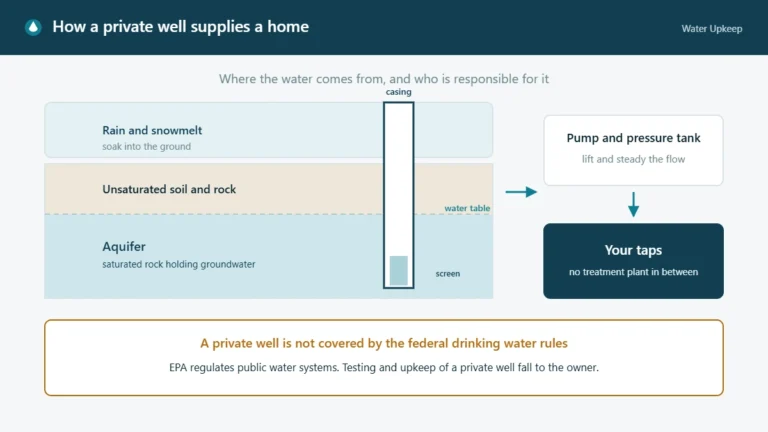
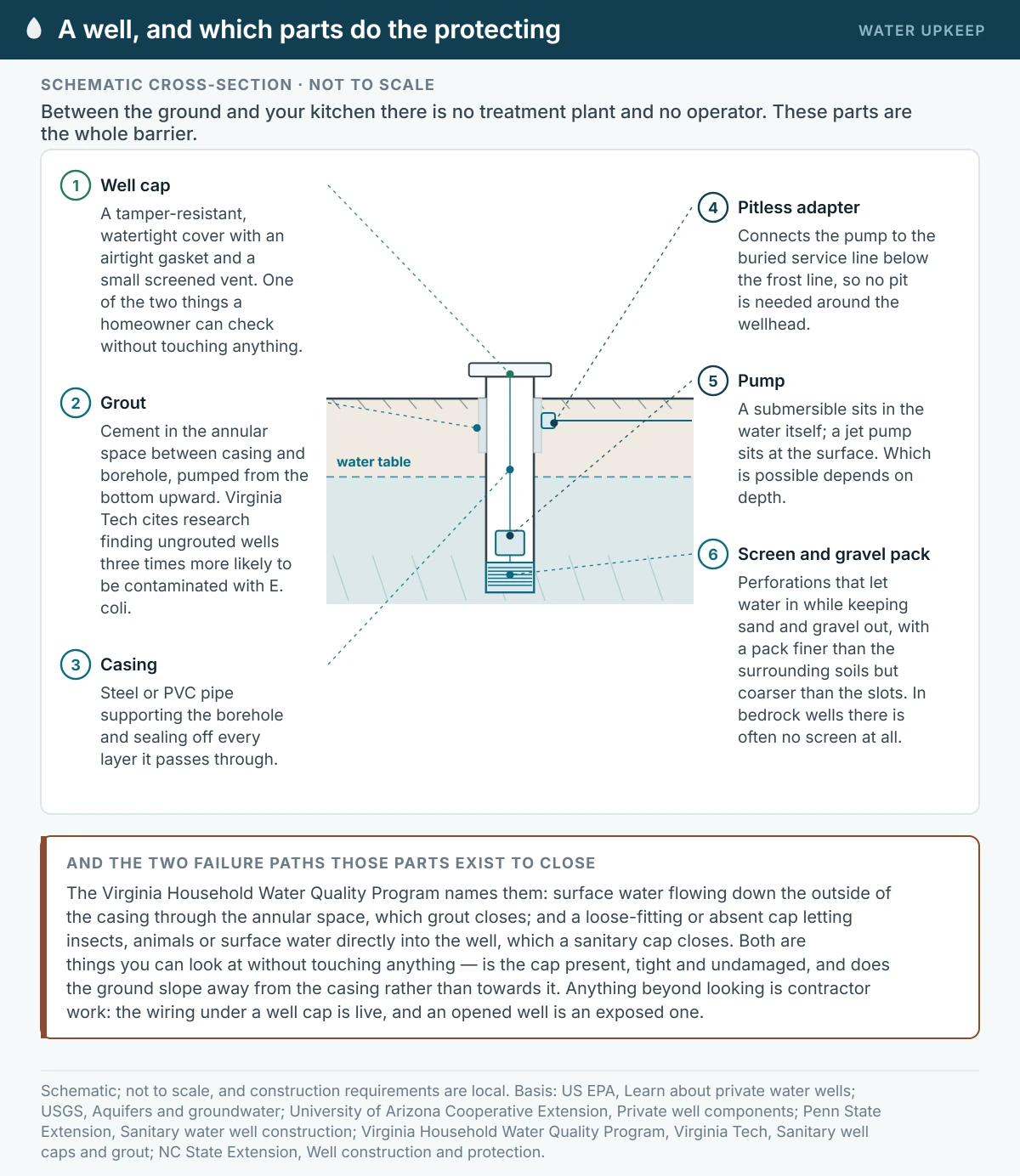
A well is a hole that reaches below the water table, lined to keep everything except groundwater out of it, with a pump that lifts water into a pressurised tank so your taps have pressure when the pump is not running. That is the whole system in one sentence. The detail that matters to a homeowner is which of those parts is doing the protecting, because a well draws from an aquifer with nothing between the ground and your kitchen — no treatment plant, no operator, no monitoring. The casing, the cap and the grout are the whole barrier.
Where the water is before it is yours
Rain and snowmelt soak into the ground and percolate down through the unsaturated zone — the layer where pores and cracks in the soil and rock hold both air and water. Below a certain depth every void is completely filled. The US Geological Survey calls the upper surface of that water-filled area the water table, and the saturated ground beneath it is the aquifer.
The water table is not a fixed line. USGS notes it fluctuates seasonally and from year to year in response to changes in recharge from precipitation. Ohio’s Department of Natural Resources puts the rhythm plainly: the level is highest in spring, at the end of the recharge season, and lowest in late autumn at the end of the growing season.
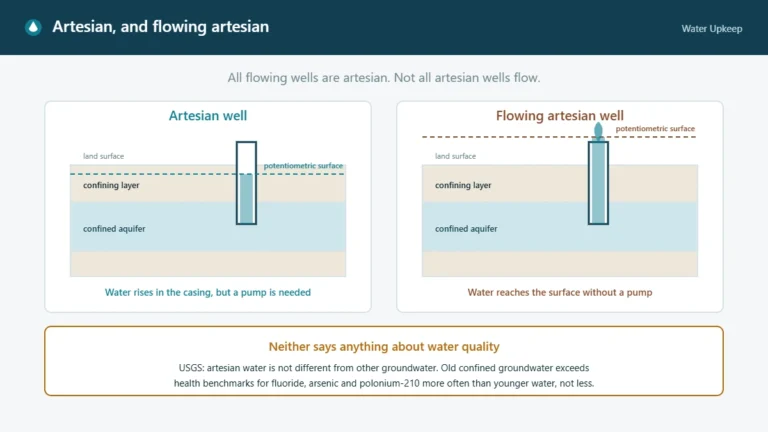
Aquifers come in two kinds, and which one you are drawing from changes how your well behaves. An unconfined or water table aquifer has its upper surface at atmospheric pressure and rises and falls freely; it is usually closer to the surface, and USGS notes such aquifers are affected by drought sooner. A confined aquifer has impermeable layers above and below, so it is under pressure — penetrate it with a well and the water rises above the top of the aquifer.
The parts, and what each one is for
| Component | What it does |
|---|---|
| Casing | Steel or PVC pipe installed in the borehole to support the sides and seal off the layers it passes through |
| Well cap | Tamper-resistant, watertight cover on the top of the casing |
| Grout | Cement placed in the space between casing and borehole to stop contaminants entering from the land surface |
| Screen | Perforations that let water in while keeping sand and gravel out |
| Gravel pack | Sand or gravel around the screen, finer than surrounding soils but coarser than the screen slots |
| Pitless adapter | Connects the pump to the service line below the frost line |
| Drop pipe | The pipe water travels up to the surface |
| Check valve | Stops water flowing back down into the well |
| Pressure tank | Stores water and delivers it under pressure between pump cycles |
Why there is no one well diagram
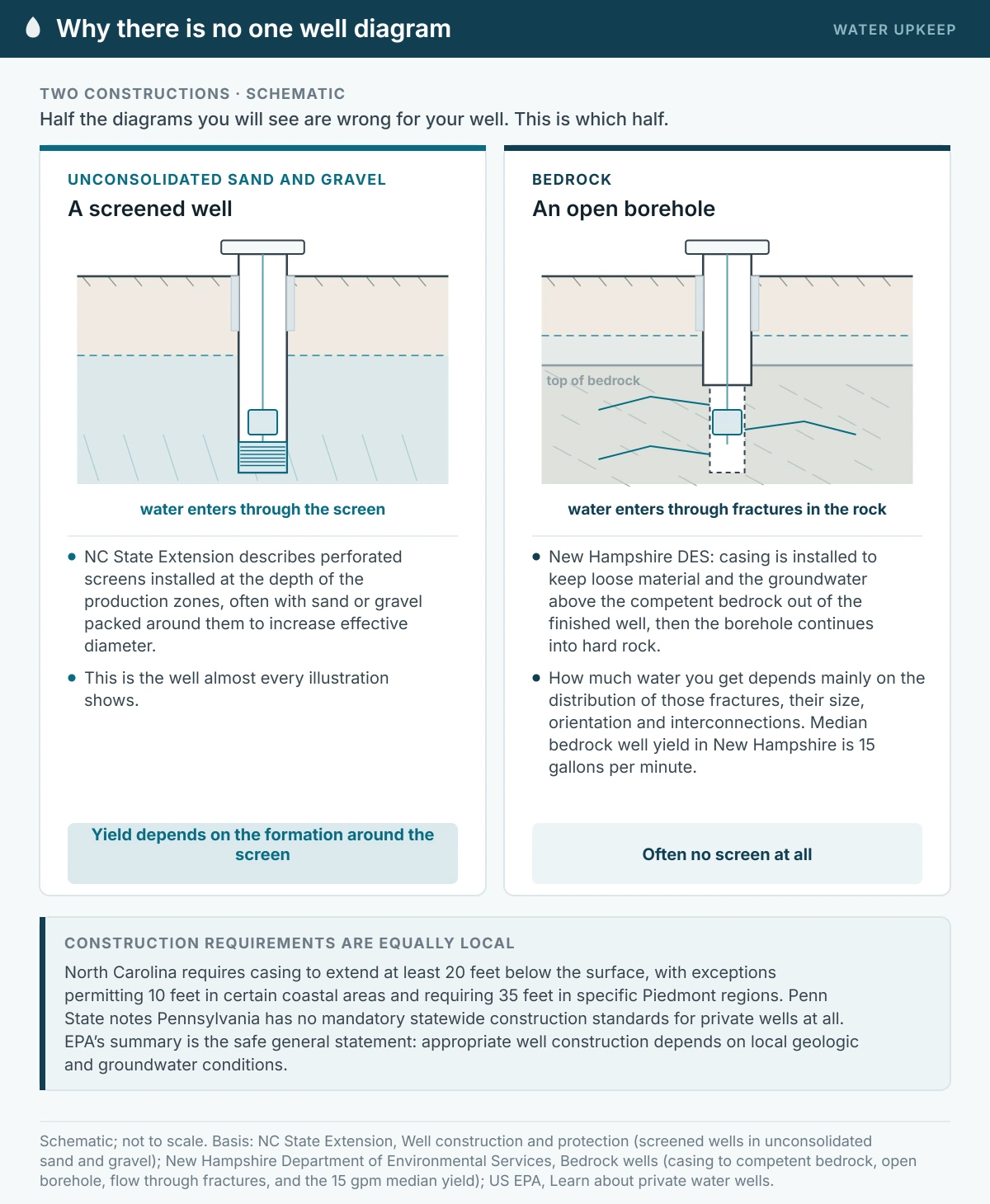
Half the diagrams you will see are wrong for your well, and it is worth knowing which half.
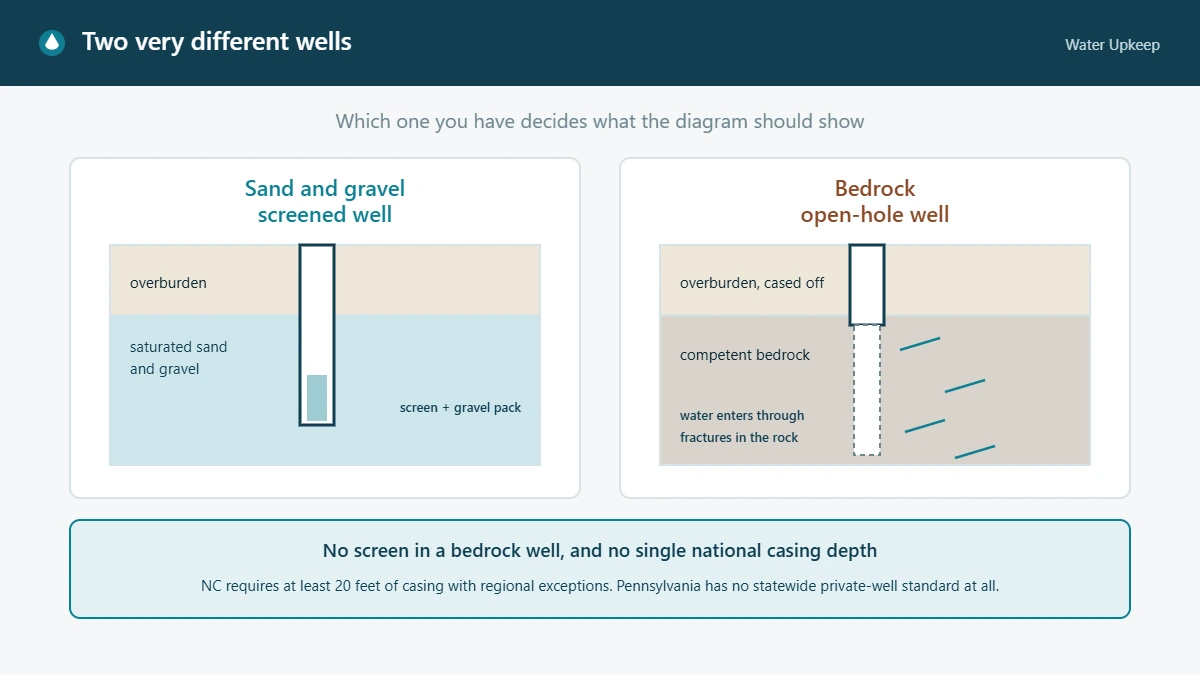
Where the water-bearing formation is unconsolidated sand and gravel, NC State Extension describes perforated screens installed at the depth of the production zones, often with sand or gravel packed around them to increase effective diameter. That is the well most illustrations show.
Where the formation is bedrock, there is often no screen at all. New Hampshire’s Department of Environmental Services describes it: casing is installed to keep the loose material and groundwater above the competent bedrock out of the finished well, then the borehole continues into hard rock, and water flows through fractures in the rock into the open borehole. How much water you get depends mainly on the distribution of those fractures, their size, orientation and interconnections. Median bedrock well yield in New Hampshire is 15 gallons per minute.
Construction requirements are equally local. NC requires casing to extend at least 20 feet below the surface, with exceptions permitting 10 feet in certain coastal areas and requiring 35 feet in specific Piedmont regions. Penn State notes that Pennsylvania has no mandatory statewide construction standards for private wells at all. EPA’s summary is the safe general statement: appropriate well construction depends on local geologic and groundwater conditions.
The three broad types differ mainly in depth and therefore in exposure. EPA puts dug and bored wells at roughly 10 to 30 feet, driven wells at roughly 30 to 50 feet, and drilled wells at potentially thousands. Driven wells can be contaminated easily because they draw from aquifers near the surface, while drilled wells have lower contamination risk thanks to depth and continuous casing. Our guide to what well water is covers those types and the regulatory picture in more detail.
How the pump and pressure tank work together
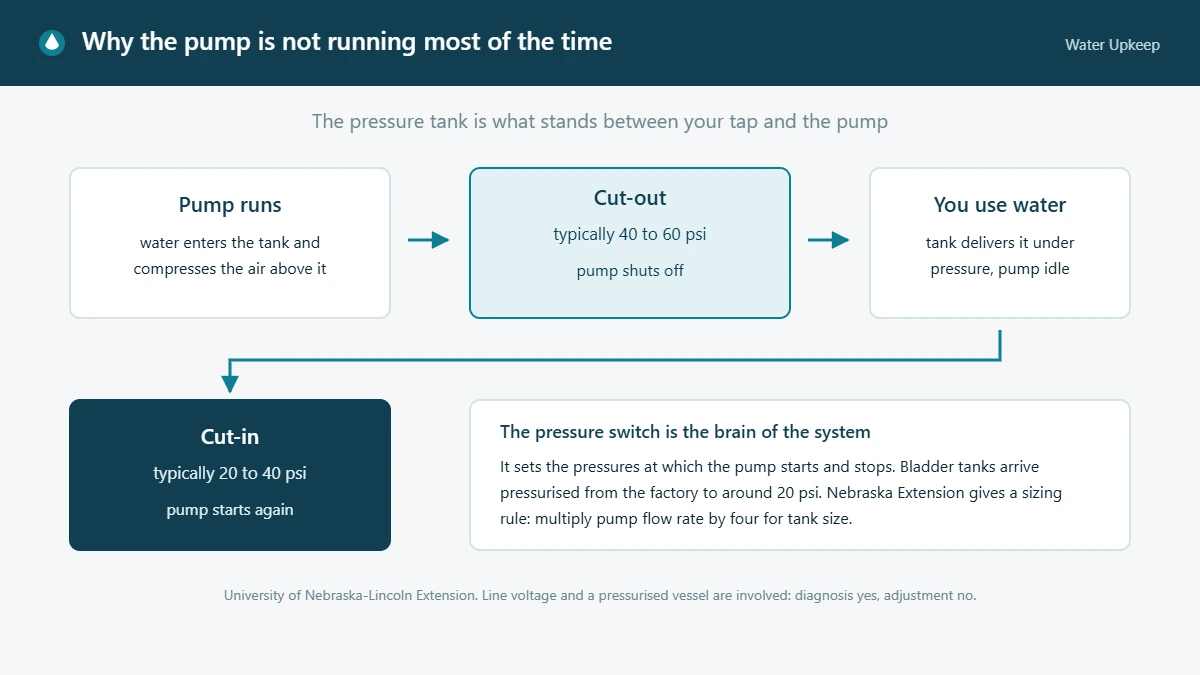
The pressure tank is what stops the pump running every time someone washes their hands. University of Nebraska–Lincoln Extension explains the cycle: when water is pumped into a tank containing air, the air compresses and puts the water under pressure. When pressure reaches a preset level — typically 40 to 60 psi — the pump shuts off automatically. As water is used, pressure falls, and at a preset lower level — typically 20 to 40 psi — the pump starts again. The pressure switch, usually at or near the tank, is what UNL calls the brain of the system: it determines the pressures at which the pump starts and stops. Bladder tanks arrive pressurised from the factory to around 20 psi.
UNL also gives a sizing rule that is easier to remember than most: multiply the pump’s flow rate by four to get the tank size. A 9-gallon-per-minute pump calls for a 36-gallon diaphragm or bladder tank.
The pitless adapter matters more than its name suggests. It is a fitting that attaches to the casing below ground and discharges water to the house through a buried pipe, which keeps the connection below the frost line without needing a pit around the wellhead.
Why the pump type depends on the depth
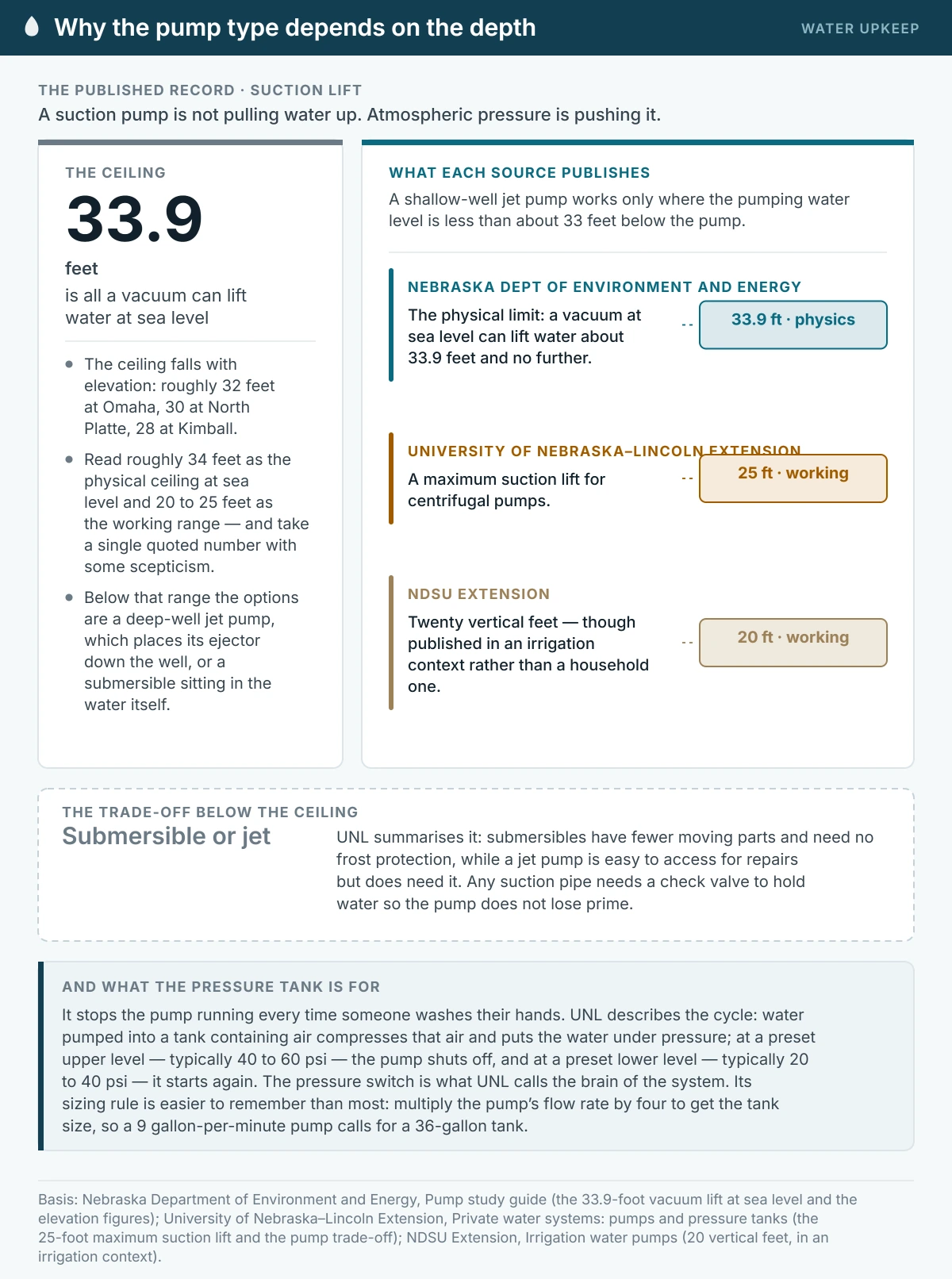
A suction pump cannot pull water up indefinitely, because it is not really pulling — atmospheric pressure is pushing. Nebraska’s Department of Environment and Energy sets out the physics: a vacuum at sea level can lift water about 33.9 feet and no further. A shallow-well jet pump therefore only works where the pumping water level is less than about 33 feet below the pump. That ceiling falls with elevation — roughly 32 feet at Omaha, 30 at North Platte, 28 at Kimball.
Practical working limits are stated lower. UNL gives a maximum suction lift of 25 feet for centrifugal pumps; NDSU gives 20 vertical feet, though in an irrigation context. Read roughly 34 feet as the physical ceiling at sea level and 20 to 25 feet as the working range, and take a single quoted number with some scepticism.
Below that, the options are a deep-well jet pump, which places its ejector down the well, or a submersible sitting in the water itself. UNL summarises the trade-off: submersibles have fewer moving parts and need no frost protection, while a jet pump is easy to access for repairs but does need it. Any suction pipe needs a check valve to hold water so the pump does not lose prime.
Static level, drawdown and yield
Three terms appear on well records and in contractors’ quotes, and they are worth being able to read.
- Static water level — the level at which water stabilises in the well with no outside force acting on it.
- Drawdown — the difference in feet between the pre-pumping static level and the final pumping level measured at the end of the well test.
- Well yield — the maximum rate in gallons per minute the well can be pumped without lowering the water level below the pump intake.
Pumping creates what Ohio DNR describes as a three-dimensional cone surrounding the well — the cone of depression — representing the volume of water removed. USGS notes that if water is withdrawn faster than it is replenished, the water table can be lowered and wells can go dry.
“Going dry” is more specific than it sounds. USGS defines it as water levels dropping below the pump intake, which depends on well depth, whether the aquifer is confined, how much pumping happens and how much recharge occurs. Wells screened in unconfined aquifers are more directly influenced by lack of rain than deeper confined ones, and a dry well may recover as recharge increases. Penn State notes the depth of water in a well may vary dramatically between wet and dry periods, and New Hampshire gives a useful scale for what is stored in the casing itself: a typical six-inch casing holds about 1.5 gallons per foot of water depth above the pump.
What keeps surface water out
The Virginia Household Water Quality Program names the two failure paths: surface water flowing down the outside of the casing through the annular space, and a loose-fitting or absent cap letting insects, animals or surface water directly into the well.
Grout closes the first. Penn State describes it as usually neat cement with no aggregate, pumped into the annular space between the drilled hole and the casing using a tremie pipe, filling from the bottom upward. Virginia Tech cites research finding ungrouted wells three times more likely to be contaminated with E. coli than grouted ones.
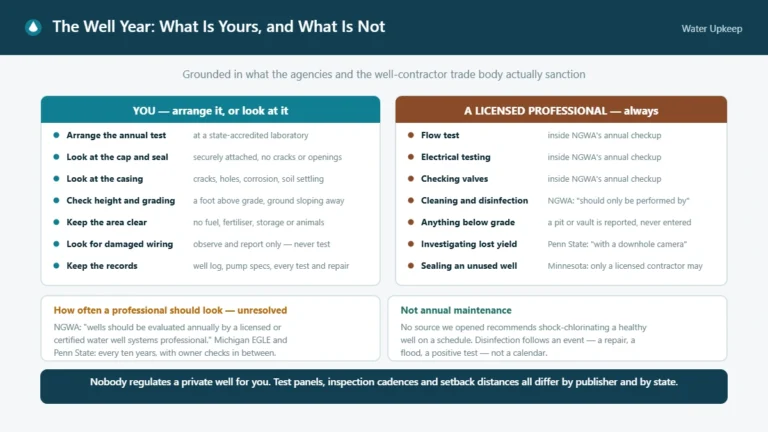
A sanitary well cap closes the second. It includes an airtight rubber gasket seal and a small screened vent for air exchange, with bolts running vertically from the top. Both are things you can look at without touching anything: is the cap present, tight and undamaged, and does the ground slope away from the casing rather than towards it. Anything beyond inspection is contractor work — the wiring under a well cap is live, and an opened well is an exposed one.
Setback distances: guidance and code
CDC publishes general minimum distances: at least 50 feet from septic tanks, septic leach fields and livestock yards; 100 feet from petroleum tanks, liquid-tight manure storage, and where fertiliser is stored or handled; 250 feet from manure stacks. CDC also tells owners to contact their local water quality or environmental protection department to learn what is required in their area, which is the important part.
State codes are what actually govern, and they differ. Michigan matches CDC at 50 feet for a septic tank and drainfield, but adds that these are minimums and that the regulatory agency may increase them based on geology, groundwater flow direction, well construction or contaminant type — and may grant deviations case by case. Minnesota requires 50 feet from a septic tank but 75 feet from a cesspool, seepage pit or dry well, 150 feet for medical facility systems and 300 feet for soil dispersal systems above 10,000 gallons a day, with minimums doubled for wells classified as sensitive. Penn State separately recommends a 100-foot wellhead protection area.
Treat CDC’s numbers as the floor of a conversation with your county, not the answer.
Nobody is testing it for you
CDC states the position directly: the federal Safe Drinking Water Act focuses on public water systems and does not cover private drinking water sources, EPA’s rules for public systems do not apply to privately owned wells, and government officials do not regulate, treat or monitor tap water from private wells. About one in eight American residents get their drinking water from a private well.
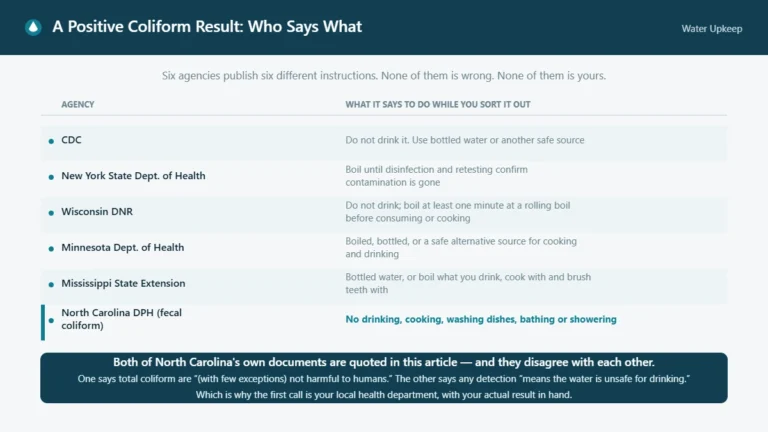
CDC’s baseline recommendation is to test at least once a year for total coliform bacteria, nitrates, total dissolved solids and pH. If your water has changed in taste, smell or appearance, that is a reason to test sooner — a rotten-egg odour, for instance, can point at several different causes, which we cover in why water smells like rotten eggs.
When to call a professional
- Pressure is low, fluctuating, or the pump cycles rapidly. Pressure switches carry line voltage and pressure tanks are pressurised vessels; diagnosis is fine, adjustment is not a homeowner job.
- The well cap is loose, damaged or missing, or the ground has settled so water pools around the casing.
- Yield has dropped, or the well runs out during normal use.
- You are buying a property with a well and have not seen the well record showing static level, drawdown and yield.
- Any work requiring the well to be opened, or entry into a well pit or other enclosed space.
More on owning and maintaining a private supply in our well water hub.
Sources and standards
- US Geological Survey — Aquifers and groundwater, Confined and unconfined aquifers, What determines if a well will go dry and Circular 1186
- Centers for Disease Control and Prevention — Private water and public health, Guidelines for testing well water and Well water safety
- US Environmental Protection Agency — Learn about private water wells
- University of Nebraska–Lincoln Extension — Private water systems: pumps and pressure tanks
- Nebraska Department of Environment and Energy — Pump study guide
- Ohio Department of Natural Resources — Fact sheet 01-62, water wells
- University of Arizona Cooperative Extension — Private well components
- Penn State Extension — Sanitary water well construction and Using low-yielding wells
- Virginia Household Water Quality Program, Virginia Tech — Sanitary well caps and grout
- NC State Extension — Well construction and protection
- New Hampshire Department of Environmental Services — Bedrock wells
- Michigan Department of Environment, Great Lakes and Energy — Minimum well isolation distances
- Minnesota Office of the Revisor of Statutes — Minnesota Rules 4725.4450
- North Dakota State University Extension — Irrigation water pumps
Last reviewed September 8, 2026.