A Positive Coliform Test on Your Well
Two things matter first, and they are not the same thing. A total coliform positive and an E. coli positive mean different things and carry different urgency. And the agencies that publish guidance on this — six state and extension services plus EPA and CDC — do not agree with each other about what your result means, whether to stop drinking immediately, or what to do first. Some of them do not even agree with themselves.
What almost every page on this subject gets wrong is the order. Disinfecting the well is one branch of the decision, not the destination. Four of the sources below send a positive result to a confirmation retest first, and three send it to a well-construction investigation — because shock chlorinating a well with a cracked casing fixes nothing.
Before anything else: contact your local health department. Every federal source says so, and they are the body that knows your area, your geology and your reporting requirements. Nothing on this page substitutes for that call.
Why nobody is going to tell you the answer
EPA is direct about the regulatory position: “the quality and safety of drinking water from private domestic wells are not regulated by the Federal Government under the Safe Drinking Water Act nor by most state governments and laws,” and “private well owners are responsible for delivering safe drinking water to their households.” CDC puts it in the second person: “as a water well owner, you are responsible for testing your well to make sure the water is safe to drink.” USGS notes that more than 43 million people — about 15 percent of the US population — rely on private wells.
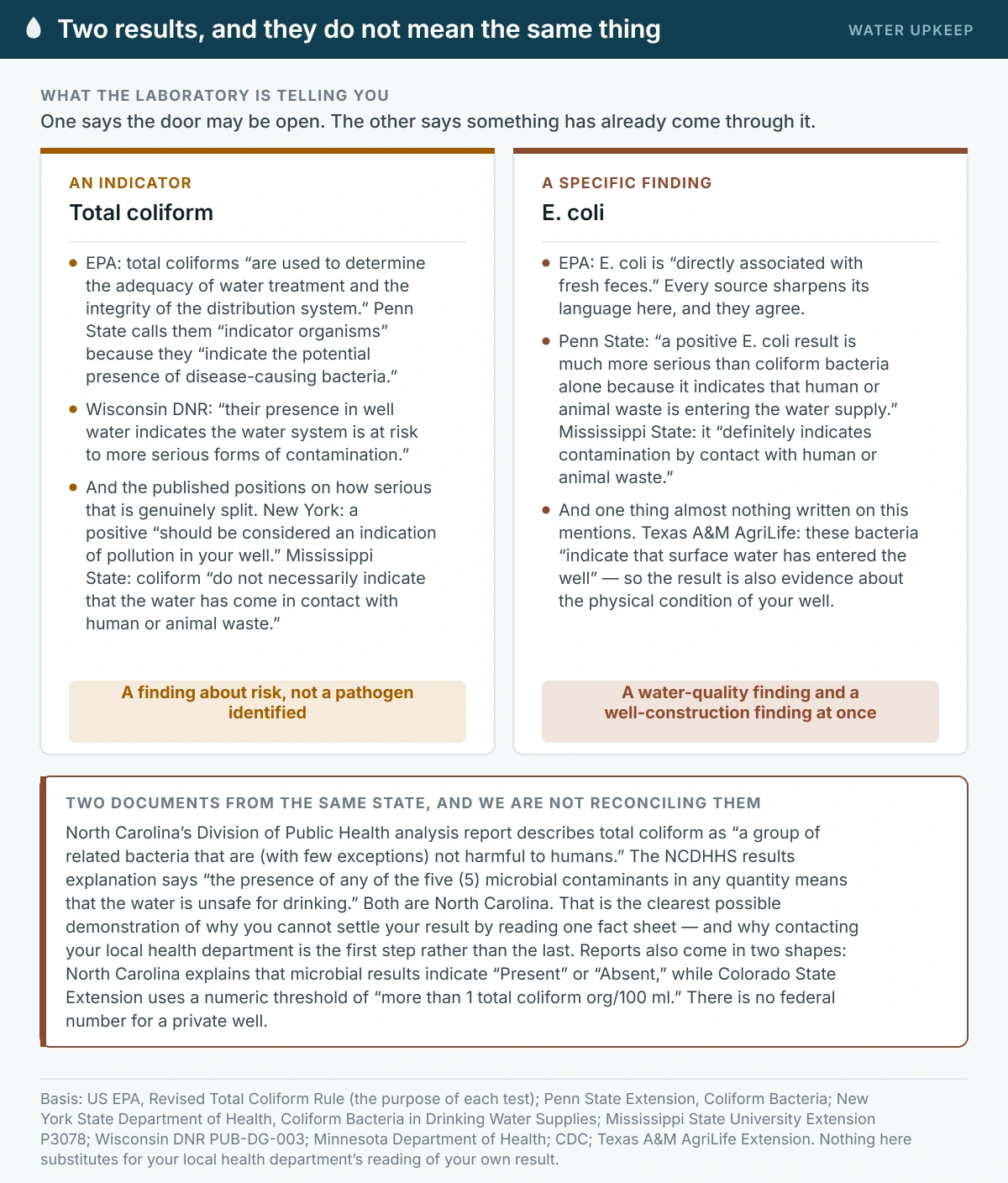
You may find the federal Revised Total Coliform Rule while searching. It does not apply to your well. EPA’s own scope statement is that “all public water systems… must comply with the RTCR” — private wells are not public water systems. There is no MCL for your well, no violation, and no notification requirement. What the rule is useful for is EPA’s clearest statement of what these tests are for: total coliforms “are used to determine the adequacy of water treatment and the integrity of the distribution system,” while E. coli is “directly associated with fresh feces.”
What your result actually says
Total coliform is an indicator, not a pathogen
Six sources agree on that much. Penn State: coliform bacteria “are often referred to as ‘indicator organisms’ because they indicate the potential presence of disease-causing bacteria in water.” New York’s health department: “total coliform counts give a general indication of the sanitary condition of a water supply.” Illinois: a positive “indicates that the well sample may have been contaminated by surface water or fecal material.” Wisconsin DNR: “their presence in well water indicates the water system is at risk to more serious forms of contamination.” Minnesota: a positive “can indicate that surface contamination has gotten into the water and that disease-causing microorganisms may be present.” CDC: “if the total coliform count is high in your water, it is likely that harmful germs… are also in your water.”
But on how seriously to take it, they split — and this is the honest core of the article.
| Source | What it publishes |
|---|---|
| New York State Department of Health | “A positive total coliform sample should be considered an indication of pollution in your well.” |
| Mississippi State University Extension, P3078 | “Coliform bacteria are common and do not necessarily indicate that the water has come in contact with human or animal waste.” |
| North Carolina Division of Public Health (analysis report) | “Total Coliform are a group of related bacteria that are (with few exceptions) not harmful to humans.” |
| NCDHHS Office of Epidemiology (results explanation) | “The presence of any of the five (5) microbial contaminants in any quantity means that the water is unsafe for drinking.” |
Look at the last two rows. Both are North Carolina. One says total coliform are largely not harmful to humans; the other says any detection means the water is unsafe for drinking. We are not going to reconcile those, because they are not ours to reconcile — but they are the clearest possible demonstration of why you cannot settle your result by reading one fact sheet, and why the call to your local health department is the first step rather than the last.
E. coli is a different result
Every source sharpens its language here, and they agree.
- Penn State: “a positive E. coli result is much more serious than coliform bacteria alone because it indicates that human or animal waste is entering the water supply.”
- New York DOH: E. coli “is considered to be the species of coliform bacteria that is the best indicator of fecal pollution and the possible presence of pathogens,” and positive fecal coliform results “should be considered indication of fecal pollution in your well.”
- Mississippi State: “the presence of fecal coliform or E. coli in water definitely indicates contamination by contact with human or animal waste.”
- Wisconsin DNR: E. coli “indicates fecal contamination of the water.”
- CDC: a positive for fecal coliforms or E. coli “likely means that poop… [has] gotten into your well water.”
There is a second thing an E. coli result tells you, and almost nothing written on this mentions it. Texas A&M AgriLife Extension: “testing the well water for fecal coliform or E. coli bacteria is one way to determine if there are subsurface cracks as the presence of these bacteria indicate that surface water has entered the well.” The result is not only a water-quality finding. It is evidence about the physical condition of your well.
Present/absent, or a count?
Reports come in two shapes and it matters which you are holding. North Carolina’s guidance explains the first: “for microbial contaminants like coliform bacteria… the results will indicate whether the analyte is ‘Present’ or ‘Absent’.” Colorado State Extension’s guidance assumes the second, using a numeric threshold of “more than 1 total coliform org/100 ml.” New York’s coliform page publishes no numeric threshold at all.
There is no federal number for a private well. Colorado State’s figure is one extension service’s threshold and should not be read as a national limit.
Should you stop drinking the water?
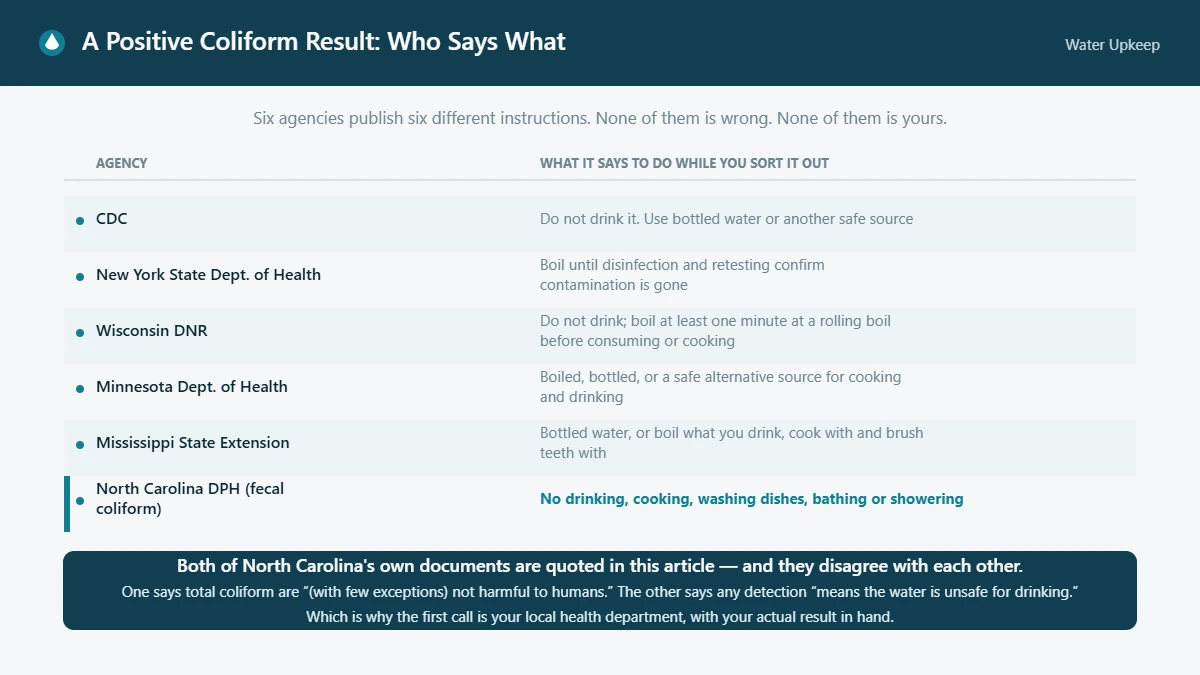
This is the question people actually have at 9pm holding the result, and here is every published answer, attributed.
| Source | What it says to do |
|---|---|
| CDC | “If your well is contaminated with harmful germs or chemicals, or you suspect it is, do not drink your well water. Instead, drink and use bottled water or water from another safe source.” |
| New York DOH | “Boiling the water is advised until disinfection and retesting can confirm that contamination has been eliminated.” |
| Wisconsin DNR | “You should not drink the water”; it “should not be consumed or used for preparation of food unless it is first boiled for at least one minute, at a rolling boil.” |
| Minnesota DOH | “Use boiled or bottled water or water from a safe alternative source for cooking and drinking until you address the issue.” |
| Mississippi State Extension | “Use bottled water for drinking and cooking,” or “boil the water used for drinking, cooking, and brushing your teeth.” |
| North Carolina DPH, on a fecal coliform positive | “Do not use the water for drinking, cooking, washing dishes, bathing or showering.” — the broadest restriction of any source, and the only one naming bathing |
Notice North Carolina’s is a fecal coliform instruction specifically, and notice that North Carolina publishes no boiling instruction at all. The others differ on whether bottled water or boiling is the primary answer. Your health department’s instruction, for your result, is the one to follow.
CDC also names one circumstance for additional caution, and we are quoting it once and handing it straight over: consider treatment if you need to “take extra precautions against diseases spread through water because you or someone you live with has a weakened immune system.” If that describes your household, that is a conversation with a clinician and your health department, not with a website.
If you boil: two thresholds, and one caution
EPA: “bring water to a rolling boil for at least one minute,” and “at altitudes above 5,000 feet (1,000 meters), boil water for three minutes.” CDC: “to kill germs, bring clear water to a rolling boil for 1 minute. At elevations above 6,500 feet, boil for 3 minutes.”
Those are two different altitude thresholds from two federal agencies and we are not going to average them. If you live between 5,000 and 6,500 feet, use the longer boil. Below 5,000 feet both agencies say one minute.
And one caution that no page-1 result surfaces. The same annual panel that produced your coliform result almost certainly produced a nitrate result too. Boiling concentrates nitrate — it does not remove it, and evaporating water leaves more nitrate behind in what remains. It also does not remove lead. If your nitrate result is elevated, boiling for the bacteria makes the nitrate problem worse, and that is a specific thing to raise with your health department rather than something to work out alone.
The order the sources actually recommend
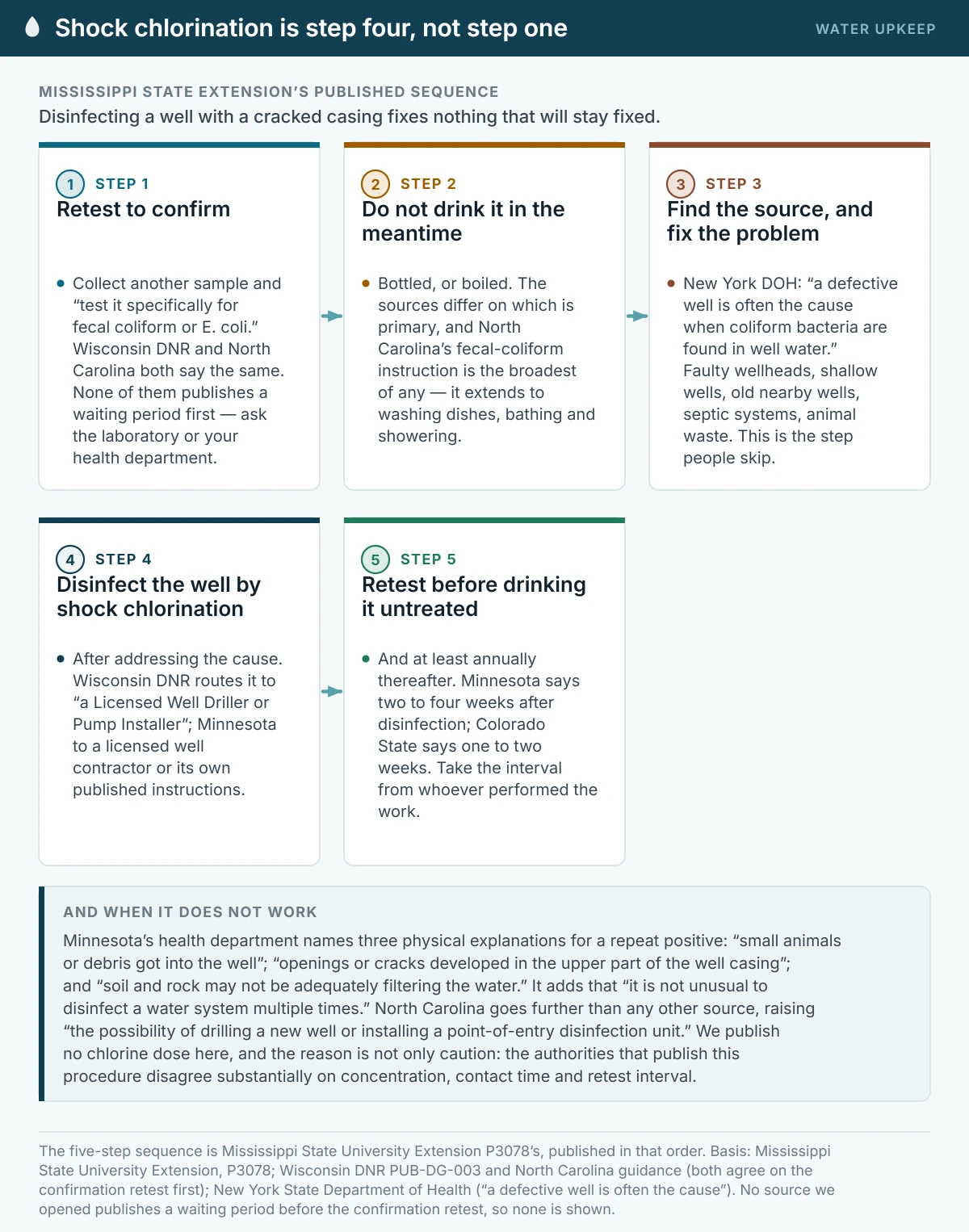
Mississippi State Extension publishes the clearest sequence, and it is worth following because of where disinfection sits in it — fourth.
- Retest to confirm — collect another sample and “test it specifically for fecal coliform or E. coli.”
- Do not drink the water in the meantime — bottled, or boiled.
- Find the source, and fix the problem — faulty wellheads, shallow wells, old nearby wells, septic systems, animal waste.
- Disinfect the well by shock chlorination — after addressing the cause.
- Retest before drinking it untreated, and at least annually thereafter.
Wisconsin DNR agrees on the first step: “first resample your well… to confirm your first ‘at risk’ or ‘unsafe’ result.” North Carolina: “it is recommended that your well water be re-tested to verify that the result is accurate.” None of them publishes a waiting period before that confirmation retest — so we are not inventing one. Ask the laboratory or your health department.
Step 3 is the one people skip
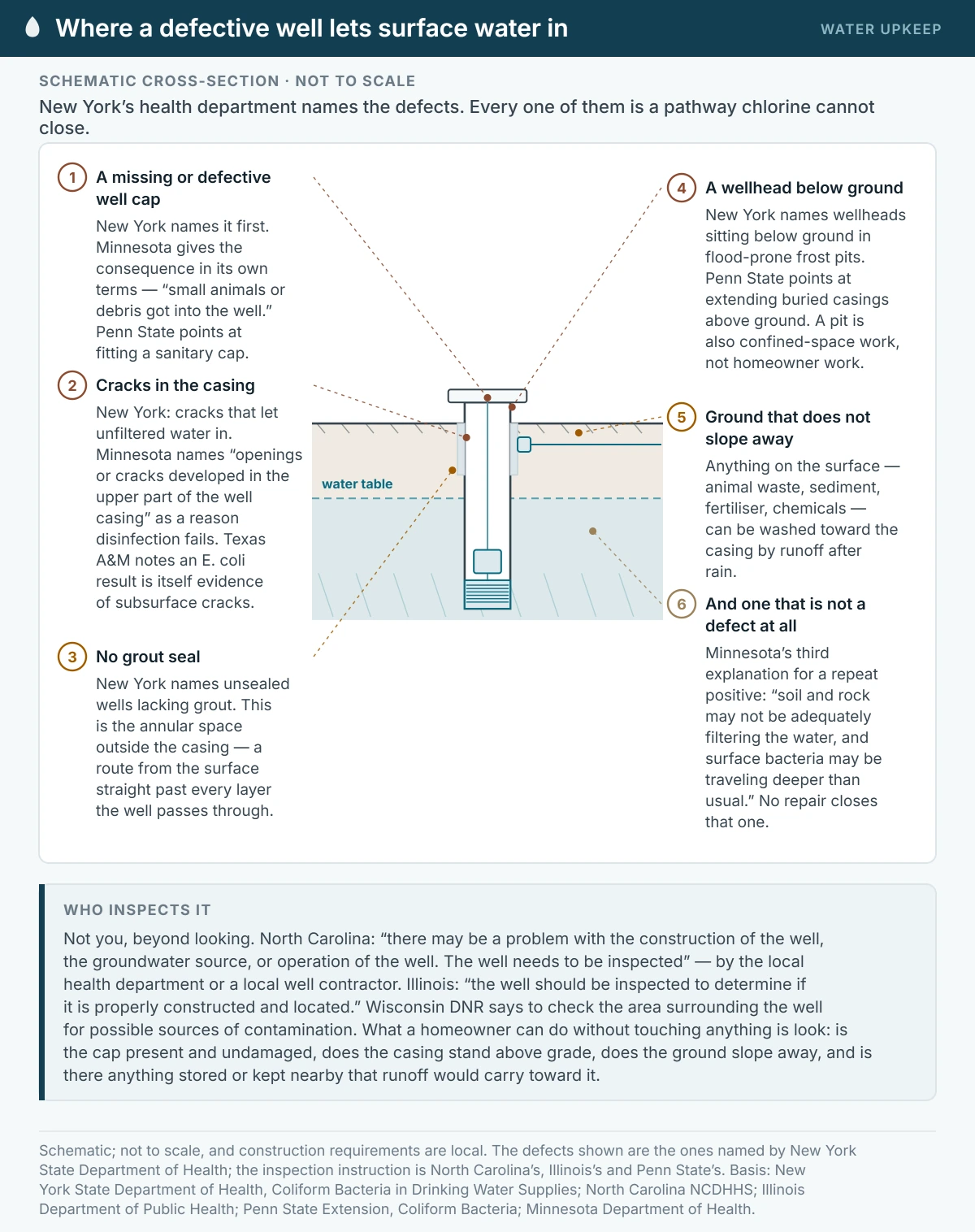
New York’s health department is blunt: “a defective well is often the cause when coliform bacteria are found in well water.” It names the defects: missing or defective well caps; cracks in the casing that let unfiltered water in; unsealed wells lacking grout; and wellheads sitting below ground in flood-prone frost pits.
North Carolina says the same in procedural terms: “there may be a problem with the construction of the well, the groundwater source, or operation of the well. The well needs to be inspected” — by the local health department or a local well contractor. Illinois: “the well should be inspected to determine if it is properly constructed and located.” Penn State points at extending buried casings above ground and fitting sanitary caps, and at septic systems and animal waste nearby. Wisconsin DNR says to “check the area surrounding your well for possible sources of contamination.”
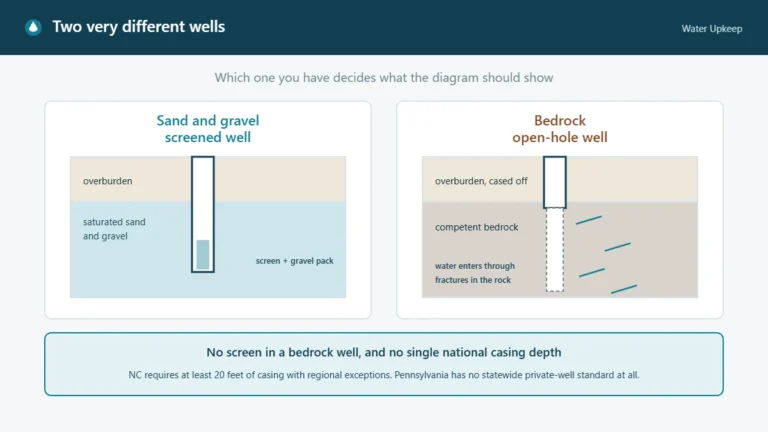
If well anatomy is unfamiliar, how a well works and what well water is cover the cap, casing, grout and screen this section refers to.
Who does the disinfection
Wisconsin DNR: “have your entire system inspected and disinfected by a Licensed Well Driller or Pump Installer.” Minnesota: “contact a licensed well contractor to disinfect your well, or use the instructions on the Well Disinfection webpage.” Illinois notes that after construction or repair, “the well and pump contractor is responsible for disinfecting the well.”
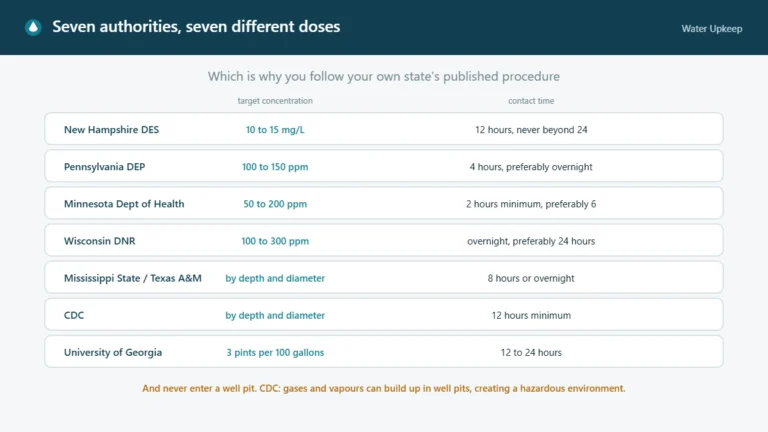
We publish no chlorine dose, concentration or contact time on this page, and there is a reason beyond caution: the authorities that publish shock chlorination procedures disagree substantially with one another on concentration, contact time and retest interval. That procedure, with each source’s figures kept separate, is how to shock a well.
When disinfection does not work
Minnesota’s health department is unusually candid about this, and names three physical explanations for a repeat positive: “small animals or debris got into the well”; “openings or cracks developed in the upper part of the well casing”; and “soil and rock may not be adequately filtering the water, and surface bacteria may be traveling deeper than usual.” It also notes that “it is not unusual to disinfect a water system multiple times to eliminate total coliform if it has been growing in the system for an extended period of time,” and that where attempts fail “the well may need to be cleaned as well as disinfected.”
North Carolina takes it further than any other source: “if the contamination continues, you should investigate the possibility of drilling a new well or installing a point-of-entry disinfection unit which can use chlorine, ultraviolet light, or ozone.” Penn State and New York both name continuous disinfection equipment as the long-term option after shock chlorination attempts.
If continuous UV is where this is heading, the class distinction matters enormously — see UV water disinfection and NSF/ANSI 55, and note that Penn State publishes a ceiling above which it does not recommend UV at all. Whatever equipment you consider, well water filtration systems covers how the pieces fit together, and none of it is a substitute for your health department’s advice on your result.
On the retest interval afterwards
Minnesota says to retest “between two to four weeks after disinfection.” Colorado State says the well “should be disinfected and retested in one to two weeks.” Those are two published intervals that do not agree, and across the wider shock-chlorination literature the spread is considerably larger. Take the interval from whoever performs the disinfection, or from your health department.
How often should you be testing anyway?
There is no single national panel and no single national frequency.
- CDC: “test your well water at least once every year for total coliform bacteria, nitrates, total dissolved solids, and pH level.”
- EPA: the same four, annually.
- Penn State: “all private water supplies (wells, springs, and cisterns) be tested for total coliform bacteria every year.”
- New York DOH: at least once a year, and notes that “late spring or early summer are the best times to test your well, since coliform contamination is most likely to show up during wet weather.”
- Texas A&M AgriLife: annually for nitrate, TDS, and E. coli or fecal coliform — note total coliform is not on Texas’s named panel.
- Colorado State Extension: “every one to two years” — the only source we opened that does not say annually.
EPA also lists “recurring gastro-intestinal illness” among the circumstances that warrant ordering a coliform test. That is a reason to test. It is not a basis for concluding that any illness in your household came from your water — that is a question for a clinician, and only a clinician.
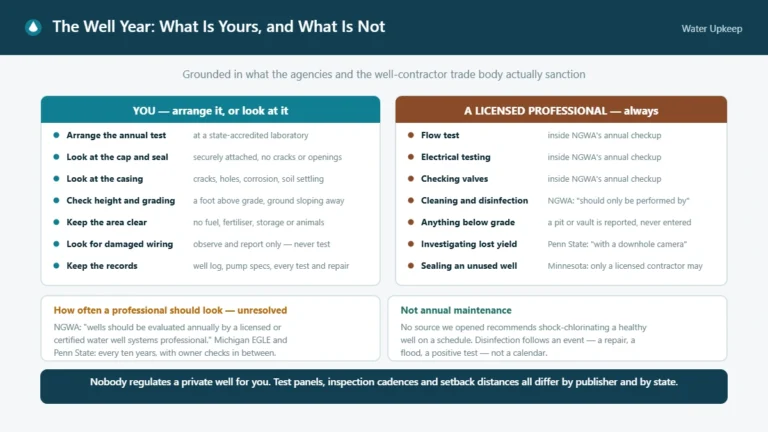
The routine side of this — the annual test, the wellhead checks, the record-keeping that makes a positive result interpretable — is covered in annual well maintenance.
Frequently asked questions
Is total coliform in my well dangerous?
The published positions differ. New York’s health department says a positive “should be considered an indication of pollution in your well.” Mississippi State says coliform “do not necessarily indicate that the water has come in contact with human or animal waste.” North Carolina’s own two documents say both that these bacteria are largely not harmful and that any detection means the water is unsafe to drink. Call your local health department with your actual result.
What is the difference between total coliform and E. coli?
Total coliform is an indicator that surface contamination may have reached your water. E. coli is more specific: Penn State calls a positive “much more serious,” and Mississippi State says it “definitely indicates contamination by contact with human or animal waste.” An E. coli result is also evidence about the physical integrity of the well itself.
Do I need to stop drinking the water immediately?
CDC’s position is do not drink it — use bottled water or another safe source. Several state agencies accept boiling as an alternative. North Carolina, on a fecal coliform positive, extends the restriction to washing dishes, bathing and showering. Follow your health department’s instruction for your result.
Should I just shock chlorinate the well?
Not first. Mississippi State puts disinfection fourth, after confirming the result, stopping consumption and finding the cause. New York says “a defective well is often the cause.” Disinfecting a well with a cracked casing or a defective cap fixes nothing that will stay fixed.
How soon should I retest to confirm?
No source we opened publishes a waiting period for the initial confirmation retest — Wisconsin, North Carolina and Mississippi State all say to resample and none gives a timeframe. Ask the laboratory or your health department.
My well keeps testing positive after disinfection. What now?
Minnesota names three physical explanations: animals or debris entering the well, cracks in the upper casing, and soil and rock not filtering the water adequately. North Carolina raises drilling a new well or fitting a point-of-entry disinfection unit. Either way this is now a licensed well contractor’s problem, not a chemical one.
Sources and standards
- US EPA — Private Drinking Water Wells, Protect Your Home’s Water, the Revised Total Coliform Rule (public water systems) and Emergency Disinfection of Drinking Water
- CDC — guidelines for testing well water, guidelines for treating well water and water treatment options when hiking, camping or traveling
- USGS — Domestic (Private) Supply Wells
- New York State Department of Health — Coliform Bacteria in Drinking Water Supplies
- Minnesota Department of Health — Bacterial Safety of Well Water and Well Disinfection
- Wisconsin Department of Natural Resources — Bacteriological Contamination of Drinking Water Wells (PUB-DG-003)
- North Carolina — Division of Public Health biological analysis report and NCDHHS understanding your well water test results
- Mississippi State University Extension — P3078, What to Do about Coliform Bacteria in Well Water
- Penn State Extension — Coliform Bacteria
- Illinois Department of Public Health — Well Sampling for Coliform and Nitrate
- Colorado State University Extension — Bacteria in Water Wells
- Texas A&M AgriLife Extension — ESC-058, How to Ready Your Well for the Next Flood and Water Well Basics
Last reviewed September 9, 2026.