Reverse Osmosis Filter Replacement
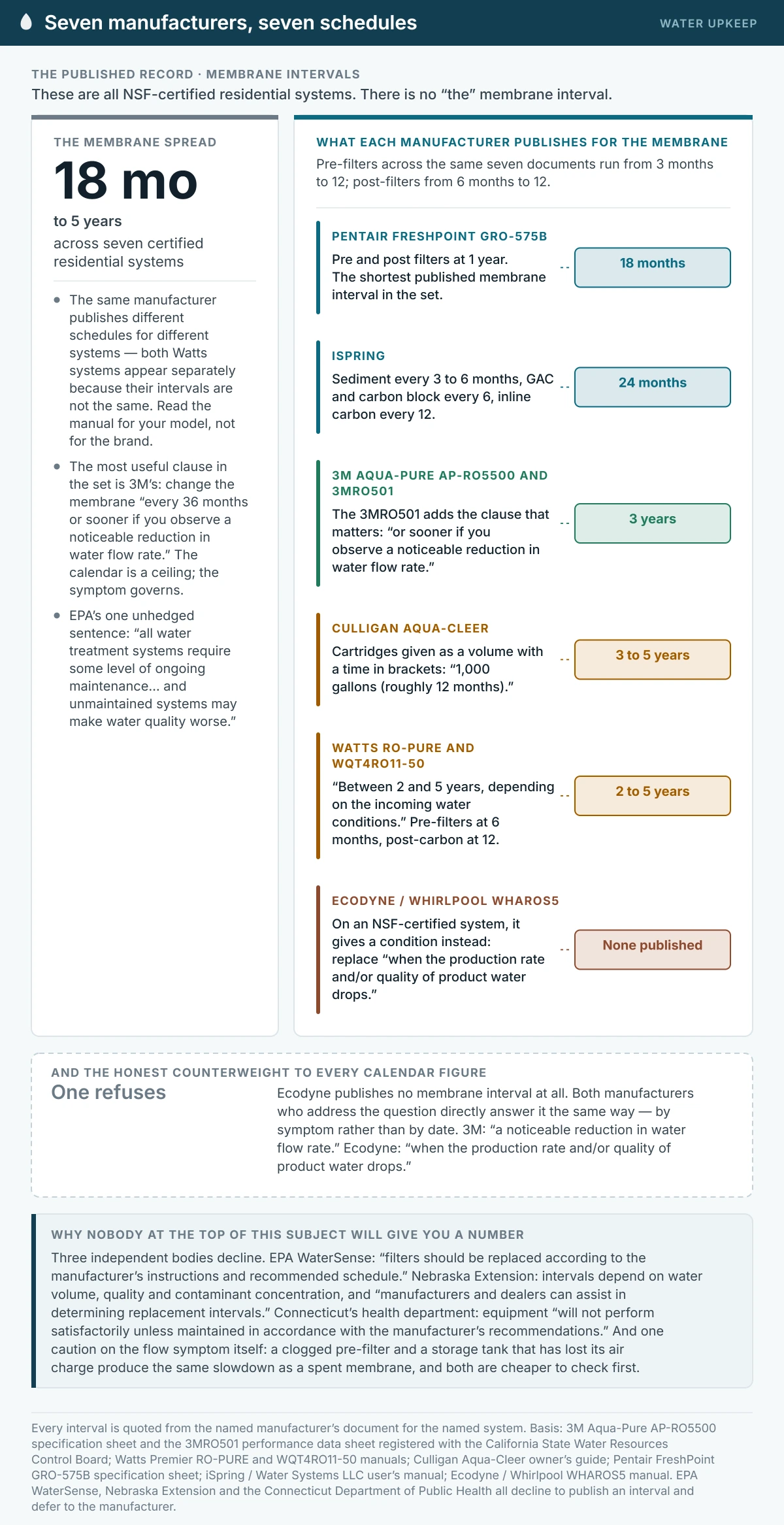
There is no universal reverse osmosis service schedule. Three independent bodies decline to publish one. EPA WaterSense: “filters should be replaced according to the manufacturer’s instructions and recommended schedule.” Nebraska Extension: replacement intervals depend on water volume, quality and contaminant concentration, and “manufacturers and dealers can assist in determining replacement intervals.” Connecticut’s health department: equipment “will not perform satisfactorily unless maintained in accordance with the manufacturer’s recommendations.”
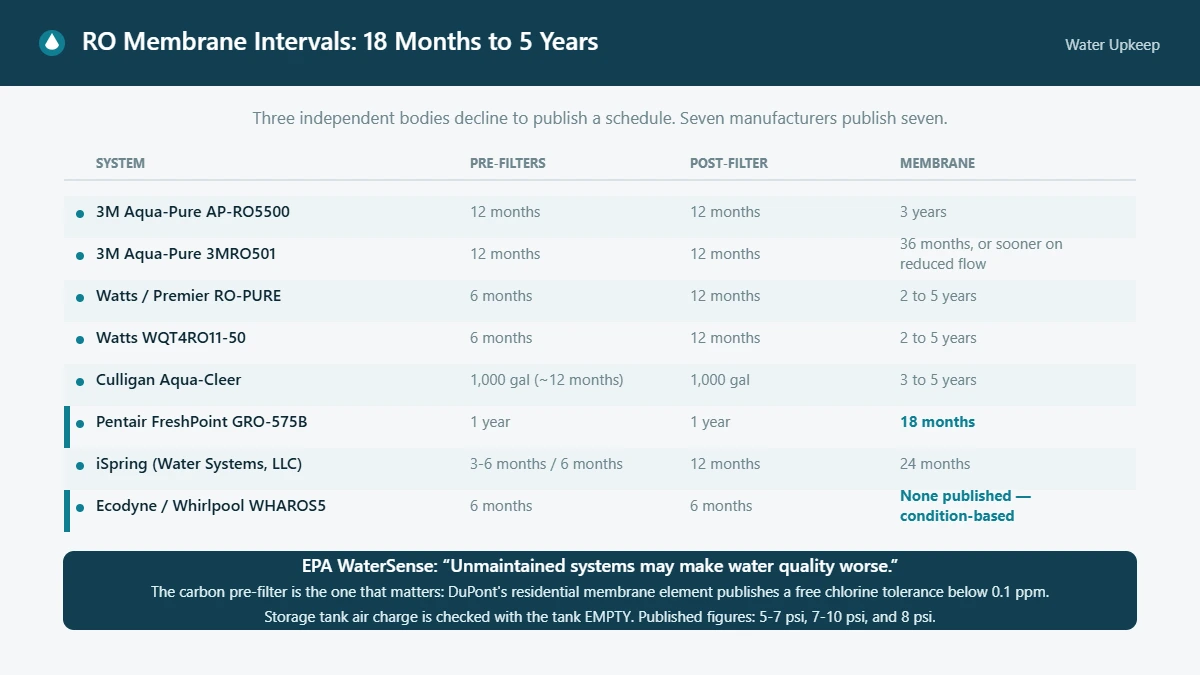
So every number below belongs to a named manufacturer’s named system, and they disagree substantially — published membrane intervals run from 18 months to 5 years, and one NSF-certified system declines to publish a membrane interval at all.
EPA does publish one unhedged sentence worth carrying: “all water treatment systems require some level of ongoing maintenance to ensure they remain effective and efficient, and unmaintained systems may make water quality worse.”
Seven manufacturers, seven schedules
| System | Pre-filters | Post-filter | Membrane |
|---|---|---|---|
| 3M Aqua-Pure AP-RO5500 | Pre-filter and post-filter: “once every twelve (12) months” | “Once every three (3) years” | |
| 3M Aqua-Pure 3MRO501 | “Change the disposable filter cartridge every 12 months” | “Every 36 months or sooner if you observe a noticeable reduction in water flow rate“ | |
| Watts / Premier RO-PURE | Sediment and carbon block at 6 months | Carbon post-filter annually | “Between 2 and 5 years, depending on the incoming water conditions” |
| Watts WQT4RO11-50 | Sediment and pre-carbon: “recommended change 6 months” | Post-carbon: “recommend change 12 months” | “Recommended change 2-5 years” |
| Culligan Aqua-Cleer | “Each filter is designed to last for 1,000 gallons (roughly 12 months)” | “Every 3-5 years” | |
| Pentair FreshPoint GRO-575B | “Pre/Post Filters: 1 year” | “RO Membrane: 18 months” | |
| iSpring (Water Systems, LLC) | Sediment “every 3~6 months”; GAC and carbon block “every 6 months” | Inline carbon “every 12 months” | “Every 24 months” |
| Ecodyne / Whirlpool WHAROS5 | Prefilter and postfilter “at least every 6 months of product water use” | None published — “it’s time to replace the Reverse Osmosis cartridge when the production rate and/or quality of product water drops” | |
Three things to take from that table.
First, the membrane spread is more than threefold. Pentair publishes 18 months; Watts and Culligan publish up to 5 years. These are all NSF-certified residential systems. There is no “the” membrane interval.
Second, one manufacturer refuses the question. Ecodyne, on an NSF-certified system, publishes no membrane interval and gives a condition instead. That is the honest counterweight to every calendar figure above it.
Third, the same manufacturer publishes different schedules for different systems. Both Watts systems appear separately above because their service intervals are not the same. Read the manual for your own model, not for the brand.
The most useful clause in the whole set is 3M’s, on the performance data sheet registered with California’s State Water Resources Control Board: “change the disposable filter membrane every 36 months or sooner if you observe a noticeable reduction in water flow rate.” The calendar is a ceiling; the symptom governs. Culligan frames its cartridges the same way — a volume with a time in parentheses, 1,000 gallons or roughly 12 months.
Why the carbon pre-filter is the one that matters most
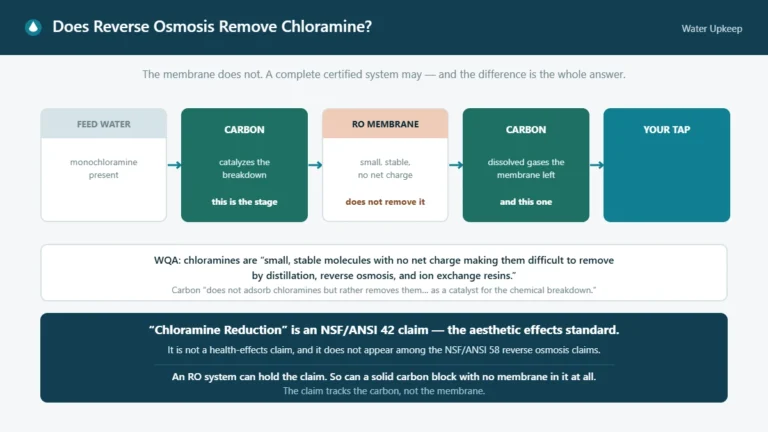
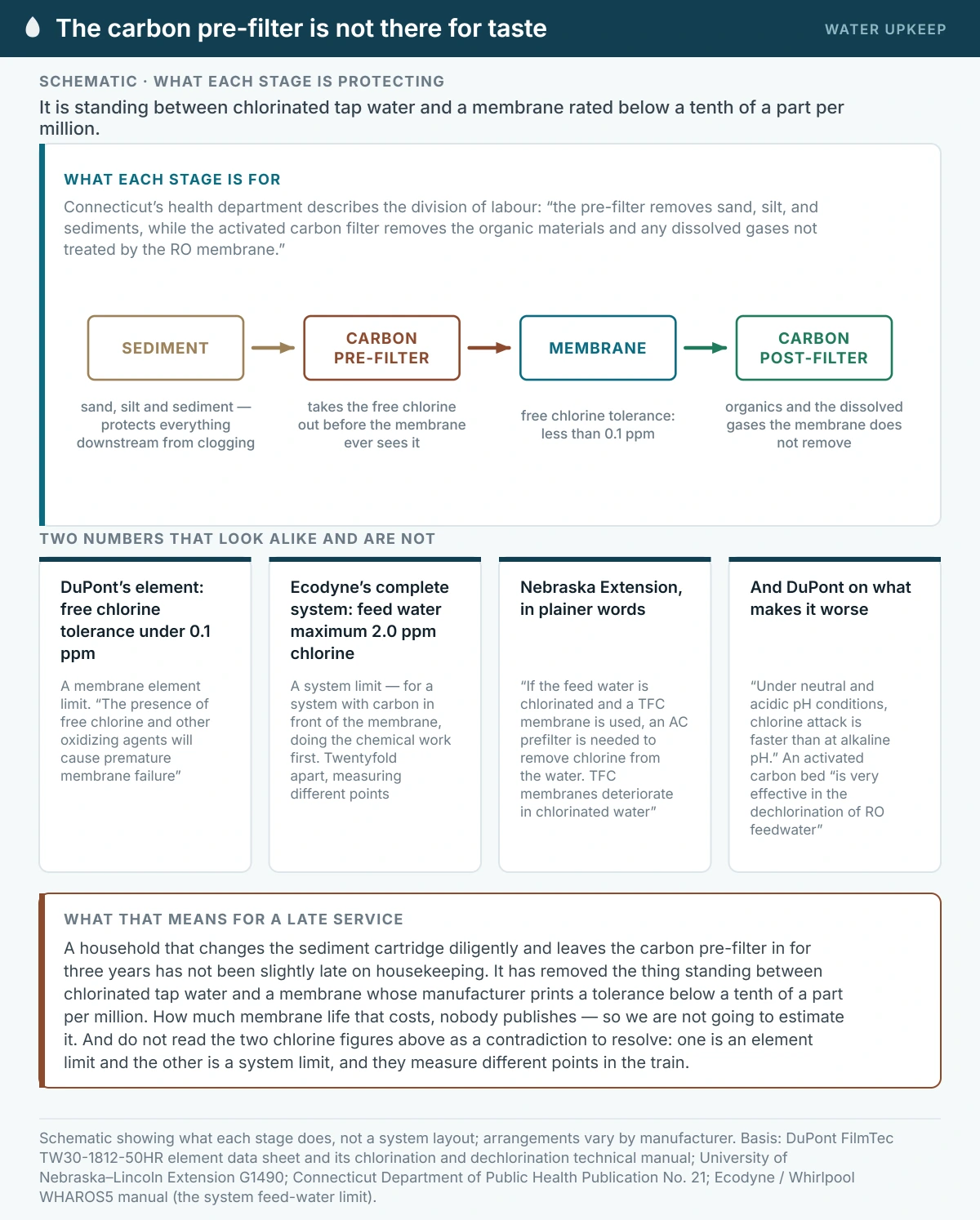
If you take one thing from this page, take this. The carbon pre-filter is not there for taste. It is there to protect the membrane from chlorine, and the membrane’s own published tolerance is startlingly low.
DuPont’s data sheet for its FilmTec TW30-1812-50HR residential element publishes a free chlorine tolerance of less than 0.1 ppm. The same manufacturer states that “the presence of free chlorine and other oxidizing agents will cause premature membrane failure,” and recommends “removing residual free chlorine by pretreatment prior to membrane exposure.” Its technical manual adds that “an activated carbon bed is very effective in the dechlorination of RO feedwater,” and notes that “under neutral and acidic pH conditions, chlorine attack is faster than at alkaline pH.”
Nebraska Extension says the same thing in plainer words: “if the feed water is chlorinated and a TFC membrane is used, an AC prefilter is needed to remove chlorine from the water. TFC membranes deteriorate in chlorinated water.”
So a household that changes the sediment cartridge diligently and leaves the carbon pre-filter in for three years has not been slightly late on housekeeping. It has removed the thing standing between chlorinated tap water and a membrane whose manufacturer prints a tolerance below a tenth of a part per million. How much membrane life that costs, nobody publishes — so we are not going to estimate it.
Two numbers that look alike and are not. DuPont’s under-0.1 ppm is a membrane element limit. Ecodyne’s feed-water table for the WHAROS5 lists a maximum chlorine of 2.0 ppm — that is a system limit for a system that has carbon in front of the membrane. Different things, measuring different points in the train. Do not compare them.
The post-filter has its own job and its own interval. Connecticut’s health department: “the pre-filter removes sand, silt, and sediments, while the activated carbon filter removes the organic materials and any dissolved gases not treated by the RO membrane.” Nebraska adds that carbon post-filters “can also remove certain pesticides and organic solvents that the RO membrane does not remove.” What the membrane does and does not do with dissolved gases is a subject in its own right — see does reverse osmosis remove chloramine.
The storage tank: check it empty, and the numbers differ
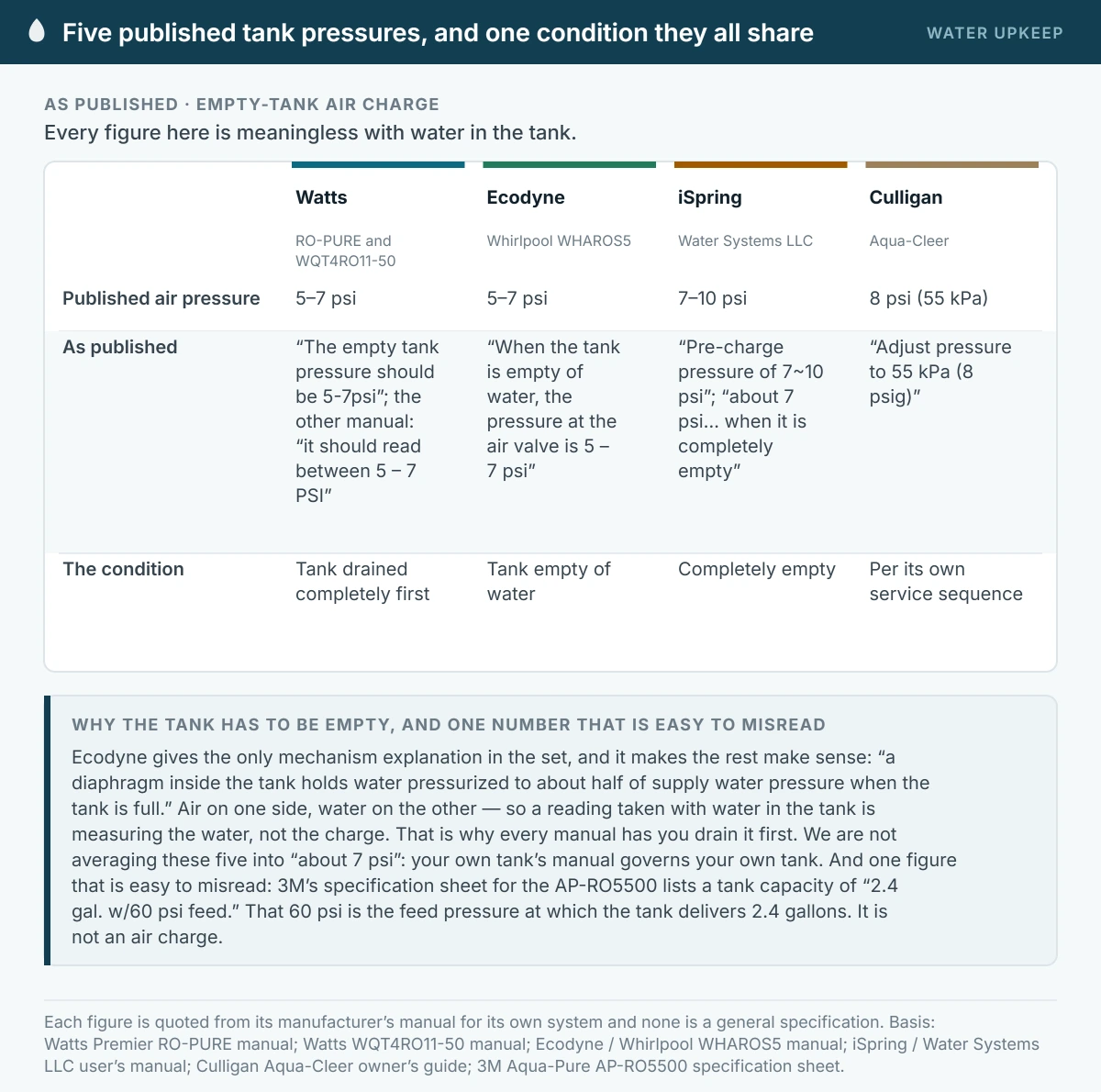
Ecodyne gives the only mechanism explanation in the set, and it makes everything else make sense: “a diaphragm inside the tank holds water pressurized to about half of supply water pressure when the tank is full.” Air on one side, water on the other. That is why the air charge is checked with the tank empty, and why every manual has you drain it first.
| Manufacturer and model | Published empty-tank air pressure |
|---|---|
| Watts RO-PURE | “The empty tank pressure should be 5-7psi” |
| Watts WQT4RO11-50 | “It should read between 5 – 7 PSI” |
| Ecodyne / Whirlpool WHAROS5 | “When the tank is empty of water, the pressure at the air valve is 5 – 7 psi” |
| iSpring (Water Systems, LLC) | “Pre-charge pressure of 7~10 psi”; “about 7 psi… when it is completely empty” |
| Culligan Aqua-Cleer | “Adjust pressure to 55 kPa (8 psig)” |
Five figures: 5–7, 5–7, 5–7, 7–10, and 8. Every one is an empty-tank figure and meaningless without that condition. We are not averaging them into “about 7 psi” — your own tank’s manual governs your own tank.
One number that is easy to misread: 3M’s specification sheet for the AP-RO5500 lists a tank capacity of “2.4 gal. w/60 psi feed.” That 60 psi is the feed pressure at which the tank delivers 2.4 gallons. It is not an air charge.
Before you open anything
Every manual we opened says the same thing in its own words. Watts, in capitals: “BEFORE DISCONNECTING ANY TUBES, MAKE SURE TO TURN OFF WATER SUPPLY AND MAKE SURE THE SYSTEM IS DEPRESSURIZED.” iSpring: “shut off the system by turning off the water supply, and turn off the tank valve, open the spigot to depressurize.” Culligan: “shut off water supply then remove all filters.” Ecodyne: “make sure that the water supply to the Reverse Osmosis system is off.”
The transferable sequence, present in one form or another in all of them:
- Close the feed valve to the RO system.
- Close the tank ball valve if your system has one — iSpring names it as a separate isolation point.
- Open the RO faucet and let it run until it stops. Watts is explicit that the tank must be drained completely before an air-charge check.
- Then open a housing or disconnect a tube.
Cartridge mechanics differ by system. Watts’ quick-twist design has you “push and hold the button on the valve head above the filter,” pull the cartridge downward, and insert the new one “until you hear an audible ‘click’.” Threaded-sump housings are a different job entirely, with their own disagreements about lubricant and tightening — see how to change a whole house water filter.
Where service ends and installation begins
Changing a cartridge is service. Cutting into a supply line, drilling a sink, or moving a drain saddle is installation, and that is where this page stops. Watts’ own handoff: “if you are unsure about installing this product, consult a professional plumber.”
One symptom worth knowing after a service, because it is easy to misdiagnose: if water backs up and comes out of the air gap hole in the back of the faucet, Watts attributes that to bends or sags in the drain line rather than to a failed cartridge. Its own drain requirements are that the saddle sit “at least 1½″ above the nut of the P-Trap elbow,” and that the drain tube be “as SHORT and STRAIGHT as possible” with “a downward slope from faucet to drain saddle.”
On sanitizing
Some manufacturers publish a sanitizing procedure with a specific bleach volume as part of an annual service. We do not reproduce doses on this site. If your manual publishes one, that is the figure for your system, and it is the one to use. Note also that at least one manufacturer in this set publishes no sanitizing procedure at all.
What an RO system is not
It is not a microbiological barrier. Every manufacturer manual we opened carries a version of the same sentence: “do not use with water that is microbiologically unsafe or of unknown quality without adequate disinfection before or after the system.” Nebraska Extension is more specific: reverse osmosis “can remove microorganisms. However, it is not recommended for that use (i.e., only coliform-free water should be fed to the system).” Connecticut’s health department: “alone, reverse osmosis (RO) units are not recommended for treatment of bacteria and other microscopic organisms.”
If that is your situation, it starts with a positive coliform test on your well and your local health department, and disinfection technology is UV and NSF/ANSI 55.
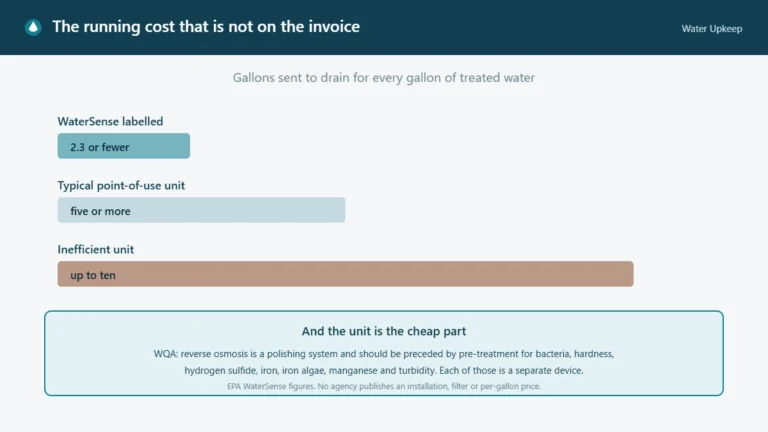
It is not a whole-house system. Connecticut describes the architecture: “a complete reverse osmosis system consists of a RO module, a storage tank, and a separate faucet,” and notes the recovery — “four gallons of raw water into the system produce about one gallon of treated water.” That ratio is why RO sits under a sink rather than on the main.
It does not handle everything. Connecticut lists what it is not effective against: “dissolved gases, most volatile and semi-volatile organic contaminants including some pesticides and solvents.” That is precisely why the carbon post-filter exists.
And whatever your system does, Connecticut’s advice is to verify it: “after installation, retest both the raw water (prior to treatment) and the treated water at a state certified laboratory,” and continue testing “annually or more frequently (quarterly or semi-annually) if high levels of contaminants are present.” See water testing. A TDS meter is not that test — see what TDS actually measures.
Frequently asked questions
How often should I change RO filters?
According to your own system’s manual. EPA, Nebraska Extension and Connecticut’s health department all decline to publish an interval and defer to the manufacturer. Across seven manufacturer documents, pre-filters run from 3 months to 12, post-filters from 6 months to 12, and membranes from 18 months to 5 years — with one manufacturer publishing no membrane interval at all.
Which filter matters most?
The carbon pre-filter, if your water is chlorinated. DuPont’s residential membrane element publishes a free chlorine tolerance of less than 0.1 ppm, and states that free chlorine “will cause premature membrane failure.” Nebraska Extension: “TFC membranes deteriorate in chlorinated water.”
How do I know when the membrane needs replacing?
The two manufacturers who address it directly give the same kind of answer. 3M: “or sooner if you observe a noticeable reduction in water flow rate.” Ecodyne: “when the production rate and/or quality of product water drops.” Nebraska adds the obvious case: “completely clogged or torn membranes require replacement.”
What pressure should the storage tank be at?
Whatever your manual says, checked with the tank completely empty. Published figures across five systems are 5–7 psi, 7–10 psi and 8 psi. The empty condition is not optional — the reading is meaningless with water in the tank.
My RO water flow has slowed down. Is it the membrane?
Possibly, and both 3M and Ecodyne treat reduced flow as the membrane replacement signal. But a clogged pre-filter and a tank that has lost its air charge produce the same symptom, and both are cheaper to check first.
Can an RO system make my well water safe to drink?
No, not on its own. Every manufacturer manual we read says not to use these systems on water that is microbiologically unsafe or of unknown quality without adequate disinfection, and both Tier 1 sources say the same. Nebraska’s phrasing is the clearest: “only coliform-free water should be fed to the system.”
Sources and standards
- US EPA WaterSense — Guide to Selecting Water Treatment Systems (November 2024)
- University of Nebraska–Lincoln Extension — G1490, Drinking Water Treatment: Reverse Osmosis
- Connecticut Department of Public Health — Publication No. 21, Reverse Osmosis Treatment of Private Drinking Water Systems
- California State Water Resources Control Board — performance data sheet for the 3M 3MRO501
- 3M / Aqua-Pure (manufacturer documentation) — AP-RO5500 specification sheet
- Watts (manufacturer documentation) — Premier RO-PURE manual and the WQT4RO11-50 manual
- Culligan (manufacturer documentation) — Aqua-Cleer Advanced Drinking Water Systems owner’s guide
- Pentair (manufacturer documentation) — FreshPoint GRO-575B specification sheet
- Ecodyne / Whirlpool (manufacturer documentation) — WHAROS5 manual
- DuPont (manufacturer documentation) — FilmTec TW30-1812-50HR element data sheet and the chlorination and dechlorination technical manual excerpt
- iSpring / Water Systems, LLC (manufacturer documentation) — user’s manual, version 2013-1
Last reviewed September 9, 2026.