TDS in Water: What the Number Actually Means
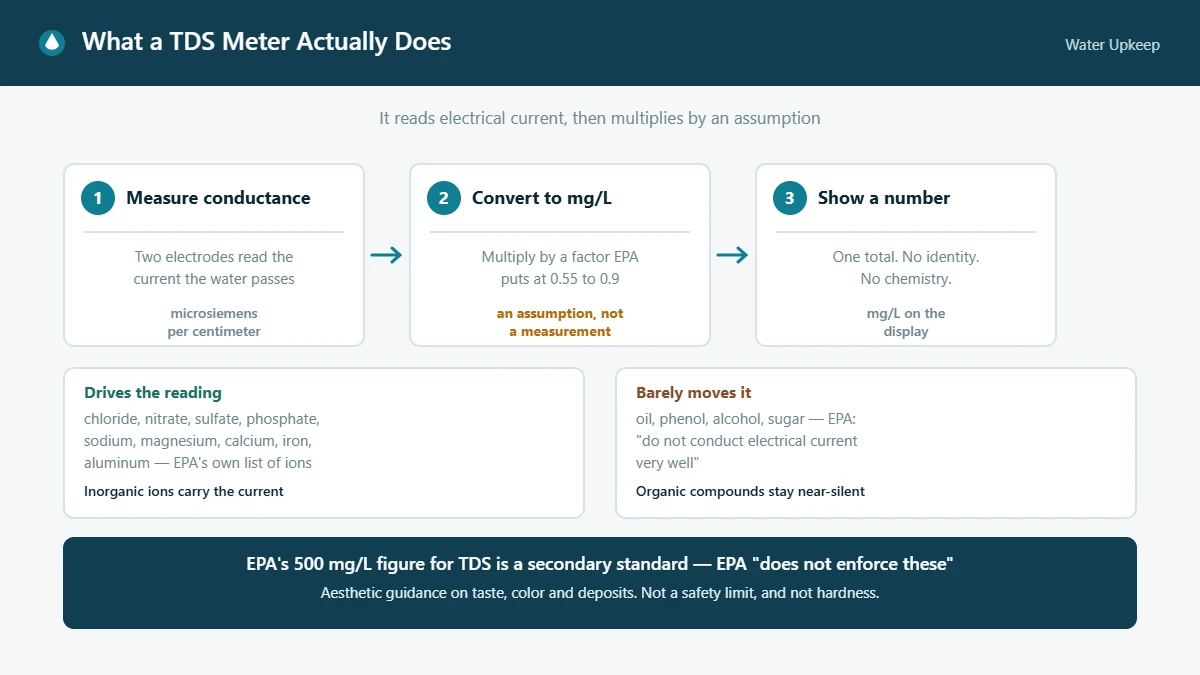
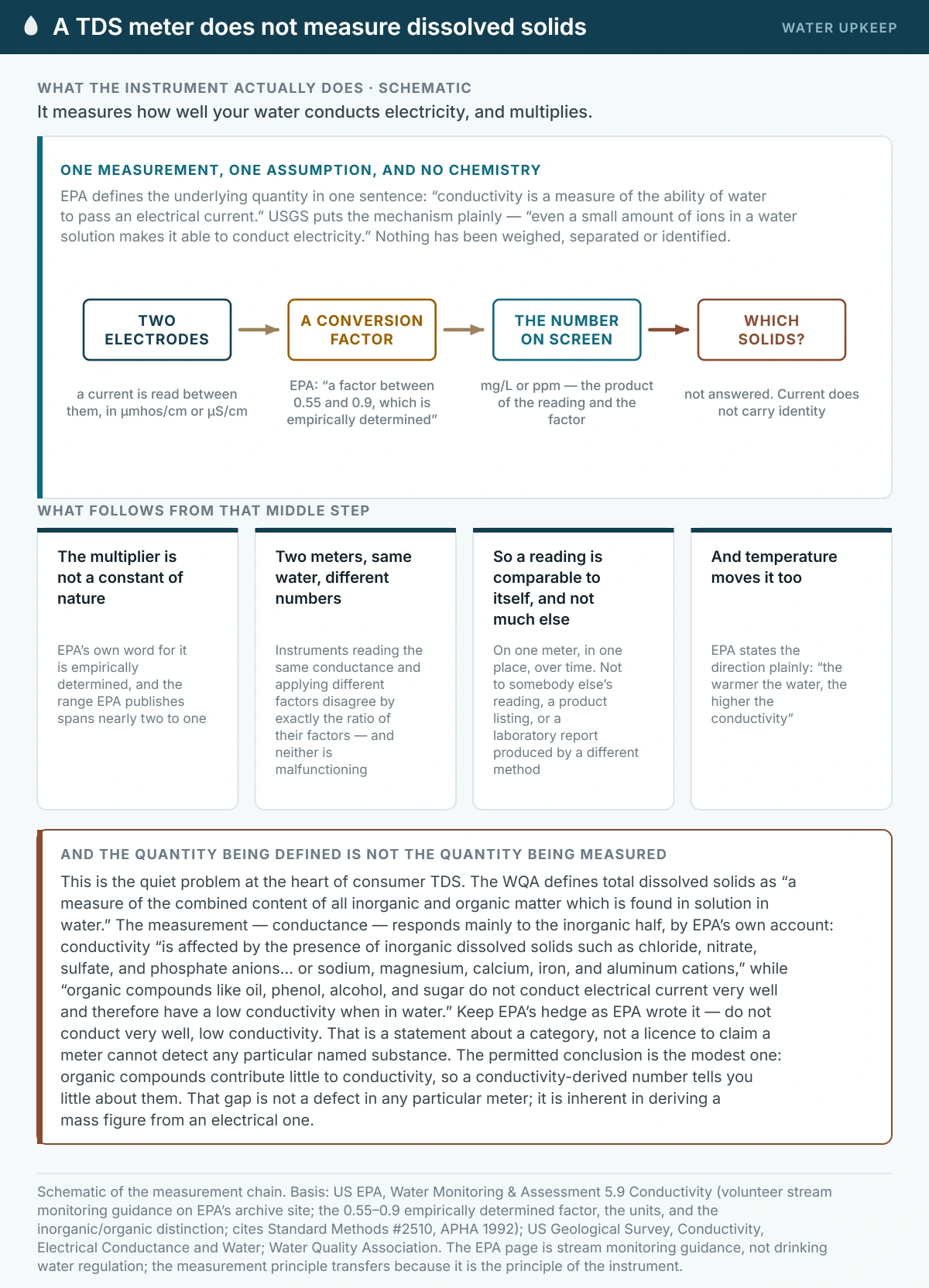
A TDS meter does not measure dissolved solids. It measures how well your water conducts electricity and multiplies that reading by a conversion factor — EPA’s volunteer stream monitoring guidance puts that factor “between 0.55 and 0.9, which is empirically determined.” So the number on the screen is one measurement, one assumption, and no chemistry. It tells you roughly how much dissolved ionic material is present, and nothing at all about which. EPA’s only figure for TDS is 500 mg/L, and it is a secondary standard that EPA says it “does not enforce” — an aesthetic guideline about taste, color and deposits, not a safety limit. TDS is also not hardness: soften your water and the hardness falls to near zero while, according to the Water Quality Association, the TDS does not come down at all.
That is the whole answer. The rest of this page is the evidence, the boundary against hardness, and an honest account of what no published source says — including the fact that no source we could open publishes a “good” TDS range for drinking water.
What a TDS meter is actually doing
Conductance, not chemistry
EPA’s volunteer monitoring guidance defines the underlying quantity in one sentence: “Conductivity is a measure of the ability of water to pass an electrical current.” The instrument puts two electrodes in the sample and reads the current that flows between them. Pure water is a poor conductor. Dissolved ions are what carry the charge.
The US Geological Survey describes the same mechanism in plainer language: “Water stops being an excellent insulator once it starts dissolving substances around it,” and “Even a small amount of ions in a water solution makes it able to conduct electricity.” USGS notes that its own scientists “almost always measure the conductivity of water when water samples are collected,” using “a probe called a ‘conductivity cell’.”
So far, nothing has been weighed, separated or identified. A current has been measured.
The conversion factor, and why it is a range
Here is the step that almost no consumer page mentions. EPA’s guidance states: “The total dissolved solids concentration in milligrams per liter (mg/L) can also be calculated by multiplying the conductivity result by a factor between 0.55 and 0.9, which is empirically determined.” The method reference EPA cites on that page is Standard Methods #2510, APHA 1992.
Read that carefully. The multiplier is not a constant of nature. EPA’s own word for it is empirically determined, and the range EPA publishes spans nearly two to one. A meter applying 0.55 and a meter applying 0.9 to the same conductance reading will print two different mg/L numbers, and neither of them is wrong — they are two different empirical assumptions about what is dissolved in the sample.
One scope note, because it matters: that EPA page is volunteer stream monitoring guidance, it lives on EPA’s archive site, and its worked examples are rivers, not taps. The measurement principle transfers because it is the principle of the instrument. It is not drinking water regulation, and we do not present it as such.
Two meters, same water, different numbers
The factor is the reason. If two instruments read the same conductance and apply different multipliers, they disagree by exactly the ratio of their factors. We cannot tell you what any specific meter uses, because no source we could open publishes the conversion factor used by any consumer TDS meter, and most of them do not disclose it in their documentation.
The practical consequence is that a TDS reading is comparable to itself over time, on one meter, in one place. It is not reliably comparable to somebody else’s reading, to a number quoted in a product listing, or to a figure from a laboratory report produced by a different method.
What “mg/L” and “ppm” mean on the display
Conductivity itself is reported, per EPA, in “micromhos per centimeter (µmhos/cm) or microsiemens per centimeter (µs/cm).” Those are the units the sensor works in. The mg/L or ppm figure on a consumer display is the product of that reading and the factor above. EPA gives one useful reference point for scale: “Distilled water has a conductivity in the range of 0.5 to 3 µmhos/cm.”
Why temperature changes the reading
EPA lists temperature among the influences on conductivity, and states the direction plainly: “the warmer the water, the higher the conductivity.” EPA also names geology as an influence — granite bedrock tends toward lower conductivity, clay soils toward higher — along with discharges into the water body.
The 500 mg/L figure, and what kind of number it is
EPA’s secondary standards, in EPA’s own words
“National Secondary Drinking Water Standards that set non-mandatory water quality standards for 15 contaminants. EPA does not enforce these ‘secondary maximum contaminant levels’ (SMCLs). They are established as guidelines to assist public water systems in managing their drinking water for aesthetic considerations, such as taste, color, and odor.”
US EPA, Secondary Drinking Water Standards: Guidance for Nuisance Chemicals
TDS is one of those 15. Its secondary maximum contaminant level is 500 mg/L. It is non-mandatory, it is about aesthetics, and EPA says in that sentence that it does not enforce it. Every time you see 500 mg/L quoted as a limit, a maximum or a safety threshold, that is a description EPA’s own page does not support.
What EPA says elevated TDS looks like
EPA’s noticeable-effects column for TDS reads: “hardness; deposits; colored water; staining; salty taste.” Note what kind of list that is. Every item is something you can see, taste or feel — which is what an aesthetic standard is for. It is not a list of health outcomes.
The word “hardness” in that list is the origin of a great deal of confusion, and we deal with it directly in the next section.
Corroboration, and a caveat that belongs on the page
Montana State University Extension repeats EPA’s classification and its figure: “TDS is classified as a secondary contaminant by the US Environmental Protection Agency (USEPA) and a suggested maximum for drinking water is 500 mg/L.” Montana State also explains the reasoning: “This secondary standard is set because elevated TDS can give water a murky appearance and detract from the taste quality of the water. People not accustomed to water with high TDS may experience gastrointestinal irritation from drinking the water.”
That last sentence carries a qualifier that is easy to drop and important to keep: the effect is attributed to people not accustomed to high-TDS water. That is a very different statement from “high TDS causes illness,” and we are not going to turn one into the other.
Montana State also cuts against the argument this article is making, and it would be dishonest to leave it out. The same page calls TDS “a good general indicator of water quality.” We publish that, attributed, because it is what the source says. Our reading is narrower than theirs: a general indicator is not a specific answer, and the sections below set out precisely which specifics it misses.
Why there is no “good” number
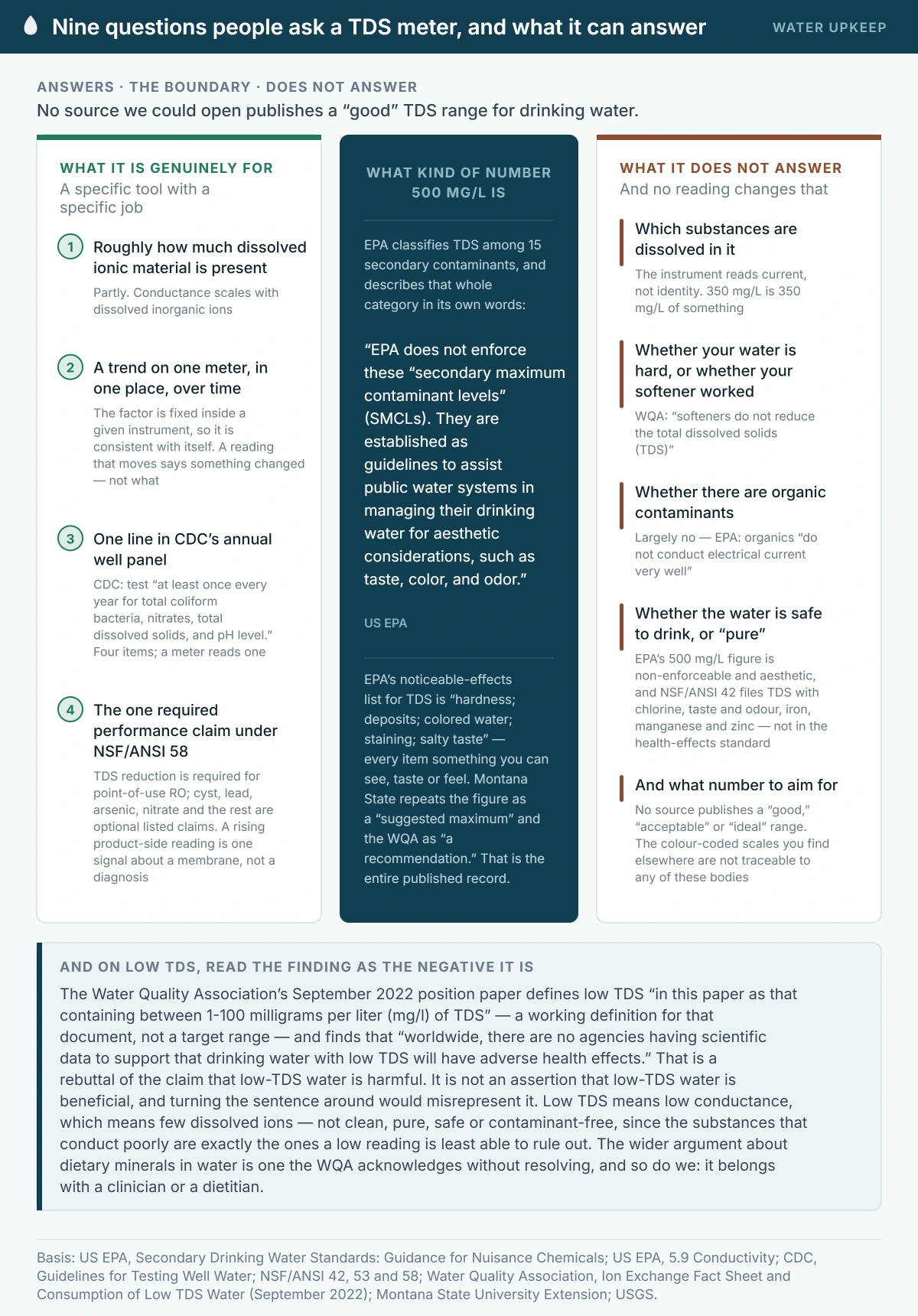
We looked, and we are going to state the result as a finding rather than quietly leave a gap. No source we could open publishes a “good,” “acceptable” or “ideal” TDS range for drinking water. EPA publishes one non-enforceable aesthetic figure. Montana State repeats it as a “suggested maximum.” The Water Quality Association repeats it as “a recommendation.” That is the entire published record.
The color-coded ranges you will find elsewhere — under 50 excellent, 50 to 150 good, and so on — are not traceable to any of these bodies. We are not going to invent one to compete with them.
TDS is not hardness
What hardness is
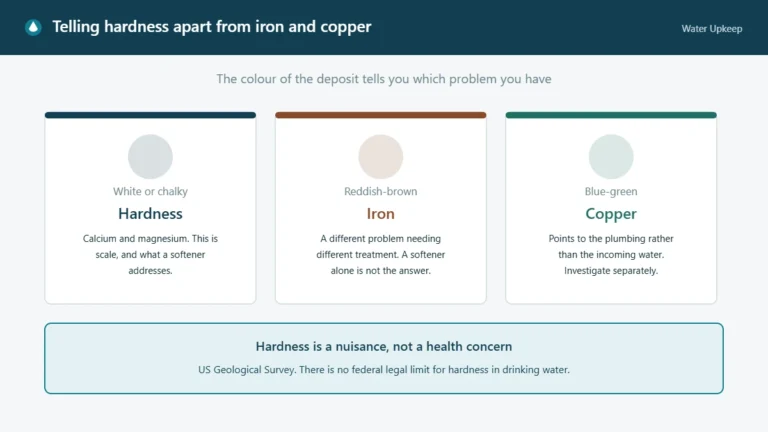
USGS gives the definition: “The simple definition of water hardness is the amount of dissolved calcium and magnesium in the water,” adding that “Hardness is caused by compounds of calcium and magnesium, and by a variety of other metals.” Two named cations, at the center of it. Hardness is a named subset.
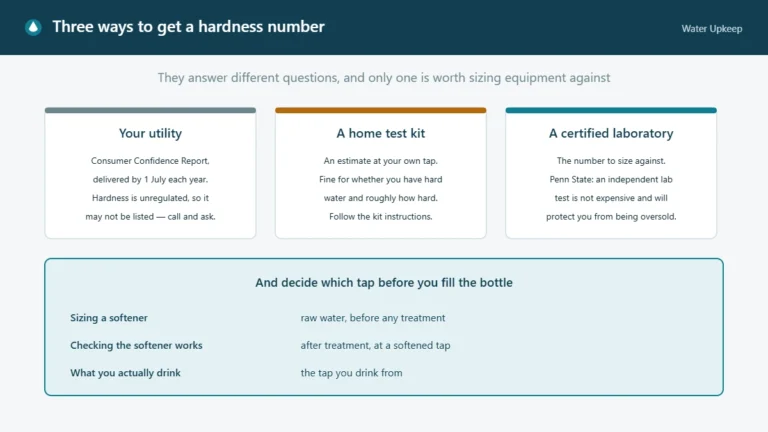
The procedure for measuring hardness, the grains-per-gallon reading and the classification scales that different publishers use are covered in how to test water hardness. Those scales genuinely disagree with each other, which is a good reason not to reprint any one of them here.
What TDS is
WQA defines TDS as “a measure of the combined content of all inorganic and organic matter which is found in solution in water.” Montana State puts it operationally: “TDS is a measure of the material in a water sample that is smaller than 2 microns (2 millionths of a meter) and cannot be removed by a traditional filter. TDS is basically the sum of all minerals, metals, and salts dissolved in the water.”
A total, then — not a named substance. Calcium and magnesium are inside it. So are sodium, potassium, chloride, sulfate, nitrate, bicarbonate, iron, manganese and silica, none of which is inside hardness.
The softener proof
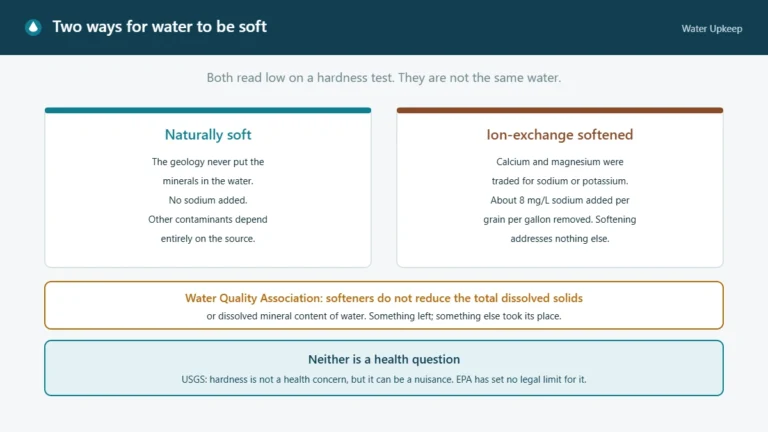
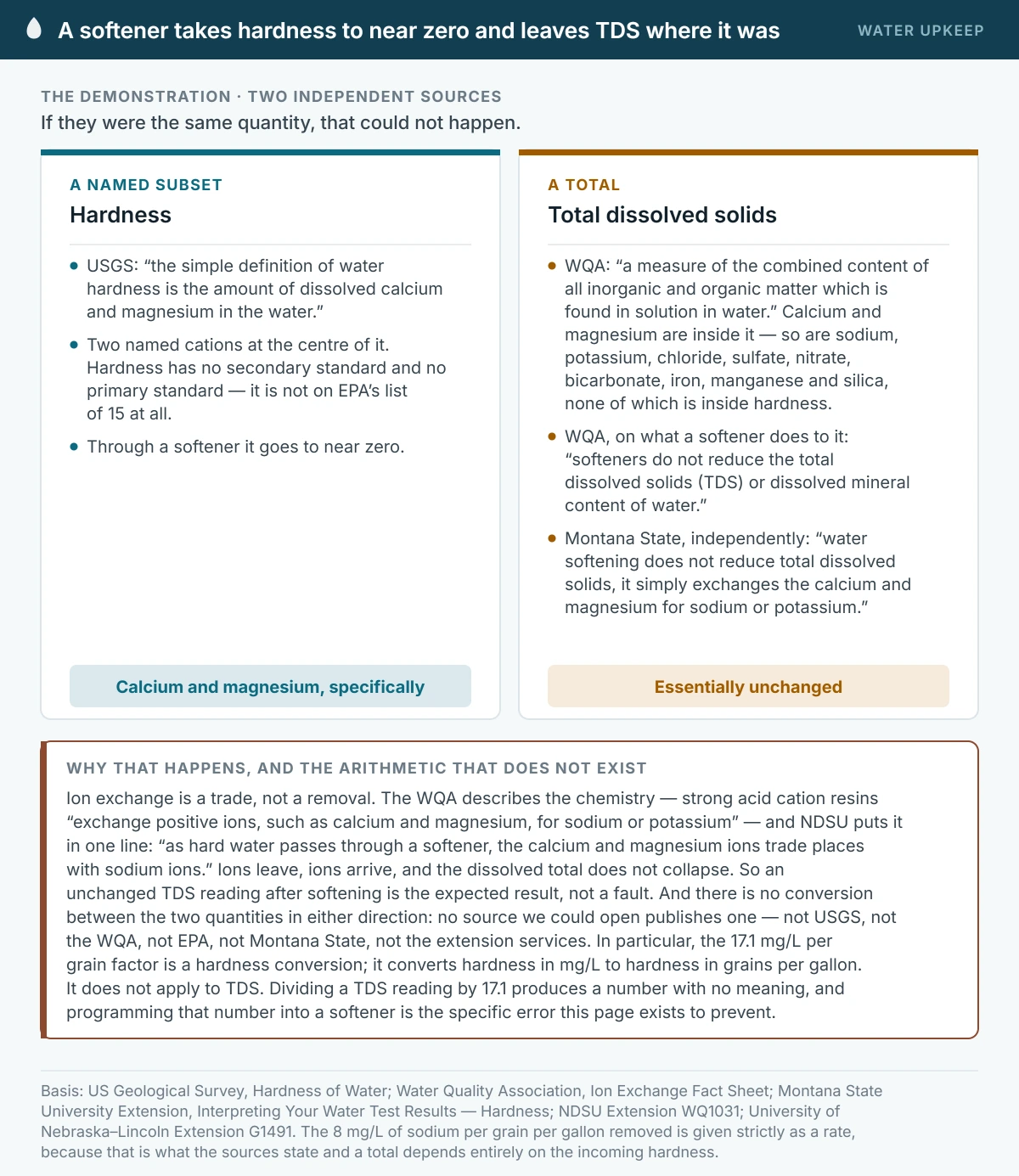
If TDS and hardness were the same quantity, an appliance that removes essentially all of one would have to move the other. It does not, and two independent sources say so in near-identical terms.
“Softeners do not reduce the total dissolved solids (TDS) or dissolved mineral content of water.”
Water Quality Association, Ion Exchange Fact Sheet
“Water softening does not reduce total dissolved solids, it simply exchanges the calcium and magnesium for sodium or potassium.”
Montana State University Extension, Interpreting Your Water Test Results — Hardness
One trade-body technical fact sheet, one university extension service. A softener drives hardness toward zero and leaves the TDS reading essentially where it was. That is the demonstration, and it is the single most useful thing on this page.
Why that happens
Ion exchange is a trade, not a removal. WQA describes the chemistry: “Strong Acid Cation resins (SAC) typically contain sulfonic acid functionality (R-SO3¹⁻) that can exchange positive ions, such as calcium and magnesium, for sodium or potassium.” NDSU Extension puts the same idea in one line: “As hard water passes through a softener, the calcium and magnesium ions trade places with sodium ions.”
Ions leave, ions arrive, and the dissolved total does not collapse. Both UNL Extension and NDSU publish the rate at which the incoming ion is added: about 8 mg/L of sodium for each grain per gallon of hardness removed. We give that strictly as a rate, because it is what the sources state and because a total depends entirely on the incoming hardness. It is here only to explain why the TDS number stays up. The full mechanism is in how water softeners work.
Why EPA listing “hardness” under TDS effects does not make them the same thing
EPA’s effects column is a list of things elevated TDS may show up as. If the dissolved load in a particular water happens to be mostly calcium and magnesium, then high TDS and hard water will travel together and hardness is one of the effects you notice. That is a statement about a common case, not a definition. In water where the dissolved load is mostly sodium and chloride, the TDS number can be high and the hardness low. Both are consistent with EPA’s row.
There is also a structural tell on EPA’s own page: hardness has no secondary standard and no primary standard. It is not on the list of 15 at all. TDS is. Two quantities cannot be interchangeable when one of them is regulated and the other is not even listed.
There is no conversion between them, in either direction
This is worth saying in plain words because the arithmetic looks so tempting. No source we could open publishes a conversion between TDS and hardness, or between TDS and grains per gallon — not USGS, not WQA, not EPA, not Montana State, not the extension services. There is no such conversion, because the two quantities are not measuring the same set of things.
In particular: the 17.1 mg/L per grain factor is a hardness conversion. It converts hardness expressed in mg/L to hardness expressed in grains per gallon. It does not apply to TDS. Dividing a TDS reading by 17.1 produces a number with no meaning, and programming that number into a softener is the specific error this article exists to prevent — see what hardness number to program into your softener.
What a TDS reading cannot tell you
It does not identify which solids
The instrument reads current. Current does not carry identity. A reading of 350 mg/L is 350 mg/L of something, and the meter has no way to say whether that something is bicarbonate from limestone, sodium from a softener, or nitrate from a field upslope. Those three waters would want three completely different responses, and the meter gives the same answer for all of them.
Organic compounds conduct poorly
EPA names what drives the reading and what does not. On the driving side: “Conductivity in water is affected by the presence of inorganic dissolved solids such as chloride, nitrate, sulfate, and phosphate anions (ions that carry a negative charge) or sodium, magnesium, calcium, iron, and aluminum cations (ions that carry a positive charge).”
And on the other side: “Organic compounds like oil, phenol, alcohol, and sugar do not conduct electrical current very well and therefore have a low conductivity when in water.”
Keep EPA’s hedge as EPA wrote it. The sentence says do not conduct very well and low conductivity. It does not say invisible, undetectable or zero, and it is a statement about a category, not a license to claim that a meter cannot detect any particular named substance. The permitted conclusion is the modest one: organic compounds contribute little to conductivity, so a conductivity-derived number tells you little about them.
The definition and the measurement do not cover the same set
This is the quiet problem at the heart of consumer TDS. WQA’s definition of total dissolved solids explicitly includes “all inorganic and organic matter which is found in solution in water.” The measurement — conductance — responds mainly to the inorganic half, by EPA’s own account.
So the quantity being defined and the quantity being measured are not the same set of substances. That gap is not a defect in any particular meter. It is inherent in deriving a mass figure from an electrical one, and it is a reason to treat the display as an indicator rather than an inventory.
What CDC actually recommends testing
For a private well, CDC’s instruction is specific: “Test your well water at least once every year for total coliform bacteria, nitrates, total dissolved solids, and pH level.” CDC also says to test if “You notice a change in your water’s taste, color, or smell.”
Four items. A TDS meter reads one of them. That is the honest framing of what a meter is worth: it is an argument for measuring TDS alongside three other things, not for owning a meter instead of testing. Total coliform is the first item on that list, and a positive result is a different kind of event entirely — see what a positive coliform test on your well means.
Where the real answers come from
Identification requires a laboratory method that separates and quantifies specific substances. For a private well, that means a panel from a state-certified laboratory; your state or county health department maintains the list. For a home on a public system, most of the contaminant data already exists in the utility’s annual Consumer Confidence Report, which is published for you whether you ask for it or not. Lead is the clearest example of a question a meter does not touch — testing for lead in water is its own procedure. Our water testing hub covers what to test and in what order, and well owners planning treatment should read well water filtration systems test-first.
Where TDS genuinely is useful
None of the above makes TDS worthless. It makes it a specific tool with a specific job. Here is where the published record actually puts it to work.
As the one required certification claim for point-of-use RO
NSF/ANSI 58 is the standard for point-of-use reverse osmosis drinking water treatment systems. Its scope covers safety of materials in contact with drinking water, structural integrity, TDS reduction performance, efficiency rating, recovery rating, contaminant reduction performance and information for the end user. Of the performance claims, TDS reduction is the required one. The rest — cyst, chromium, arsenic, nitrate and nitrite, cadmium, lead, barium, turbidity, fluoride, copper, VOC, asbestos, perchlorate, radium 226/228, selenium — are optional, meaning a given system may or may not carry them.
That is a useful thing to know when reading a product page. A system certified to NSF/ANSI 58 for the TDS reduction claim is certified for TDS reduction. It is not thereby certified for lead, arsenic or anything else — those are separate listed claims, and the listing is where you check. We do not use bare phrases like “NSF certified” anywhere on this site for exactly that reason.
As an aesthetic claim under NSF/ANSI 42
The standards themselves classify TDS, and the classification is instructive. NSF/ANSI 42 covers “systems designed to reduce non-health-related contaminants,” and its claim list is chlorine, taste and odor, chloramine, particulate, iron, manganese, zinc, and total dissolved solids. NSF/ANSI 53 covers “systems designed to reduce specific health-related contaminants” — lead, Cryptosporidium, VOCs, chromium and more than 50 others.
TDS is on the first list and not on the second. A standards body, working independently of EPA, has filed TDS alongside chlorine, taste and odor, iron, manganese and zinc — in the aesthetic-effects standard. That is corroboration of EPA’s secondary classification from a completely different institution, and it is the cleanest available answer to “is a high TDS number dangerous?” It is a taste-and-appearance parameter by the judgment of both bodies that classify it. For the underlying vocabulary, see what filtered water actually means and what a water purifier is.
As a trend on one meter, in one place, over time
Because the conversion factor is fixed inside a given instrument, that instrument is consistent with itself. A reading that has sat around one value for a year and then moves is telling you something changed — not what changed, but that a change happened and is worth investigating. This is the one use of a consumer meter that survives everything else on this page.
As one line in an annual well panel
CDC puts TDS in the four-item annual test for private wells, so a laboratory TDS figure has a defined place in a well owner’s records. It sits next to total coliform, nitrate and pH, and it is read in their company rather than on its own.
As a signal on a reverse osmosis system
Since TDS reduction is NSF/ANSI 58’s required performance claim, TDS is the parameter an RO system is defined by. A reading on the product side that climbs over time is one signal about the state of the membrane. It is a signal, not a diagnosis, and it does not set a schedule — the service question belongs in reverse osmosis filter replacement, which handles what the published manufacturer schedules actually say and where they disagree.
Low TDS, and the marketing around it
What WQA actually found
The Water Quality Association published a position paper on this in September 2022, defining low TDS “in this paper as that containing between 1-100 milligrams per liter (mg/l) of TDS” — a working definition for that document, not a target range. Its finding: “Worldwide, there are no agencies having scientific data to support that drinking water with low TDS will have adverse health effects.”
That is a negative finding and it should be read as one. WQA is rebutting the claim that low-TDS water is harmful. It is not asserting that low-TDS water is beneficial, and turning the sentence around would misrepresent it.
Why low TDS is not a purity claim
Low TDS means low conductance, which means few dissolved ions. It does not mean clean, pure, safe, filtered or contaminant-free. The reason is already on this page: the substances that conduct poorly are the ones a low reading is least able to rule out. A demonstration in which a meter is dipped into tap water and then into treated water, with the second number much lower, is a demonstration that ions were removed. It is not a demonstration about anything else.
The same logic runs the other way, incidentally, for a related confusion: cloudy water and a TDS number are not the same observation either. Cloudy tap water is usually an appearance question with its own explanations.
Why the mineral argument is not settled here
You will find confident claims in both directions — that you need dissolved minerals from your water, and that you get all of them from food anyway. WQA’s paper acknowledges the debate without resolving it. We have no source that resolves it either, so we are not going to pick a side and present it as settled. That question belongs with a clinician or a dietitian, not with a plumbing site.
What TDS does and does not answer
| The question you have | Does the TDS number answer it? | Why |
|---|---|---|
| Roughly how much dissolved ionic material is in my water? | Partly | Conductance scales with dissolved inorganic ions (EPA) |
| Which substances are dissolved in it? | No | The instrument reads current, not identity |
| Is my water hard? | No | Hardness is calcium and magnesium specifically; TDS is a total (USGS; WQA) |
| Did my softener work? | No | “Softeners do not reduce the total dissolved solids (TDS)” (WQA; Montana State) |
| Are there organic contaminants? | Largely no | Organics “do not conduct electrical current very well” (EPA) |
| Is my water safe to drink? | No | EPA’s TDS figure is non-enforceable and aesthetic; NSF/ANSI 42 files TDS under aesthetic effects |
| Is my water “pure”? | No | Low conductance is not purity |
| Do I need a laboratory test? | It cannot tell you | CDC’s annual well panel is four items; a meter reads one |
| Is my RO membrane still working? | It is one signal | TDS reduction is NSF/ANSI 58’s required performance claim |
| What number should I be aiming for? | No source publishes one | EPA’s 500 mg/L is aesthetic and non-enforceable; nothing else exists |
TDS’s companions on EPA’s secondary list
Seeing the company TDS keeps makes the classification obvious. These are all secondary maximum contaminant levels, and EPA “does not enforce” any of them.
| Parameter | SMCL | EPA’s noticeable effects | Enforceable |
|---|---|---|---|
| Total dissolved solids | 500 mg/L | hardness; deposits; colored water; staining; salty taste | No |
| Chloride | 250 mg/L | salty taste | No |
| Sulfate | 250 mg/L | salty taste | No |
| Iron | 0.3 mg/L | rusty color; sediment; metallic taste; reddish or orange staining | No |
| Manganese | 0.05 mg/L | black to brown color; black staining; bitter metallic taste | No |
| Zinc | 5 mg/L | metallic taste | No |
| Color | 15 color units | visible tint | No |
| pH | 6.5–8.5 | low pH: bitter metallic taste; corrosion; high pH: slippery feel; soda taste; deposits | No |
| Hardness | not listed | — | — |
Every parameter on that list is aesthetic, none of them is enforced, and hardness is not on the list at all. Two of TDS’s neighbors have their own pages here: iron in well water and manganese in drinking water, the one parameter on this list that also carries a separate health advisory.
Before you act on a reading
Water Upkeep does not test water, does not own meters, does not interpret results, and does not advise on whether any water is safe to drink. A TDS reading is a starting point for a question, not an answer to one.
- Private well. CDC’s annual schedule covers total coliform bacteria, nitrates, total dissolved solids and pH — and CDC adds that you should test after any change in taste, color or smell. That panel goes to a state-certified laboratory, not to a meter.
- Any infant, pregnancy or medical concern. The route is your local health department and a clinician. It is not this page and it is not a number on a display.
- Any suspicion of lead, bacteria or nitrate. None of these is addressed by a TDS reading. Each has its own test.
- On a public system. Your utility’s annual Consumer Confidence Report already contains its contaminant monitoring data, published to you by requirement.
Frequently asked questions
What is a good TDS level for drinking water?
No source we could open publishes one, and we think saying so is more useful than inventing a range. EPA’s 500 mg/L is a non-enforceable secondary standard for aesthetics. Montana State calls it a “suggested maximum.” WQA calls it “a recommendation.” Nobody with authority over drinking water publishes a “good” figure, because the number on its own does not describe anything you could be good or bad about.
My reading is 350. Is that safe?
Nobody can answer that from a TDS number, including us. The question the reading leaves open is 350 mg/L of what — and neither the meter nor anyone reading its output knows. Safety questions are answered by identifying and quantifying specific substances, which means a laboratory panel. Start at our water testing hub, and for a well, follow CDC’s four-item annual list.
Is TDS the same as hardness?
No. USGS defines hardness as “the amount of dissolved calcium and magnesium in the water”; WQA defines TDS as “the combined content of all inorganic and organic matter which is found in solution in water.” The proof is a softener: WQA states that “Softeners do not reduce the total dissolved solids (TDS) or dissolved mineral content of water,” while the same appliance takes hardness to near zero. If you want the hardness number itself, that is a different test, and the symptom side is covered in how to tell if you have hard water.
My softener did not change my TDS reading. Is it broken?
Not on that evidence. WQA and Montana State both state that softening does not reduce TDS — the process exchanges ions rather than removing them, so the dissolved total stays up. An unchanged TDS reading after softening is the expected result, not a fault. If you have actual symptoms that suggest a problem, water softener troubleshooting works through what they usually mean.
Does a low TDS number mean my water is pure?
No. It means few dissolved ions. EPA states that organic compounds “do not conduct electrical current very well,” so the low reading tells you least about exactly the class of substances it responds to least. WQA’s finding that no agency has data showing adverse effects from low-TDS water is a negative finding about harm — not a statement that low TDS is a mark of quality.
Why do two meters give different readings on the same water?
The conversion factor. Both instruments measure conductance; each multiplies by a factor to produce mg/L. EPA describes that factor as lying “between 0.55 and 0.9, which is empirically determined.” Two devices sitting at opposite ends of that range will disagree substantially, and neither is malfunctioning. Temperature contributes too — EPA notes that “the warmer the water, the higher the conductivity.”
Does my RO system’s TDS display prove it is working?
It gives you one signal about one thing. TDS reduction is the required performance claim under NSF/ANSI 58, so it is the parameter the system is defined by, and a product-side reading that climbs over time is worth paying attention to. But a system certified for the TDS reduction claim is not thereby certified for any other claim, and a display is not a service schedule. Reverse osmosis filter replacement covers what the published schedules say.
Should I test for TDS at all?
If you have a private well, CDC says yes — as one of four items tested annually, alongside total coliform bacteria, nitrates and pH. That is an argument for including TDS in a proper panel. It is not an argument for buying a meter and treating the display as a water quality report, which is the substitution this whole page is written to prevent.
Sources and Standards
- US Environmental Protection Agency — Secondary Drinking Water Standards: Guidance for Nuisance Chemicals (the 500 mg/L SMCL for TDS, the non-enforcement statement, and the noticeable-effects list)
- US Environmental Protection Agency — Water Monitoring & Assessment, 5.9 Conductivity (volunteer stream monitoring guidance; the 0.55–0.9 empirically determined conversion factor, units, the inorganic/organic distinction, temperature; cites Standard Methods #2510, APHA 1992)
- US Environmental Protection Agency — Indicators: Conductivity
- US Geological Survey — Conductivity, Electrical Conductance and Water
- US Geological Survey — Hardness of Water (definition of hardness)
- Centers for Disease Control and Prevention — Guidelines for Testing Well Water (the four-item annual private-well panel)
- Water Quality Association — Ion Exchange Fact Sheet (softeners do not reduce TDS; strong acid cation resin chemistry)
- Water Quality Association — Consumption of Low TDS Water, 27 September 2022 (definition of TDS; the low-TDS negative finding)
- NSF International — NSF/ANSI 58: Reverse Osmosis Drinking Water Treatment Systems (TDS reduction as the required performance claim)
- NSF International — NSF/ANSI 42, 53 and 401 Filtration Systems Standards (TDS listed under NSF/ANSI 42, aesthetic effects)
- Montana State University Extension — Well Educated: Interpreting Your Water Test Results — Alkalinity, pH and TDS
- Montana State University Extension — Interpreting Your Water Test Results — Hardness
- University of Nebraska–Lincoln Extension — Drinking Water Treatment: Water Softening (Ion Exchange), NebGuide G1491 (Skipton & Dvorak, revised September 2014)
- North Dakota State University Extension — Water Softening (Ion Exchange), WQ1031 (Scherer, revised May 2022)
Certification references on this page name both the standard and the specific claim, because a certification is only ever to a named claim. Water Upkeep does not test water or equipment, and nothing here is a health assessment.
Last reviewed September 9, 2026.