How to Test Water Hardness
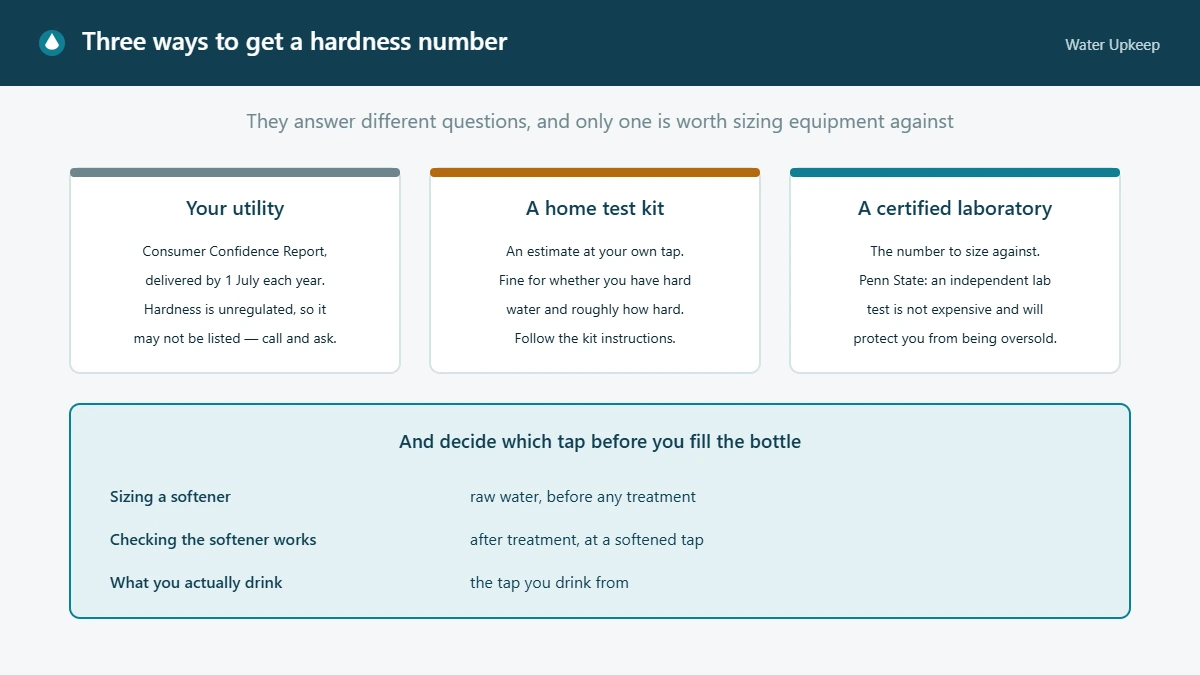
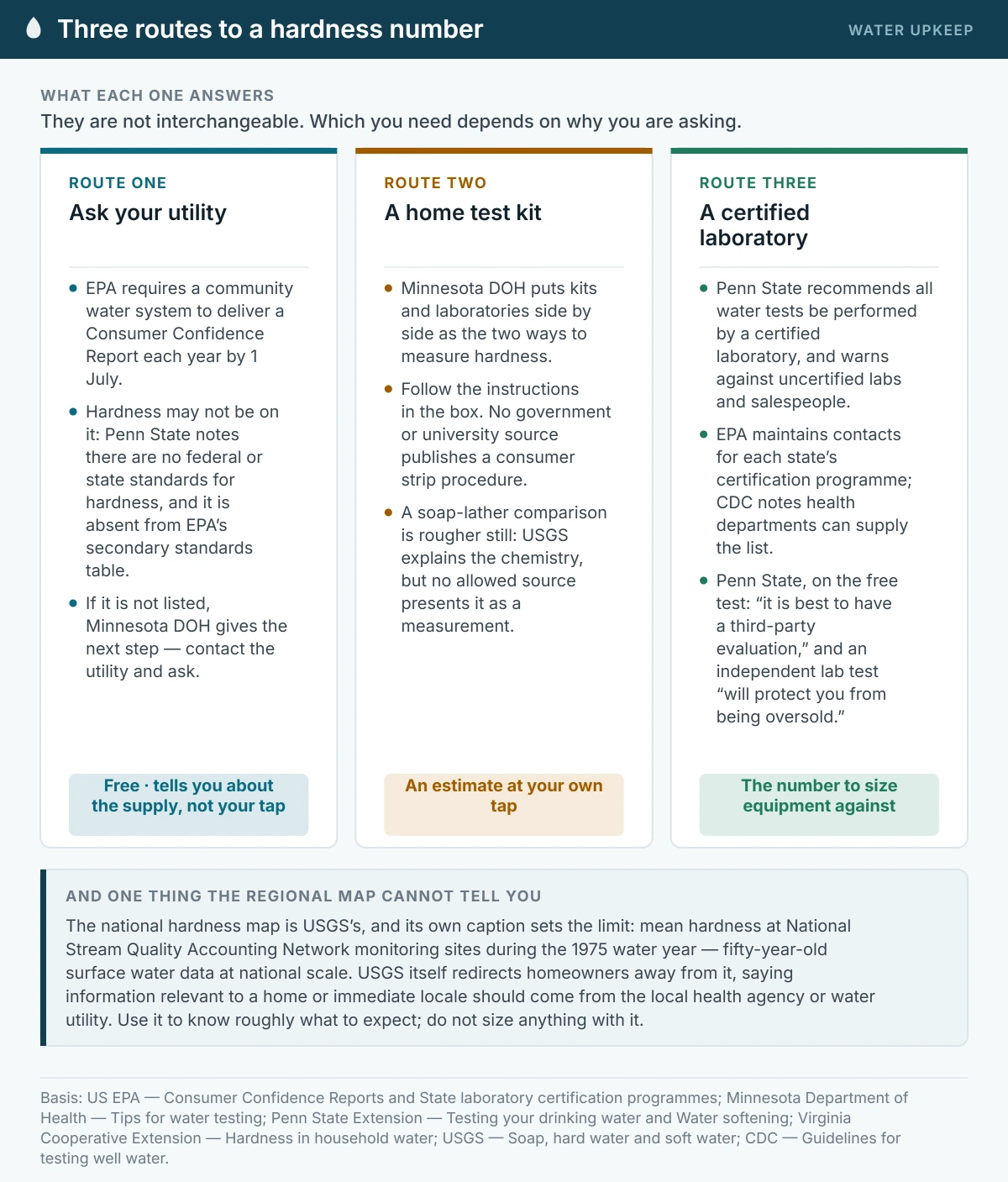
There are three ways to get a hardness number, and they answer different questions. Your utility can tell you what is in the supply. A home test kit gives you an estimate at your own tap. A state-certified laboratory gives you the number worth sizing equipment against. Which you need depends on why you are asking — and if the answer is “because I am about to buy a softener,” Penn State Extension has a warning worth reading before you accept anyone’s free test.
Route one: ask your utility
If you are on a community water system, EPA requires your supplier to deliver a Consumer Confidence Report each year by 1 July, covering the water source and the regulated contaminants found.
Hardness may not be on it. Penn State Extension notes there are no federal or state standards for hardness, so public supplies sometimes do contain high levels — and it lists hardness among the reasons a public-water customer would test on their own. Hardness does not appear on EPA’s secondary standards table either. If the report does not show it, the Minnesota Department of Health gives the simple next step: contact the utility directly and ask.
Route two: a home test kit
The Minnesota Department of Health puts both routes side by side: you can measure the hardness of your water using a test kit or an independent laboratory. A kit is fine for answering whether you have hard water and roughly how hard. Follow the instructions that come with it — no government or university source publishes a consumer strip procedure, so anyone giving you step counts is repeating a manufacturer’s directions rather than a standard.
A soap test is even rougher, and worth understanding for what it is. USGS explains the chemistry: in hard water, minerals react with soap to form soap scum, and soap lathers more easily in soft water so less is needed. A lather comparison tells you which of two waters is harder. It does not give you grains per gallon, and no allowed source presents it as a measurement.
Route three: a certified laboratory
Penn State Extension recommends that all water tests be performed by a certified water testing laboratory, and warns against uncertified labs and salespeople. Virginia Cooperative Extension puts it plainly: a qualified laboratory can analyse your water for hardness. This is the number to use when you are sizing equipment or comparing quotes.
Penn State is more direct about the reason than most: although many water softening companies offer free hardness testing, it is best to have a third-party evaluation, and an independent lab test is not expensive and will protect you from being oversold. That is the single most useful sentence on this page.
EPA maintains contact information and links for each state’s drinking water laboratory certification programme, and CDC notes that local and state health departments can supply a list of state-certified laboratories in your area.
Taking the sample
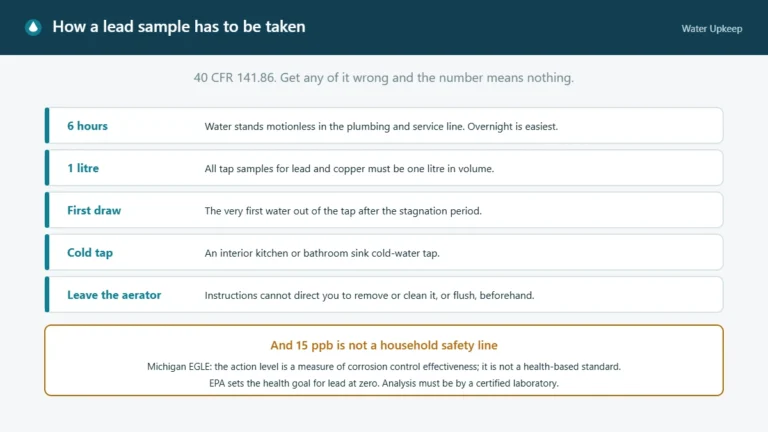
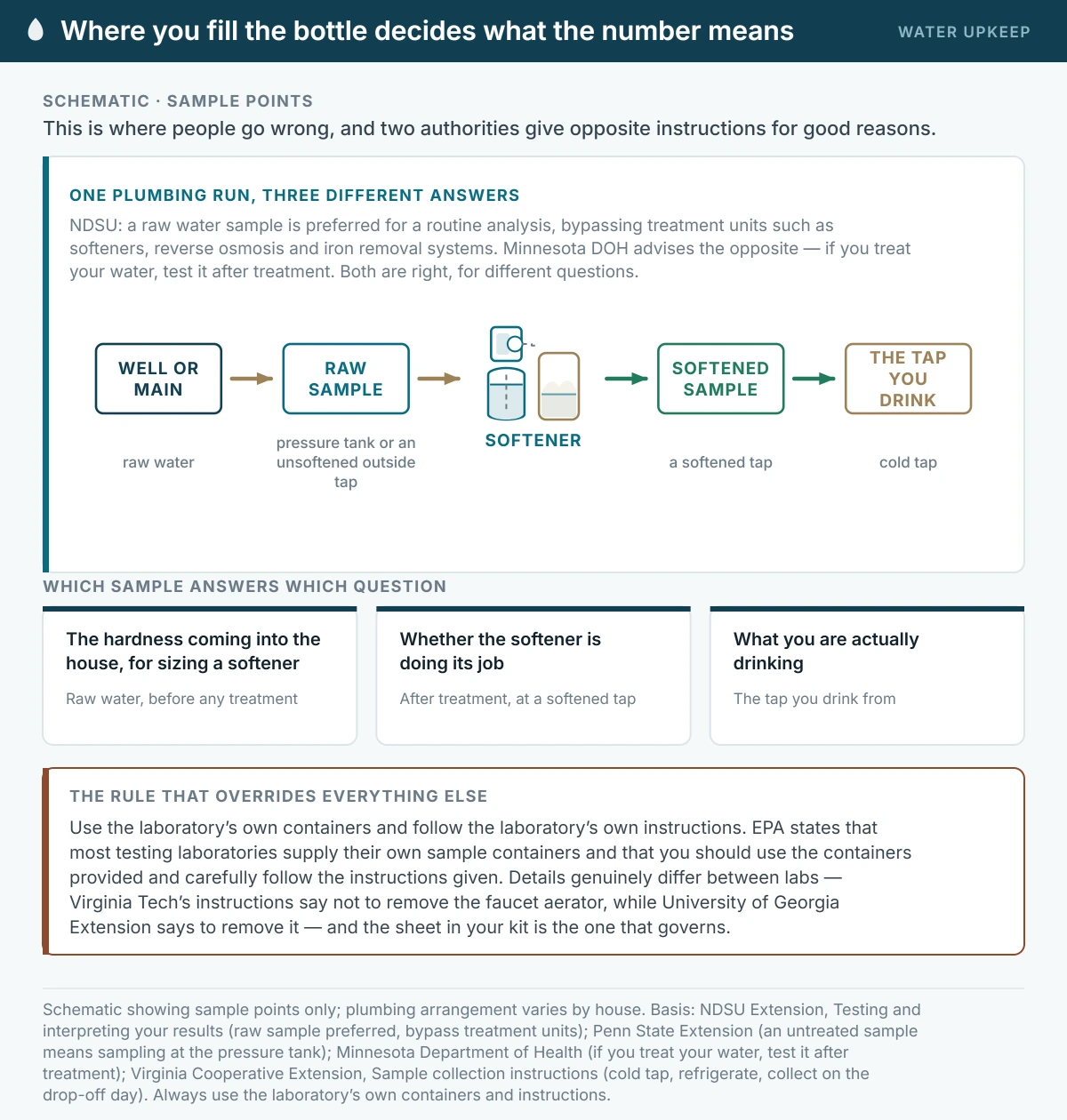
The rule that overrides everything else: use the laboratory’s own containers and follow the laboratory’s own instructions. EPA states that most testing laboratories supply their own sample containers and that you should use the containers provided and carefully follow the instructions given for collecting, preserving and handling samples. Minnesota and Penn State say the same. Details genuinely differ between labs — Virginia Tech’s instructions say not to remove the faucet aerator, while University of Georgia Extension says to remove it — and the sheet in your kit is the one that governs.
Beyond that, two things matter for hardness specifically.
Sample the cold tap. Virginia Tech’s instructions specify the cold water tap where drinking water is obtained, storing samples in the refrigerator or on ice, and collecting only on the day you drop them off.
Decide whether you want raw or treated water — and know why. This is where people go wrong. NDSU Extension states that a raw water sample is preferred for a routine analysis and advises bypassing treatment units such as softeners, reverse osmosis and iron removal systems when collecting. Penn State makes the same point: with treatment equipment installed, a kitchen or bathroom sample will often be influenced by it, and an untreated sample means sampling at the pressure tank before treatment.
Minnesota Department of Health advises the opposite — if you treat your water, test it after treatment. Both are right, for different purposes:
| What you want to know | Where to sample |
|---|---|
| The hardness coming into the house, for sizing a softener | Raw water, before any treatment — typically at the pressure tank or an unsoftened outside tap |
| Whether the softener is doing its job | After treatment, at a softened tap |
| What you are actually drinking | The tap you drink from |
Taken together those two samples are the before-and-after pair that tells you whether a unit is working. What the interval between regenerations should be is covered in how often a softener should regenerate.
Reading the result
Laboratories usually report hardness in milligrams per litre as calcium carbonate. Penn State notes that a milligram per litre is the same as one part per million. Softeners are rated in grains, so you will need the conversion.
One grain per gallon equals 17.1 mg/L. University of Georgia Extension gives it in both directions — multiply mg/L by 0.0584 for grains per gallon, or grains per gallon by 17.1 for mg/L — and Montana State University Extension and the Water Quality Association state the same figure. Penn State rounds it to approximately 17.
Then the bands, and here authorities genuinely differ. USGS uses four:
| Classification | Hardness (mg/L as calcium carbonate) |
|---|---|
| Soft | 0 to 60 |
| Moderately hard | 61 to 120 |
| Hard | 121 to 180 |
| Very hard | More than 180 |
Virginia Tech, Penn State and University of Georgia Extension use five bands, splitting the bottom one: soft below 1.0 grain per gallon (under 17.1 mg/L), slightly hard from 1.0 to 3.5 grains, then moderately hard, hard and very hard at the same 120 and 180 mg/L breakpoints. Oklahoma State University Extension matches USGS.
One source is a real outlier. Montana State University Extension puts hard at 121 to 300 mg/L and very hard above 300 — so water at 200 mg/L is very hard to USGS and merely hard to Montana State. If a number you have been quoted seems to disagree with a label, check which table it came from.
Minnesota Department of Health offers an action threshold rather than a label: above 7 grains per gallon, or 120 mg/L, you might need a softener.
Why a regional map is not your number
The national hardness map you have probably seen is USGS’s, and its own caption tells you its limits: mean hardness as calcium carbonate at National Stream Quality Accounting Network water-monitoring sites during the 1975 water year. Fifty-year-old surface water data at national scale.
USGS itself redirects homeowners away from it, saying that information directly relevant to hardness at a home or immediate locale should come from the local health agency or water utility. Use the map to know roughly what to expect. Do not use it to size anything.
What else to test at the same time
If you are already paying for a laboratory test on a private well, the marginal cost of adding parameters is small and the annual baseline is well established. CDC recommends testing at least once every year for total coliforms, nitrates, total dissolved solids and pH. EPA gives the same four, and adds sulfate, chloride, iron and manganese every three years if you have taste or odour issues.
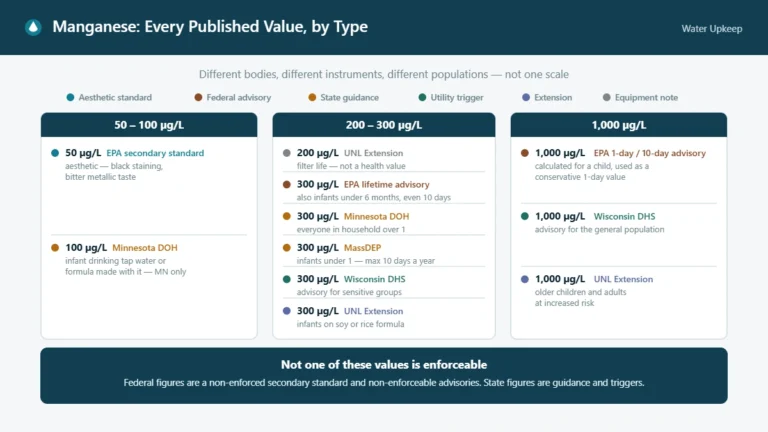
Iron and manganese matter particularly if a softener is under consideration. Penn State recommends no more than 0.3 mg/L of iron and less than 0.05 mg/L of manganese, and notes softeners are generally only recommended where pH is above 6.7, hardness is between 3 and 20 grains per gallon, and dissolved iron is below 5 mg/L. Montana State puts hardness in its fuller domestic analysis rather than the basic annual one, on nuisance grounds: it causes scaling in pipes and water heaters and reduces the effectiveness of soap and detergent.
University of Georgia Extension sequences it sensibly: a comprehensive test at least once initially, before selecting equipment, then basic testing annually.
What you probably do not need
Chain-of-custody testing is a specific legal procedure, not a normal hardness test. Penn State describes it as documentation of water quality typically before nearby gas drilling, mining or construction, and sometimes in real estate transactions, where samples are collected by professionals and delivered to a state-accredited laboratory so that only unbiased professionals have had access to the sample. Unless you are protecting a legal position, a routine test does not need it.
Nor did we find any allowed source stating that hardness varies seasonally or recommending quarterly hardness testing. The supported cadence is the annual well test above, plus a retest after any work on the well.
When to call a professional
- You are about to spend money on treatment equipment. Get an independent laboratory number first, not a seller’s.
- You are on a private well and have never had a full analysis — hardness alone is not enough to design a system.
- Iron, manganese or hydrogen sulfide are present, which changes what equipment is appropriate.
- You need results that will stand up legally, which is a chain-of-custody job.
- A softened tap tests hard and cleaning the brine tank has not fixed it.
Once you have the number, our guide to what size softener you need shows the arithmetic it feeds. More on establishing what is in your water in our water testing hub.
Sources and standards
- US Geological Survey — Hardness of water, Map of water hardness in the United States and Soap, hard water and soft water
- Penn State Extension — Testing your drinking water, Water softening, How to interpret a water analysis report, Water tests for households on public supplies, Chain-of-custody water testing and Iron and manganese in private water systems
- US Environmental Protection Agency — Consumer Confidence Reports, State laboratory certification programmes, Home water testing and Secondary drinking water standards
- Centers for Disease Control and Prevention — Guidelines for testing well water
- Minnesota Department of Health — Home water softening and Tips for water testing
- Virginia Cooperative Extension, Virginia Tech — Hardness in household water and Sample collection instructions
- NDSU Extension — Testing and interpreting your results
- University of Georgia Cooperative Extension — Water quality and common treatments
- Montana State University Extension Water Quality — Hardness and Choosing what to test for
- Oklahoma State University Extension — Understanding your household water test report
- Water Quality Association — Scale deposits
Last reviewed September 8, 2026.