How to Tell If You Have Hard Water
You cannot see hard water. What you can see is what it leaves behind: chalky white scale on the kettle and showerhead, film on glassware, soap that refuses to lather, and appliances that seem to age faster than they should. If several of those are familiar, you very likely have hard water. This guide covers the signs worth trusting, how to tell scale apart from the two mineral stains people confuse it with, and how to put an actual number on it.
What hard water actually is
Hardness is dissolved calcium and magnesium, picked up as water moves through soil and rock. Because those minerals are dissolved, the water itself looks perfectly clear. They only become visible when water evaporates or is heated, leaving the minerals behind as scale.
That is why diagnosing hard water is a matter of reading the evidence around your house rather than looking at the water in a glass.
The signs you can actually see
- White, chalky scale on taps, showerheads, kettles and the inside of pans.
- Spotting and film on glassware that comes out of the dishwasher looking cloudy rather than clean.
- Soap and shampoo that will not lather properly, so you reach for more of it.
- Soap scum — a sticky residue in the tub and on shower screens that ordinary cleaning does not shift easily.
- Laundry that feels stiff or looks dull after washing.
- Reduced flow from showerheads as scale gradually narrows the openings.
- Water heaters and dishwashers losing efficiency, or failing earlier than you would expect, as scale builds on heating surfaces.
No single one of these is conclusive on its own. Several of them together is a strong indication.
Is it hardness, iron or copper?
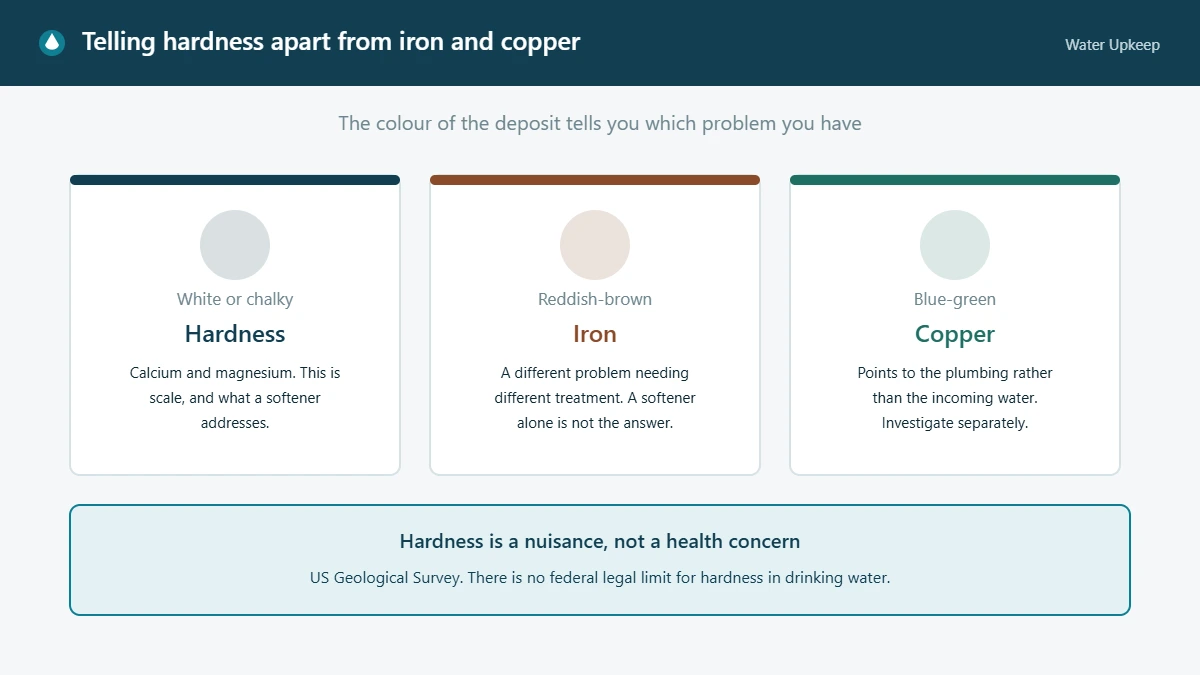
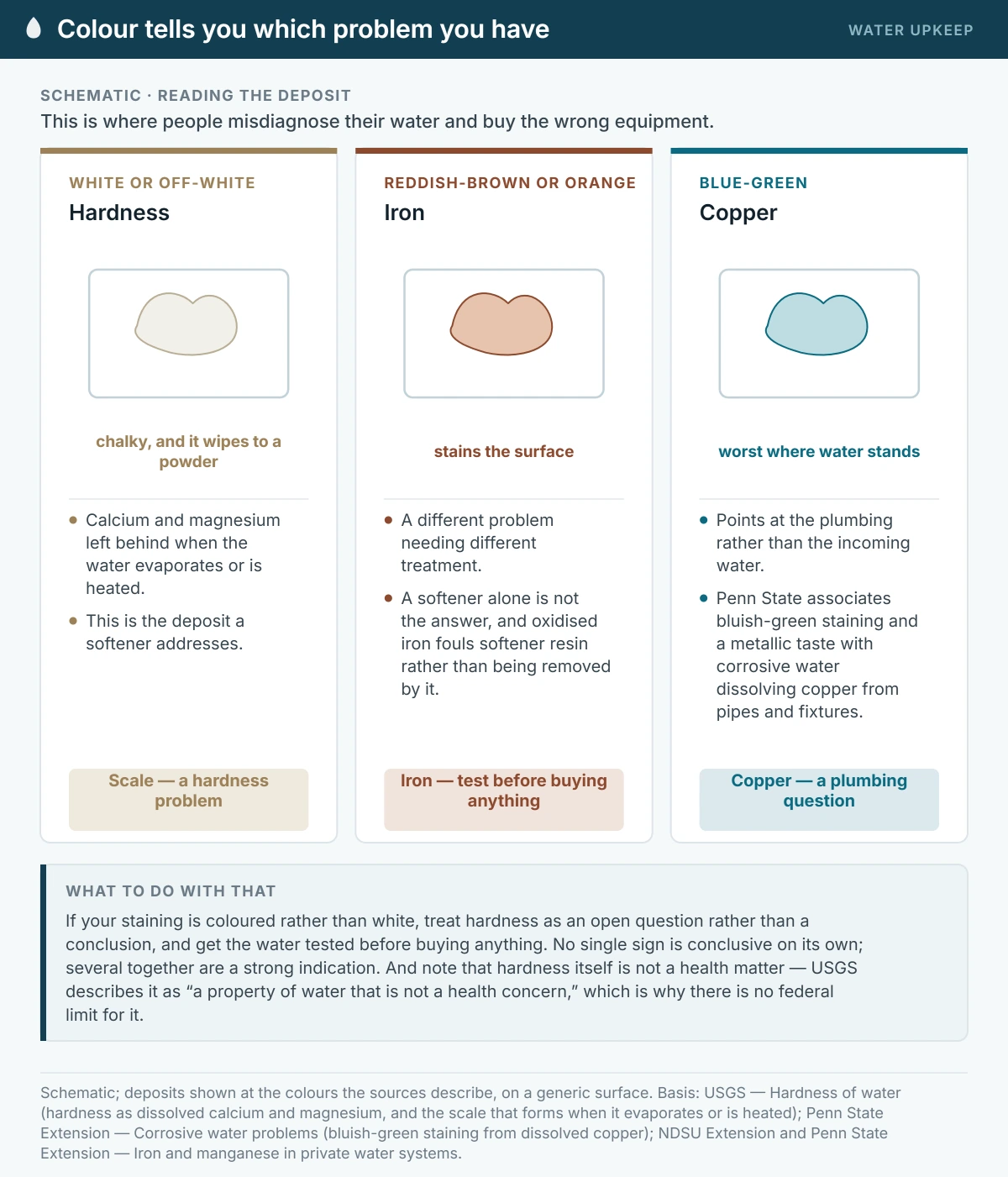
This is where people most often misdiagnose their water and end up buying the wrong equipment. Colour is the giveaway.
| What you see | Likely cause | What it means |
|---|---|---|
| White or off-white chalky deposit | Hardness (calcium and magnesium) | Scale. This is what a softener addresses. |
| Reddish-brown or orange staining | Iron | A different problem needing different treatment. A softener alone is not the answer. |
| Blue-green staining | Copper | Points to the plumbing rather than the incoming water. Worth investigating separately. |
If your staining is coloured rather than white, treat hardness as an open question rather than a conclusion, and get the water tested before buying anything.
How hard is hard? Reading the classification scales
The US Geological Survey classifies hardness in milligrams per litre as calcium carbonate, in four bands:
| Classification | Hardness (mg/L as calcium carbonate) |
|---|---|
| Soft | 0 to 60 |
| Moderately hard | 61 to 120 |
| Hard | 121 to 180 |
| Very hard | More than 180 |
Two things are worth knowing about this table. First, these are conventions for describing water, not regulatory limits — there is no legal threshold for hardness. Second, USGS publishes these figures in milligrams per litre only. It does not publish a grains-per-gallon scale.
Grains per gallon is the unit the water treatment industry uses for sizing equipment, and the classification bands you will see quoted in grains come from university extension services rather than from USGS. Different extension services draw the boundaries slightly differently. If someone quotes you a hardness band in grains, it is worth asking whose scale they are using.
You may also come across the USGS national hardness map. It is a useful illustration of broad regional patterns, but it is built on data from 1975 and says nothing reliable about your specific supply today.
How to find your hardness number without testing
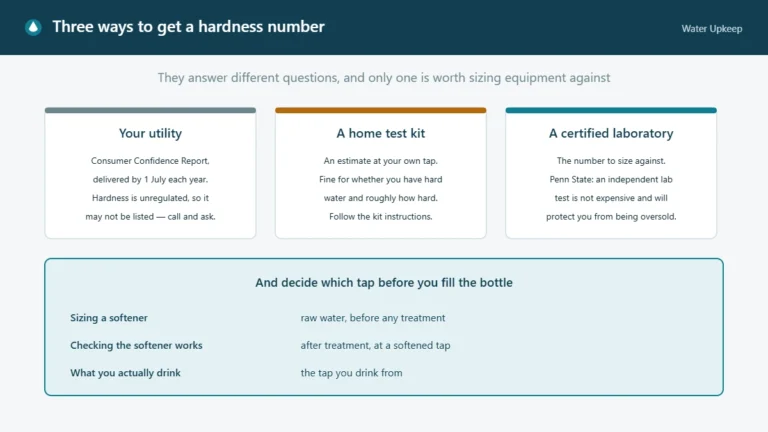
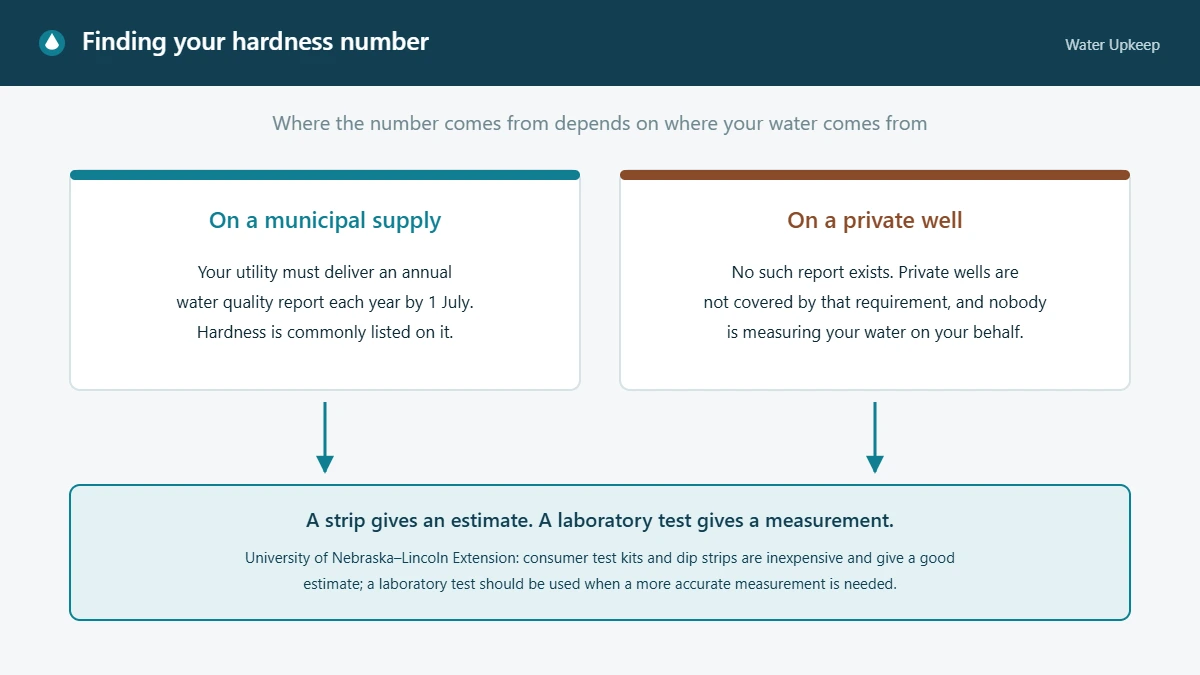
If you are on a municipal supply, you may already have the number. Community water systems in the US must deliver an annual water quality report — often called a Consumer Confidence Report — to their customers each year by 1 July. Hardness is commonly listed on it.
If you draw from a private well, no such report exists. Private wells are not covered by that requirement, and nobody is measuring your water on your behalf. Testing is the only way to get the number.
When is a test worth it?
University of Nebraska–Lincoln Extension puts the options plainly: consumer hardness test kits and dip strips are easy to use, relatively inexpensive, and give a good estimate of hardness. A laboratory test should be used when a more accurate measurement is needed.
In practice that means a strip is fine for answering whether you have hard water and roughly how hard — but if you are about to size and buy equipment, or you are dealing with a well where iron or other issues may be in play, a certified laboratory test is the sounder basis. We have not tested consumer kits ourselves, and we are not aware of any authoritative published comparison of their accuracy, so treat any specific accuracy claim you see elsewhere with caution.
Our water testing guide covers what to test for and how to go about it.
Is hard water a health problem?
No. The US Geological Survey describes hardness as a property of water that is not a health concern, though it can be a nuisance. There is no federal legal limit for hardness in drinking water, because it is not regulated as a health contaminant.
Hard water is a practical and economic nuisance — scale, soap consumption, appliance wear — not a safety issue. That distinction matters, because a good deal of marketing blurs it.
What to do next
- Check whether your staining is white (hardness) or coloured (iron or copper).
- If you are on a municipal supply, look up hardness on your annual water quality report.
- If you are on a well, or the report does not list it, test — a strip for a rough answer, a certified lab if you are about to buy equipment.
- Only then look at treatment. Sizing depends on the hardness figure, so the number comes first.
Our water softeners guide explains what ion exchange does and does not address once you have your number.
Sources and standards
- US Geological Survey — Hardness of Water. Classification bands in mg/L, and hardness as a nuisance rather than a health concern.
- University of Nebraska–Lincoln Extension — Drinking Water: Hard Water (Calcium and Magnesium), G1274. Test kits and dip strips versus laboratory testing.
- Penn State Extension — Water Softening. Hardness in grains per gallon and its role in equipment sizing.
- US EPA — Understanding Your Annual Water Quality Report. Annual delivery requirement for community water systems.
- CDC — How to Read Drinking Water Quality Reports. Who receives a report and who does not.
Water Upkeep does not sell or install water treatment equipment and does not conduct product testing. Every figure above is drawn from the published sources listed.
Last reviewed September 18, 2026.