How to Flush a Water Heater
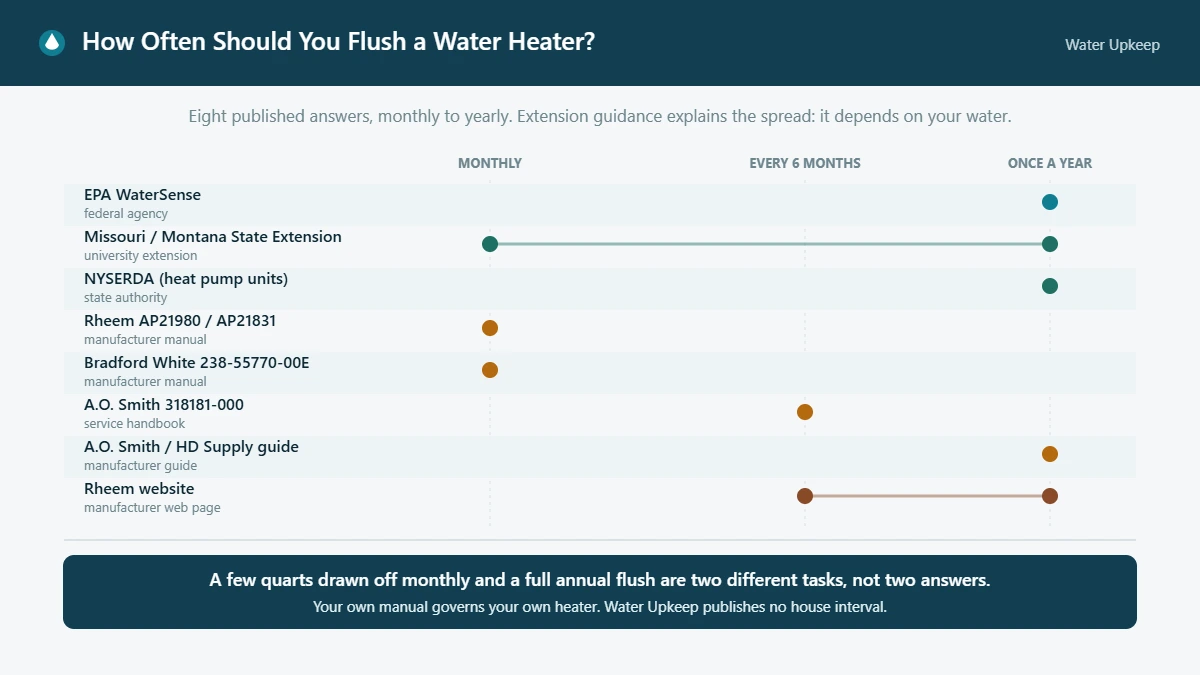
The EPA’s WaterSense program recommends flushing a water heater once a year “to reduce sediment buildup which can decrease efficiency.” But there is no universal interval. Extension guidance says the right frequency depends on how hard your water is, and the manufacturers’ own manuals range from a few quarts drawn off every month to a full flush every six months — including two different answers from the same manufacturer. Your own manual governs your own heater. And before any of that: the New Jersey Department of Health strongly recommends hiring a licensed plumber for this job, and names groups of people who should not do it at all.
Who should not do this job
This belongs at the top rather than in a footnote. The New Jersey Department of Health publishes guidance on draining and flushing water heaters, and it includes an exclusion:
Individuals at increased risk (e.g., individuals who are ≥50 years old, smoke, have a weakened immune system, have chronic lung disease, or have underlying health conditions) should not participate in draining and flushing activities.
That is the department’s recommendation in the department’s own words, and we are neither extending it nor explaining it. If you are in one of those groups, hire the job out. The same document adds that “it is strongly recommended to hire a licensed or qualified plumber,” and that “you must refer to original manufacturer’s instructions.” EPA says something similar in its own maintenance guidance: “it may be best to hire a professional to service your home’s water heater at least once a year.”
If you are going to do it yourself, New Jersey’s guidance recommends wearing protective goggles and heavy-duty rubber gloves, and keeping children and pets clear of the working area.
The short answer, and why there isn’t a single number
The most useful sentence anyone publishes on this comes from university extension work by Montana State University Extension and the University of Wyoming, distributed by the University of Missouri Extension:
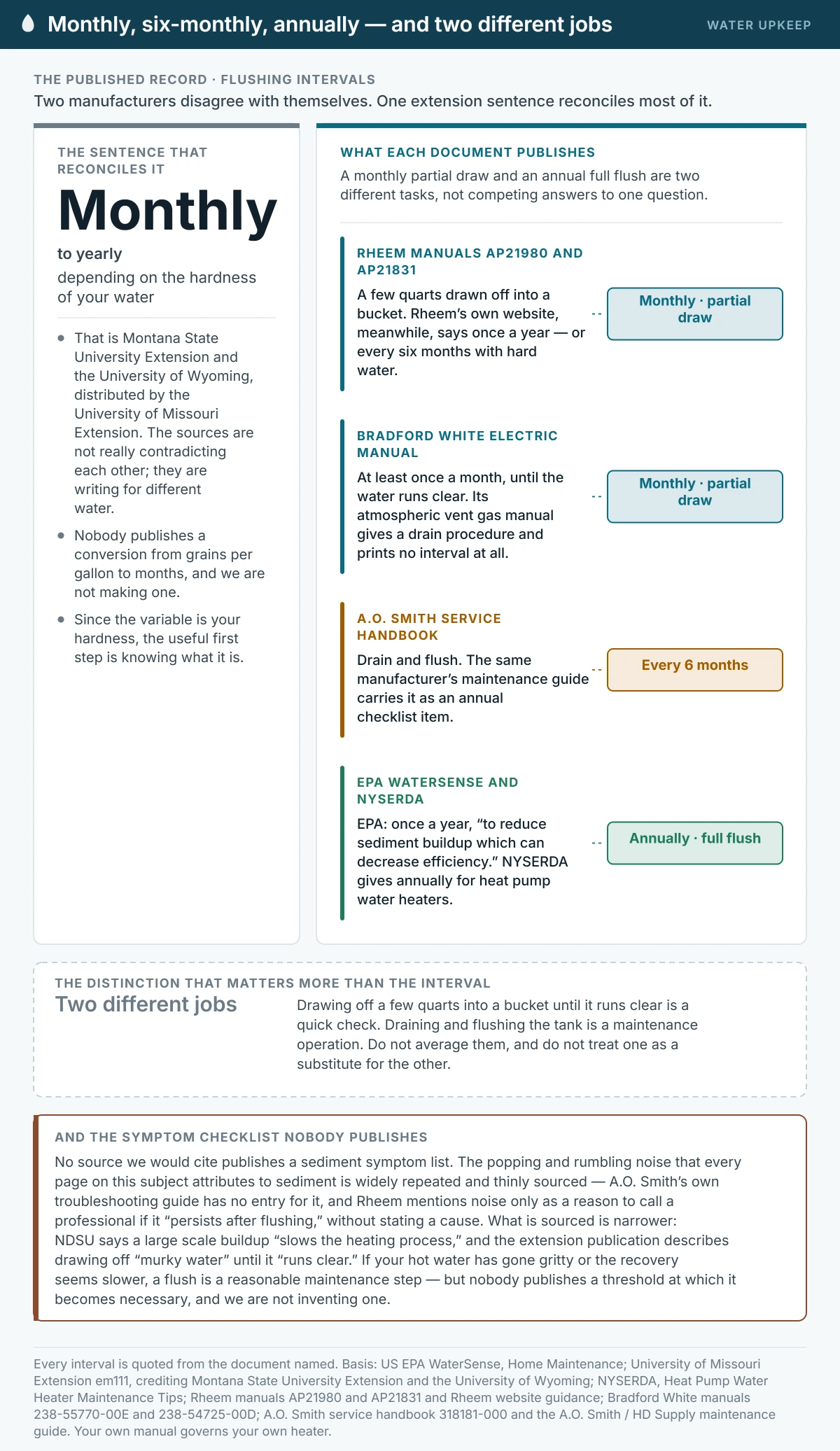
In some areas, depending on the hardness of the water, monthly flushing is recommended, and in others the tank need only be flushed once a year.
That reconciles most of the apparent disagreement below. The sources are not really contradicting each other; they are writing for different water. Here is every interval we could find, with the document it came from.
| Source | Type | What it says | Full flush or partial draw? |
|---|---|---|---|
| EPA WaterSense, Home Maintenance | Federal agency | Once a year | Flush |
| University of Missouri Extension em111 (crediting Montana State and Wyoming) | University extension | Monthly to yearly, depending on hardness | Partial draw described |
| NYSERDA, heat pump water heater fact sheet | State authority | Annually (heat pump water heaters) | Drain |
| Rheem AP21980 (electric) and AP21831 (gas) use and care manuals | Manufacturer manual | A few quarts every month | Partial draw |
| Bradford White 238-55770-00E, electric | Manufacturer manual | At least once a month, until the water runs clear | Partial draw |
| A.O. Smith 318181-000 service handbook | Manufacturer service handbook | Every 6 months | Drain and flush |
| A.O. Smith / HD Supply maintenance guide | Manufacturer guide | Annual checklist item | Drain and flush |
| Rheem website guidance | Manufacturer web guidance | Once a year, or every 6 months with hard water | Flush |
| Bradford White 238-54725-00D, atmospheric vent gas | Manufacturer manual | Drain procedure given, no interval printed | — |
Two things worth pulling out of that table. First, Rheem’s manuals say monthly and Rheem’s own website says annually; A.O. Smith’s service handbook says six months and A.O. Smith’s maintenance checklist is annual. That is not sloppy research on our part — it is what the documents say. Second, and more usefully: a monthly partial draw and an annual full flush are two different tasks, not competing answers to one question. Drawing off a few quarts into a bucket until it runs clear is a quick check. Draining and flushing the tank is a maintenance operation. Do not average them, and do not treat one as a substitute for the other.
Since the variable is your hardness, the useful first step is knowing what it is: see how to test water hardness. NDSU’s own advice on the subject is simply “always have your water tested and base any treatment on those results.”
What the sediment actually is, and why hard water makes it
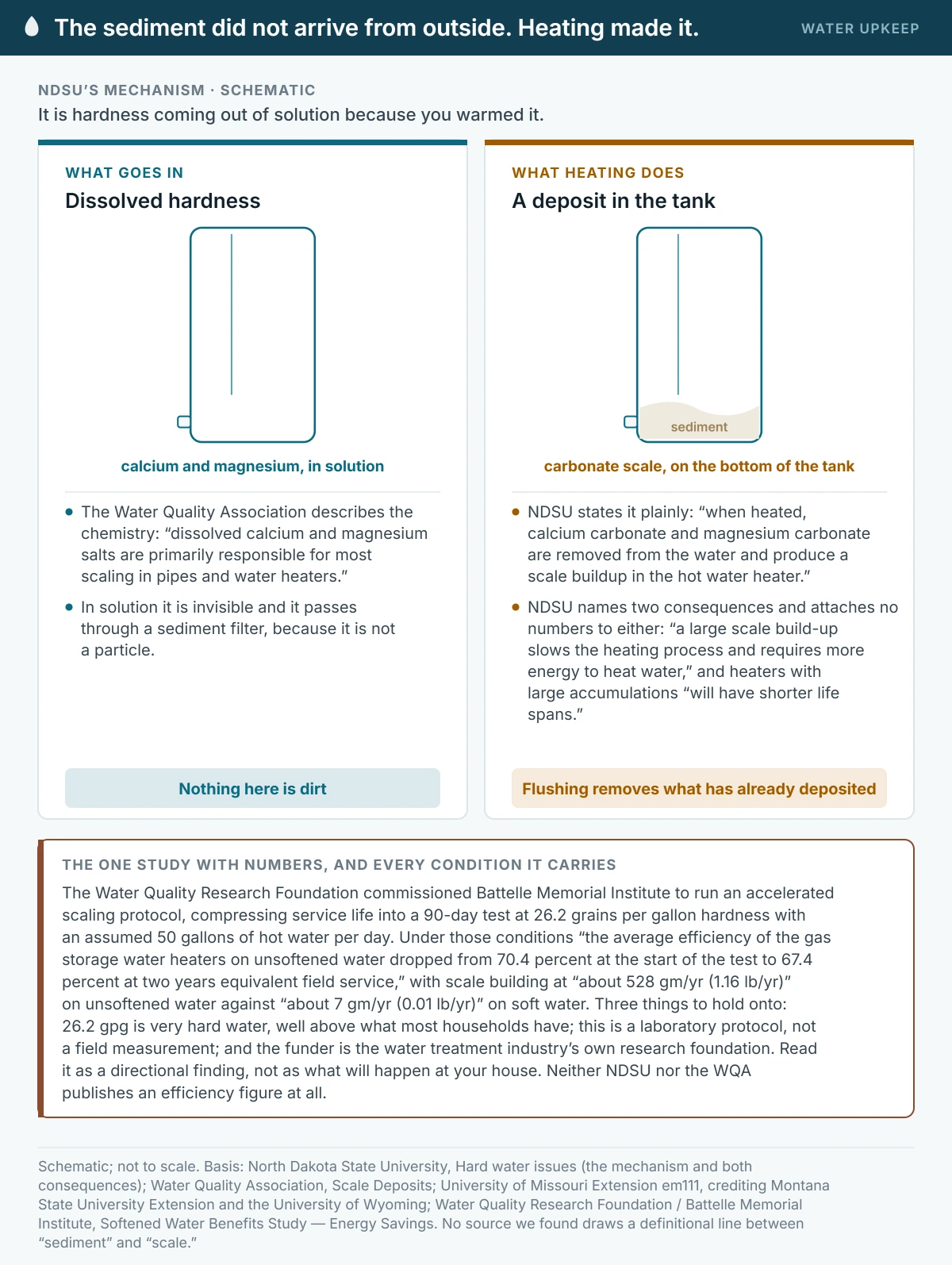
This is the connection that almost nothing else written on this subject makes. North Dakota State University states the mechanism plainly: “when heated, calcium carbonate and magnesium carbonate are removed from the water and produce a scale buildup in the hot water heater.” Heating the water is what causes the deposit. It is not dirt arriving from outside; it is hardness coming out of solution because you warmed it.
NDSU names two consequences, and attaches no numbers to either: “a large scale build-up slows the heating process and requires more energy to heat water,” and “water heaters with large accumulations of mineral build-up will have shorter life spans.” The Water Quality Association describes the same chemistry — “dissolved calcium and magnesium salts are primarily responsible for most scaling in pipes and water heaters” — and likewise publishes no efficiency figure.
Note that no source we found draws a definitional line between “sediment” and “scale.” The extension publication uses them as one phrase — “sediment and scale — dirt and mineral deposits from the water — build up over time inside your water tank” — and so do we.
There is one laboratory study that puts numbers on the efficiency question, and it needs all of its conditions attached. The Water Quality Research Foundation commissioned Battelle Memorial Institute to run an accelerated scaling protocol, compressing service life into a 90-day test at 26.2 grains per gallon hardness with an assumed 50 gallons of hot water per day. Under those conditions, “the average efficiency of the gas storage water heaters on unsoftened water dropped from 70.4 percent at the start of the test to 67.4 percent at two years equivalent field service,” and the rate of scale buildup was “about 528 gm/yr (1.16 lb/yr)” on unsoftened water against “about 7 gm/yr (0.01 lb/yr)” on soft water. Three things to hold onto: 26.2 gpg is very hard water, well above what most households have; this is a laboratory protocol, not a field measurement; and the funder is the water treatment industry’s own research foundation. Read it as a directional finding, not as what will happen at your house.
Sediment is not purely an efficiency matter, either. OSHA — a workplace authority, and the framing matters — states that “water heaters maintained below 60°C (140°F) and that contain scale and sediment may foster Legionella growth.” The temperature half of that sentence is a subject in its own right, with genuinely conflicting guidance behind it, and it is covered in what temperature a water heater should be set to. We are not going further with it here.
The same water that deposits in the tank is what leaves marks on your fixtures — see how to remove hard water stains — and the upstream question of whether to treat it at all is how to treat hard water.
Signs your heater may have a sediment problem
Here we have to be honest about a gap. No source we would cite publishes a sediment symptom checklist. The popping and rumbling noise that every page on this subject attributes to sediment is widely repeated and thinly sourced; A.O. Smith’s own troubleshooting guide has no entry for it at all. Rheem mentions noise only in one context — as a reason to call a professional if it “persists after flushing” — and does not state a cause.
What is sourced is narrower and less satisfying: NDSU says a large scale buildup “slows the heating process,” and the extension publication describes drawing off “murky water” until it “runs clear.” That is the extent of what anyone credible publishes as an observable sign. If your hot water has gone gritty or cloudy, or the recovery seems slower than it used to be, a flush is a reasonable maintenance step — but nobody publishes a threshold at which it becomes necessary, and we are not going to invent one.
If you have not established whether your water is hard in the first place, start at how to tell if you have hard water.
How to flush a water heater
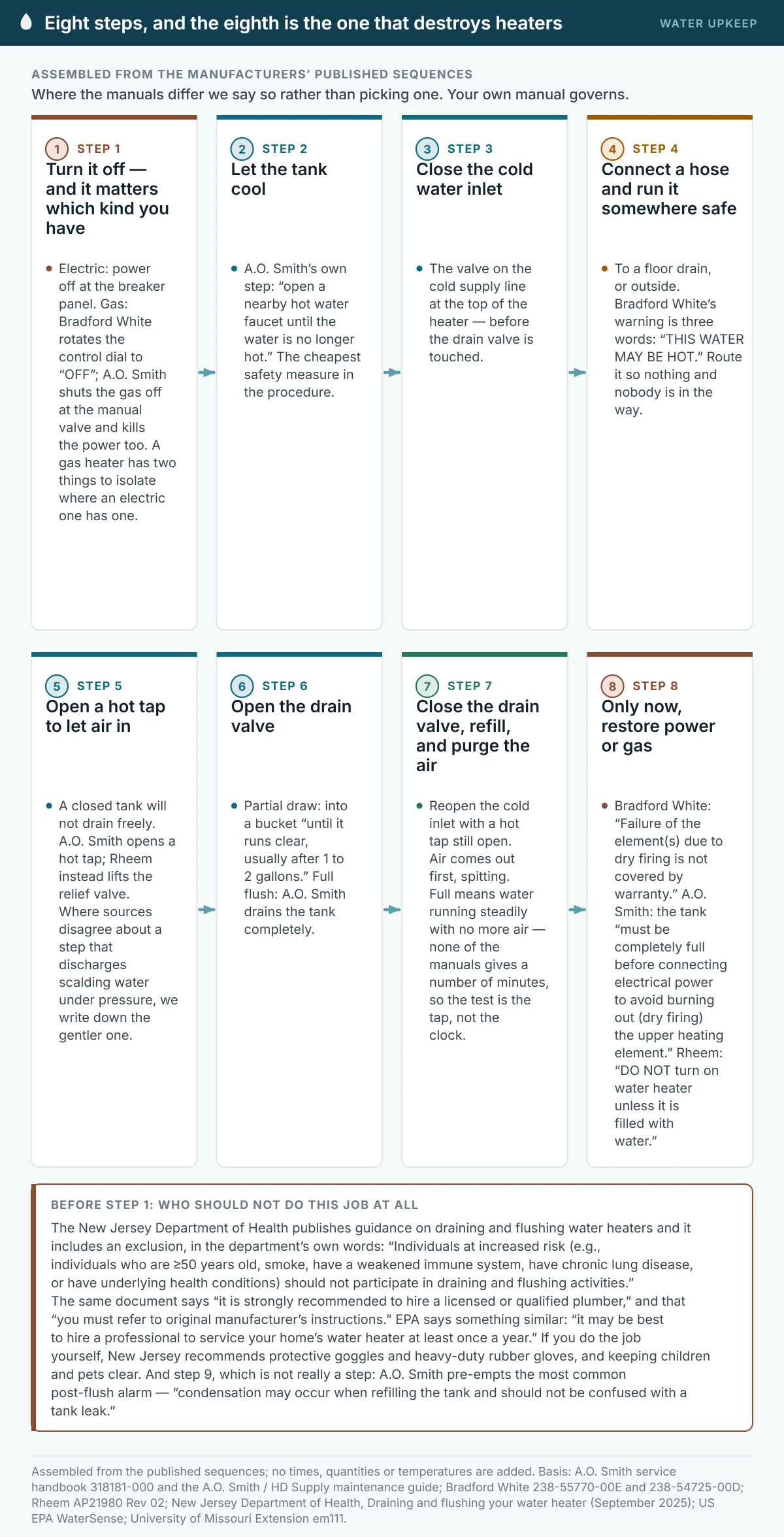
What follows is assembled from the manufacturers’ published sequences, and where they differ we say so rather than picking one. Your own manual governs. You will need a garden hose, somewhere safe for hot water to discharge, a bucket, and the goggles and heavy-duty rubber gloves New Jersey’s guidance recommends.
Step 1: Turn it off — and it matters which kind you have
Electric. Power off at the breaker panel, before anything else. Rheem’s manual: “CAUTION: Shut off power to the water heater before draining water.” Isolation happens at the panel, on the outside of the appliance — do not open any access panel on the heater.
Gas. The manuals differ here and you should follow yours. Bradford White’s atmospheric vent gas manual: “rotate the gas control dial counterclockwise to the ‘OFF’ position.” A.O. Smith’s service handbook: “turn off the gas to the water heater at the manual gas shut-off valve and turn off the electrical power.” A.O. Smith’s maintenance guide allows either: “turn power off or set control to ‘pilot’ before performing maintenance.” A gas heater has two things to isolate where an electric one has one, and “turn off the water heater” is not a single instruction that covers both.
Turning the gas control dial to OFF or to the pilot setting, as your manual directs, is the only gas action described on this page. Nothing else about the gas side — the burner, the flue, the vent, the thermocouple, the manual shut-off valve beyond the fact that some manuals name it — is a homeowner task here. And if the pilot goes out and you are not certain how your model relights, that is where the job ends: call a licensed plumber or your gas utility.
On an electric heater, the power stays off until the tank is completely full again. That is not a general caution; it is a specific, warranty-relevant rule, and it comes back in full at step 8.
Step 2: Let the tank cool
A.O. Smith’s own step, quoted: “open a nearby hot water faucet until the water is no longer hot.” The tank is holding water at whatever the thermostat is set to. Running it down before you open anything is the single cheapest safety measure in the whole procedure.
Step 3: Close the cold water inlet
The valve on the cold supply line at the top of the heater. A.O. Smith and Bradford White both put this immediately after isolation and before the drain valve is touched.
Step 4: Connect a hose and run it somewhere safe
To a floor drain, or outside. Bradford White’s warning is short and worth taking literally: “THIS WATER MAY BE HOT.” Route the hose so that discharging water cannot reach a person, a pet, or anything that will be damaged, and keep children and pets clear of the area.
Step 5: Open a hot tap to let air in
A closed tank will not drain freely. A.O. Smith’s sequence opens a hot water faucet for this. Rheem’s published homeowner sequence instead has you lift the pressure relief valve. Those are two different methods and we are describing the faucet one, for a reason Bradford White’s own manual gives: “when lifting lever of the combination temperature and pressure relief valve, hot water will be released under pressure. Be careful that any released water does not result in bodily injury or property damage.” Where sources disagree about a step that discharges scalding water under pressure, the gentler one is the one we will write down. If your own manual tells you to use the relief valve, follow your manual.
Step 6: Open the drain valve
For a partial draw, the extension guidance is to “open the valve and let the murky water drain into a bucket until it runs clear, usually after 1 to 2 gallons.” Bradford White’s monthly instruction is the same idea: drain “until the water runs clear.”
For a full flush, A.O. Smith’s handbook says to “open the water heater drain valve and allow all the water to drain from the tank.” Some sequences then briefly reopen the cold inlet to stir up what is left and drain again; that is a step you should take from your own manual rather than from us.
Step 7: Close the drain valve, refill, and purge the air
Close the drain valve, disconnect the hose, then reopen the cold water inlet with a hot tap still open upstairs. Air will come out of that tap first, spitting and sputtering. The tank is full when water runs steadily and smoothly from the open hot tap with no more air. Then close the taps. We are not giving you a number of minutes for this, because none of the manuals does — the test is the tap, not the clock.
Step 8: Only now, restore power or gas
This is the step that damages heaters, and three manufacturers say the same thing about it in three separate documents.
- Bradford White: “Complete failure of the heating element(s) will result if they are not always immersed in water. Failure of the element(s) due to dry firing is not covered by warranty.”
- A.O. Smith / HD Supply: “Tank must be completely full before connecting electrical power to avoid burning out (dry firing) the upper heating element.”
- Rheem: “DO NOT turn on water heater unless it is filled with water.”
The upper element is the one that gets exposed first as the tank empties, which is why A.O. Smith names it specifically. The destructive moment is not the draining — it is switching the breaker back on before the tank has refilled. For a gas heater the failure mode is different and the sources do not describe elements, but the same handling applies: A.O. Smith’s guide says to “make sure water heater is completely full of water before returning to service,” and the restart itself follows your manual.
Step 9: Condensation is normal
A.O. Smith pre-empts the most common post-flush alarm: “condensation may occur when refilling the tank and should not be confused with a tank leak.” A cold tank filling in a warm room sweats. Give it a while before you conclude anything.
A word about the relief valve
EPA’s maintenance guidance includes it: “at least once a year, check the temperature and pressure valve to make sure it functions correctly.” Rheem’s manual says the same in more detail — “at least once a year, lift and release the lever handle on the temperature pressure relief valve, located near the top of the water heater, to make certain the valve operates freely.”
We are not writing that up as a procedure, because the same manufacturers warn that lifting the lever discharges hot water under pressure and can cause injury or property damage. What we will tell you about the valve is what the documents establish: it is a safety device built to ANSI Z21.22/CSA 4.4, it is factory-installed and must stay in the opening provided for it, its discharge must be piped to an adequate drain and pitched to drain by gravity, and — in A.O. Smith’s words on its own installation diagram — it must not be capped or plugged. If a relief valve drips or will not reseat after being touched, that is a plumber’s job, not a tap-it-and-see one.
When to stop and call a plumber
Stop and call a licensed plumber if the drain valve will not open or will not close, if you see rust, corrosion or any leak that is not condensation on a refilling tank, if the relief valve drips after you touch it, if the pilot goes out and you are not certain how your model relights, if the heater is old enough that Rheem’s own guidance would have you call someone — 8 to 12 years or more — or if you are, in Rheem’s words, “unsure about handling gas or electrical components.” Rheem also notes that older systems with hardened sediment may need specialized tools, and routes those straight to a professional. And if you are in one of the groups the New Jersey Department of Health names as being at increased risk, do not do this job at all: hire it out.
Some things we have deliberately left out because they cannot be made safe in written form: removing or replacing the anode rod, removing a heating element to break up hardened deposits, replacing a failed drain valve, circulating acid or any descaling chemical through a tank heater, and relighting a pilot. A heater in an attic, a crawl space, or a closet with no floor drain is also a good reason to hire the job rather than improvise a workaround.
On cost, we have exactly one figure and it is narrow: the New Jersey Department of Health, in guidance dated September 2025, puts hiring a plumber for this at $75 to $250 depending on heater type. That is a state agency’s estimate for New Jersey. It is not a national figure and it is not ours.
Flushing itself is maintenance and nothing we read suggests it needs a permit. But the relief valve’s discharge piping, the heater’s installation, its venting and thermal expansion control are all code-governed, and the applicable code varies by jurisdiction — there is no single national plumbing code in the United States. Any change to any of those is a licensed plumber and your local authority having jurisdiction. Rheem’s own manual wording is the right instinct: contact a licensed plumber or the local plumbing authority for further information.
What flushing does not fix
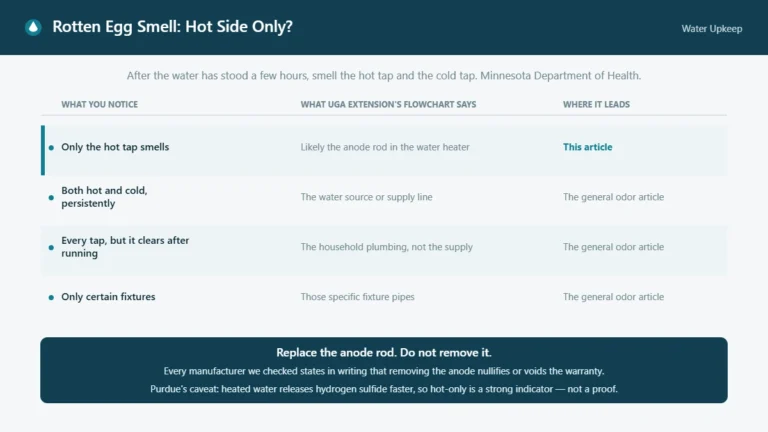
- The anode rod. It is on the manufacturers’ maintenance checklists, and NYSERDA suggests checking its condition every one to three years on a heat pump water heater. It is also a plumber’s job and a separate subject — see why only the hot water smells like sulfur.
- The temperature setting. Different question, genuinely conflicting guidance behind it: what temperature a water heater should be set to.
- The hardness itself. Flushing removes what has already deposited; it does nothing about the water arriving tomorrow. That is how to treat hard water, and if you are considering equipment, what a water softener costs covers the drivers.
- A sediment filter will not help either. A hard water filter catches particles; it does not remove the dissolved calcium and magnesium that come out of solution when you heat the water. Different problem, different equipment.
- A tank that has already failed. Rust, corrosion or a real leak is a replacement conversation, not a maintenance one.
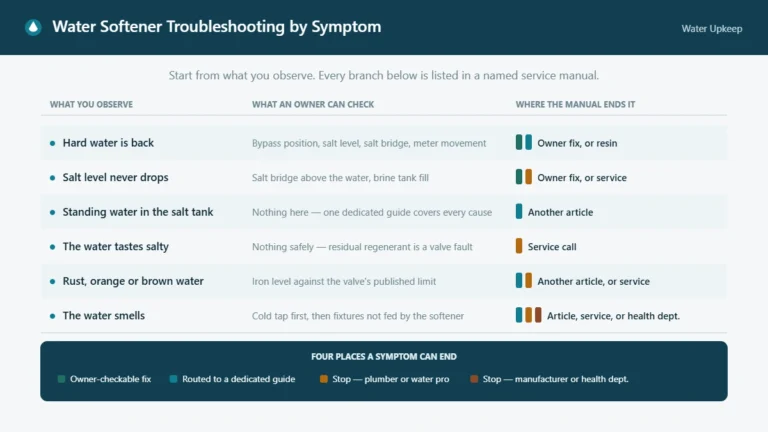
If you have a softener as well, its own routine is in water softener maintenance.
Frequently asked questions
How often should I really flush my water heater?
EPA WaterSense says once a year. Your manual may say something different — Rheem’s manuals ask for a few quarts monthly, Bradford White’s electric manual asks for a monthly draw until clear, and A.O. Smith’s service handbook says every six months. Extension guidance explains the spread: it depends on how hard your water is. Follow your own manual.
Does hard water mean I have to flush more often?
That is what the sources indicate, though none of them defines a hardness number that triggers a particular interval. Extension guidance says the interval depends on hardness; Rheem’s website says “once per year for most homes, or every 6 months if you have hard water.” Nobody publishes a conversion from grains per gallon to months, and we are not making one.
Is it bad to flush an old water heater?
Rheem treats age as a reason to call someone rather than proceed: it lists a unit that is 8 to 12 years old or more among its reasons to get professional help, and warns that hardened sediment in older systems may require specialized tools. That is Rheem’s caution about when to hire out the work; it is not a statement about how long water heaters last.
Do I have to turn the power off to flush an electric water heater?
Yes, and it has to stay off until the tank is full again. Bradford White: “complete failure of the heating element(s) will result if they are not always immersed in water,” and that failure is not covered by warranty. A.O. Smith names the upper element specifically, because it is the first one exposed as the tank drains.
Why does my water heater still make noise after flushing?
We cannot tell you, and neither can any source we would cite — no manufacturer troubleshooting guide we read carries an entry for heater noise. Rheem treats noise that persists after a flush as a reason to call a professional, and that is the honest answer here too.
Can I flush a tankless water heater the same way?
No. Servicing a tankless unit’s heat exchanger is descaling, which is a different operation with different equipment and chemicals, and it is outside what this page covers. Use your manufacturer’s instructions.
Is the water coming out of the drain valve dangerous?
It is at whatever temperature your thermostat is set to, and Bradford White’s manual says exactly that in three words: “THIS WATER MAY BE HOT.” Cool the tank first by running a hot tap until the water is no longer hot, route the hose somewhere safe, and wear the goggles and gloves New Jersey’s guidance recommends.
Should I check the anode rod at the same time?
It is on the manufacturers’ own maintenance checklists, so a professional service visit will normally cover both. It is not a step we describe, because it means opening a hot pressurized vessel with a large socket and there is a warranty consequence for getting it wrong. See why only the hot water smells like sulfur for what the anode is doing.
Sources and standards
- US EPA WaterSense — Home Maintenance
- New Jersey Department of Health — Draining and flushing your water heater (September 2025)
- University of Missouri Extension em111 — E3A: Energy Management for Home, crediting original work by Montana State University Extension and the University of Wyoming
- North Dakota State University — Hard water issues
- NYSERDA — Heat Pump Water Heater Maintenance Tips
- OSHA — Legionellosis: Control and Prevention (a workplace authority)
- Water Quality Association — Scale Deposits, and the Water Quality Research Foundation’s Softened Water Benefits Study — Energy Savings, performed by Battelle Memorial Institute
- Colorado State University Extension Fact Sheet 10.637 — Water Heating in Colorado Homes
- Rheem (manufacturer documentation) — Electric Residential use and care manual AP21980 Rev 02 and How often to flush your water heater
- Bradford White (manufacturer documentation) — Electric water heater installation and operation manual 238-55770-00E and Atmospheric vent gas manual 238-54725-00D
- A.O. Smith (manufacturer documentation) — Service handbook 318181-000 and the A.O. Smith / HD Supply maintenance and troubleshooting guide
Last reviewed September 9, 2026.