How Much Is a Water Softener? What Actually Drives the Price
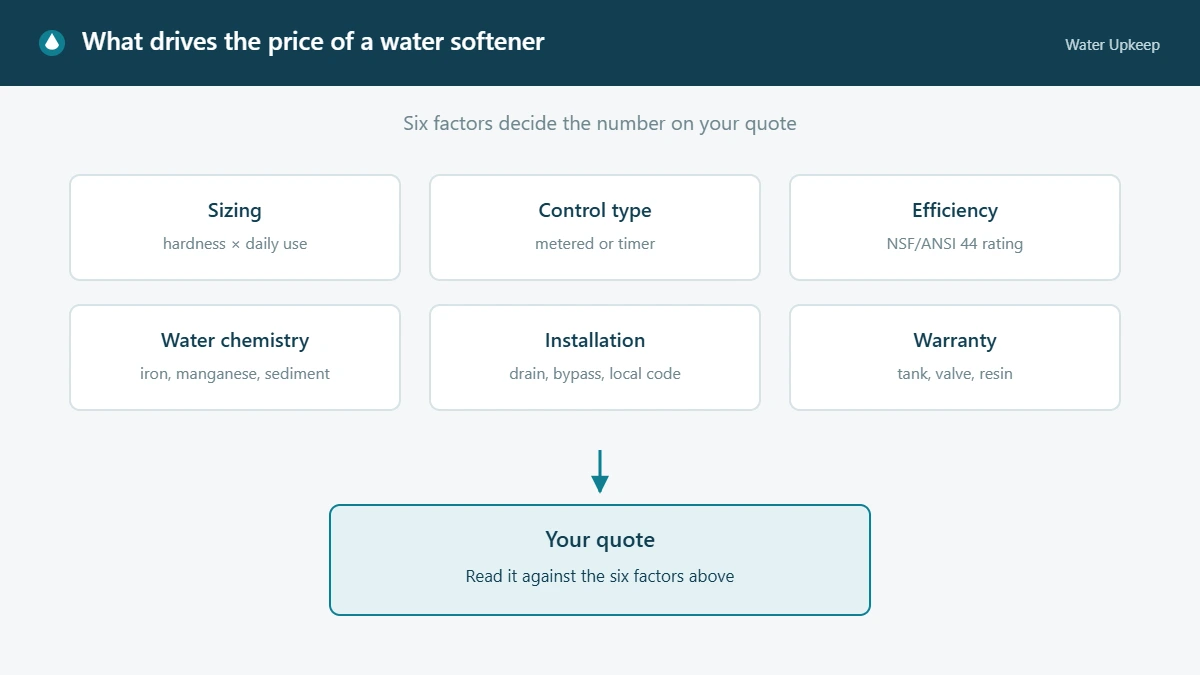
There is no single price for a water softener, and any figure quoted without knowing your water is a guess. What a softener costs you depends on four things you can actually measure: how hard your water is, how much water your household uses, how the unit decides when to regenerate, and what else is in your water that has to be dealt with first. This guide explains each of those, so you can read a quote and know whether the number in front of you is reasonable.
Why there is no single price
A water softener is not a fixed product. It is a system sized to a specific house, and two homes on the same street can need meaningfully different equipment if one draws from a private well and the other from a municipal supply. Published averages tend to blur together retail units, mid-range systems and full dealer installations, which is why they vary so widely and why they are a poor basis for a decision.
We do not publish price figures on this site. Federal and university sources that we treat as authoritative on water treatment do not survey residential prices, and the figures that circulate online come almost entirely from companies selling installations. Instead, the useful thing we can do is explain exactly what moves the number, so you can evaluate a quote on its merits.
What determines the size you need?
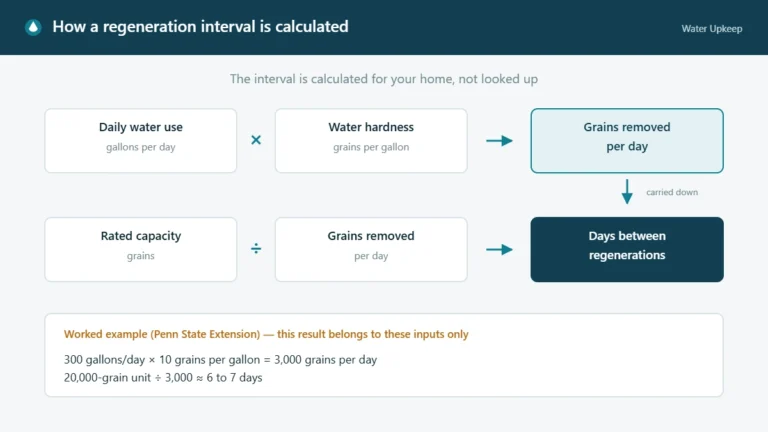
Sizing is the single largest driver of cost, and it is arithmetic rather than opinion. Penn State Extension sets it out as a straightforward calculation.
Your water hardness
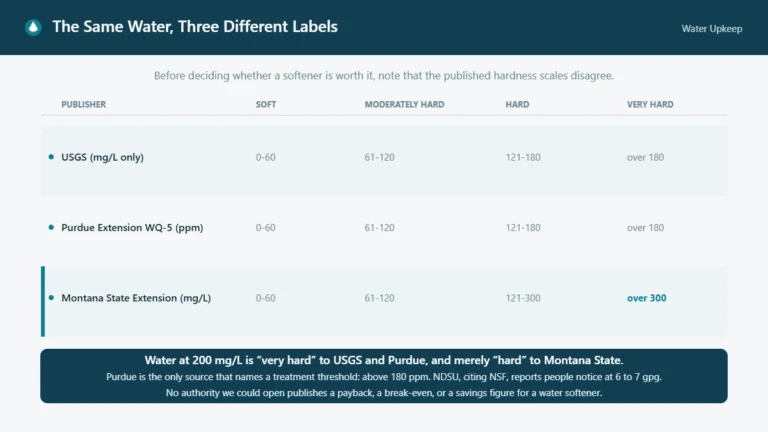
Hardness is dissolved calcium and magnesium, and it is commonly expressed in grains per gallon for softener sizing. The US Geological Survey notes that hardness is a property of water that is not a health concern, though it can be a nuisance. For sizing purposes it is simply an input: the harder the water, the more work the resin does per gallon.
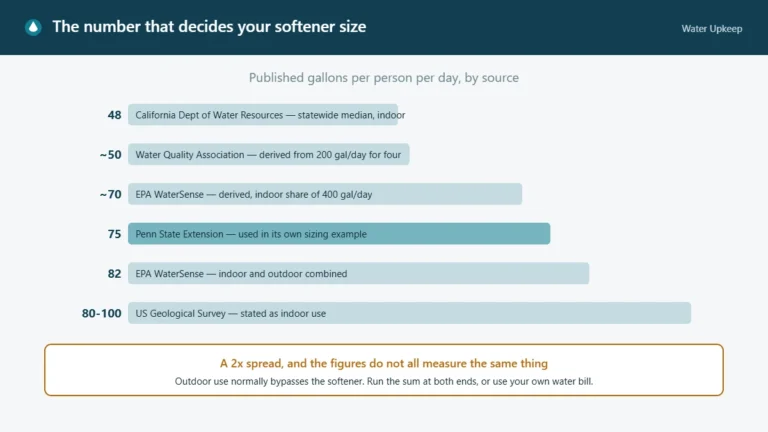
Your household’s water use
More people, or more water-using appliances, means more gallons passing through the resin each day. Multiply your daily household water use in gallons by your hardness in grains per gallon, and you have the grains of hardness the softener has to remove every day.
Rated grain capacity
Every softener carries a rated grain capacity. Divide that capacity by your grains-per-day figure and you get the number of days the unit can run before it needs to regenerate. Undersize the unit and it regenerates constantly, consuming more salt and water. Oversize it and you have paid for capacity you will not use.
Grain capacities are model-specific. Treat any capacity figure as belonging to the particular unit a supplier is quoting, not as a general rule for a household of your size.
How the control type changes what you pay to run it
Softeners differ in how they decide that it is time to regenerate, and this affects running cost more than most buyers expect. NDSU Extension describes four arrangements:
- Semiautomatic — you start the regeneration cycle manually; the unit completes it.
- Timer or automatic — regeneration runs on a fixed clock schedule.
- Demand-initiated regeneration (DIR), also called metered — the unit tracks the water actually treated and regenerates when capacity is genuinely used up.
- Off-site exchange service — a service provider swaps out the resin tank periodically.
A timer regenerates on schedule whether or not the capacity has been used. If you travel, or your usage varies week to week, that is salt and water spent for nothing. Demand-initiated control avoids that by measuring instead of assuming, which is why EPA’s WaterSense programme treats demand-initiated regeneration as the more efficient arrangement.
Salt and water efficiency under NSF/ANSI 44
There is a published efficiency standard, and it gives you a concrete thing to ask about. Under NSF/ANSI 44, a softener carrying an efficiency rating must remove at least 3,350 grains of hardness per pound of salt and use no more than 5.0 gallons of water per 1,000 grains of hardness removed.
Those two numbers are worth carrying into a showroom. A unit certified against that rating is making a testable claim about how much salt and water it consumes for the work it does. A unit that is not certified is not making that claim at all.
What you will keep spending after installation
Three inputs continue after the system is in: salt, water and a small amount of electricity for the control head.
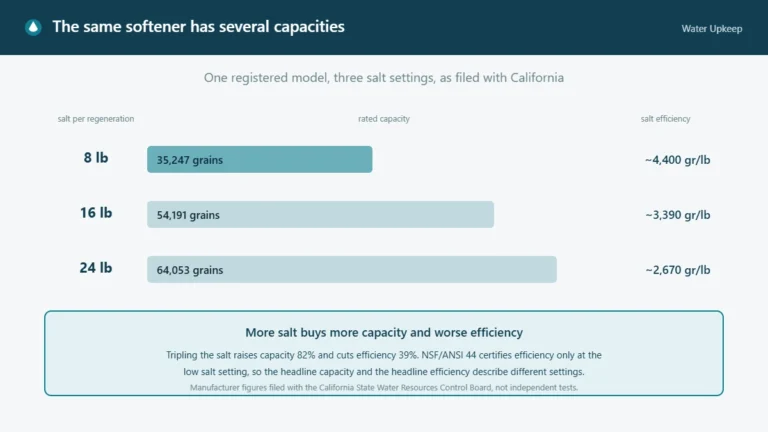
Water use per regeneration typically falls in the range of 20 to 70 gallons, and can reach around 200 gallons on large systems. That is a range rather than a figure because it depends on the unit and its settings. Salt consumption is tied to the salt dose, which is adjustable: a higher dose gives more capacity from each regeneration but a worse grains-per-pound efficiency. That trade-off is worth understanding before someone sets it for you.
What your water chemistry adds
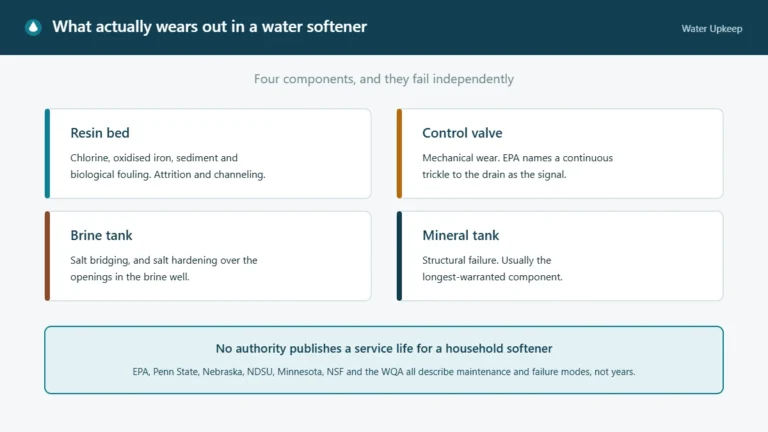
Hardness is rarely the only thing in the water. Iron, manganese or sediment may need to be dealt with ahead of the softener, because they can foul the resin. That means additional equipment, and it is a common reason two quotes for the same house differ. Private wells run into this more often than municipal supplies, since nobody is treating the water before it reaches you.
What installation actually involves
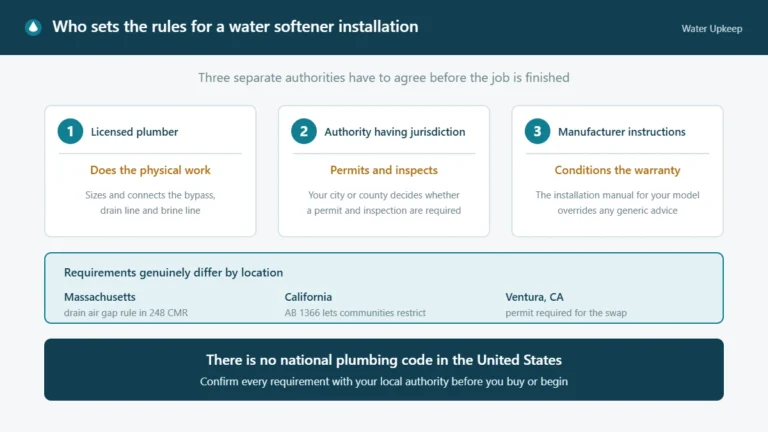
A softener needs a tie-in to the incoming water line, a drain connection to carry brine away, and a bypass valve so the unit can be isolated for service. Brine discharge is regulated: it must meet local plumbing code, and some jurisdictions place restrictions on softener discharge. This is licensed-plumber work, and the requirements are local rather than national.
How to read a water softener quote
Once you know what drives the price, a quote becomes readable. These are the items worth checking on any proposal:
| What to check | Why it matters |
|---|---|
| Rated grain capacity | Should follow from your measured hardness and household water use, not from a household-size rule of thumb. |
| Control type | Metered or demand-initiated versus a fixed timer. This drives ongoing salt and water use. |
| NSF/ANSI 44 certification | Ask whether the unit is certified, and specifically whether it carries the efficiency rating. |
| Warranty terms | Tank, control valve and resin are often warranted for different periods. Ask for each separately. |
| What installation includes | Drain connection, bypass valve, and whether permits or code compliance are the installer’s responsibility. |
| Pretreatment | Whether iron, manganese or sediment removal is required, and whether it is in the quote or extra. |
Test your water before you buy anything
Hardness in grains per gallon is the input that drives sizing, and sizing drives the price. A quote produced without a hardness figure is an estimate built on an assumption. If you are on a municipal supply, your utility’s annual water quality report often lists hardness. If you are on a private well, you will need to have the water tested, and a test will also reveal whether iron or manganese are going to require pretreatment.
You can read more about the equipment options in our water softeners guide, about whether a softener is worth it for your household, and about establishing what is in your water in our water testing guide.
When to bring in a professional
Sizing, installation and the drain connection are jobs for a licensed plumber or a qualified water treatment professional, and local plumbing code governs how brine discharge is handled. If a unit is under warranty, adjusting its settings is normally a dealer or technician task rather than something to do yourself. Our maintenance and repair guide covers what owners can reasonably handle and what should be handed over.
Sources and standards
- Penn State Extension — Water Softening. Sizing calculation and regeneration principles.
- US EPA WaterSense — Water Softeners technical sheet. NSF/ANSI 44 efficiency rating figures and demand-initiated regeneration.
- NDSU Extension — Water Softening (Ion Exchange). Control types and system operation.
- US Geological Survey — Hardness of Water. Hardness as a nuisance rather than a health concern.
- NSF International — Standards for Water Treatment Systems. What certification to a standard covers.
Water Upkeep does not sell or install water treatment equipment and does not conduct product testing. Every figure above is drawn from the published sources listed.
Last reviewed September 18, 2026.