Are Water Softeners Worth It?
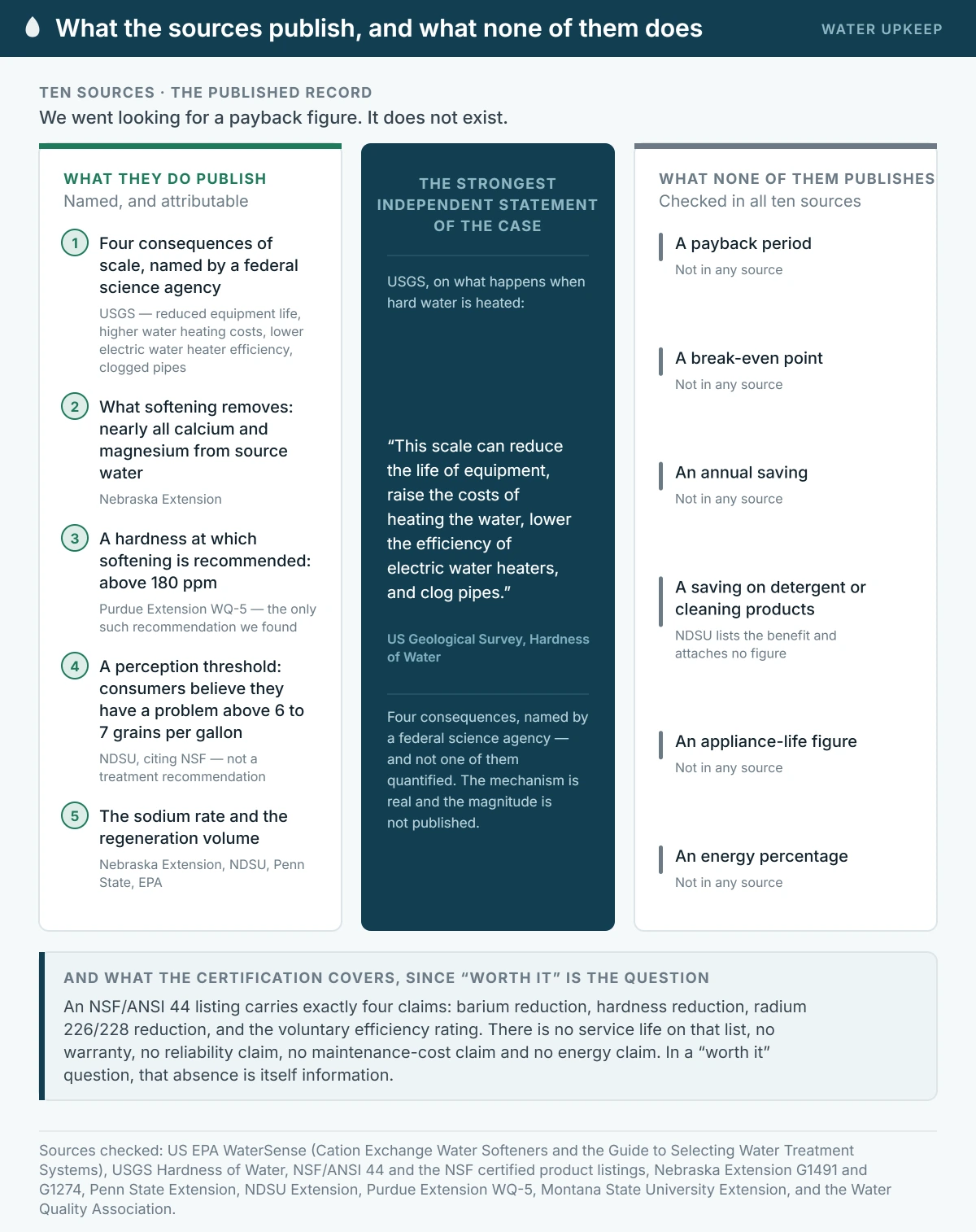
Start with the finding that shapes everything else on this page: no authority we could open publishes a payback figure for a water softener. Not EPA, not USGS, not NSF, not the Water Quality Association, not one extension service. There is no break-even period, no annual saving, no “pays for itself in three years.” The pages that give you one made it up.
What the sources do publish is enough to make the decision anyway: a hardness level at which one extension service recommends softening, an honest list of what softening delivers and what it does not, the running costs in kind, and three constraints that can make the answer no regardless of your hardness. Here is all of it.
The number you came for does not exist
We went looking specifically for a payback, a break-even, a saving on detergent, an appliance-life figure, or an energy percentage. Here is what each source publishes instead.
| Source | What it publishes on the economics |
|---|---|
| EPA WaterSense, Cation Exchange Water Softeners | Softeners “can help protect appliances and make water more appealing.” No figure. |
| EPA WaterSense, home water treatment guide | An efficiency rating and selection advice. No savings figure. |
| USGS, Hardness of Water | Four named consequences of scale, with no number attached to any of them. |
| NSF/ANSI 44 | Four certified claims, none of them economic. |
| Nebraska Extension G1491 and G1274 | Sodium rate and regeneration volume. No economics. |
| Penn State Extension | “Protects appliances and saves cleaning time.” No figure. |
| NDSU Extension | A benefit list. No payback, no savings, no appliance-life figure. |
| Purdue Extension WQ-5 | A hardness threshold recommendation. No economics. |
| Montana State Extension | Trade-offs described qualitatively. No economics. |
| Water Quality Association | Mechanism and septic compatibility. No economics. |
Note what USGS does say, because it is the strongest independent statement of the case for softening anywhere: when hard water is heated, “solid deposits of calcium carbonate can form. This scale can reduce the life of equipment, raise the costs of heating the water, lower the efficiency of electric water heaters, and clog pipes.” Four consequences, named by a federal science agency — and not one of them quantified. That is the shape of the honest answer: the mechanism is real and the magnitude is not published.
We publish no dollar figures on this site for softeners, and that is not evasion — it is that nothing in the evidence supports one. The variables that move a price are covered in what a water softener costs.
Start with your hardness — and note that the scales disagree
NDSU’s advice is the right first move: “always have your water tested and base any treatment on those results.” The procedure is in how to test water hardness, and if you are not yet sure you have a hardness problem at all, how to tell if you have hard water.
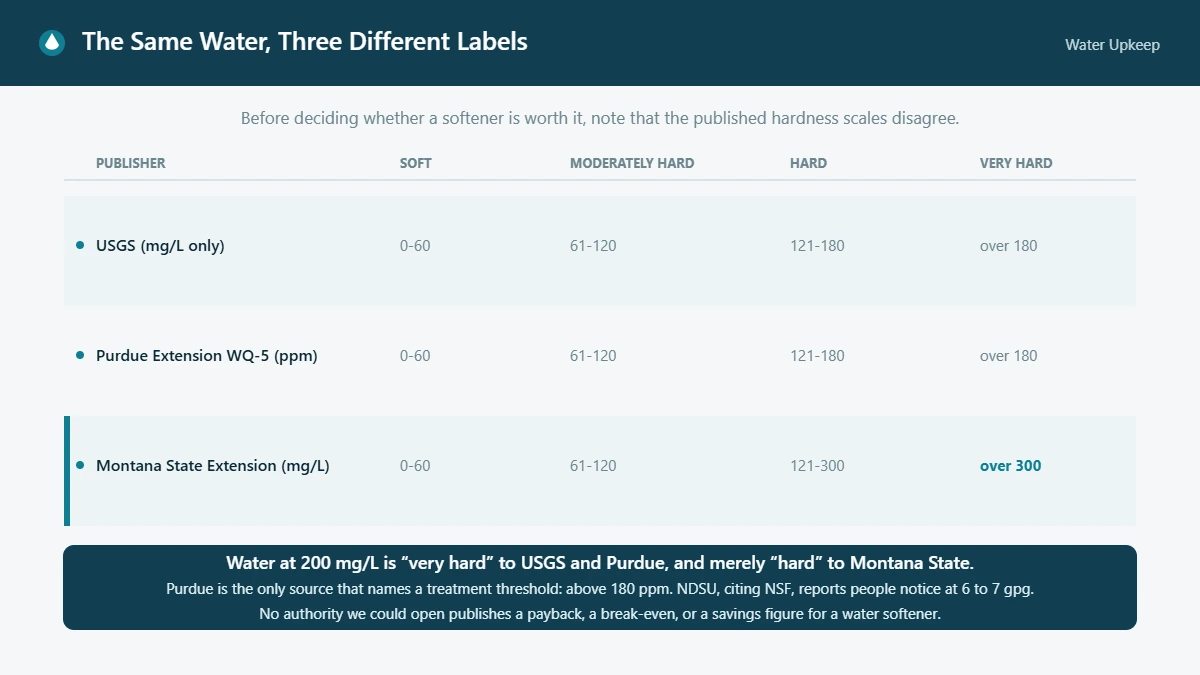
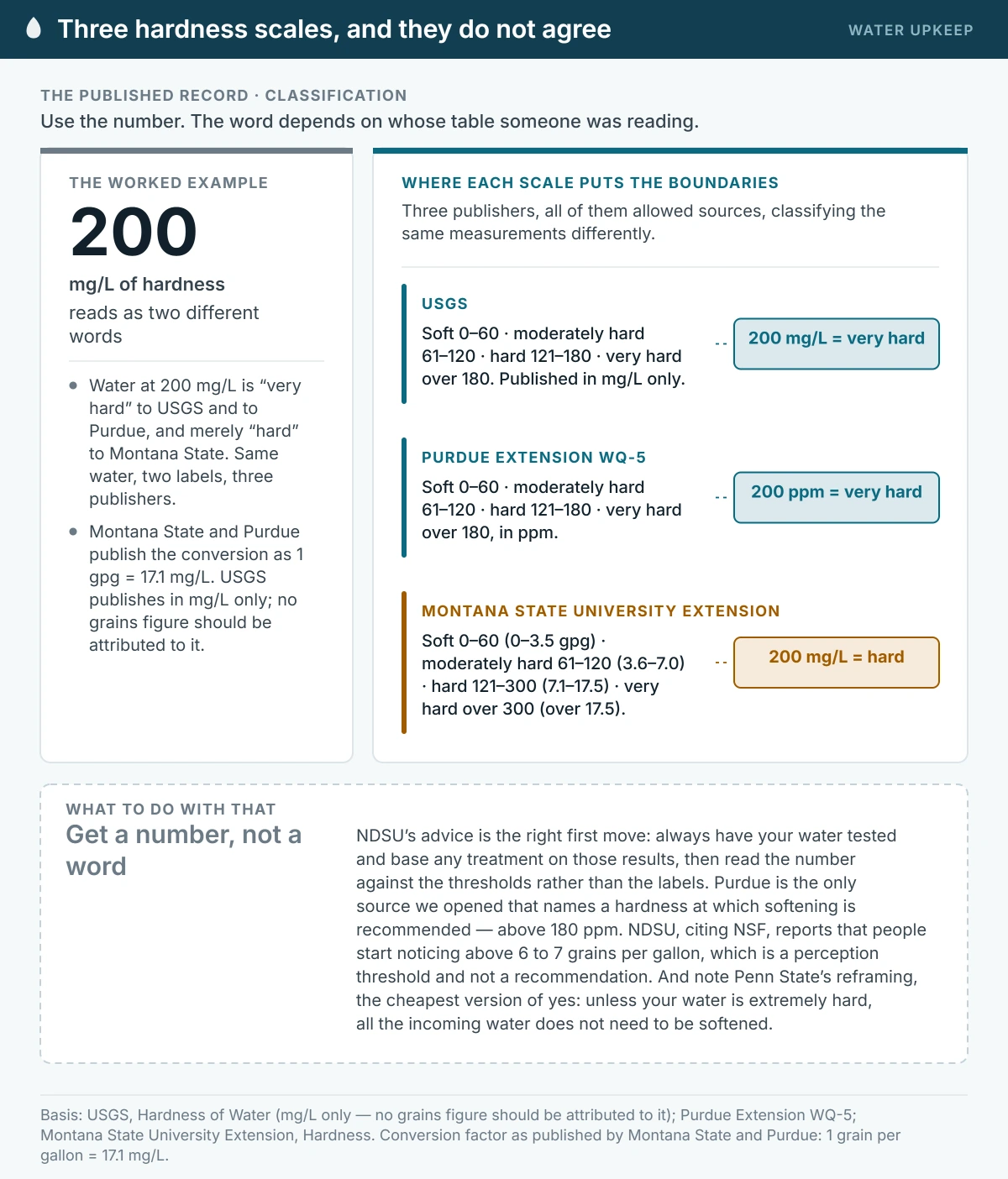
Then read your number against these three published scales — and notice that they do not agree.
| Publisher | Soft | Moderately hard | Hard | Very hard |
|---|---|---|---|---|
| USGS (mg/L only) | 0–60 | 61–120 | 121–180 | over 180 |
| Purdue Extension WQ-5 (ppm) | 0–60 | 61–120 | 121–180 | over 180 |
| Montana State Extension (mg/L, with gpg) | 0–60 (0–3.5 gpg) | 61–120 (3.6–7.0 gpg) | 121–300 (7.1–17.5 gpg) | over 300 (over 17.5 gpg) |
Water at 200 mg/L is “very hard” to USGS and Purdue, and merely “hard” to Montana State. Same water, two labels, three publishers. So a result described as “very hard” tells you which table someone was reading as much as it tells you about your water. Use the number, not the word.
On units: Montana State gives the conversion as 1 grain per gallon = 17.1 mg/L, and Purdue publishes the same factor as “gpg x 17.1 = ppm.” Note that USGS publishes its scale in mg/L only and no grains figure should ever be attributed to it.
Two thresholds, and they measure different things
Purdue Extension is the only source we opened that names a hardness at which softening is recommended: “the general recommendation is water with hardness greater than 180 ppm should be conditioned with a water softener.” That is Purdue’s recommendation, in Purdue’s words.
NDSU publishes a different kind of number entirely, attributed to NSF: “consumers believe they have a problem when hardness surpasses the 6 to 7 grain per gallon level.” That is not a treatment recommendation — it is a statement about when people start noticing. Both are useful, and confusing them is easy.
Penn State declines to give a threshold and reframes the question instead: “recognize that unless your water is extremely hard, all the incoming water does not need to be softened.” That is worth holding onto, because it converts a yes-or-no decision into a how-much decision — and it is the cheapest version of yes.
What softening delivers, and what it does not
| What it does | What it does not do |
|---|---|
| Removes hardness. Nebraska Extension: the process “can remove nearly all calcium and magnesium from source water.” | Nebraska Extension, in full: “water softening does not remove bacteria, hydrogen sulfide, silt or sand, lead, nitrate, pesticides, and many other organic and inorganic compounds.” |
| Stops soap scum. USGS: in hard water “soap reacts with the calcium… to form ‘soap scum’.” | Not a health treatment. EPA: “some water hardness is generally not a health hazard.” |
| Addresses scale in pipes and water heaters. WQA: dissolved calcium and magnesium salts “are primarily responsible for most scaling in pipes and water heaters.” | Not a purifier. If your concern is contaminants rather than hardness, see well water filtration and what a water purifier is. |
| NDSU’s benefit list: “cleaner, softer-feeling clothes,” “longer life of appliances including washing machine, dishwasher and water heater,” “less use of household cleaning products, such as detergents.” | NDSU attaches no figure to any of those, and neither will we. |
EPA’s own verb is the ceiling on how strongly anyone should state the case: softeners “can help protect appliances and make water more appealing to people who live in areas with hard water.” Note also that EPA’s WaterSense program does not currently label water softeners at all.
The mechanism itself — what ion exchange actually is — is covered in how water softeners work, and the underlying distinction in the difference between hard and soft water.
What the certification does and does not cover
If a softener is certified, it is certified to NSF/ANSI 44, and the listing carries exactly four claims: barium reduction; hardness reduction, meaning “published capacity ratings for reducing hardness have been verified”; radium 226/228 reduction; and efficiency rated, defined as achieving “a minimum of 3,350 grains of hardness removed per pound of regenerant salt” and using “5 gallons or less of regenerant water per 1,000 grains.”
Look at what is not on that list: no service life, no warranty, no reliability claim, no maintenance-cost claim, no energy claim. In a “worth it” question, that absence is itself information. And EPA is explicit that the efficiency rating is voluntary — it advises buyers to “identify a model with demand-initiated regeneration that has a lower water consumption… and higher salt efficiency.”
What it costs you in kind
Since the dollar figures are not published, here is what a softener actually consumes and requires — which is what you are really deciding about.
Salt, permanently
A softener is a device you buy bags of salt for, forever, and physically carry them to wherever the brine tank lives. No source we opened publishes pounds of salt per year, per month or per household, so we cannot tell you how many bags. What is published: NSF/ANSI 44’s efficiency threshold of at least 3,350 grains of hardness removed per pound of salt, and NDSU’s note that “about 10% more potassium chloride salt is used during the backflush operation” if you use potassium chloride instead of sodium chloride.
Water, on two non-comparable measures
Nebraska Extension: “approximately 50 gallons of water… is used to regenerate a water softener.” Penn State: “estimates indicate that about 50 gallons of water are used for each regeneration cycle.” EPA WaterSense: “the process of regeneration can use 25 gallons of water or more per day, or up to 10,000 gallons per year.”
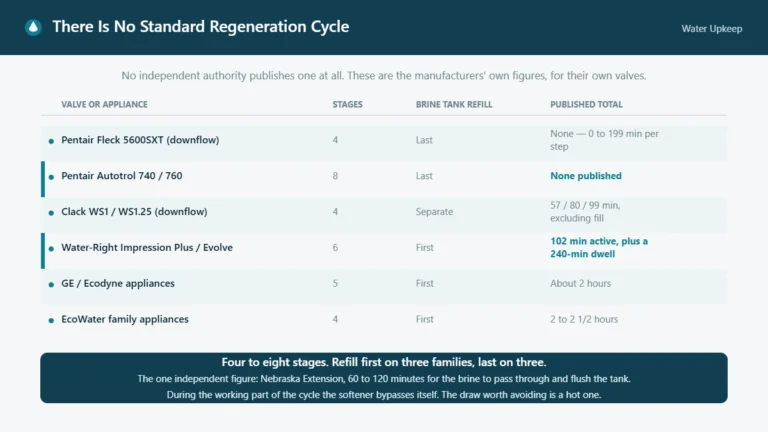
Those are not the same measurement expressed two ways. A per-cycle figure and a per-day or per-year figure describe different equipment under different assumptions, and blending them produces a number nobody published. Take them as two independent indications that a softener has a real and recurring water cost. How long an individual cycle actually runs is a separate question, covered in how long regeneration takes.
Somewhere for the water to go
Regeneration produces a discharge, and it has to go somewhere permitted. That is a feasibility question before it is a plumbing question, and in some places it is a legal one — EPA’s guide notes plainly that “some local jurisdictions have restrictions on the installation and use of these systems.”
California is the worked example. Water Code section 13148 is an enabling statute, not a statewide ban, and its four scope conditions all travel together: it applies only in named hydrologic regions and counties; only local agencies that own or operate a community sewer system or water recycling facility may act; it covers only appliances that “discharge brine into a community sewer system,” so not septic; and a local agency may act only after a regional board has made a finding at a public hearing that controlling residential salinity input will help achieve water quality objectives. The full treatment of where a drain line may legally go is in where a water softener drain line can discharge; the physical installation requirements are in how to install a water softener.
The practical version: check your local rules before you buy, not after.
The sodium question
Softening adds sodium at a rate, and that rate is meaningless without its denominator. Three sources publish it; a fourth publishes it on a different volume basis entirely.
| Source | What it publishes |
|---|---|
| Nebraska Extension G1491 | “Sodium is added to water at a rate of about 8 mg/L for each grain per gallon (gpg) of hardness.” |
| Nebraska Extension G1274 | Attributing to WQA: the process “adds sodium at the rate of about 8 mg/liter for each grain of hardness removed per gallon of water.” |
| NDSU Extension | “For every grain of hardness removed from water, about 8 mg/1 (ppm) of sodium is added.” |
| Penn State Extension | “The exchange of hardness minerals for sodium adds 7.5 milligrams per quart for each gpg of hardness removed.” |
Penn State’s figure is expressed per quart, not per liter. We are publishing both as they were published and not converting one into the other.
Penn State calls the sodium question “the major disadvantage to water softening,” in the context of people on low-sodium diets. Nebraska Extension describes physicians advising some individuals “not to install water softeners, to soften only hot water, or to bypass the water softener with a cold water line,” and notes that drinking and cooking with softened water “is often avoided by having a cold water line to the kitchen tap that bypasses the water softener.”
That is what the sources say, and we are not going further. We are not telling you whether softened water is appropriate for anyone in your household. If that is a live question for you, the person to ask is a clinician — and the bypass arrangement the extension services describe is a real option to raise with them, and with your plumber.
One more sodium consequence worth knowing before you buy: Nebraska Extension states that “it is not recommended to repeatedly use softened water for plants, lawns or gardens due to the sodium content.” If your outside taps run on softened water, that is a plumbing question you would rather answer before installation than after.
Septic systems: a genuine three-way disagreement
If you are on septic, this may be the constraint that decides it — and the published positions do not agree, on two different mechanisms.
| Source | Position |
|---|---|
| University of Missouri Extension | Asked three questions about whether softeners hurt septic tanks, its answer is “(1) no, (2) no, and (3) no.” It found the increased sodium “was actually helpful to the bacterial organisms in the septic tank,” that backwash volume “was easily within the limits of what the septic tank could handle,” and that an undersized tank or heavy use of drain cleaners is more likely to disrupt operation. |
| Water Quality Association | “When water softeners are operated properly and efficiently, they have no negative impact on septic systems and may improve performance” — with the condition that “when a water softener is set very inefficiently or regeneration wastes are diverted, there could be negative consequences.” WQA adds: “it is important to be aware of, and adhere to, any local codes and regulations regarding the discharge of water softeners.” |
| Montana State Extension | “In areas with clayey soils, the sodium discharged in the recharging process can increase the risk of septic drainfield failure.” |
| Nebraska Extension G1491 | “Regeneration does place additional load on a septic system.” |
| Penn State Extension | “If you own a septic system, you should consider the additional load on your drainage field from backwashing and regeneration.” |
Two distinct mechanisms are in play and they are worth separating. Nebraska and Penn State are describing a hydraulic load — extra volume through the drainfield. Montana State is describing a salinity and soil mechanism, specific to clayey soils. Missouri and WQA are rebutting both, with the condition that the softener is set efficiently.
We are not going to adjudicate that. What it means practically is that the answer depends on your septic system, your soil and how efficiently the unit is set — and those are questions for your local health department or septic authority, before you buy.
So: how to decide
- Get a number. Test, or read your utility’s report. A word like “hard” is not a number, and the scales disagree about what it means.
- Read it against the published thresholds. Purdue recommends softening above 180 ppm. NDSU reports people start noticing around 6 to 7 grains per gallon. Below both, the case is weak.
- Check the constraints before the benefits. Somewhere to put it, somewhere for the discharge to go, your local rules, your septic system if you have one, and anyone in the household for whom the sodium is a question. Any one of these can make the answer no.
- Decide how much to soften. Penn State’s point — you may not need all the incoming water softened — is the cheapest yes available, and it also solves the outside-tap and drinking-water questions in one move.
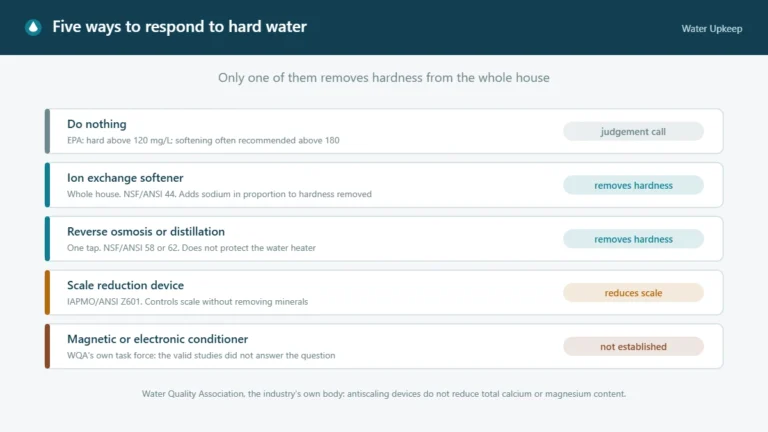
- Then choose an approach. If the answer is yes, how to treat hard water covers the options; if the answer is “maybe, but not with salt,” salt-free water softeners is the honest place to start reading before you assume they do the same job. Sizing comes after the decision, in what size softener you need.
And if the real problem turns out to be marks on your fixtures rather than hardness in your plumbing, cleaning is a cosmetic fix rather than a treatment decision — see how to remove hard water stains. If it is something other than hardness altogether, hard water filters explains what a filter does and does not do here.
Frequently asked questions
How long does a water softener take to pay for itself?
No authority we could open publishes a payback, a break-even or a savings figure — not EPA, USGS, NSF, WQA, or any of five extension services. USGS names four consequences of scale without quantifying any of them. That is the state of the published evidence, and any specific payback number you find elsewhere was not derived from it.
At what hardness is a softener worth it?
Purdue Extension’s recommendation is above 180 ppm. NDSU, citing NSF, reports that consumers “believe they have a problem when hardness surpasses the 6 to 7 grain per gallon level” — a perception threshold, not a treatment recommendation. And remember that USGS, Purdue and Montana State classify the same numbers differently.
Will a softener make my water safer to drink?
No. Nebraska Extension’s list is explicit: softening “does not remove bacteria, hydrogen sulfide, silt or sand, lead, nitrate, pesticides, and many other organic and inorganic compounds.” EPA notes that hardness itself “is generally not a health hazard.”
How much sodium does softened water contain?
There is no single figure, because it is a rate that depends on your hardness: about 8 mg/L for each grain per gallon removed, per three extension sources, or 7.5 mg per quart per grain per gallon in Penn State’s different formulation. Whether that matters for someone in your household is a question for their clinician.
Can I have a softener with a septic system?
The published positions disagree — Missouri Extension and WQA say a properly operated softener does no harm, Montana State flags a sodium risk in clayey soils, and Nebraska and Penn State both note the additional hydraulic load. Ask your local health department or septic authority about your system and your soil.
Are salt-free systems a way to get the benefit without the cost?
That is a real fork in the decision and it deserves its own reading rather than a sentence here — see salt-free water softeners, which addresses what those devices do and how it differs from ion exchange.
What does it cost to run one?
In kind: salt as a permanent consumable, water used in regeneration on two non-comparable published measures, and a drain. We publish no dollar figures for softeners, because nothing in the evidence base supports one. For the variables that move a purchase price, see what a water softener costs.
Sources and standards
- USGS — Hardness of Water
- US EPA WaterSense — Cation Exchange Water Softeners and the Guide to Selecting Water Treatment Systems
- NSF — NSF/ANSI 44 technical requirements, the certified product listings, and home water treatment system selection
- Purdue Extension WQ-5 — Water Softening
- Nebraska Extension — G1491, Water Softening (Ion Exchange) and G1274, Drinking Water Treatment and Sodium
- Penn State Extension — Water Softening
- NDSU Extension — Water Softening (Ion Exchange) and Hard Water Issues
- Montana State University Extension — Hardness
- University of Missouri Extension — Do Water Softeners Hurt Septic Tanks?
- Water Quality Association — Scale Deposits and the Water Softeners and Septic Systems white paper
- California Water Code — section 13148
Last reviewed September 8, 2026.