How Long Water Softener Regeneration Takes
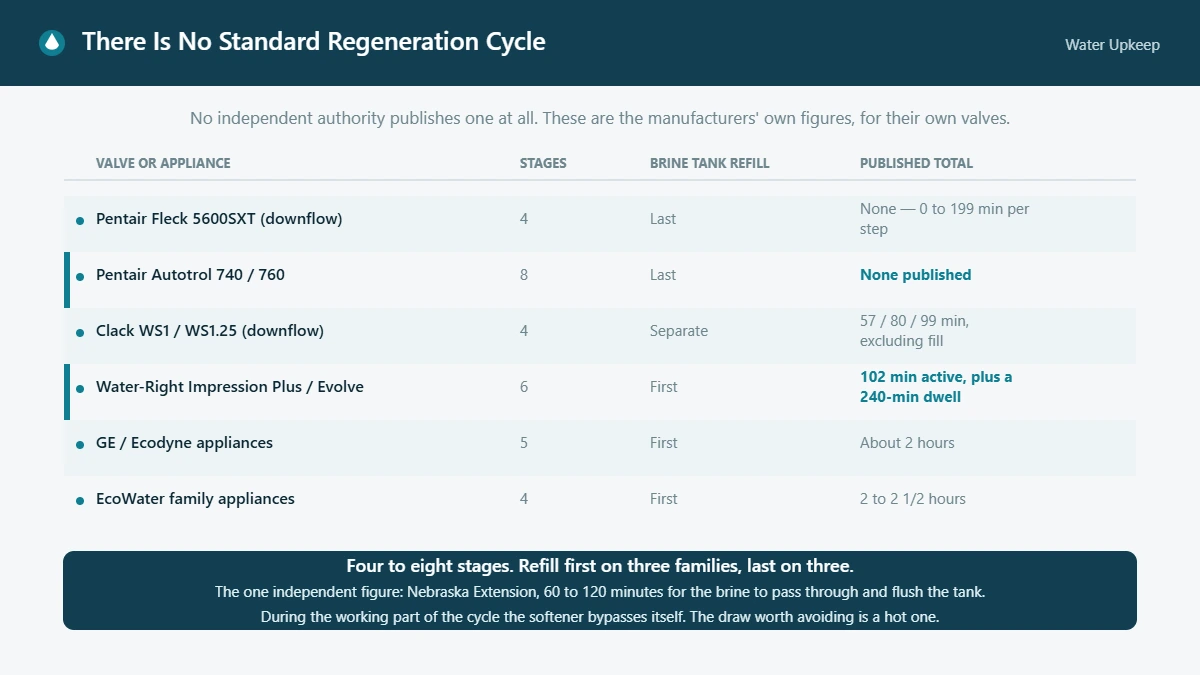
There is no single answer, and the reason is more interesting than the number. No independent authority publishes a water softener regeneration cycle at all — not EPA, not NSF, not the Water Quality Association, not one state health department or extension service. Everything you can find about stages and durations comes from the manufacturers, and the manufacturers do not agree with each other: the number of published stages runs from four to eight, the brine tank refill comes first on three families and last on three others, and the two most common control valves in American homes publish no duration at all — only an adjustable range.
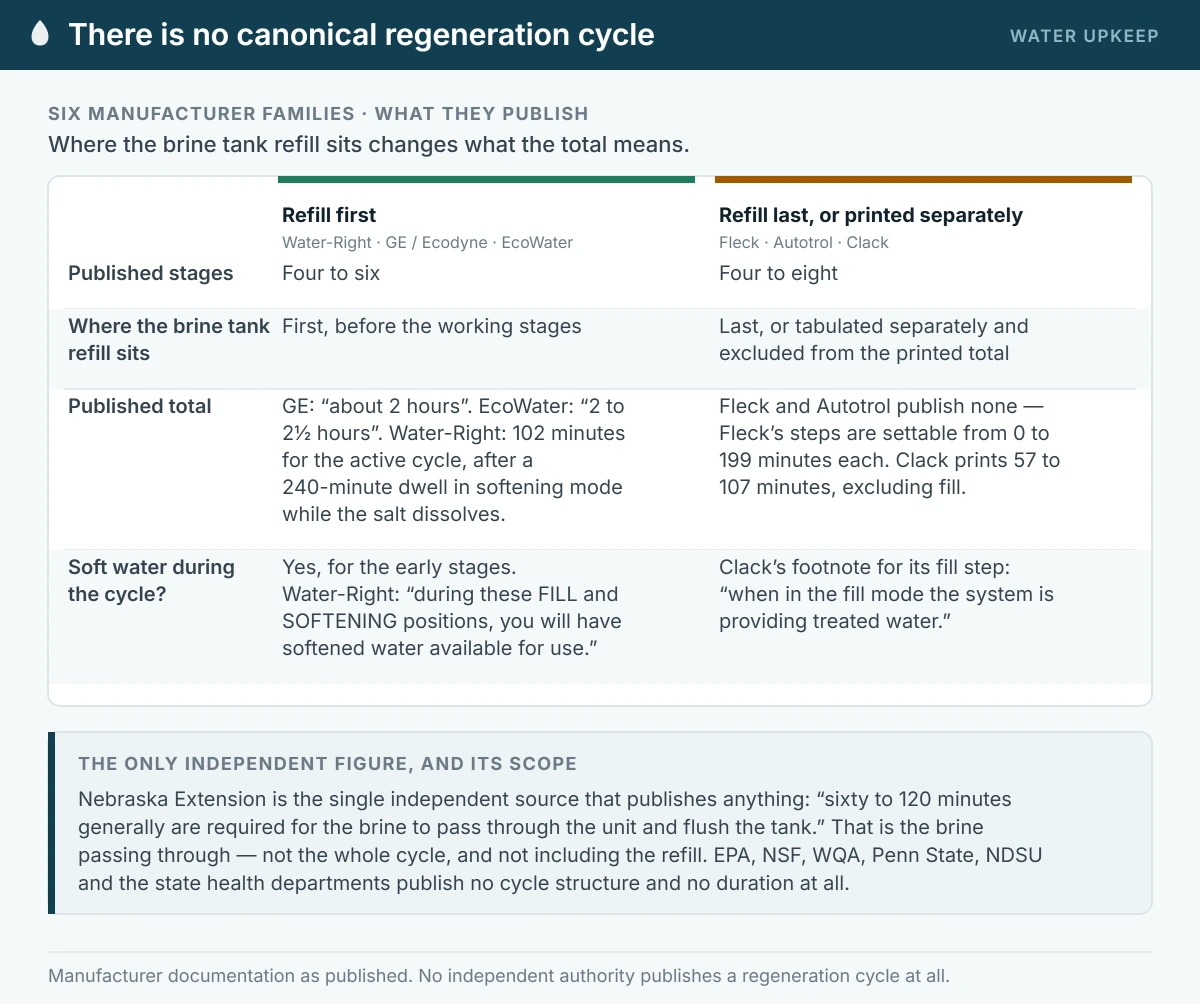
The one independent figure that exists is narrower than it looks. Nebraska Extension says “sixty to 120 minutes generally are required for the brine to pass through the unit and flush the tank.” That is the brine passing through — not the whole cycle, and not including refill.
And the answer to the question behind the question — can I use water while it does this? — is the same across five manufacturers: yes, but it will be untreated, and the one thing worth avoiding is a hot draw.
What the independent sources publish: nothing
We opened each of these individually and searched specifically for a cycle breakdown — stage names, their order, or any per-stage duration.
- EPA WaterSense describes what regeneration is for — the softener “undergoes a regeneration process to flush the system of excess ions and recharge with new sodium ions” — and gives a water-use figure, but no stages and no duration.
- NSF/ANSI 44‘s scope covers “softening capacity and rinse effectiveness” and “accuracy of the brine system.” Nothing on cycle structure or time.
- The Water Quality Association‘s ion exchange fact sheet says only that the resins “can be regenerated… and used over and over.” It publishes nothing on backwash, brine concentration, rinse steps or duration.
- Penn State Extension describes the process in one sentence — resin is backwashed with a salt solution, the brine is reverse flushed through the system — with no stage list and no time.
- NDSU, Minnesota Department of Health, Purdue, Montana State and the University of Minnesota Water Resources Center: nothing on cycle structure or duration.
The single exception is Nebraska Extension G1491, and its sentence is worth quoting in full because the scope is easy to lose: “sixty to 120 minutes generally are required for the brine to pass through the unit and flush the tank” before soft water returns. That is a figure for one part of the process. It excludes the brine tank refill on every valve, and on the valves that refill first it excludes a dwell of several hours while the salt dissolves.
So everything below is manufacturer documentation, and every minute in it carries the name of the valve or appliance it belongs to.
There is no canonical regeneration cycle
| Manufacturer / valve | Published stages | Where the refill sits | Published total |
|---|---|---|---|
| Pentair Fleck 5600SXT (downflow, dF1b) | 4 — backwash, brine and slow rinse, rapid rinse, brine tank fill | Last | None published. Each step is settable from 0 to 199 minutes |
| Pentair Autotrol 740/760 and 742/762 | 8 — including a pressure-equalizing pause, two backwashes and two fast rinses | Last | None published |
| Clack WS1 / WS1.25, downflow | 4 as tabulated, with backwash both before and after the regenerate step | Separate, and excluded from the printed total | 57 / 80 / 99 minutes (normal backwash) or 65 / 86 / 107 (longer), excluding fill |
| Clack WS1, upflow | Regenerate, backwash, rinse | Separate, excluded | 54 / 74 / 93 and 54 / 76 / 95 minutes |
| Water-Right Impression Plus / Evolve / CareSoft | 6, including a 240-minute dwell in softening mode while the salt dissolves | First | 102 minutes printed for the active cycle |
| GE / Ecodyne appliances | 5 — fill, brining, brine rinse, backwash, fast rinse | First | “About 2 hours” |
| EcoWater family appliances | 4 — brine draw and brine rinse merged into one stage | First | “2 to 2½ hours” |
Read that table before you accept any single figure. Four to eight stages. Refill first on three families, last on three. Two of the most widely installed control valves in the country publish no duration whatsoever — Fleck’s manual gives only a settable range of 0 to 199 minutes per step and no factory default. Anyone who tells you “a Fleck takes ninety minutes” is inventing it.
The Clack figures deserve their own note. They are indexed to a salt setting — grains of capacity per pound of salt, and pounds of salt per cubic foot of resin — so the same valve prints 57, 80 or 99 minutes depending on how it is dosed. And the manual’s own footnote is essential: “total time does not include fill time, which is dependent upon the amount of salt needed. When in the fill mode the system is providing treated water.”
One more honest note, on Water-Right. Its manual prints a total of 102 minutes for the active cycle alongside step times — brine refill 4:31, backwash 8, brine and rinse 90, rinse 4 — that sum to slightly more than that. We are reproducing what the manufacturer prints rather than quietly correcting it.
How long each stage takes
GE publishes per-stage ranges for its own residential softeners, hedged in GE’s own words, and they are the best cycle-stage figures available anywhere. The EcoWater family publishes a second set. Both are shown here as what they are: two manufacturers’ figures for two manufacturers’ equipment.
| Stage | GE Appliances | EcoWater family (EcoWater, Morton and related brands) | Clack WS1, downflow |
|---|---|---|---|
| Fill (brine tank refill) | “A few minutes to maybe 20 minutes” | “Around 5-15 minutes” | Not tabulated; “dependent upon the amount of salt needed” |
| Brining / brine draw | “30 minutes to maybe 100 minutes” | “Brining takes around two (2) hours and it slowly flows to the drain” (brine draw and rinse merged) | “Regenerate”: 45, 60 or 75 minutes depending on salt dose |
| Brine rinse | No duration published | ||
| Backwash | “Generally 3 to 10 minutes” | “Around 6-12 minutes” | 6, 8 or 8 minutes (normal) / 8, 10 or 12 (longer), and again after the regenerate step |
| Fast rinse | “Generally 3 to 10 minutes” | “Around 2-3 minutes” | 3, 4 or 6 minutes (normal) / 4, 6 or 8 (longer) |
Two notes on reading that. GE publishes no figure for brine rinse and we have left the cell empty rather than filling it from somewhere else. And GE’s own hedging — “can vary,” “maybe,” “generally” — is part of the data; GE also says stage durations vary with water usage and the system’s own forecasting.
Why the brine stage is the long one
Because it is meant to be. GE’s support documentation says the brine is drawn at “a very slow rate to get the best resin cleaning with the least amount of salt.” Slowness is the point: it is what makes the salt efficient. That also explains the shape of Clack’s table — its regenerate step runs 45, 60 or 75 minutes as the salt dose per cubic foot rises. More salt, longer draw.
Why backwash times differ so much
Because backwash is defined by a condition rather than a clock. Nebraska Extension: “the backwash should be continued until the water runs clear,” and “adjust the time so the backwash is long enough to produce clear water.” Clack publishes two whole sets of tables, “normal” and “longer,” for exactly this reason. Fleck’s own correction for a fouled bed is simply “increase backwash time.” Anything from three to twelve minutes appears across these documents, and none of them is wrong.
The stages that are not doing anything
Two manufacturers publish deliberate pauses inside the cycle. Water-Right’s downflow sequence is: brine tank refill, then 240 minutes of softening mode while the salt is dissolving, then backwash, brine draw and slow rinse, fast rinse, end. Pentair’s Autotrol valve has a stage called “C4 – System Pause (to repressurize tank),” which lets “the water/air pressure equalize on each side of the valve discs before moving on.”
This is why “how long is the machine in a regeneration state” and “how long is my water hard” are different questions with different answers — sometimes hours apart.
Can you use water while it regenerates?
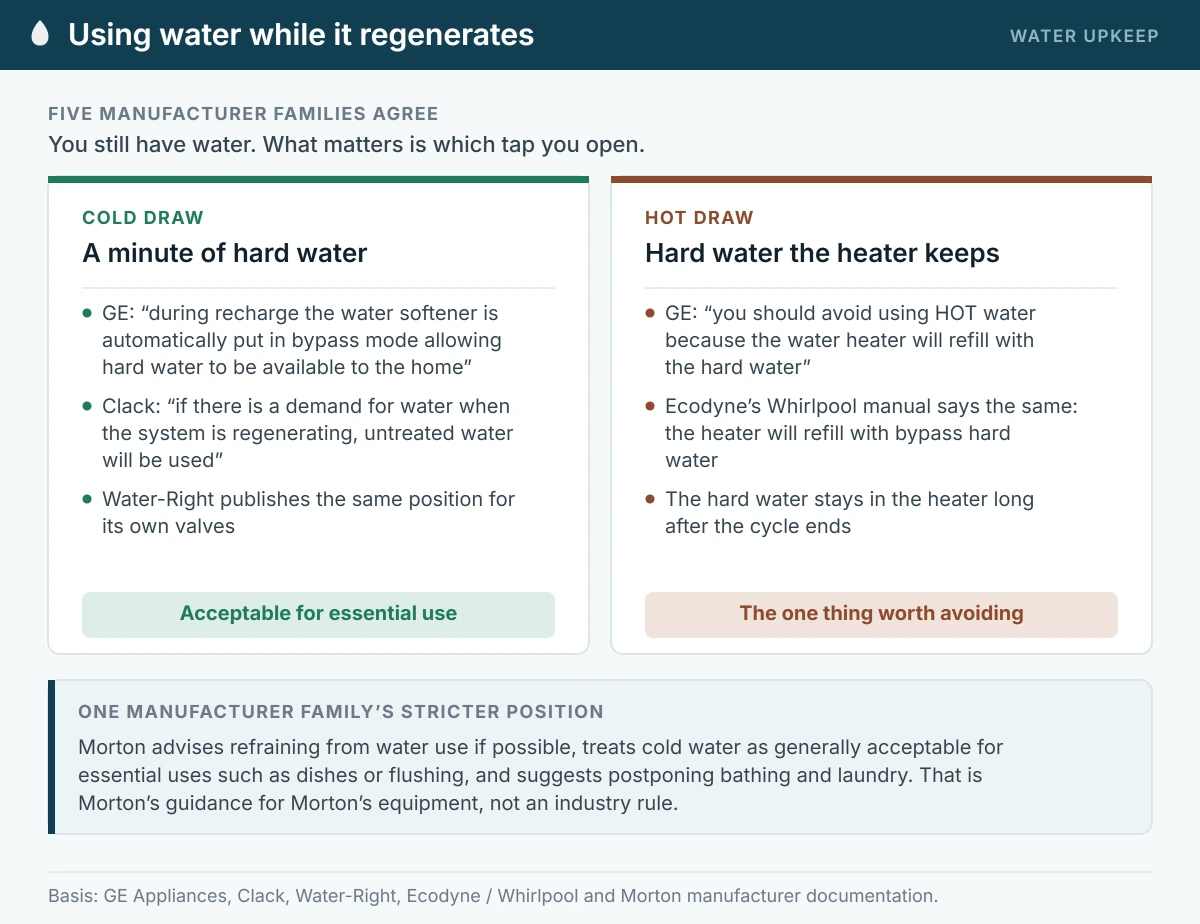
Yes, and five manufacturer families say the same thing about what you get. The softener bypasses itself internally for the working part of the cycle.
- GE: “during recharge the water softener is automatically put in bypass mode allowing hard water to be available to the home.”
- Clack: “if there is a demand for water when the system is regenerating, untreated water will be used.”
- Water-Right: “if there is a demand for water when the system is regenerating, untreated water will be delivered.”
The caution that actually matters is about hot water, not cold. GE’s older manual: “for emergency needs, hard water is available to the home during the recharge cycles. However, you should avoid using HOT water because the water heater will refill with the hard water.” Ecodyne’s Whirlpool manual says the same: “avoid using hot water while the softener is regenerating, because the water heater will refill with bypass hard water.” A cold draw is a minute of hard water. A hot draw loads your water heater with hard water that stays there long after the cycle ends — which matters for scale, and connects to flushing a water heater.
Morton’s guidance, which is one manufacturer family’s position rather than a rule, is to “refrain from water use if possible,” treat cold water as generally acceptable for essential uses such as dishes or flushing, and postpone bathing and laundry.
Part of the cycle still delivers soft water
On the valve families that refill first, the early part of the cycle is not untreated at all. Water-Right: “during these FILL and SOFTENING positions, you will have softened water available for use,” and it is only “once the unit advances to the BACKWASH position and subsequent positions thereafter” that the water becomes untreated. Clack’s footnote says the same for its fill step: “when in the fill mode the system is providing treated water.”
That is the most useful nuance on this page. On a Water-Right unit, four of the roughly five and a half hours between “regeneration started” and “regeneration ended” are spent delivering soft water while salt dissolves.
One published hazard, with both of its conditions
Water-Right’s manual carries a warning attached to its bypass valve’s shut off position: “a negative pressure in the building combined with the softener being in regeneration could cause a siphoning of brine into the building.” Both conditions are in that sentence and both belong there. It is Water-Right’s warning, about Water-Right’s valve, in one specific position — not a general reason to avoid using water during a regeneration. The bypass positions themselves are covered in how to bypass a water softener.
Why you have never seen it happen
Because the manufacturers schedule it for the small hours. Water-Right: “the manufacturer has factory set 2:00 A.M. as the default.” GE’s support content describes the recharge as scheduled for 2 AM. Nebraska Extension notes that regeneration “is generally done during periods of low water usage, such as between midnight and 4 a.m.”
If your water goes briefly hard at an odd hour, that is the most likely explanation. Whether it should be happening as often as it is — and whether the start time is set sensibly — is a different question, answered in how often a water softener should regenerate.
When it is taking too long
A cycle that never ends is a fault, not a long cycle, and both major valve makers name it. Fleck lists “drain flows continuously” and “control cycles continuously,” with causes including incorrect programming, foreign material in the control and an internal control leak. Clack lists “water running to drain,” with causes including a power outage during regeneration, a damaged seal and stack assembly, a piston assembly failure and a drive cap not tightened properly; its error codes E3, Err-1003 and Err-103 all signify that the motor ran too long.
If that is what you are seeing, work through the softener troubleshooting index rather than waiting it out. Low supply pressure can also stall a cycle: Fleck requires “a minimum of 20 psi (1.4 bar) of water pressure… for the regeneration valve to operate effectively,” while Clack’s specification says 20 psi but its own troubleshooting section says pressure “must stay minimum 25 psi” — the manual disagreeing with itself, which is worth knowing before you chase a number.
And a note on the boundary of your own involvement: if anything about this leads you toward opening the unit, both manufacturers require the system to be depressurized first, and Clack requires power to be disconnected before servicing. Putting the unit in bypass does not depressurize it. Routine care is covered in water softener maintenance; if the diagnosis lands on the media itself, when softener resin needs replacing.
What the standard does and does not cover
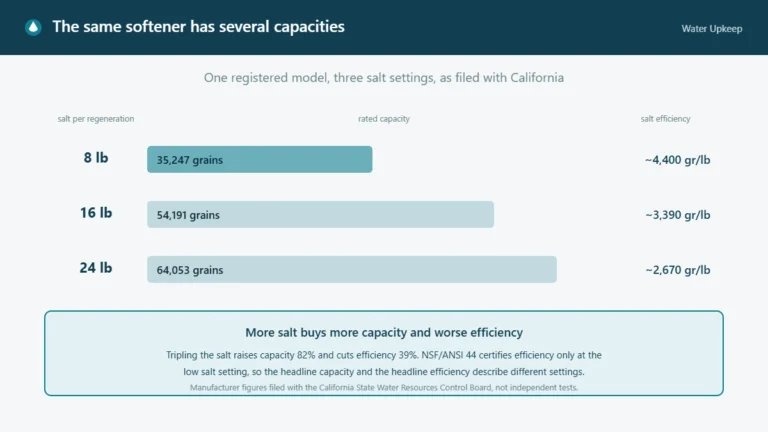
Since it comes up: NSF/ANSI 44 includes a voluntary efficiency rating, and EPA describes it as requiring softeners “to use 5.0 gallons of water or less per 1,000 grains of hardness removed.” That is a measure of water and salt per grain. Nothing in the standard as published certifies, limits or characterizes how long a regeneration takes. Efficiency and duration are different things, and a certified-efficient softener may run a longer cycle precisely because a slow brine draw uses less salt.
The water a cycle consumes is a separate question with its own published figures, and it belongs with regeneration frequency and maintenance rather than here. The programmed hardness that drives the whole schedule is covered in what hardness number to program, and the mechanism itself in how water softeners work.
Frequently asked questions
How long does a water softener regeneration take?
It depends entirely on your valve. GE and the EcoWater family publish about two to two and a half hours for their appliances. Clack publishes 57 to 107 minutes for its WS1, excluding the brine tank fill. Water-Right’s sequence spans more than five hours, though four of those are a salt-dissolving dwell during which you still have soft water. Fleck and Autotrol publish no total at all.
Can I use water while my softener is regenerating?
Yes. GE, Clack, Water-Right, Ecodyne and Morton all say the water will be untreated for the working part of the cycle. The one thing worth avoiding is a hot draw, because the water heater will refill with hard water and keep it.
Why does the brine stage take so long?
Deliberately. GE says the brine is drawn “at a very slow rate to get the best resin cleaning with the least amount of salt.” A slow draw is what makes a given amount of salt go further.
Is there a standard regeneration cycle?
No. Across six manufacturer families the published stage count runs from four to eight, and the brine tank refill is the first stage on three of them and the last on three others. The commonly repeated “five stages of regeneration” is one manufacturer’s structure, not an industry standard.
Why does my softener always run at 2 AM?
Because that is the factory default. Water-Right sets 2:00 AM explicitly; GE’s documentation describes the same schedule; Nebraska Extension notes regeneration is generally done between midnight and 4 AM, when nobody is drawing water.
My softener has been running for hours. Is that normal?
It may be, on a valve with a long salt-dissolving dwell. It may also be a fault — both Fleck and Clack list continuous drain flow as a specific problem with named causes, and Clack has error codes for a motor that ran too long. Start with the troubleshooting index.
Sources and standards
- Nebraska Extension G1491 — Drinking Water Treatment: Water Softening (Ion Exchange)
- Penn State Extension — Water Softening
- US EPA WaterSense — Cation Exchange Water Softeners and the water softeners technical sheet
- NSF — NSF/ANSI 44 technical requirements
- Pentair Fleck (manufacturer documentation) — 5600SXT downflow service manual
- Pentair Autotrol (manufacturer documentation) — 740/760 control manual
- Clack Corporation (manufacturer documentation) — Water Specialist WS1 and WS1.25 operation manual and the drawings and service manual
- Water-Right (manufacturer documentation) — Impression Plus Series metered softener manual
- GE Appliances (manufacturer documentation) — GXSF27E and GXSF31E owner’s manual, the five recharge stages and water bypass during recharge
- EcoWater Systems and Morton Water Softeners (manufacturer documentation) — how long a recharge takes and running water during a recharge. These brands publish substantially identical text on a shared support platform and are treated here as one manufacturer position
- Ecodyne / Whirlpool (manufacturer documentation) — WHES30 and WHES33 manual
Last reviewed September 8, 2026.