How to Bypass a Water Softener
Putting a water softener in bypass sends your household water around the unit instead of through it. You keep your pressure and your supply; you lose soft water. On most units it takes a few seconds once you know which of the three bypass designs you have. What bypass does not do is empty the softener, relieve the pressure inside it, or switch it off — manufacturers publish bypass as the first step of depressurizing a unit, and as one of two steps for leaving it over a holiday. Going into bypass is quick. Coming back out is the part every manufacturer that addresses it tells you to do slowly.
What bypass actually does, and the three things it doesn’t
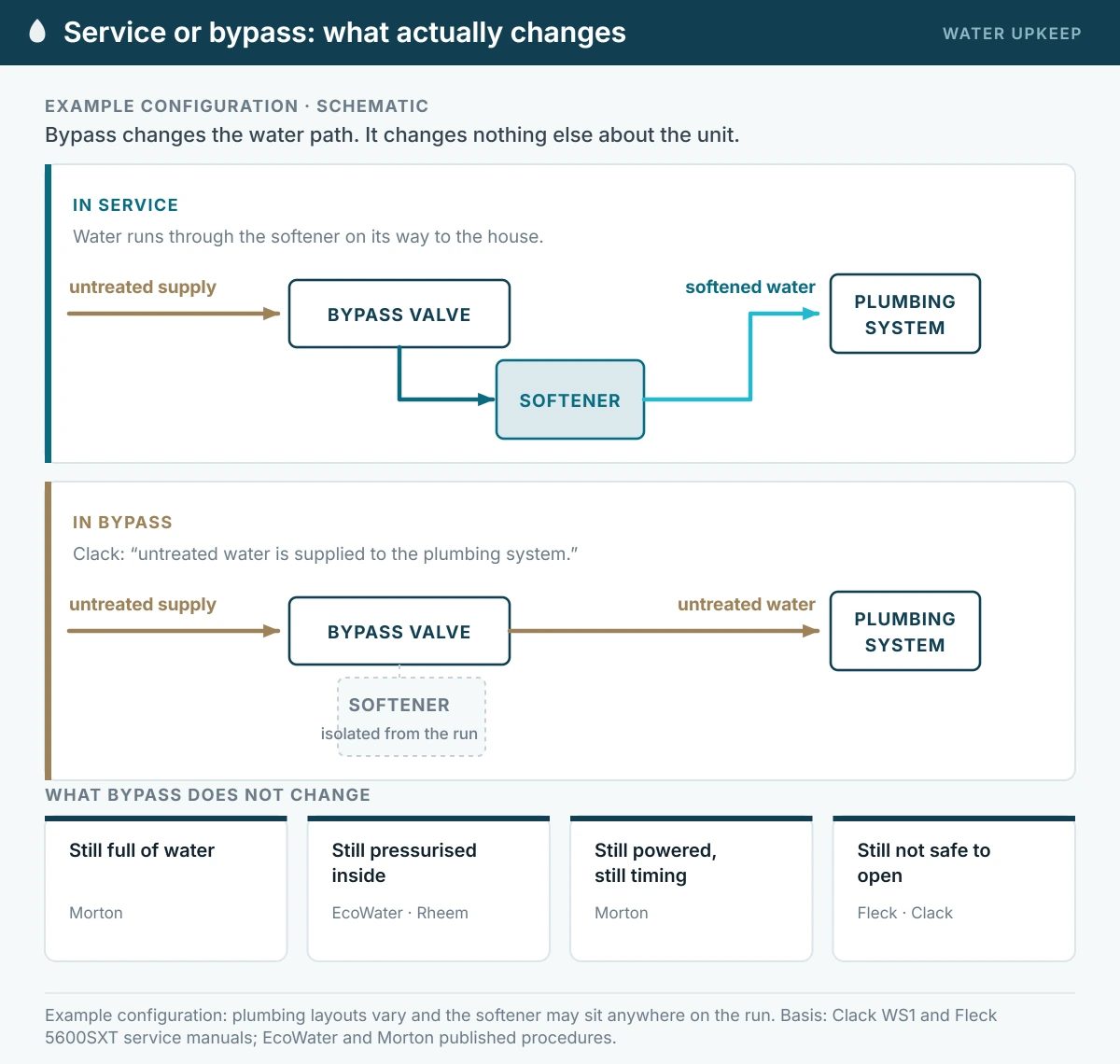
Clack’s WS1 service manual describes the bypass position exactly: “the control valve is isolated from the water pressure contained in the plumbing system,” and “untreated water is supplied to the plumbing system.” That is the whole function. Your fixtures still run. The water reaching them is whatever comes off your supply, untreated.
| Question | Answer | Why we can say that |
|---|---|---|
| Do I still have water in the house? | Yes — untreated | Clack: “Untreated water is supplied to the plumbing system” |
| Is the softener still full of water? | Yes | Morton publishes a separate freeze-preparation procedure precisely because it is |
| Is it still pressurized inside? | Yes | EcoWater’s published depressurizing procedure starts with bypass and then adds three more steps |
| Is it still powered and keeping time? | Yes, unless you unplug it | Morton’s vacation procedure lists unplugging as a second, separate step |
| Is it safe to open a fitting now? | No | Fleck: “The system must be depressurized before removing any connections for servicing” |
| Is it protected from freezing? | No | Morton’s freeze procedure removes the valve head from the tank |
It does not depressurize the unit
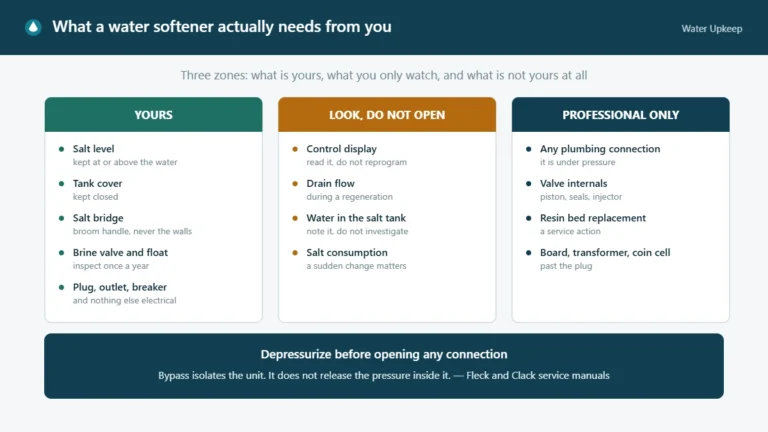
This is the single most useful thing on this page, and the evidence for it is a manufacturer’s own instructions. EcoWater publishes a procedure titled Depressurize a Water Softener, and it runs like this: first, “you’ll need to bypass the water softener by pushing the handle IN”; then hold the Recharge button until the motor starts; then press Recharge again to advance to the next cycle; then repeat until the flashing recharge indicator clears. Rheem publishes the same four-step procedure under its own brand.
Bypass is step one of four. If moving the bypass valve relieved the pressure inside the softener, the other three steps would not exist. Rheem also publishes an alternative for units where a recharge cannot be started, and the order it gives is instructive: shut the water off to the home while the softener is still in service, open faucets to bleed the plumbing, and only then push the bypass handle in before turning the water back on. With the house pressurized, moving the bypass relieves nothing.
Two other valve makers say the same thing from the other direction. Fleck: “The system must be depressurized before removing any connections for servicing.” Clack: “Pressure hazard; depressurize valve before servicing,” and separately, “Disconnect from electrical power prior to servicing.” None of these three manufacturers treats the bypass valve as the depressurizing step. Each names a separate action.
The practical rule: bypass is enough to stop soft water. It is not enough to open anything.
It does not empty the unit, or protect it from freezing
A bypassed softener is still full of water. That is why Morton publishes a freeze-preparation procedure that goes considerably further than bypass: it turns off the main supply, bypasses the unit, cycles the valve through its recharge positions, and then requires removing the top cover, disconnecting the motor and wiring, releasing the clips at the softener and bypass connection, disconnecting the drain and brine hoses, and pulling the valve head off to store it somewhere warm. We are not reproducing that procedure here — it is a service operation, and it sits past the line this site draws.
The manufacturers’ own operating limits make the point independently. Fleck states the unit “cannot be subjected to freezing conditions.” Clack gives minimum and maximum operating temperatures of 40°F to 110°F. Water-Right’s Impression Plus manual gives a water temperature range of 33–100°F. Morton says plainly that it does “not recommend installing your water softener in an environment that regularly drops below freezing temperatures.” If freezing is a real possibility where your unit lives, that is a conversation with your dealer or the manufacturer, not a bypass handle.
It does not switch the softener off
Morton’s published vacation procedure is two steps, not one: push in on the bypass handle, and disconnect the power supply “to prevent recharging while you’re away.” A manufacturer would not publish the second step if the first accomplished it. So bypassing alone does not guarantee the unit will not attempt a regeneration while you are gone.
One related detail, because people notice it: Clack lists “bypass valve in bypass position” as the first cause of the fault “display does not indicate water flowing.” A metered valve stops accumulating treated volume while it is bypassed. That is about volume accounting, not about the clock.
Find your bypass valve first: the three designs
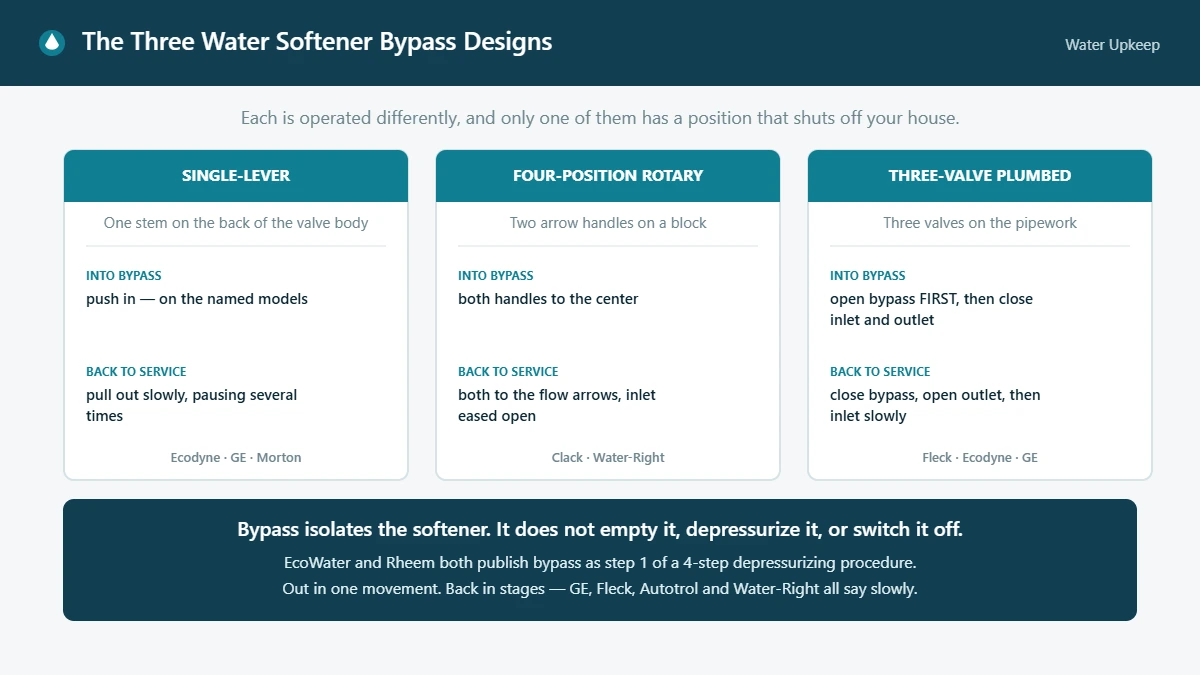
Almost every page you will find on this subject treats bypassing as one undifferentiated action. It isn’t. There are three architectures in common use, they are operated differently, and on one of them there are two positions that look similar and do opposite things.
| What you see | Common name | Into bypass | Back to service | Published in |
|---|---|---|---|---|
| A single stem or lever on the back of the valve body | Single-lever or cartridge bypass | Push in (on the models named here) | Pull out slowly, pausing several times | Ecodyne WHES30/33; GE GXSF27E/31E; GE GXSH40V/45V; Morton |
| Two arrow-shaped handles on a block behind the valve | Four-position rotary bypass | Both handles pointing to the center of the bypass | Both handles back to the engraved flow arrows, inlet eased open | Clack WS1/WS1.25; Water-Right Impression Plus, Evolve and CareSoft |
| Three separate valves on the pipework | Three-valve plumbed bypass | Open the bypass valve first, then close inlet and outlet | Close the bypass valve, then open the outlet, then open the inlet slowly | Pentair Fleck 5600SXT; Ecodyne WHES30/33; GE GXSH40V/45V |
Single-lever or cartridge bypass
One stem, two positions. Ecodyne’s Whirlpool WHES30 and WHES33 manual labels them “pull out for ‘Service’ (Soft water)” and “push in for ‘Bypass’.” GE’s manual for the GXSF27E and GXSF31E uses the same convention: “pull out for soft water service,” “push in for bypass.” Morton’s support documentation describes the same handle and gives the only stuck-valve advice published anywhere we would cite: “if your bypass handle is stuck, twist or turn the handle to get it moving.”
Note that push-in-for-bypass is the convention on those named models. We are not going to tell you that every single-lever bypass in the world works that way, because that is not something any source establishes. Look at your own unit’s markings or manual.
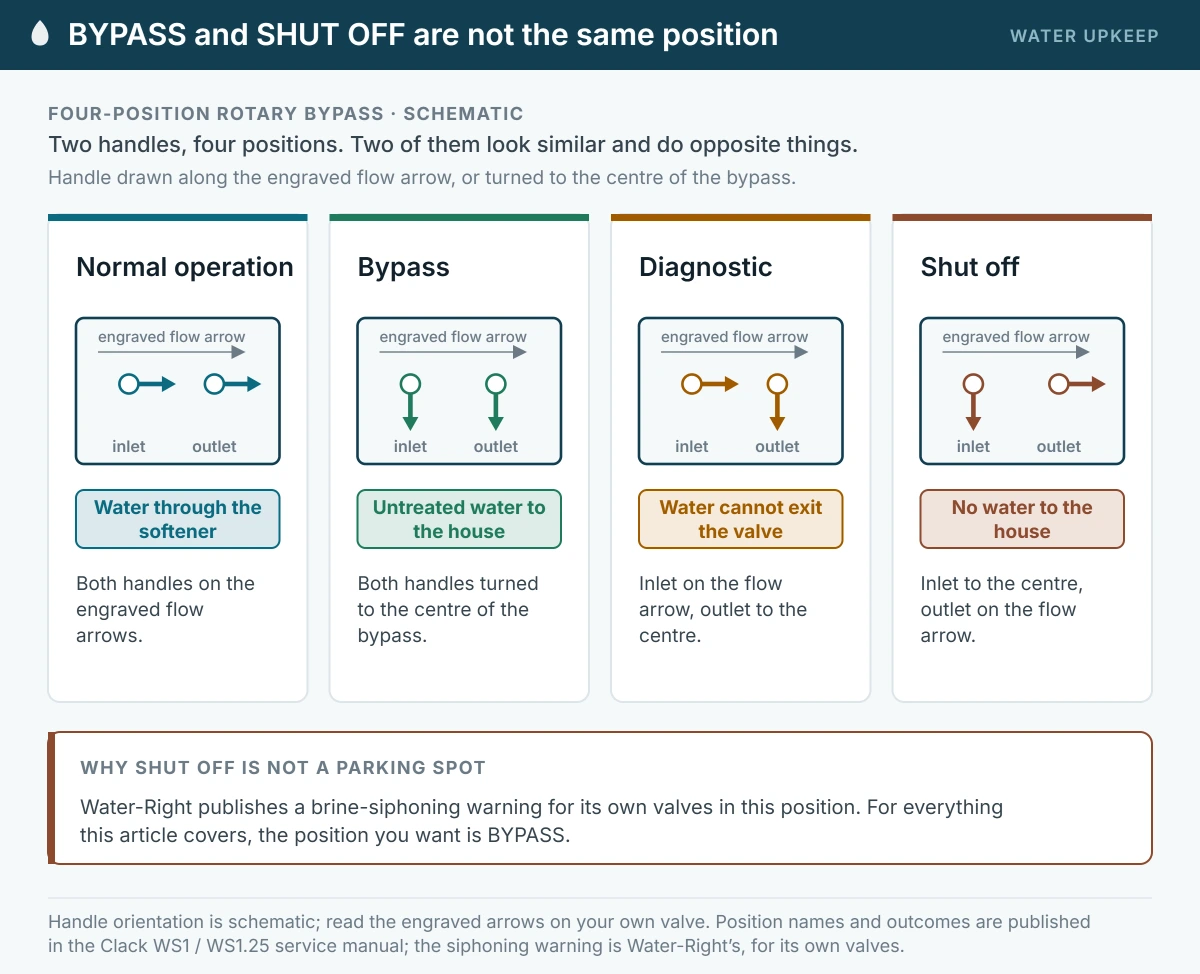
Four-position rotary bypass — use BYPASS, not SHUT OFF
This is the design where people get into trouble, because two handles and four positions produce outcomes that are not interchangeable. Clack’s manual defines all four:
- Normal operation — “the inlet and outlet handles point in the direction of flow indicated by the engraved arrows on the control valve.”
- Bypass — “the inlet and outlet handles point to the center of the bypass, the control valve is isolated from the water pressure contained in the plumbing system.” Untreated water is supplied to the house.
- Diagnostic — inlet handle in the direction of flow, outlet handle to the center: pressure reaches the control valve and the plumbing, but water cannot exit the valve into the plumbing.
- Shut off — inlet handle to the center, outlet handle in the direction of flow: “the water is shut off to the plumbing system.”
Bypass keeps your house supplied. Shut off does not. Water-Right’s Impression Plus and Evolve manuals use the same four-position architecture and the same definitions, and Evolve adds that in the shut off position “the water treatment system will depressurize upon opening a tap in the building.”
There is also a published hazard attached to leaving a valve in shut off. Water-Right’s manual states: “A negative pressure in the building combined with the softener being in regeneration could cause a siphoning of brine into the building.” That is Water-Right’s warning, about that combination of conditions, on its own valves — we are not extending it to other manufacturers. But it is a sound reason to treat shut off as a service position rather than a parking spot. For everything this article covers, the position you want is BYPASS.
Three-valve plumbed bypass, and why the order matters
Older and custom installations often have three ordinary valves on the pipework: one on the inlet to the softener, one on the outlet, and one on a loop of pipe joining them. Fleck publishes the sequence and it is not symmetrical: “If the conditioner installation has a ‘three valve’ bypass system, first open the valve in the bypass line, then close the valves at the conditioner inlet and outlet.”
Open the bypass first. If you close the inlet and outlet first, you have briefly shut off the house. Coming back, Ecodyne’s instruction reverses it: “fully close the bypass valve and open the outlet valve,” and GE’s manual for the GXSH40V and GXSH45V adds the crucial qualifier for the last move — “slowly open the inlet valve, pausing several times to allow the water softening system to fill with water.”
If you cannot find a bypass at all
Some units are plumbed in without one. Fleck’s installation instructions tell the installer to “always provide for the installation of a bypass valve if unit is not equipped with one” — but adding one is pipework on your potable supply, and that is a licensed plumber’s job and a question for your local authority having jurisdiction, not something to attempt from a web page. See how to install a water softener for what that work involves. In the meantime, your house shut-off is the only isolation you have, and it stops water to everything.
Worth knowing: bypass valves are a standardized product in their own right. IAPMO publishes IGC 230-2006, Manually operated water softener by-pass valves, whose scope covers “general requirements, strength and performance tests for such products, in addition to method of markings and identification.” We have not purchased the standard text, so that is all we can tell you about it — but the fact that a product standard exists is a reasonable answer to “is this just a plumbing fitting someone improvised?”
Putting it back into service, slowly
Here is an asymmetry worth noticing. Four manufacturers publish an instruction to move slowly when returning a softener to service. Not one of the manuals we read publishes a slowness instruction for entering bypass. So we are not going to invent one.
- GE (GXSF27E/31E): “SLOWLY pull or slide the valve stem (out) toward the service position, pausing several times to allow the softener to pressurize slowly.”
- GE (GXSH40V/45V): “Slowly move the valve stem toward ‘service,’ pausing several times to allow the water softening system to fill with water.”
- Fleck 5600SXT: “Slowly place the bypass in service position and let water flow into the mineral tank.”
- Pentair Autotrol: at start-up, “open the water supply valve very slowly to approximately the 1/4 open position.”
- Water-Right: “Open the inlet handle of the bypass valve very slightly allowing water to fill the tank slowly in order to expel air.”
Water-Right is the only one that publishes the consequence, and it is worth having: fill the tank too quickly and “there will be a loss of media to the drain.” An isolated tank is full of air as well as water. Re-pressurizing it in one movement drives water through the resin bed hard enough to carry media into the drain line. Pentair builds a pause into the Autotrol valve’s own cycle for the same reason, naming a stage “C4 – System Pause (to repressurize tank),” which allows “the water/air pressure to equalize on each side of the valve discs before moving on.” Fleck separately lists air in the water system as the first cause of the fault “loss of mineral through drain line.”
So: out in one movement, back in stages. Nobody publishes a number of seconds to pause for, and we are not going to make one up — the instruction as published is to pause several times and let the tank fill.
If the unit has been standing for a while
Coming out of a long bypass is not a null operation. Morton publishes what to do for a softener that has been out of service for an extended time: empty the brine tank of all water and salt, wipe the inside clean with a damp cloth, refill with three gallons of fresh water and then add salt no higher than halfway to prevent bridging, check the programming because settings may have been lost, and then start a manual recharge by holding the Recharge button for about three seconds. Morton puts that cycle at “about 2 – 2 1/2 hours” — that is Morton’s figure for Morton’s units, and the general question of how long regeneration takes is covered in how long a softener regeneration takes. For the salt tank itself, see water softener maintenance.
When bypassing is the right move
You are servicing or moving the unit
This is what the valve is for, and Fleck’s instructions cover both directions: bypass while you work, then “return bypass or inlet valve to normal In Service position,” with the note “be sure to shut off any bypass line.” But note the boundary again — if the job involves opening anything, bypass is not sufficient. That includes replacing media, which is covered in when softener resin needs replacing, and anything involving the clips on the inlet or outlet: Ecodyne’s manual is explicit that “if a leak occurs at a clip, depressurize the plumbing (turn off the water supply and open faucets) before removing clip.”
Watering the garden or the lawn
If your outside spigots run on softened water, Morton’s own guidance is to bypass while watering: “we generally do not recommend watering plants with softened water. This is due to the sodium levels,” and its instruction is to push the handle in on the back of the unit and pull it back out when you are done.
The mechanism behind that has independent support, though with a narrower scope than people usually give it. J. Robert Nuss, professor of ornamental horticulture at the Penn State College of Agricultural Sciences, in a 1998 university news release about indoor container plants: “Sodium is used by plants only in very small amounts. Over long periods of time, sodium becomes toxic to plants,” and “never allow plants to stand in softened water.” That is about houseplants. It is not a finding about turf, vegetable beds or irrigation rates, and we have not found one that is.
On how much sodium a softener adds, the extension services state it as a rate rather than a total: NDSU, “for every grain of hardness removed from water, about 8 mg/1 (ppm) of sodium is added”; Nebraska Extension, “about 8 mg/L for each grain per gallon (gpg) of hardness.” It is a rate that depends entirely on your hardness, so it cannot be turned into a single number for your tap.
Filling a pool or another one-off large draw
We could not find a single independent source, or a manufacturer technical document, that addresses filling a swimming pool through or around a softener. Everything on the first page of results for that question is a dealer blog or a forum thread, so we will not pretend to an answer.
What is supportable is the mechanism. A softener is rated by capacity in grains — NDSU describes units as “rated by the total number of grains the unit can remove before being recharged,” and Fleck’s setting for it is literally “the capacity of the media bed in grains of hardness.” A metered valve counts treated gallons against that capacity. So a very large one-off draw consumes capacity and brings the next regeneration forward. That is the whole of what we can tell you. We make no claim about pool chemistry, pool surfaces, or any volume at which bypassing becomes worthwhile.
Going away
Morton’s procedure is bypass plus unplug, as covered above, with a manual recharge on your return. Some valves have a software alternative that does the job better. Water-Right publishes a Vacation Mode: “when turned ‘ON’, the unit will not regenerate while there is no water usage. Once water usage is observed (minimum of 50 gallons), the unit will automatically regenerate that night and resume normal operation.” The same manufacturer publishes a caution with it: “depending on the severity of water conditions and the length of no water usage, it may not be recommended to use this feature. Please contact dealer or manufacturer for more information.” Which of these two routes applies to you is a question for your own manual.
You think the softener has failed
Both major valve makers list the bypass itself as a cause of hard water — Fleck’s correction for the problem “hard water” with the cause “bypass valve is open” is simply “close bypass valve,” and Clack’s first listed cause of “hard or untreated water delivered” is “bypass valve open or faulty.” So checking the bypass position is the first move, not the last.
Bypassing deliberately also gives you a clean isolation test: compare water from a fixture that is not fed by the softener with one that is. The Minnesota Department of Health uses the same logic for odor complaints — “is there a smell from the cold water faucet? If no, the problem is likely in the water heater. If yes, is there a smell from faucets not connected to the water softener?” Interpreting what your comparison tells you belongs to our softener troubleshooting index, and confirming what actually changed is in how to tell if you have hard water.
The better long-term answer for hose bibs and outside taps
If you find yourself bypassing every weekend to water the yard, the recurring chore is a symptom of how the house was plumbed. The Minnesota Department of Health puts the alternative plainly:
Soften only what you need to. People often choose to soften showers, sinks, and laundry hookups. Toilets, hose bibs, basement sinks, and other cold water taps typically do not need to be connected to a softener. In many cases, people choose to soften only the hot water.
That is a state health department describing a plumbing decision, not a dealer selling one. Re-routing a hose bib off the softened loop is plumbing work with the same licensing and permitting considerations as any other alteration — but it converts a weekly chore into a one-time job, and it is the honest answer to “how do I stop doing this.” The broader question of what to treat and how sits in how to treat hard water.
“My water went hard and I never touched the bypass”
There are two kinds of bypass, and the second one happens by itself. GE’s manual: “during recharge the water softener is automatically put in bypass mode allowing hard water to be available to the home.” Clack: “if there is a demand for water when the system is regenerating, untreated water will be used.” GE adds a practical note for the older models — hard water is available during recharge for emergency needs, “however, you should avoid using HOT water because the water heater will refill with the hard water.” Morton’s guidance is to “refrain from water use if possible” during a recharge, for the same reason.
So hard water at an odd hour may be nothing more than a regeneration in progress. When that happens and how long it takes belongs to how long regeneration takes and how often a softener should regenerate. If it is hard all day, start with the symptom index. For the mechanism itself, how water softeners work.
Where to stop
Stop and call a licensed plumber, or the manufacturer or dealer, at any of these.
- There is no bypass valve. Adding one is pipework on the potable supply.
- The bypass will not move, beyond Morton’s single published remedy of twisting or turning the handle to get it moving. Do not strike it, lever it, heat it or put a wrench on it.
- A connection leaks once you have bypassed or returned to service. At that point the job is a repair, and the plumbing has to be depressurized before a clip or fitting is touched.
- You intend to open the unit — remove a clip, unscrew a fitting, pull the valve head, or replace media. Bypass is not enough; the manufacturers require a separate depressurizing step, and Autotrol’s service manual even publishes a mechanical relief action (“release water pressure by pushing the last valve discs open with a screwdriver”) that is unmistakably a technician’s instruction in a service manual.
- Freezing is possible. Bypass is not freeze protection.
- You would have to park a four-position valve in SHUT OFF. Use BYPASS instead, for the reason Water-Right publishes.
- The supply may be microbiologically unsafe. Hellenbrand’s manual states the position for all of them: a softener “is not intended to be used for treating water that is microbiologically unsafe or of unknown quality without adequate disinfection.”
On the electrical side, the boundary is the transformer plug at the wall outlet. Unplugging it is in scope — that is exactly what Morton’s vacation procedure asks for. Everything past the transformer is not: Clack’s US control runs on a 100–120 VAC supply with a 15 VDC, 500 mA output, and its manual carries a warning about the board’s button cell that is worth quoting in full — “DEATH or serious injury can occur if ingested…A swallowed button cell or coin battery can cause Internal Chemical Burns in as little as 2 hours.” Do not open the control head.
One last thing about pressure figures, because they are quoted loosely everywhere. There is no single “water softener pressure range.” Fleck and Clack both publish 20 to 125 psi. Ecodyne’s Whirlpool units and GE’s GXSH40V/45V publish 20 to 125 psi. Water-Right’s Impression Plus publishes 30 to 100 psi, and its Evolve and CareSoft units 25 to 100 psi. Pentair’s Autotrol manual gives 20 to 125 psi in the US and 20 to 100 psi in Canada. Six manufacturers, four different minimums. Use the figure from your own manual.
Frequently asked questions
Does bypassing a water softener turn it off?
No. It isolates the unit hydraulically and sends untreated water to the house. The softener stays full of water, stays pressurized inside, and stays powered unless you unplug it.
Will the softener still regenerate while it is in bypass?
Bypass on its own is not what stops it. Morton’s vacation procedure adds unplugging the unit as a separate step “to prevent recharging while you’re away,” which tells you the bypass alone was not considered sufficient. Some valves have a vacation mode in software instead; check your manual.
Is a bypassed softener safe to open or unplumb?
No. Fleck requires the system to be depressurized before any connection is removed, and Clack carries a pressure hazard warning with the same instruction. EcoWater’s own depressurizing procedure treats bypass as step one of four.
Which way do I turn the handles, and what is the difference between bypass and shut off?
On a four-position rotary bypass, both handles pointing to the center of the bypass is BYPASS — your house keeps untreated water. Inlet handle to the center with the outlet handle on the flow arrow is SHUT OFF — water stops to the house. On a single-lever bypass, the named models above use push in for bypass and pull out for service, but that convention is model-specific; read your own markings.
Can I leave my softener in bypass for months?
Nothing we found forbids it, but coming back is not a null operation. Morton publishes a restart procedure for units that have stood: empty and clean the brine tank, refill with fresh water and salt no more than halfway, re-check the programming because settings may have been lost, and run a manual recharge. And if freezing is possible where the unit sits, bypass does not address that at all.
Should I bypass before watering the garden?
Morton recommends it if your outdoor taps are on softened water, on account of the sodium. The longer-term answer, per the Minnesota Department of Health, is that hose bibs typically do not need to be connected to a softener at all.
My water went hard on its own — is it stuck in bypass?
Check the bypass position first; both Fleck and Clack list an open bypass as a cause of hard water. If it is in service and the water is still hard, work through the symptom index. If it is hard only for an hour or two overnight, that is likely a regeneration.
Sources and standards
- Minnesota Department of Health — Home Water Softening Frequently Asked Questions and Hydrogen Sulfide in Well Water
- IAPMO — IGC 230-2006, Manually operated water softener by-pass valves (designation, title and scope only; the standard text was not purchased)
- NDSU Extension WQ1031 — Water Softening (Ion Exchange)
- Nebraska Extension G1491 — Drinking Water Treatment: Water Softening
- Penn State — Softened water can cause hard times for indoor plants (J. Robert Nuss, College of Agricultural Sciences, 1998)
- Pentair Fleck (manufacturer technical documentation) — 5600SXT downflow service manual
- Pentair Autotrol (manufacturer technical documentation) — 255 and Performa series service manual and the 740/760 control manual
- Clack Corporation (manufacturer technical documentation) — WS1 and WS1.25 drawings and service manual
- Ecodyne / Whirlpool (manufacturer technical documentation) — WHES30 and WHES33 installation and operation manual
- GE Appliances (manufacturer technical documentation) — GXSF27E and GXSF31E owner’s manual
- Water-Right (manufacturer technical documentation) — Impression Plus Series metered water softeners manual
- Morton Water Softeners (manufacturer technical documentation) — support articles on how a bypass valve works, preparing a softener before vacation, preparing for freezing temperatures, restarting after an extended outage, watering plants with softened water and running water during a recharge
- EcoWater Systems (manufacturer technical documentation) — Depressurize a Water Softener
- Rheem Water Treatment (manufacturer technical documentation) — Depressurizing your Softener
Last reviewed September 8, 2026.