What Temperature Should a Water Heater Be Set To?
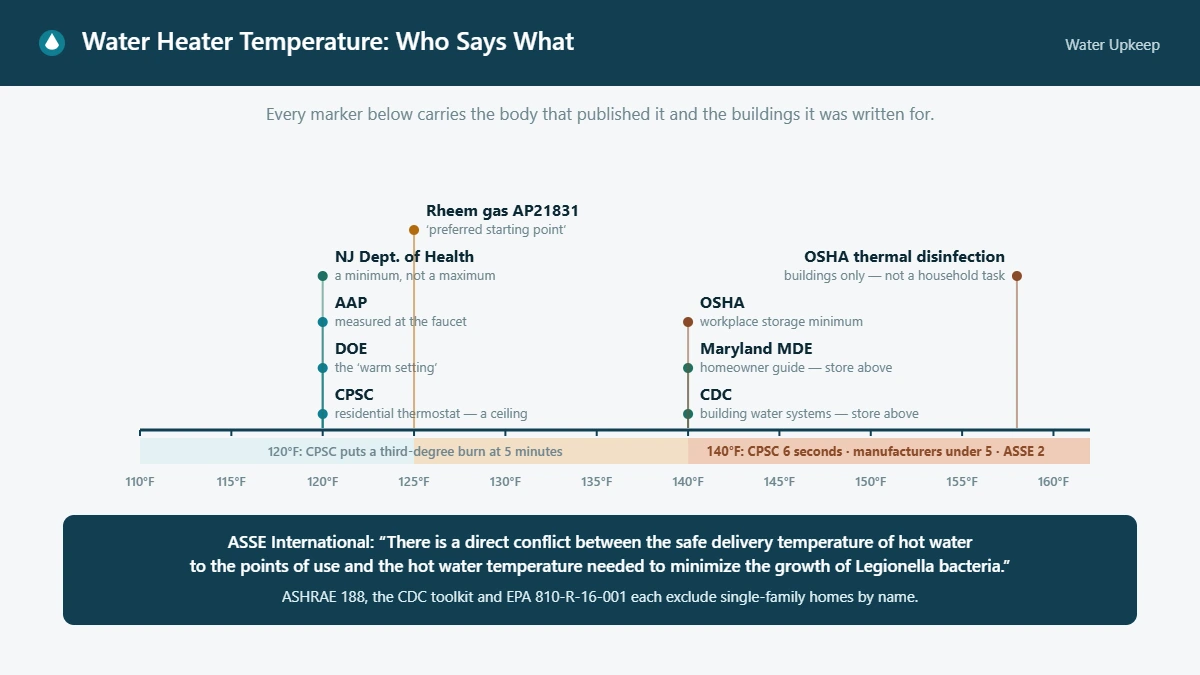
The most-cited answer is 120°F. It comes from the U.S. Consumer Product Safety Commission, which “urges all users to lower their water heaters to 120 degrees Fahrenheit” to prevent scalds — injuries that fall hardest on children under five and on older adults. The Department of Energy recommends the same setting. But it is not the only answer. A different set of agencies recommends a higher storage temperature for a completely different reason, and those recommendations genuinely conflict. A plumbing standards body says so in exactly those words, and points at the piece of hardware that lets both be true at once.
This page reports who says what, and to whom. It does not add a tenth opinion, and it does not tell you what to set your heater to.
The short answer: 120°F, and who says so
CPSC, in Avoiding Tap Water Scalds: “the U.S. Consumer Product Safety Commission (CPSC) urges all users to lower their water heaters to 120 degrees Fahrenheit. In addition to preventing accidents, this decrease in temperature will conserve energy and save money.” Elsewhere in the same document it phrases it as a possibility rather than a rule — “a thermostat setting of 120 degrees Fahrenheit (49 degrees Celsius) may be necessary for residential water heaters to reduce or eliminate the risk of most tap water scald injuries” — and adds that consumers “should consider lowering the thermostat to the lowest settings that will satisfy hot water needs for all clothing and dish washing machines.”
The Department of Energy’s Home Energy Checklist says simply: “turn down the temperature of your water heater to the warm setting (120°F).”
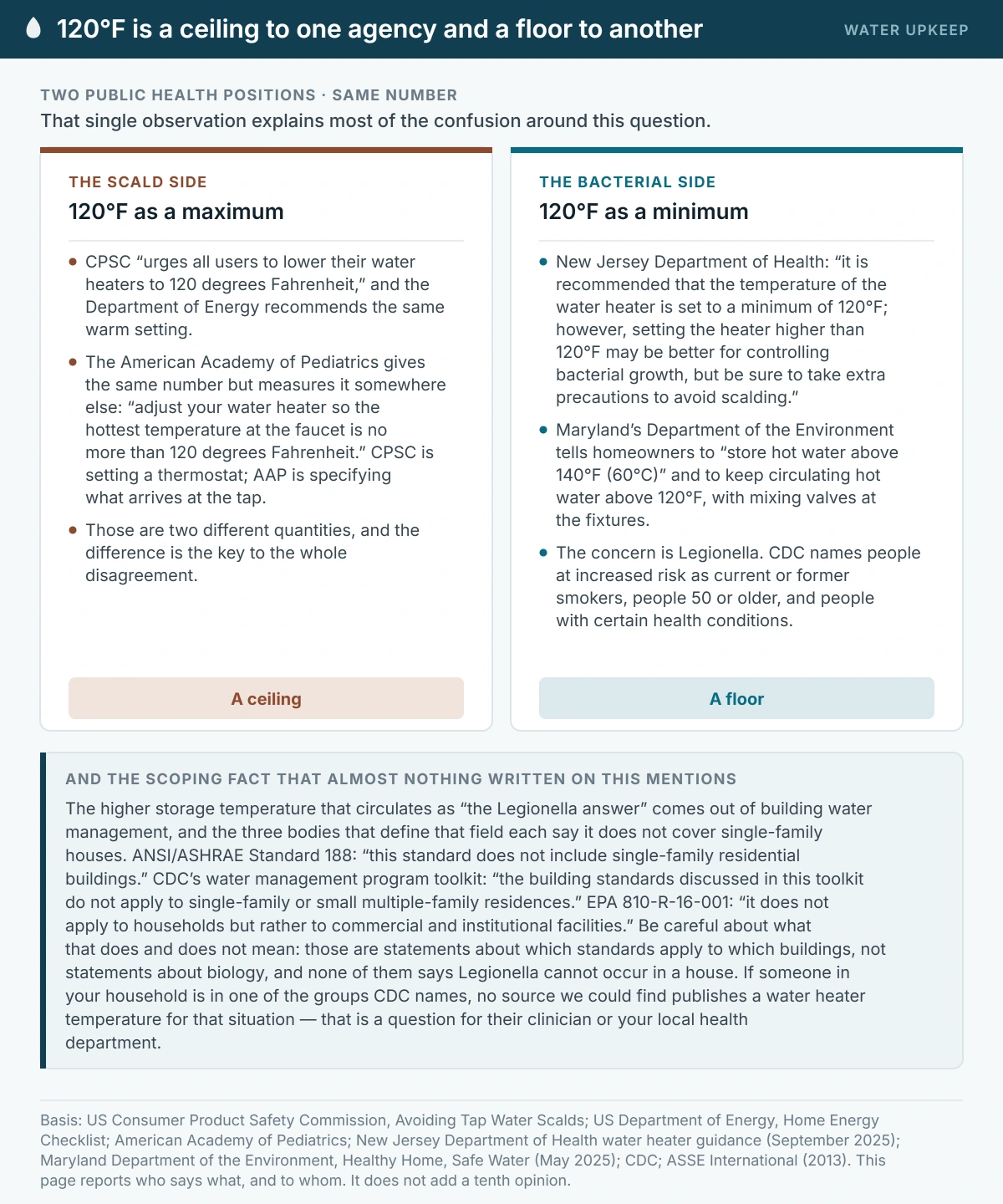
The American Academy of Pediatrics gives the same number but measures it somewhere else, and the difference matters more than it looks: “adjust your water heater so the hottest temperature at the faucet is no more than 120 degrees Fahrenheit.” CPSC is setting a thermostat. AAP is specifying what arrives at the tap. Those are two different quantities, and we come back to that below, because it is the key to the whole disagreement.
Why 120°F: what hot water does to skin
CPSC’s own statement: “most adults will suffer third-degree burns if exposed to 150 degree water for two seconds. Burns will also occur with a six-second exposure to 140 degree water or with a thirty second exposure to 130 degree water. Even if the temperature is 120 degrees, a five minute exposure could result in third-degree burns.”
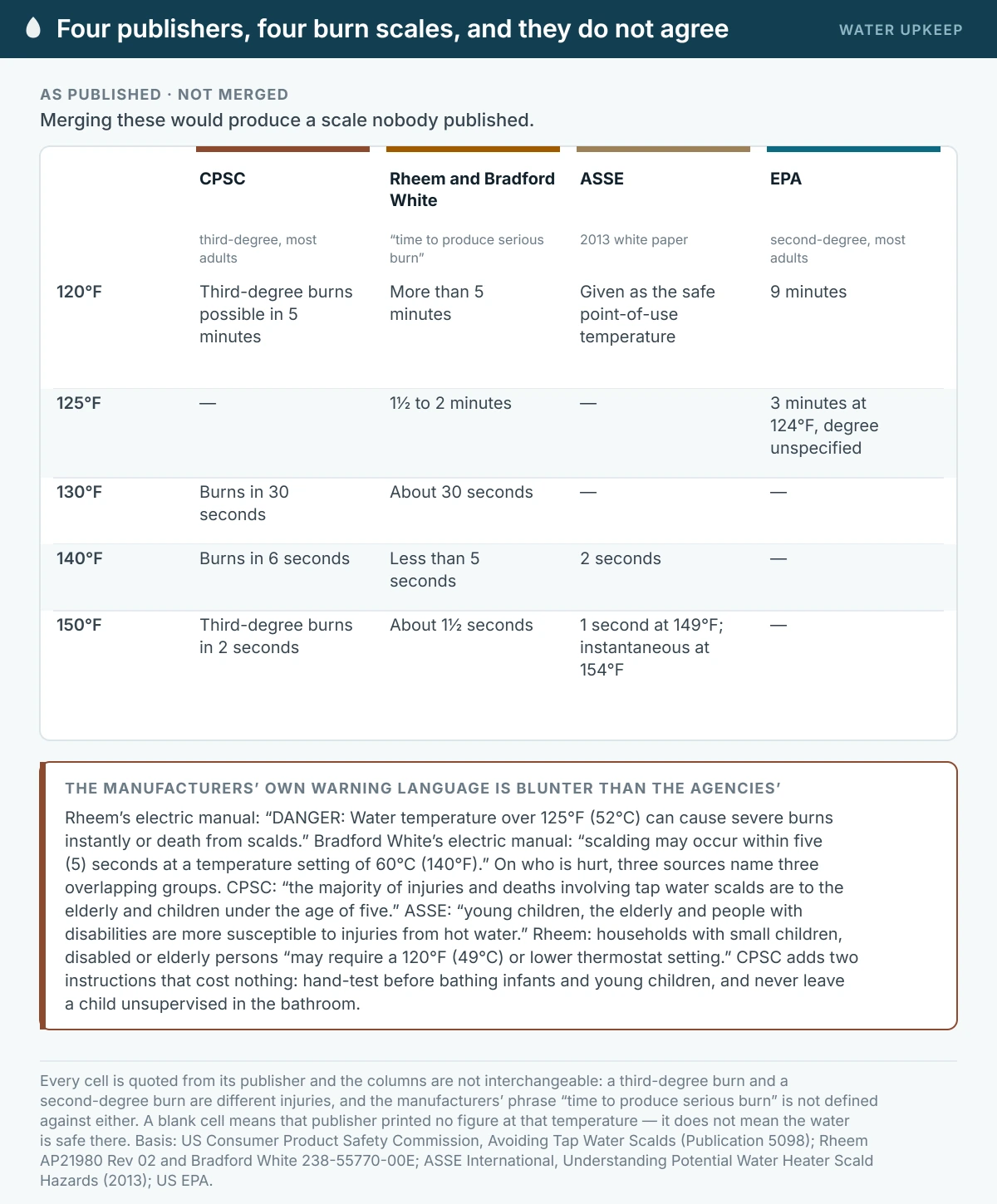
Four bodies publish burn timings, and they do not agree — not on the times, and not even on which injury they are describing. We are showing all four side by side rather than picking one, because merging them would produce a scale nobody published.
| Water temperature | CPSC (third-degree, most adults) | Rheem and Bradford White manuals (“time to produce serious burn”) | ASSE (2013 white paper) | EPA (second-degree, most adults) |
|---|---|---|---|---|
| 120°F | Third-degree burns possible in 5 minutes | More than 5 minutes | Given as the safe point-of-use temperature | 9 minutes |
| 124°F | — | — | — | 3 minutes (degree unspecified) |
| 125°F | — | 1½ to 2 minutes | — | — |
| 130°F | Burns in 30 seconds | About 30 seconds | — | — |
| 135°F | — | About 10 seconds | — | — |
| 140°F | Burns in 6 seconds | Less than 5 seconds | 2 seconds | — |
| 145°F | — | Less than 3 seconds | — | — |
| 149°F | — | — | 1 second | — |
| 150°F | Third-degree burns in 2 seconds | About 1½ seconds | — | — |
| 154°F | — | — | Instantaneous | — |
| 155°F | — | About 1 second | — | — |
A blank cell means that publisher did not print a figure at that temperature, not that the water is safe there. And the columns are not interchangeable: a third-degree burn and a second-degree burn are different injuries, and the manufacturers’ phrase “serious burn” is not defined against either.
The manufacturers’ own warning language is blunter than the agencies’. Rheem’s electric manual: “DANGER: Water temperature over 125°F (52°C) can cause severe burns instantly or death from scalds.” Bradford White’s electric manual: “scalding may occur within five (5) seconds at a temperature setting of 60°C (140°F).”
Who is most at risk
Three sources name three overlapping groups. CPSC: “the majority of injuries and deaths involving tap water scalds are to the elderly and children under the age of five.” ASSE: “young children, the elderly and people with disabilities are more susceptible to injuries from hot water.” Rheem’s electric manual: “households with small children, disabled, or elderly persons may require a 120°F (49°C) or lower thermostat setting to prevent contact with ‘HOT’ water.”
CPSC adds two instructions that cost nothing: “never take hot water temperature for granted. Always hand-test before using, especially when bathing infants and young children,” and “leaving a child unsupervised in the bathroom, even if only for a second, could cause serious injuries.”
Why some agencies say to go higher
The other side of this is Legionella, the bacterium that causes Legionnaires’ disease. CDC’s basic facts: the most common way to get sick is “by breathing in mist containing Legionella“; “you can’t catch Legionnaires’ disease from someone else”; and “about 1 out of 10 people who get Legionnaires’ disease will die from the infection.” CDC names people at increased risk as current or former smokers, people 50 years or older, and people with certain health conditions including cancer, chronic lung disease, diabetes, kidney failure, liver failure and weakened immune systems.
The growth temperatures, which also differ by source
- CDC: a favorable range of 77–113°F (25–45°C), noting it “may grow at temperatures as low as 68°F (20°C).”
- EPA (scientific literature review, 2016): growth “between 35 and 46 degrees Celsius (C) (95–115 degrees Fahrenheit (F)).”
- OSHA: “ideal temperature ranges for Legionella growth: 20°-50°C (68°-122°F),” and “water stored below 20°C (68°F) is generally not an environment in which Legionella will grow.”
The scoping fact that changes the whole question
Here is the thing almost nothing written on this subject mentions. The higher storage temperature that circulates as “the Legionella answer” comes out of building water management, and the three bodies that define that field each say, in their own words, that it does not cover single-family houses.
- ANSI/ASHRAE Standard 188, Legionellosis: Risk Management for Building Water Systems: “this standard does not include single-family residential buildings.” It applies to “human-occupied commercial, institutional, multiunit residential, and industrial buildings.”
- CDC’s water management program toolkit: “the building standards discussed in this toolkit do not apply to single-family or small multiple-family residences (e.g., duplexes).”
- EPA 810-R-16-001: “this document focuses on premise plumbing systems of large buildings, such as hotels, schools, hospitals and other similar buildings with more complex plumbing infrastructure… It does not apply to households but rather to commercial and institutional facilities.”
Be careful about what that does and does not mean. Those are statements about which standards apply to which buildings. They are not statements about biology, and none of the three says Legionella cannot occur in a house. Note also what CDC’s own page on how Legionella spreads actually lists as the places it grows: showerheads and sink faucets, hot tubs, decorative fountains, large complex plumbing systems, and cooling towers. Residential water heaters are not on that list — but showerheads and faucets are, which is a more careful statement, and one that matters when we get to mixing valves.
What CDC says where it does address a dwelling
CDC’s guidance for vacation rental owners and managers is the closest thing to a household-scale CDC statement we could find, and it names the trade-off directly:
Set your property’s water heater at or above 120°F to minimize the growth of Legionella… A hotter water temperature of 130–140°F can kill many harmful germs, but also increases the scalding risk.
Where the heater exceeds 120°F, CDC says to “use thermostatic mixing valves at the faucet or shower to avoid scalding” and to follow local scalding laws. It also says to “routinely flush the water heater according to manufacturer recommendations” — that part is covered in how to flush a water heater.
Scope matters here too: this is written for a property with intermittent occupancy, stagnation between guests, and occupants the owner does not know. It is residential-adjacent, not household guidance.
For completeness, and clearly labeled: CDC’s guidance for building water systems under a water management program is to “store hot water at temperatures above 140°F (60°C)” and “ensure hot water in circulation does not fall below 120°F (49°C),” with thermostatic mixing valves installed “as close as possible to fixtures.” That is the building figure, from the category houses are excluded from. OSHA, a workplace authority, goes further for workplaces: “storing domestic hot water at a minimum of 60°C (140°F) and delivering hot water at a minimum of 50°C (122°F) to all outlets,” and notes that “water heaters maintained below 60°C (140°F) and that contain scale and sediment may foster Legionella growth.” OSHA also publishes a thermal disinfection procedure for contaminated building systems that runs the water heater at 158°F for 24 hours — with its own warning to warn occupants or do it when the building is empty “to avoid serious burns from the high water temperatures used in this process.” That is a remediation procedure for a building, performed by people managing a building. It is not a household task and we are not describing it as one.
Two state agencies that give homeowners the building number anyway
The Maryland Department of the Environment, in a guide titled Healthy Home, Safe Water: A Legionella Prevention Guide for Maryland Homeowners (last updated May 2025), tells homeowners to “store hot water above 140°F (60°C),” to “ensure hot water in circulation does not fall below 120°F (49°C),” and to “install thermostatic mixing valves as close as possible to water fixtures to prevent scalding while permitting circulating hot water temperatures above 120°F.” It also advises running both hot and cold taps for three minutes each after a week or more of disuse, and five minutes on returning to an unoccupied property. Its own closing line is where this article ends up too: “for additional questions regarding Legionnaires’ disease, please feel free to contact your local health department.”
The New Jersey Department of Health, in guidance dated September 2025, is more cautiously worded and is the single most useful source here for a household reader:
It is recommended that the temperature of the water heater is set to a minimum of 120°F; however, setting the heater higher than 120°F may be better for controlling bacterial growth, but be sure to take extra precautions to avoid scalding… You may consider installing a mixing valve if you have household members at increased risk of scalding, such as young children.
Read that against CPSC and notice the reversal. CPSC’s 120°F is a ceiling. New Jersey’s 120°F is a floor. Same number, opposite meaning, both from public health agencies. That single observation explains most of the confusion around this question.
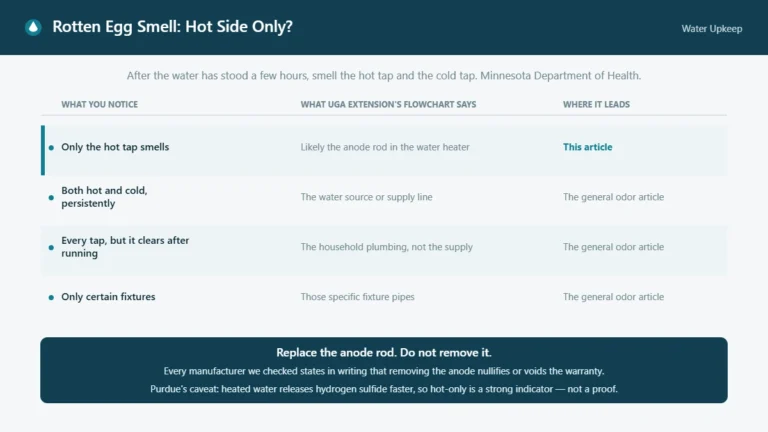
One more source of higher-temperature advice that readers run into: guidance for treating sulfur odor in hot water, which in at least two published cases involves temporarily raising the heater well above any of these figures. That is a separate, conditioned procedure and it is covered — with its conditions intact — in why only your hot water smells like sulfur and, for the general odor question, why your water smells like rotten eggs. Do not treat it as a standing setting.
The conflict, stated plainly
ASSE International, a plumbing standards body, put it in one sentence in a 2013 white paper:
There is a direct conflict between the safe delivery temperature of hot water to the points of use and the hot water temperature needed to minimize the growth of Legionella bacteria.
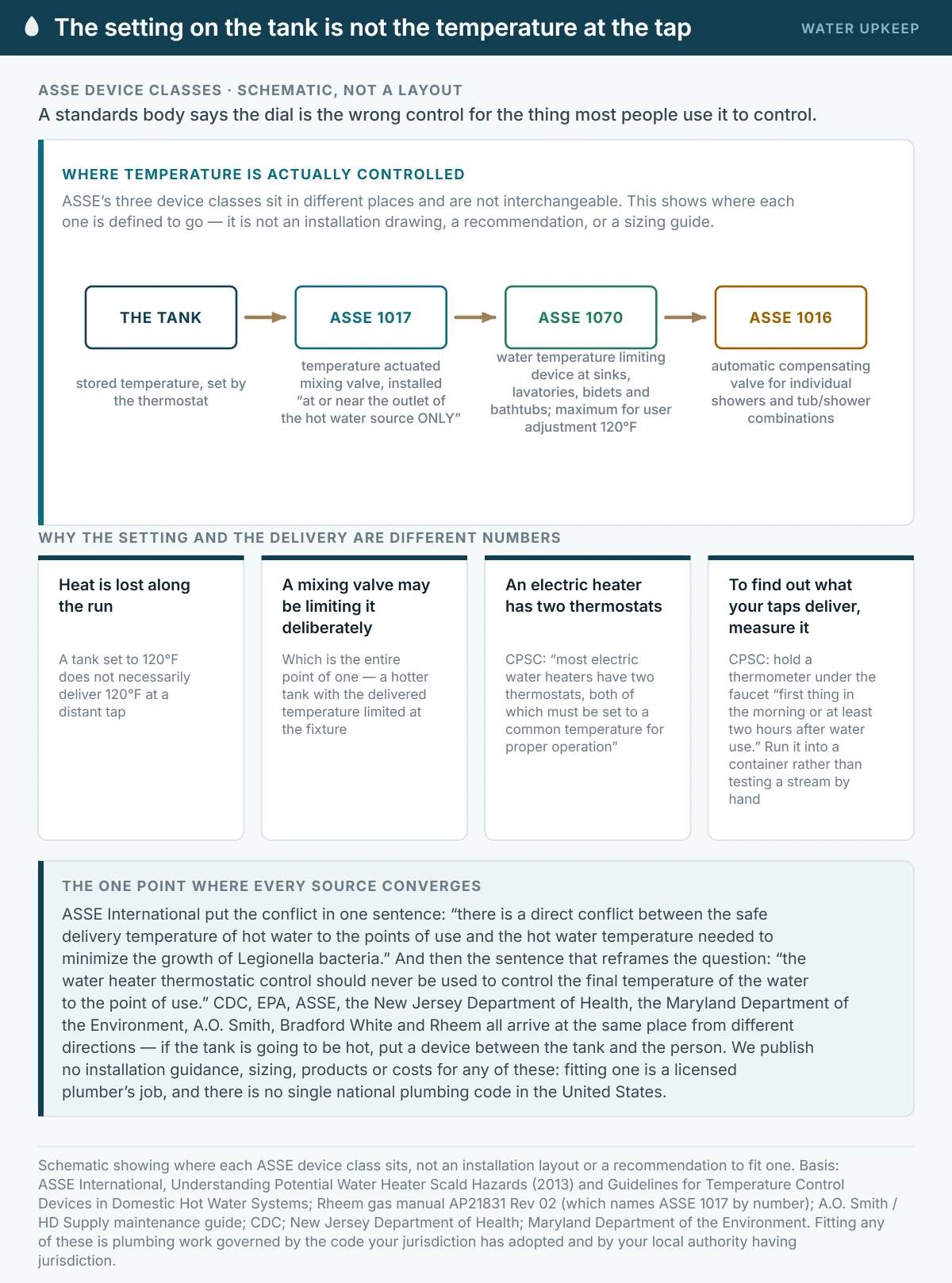
And then the sentence that reframes the entire question: “the water heater thermostatic control should never be used to control the final temperature of the water to the point of use.”
That is a standards body saying the dial on the tank is the wrong control for the thing most people are trying to control with it.
| Household | What the scald side says, and who says it | What the bacterial side says, and who says it | Where the sources point |
|---|---|---|---|
| Young children at home | CPSC: 120°F; children under five are among those most injured. Rheem: small children “may require a 120°F (49°C) or lower thermostat setting.” AAP: no more than 120°F at the faucet | NJ DOH: 120°F is a minimum; higher may be better for bacterial control, with extra scald precautions | NJ DOH names the mixing valve for exactly this household |
| Older adults at home | CPSC: the elderly are among those most injured. ASSE: older adults more susceptible | CDC: people 50 or older are at increased risk of Legionnaires’ disease | Both sides name the same group, for opposite reasons. No source resolves it. Health department or clinician |
| Someone with a weakened immune system, cancer, chronic lung disease, diabetes, or kidney or liver failure | CPSC: 120°F, as general guidance | CDC names all of these as increased-risk groups. Maryland MDE tells homeowners to store above 140°F | No source publishes a temperature for this household. Clinician or local health department |
| No one in either group | CPSC: 120°F. DOE: the warm setting | NJ DOH: 120°F minimum. Building standards do not apply to your house | Your own manual, and your jurisdiction’s code |
If someone in your household is at increased risk — the groups CDC names are people 50 or older, current or former smokers, and people with cancer, chronic lung disease, diabetes, kidney or liver failure, or a weakened immune system — this is not a question a water treatment site should answer for you. No source we could find publishes a water heater temperature for that situation. Talk to the person’s clinician, or to your local health department, which is where the Maryland Department of the Environment sends homeowners too.
The thing almost every source agrees on: the mixing valve
CDC, EPA, ASSE, the New Jersey Department of Health, the Maryland Department of the Environment, A.O. Smith, Bradford White and Rheem all arrive at the same place from different directions: if the tank is going to be hot, put a device between the tank and the person. It is the only point in this entire subject where the sources converge.
ASSE’s own taxonomy names three device classes and — this matters — they sit in different places and are not interchangeable.
- ASSE 1017 — “temperature actuated mixing valves for hot water distribution systems,” installed “at or near the outlet of the hot water source ONLY” (the capitals are ASSE’s). This is the one at the heater.
- ASSE 1070 — “water temperature limiting devices” for fittings at sinks, lavatories, bidets and bathtubs, with a maximum for user adjustment of 120°F.
- ASSE 1016 — “automatic compensating valves for individual showers and tub/shower combinations,” controlling temperature at the point of use.
ASSE’s own summary of what these buy you: “these valves allow the water to be stored at a higher temperature, extending the amount of hot water available, and also reducing the chance of legionella.” Rheem’s gas manual is the one manufacturer document here that names the standard by number: “it is recommended that a mixing valve complying with the Standard for Temperature Actuated Mixing Valves for Hot Water Distribution Systems, ASSE 1017 be installed.” A.O. Smith’s maintenance guide puts it as a conditional: “if temperature is set above 120F, install a thermostatic mixing valve.”
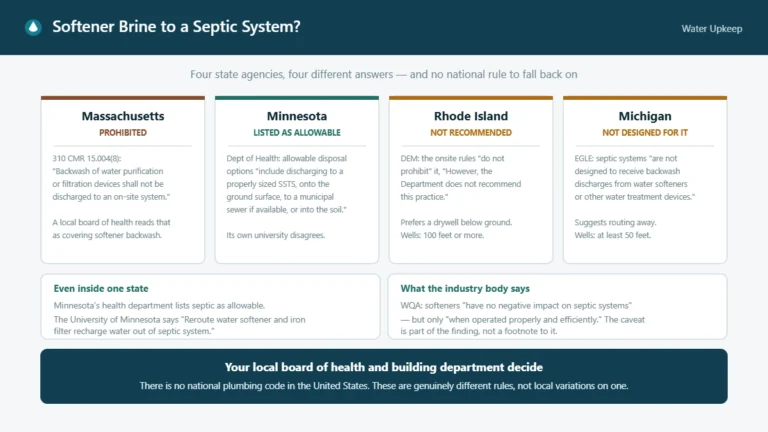
We are not publishing installation guidance, sizing, products or costs for any of these. Fitting one is plumbing work, governed by the plumbing code your jurisdiction has adopted — and there is no single national plumbing code in the United States, a point covered in where a water softener drain line can discharge — and by your local authority having jurisdiction. Rheem’s manual gives the right instruction: contact a licensed plumber or the local plumbing authority for further information.
Thermostat setting is not delivered temperature
This is why CPSC and the American Academy of Pediatrics can give the same number and mean different things. A tank set to 120°F does not necessarily deliver 120°F at a distant tap, and a tank set higher behind a mixing valve can deliver considerably less. The setting and the delivery are two different measurements, which is the practical form of ASSE’s sentence about the thermostat being the wrong control.
If you want to know what your taps actually deliver, CPSC publishes the method: “hold a candy or meat thermometer under faucet for most accurate reading first thing in the morning or at least two hours after water use.” Run the water into a container and put the thermometer in that — do not hold a thermometer in a stream you have not tested, and do not test with your hand first at a heater you suspect is set high.
One more fact from CPSC that explains a lot of failed adjustments: “most electric water heaters have two thermostats, both of which must be set to a common temperature for proper operation.” Changing one and not the other does not give you the setting you think you have.
What the law actually requires, in one state
Washington State has a statute on this, RCW 19.27A.060. It requires manufacturers to preset thermostats on new water heaters offered for sale or lease no higher than 120°F (or the minimum setting if the unit cannot go that low) and to attach a warning tag stating that higher settings “may cause severe burns and consume excessive energy.” It requires property owners or their agents to set thermostats to that temperature “upon occupancy of a new tenant” in rental residential units with accessible individual water heaters. It requires utilities to include the recommendation and notice of the requirement in annual billing statements. It exempts “multiple-unit residences supplied by central water heater systems.” Residents and owner-occupants may readjust after occupancy, which relieves owners and manufacturers of liability for resulting damage.
That is Washington State law. Most states have no equivalent statute, there is no national plumbing code in the United States, and we are not going to tell you what your own jurisdiction requires.
What your own heater’s manual says
The manufacturers do not all say 120°F either, and one of them names a higher starting point.
| Document | What it says about the setting | Mixing valve position |
|---|---|---|
| A.O. Smith service handbook 318181-000 | Recommended setting 120°F (49°C) | — |
| A.O. Smith / HD Supply maintenance guide | “Higher tank temperatures will increase hot water delivery but also increase the risk of scalding” | “If temperature is set above 120F, install a thermostatic mixing valve” |
| Bradford White gas 238-54725-00D | “It is suggested that the starting point setting not be greater than the ‘HOT’ mark on the thermostat dial (approximately 120°F [48.9°C])” | “Install an ASSE approved mixing valve in the water system” |
| Bradford White electric 238-55770-00E | Preset to approximately 50°C (122°F); “hotter water increases the risk of scald injury” | Recommends an ASSE approved mixing valve |
| Rheem electric AP21980 Rev 02 | “DANGER: Water temperature over 125°F (52°C) can cause severe burns instantly or death from scalds”; households with small children, disabled or elderly persons “may require a 120°F (49°C) or lower thermostat setting” | — |
| Rheem gas AP21831 Rev 02 | Adjustable up to 160°F; 125°F named as “the preferred starting point for setting the control for supplying general purpose hot water,” with the same 125°F danger warning | Names ASSE 1017 by number |
Rheem’s own two manuals are worth noticing side by side: the gas manual calls 125°F the preferred starting point while carrying a danger warning about temperatures over 125°F, and the electric manual flags 120°F or lower for households with small children, disabled or elderly people. Your manual, for your model, is the document that governs your heater.
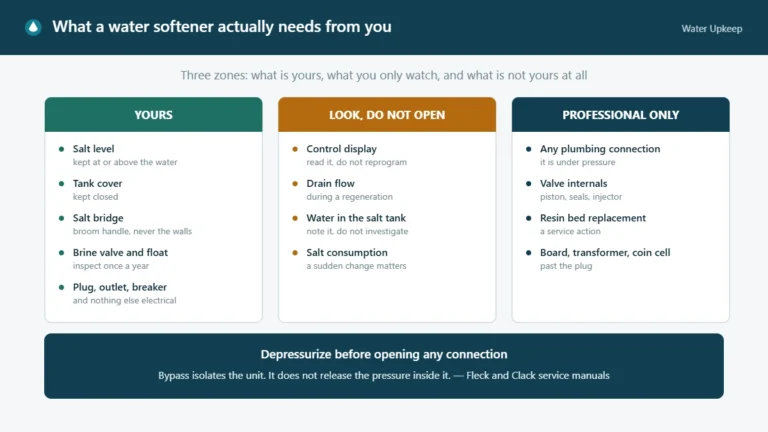
One adjacent limit worth knowing if you have a softener: residential control valves are rated to around 110°F, well below any of the figures on this page, which is one reason a softener is plumbed on the cold side. That limit is covered in water softener maintenance.
Energy
DOE recommends the warm setting of 120°F, and notes that “water heating can account for 14%-25% of the energy consumed in your home” — that is the share of your energy that goes to hot water, not a saving from turning the dial down. CPSC says lowering the temperature “will conserve energy and save money,” without a figure.
You will see a specific percentage saved per ten degrees quoted all over the internet and attributed to DOE. We could not locate it on any DOE page that resolved, so we are not publishing it. Rheem’s manual states the principle without a number, which is about as far as the evidence goes: “the most energy efficient operation will result when the temperature setting is the lowest value that satisfies the needs consistent with the application.”
How to change it — and where this article stops
CPSC’s own guidance for both fuel types starts with a phone call, and we are following it.
- Gas: CPSC says “because thermostats differ, call your local gas company for instructions.” Gas heaters have an external control dial with marked positions, and your manual defines what those marks mean — Bradford White’s, for instance, puts the “HOT” mark at approximately 120°F.
- Electric: CPSC says “call your local electric company to adjust the thermostat. Some companies offer this service at no-charge.” If you are measuring or setting, “hot water should not be used for at least two hours prior to setting.” And there are two thermostats, both of which have to match.
- Other systems: CPSC says to contact your fuel supplier, or your building manager if you rent. It notes that reducing water temperature will not affect a furnace’s heating capacity.
Setting the dial on a gas heater to a marked position is the only temperature adjustment this article describes. If your heater is electric, if the thermostats are behind access panels, if you want a mixing valve fitted, or if you are weighing a higher setting because of someone’s health — stop here. For the heater, call a licensed plumber, or your electric or gas utility, which is what CPSC’s own guidance suggests first. For the health question, call the person’s clinician or your local health department. We do not have an answer to that one, and as far as we could find, neither does any published source.
Frequently asked questions
What temperature should my water heater be set to?
CPSC and DOE both say 120°F. Your manual may say something slightly different — Rheem’s gas manual calls 125°F the preferred starting point. Public health guidance treats 120°F as a minimum rather than a maximum. We report those positions; we do not add one.
Is 140°F safe?
It is what CDC’s building water system guidance calls for and what the Maryland Department of the Environment tells homeowners. It is also a temperature at which CPSC puts a burn at six seconds, the manufacturers’ own table puts a serious burn at under five seconds, and ASSE puts it at two. Which is precisely why every source that recommends storing water that hot also names a mixing valve in the same breath.
Is 120°F hot enough to kill bacteria in my water heater?
No source in this article says any household temperature kills bacteria. CDC’s vacation-rental guidance says 130–140°F “can kill many harmful germs” and immediately names the scald consequence. If this is a health question for a specific person, it belongs with their clinician or your local health department.
My dishwasher says it needs 140°F water — what do I do?
CPSC’s own wording anticipates this: set “the lowest settings that will satisfy hot water needs for all clothing and dish washing machines.” Many dishwashers have internal booster heaters. And this is the case the mixing valve exists for — a hotter tank with the delivered temperature limited at the fixtures. That is a licensed plumber’s job.
Does turning down my water heater save money?
DOE recommends the warm setting and CPSC says it conserves energy and saves money. Neither publishes a figure we could locate, so there is no number here.
Someone in my household is immunocompromised — what should I set it to?
We do not know, and no published source we could find answers it. CDC names weakened immune systems among the increased-risk groups for Legionnaires’ disease; CPSC’s guidance is aimed at scald risk and does not consider bacteria at all. This is a question for the person’s clinician or your local health department.
Why does the temperature at my tap not match the setting on the tank?
Because they are different quantities. Heat is lost along the run to the fixture, mixing valves may be limiting it deliberately, and on an electric heater the two thermostats may not be set to the same value. CPSC’s measuring method — a candy or meat thermometer at the tap, first thing in the morning or two hours after any hot water use — tells you what is actually arriving.
Is there a law about water heater temperature?
In Washington State, yes — RCW 19.27A.060 imposes duties on manufacturers, landlords and utilities around the 120°F setting. Nationally, no, and there is no single national plumbing code. What applies to you depends on the code your jurisdiction has adopted.
Sources and standards
- US Consumer Product Safety Commission — Avoiding Tap Water Scalds, Publication 5098
- CDC — Controlling Legionella in Potable Water Systems, the water management program toolkit, considerations for vacation rental owners and managers, and how Legionella spreads
- ANSI/ASHRAE Standard 188 — Legionellosis: Risk Management for Building Water Systems (2018 preview) and the 2021 fact sheet
- US EPA — Technologies for Legionella Control in Premise Plumbing Systems (EPA 810-R-16-001, 2016) and Legionella in the Indoor Environment
- OSHA — Legionellosis: Control and Prevention (a workplace authority)
- ASSE International — Understanding Potential Water Heater Scald Hazards (revised May 2013) and Guidelines for Temperature Control Devices in Domestic Hot Water Systems
- Maryland Department of the Environment — Healthy Home, Safe Water: A Legionella Prevention Guide for Maryland Homeowners (May 2025)
- New Jersey Department of Health — Water heater guidance (September 2025)
- American Academy of Pediatrics — Burn treatment and prevention tips for families
- US Department of Energy — Home Energy Checklist
- Washington State Legislature — RCW 19.27A.060, Hot water heaters — Temperature regulation
- Manufacturer documentation — Rheem AP21980 Rev 02; Bradford White 238-54725-00D and 238-55770-00E; A.O. Smith service handbook 318181-000 and the A.O. Smith / HD Supply maintenance guide
Last reviewed September 9, 2026.