When Water Softener Resin Needs Replacing
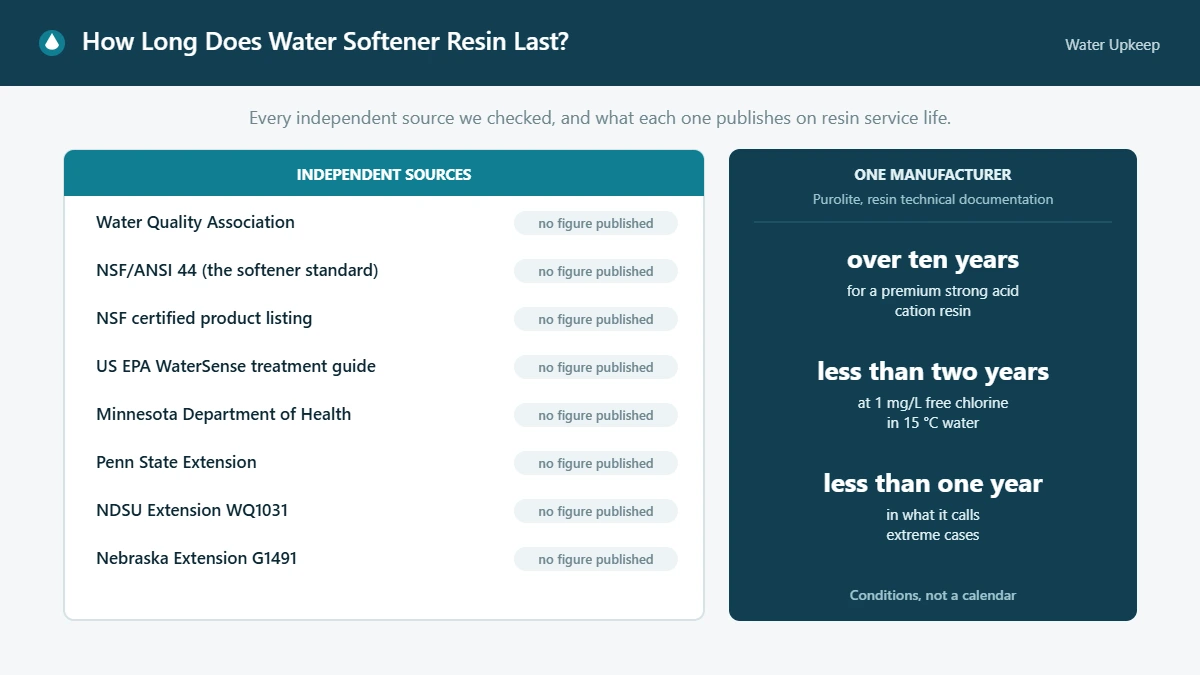
No independent authority publishes a service life for water softener resin. Not the Water Quality Association, not NSF/ANSI 44, not the EPA, not a state health department, not a single extension service — which means the confident “resin lasts 10 to 15 years” you will find on most pages about this has no source standing behind it. The one manufacturer that does publish guidance ties resin life to water chemistry rather than to a calendar. So the useful question is not how old your bed is. It is how much free chlorine and how much iron that bed has been asked to swallow — and, before any of that, whether the hard water you are seeing is the resin at all, because in both major control valve manuals most of the listed causes are not.
The short answer, and the number nobody actually publishes
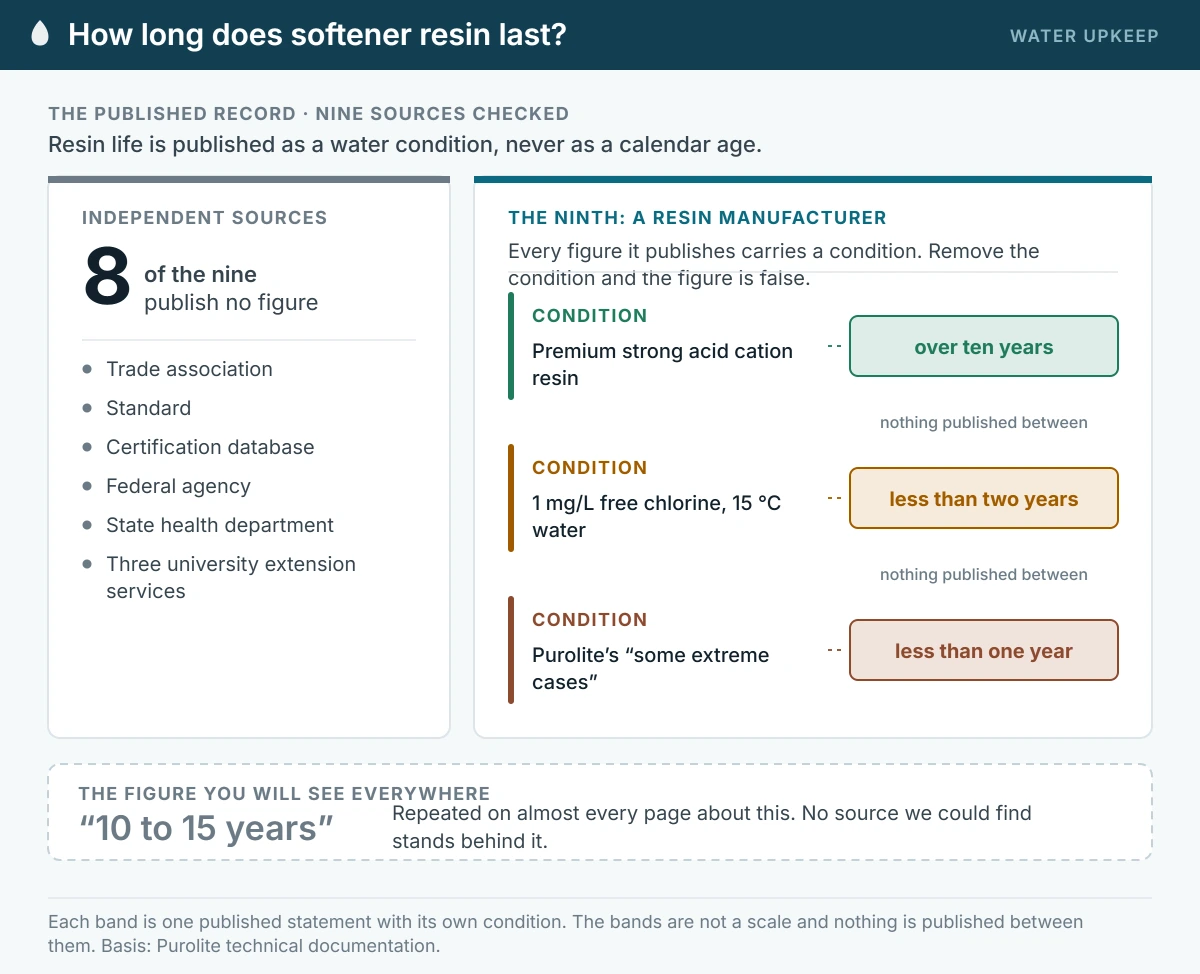
We went through every independent source that covers ion exchange softening in a residential context and checked each one specifically for a resin service life. Eight of them do not publish one. The ninth is a resin manufacturer, and its figures are conditional on water chemistry rather than on elapsed time.
| Source | Type | Resin service life published? | What it does say |
|---|---|---|---|
| WQA, Ion Exchange Fact Sheet | Trade association | None | Only that the process is reversible: “the ion exchangers can be regenerated (put back into their original ‘salt form’) and used over and over” |
| NSF/ANSI 44 technical requirements | Standard | None | Scope covers softening capacity, rinse effectiveness, material safety, structural integrity, pressure drop, brine system accuracy and accuracy of information to end users — durability is not an element |
| NSF certified product listing | Certification database | None | The searchable claims under cation exchange softeners are Barium Reduction, Efficiency Rated Hardness Reduction and Radium 226/228 Reduction. There is no lifetime claim to certify against |
| EPA WaterSense, Guide to Selecting Water Treatment Systems (2025) | Federal agency | None | “Filters should be replaced according to the manufacturer’s instructions” |
| Minnesota Department of Health, Water Softeners | State health department | None | Covers operation and sodium, not media life |
| Penn State Extension, Water Softening | University extension | None | Covers clogging and fouling, with no interval attached |
| NDSU Extension WQ1031 | University extension | None | Covers iron and manganese limits, not media life |
| Nebraska Extension G1491 | University extension | None | Says only that resin “may eventually need to be cleaned or replaced” |
| Purolite, Factors That Affect Softening Resin Performance and Life | Resin manufacturer technical documentation | Conditional figures only | See the quotations below — every figure is tied to chlorine concentration, temperature or resin grade |
The only published figures, and the conditions attached to them
Purolite, a resin manufacturer, publishes the following in its own technical documentation. Each figure is quoted here with the condition it was published under, because removing the condition makes the figure false.
- “Softening resin employing a premium strong acid cation resin can give reliable operation for over ten years” — note the resin grade in that sentence.
- “Having 1 mg/l free chlorine present in 15 °C water temperature reduces softening resin life to less than two years” — both the chlorine concentration and the temperature are load-bearing.
- “At a level of 0.3 mg/l (0.3 ppm) ‘free chlorine,’ there is little reduction in resin life in cold water applications.”
- “In some extreme cases…resin life can be reduced considerably, to less than one year.”
- “For each 1 mg/l (1 ppm) of chlorine present in the incoming water supply, the life of the resin will be reduced by 50%.”
Those are one manufacturer’s published figures, uncorroborated by any independent authority, and we are not going to turn the last one into a calculator. The relationship is Purolite’s; applying it to your chlorine residual to produce a number of years for your house would be our arithmetic dressed up as their evidence. What the figures are genuinely good for is the shape of the answer: the same bed can last a decade or less than a year, and what moves it between those two outcomes is upstream water chemistry.
Why “how old is it?” is the wrong question
A bed on a chlorine-free well with no iron is doing very little violence to itself. The same bed on a chlorinated municipal supply, or on a well carrying oxidized iron, is being chemically attacked every day it runs. Age is a proxy for exposure, and it is a poor one. Two variables you can actually find out — your free chlorine residual and your iron — tell you more about the state of that bed than its install date does.
First: is it the resin at all?
Almost everyone who searches for this has been told, usually by someone quoting for the work, that their resin is spent. Before accepting that, look at what the control valve manufacturers themselves list as causes of hard water coming out of a softener.
Clack’s WS1 service manual lists ten causes under “Hard or Untreated Water Delivered”: bypass valve open or faulty; media exhausted from high usage; meter not registering; water quality fluctuation; no or low regenerant in the tank; failure to draw regenerant; insufficient regenerant level; damaged seal and stack assembly; body and piston type mismatch; and fouled media bed. Two of those ten involve the media.
Fleck’s 5600SXT service manual lists seven causes of hard water: open bypass valve; no salt in the brine tank; plugged injector screen; insufficient water flowing into the brine tank; hot water tank hardness; a leak at the distributor tube; and an internal valve leak. None of the seven is the resin.
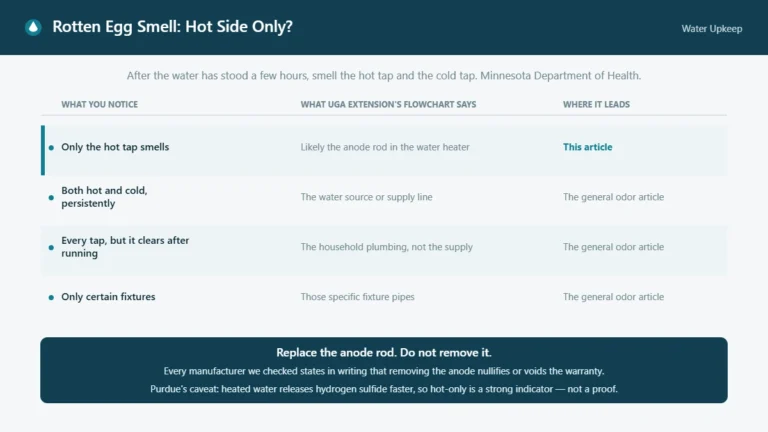
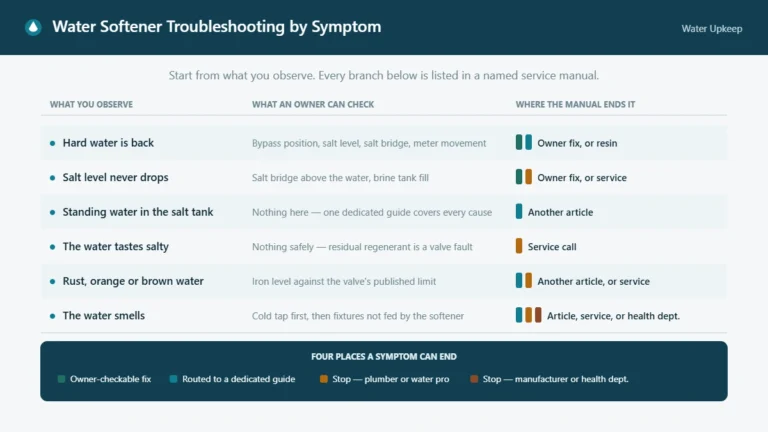
So the honest first answer to “do I need new resin?” is usually “probably not yet, and here is the order in which to rule things out.” Five of those causes are checkable by an owner without opening anything: the bypass position, whether there is salt at or above the water level, whether there is a bridged crust you can push through, whether the display registers flow when a tap is running, and whether the programmed hardness still matches the water. Our troubleshooting index by symptom works through all of them, and the programming question is covered in what hardness number to program. If the water is hard only on the hot side, Fleck attributes that to hardness already sitting in the water heater, not to the softener — see flushing a water heater.
Beads in the aerator are a mechanical fault, not wear-out
Finding resin beads in a faucet aerator or a toilet tank feels like the bed falling apart. Fleck lists it separately, under “Loss of mineral through drain line,” with two causes: air in the water system, corrected by checking the air eliminator control and looking for a dry well condition; and an improperly sized drain line flow control, corrected by checking the drain rate. It also lists a cracked distributor tube, with the correction “make sure distributor tube is not cracked. Check o-ring and tube pilot.” All three are containment failures — media leaving through something meant to retain it — and all three are service items rather than evidence that the resin is finished.
How softening resin actually degrades
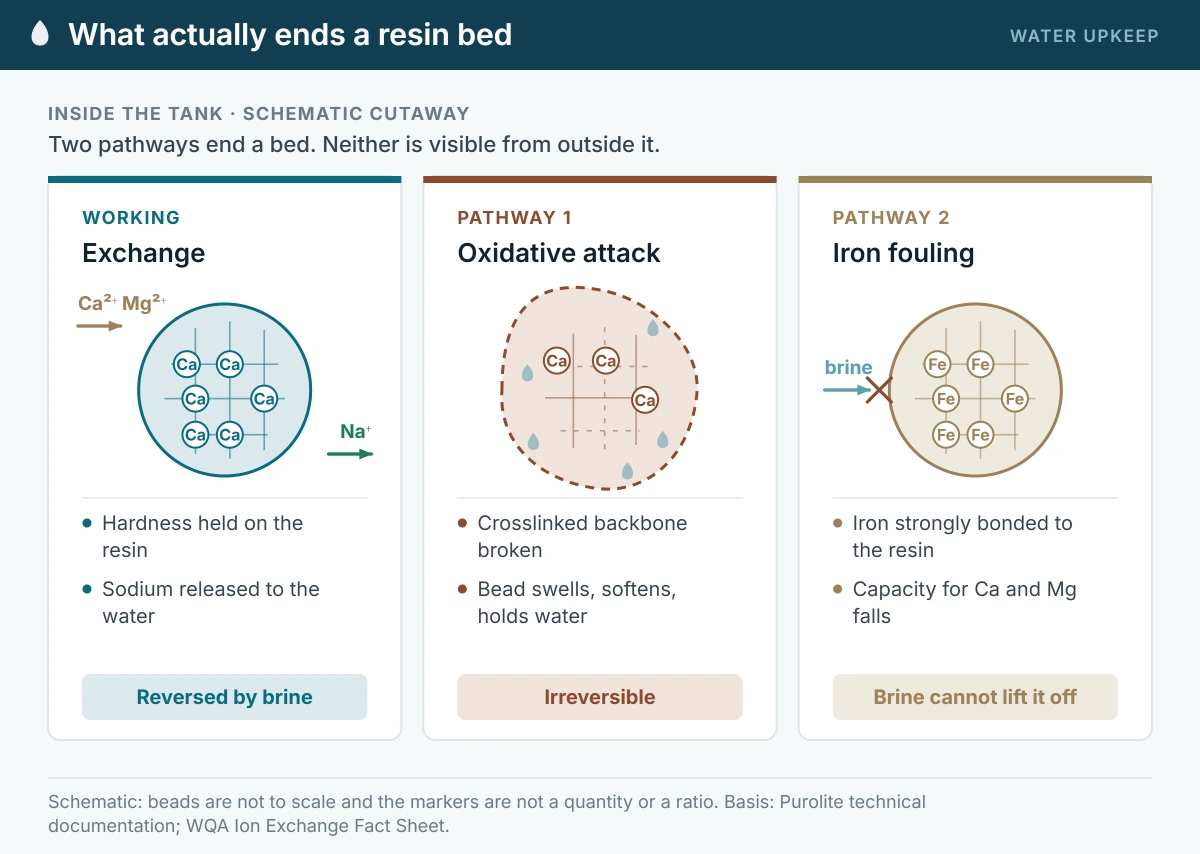
There are two pathways that genuinely end a bed, and two more that foul it in ways that may be recoverable.
| Pathway | Mechanism, as published | What accelerates it | Reversible? | How it shows from outside |
|---|---|---|---|---|
| Oxidative attack | Purolite: “All oxidizing chemicals attack synthetic ion exchange resins, negatively impacting the crosslinking of their resin backbone” | Higher oxidant levels; higher water temperature; lower crosslinking in the resin grade | No — Purolite’s word is “irreversible” | Falling capacity, so shorter runs between regenerations; in severe cases a pressure drop |
| Iron fouling | Purolite: strong acid cation resins have “a high selectivity for iron, which creates a strong bond to the resin, making it impossible for the brine regenerant to obtain a good reversible removal” | Iron in the raw water, particularly oxidized iron; iron also acts as a catalyst for oxidative attack | Effectively no, under ordinary brine regeneration | Falling capacity; discolored water; Fleck lists iron buildup as a cause of lost pressure |
| Physical fouling | Penn State: “If the raw water supply is turbid it may clog the resin with mud and clay” | Turbidity, silt, sand; no pre-filter upstream | Possibly, through adequate backwashing or cleaning | Reduced effectiveness; pressure drop |
| Biological fouling | Penn State: “Bacteria and fungi also form mats in the resin that reduce its effectiveness” | Undisinfected supply | Possibly — Penn State names disinfection upstream or periodic cleaning | Reduced effectiveness; odor |
Oxidative attack, and why crosslinking matters
Purolite names the agents directly: “When chlorine, chlorine dioxide, hypochlorite, peroxide or any other oxidizing agents are dosed at levels resulting in a higher oxidizing potential, they can cause quick and irreversible damage to the resin.” It adds that “the higher the water temperature, the faster the breakdown and loss of performance.”
Not all resin resists this equally. Purolite: “Cation resins are available with different crosslinking content. The higher the crosslinking (DVB content), the greater the resistance to oxidative attack and the longer the resin life.” And: “Some lower price softening resins have only 6% DVB content or less, which means they will have good kinetic performance, but the lowest resistance to oxidative attack.” That is a manufacturer describing its own product range, and it is worth knowing when someone quotes you for a re-bed — but we are not going to tell you which resin to buy or what DVB number to insist on, because no independent source rates them.
If you are on a chlorinated municipal supply and this is your concern, the upstream question is chlorine reduction ahead of the softener rather than resin selection. That is covered in removing chlorine from water and, for whole-house treatment, in our whole house water filter guide.
What a degraded bead physically becomes
Purolite describes the end state precisely: “Analytical testing of a resin sample from the bed will show a reduction in the resin’s total capacity of the resin and this will be combined with a significant increase in the intrinsic moisture content (or water retention) within the resin beads.” And: “Resin beads near the inlet to the bed will become physically weak and soft, and — in severe cases — they become ‘jelly-like,’ causing increased pressure-drop.”
Read that sentence again, because it settles a question people ask constantly. The definitive evidence is a laboratory analysis of a sample drawn from the bed. It is not something you can see, feel or judge from outside the tank, and drawing that sample means opening a vessel that all three control valve manuals we consulted rate to 125 psi. That is a professional action, not a home test.
Iron fouling: the pathway you can see coming
Iron is the one degradation input a homeowner can measure cheaply and act on before the bed pays for it. Purolite: “Iron consequently builds upon the resin slowly and reduces the resin’s capacity for calcium and magnesium,” and “Iron will also act as a catalyst, accelerating the effect of an oxidative attack on the resin and further shortening resin life.”
Penn State Extension corroborates the mechanism from a different direction and adds the distinction that matters: “Although colorless, reduced iron will be removed by the unit, red-oxidized iron (iron that has been exposed to air or chlorine) will clog the resin.” Its conclusion is a design instruction — “Filtration prior to softening insures that oxidized iron is not processed in the softener.”
The iron ceiling, where two extension services disagree
There is no single published limit on how much iron a softener can handle, and we are not going to invent one by averaging. Two university extension services publish different numbers, and both are worth having.
- Nebraska Extension (G1491) says softeners “may also remove as much as 5-10 ppm,” that “excess iron (above 5 ppm) or hydrogen sulfide in the water can reduce the effectiveness,” and that concentrations “greater than the softener’s removal rating may require pretreatment.” It adds that sediment also reduces effectiveness.
- NDSU Extension (WQ1031) says “some softeners will also remove up to 10 ppm of iron and manganese,” and that supplies “with high levels of iron and manganese (greater than 10 ppm) may need a dedicated iron removal system.” It notes that more frequent backflushing may be needed to remove iron buildup.
If your water is over your own unit’s published iron rating — which is on its data plate or in its manual, not in either of those documents — the answer is iron removal upstream, not a new bed that will foul the same way. That is the subject of removing iron from well water, and for well owners choosing a whole treatment train, well water filtration systems.
Fouling that may be recoverable
Penn State is blunt about the two remaining pathways: “Periodic clogging of the resin also requires special attention.” Mud and clay from a turbid supply clog the bed mechanically. Bacteria and fungi “form mats in the resin that reduce its effectiveness.” Its stated remedies are disinfecting the water ahead of the softener, or periodically cleaning the softener with chlorine bleach — and it publishes no dose for that, which is why we do not either. The sanitizing question, including why the two manufacturer procedures we located are not on a comparable basis, is handled in water softener maintenance, which sends you to your own manual for the figure.
Note the ceiling on that claim: Penn State’s language is that biological mats “reduce its effectiveness.” It does not say the water becomes unsafe. If your concern is bacteria in the water rather than in the resin, that is a testing and public health question, not a media question — start with a positive coliform test on your well and your local health department.
Backwash is the operational defense, and it can be wrong
Nebraska Extension gives the only homeowner-legible test of whether backwashing is doing its job: it “should be continued until the water runs clear,” and you “adjust the time so the backwash is long enough to produce clear water.” Its summary is that “adequate backwashing of the resin bed is important to ensure efficient regeneration.” If backwash is short, physical fouling accumulates that the bed was never designed to hold — Purolite’s own engineering bulletin for its C100 resin states plainly that “this service bed should not be used as a mechanical filter. Proper pretreatment should be incorporated.”
That is the argument for a sediment pre-filter upstream of the softener, and it is a sizing question we deliberately do not answer here: see what micron rating your filter needs. Cycle timing itself belongs to how often a softener should regenerate rather than to this page.
How you would actually know
Here is the complete set of evidence available to you without opening anything.
- Test the softened water, and the raw water. A bed that is not exchanging shows up as hardness at the tap that is close to the untreated supply. The procedure is in how to test water hardness.
- Find your free chlorine residual. On a public supply it is in your utility’s annual Consumer Confidence Report. This is the single variable every one of Purolite’s service life figures is conditioned on.
- Find your iron. On a well, that means a laboratory test. Compare it against your own unit’s published rating, not against a general number.
- Watch salt use and regeneration frequency as a trend. A bed losing capacity regenerates more often for the same water use. The trend is the signal; there is no threshold number to compare it to.
- Rule out the mechanical causes first — bypass, salt, salt bridge, meter, programming — because they mimic a spent bed exactly.
What you cannot do is confirm it. Purolite’s definitive test is analytical testing of a drawn sample, measuring lost capacity and increased moisture retention. Nothing you can observe from outside substitutes for it, and no visual home test for spent resin exists in any source we would cite.
Replace the bed, clean it, or adjust the cycle?
This is where the two major control valve manufacturers give different first answers to the same fault, which is worth seeing plainly.
| Manual | The fault as named | The stated correction |
|---|---|---|
| Clack WS1 service manual | “Fouled media bed” (under Hard or Untreated Water Delivered) | “Replace media bed” |
| Fleck 5600SXT service manual | “Fouled mineral bed” (under Iron in conditioned water) | “Check backwash, brine draw, and brine tank fill. Increase frequency of regeneration. Increase backwash time” |
| Fleck 5600SXT service manual | “Iron buildup in water conditioner” (under Loss of water pressure) | “Clean control and add mineral cleaner to mineral bed. Increase frequency of regeneration” |
One manufacturer’s first move is to replace the media. The other’s is to adjust the cycle and clean the bed. Neither is wrong, and we are not going to pick between them on your behalf — your own manual is the document that governs your unit. What we will say is that “you need new resin” is one manufacturer’s first answer to one fault, not a settled diagnosis, and that Fleck listing a mineral cleaner as a correction is not a claim that cleaning restores a fouled bed. No source we would cite publishes a recovery rate for that.
What re-bedding involves, and why there is no procedure here
We are not publishing a re-bedding walkthrough, and the reason is in the manuals rather than in our own caution. Fleck: “The system must be depressurized before removing any connections for servicing.” Clack: “Pressure hazard; depressurize valve before servicing,” and “Disconnect from electrical power prior to servicing.”
Descriptively, re-bedding means isolating and depressurizing the unit, removing the control valve from the tank, withdrawing the riser and distributor assembly, emptying several cubic feet of wet media, replacing any underbedding, charging the tank with new resin, reassembling and then flushing. It is a plumbing job on a pressurized vessel, and no source in our evidence base publishes homeowner guidance for it. Knowing the scope is useful when you price the work; performing it from a web page is not something we will help with. While you wait, put the unit in bypass so the house keeps water and you stop cycling a bed that is not working — see how to bypass a water softener.
When the real question is the softener, not the resin
Re-bedding an old unit competes against replacing it, and the deciding factors are usually the valve, the meter and the tank rather than the media. We do not publish a lifespan figure for the unit either, for the same reason we do not publish one for the resin — nobody credible does. What we can lay out is the failure modes, in how long water softeners last, the cost drivers in what a water softener costs, and the broader question of whether to keep one at all in are water softeners worth it. If the answer is a new unit, installation, code and drain requirements are in how to install a water softener.
One more distinction worth having if someone quotes you for “NSF certified resin.” The softener as a system may be certified to NSF/ANSI 44, where the listed claims are Efficiency Rated Hardness Reduction, Barium Reduction and Radium 226/228 Reduction. The resin as a material is a different certification: Purolite’s C100E data sheet states it is “Certified by the WQA to NSF/ANSI-61 Standard,” which is a material safety standard for drinking water system components. It says nothing about softening performance and nothing about how long the resin lasts.
After a re-bed, flush before you use the water
A 2022 master’s thesis from Purdue University examined what softener resin releases into drinking water under laboratory conditions. Its finding was that “both new and aged softener resins leached organic carbon compounds into drinking water,” and that this leaching “prompted notable reductions of drinking water free chlorine disinfectant levels.” Concentrations fell substantially over the first week of operation. That is a single laboratory study rather than settled science, and we are not publishing its measured concentrations, which are meaningless without the full experimental setup. What it supports is a simple qualitative instruction that the manufacturer procedures already contain: a freshly bedded softener gets flushed before the water is used.
When to stop, and who to call
Stop and call a licensed plumber, a certified water treatment professional, or the manufacturer at any of these points.
- Any step that would open a pressurized connection or the resin tank — including drawing a resin sample, which is the one test that would actually settle the question.
- The point where bypass, salt, salt bridge, meter and programming have all been excluded and the remaining candidates are internal to the valve.
- Any leak, any error code, any continuous flow to the drain.
- Beads escaping to fixtures or the drain — Fleck attributes this to air in the system, drain line flow control sizing, or a cracked distributor tube, all of which are service items.
- Any decision to re-bed. Media selection, quantity and underbedding are outside what any source we would cite publishes for a homeowner.
Call your health department, not a plumber, for any bacteria question, any positive coliform result, or any concern that someone has become ill. And note what a softener is not: Hellenbrand’s own manual states that its unit “is not intended to be used for treating water that is microbiologically unsafe or of unknown quality without adequate disinfection.” Nebraska Extension lists what softening does not remove at all — bacteria, hydrogen sulfide, silt or sand, lead, nitrate, pesticides.
The hydrocarbon exception, which is not a fouling case
If your water has a fuel or solvent odor, or your property has had a known contamination event, this is not a resin decision. Clack’s manual carries an absolute exclusion: “DO NOT USE CLACK CONTROL VALVE PRODUCTS ON WATER SUPPLIES THAT CONTAIN HYDROCARBONS SUCH AS BENZENE, GASOLINE, KEROSENE.” The Purdue laboratory work found resins absorbed and leached benzene, toluene, ethylbenzene and xylenes “for more than 2 weeks.” Stop using the water and contact your water utility or health department. We are not offering a remediation or flushing protocol for this, because none exists in our sources.
Frequently asked questions
How long does water softener resin last?
No independent authority publishes a figure. The only published guidance we located is from a resin manufacturer, Purolite, and it is conditional rather than calendar-based: “over ten years” for a premium strong acid cation resin, “less than two years” where the water carries 1 mg/L of free chlorine at 15 °C, and “less than one year” in what it calls extreme cases. The widely repeated “10 to 15 years” has no source we could find behind it.
What are the signs that water softener resin is bad?
Honestly, the signs overlap almost entirely with faults that are not the resin. Hard water at the tap, shorter runs between regenerations and reduced pressure all appear in both manufacturers’ cause lists under causes that have nothing to do with the media. Work through the exclusions in our symptom index first.
Does city water ruin water softener resin?
Chlorine is the mechanism Purolite names, and it publishes a relationship between chlorine concentration and resin life. It does not publish a threshold at which to act, and neither will we. If chlorine reduction upstream of the softener is what you are considering, start with removing chlorine from water.
Can iron-fouled resin be cleaned, or does it have to be replaced?
Purolite describes the iron bond as one where brine cannot achieve “a good reversible removal.” Clack’s correction for a fouled media bed is to replace it; Fleck’s is to adjust the cycle and add a mineral cleaner. Both are manufacturer positions on the same fault, and your own manual governs your unit.
Can I replace the resin myself?
We do not publish a procedure. Both manuals require the system to be depressurized before any connection is opened, and the tank operates at up to 125 psi. The description above is there so you can judge the scope of the job and price it, not so you can attempt it from a browser tab.
Are resin beads in my faucet aerator a sign the resin is worn out?
No. Fleck lists that symptom under mechanical causes — air in the water system, a wrongly sized drain line flow control, or a cracked distributor tube. Media is escaping through something that should be retaining it.
Is there a home test for spent resin?
No. Purolite’s definitive test is analytical testing of a sample drawn from the bed, which measures capacity loss and moisture retention. What you can test at home is hardness, and what you can look up or have tested is your chlorine and iron.
Does more expensive resin last longer?
Purolite states that higher crosslinking gives “greater resistance to oxidative attack and the longer the resin life,” and that some lower-priced resins have 6% DVB content or less. That is a manufacturer describing its own range. No independent body rates resin grades, so we make no recommendation.
Sources and standards
- Water Quality Association — Ion Exchange Fact Sheet
- NSF — NSF/ANSI 44 technical requirements and the certified drinking water treatment unit listing
- US EPA WaterSense — Guide to Selecting Water Treatment Systems, version 2 (2025)
- Penn State Extension — Water Softening
- NDSU Extension WQ1031 — Water Softening (Ion Exchange)
- Nebraska Extension G1491 — Drinking Water Treatment: Water Softening
- Minnesota Department of Health — Water Softeners
- Purolite (manufacturer technical documentation) — Factors That Affect Softening Resin Performance and Life, the C100 sodium cycle engineering bulletin and the C100E product data sheet
- Pentair Fleck (manufacturer technical documentation) — 5600SXT downflow service manual
- Clack Corporation (manufacturer technical documentation) — WS1 and WS1.25 drawings and service manual
- Hellenbrand (manufacturer technical documentation) — ProMate EcoMax consumer manual
- C. M. Jankowski — Water Quality Implications of Contaminated Plumbing Systems, M.S.E. thesis, Purdue University, 2022. Related peer-reviewed work: Isaacson et al., Environmental Science & Technology 57(23):8750–8759
Last reviewed September 8, 2026.