Water Softener Troubleshooting by Symptom
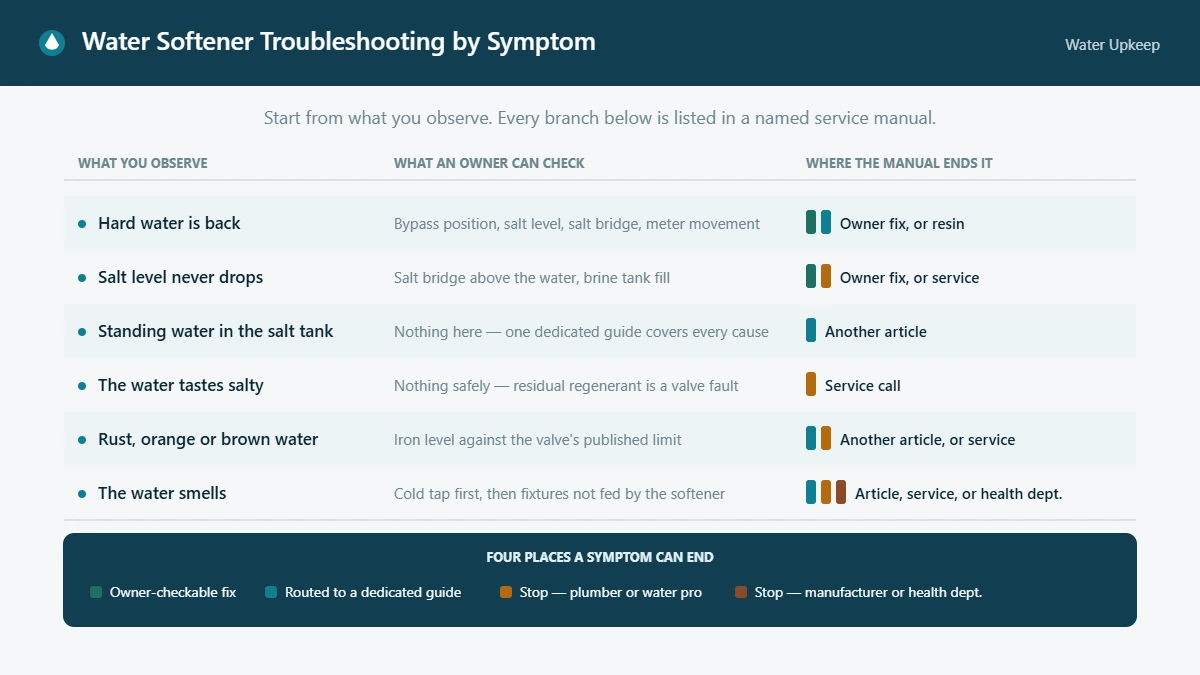
Most water softener faults announce themselves as one of about a dozen things you can actually see, and the manufacturers’ own service manuals list the causes of each. So the fastest route to an answer is to start from the symptom, not from the unit. Find yours in the index below, work through the causes an owner can genuinely check — bypass position, salt level, salt bridge, power and display, whether the meter is registering — and stop at the point where the manual’s own correction becomes a service action.
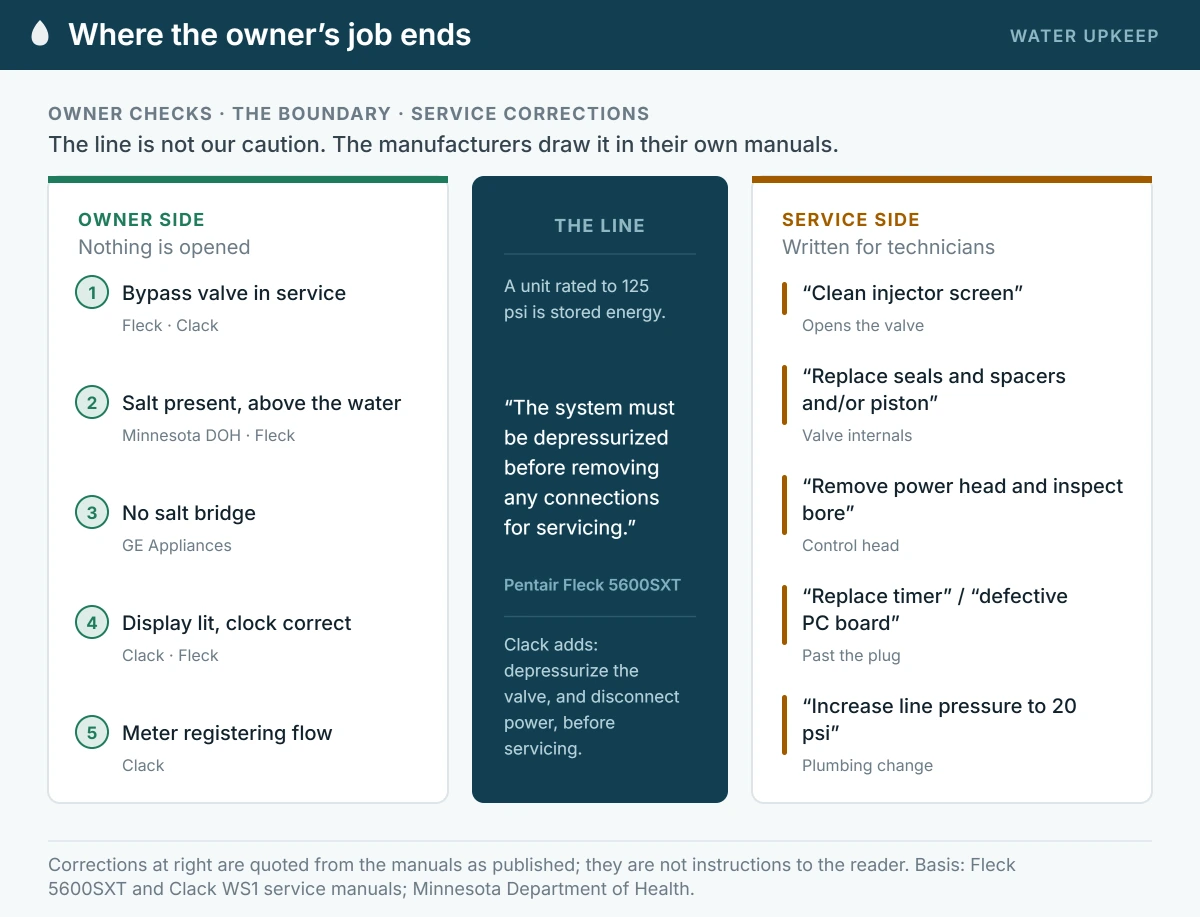
That stopping point is not our caution. Both Pentair’s Fleck manual and Clack’s WS1 manual require the system to be depressurized before any connection is opened, and Clack additionally requires disconnecting power before servicing. Everything past that line is written for technicians.
Before you look up your symptom
Five checks come before everything else, because they cost nothing and both manuals list them as causes:
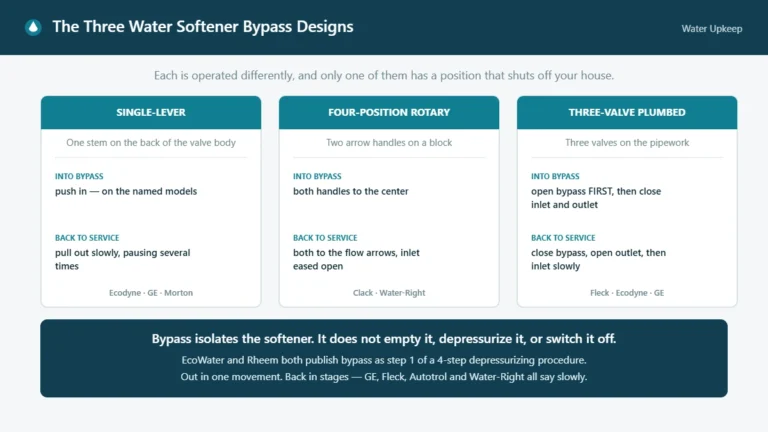
- Is the bypass valve in service? Fleck lists “bypass valve is open” as a cause of hard water. Clack lists “bypass valve in bypass position” against three separate symptoms. Clack’s bypass has four positions — normal operation, bypass, diagnostic and shutoff — so “it looks like it’s on” is not the same as being in service.
- Is there salt, and is it above the water? Minnesota DOH: keep salt “at or above the tank’s water level.” Fleck’s correction for hard water with no salt is the same sentence.
- Is the salt bridged? A crust can leave the tank looking full while the softener starves.
- Is the display lit and the time right? Clack lists a switched outlet, a tripped breaker or GFCI, and a power outage against a wrong clock. Fleck notes that interruptions longer than eight hours may lose the time setting entirely.
- Is the meter registering? On a metered valve, Clack lists a stalled turbine, a loose meter wire and a defective meter against “display does not indicate water flowing.”
One more thing worth knowing before you start: putting the unit in bypass is a legitimate interim move. It gives the house hard but usable water while you wait for service, and it isolates the unit. It does not depressurize it. The bypass procedure is here.
We have ordered this index by how easy each cause is to check, not by how common it is. That distinction matters: neither manufacturer ranks causes by frequency, and no source we could find publishes softener failure statistics. Anyone telling you the “most common cause” is guessing.
The symptom index
| What you observe | Causes you can check | Causes that need service | Listed by | Next |
|---|---|---|---|---|
| Water is hard again | Bypass open; no salt; salt below water level; salt bridge; meter not registering; programming; water quality changed | Internal valve leak; cracked distributor tube; damaged seal and stack; media exhausted or fouled | Fleck, Clack | See below |
| Only the hot water is hard | — | Fleck lists “hot water tank hardness” and calls for repeated flushings of the tank | Fleck | Flushing a water heater |
| Salt never goes down | Salt bridge; bypass left in bypass; unit not regenerating at all | Fails to draw regenerant — plugged injector, faulty regenerant piston, drain restriction, line pressure | Fleck, Clack | See below |
| Using far too much salt | Improper salt setting; improper refill setting; leaking fixtures driving frequent regeneration | Excessive water in the brine tank; undersized system | Fleck, Clack | Softener settings |
| Standing water in the salt tank | Some water is normal — how much is disputed | Plugged injector, drain restriction, damaged seal and stack, program settings | Fleck, Clack | Why it is full of water |
| Water tastes salty | — | Clack: residual regenerant in service water — low pressure, incorrect injector size, restricted drain line | Clack | Call for service |
| Water pressure has dropped | — | Fleck: iron buildup in the line or in the conditioner; inlet plugged with foreign material | Fleck | Call for service |
| Water runs to drain continuously | Check whether a cycle is simply still running | Both: valve not programming correctly, foreign material in the control, internal leak, piston or seal failure, drive cap not tightened | Fleck, Clack | Call for service |
| Never regenerates | Power interrupted; outlet on a light switch; breaker or GFCI tripped; clock wrong after an outage; meter not registering | Defective timer or PC board; broken drive gear or cap; broken piston rod | Fleck, Clack | What normal looks like |
| Regenerates at the wrong time | Time of day not set; regeneration time set wrong; set to immediate regeneration | — | Clack | Softener settings |
| Rust, orange or brown water | Whether the iron is above your unit’s rating | Fleck: fouled mineral bed, plugged injector, foreign material in the brine valve or flow control, timer not cycling | Fleck | Removing iron |
| Resin beads at aerators or in the drain | — | Fleck: air in the water system, dry well condition, or an improperly sized drain line flow control; check the distributor tube is not cracked | Fleck | Call for service |
| The water smells | Does the cold tap smell? Do fixtures not connected to the softener smell? | Depends where the branch lands | Minnesota DOH | See the odor section |
| Blank display or an error code | Plug, outlet, breaker, GFCI | Defective power adapter or PC board; every E1/E2/E3 and Err-10xx code | Clack | Call the manufacturer |
The water is hard again
Start by confirming it. A hardness test on the softened water turns a suspicion into a measurement, and it distinguishes a softener that has stopped working from a change in what the softener is being asked to do — Clack lists “water quality fluctuation” as a cause in its own right.
Then work the owner-checkable list: bypass in service, salt present and above the water line, no salt bridge, the display showing a sensible time, and the meter registering when water runs. Between them, Fleck and Clack list all of these against hard or untreated water. If the complaint is hot water only, it is probably not the softener at all — Fleck lists “hot water tank hardness” as a distinct cause and its correction is repeated flushings of the water heater.
The causes that are not yours sit in the same tables: an internal valve leak, a leak at the distributor tube, a damaged seal and stack assembly. Fleck’s corrections for those are “replace seals and spacers and/or piston” and checking the distributor tube for cracks. Both require opening a pressurized unit.
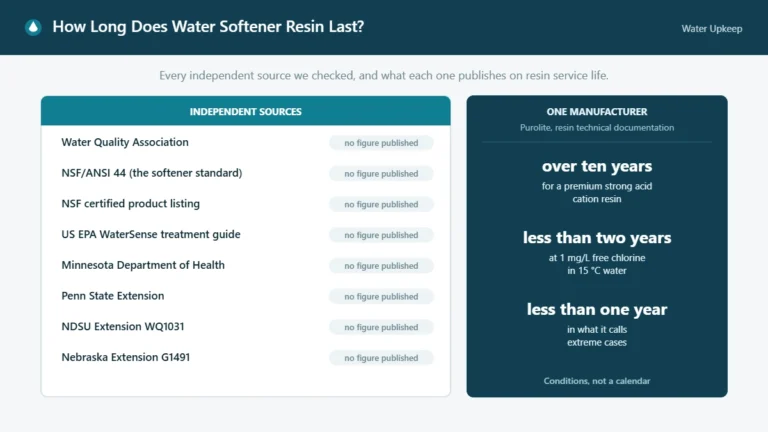
There is one branch worth naming carefully. Both manuals list a fouled or exhausted media bed as a cause — and they respond to it differently. Clack’s stated solution for a fouled media bed is to replace it. Fleck’s correction for a fouled mineral bed is to check backwash, brine draw and brine tank fill, increase regeneration frequency and increase backwash time. Two manufacturers, two answers. We are not going to adjudicate between them; that decision is its own question.
Salty-tasting water is a fault, not the sodium
Softening does add sodium, at a rate NDSU and Nebraska Extension both give as about 8 mg/L for each grain per gallon of hardness removed. That is normal operation and it is not what a salty taste means. A salty taste maps to a specific fault in Clack’s table — “residual regenerant in service water” — whose listed causes are low water pressure, an incorrect injector size, and a restricted drain line. All three are service items. Do not confuse the normal rate with the fault.
Rust or orange water after softening
Penn State Extension explains the mechanism in one sentence: “Although colorless, reduced iron will be removed by the unit, red-oxidized iron (iron that has been exposed to air or chlorine) will clog the resin.” The fix is upstream, not in the softener: “filtration prior to softening insures that oxidized iron is not processed in the softener.”
How much iron a softener can handle depends on which extension service you ask. Nebraska Extension says softeners “may also remove as much as 5-10 ppm” and that excess iron above 5 ppm reduces effectiveness. NDSU says “some softeners will also remove up to 10 ppm of iron and manganese” and that above 10 ppm you may need a dedicated iron removal system. Both are credible Tier 1 sources and they disagree. If your water is near either figure, the answer is iron removal ahead of the softener rather than more aggressive regeneration.
The water smells
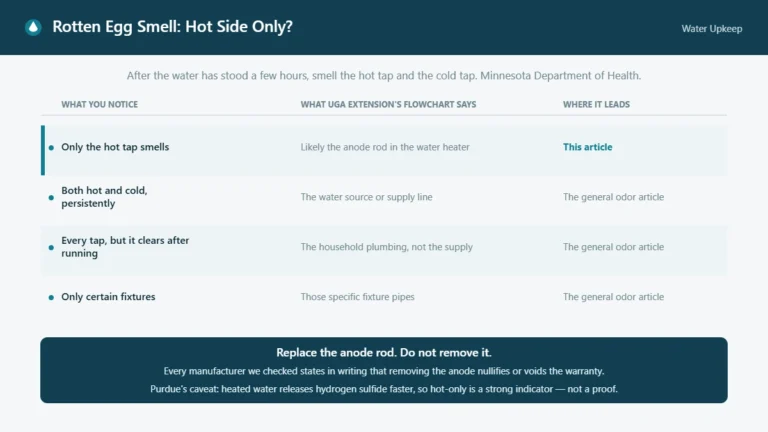
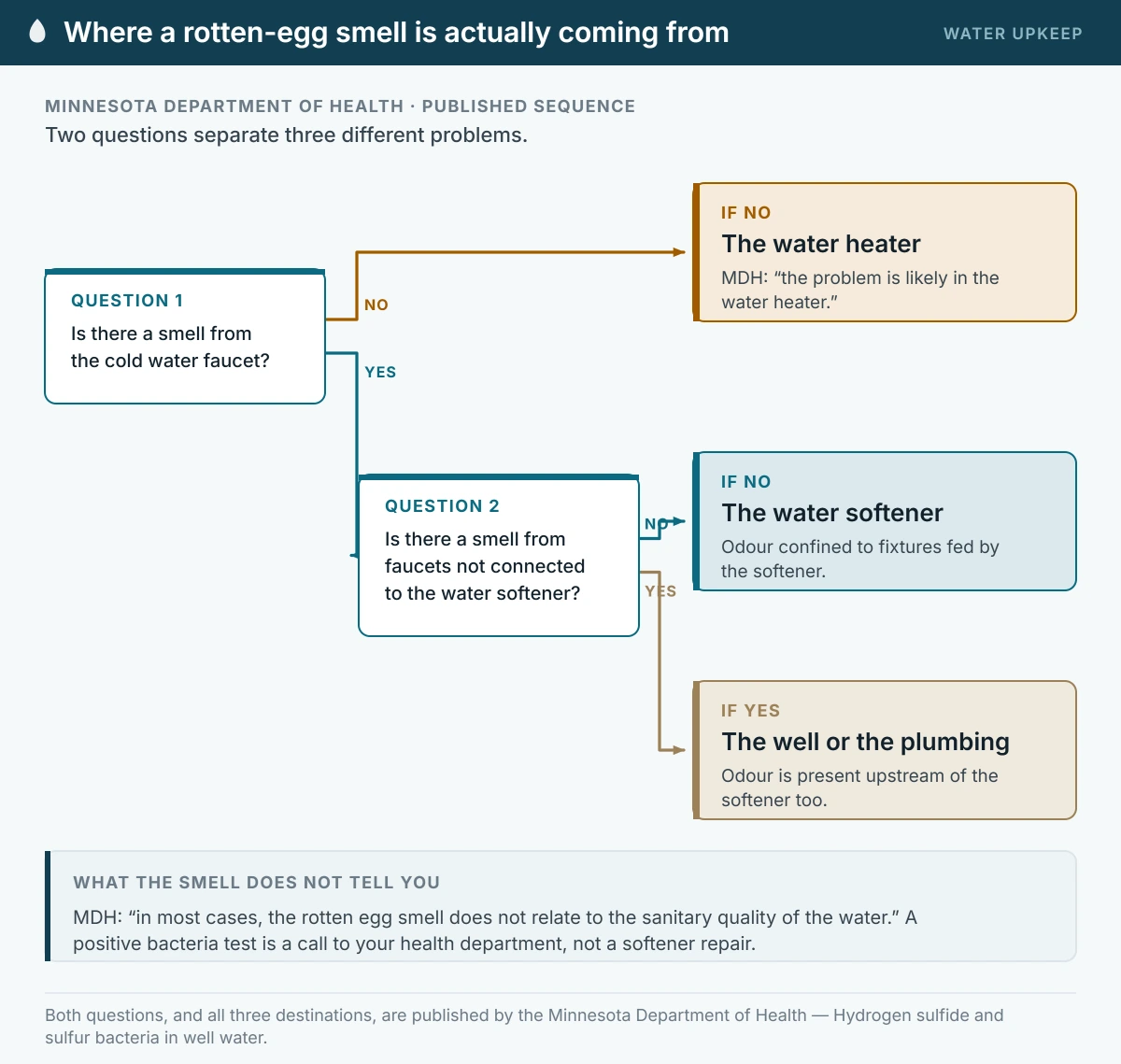
The Minnesota Department of Health publishes the only diagnostic branch we found from a public health authority, and it is better than anything in the manufacturer tables. Its question is: “Is there a smell from the cold water faucet? If no, the problem is likely in the water heater. If yes, is there a smell from faucets not connected to the water softener?”
That single sequence isolates three different problems. Hot water only points at the heater — see why only the hot water smells like sulfur. Cold water at fixtures downstream of the softener but not upstream of it points at the softener. Cold water everywhere points at the well or the plumbing system. MDH notes that sulfur bacteria may be present in the water softener, in the well, or in the plumbing, and that odor can also be “produced by sulfur bacteria or chemical reactions inside of water heaters.”
On safety, MDH’s framing is the ceiling and we will not exceed it: “While sulfur bacteria are not harmful, hydrogen sulfide gas in the air can be harmful at high levels,” and “in most cases, the rotten egg smell does not relate to the sanitary quality of the water.” If a bacteria test has come back positive, that is a call to your health department, not a softener repair.
Symptoms that are not the softener at all
Nebraska Extension lists what softening does not remove: “bacteria, hydrogen sulfide, silt or sand, lead, nitrate, pesticides.” A softener is also explicitly not a disinfection device — Hellenbrand’s manual states it “is not intended to be used for treating water that is microbiologically unsafe or of unknown quality without adequate disinfection.”
So several common complaints route elsewhere: spotting and film on glassware and fixtures is a cleaning question with a hardness cause; water that looks milky or cloudy is usually not a treatment fault at all; noise and odor from the water heater are heater problems.
Why the boundary falls where it does
Read the manufacturers’ own corrections and the line draws itself. These are not homeowner sentences.
| Manufacturer’s stated correction | Category | Why |
|---|---|---|
| “Add salt to brine tank and maintain salt level above water level” | Owner | Nothing is opened |
| “Close bypass valve” | Owner | External handle |
| “Reset time of day” | Owner | Front panel |
| “Clean injector screen” | Service | Requires depressurizing and opening the valve |
| “Replace seals and spacers and/or piston” | Service | Valve internals |
| “Remove power head and inspect bore” | Service | Control head disassembly |
| “Replace timer” / “defective PC board” | Service | Electrical, past the plug |
| “Increase line pressure to 20 psi” | Service | A plumbing change, not a setting |
On that last row: Fleck’s manual really does say it, and we quote it as the manual’s correction. It is not an instruction to you. Raising line pressure means changing plumbing.
Published minimum pressures are also not interchangeable between brands, and one manual disagrees with itself. Fleck specifies a minimum of 20 psi. Clack’s specification table says 20 psi, but two of Clack’s own troubleshooting corrections say pressure “must stay minimum 25 psi.” We are showing you that rather than picking a number.
| Valve (manufacturer documentation) | Minimum pressure | Maximum | Temperature | Note |
|---|---|---|---|---|
| Pentair Fleck 5600SXT | 20 psi | 125 psi | Not to exceed 110°F | — |
| Clack WS1 / WS1.25 | 20 psi (spec) | 125 psi | 40–110°F | Two troubleshooting entries state 25 psi minimum |
| Hellenbrand ProMate EcoMax | 20 psi | 125 psi | Not to exceed 110°F | — |
When to stop: plumber, manufacturer, or health department
We deliberately stop short of valve service and wiring, and the reason is in the manuals themselves. Fleck: “The system must be depressurized before removing any connections for servicing.” Clack: “Pressure hazard; depressurize valve before servicing,” and “disconnect from electrical power prior to servicing.” A unit rated to 125 psi is stored energy, and the corrections beyond that point are written for technicians.
- A licensed plumber or water treatment professional for: any correction that says replace, remove, or clean an internal part; any leak from the valve body, tank head or a threaded connection; resin at fixtures or in the drain; continuous flow to drain after a cycle has finished; any fault that survives the owner-checkable list.
- The manufacturer for: any error code, anything under warranty, and anything involving the control board. Have the code and the model number ready.
- Your state or county health department for: a positive coliform or bacteria test, a suspected sewage or chemical intrusion, or any illness question.
One absolute stop. Clack’s manual states: “DO NOT USE CLACK CONTROL VALVE PRODUCTS ON WATER SUPPLIES THAT CONTAIN HYDROCARBONS SUCH AS BENZENE, GASOLINE, KEROSENE.” A fuel or solvent smell is not a fault to troubleshoot. Stop using the water and call your utility or health department.
Questions people actually ask
Why is my water hard when the salt tank is full?
A full-looking tank is one of the classic symptoms of a salt bridge — a crust with brine and empty space beneath it. Check the bypass position too; both manuals list an open bypass against hard water.
What is the most common water softener problem?
Nobody knows, and anyone who tells you is guessing. Neither Fleck nor Clack ranks causes by frequency and no source publishes failure statistics. That is why this index is ordered by what is easiest to check.
Can I keep using water while the softener is broken?
In most cases yes, by putting the unit in bypass. You get hard water rather than no water, and the unit is isolated while you wait for service. It does not depressurize the unit.
My softener did not regenerate last night. Is it broken?
Check the clock first. Clack lists a power outage, a switched outlet and a tripped breaker against a wrong time; Fleck notes outages longer than eight hours can lose the setting entirely. Whether a missed cycle is abnormal at all depends on how often yours should be regenerating.
There are little beads in my aerators. What are they?
Resin escaping the tank. Fleck lists air in the system, a dry well condition and an improperly sized drain line flow control against loss of mineral through the drain, and separately says to check the distributor tube for cracks. All are service items.
Should I reset the softener to fix it?
Setting the time of day after a power outage is a legitimate correction — Fleck lists it. Key sequences that clear error codes are a different matter: the code is telling a technician something, and clearing it does not fix what caused it.
Is a fouled resin bed the same as a worn-out one?
Not necessarily, and the manufacturers treat them differently — Clack says replace a fouled bed, Fleck says adjust the cycle first. That decision has its own article.
Sources and standards
- Manufacturer technical documentation — Pentair, Fleck 5600SXT downflow service manual; Clack, Water Specialist WS1 and WS1.25 drawings and service manual; Hellenbrand, ProMate EcoMax consumer’s manual; GE Appliances, Salt Bridge — Water Softener
- Minnesota Department of Health — Hydrogen sulfide and sulfur bacteria in well water; Water Softeners
- University of Nebraska–Lincoln Extension — G1491, Drinking Water Treatment: Water Softening (Ion Exchange)
- North Dakota State University Extension — WQ1031, Water Softening (Ion Exchange)
- Penn State Extension — Water Softening
- U.S. EPA WaterSense — Guide to Selecting Water Treatment Systems
Last reviewed September 18, 2026.