
Independent, and not selling anything
Softeners, whole-house filtration, well water, drinking water and testing – explained by people who do not sell any of it. Know your water. Choose right. Keep it working.Start with your problem
- White scale and spotted glassware – hard water. Start at Water Softeners.
- Orange, brown or black staining – iron or manganese, usually on a private well. Start at Well Water.
- A rotten-egg smell – hydrogen sulfide, sometimes from the water heater rather than the well. Start at Well Water.
- Chlorine taste or smell – start at Whole-House Filtration.
- You want better drinking water at one tap – start at Drinking Water.
- Something has stopped working – start at Maintenance & Repair.
- You do not know what is in your water yet – start at Water Testing. Everything else depends on it.
The six sections
- Water Softeners – how softening works, sizing, salt, resin, costs and repair.
- Whole-House Filtration – carbon, sediment and backwashing media, filter order and flow-rate sizing.
- Well Water – iron, manganese, sulfur, bacteria, pH and the correct treatment sequence.
- Drinking Water – reverse osmosis, under-sink and countertop systems, and what certification really means.
- Water Testing – hardness, TDS, lead, PFAS, reading a Consumer Confidence Report and NSF/ANSI standards.
- Maintenance & Repair – schedules, troubleshooting trees, parts and when to call a professional.
Latest articles
-
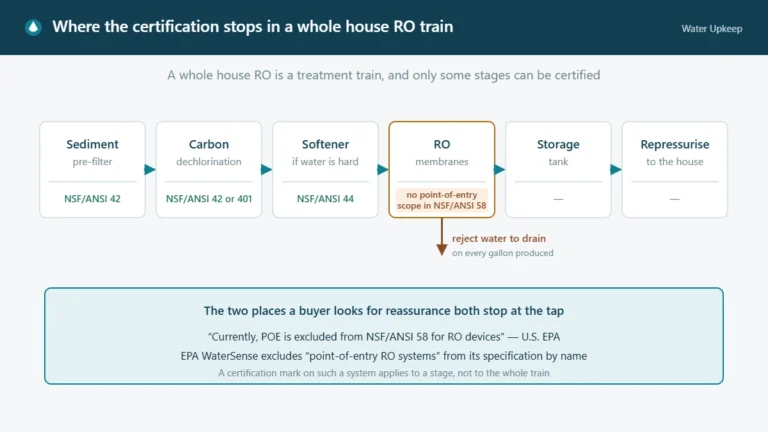
Whole House Reverse Osmosis System: Why the Standard Excludes It
Read article →: Whole House Reverse Osmosis System: Why the Standard Excludes ItNSF/ANSI 58 has no point-of-entry scope and EPA WaterSense excludes whole house RO by name. Here is what that means before you price one.
-
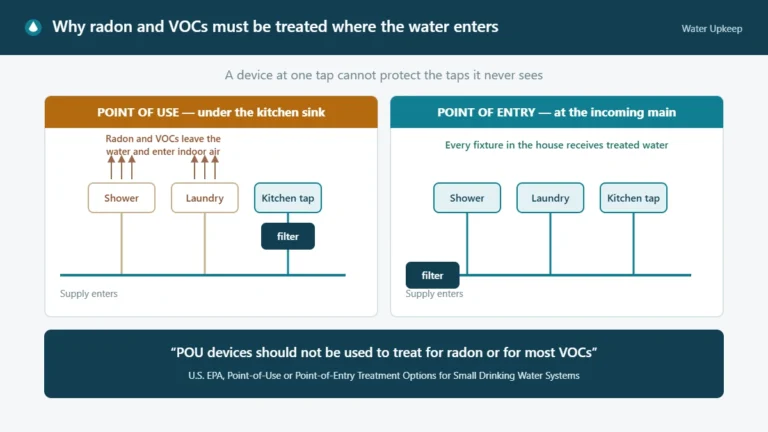
Whole House Water Filter: When Point-of-Entry Is Actually Required
Read article →: Whole House Water Filter: When Point-of-Entry Is Actually RequiredEPA says point-of-use devices should not be used for radon or most VOCs. That is the one case where a whole house filter is required rather…
-
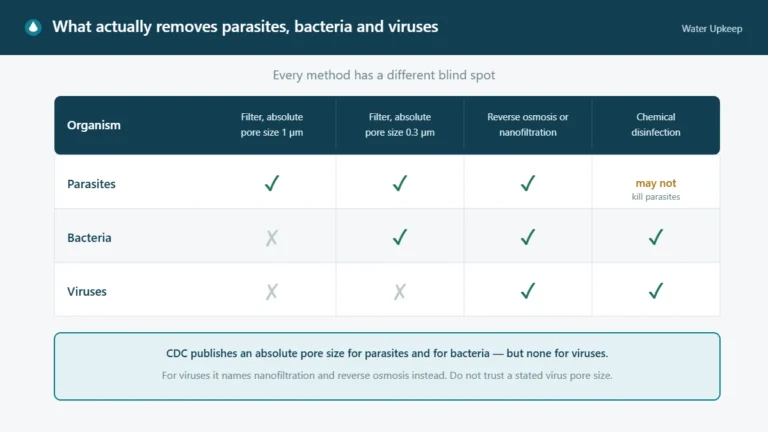
How to Filter Water at Home: Match the Method to the Problem
Read article →: How to Filter Water at Home: Match the Method to the ProblemThere is no all-purpose home water filter. Here is how to find out what is in your water, then match carbon, RO, UV, softening or sediment…
-
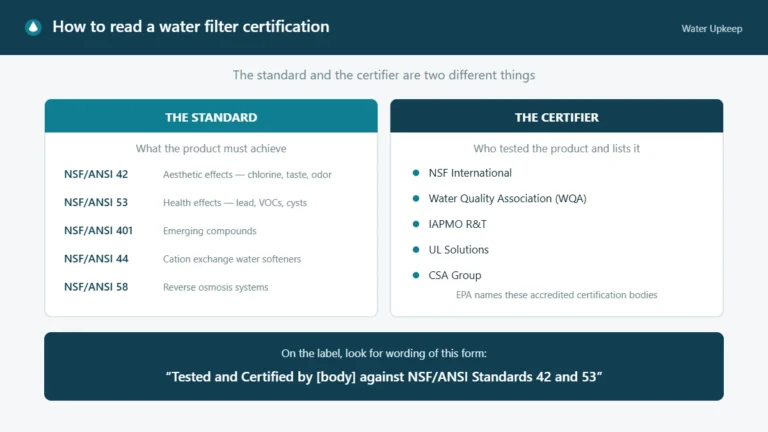
Do Brita Filters Work? What the Certifications Actually Say
Read article →: Do Brita Filters Work? What the Certifications Actually SayBrita filters are certified to reduce a specific published list of substances that differs sharply by model. Here is what each one is actually certified to…
-
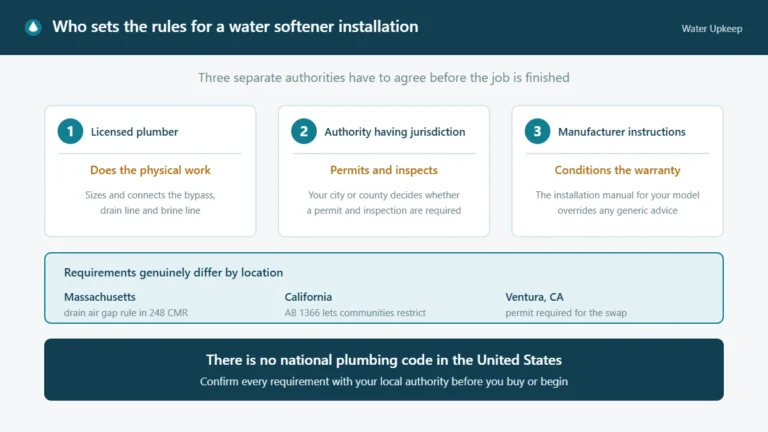
How to Install a Water Softener
Read article →: How to Install a Water SoftenerTwo things make this regulated work: the drain line air gap that prevents a cross-connection, and the fact that some jurisdictions do not permit the appliance…
-
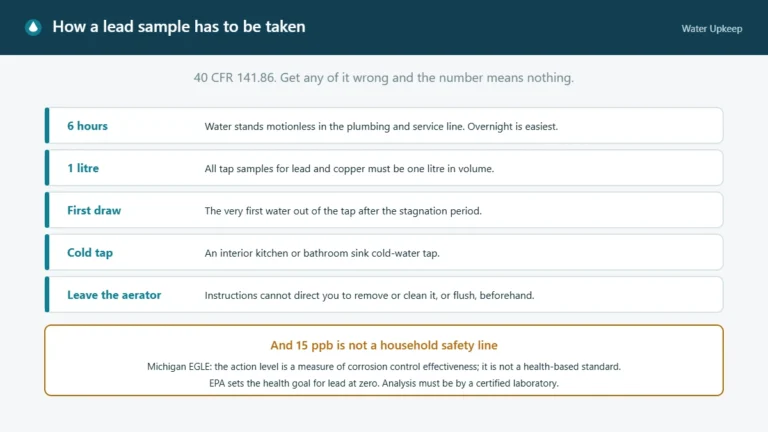
How to Test for Lead in Water
Read article →: How to Test for Lead in WaterSix hours of stagnation, a one-litre first draw, a certified laboratory. And the 15 ppb figure everyone quotes is a system compliance trigger, not a household…
How we work
- What we analyse. Certifications and the standards behind them, service flow rates, capacities, media life, installed and five-year running costs, warranty terms and parts availability – taken from manufacturer documentation, certification listings and government sources.
- What we do not do. We do not perform hands-on product testing, we do not run a laboratory, and we do not give medical advice. Where a number is a manufacturer claim, we label it as one. Read the Research and Review Methodology.
- How we are funded. We are not. There are no affiliate links, no ads and no sponsorships on this site. See the Affiliate Disclosure.