Do Brita Filters Work? What the Certifications Actually Say
Yes, Brita filters work — but only against the specific substances each individual filter has been certified to reduce, and those lists differ sharply from one Brita filter to the next. The Standard pitcher filter carries no lead claim at all. The Elite filter does. Only the Brita Hub is certified to reduce chloramine. None of them removes hardness, fluoride, nitrate, arsenic or PFAS. So the useful question is never “does Brita work” but “which Brita filter, against which substance, and how do I know?”
Every number in this article comes from a published performance data sheet or a third-party certifier’s own product listing. We have not tested any filter, and we do not publish performance figures that a certifier has not already published.
Who actually certifies Brita — and why “NSF certified” is usually the wrong phrase
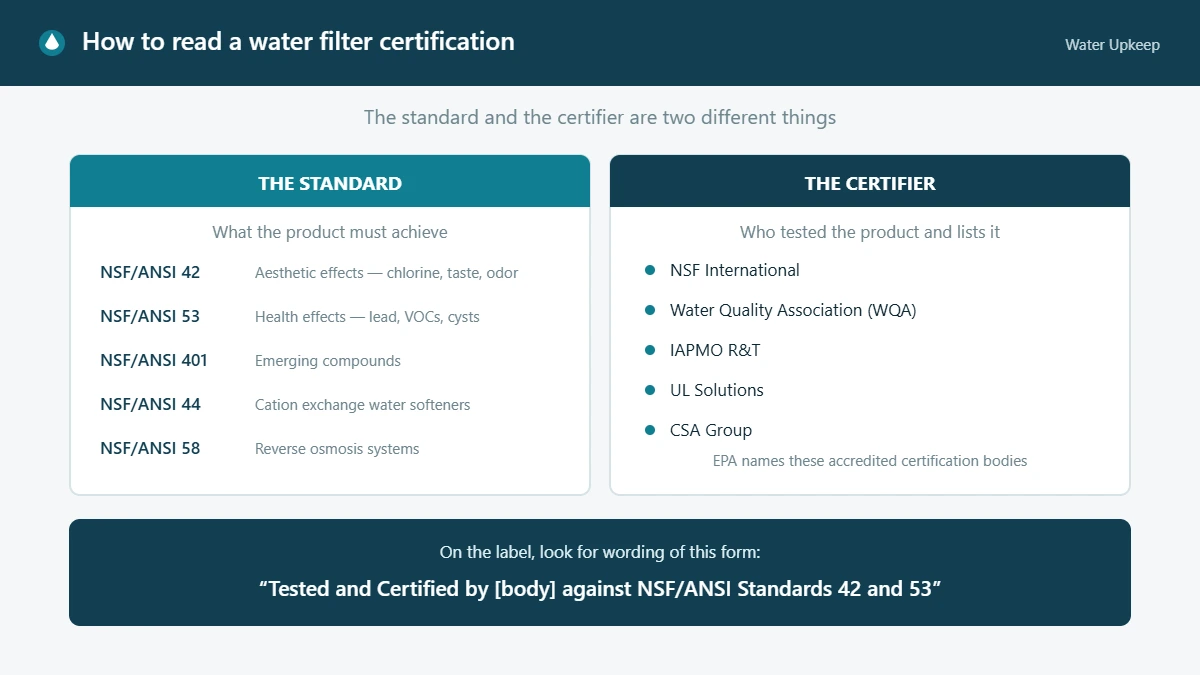
Almost every Brita product sold in the United States is certified by the Water Quality Association (WQA) against NSF/ANSI standards. WQA is the certifying body; NSF/ANSI 42, 53 and 401 are the standards being certified against. Those are two different things, and WQA is unusually blunt about the confusion: its own certification page states that people are “often confused into thinking that products then must have ‘NSF certification.’ This is not correct. It is important to understand the distinction between standards and certification.” (Water Quality Association, Product Certification)
Brita’s own data sheets use the correct phrasing. The Standard filter sheet reads: “The Brita Standard Filter (Model #OB03) has been certified by WQA against NSF/ANSI Standards 42 and 53.” The Hub sheet, the Faucet sheet, the Stream sheet and the Bottle sheet all name WQA the same way.
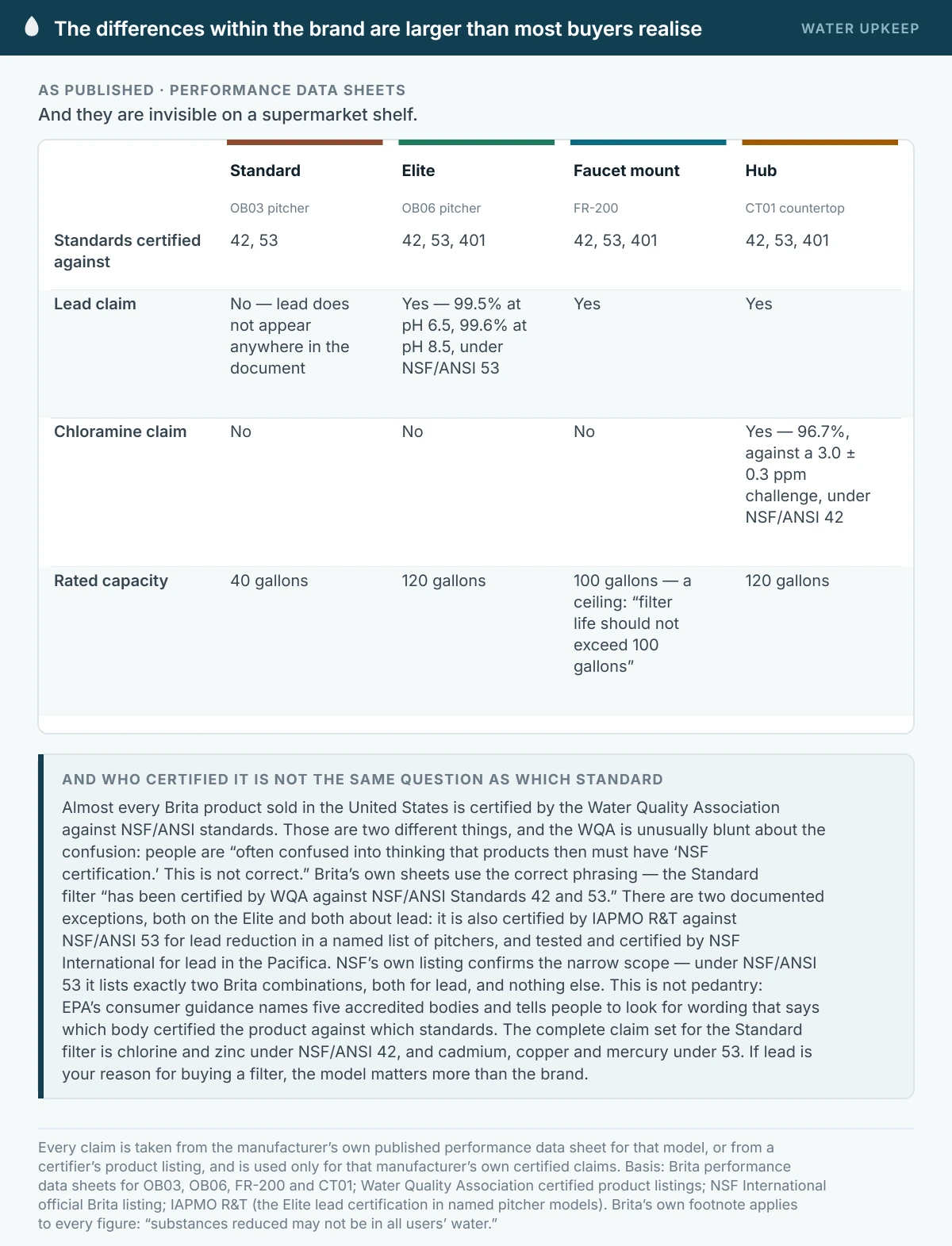
There are two documented exceptions, both on the Elite filter and both about lead. The Elite performance data sheet also states that the filter is “certified by IAPMO R&T against NSF/ANSI Standard 53 for the reduction of lead” in a named list of pitcher models, and separately that it is “tested and certified by NSF International against NSF/ANSI Standard 53 for the reduction of lead” in the Pacifica pitcher. NSF International’s own listing confirms the narrow scope: under NSF/ANSI 53, NSF lists exactly two Brita combinations — the Pacifica (OB41/OB06) and the Tidal (OB63/OB06) — both for lead reduction, and nothing else. (NSF International official listing)
This is not pedantry. The EPA’s consumer guidance tells people to look for a mark from an accredited third-party body — it names NSF, IAPMO R&T, WQA, UL Solutions and CSA — alongside wording that the filter was “Tested and Certified by (certification body) against NSF/ANSI Standards 42 and 53.” Knowing which body certified what is the whole point of the mark. (EPA/600/F-24/143, June 2024)
What each Brita filter is certified to reduce
Brita publishes a separate performance data sheet for every filter model. Here is what each one is certified against, and the claims that most often get misattributed across the range.
| Filter | Model | Standards | Lead claim? | Chloramine claim? | Rated capacity |
|---|---|---|---|---|---|
| Standard / Original | OB03 | 42, 53 | No | No | 40 gal |
| Elite (formerly Longlast) | OB06 | 42, 53, 401 | Yes | No | 120 gal |
| Plus | OB08 | 42, 53 | No | No | 40 gal |
| Refillable | OB07 | 42, 53 | No | No | 40 gal |
| Stream | OB05 | 42, 53 | No | No | 40 gal |
| Bottle | BB06 | 42 only | No | No | 40 gal |
| Faucet mount | FR-200 | 42, 53, 401 | Yes | No | 100 gal |
| Hub (countertop) | CT01 | 42, 53, 401 | Yes | Yes | 120 gal |
Every certified percentage is per substance and per model, measured under the laboratory challenge conditions the standard specifies. Brita’s own footnote on its contaminant claims is worth repeating: “Substances reduced may not be in all users’ water.” A reduction claim tells you what the filter did to a controlled test influent, not what is in your tap.
The Standard filter has no lead claim. The Elite does.
This is the single most consequential difference in the Brita range, and it is invisible on a supermarket shelf. The complete certified claim set for the Standard filter (OB03) is: chlorine 95% and zinc 64% under NSF/ANSI 42; and cadmium, copper and mercury under NSF/ANSI 53 (cadmium 91–94%, copper 73–89%, mercury 82–86%, depending on test pH). Lead does not appear anywhere in the document. Neither does chloramine, PFOA, PFOS, fluoride, arsenic or nitrate.
The Elite filter (OB06) is a different product with roughly four times as many certified claims. Its lead reduction is published at 99.5% at pH 6.5 and 99.6% at pH 8.5 under NSF/ANSI 53, alongside mercury, cadmium, asbestos, atrazine, benzene and a list of other volatile organics, plus sixteen NSF/ANSI 401 claims including microplastics at 99.6%. WQA’s certified product listing corroborates the split: the OB03 cartridge appears under NSF/ANSI 42 only, while lead appears in the Brita listing under NSF/ANSI 53. (WQA Certified Product Listings)
If lead is your reason for buying a filter, the model matters more than the brand. EPA has set the maximum contaminant level goal for lead at zero, notes that lead service lines “are typically the most significant source of lead in the water,” and advises that “if you use a filter, make sure you use a filter certified to remove lead.” EPA also warns that “boiling water does not remove lead from water.” (EPA, Basic Information about Lead in Drinking Water) If you are not sure whether lead is present, start with testing for lead in water rather than with a purchase.
Only the Brita Hub is certified to reduce chloramine
Chloramine is a distinct claim from chlorine, and across the whole Brita range exactly one product carries it. The Brita Hub filter (CT01) is certified at 96.7% chloramine reduction under NSF/ANSI 42, against an influent challenge of 3.0 ± 0.3 ppm, in system models 87340, 87340C, 87341, 87341C, 87344 and 87344C. WQA’s listing independently shows the reduction claim “Aesthetic Chloramine” on exactly those six Hub rows and on no other Brita product.
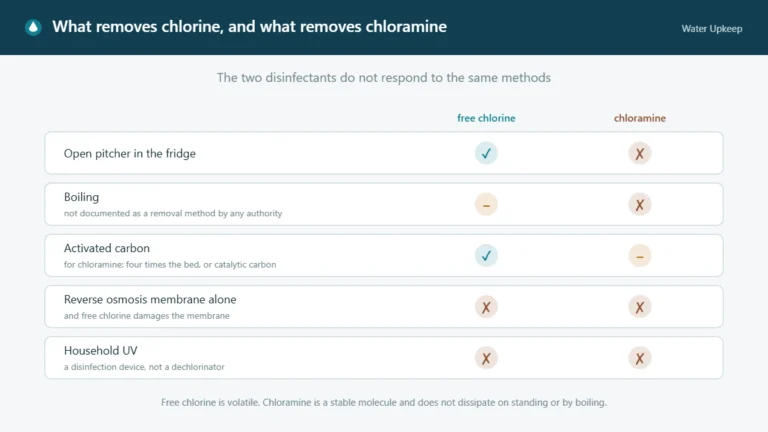
Every other Brita line — the pitchers, the bottles, the faucet mounts, Stream, Plus and Refillable — shows only combinations of aesthetic chlorine, particulate, taste and odor, and zinc under NSF/ANSI 42. That distinction matters if your utility disinfects with chloramine rather than free chlorine, because a chlorine claim is not a chloramine claim. Our guide to removing chlorine from water covers why the two behave differently.
Chlorine reduction is an aesthetic claim, not a health claim
NSF/ANSI 42 is formally titled “Drinking Water Treatment Units — Aesthetic Effects.” NSF/ANSI 53 is titled “Drinking Water Treatment Units — Health Effects.” NSF/ANSI 401 covers “Emerging Compounds / Incidental Contaminants.” Chlorine reduction and taste-and-odor reduction both sit inside the aesthetic standard. (NSF International certified product database)
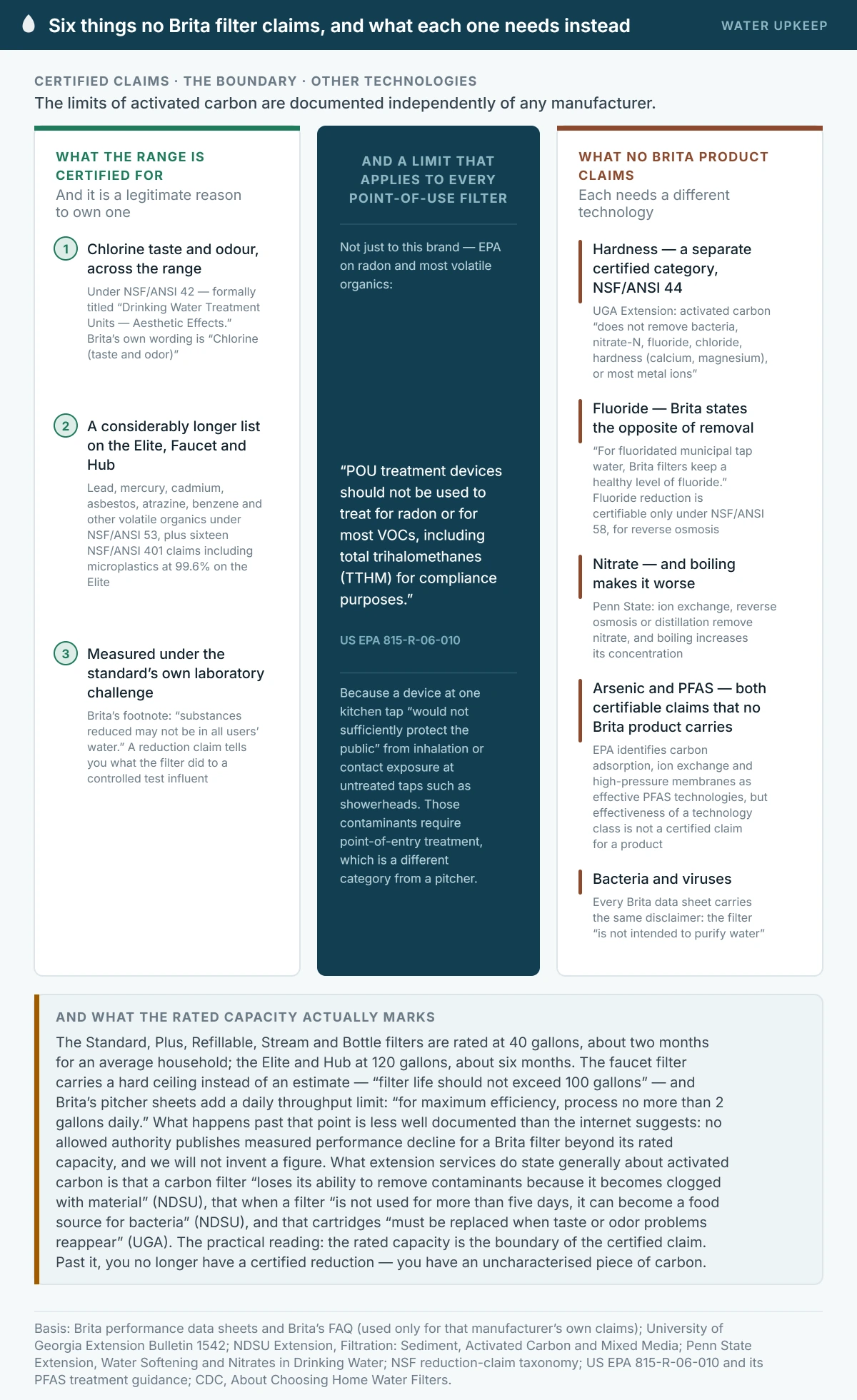
Brita’s own language follows the standard: its Bottle data sheet describes the claim as “Chlorine (taste and odor),” and its FAQ says that “all Brita filters are certified to reduce chlorine taste and odor for great-tasting water.” No Brita product carries a health-effects chlorine claim. If better-tasting tap water is what you want, that is exactly what these filters are built and certified to deliver — and that is a legitimate reason to own one.
What Brita filters do not do
The limits of activated carbon are well documented by university extension services, independently of any manufacturer. University of Georgia Extension states plainly that activated carbon “does not remove bacteria, nitrate-N, fluoride, chloride, hardness (calcium, magnesium), or most metal ions.” NDSU Extension reaches the same conclusion: activated carbon “does not remove or reduce microbes, sodium, nitrates, fluoride, hardness.”
- Hardness. No Brita filter softens water. Hardness reduction is a separate certified category entirely — NSF/ANSI 44, Cation Exchange Water Softeners. Penn State Extension describes ion exchange as the technology that removes calcium and magnesium.
- Fluoride. Brita states the opposite of removal: “For fluoridated municipal tap water, Brita filters keep a healthy level of fluoride.” Fluoride reduction exists as a certifiable claim only under NSF/ANSI 58, for reverse osmosis systems.
- Nitrate. Not claimed by any Brita product, and excluded by both extension sources above. Penn State notes that ion exchange, reverse osmosis or distillation remove nitrate — and that boiling increases nitrate concentration rather than reducing it.
- Arsenic. Arsenic (pentavalent) is a certifiable NSF/ANSI 53 claim. No Brita product carries it.
- PFAS. PFOA, PFOS and Total PFAS all exist as certifiable NSF/ANSI 53 claims. None appears on any Brita performance data sheet or in Brita’s WQA listing. EPA identifies activated carbon adsorption, ion exchange resins and high-pressure membranes as effective PFAS treatment technologies, but effectiveness of a technology class is not a certified claim for a specific product.
- Bacteria and viruses. Every Brita data sheet reviewed carries the same disclaimer: the filter “is not intended to purify water.”
One further limit comes from EPA and applies to every point-of-use filter, not just Brita. EPA states that “POU treatment devices should not be used to treat for radon or for most VOCs, including total trihalomethanes (TTHM) for compliance purposes,” because a device at one kitchen tap “would not sufficiently protect the public” from inhalation or contact exposure at untreated taps such as showerheads. Those contaminants require point-of-entry treatment. (EPA 815-R-06-010) If that describes your situation, a whole-house approach is the relevant category, not a pitcher.
A Brita is not a treatment for water of unknown quality
The Hub data sheet is explicit: “Do not use with water that is microbiologically unsafe or of unknown quality without adequate disinfection before or after the system.” CDC is equally direct about the category as a whole: “Most home water filters — like pitcher or fridge filters — are not designed to remove germs from your water,” and their “main purpose is to improve the taste and smell, rather than the safety, of water.” (CDC, About Choosing Home Water Filters)
This is reinforced in federal law. EPA notes that the Safe Drinking Water Act “prohibits EPA from listing any POU treatment units as an affordable technology to achieve compliance with an MCL or treatment technique for a microbial contaminant.” Separately, CDC warns in its household water treatment guidance that “water that has fuel, toxic chemicals, or radioactive materials in it will not be made safe by any of these treatment methods” — a statement CDC makes about boiling, chlorination, flocculation and solar disinfection specifically. If you are on a private well, none of this is a substitute for testing; see our guide to well water.
Replacement intervals, and what happens when you ignore them
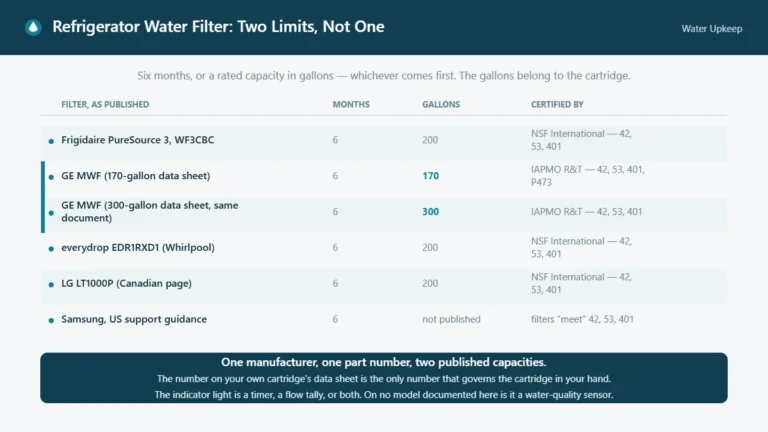
Brita publishes a rated capacity in gallons and a rough interval in months for each filter. The Standard, Plus, Refillable, Stream and Bottle filters are all rated at 40 gallons, about two months for an average household. The Elite and the Hub are rated at 120 gallons, about six months. The faucet filter carries a hard ceiling instead of an estimate: “filter life should not exceed 100 gallons.” Brita also publishes a daily throughput limit on its pitcher sheets: “For maximum efficiency, process no more than 2 gallons daily.”
What happens past that point is less well documented than the internet suggests. No allowed authority publishes measured performance decline for a Brita filter beyond its rated capacity, and we will not invent a figure. What extension services do state, generally about activated carbon: NDSU notes that a carbon filter “loses its ability to remove contaminants because it becomes clogged with material,” and that when a filter “is not used for more than five days, it can become a food source for bacteria.” UGA Extension advises that cartridges “must be replaced when taste or odor problems reappear,” with heavy loads sometimes requiring monthly replacement.
The practical reading: the rated capacity is the boundary of the certified claim. Past it, you no longer have a certified reduction — you have an uncharacterised piece of carbon.
Do you actually need one?
CDC’s position is that filtering is a choice, not a default: “Not all tap water needs to be filtered at home,” and “if your tap water is already free from harmful germs and chemicals, you may not want to filter it.” Community water systems are required to meet EPA safety standards, and they are required to tell you how they are doing.
That report is the Consumer Confidence Report, an annual drinking water quality report your supplier must send by July 1 each year. It lists your water source, regulated contaminants detected, and information about nitrate, arsenic or lead where relevant. Reading it costs nothing and tells you which of the claims above are relevant to your household. If it raises a specific question, follow it with water testing rather than with a guess about which filter to buy.
The bottom line
Brita filters work in the sense that matters to a certifier: independent, accredited bodies have tested them against published standards and confirmed specific reductions of specific substances. They are genuinely effective at what they claim — chlorine taste and odor across the range, and a considerably longer list on the Elite, Faucet and Hub.
They do not do what a great deal of online writing implies. They do not soften water, remove fluoride, remove nitrate or arsenic, address PFAS, or make unsafe water safe. And the differences within the brand are larger than most buyers realise: if you buy the Standard filter expecting lead reduction, you have bought a filter that does not claim it. Read the performance data sheet for the exact model on the box, and check the claim you care about against the certifier’s own listing. Both are free, and both are published.
Sources
- Water Quality Association — Product Certification and the Gold Seal Program; Certified Product Listings
- NSF International — Certified Drinking Water Treatment Units database and reduction-claim taxonomy; official Brita listing
- U.S. EPA — Basic Information about Lead in Drinking Water; Consumer Tool for Identifying Filters Certified to Reduce Lead (EPA/600/F-24/143); Point-of-Use or Point-of-Entry Treatment Options for Small Drinking Water Systems (EPA 815-R-06-010); Consumer Confidence Report information; Reducing PFAS in Drinking Water with Treatment Technologies
- U.S. CDC — About Choosing Home Water Filters; About Drinking Water; Household Water Treatment
- University of Georgia Extension — Activated Carbon Water Filtration Devices, Bulletin 1542
- NDSU Extension — Filtration: Sediment, Activated Carbon and Mixed Media
- Penn State Extension — Water Softening; Nitrates in Drinking Water
- Brita (manufacturer performance data sheets, used only for that manufacturer’s own certified claims) — Performance Data Sheets index; FAQ
Last reviewed September 9, 2026.