Does Boiling Water Remove Chlorine?
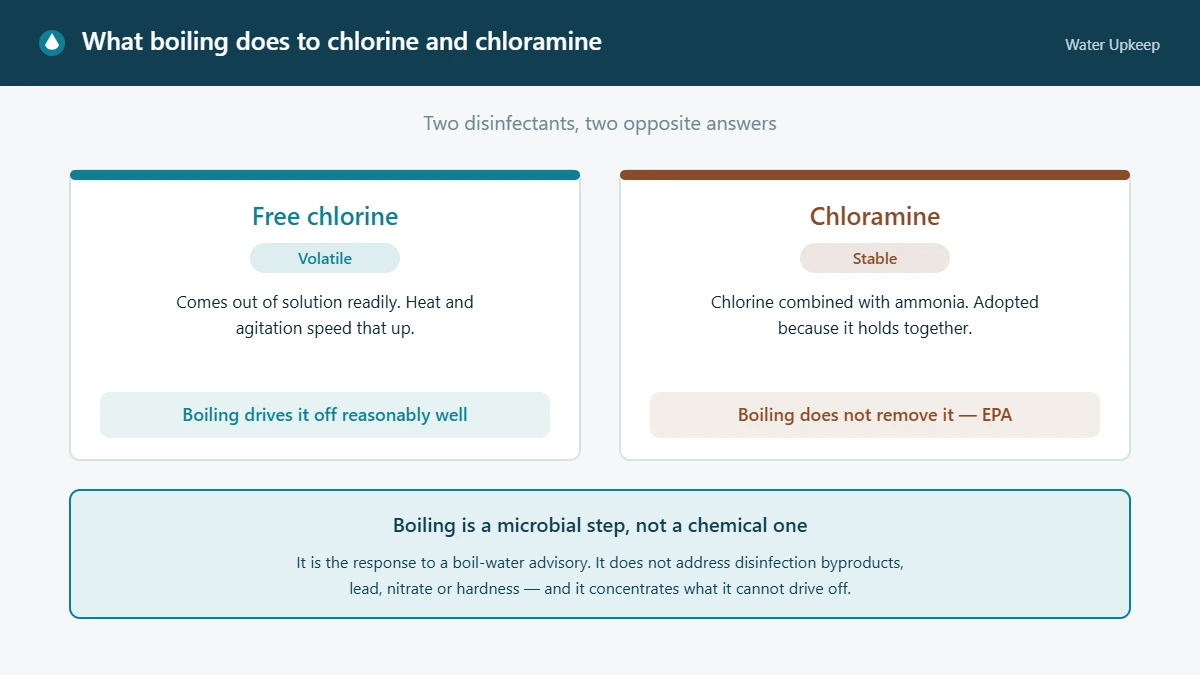
It depends entirely on which disinfectant your utility uses, and the two answers are opposite. Boiling drives off free chlorine reasonably well. Boiling does not remove chloramine — EPA states that plainly. Since most people asking this question do not know which one is in their water, the useful first step is finding that out. This guide covers how the two behave, how to check which you have, and what boiling genuinely does and does not achieve.
Why chlorine and chloramine behave differently
Both are disinfectants added by water utilities to keep water microbiologically safe on its journey through the distribution system to your tap. CDC notes that levels up to 4 milligrams per litre are considered safe in drinking water.
They differ in stability, and that is the whole story. Free chlorine is volatile: it comes out of solution readily, which heat and agitation accelerate. Chloramine — chlorine combined with ammonia — is a far more stable molecule. It was adopted precisely because it persists longer in the pipes and produces fewer disinfection byproducts than chlorine. The property that makes it useful to a utility is the same property that makes it stubborn in your kitchen.
What EPA says about boiling and chloramine
EPA addresses this directly, and the guidance is unambiguous on three points:
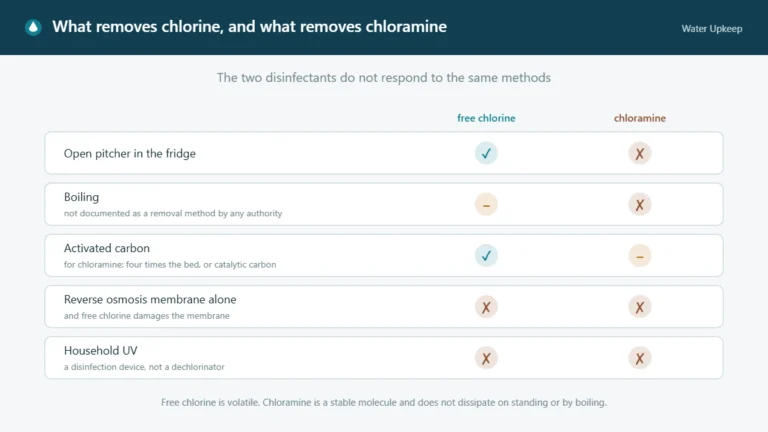
- Boiling water does not remove monochloramine from drinking water.
- Letting water stand at room temperature does not remove monochloramine either.
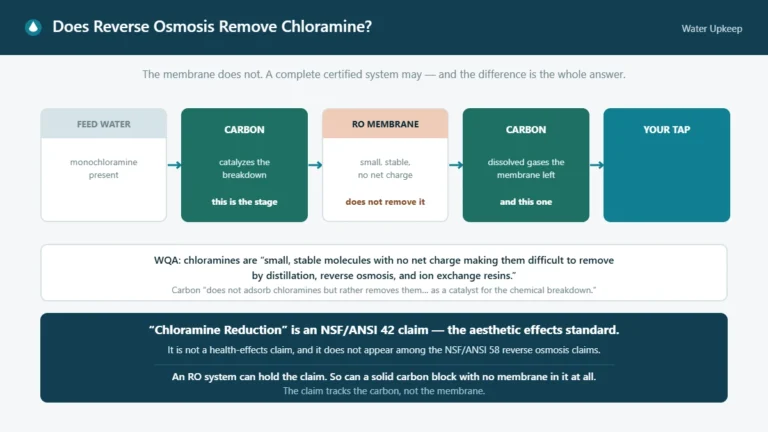
- Reverse osmosis filters do not remove monochloramine.
That last point catches people out, because reverse osmosis is often assumed to remove everything. It is worth knowing before spending money on the wrong equipment for a chloramine complaint.
For free chlorine the picture is different — heat and agitation help it leave the water. We are not aware of any authoritative published boiling time for removing chlorine, so we do not give one. Any specific duration you see quoted elsewhere is not coming from a federal or university source.
How do you find out which one is in your water?
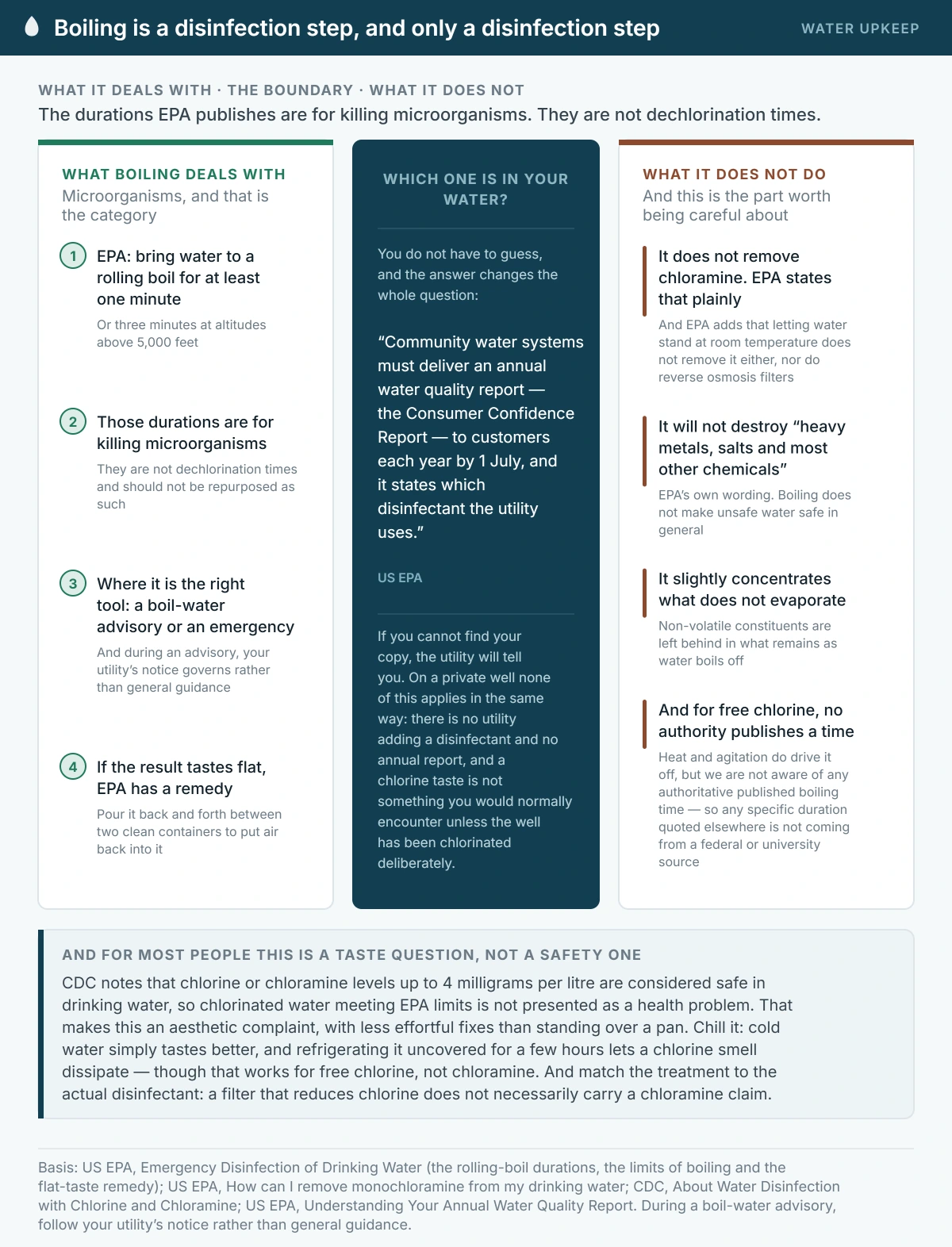
You do not have to guess. Community water systems must deliver an annual water quality report — the Consumer Confidence Report — to customers each year by 1 July, and it states which disinfectant the utility uses. If you cannot find your copy, the utility will tell you.
If you draw from a private well, none of this applies in the same way: there is no utility adding a disinfectant, and no annual report. A chlorine or chloramine taste is not something you would normally encounter unless the well has been chlorinated deliberately.
| If your utility uses… | Does boiling help? | Better options |
|---|---|---|
| Free chlorine | Yes — heat and agitation drive it off | Refrigerating uncovered for a few hours also lets the smell dissipate |
| Chloramine | No — EPA states boiling does not remove it | Standing and reverse osmosis do not work either; treatment needs to be chosen specifically for chloramine |
What boiling does not do
This is the part worth being careful about. Boiling is a disinfection step — it deals with microorganisms. EPA is explicit that boiling or disinfection will not destroy other contaminants such as heavy metals, salts and most other chemicals.
Boiling does not make unsafe water safe in general, and it should never be treated as a substitute for knowing what is in your water. If anything, boiling concentrates non-volatile constituents slightly as water evaporates.
Where boiling is the right tool is during a boil-water advisory or an emergency, and there EPA gives a specific instruction: bring water to a rolling boil for at least one minute, or three minutes at altitudes above 5,000 feet. Those durations are for killing microorganisms. They are not dechlorination times and should not be repurposed as such. During an advisory, follow your utility’s notice rather than general guidance.
Easier ways to deal with the taste and smell
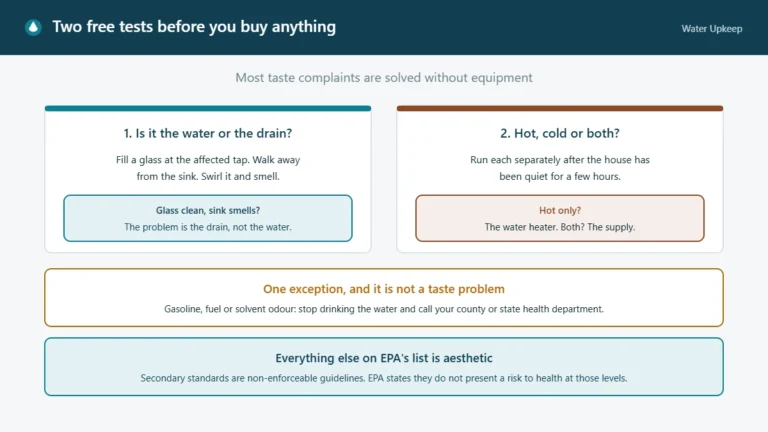
Most people asking about boiling are reacting to taste or smell rather than to a safety concern, and it is worth being clear that chlorinated water meeting EPA limits is not presented by CDC as a health problem. This is an aesthetic complaint, and there are less effortful fixes than standing over a pan.
- Chill it. Cold water simply tastes better, and refrigerating it uncovered for a few hours lets a chlorine smell dissipate. This works for free chlorine, not chloramine.
- Fix flat-tasting boiled water. If you have boiled water and it tastes flat, EPA’s remedy is to pour it back and forth between two clean containers to put air back into it.
- Match treatment to the actual disinfectant. If you have chloramine and want it gone, the equipment has to be selected for chloramine specifically — a filter that reduces chlorine does not necessarily carry a chloramine claim.
Our drinking water guide covers point-of-use options, and our water testing guide covers establishing what is actually in your supply.
Sources and standards
- US EPA — How can I remove monochloramine from my drinking water? Boiling, standing and reverse osmosis do not remove monochloramine.
- CDC — About Water Disinfection with Chlorine and Chloramine. The 4 mg/L figure, persistence in pipes, and taste differences.
- US EPA — Emergency Disinfection of Drinking Water. Rolling boil durations, the limits of boiling, and the flat-taste remedy.
- US EPA — Understanding Your Annual Water Quality Report. Annual delivery and what the report states.
Water Upkeep does not sell or install water treatment equipment and does not conduct product testing. Every statement above is drawn from the published sources listed.
Last reviewed September 9, 2026.