How Much Does a Reverse Osmosis System Cost?
We are not going to give you a price, because no government agency or university publishes one and the honest answer is that the system is the cheap part. What decides the total is your feed water: reverse osmosis is a polishing technology, and the Water Quality Association says it should be preceded by pre-treatment for bacteria, hardness, hydrogen sulfide, iron, iron algae, manganese and turbidity. Every one of those is a separate device. The only dollar figures published by a federal agency are broad brackets, and there is no published replacement schedule for filters or membranes at all — which turns out to be a finding rather than a gap.
The only published figures
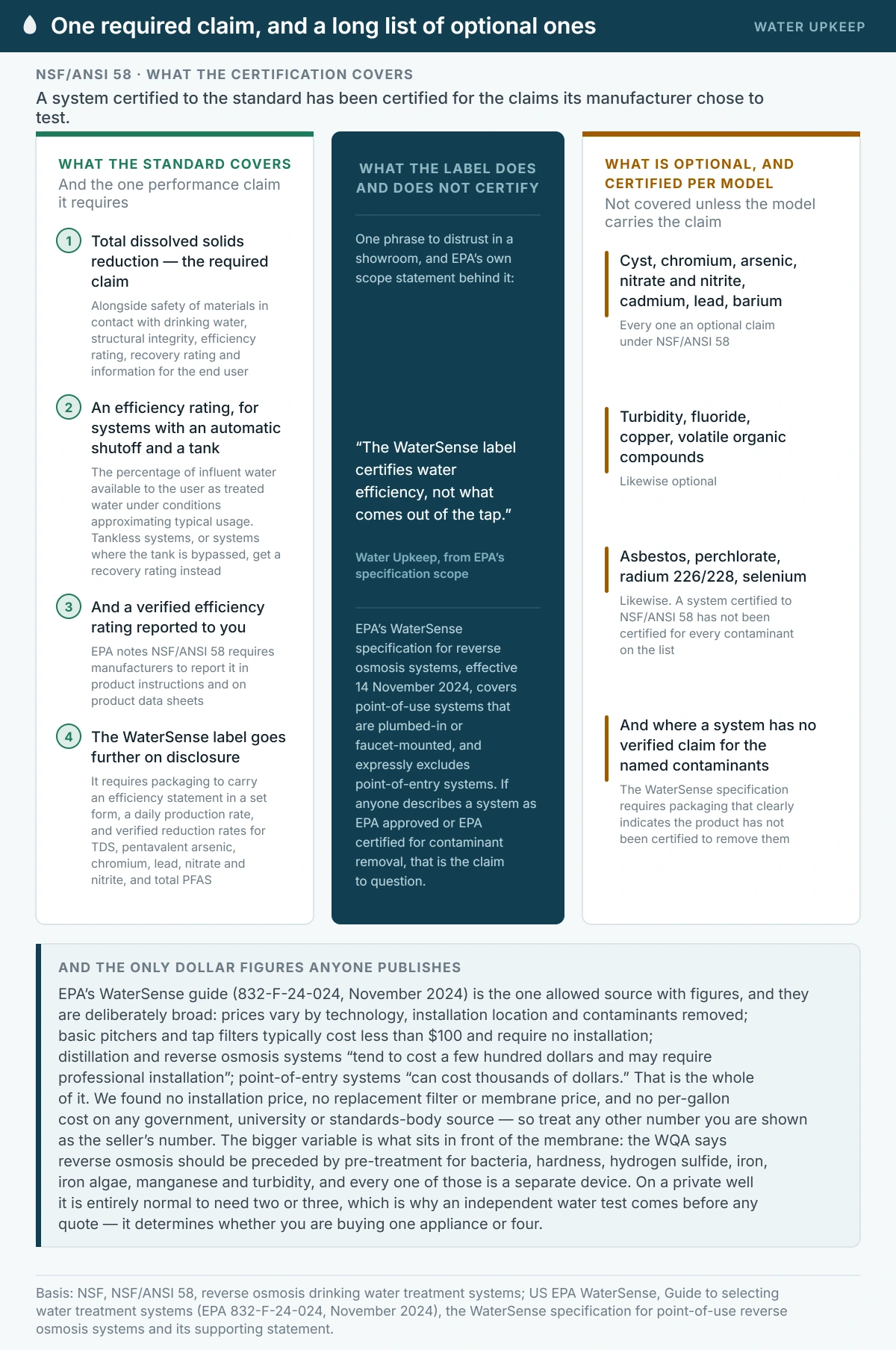
EPA’s WaterSense Guide to Selecting Water Treatment Systems (publication 832-F-24-024, November 2024) is the one allowed source with dollar figures, and they are deliberately broad: prices vary depending on the technology used, where the unit is installed and what contaminants it removes; basic water pitchers and tap filters typically cost less than $100 and require no installation, whereas distillation and reverse osmosis systems tend to cost a few hundred dollars and may require professional installation; point-of-entry systems can cost thousands of dollars and generally require professional installation.
That is the whole of it. We found no installation price, no replacement filter or membrane price, and no per-gallon cost of reverse osmosis water on any government, university or standards-body source. Treat any other number you are shown as the seller’s number.
What actually drives the total
Pre-treatment, decided by your water test
This is the biggest variable and the one most quotes gloss over. A typical residential train, per the Water Quality Association, is a 5-micron or carbon prefilter, a cellulose acetate or thin film composite membrane, and an acid-washed bituminous carbon postfilter. But that assumes reasonable feed water.
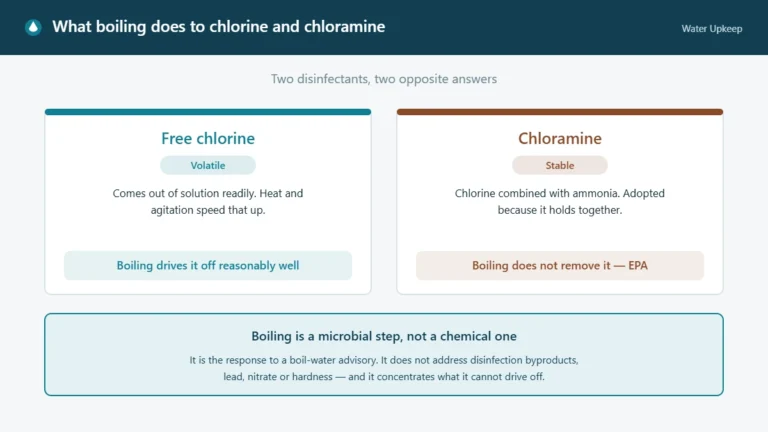
Membrane chemistry is why chlorine matters. The WQA notes one advantage of the cellulose acetate membrane is that it is more resistant to chlorine than the thin film composite membrane. On a chlorinated municipal supply with a thin film composite membrane, carbon pre-treatment is not optional; it protects the most expensive component in the system.
Hardness scales a membrane. Iron fouls one. Sediment clogs it. Each of those is another device in front of the reverse osmosis unit, and on a private well it is entirely normal to need two or three. That is why an independent water test comes before any quote — it is what determines whether you are buying one appliance or four.
Where it is installed
EPA defines point-of-use as treating water at the tap or where it is used, including a filtering pitcher, a dedicated faucet, or a device installed under the sink. Point-of-entry treats water where it enters the building, for all uses, and EPA positions it for situations where the water source poses consistent and significant contamination challenges.
Worth noticing what the certification landscape says about whole-house reverse osmosis. EPA’s WaterSense specification for reverse osmosis systems, effective 14 November 2024, covers point-of-use systems that are plumbed-in or faucet-mounted, and expressly excludes point-of-entry systems. The WQA describes reverse osmosis as a polishing system. Both the labelling programme and the design literature treat it as a point-of-use technology.
Tank or tankless, and what that changes
NSF/ANSI 58 rates the two differently, and the distinction is genuinely useful. An efficiency rating — the percentage of influent water available to the user as treated water under conditions approximating typical usage — applies only to systems with an automatic shutoff valve and a pressurised or non-pressurised tank. Tankless systems, or systems where the tank is bypassed, get a recovery rating instead.
EPA notes tankless models might require a booster pump or take a little longer to fill a glass. It also describes a permeate pump as a non-electric device, and its specification requires that where a companion product such as a permeate pump is needed to reach the efficiency threshold, it must be packaged and sold with the system. An automatic shutoff device is mandatory under that specification.
The running cost nobody puts on the invoice
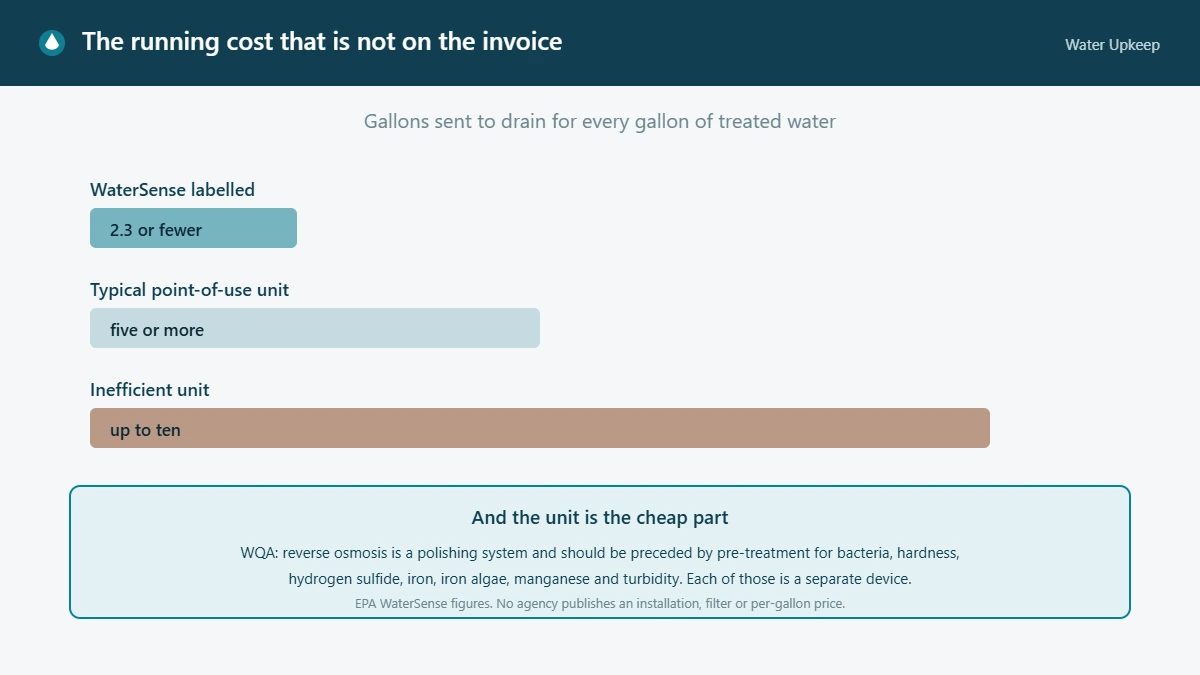
Reverse osmosis sends water to drain, and the volumes are substantial. EPA states that a typical point-of-use system will generate five gallons or more of reject water for every gallon of treated water produced, and that some inefficient units will generate up to ten gallons per gallon treated.
The WaterSense label exists to address exactly this. Labelled point-of-use reverse osmosis systems must demonstrate that they send just 2.3 gallons of water or less down the drain for every gallon of treated water they produce. That comes from a minimum 30 per cent efficiency rating: waste-to-product ratio equals one hundred divided by the efficiency rating, minus one. EPA’s own worked example is that a system sending two gallons to drain per gallon treated has an efficiency rating of 33 per cent. EPA reports labelled systems reduce water use on average by more than 3,100 gallons a year.
| System | Gallons to drain per gallon produced |
|---|---|
| Typical point-of-use unit | Five or more |
| Inefficient unit | Up to ten |
| WaterSense labelled | 2.3 or fewer |
If you are on metered municipal water, that ratio is a line on your bill for the life of the unit. If you are on a well with a low yield, it is a different kind of problem entirely.
What the label has to tell you
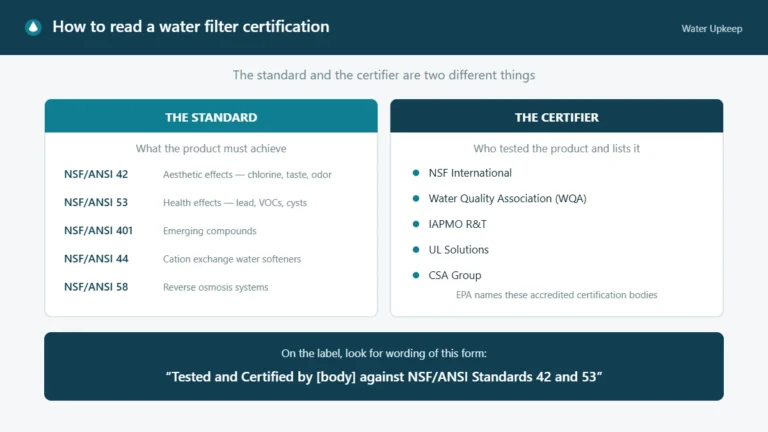
WaterSense-labelled systems must be certified to NSF/ANSI 58, and NSF publishes what that standard covers: safety of materials in contact with drinking water, structural integrity, total dissolved solids reduction performance, efficiency rating, recovery rating, contaminant reduction performance, and information for the end user. Total dissolved solids reduction is the required claim. Everything else — cyst, chromium, arsenic, nitrate and nitrite, cadmium, lead, barium, turbidity, fluoride, copper, volatile organic compounds, asbestos, perchlorate, radium and selenium — is an optional claim, certified per model.
That last point is the one to carry into a showroom. A system certified to NSF/ANSI 58 has not been certified for every contaminant on that list. It has been certified for the ones its manufacturer chose to test.
EPA notes that NSF/ANSI 58 requires manufacturers to report the system’s verified efficiency rating in product instructions and on product data sheets. Its own WaterSense specification goes further, requiring the packaging to carry an efficiency statement in a set form, a daily production rate, and verified reduction rates for total dissolved solids, pentavalent arsenic, chromium, lead, nitrate and nitrite, and total PFAS — and, where a system has no verified claim for those, packaging that clearly indicates the product has not been certified to remove them.
Why there is no replacement schedule
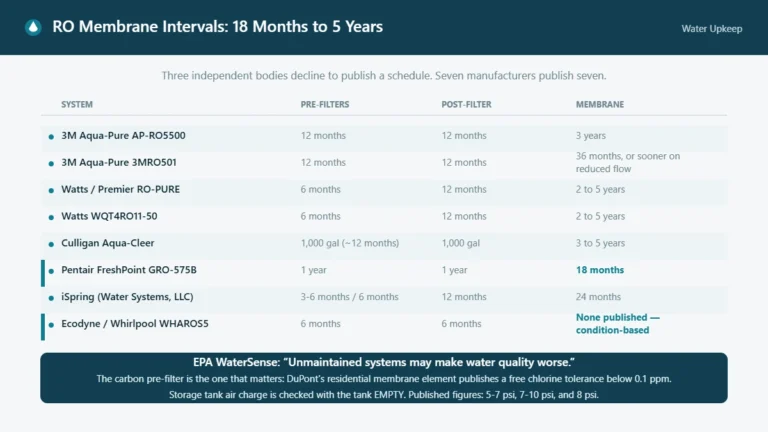
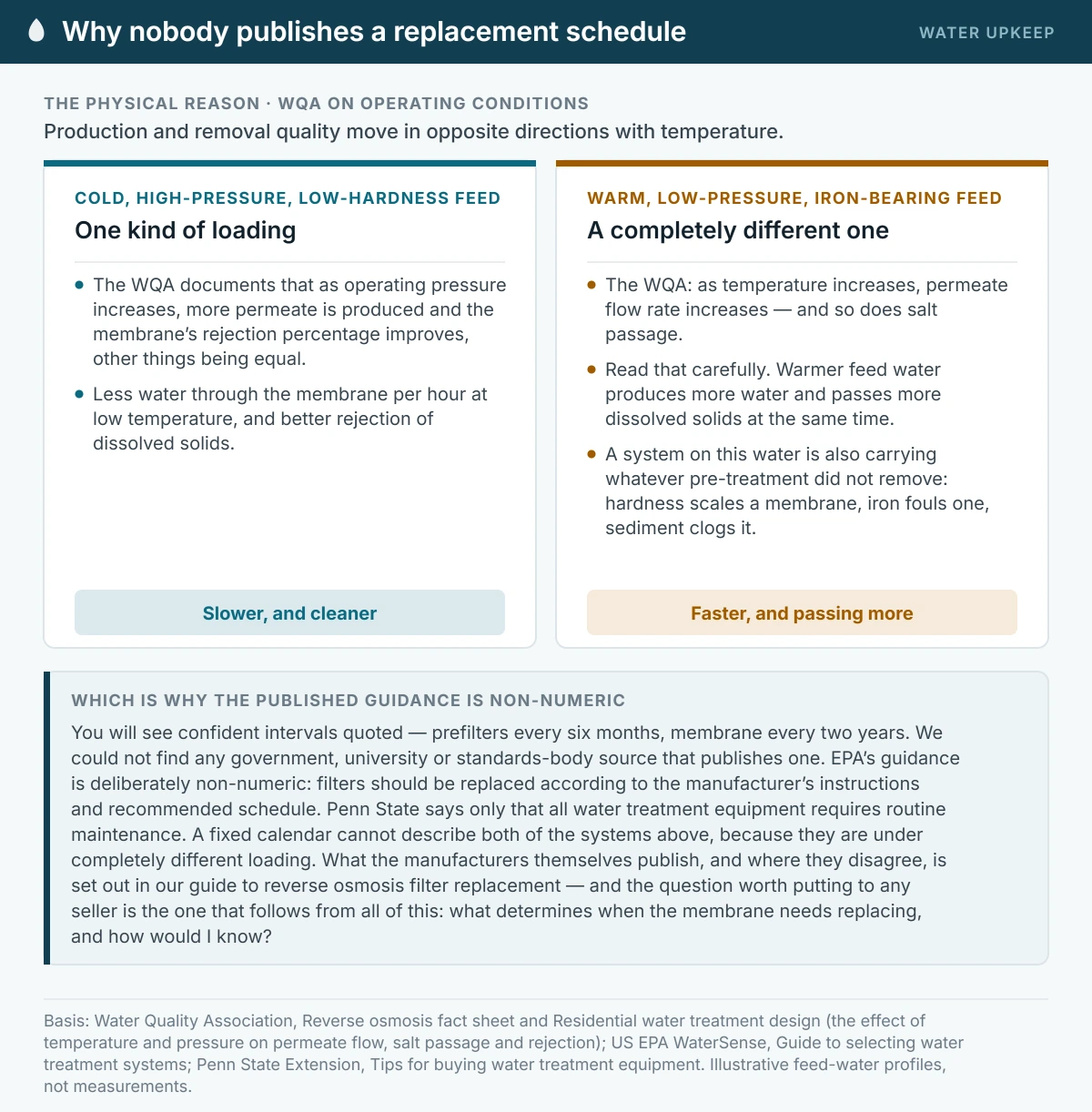
You will see confident intervals quoted — prefilters every six months, membrane every two years. We could not find any government, university or standards-body source that publishes one. EPA’s guidance is deliberately non-numeric: filters should be replaced according to the manufacturer’s instructions and recommended schedule. Penn State says only that all water treatment equipment requires routine maintenance.
There is a physical reason for that. The WQA documents that reverse osmosis performance moves with operating conditions. As temperature increases, permeate flow rate increases and so does salt passage. As operating pressure increases, more permeate is produced and the membrane’s rejection percentage improves, other things being equal.
Read that carefully: warmer feed water produces more water and passes more dissolved solids. Production and removal quality move in opposite directions with temperature. A system running on cold, high-pressure, low-hardness feed water is under completely different loading from one running on warm, low-pressure, iron-bearing well water. A fixed calendar cannot describe both.
What reverse osmosis does not do alone
The WQA notes reverse osmosis systems can remove most organics, metals and nitrate but are often used in succession with activated carbon and ultraviolet light for increased efficiency and for removal of inorganic compounds — a multibarrier approach that eliminates a wide variety of contaminants no single system can fully address.
Which brings the question back where it started. What you need depends on what is in your water, and matching technologies to findings is covered in choosing a well water filtration system. Our guide to what filtered water means covers how the certification numbers fit together.
Questions to ask before you accept a quote
- What did the water test show, and which findings is each component in this quote addressing?
- Is the system certified to NSF/ANSI 58, and for which specific contaminant claims?
- What is its verified efficiency rating, and how many gallons go to drain per gallon produced?
- Is it WaterSense labelled? If not, how does its ratio compare to the 2.3-gallon threshold?
- What pre-treatment does my feed water require to protect the membrane, and is it in this price?
- Is an automatic shutoff device included? Is a permeate pump needed to hit the stated efficiency, and is it included?
- What determines when the membrane needs replacing, and how would I know?
When to call a professional
- You are on a private well and have no current laboratory analysis. The analysis determines the pre-treatment, and the pre-treatment determines the cost.
- Iron, manganese, hydrogen sulfide or bacteria are present. Reverse osmosis goes last in that train, not first.
- You are being quoted for a whole-house reverse osmosis system. Ask why point-of-use will not do.
- Your water pressure is low, or your feed water is warm, both of which change how the system performs.
- Anyone describes a system as EPA approved or EPA certified for contaminant removal. The WaterSense label certifies water efficiency, not what comes out of the tap.
More on treating drinking water in our drinking water hub.
Sources and standards
- US Environmental Protection Agency, WaterSense — Guide to selecting water treatment systems (EPA 832-F-24-024, November 2024), Point-of-use reverse osmosis systems, WaterSense specification for point-of-use reverse osmosis systems, Specification supporting statement and Treating water with less waste
- NSF — NSF/ANSI 58, reverse osmosis drinking water treatment systems
- Water Quality Association — Reverse osmosis fact sheet, Reverse osmosis and Residential water treatment design
- Penn State Extension — Tips for buying water treatment equipment
Last reviewed September 9, 2026.