How to Shock a Well
Shock chlorination is a one-off disinfection of a well and its plumbing, and it is the standard response to a coliform-positive result, to work on the well or pump, or to flooding. We are deliberately not publishing a single dose, because the state health departments that publish this procedure disagree by a factor of up to fifty — New Hampshire targets 10 to 15 mg/L, Wisconsin’s technical guidance runs to 500 mg/L. Follow your own state’s published procedure. What this guide gives you is the shape of the job, the steps every authority agrees on, and the two things that matter most: never enter a well pit, and bypass or disconnect your treatment equipment before you start.
When it is the right response, and when it is not
Appropriate: after a total coliform positive; after new construction or repairs to the well, pump or piping; and after flooding or a known contamination event. Pennsylvania DEP and the Minnesota Department of Health both list those.
Not appropriate: for chemical contamination of any kind. CDC states it flatly — water contaminated with fuel or toxic chemicals will not be made safe by boiling or disinfection. If your water smells of fuel or solvent, stop using it and contact your local or state health department. CDC’s advice after a disaster is to drink bottled water until you are certain the water is free of contaminants.
Not a maintenance routine. New Hampshire DES gives the clearest homeowner threshold: a well should not need to be chlorinated more than once per year, and anyone needing it more often should seek professional help. Pennsylvania DEP calls it only a temporary measure that should not be considered a permanent correction where a source is continuously contaminated because of improper construction or location.
The durability evidence is sobering. Penn State Extension studied coliform-contaminated wells and found that shock chlorination plus a sanitary well cap successfully removed the bacteria for one year in 15 per cent of them. If bacteria return, a continuous disinfection treatment system will be necessary.
Not a cure for iron or sulfur bacteria. Wisconsin DNR is candid: in the months or years following treatment, iron bacteria tend to build up in layers of slime, and in many cases it is only possible to control severe infestations rather than completely eradicate them. University of Georgia Extension puts it more sharply still — shock chlorination is not a recommended method for treating recurring bacteria problems.
The step that is not optional: protect your equipment
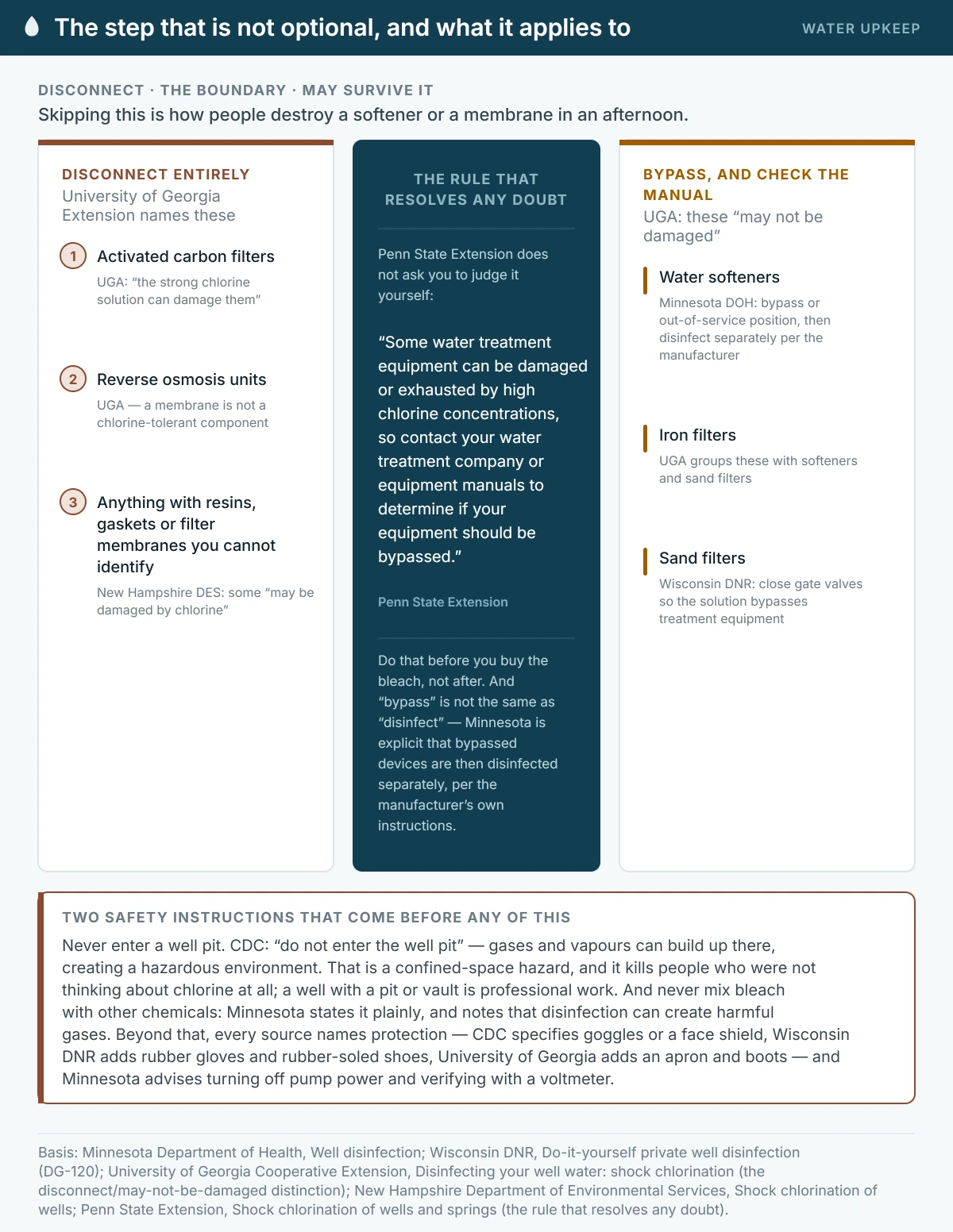
Every authority that publishes this procedure includes it, and skipping it is how people destroy a softener or a reverse osmosis membrane in an afternoon.
Minnesota Department of Health: turn or push the bypass valves to the bypass or out-of-service position for all water treatment devices — softeners, reverse osmosis systems and so on — and disinfect those devices separately per the manufacturer’s instructions. Wisconsin DNR: close gate valves so the chlorine solution will bypass your water softener and any other water treatment equipment.
University of Georgia Extension draws a distinction worth knowing: disconnect all carbon filters and reverse osmosis units, because the strong chlorine solution can damage them, while water softeners, iron filters and sand filters may not be damaged. New Hampshire DES notes some resins, gaskets and filter membranes may be damaged by chlorine.
Penn State Extension gives the rule that resolves any doubt: some water treatment equipment can be damaged or exhausted by high chlorine concentrations, so contact your water treatment company or equipment manuals to determine if your equipment should be bypassed. Do that before you buy the bleach, not after.
Safety, before anything else
- Never enter a well pit. CDC: do not enter the well pit — gases and vapours can build up in well pits, creating a hazardous environment. This is a confined-space hazard, and it kills people who were not thinking about chlorine at all.
- Never mix bleach with other chemicals. Minnesota Department of Health states it plainly, and also that disinfection can create harmful gases.
- Ventilate. Minnesota requires the area around the well to be well ventilated; CDC says to work in well-ventilated areas and avoid breathing vapours when mixing and handling chlorine solutions.
- Wear protection. CDC specifies goggles or a face shield. Wisconsin DNR adds rubber gloves and rubber-soled shoes; University of Georgia Extension adds a protective apron and boots. Pennsylvania DEP strongly recommends eye and body protection.
- Kill the power, and check it. Minnesota advises turning off pump power and verifying with a voltmeter. New Hampshire DES adds shutting off power to the hot water tank while it is draining, and not restoring it until the tank is refilled.
- Keep children and animals away from the well area during the work.
The shape of the procedure
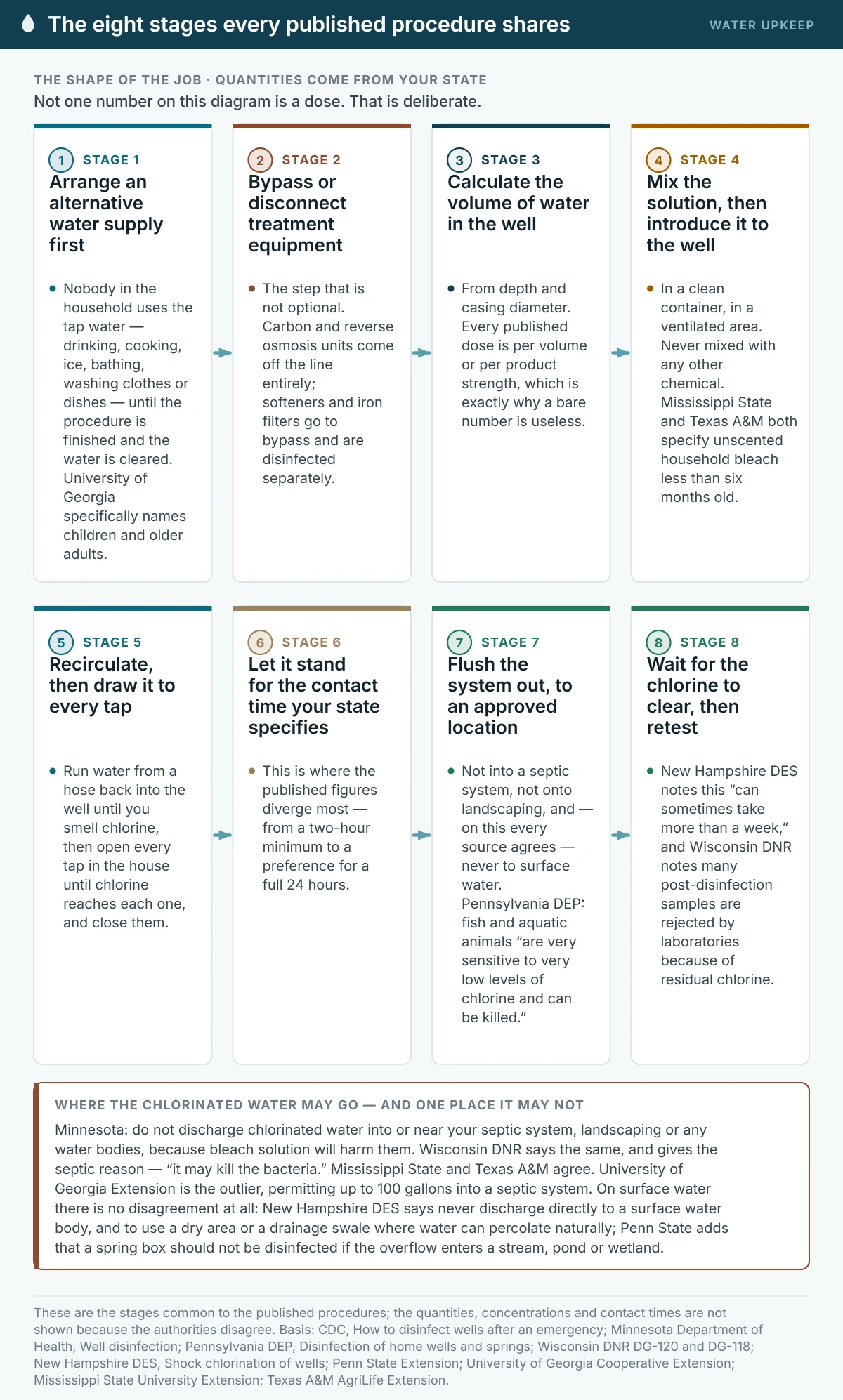
These are the stages all the published procedures share. The quantities and times come from your state’s document, not from here.
- Arrange an alternative water supply first. Nobody in the household uses the tap water — for drinking, cooking, making ice, bathing, washing clothes or dishes — until the procedure is finished and the water has been cleared. University of Georgia Extension specifically names children and older adults.
- Bypass or disconnect treatment equipment, per the section above.
- Calculate the volume of water in the well, from depth and casing diameter. Every published dose is per volume or per product strength, which is why a bare number is useless.
- Mix the chlorine solution in a clean container in a ventilated area, then introduce it to the well.
- Recirculate — run water from a hose back into the well until you smell chlorine — then open every tap in the house until chlorine reaches each one, and close them.
- Let it stand for the contact time your state specifies.
- Flush the system out, to an approved location.
- Wait for the chlorine to clear, then retest.
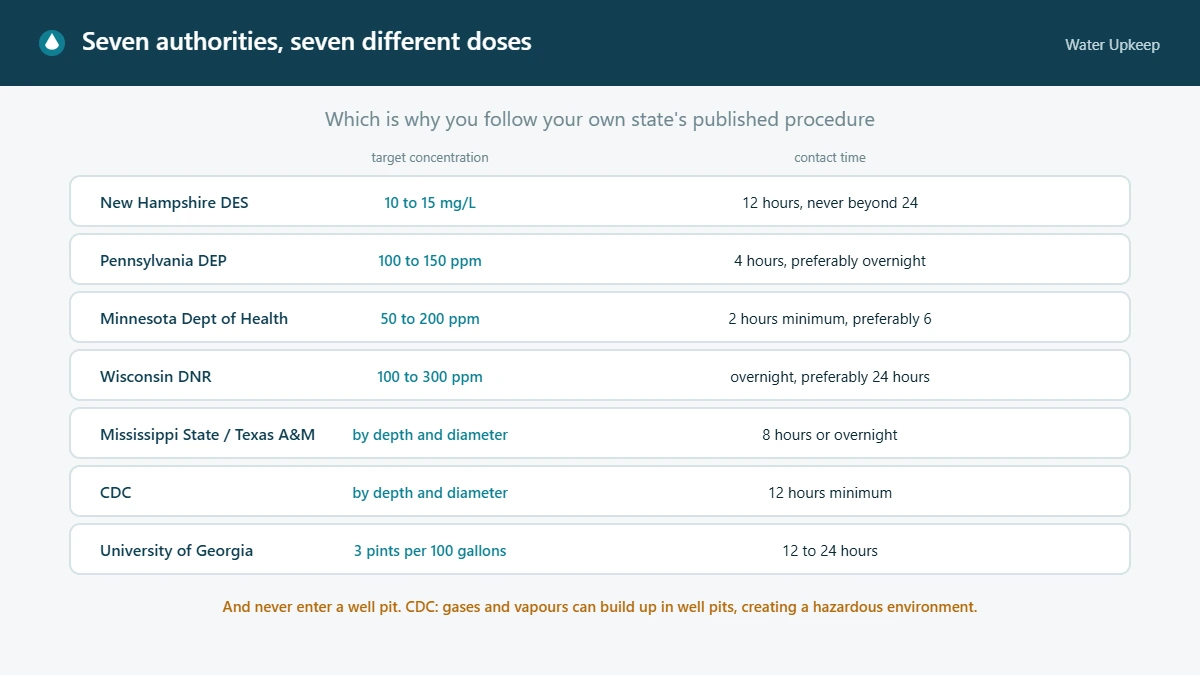
Why we are not giving you a dose
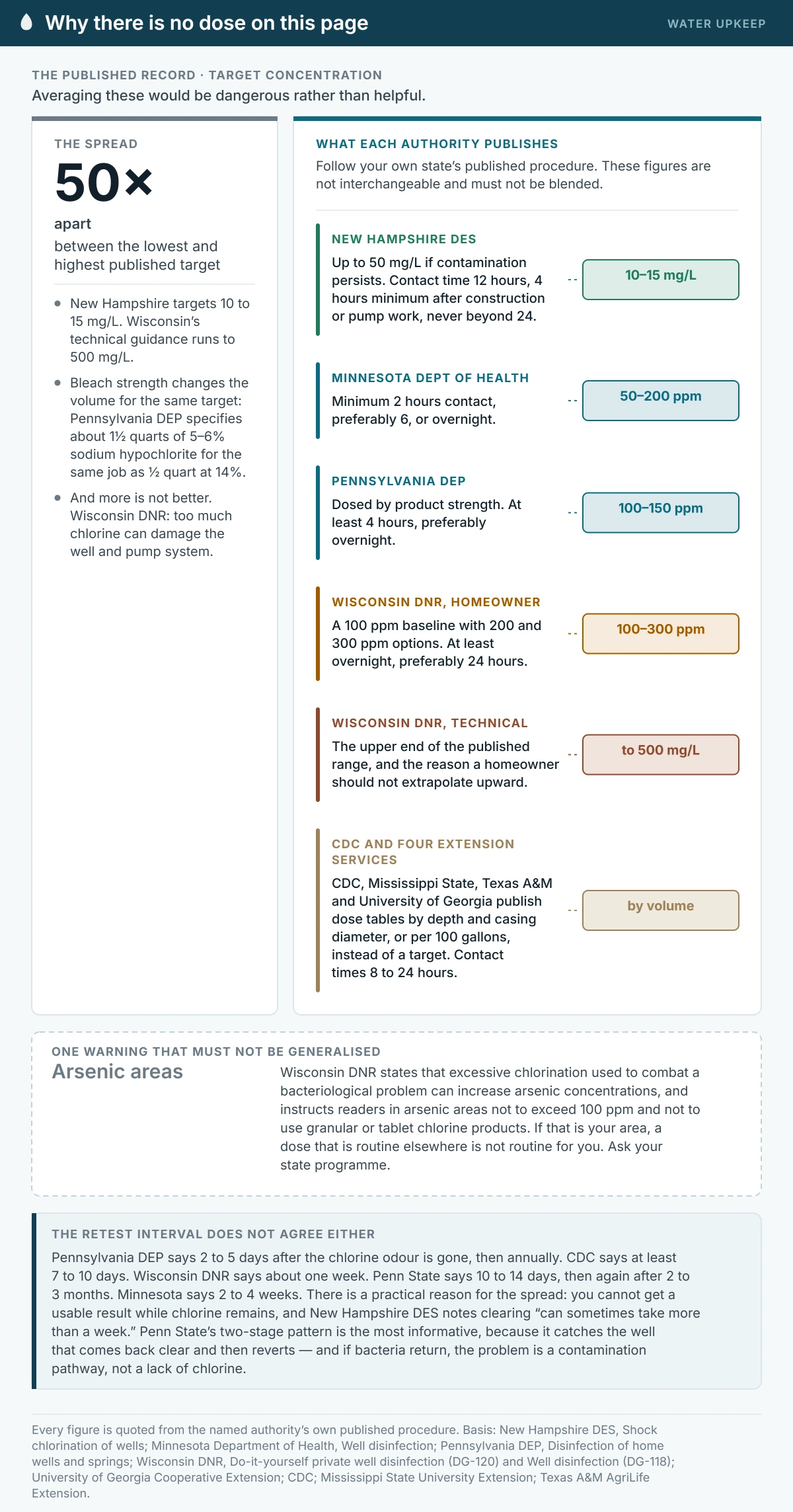
Because the authorities do not agree, and averaging them would be dangerous rather than helpful.
| Authority | Target concentration | Contact time |
|---|---|---|
| New Hampshire DES | 10 to 15 mg/L; up to 50 mg/L if contamination persists | 12 hours; 4 hours minimum after construction or pump work; never beyond 24 hours |
| Pennsylvania DEP | 100 to 150 ppm, dosed by product strength | At least 4 hours, preferably overnight |
| Minnesota Department of Health | 50 to 200 ppm | Minimum 2 hours, preferably 6, or overnight |
| Wisconsin DNR (homeowner guide) | 100 ppm baseline, with 200 and 300 ppm options | At least overnight, preferably 24 hours |
| Mississippi State and Texas A&M Extension | Dose table by depth and diameter | Minimum 8 hours or overnight |
| CDC | Amounts by depth and diameter, unscented bleach 5 to 9 per cent | Minimum 12 hours |
| University of Georgia Extension | 3 pints per 100 gallons in the well, plus 3 extra pints for household plumbing | 12 to 24 hours |
Pennsylvania DEP is the clearest illustration of why bleach strength matters: for the same target it specifies about 1½ quarts of 5 to 6 per cent sodium hypochlorite, about ¾ quart at 10 per cent available chlorine, about ½ quart at 14 per cent, or about four ounces of 65 to 70 per cent calcium hypochlorite granules. Mississippi State and Texas A&M both specify unscented household bleach less than six months old.
And more is not better. Wisconsin DNR’s technical guidance says so directly: using too much chlorine can damage the well and pump system, and concentrated bleach landing on the pitless adapter can corrode through it if not adequately rinsed. Mississippi State: excessive chlorination can be harmful.
One regional warning that must not be generalised. Wisconsin DNR states that excessive chlorination used to combat a bacteriological problem can increase arsenic concentrations, and its homeowner guide instructs readers not to exceed 100 ppm in arsenic areas and not to use granular or tablet chlorine products there. If you are in an arsenic area, a dose that is routine elsewhere is not routine for you. Ask your state programme.
Where the chlorinated water can go
This is the other place authorities differ, and it has environmental consequences.
Minnesota Department of Health: do not discharge chlorinated water into or near your septic system, landscaping, or any water bodies, because bleach solution will harm them. Wisconsin DNR: flush to a location away from your lawn and landscaping, and do not run the chlorinated solution into your septic system because it may kill the bacteria. Mississippi State and Texas A&M say the same. University of Georgia Extension is the outlier, permitting up to 100 gallons into a septic system.
On surface water there is no disagreement at all. Pennsylvania DEP: fish and aquatic animals are very sensitive to very low levels of chlorine and can be killed. New Hampshire DES: never discharge groundwater directly to a surface water body — use a dry area or a drainage swale where water can percolate naturally. Penn State adds that disinfection of a spring box should not be attempted if the overflow enters a stream, pond or wetland.
Retesting, and what a second positive means
Retest intervals vary widely and for a practical reason: you cannot get a usable result while chlorine remains. Wisconsin DNR notes many post-disinfection samples are rejected by laboratories because of residual chlorine, and New Hampshire DES says to wait until all the chlorine is out of the system, which can sometimes take more than a week.
| Authority | Retest after |
|---|---|
| Pennsylvania DEP | 2 to 5 days after the chlorine odour is gone, then annually |
| CDC | At least 7 to 10 days |
| Wisconsin DNR | About one week |
| Penn State Extension | 10 to 14 days, then again after 2 to 3 months |
| Minnesota Department of Health | 2 to 4 weeks |
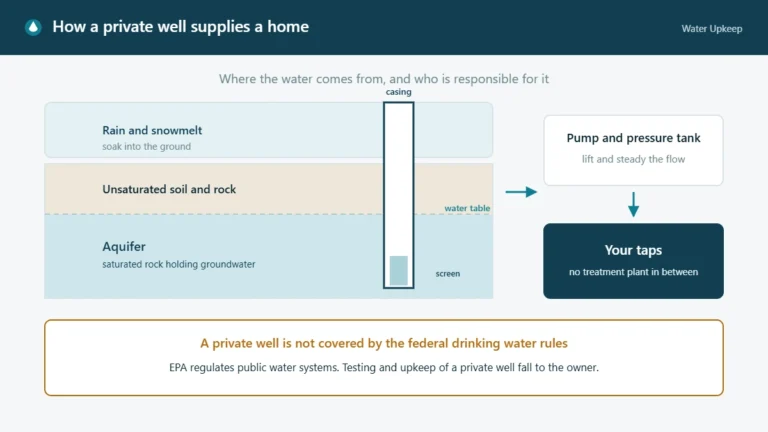
Penn State’s two-stage retest is the most informative pattern, because it catches the well that comes back clear and then reverts. If bacteria return, the problem is a contamination pathway, not a lack of chlorine. Check the wellhead: casing extending above ground, ground sloping away, a sanitary cap in place. Our guide to how a well works covers what those parts do, and choosing a well water filtration system covers continuous disinfection.
When to call a professional
- You have needed to shock the well more than once in a year. New Hampshire DES treats that as the threshold for professional help.
- Your well has a pit, vault or any enclosed space. That is confined-space work, not homeowner work.
- You are in an arsenic area.
- You do not know what treatment equipment is on the line, or the manufacturer’s guidance on chlorine.
- The water smells of fuel or solvent, or you suspect chemical contamination. Stop using the water and call the health department.
- Bacteria return after a correctly performed procedure.
Find your own state’s procedure before you begin. More on owning a private supply in our well water hub.
Sources and standards
- Centers for Disease Control and Prevention — How to disinfect wells after an emergency and Guidelines for treating well water
- Minnesota Department of Health — Well disinfection
- Pennsylvania Department of Environmental Protection — Disinfection of home wells and springs
- Wisconsin Department of Natural Resources — Do-it-yourself private well disinfection (DG-120), Well disinfection (DG-118) and Iron bacteria problems in wells
- New Hampshire Department of Environmental Services — Shock chlorination of wells
- Penn State Extension — Shock chlorination of wells and springs and Coliform bacteria
- University of Georgia Cooperative Extension — Disinfecting your well water: shock chlorination
- Mississippi State University Extension — Disinfecting a water well through shock chlorination
- Texas A&M AgriLife Extension, Texas Well Owner Network — How to disinfect a water well through shock chlorination
Last reviewed September 9, 2026.