Manganese in Drinking Water: What Each Number Actually Is
Manganese is a naturally occurring metal that turns water black or brownish-black and stains fixtures and laundry — and it is the rare contaminant that carries two completely different kinds of number. 0.05 mg/L is EPA’s secondary standard: aesthetic, about staining and taste, and in EPA’s own words, “EPA does not enforce these.” 0.3 mg/L is EPA’s lifetime health advisory, and EPA’s document says a health advisory “is not an enforceable standard for action.” Above that, several states publish their own guidance, and they do not agree with each other. Minnesota’s value for an infant drinking tap water or formula made with tap water is 100 µg/L — one-third of the federal advisory. Massachusetts frames its infant guidance as a duration limit. Wisconsin frames its numbers as advisory triggers at 300 and 1,000 µg/L.
Which framework applies to you depends on where you live and who lives in your house. This page puts every published number in one table with its type, its issuer and its scope attached. It does not tell you what to do about an infant — that goes to your health department and your clinician.
Water Upkeep tests no water and owns no equipment. This page reports what EPA and four state and university bodies have published about manganese, with each number’s source, type and scope attached. It does not tell you whether your water is safe, does not advise on infant feeding, and makes no health, developmental or neurological claim of its own. Those judgments belong to your local health department, your state-certified laboratory, and a clinician.
What manganese does to your house
The black and brownish-black stain
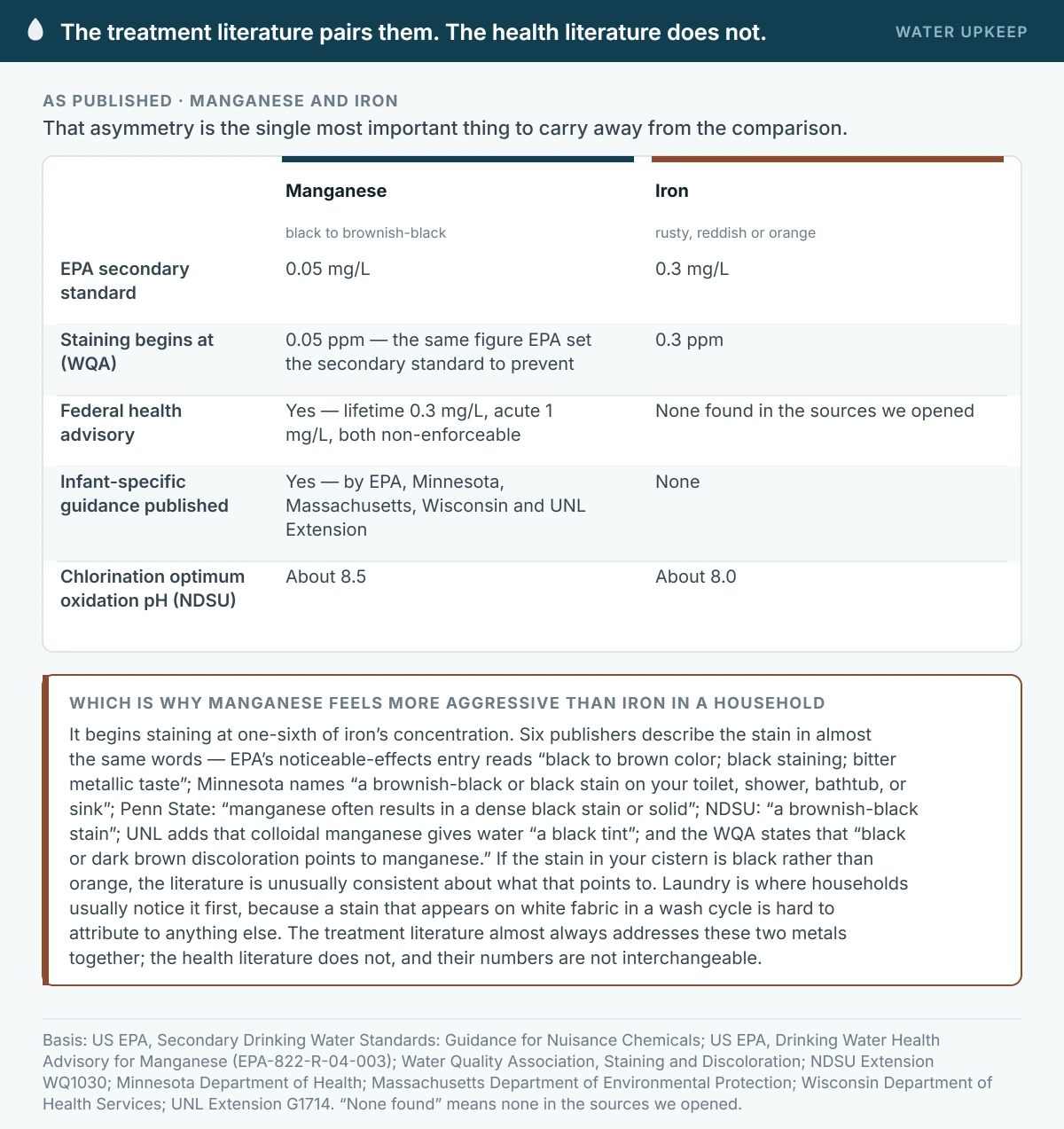
Six publishers describe the same thing in almost the same words, which is unusual enough to be worth noting. EPA’s noticeable-effects entry for manganese reads “black to brown color; black staining; bitter metallic taste.” Minnesota DOH: manganese “can also create a brownish-black or black stain on your toilet, shower, bathtub, or sink.” Penn State Extension: “Manganese often results in a dense black stain or solid.” NDSU Extension: manganese “causes a brownish-black stain.” UNL Extension says the same, and adds that colloidal manganese gives water “a black tint.” WQA: “black or dark brown discoloration points to manganese.”
If the stain in your toilet cistern is black rather than orange, the literature is unusually consistent about what that points to.
Laundry, tubs, toilets and fixtures
WQA’s manganese fact sheet is explicit about the range of damage: “Manganese in drinking water can also cause aesthetic issues such as metallic-tasting water and black stains on tubs/showers, toilets, plumbing fixtures, and laundry.”
Laundry is where households usually notice it first, because a stain that appears on white fabric in a wash cycle is harder to attribute to anything else.
The black specks, and why they appear
Manganese arrives at the tap in one of two states, and the difference decides everything downstream. Penn State describes the second case: “Sometimes, solid particles of iron and manganese will be apparent immediately in water from the well or spring. In this case, the metals are already in the oxidized form.” Those are the black specks — manganese that has already turned from a dissolved ion into an insoluble solid before it reached you.
Water that is clear when drawn and dark an hour later
The other case is dissolved manganese, and NDSU describes its signature: tap water “varies from a blackish hue to almost black when first drawn but clears after standing for 24 hours.” UNL notes that colloidal manganese gives water “a black tint.”
These are published descriptions, not a household test with a defined protocol, and we are not going to turn them into one. The appearance side of dark or cloudy water is handled in why your tap water looks cloudy, which deliberately carries no manganese health content. Once manganese is a solid particle, particle size becomes the question, and that belongs in what micron rating your filter needs.
Why staining starts at exactly the secondary standard
WQA puts manganese staining at “0.05 ppm of manganese,” against “0.3 parts per million (ppm) of iron.” That first figure is the same number as EPA’s secondary maximum contaminant level, and that is not a coincidence — EPA set the SMCL for manganese to protect against black staining and bitter metallic taste, which is precisely what starts happening at that concentration.
It also explains why manganese feels so much more aggressive than iron in a household: it begins staining at one-sixth of iron’s concentration.
Manganese and iron, side by side
| Manganese | Iron | |
|---|---|---|
| EPA secondary standard | 0.05 mg/L | 0.3 mg/L |
| Stain color | black to brownish-black | rusty, reddish or orange |
| Staining begins at (WQA) | 0.05 ppm | 0.3 ppm |
| Federal health advisory | Yes — lifetime 0.3 mg/L; acute 1 mg/L | None found in the sources we opened |
| Infant-specific guidance published | Yes — EPA, Minnesota, Massachusetts, Wisconsin, UNL | None |
| Chlorination optimum oxidation pH (NDSU) | about 8.5 | about 8.0 |
The treatment literature almost always addresses these two metals together. The health literature does not, and that asymmetry is the single most important thing to carry away from this comparison. Iron has its own article — how to remove iron from well water — and its numbers are not interchangeable with these.
The numbers, and what kind of number each one is
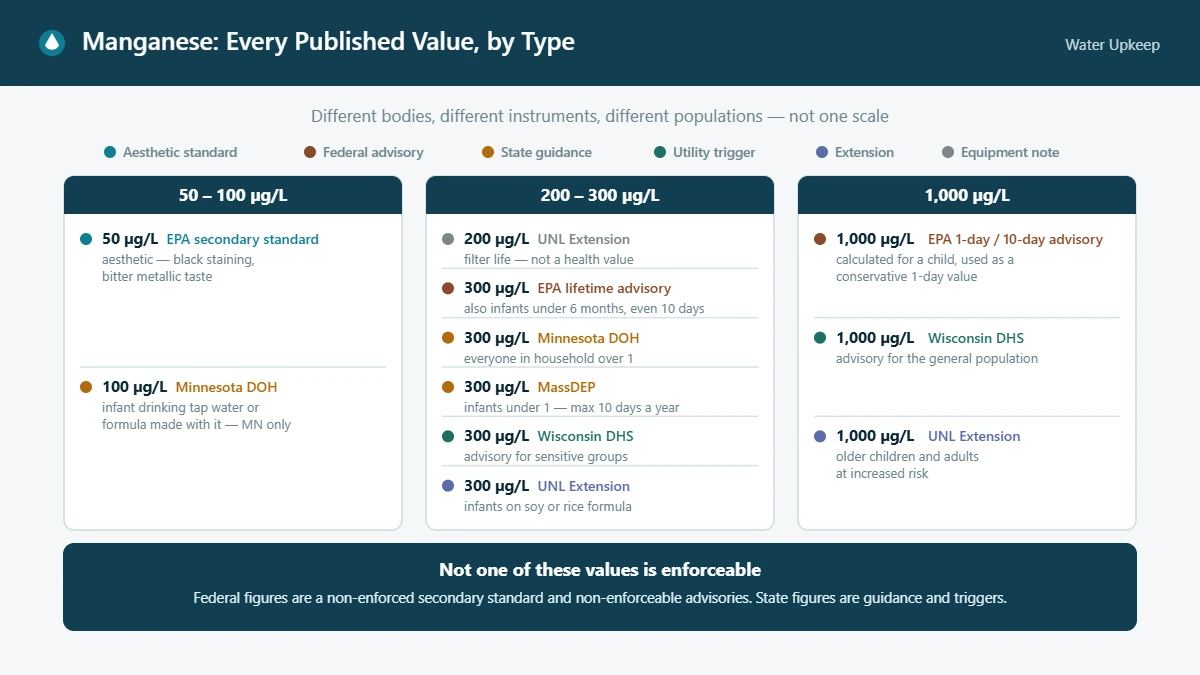
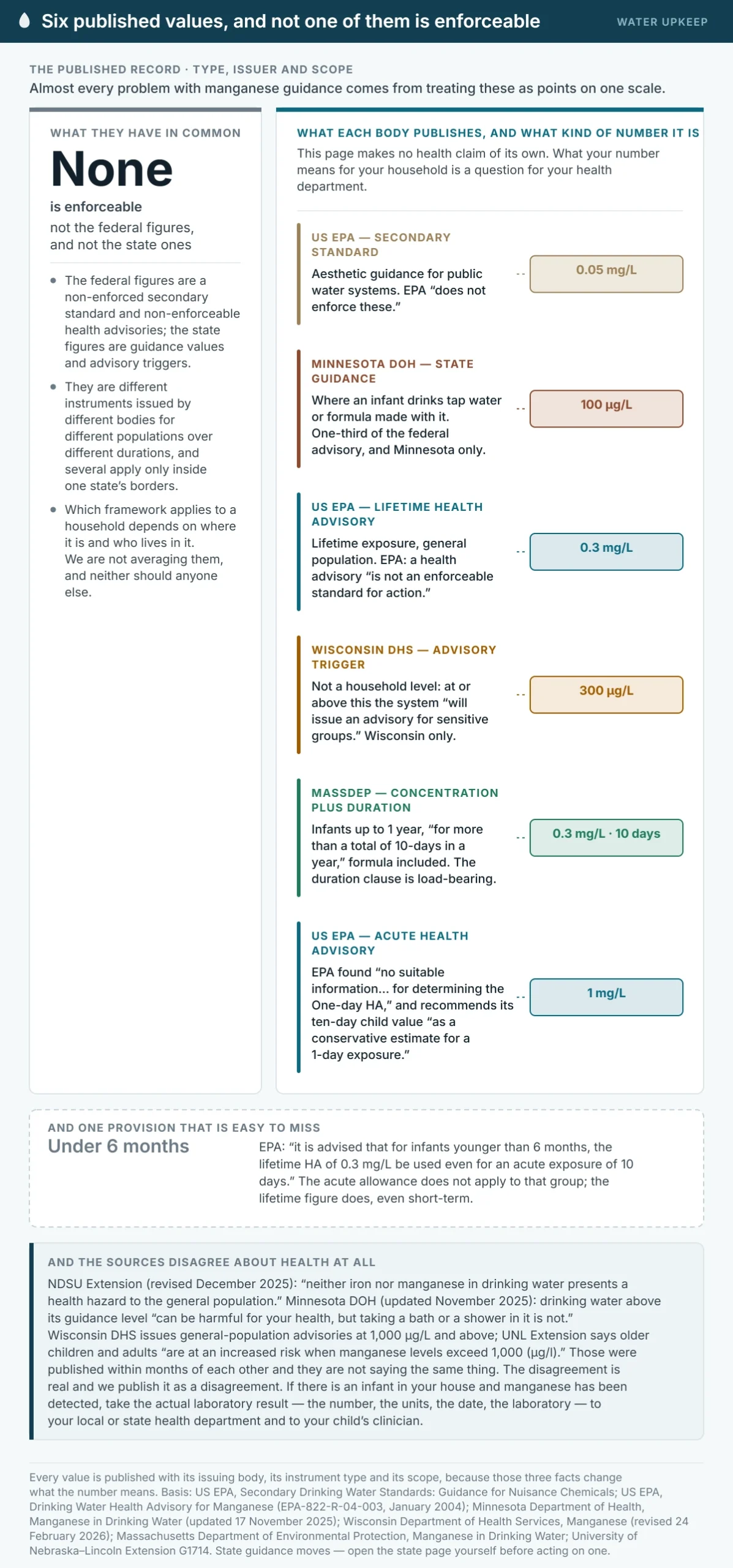
Almost every problem people have with manganese guidance comes from treating these values as points on one scale. They are not. They are different instruments issued by different bodies for different populations over different durations, and several of them apply only inside one state’s borders.
| Value | Type | Issuing body | Scope — who, and for how long | Enforceable |
|---|---|---|---|---|
| 0.05 mg/L (50 µg/L) | Secondary Maximum Contaminant Level | US EPA | Aesthetic guidance for public water systems: black-to-brown color, black staining, bitter metallic taste | No |
| 0.05 mg/L | Bottled water quality figure | FDA, as reported by ATSDR | Bottled drinking water | Not characterized in the source |
| 0.3 mg/L (300 µg/L) | Lifetime Health Advisory | US EPA | Lifetime exposure, general population | No — “not an enforceable standard for action” |
| 1 mg/L (1,000 µg/L) | One-day and Ten-day Health Advisory | US EPA | Acute exposure up to 10 days; calculated for a child and recommended by EPA as a conservative one-day value for children and adults | No |
| 0.3 mg/L | The lifetime value applied to acute exposure | US EPA | Infants younger than 6 months, even for a 10-day exposure | No |
| 100 µg/L | State guidance value | Minnesota DOH | Infants who drink tap water or formula made with tap water — Minnesota only | No |
| 300 µg/L | State guidance value | Minnesota DOH | Households where everyone is over one year old, and infants who never drink tap water or formula made with it — Minnesota only | No |
| 300 µg/L or above | Public-system advisory trigger | Wisconsin DHS | System issues an advisory for sensitive groups — Wisconsin only | Operational trigger |
| 1,000 µg/L or above | Public-system advisory trigger | Wisconsin DHS | System issues a general-population advisory — Wisconsin only | Operational trigger |
| 0.3 mg/L, max 10 days a year | State guidance: concentration plus duration | MassDEP | Infants up to 1 year, drinking water and formula — Massachusetts | No |
| above 1 mg/L | State advisory suggestion | MassDEP | General population “may also want to limit consumption” — Massachusetts | No |
| above 300 µg/L | Extension risk statement | UNL Extension G1714 | Infants fed soy or rice-based formula | No |
| above 1,000 µg/L | Extension risk statement | UNL Extension G1714 | “Older children and adults… at an increased risk” | No |
| 200 µg/L | Equipment consideration — not a health value | UNL Extension G1714 | Above this, point-of-use filter life “may be significantly shortened” | No |
Not one of these is enforceable. The federal figures are a non-enforced secondary standard and non-enforceable health advisories. The state figures are guidance values and advisory triggers. The framework that applies to a household depends on where it is and who lives in it.
The secondary standard: aesthetic, and not enforced
“National Secondary Drinking Water Standards that set non-mandatory water quality standards for 15 contaminants. EPA does not enforce these ‘secondary maximum contaminant levels’ (SMCLs). They are established as guidelines to assist public water systems in managing their drinking water for aesthetic considerations, such as taste, color, and odor.”
US EPA, Secondary Drinking Water Standards: Guidance for Nuisance Chemicals
Manganese’s SMCL is 0.05 mg/L, and it sits on that list next to iron, zinc, chloride, sulfate, color and pH. What secondary means in practice is covered in TDS in water, which explains the whole category using manganese’s neighbors on the same list.
The lifetime health advisory: guidance, and not enforceable
EPA’s Drinking Water Health Advisory for Manganese (EPA-822-R-04-003, January 2004) states its own status in one sentence: “A Drinking Water Health Advisory is not an enforceable standard for action.” Its lifetime value: “The lifetime health advisory value of 0.3 mg/L will protect against concerns of potential neurological effects.”
WQA restates the same structure independently: “In 2004, EPA set a non-enforceable lifetime health advisory (HA) level of 0.3 mg/L for chronic exposure to manganese and a 1-day and 10-day HA of 1 mg/L for acute exposure.”
The acute advisory, and the substitution EPA made
This one is widely quoted and rarely quoted correctly. EPA did not derive a one-day health advisory for manganese. Its document says: “No suitable information was found in the available literature for determining the One-day HA for manganese.” What EPA did instead is stated on the same page: “The Ten-day HA for a child of 1 mg/L, calculated below is recommended for use as a conservative estimate for a 1-day exposure for both children and adults.”
So the 1 mg/L figure you will see described as EPA’s one-day advisory is a ten-day value, calculated for a child, carried across to one day as a conservative substitute. EPA summarizes it as “a One-day and 10-day HA of 1 mg/L for acute exposure.” Both statements are EPA’s, and the second only makes sense with the first attached.
Infants under six months: what EPA actually advises
The provision is one sentence in EPA’s document, and it is easy to miss:
“However, it is advised that for infants younger than 6 months, the lifetime HA of 0.3 mg/L be used even for an acute exposure of 10 days.”
US EPA, Drinking Water Health Advisory for Manganese, EPA-822-R-04-003
In other words the acute allowance does not apply to this group; the lifetime figure does, even short-term. If there is an infant in your house and manganese has been detected in your water, take your actual laboratory result to your local or state health department and to your child’s clinician. Water Upkeep is not a health authority, does not advise on infant feeding, and is not going to tell you what your number means for your baby. UNL Extension puts the handoff plainly: “Health concerns should be discussed with one’s healthcare provider.”
Where the states go further, and where they differ
Minnesota Department of Health (page last updated 17 November 2025) publishes three household situations rather than one number:
- “If you have an infant who drinks tap water or drinks formula made with tap water, a safe level of manganese in your water is 100 micrograms of manganese per liter of water (µg/L) or less.”
- “If you have an infant who never drinks tap water or formula made with tap water, a safe level of manganese in your water is 300 µg/L or less.”
- “If everyone in your household is more than one year old, a safe level of manganese in your water is 300 µg/L or less.”
The phrase “safe level” there is Minnesota’s, not ours. And the 100 µg/L figure needs three facts attached every time it is quoted: it is Minnesota Department of Health guidance; it applies to infants who drink tap water or formula made with tap water; and it is one-third of EPA’s lifetime advisory and is not in force anywhere outside Minnesota. Note also that Minnesota’s 300 µg/L and EPA’s 0.3 mg/L are the same number issued by different bodies as different instruments for different populations — they are not the same guidance.
Wisconsin Department of Health Services (page revised 24 February 2026) does something structurally different: its numbers are triggers for a public water system to issue an advisory, not household safe levels. “At manganese levels equal to or greater than 300 micrograms per liter (μg/L), the system will issue an advisory for sensitive groups.” And: “At manganese levels equal to or greater than 1,000 μg/L, the system will issue an advisory for the general population.” Wisconsin defines its sensitive group its own way: “People over the age of 50, infants less six months, people with certain medical conditions (iron-deficiency anemia, liver disease) are the most sensitive to these effects.”
Two neighboring states, both drawing on the same federal literature, and their infant figures are 100 and 300 µg/L, with infant defined as under one year in one and under six months in the other.
MassDEP publishes a third kind of instrument entirely — concentration plus duration: “Infants up to 1 year of age should not be given water with manganese concentrations greater than 0.3 mg/L for more than a total of 10-days in a year, nor should the water be used to make formula for more than a total of 10-days in a year.” The duration clause is load-bearing; dropping it produces a stricter rule than the one Massachusetts published. MassDEP adds, for everyone else, that “People may also want to limit consumption of waters containing greater than 1 mg/L.”
UNL Extension adds a fifth framing with a distinction no agency makes: “Infants fed soy or rice-based formula, which is naturally rich in manganese, are at greater risk for adverse neurological effects if the water used to make the formula also contains high levels of manganese, greater than 300 micrograms per liter (µg/l).” It also states that “Older children and adults are at an increased risk when manganese levels exceed 1,000 (µg/l).”
Five bodies, five frameworks, and no way to average them into one. We are not going to try. If an infant number matters to your household, the number that matters is the one your own health department applies — and the person to ask is there, not here.
Why the sources disagree about health at all
This is worth setting out plainly, because a reader who visits three of these pages will come away confused otherwise.
- NDSU Extension (WQ1030, revised December 2025): “Neither iron nor manganese in drinking water presents a health hazard to the general population.”
- Minnesota DOH (updated November 2025): “Drinking water with a level of manganese above the MDH guidance level can be harmful for your health, but taking a bath or a shower in it is not.”
- Wisconsin DHS (revised February 2026): issues general-population advisories at 1,000 µg/L and above.
- UNL Extension (revised May 2021): “Older children and adults are at an increased risk when manganese levels exceed 1,000 (µg/l).”
These were published within months of each other and they are not saying the same thing. One observation, offered as an observation rather than a resolution: NDSU is writing a treatment article about manganese at the aesthetic concentrations its subject concerns, while Minnesota, Wisconsin and UNL are describing what happens at and above the advisory concentrations. That reading is consistent with all four texts, but it is our reading and not something any of them states. The disagreement is real and we are publishing it as a disagreement.
Bottled water has its own figure
ATSDR’s ToxFAQs for Manganese reports a fourth kind of instrument again: “The FDA has determined that the manganese concentration in bottled drinking water should not exceed 0.05 mg/L.” That is a bottled-water quality figure, not a tap-water standard, and it happens to be the same number as EPA’s aesthetic SMCL.
ATSDR also records the point that most of these pages open with: “Manganese is an essential nutrient, and eating a small amount of it each day is important to stay healthy.”
If there is an infant in the house
Everything below is a report of what agencies have published. None of it is advice from Water Upkeep, and none of it substitutes for your health department or your child’s clinician.
Do not boil the water
Boiling is the instinctive response and it is the wrong one. MassDEP puts this in its explicit “Do not” list:
“boil the water as boiling will not destroy manganese. If boiled too long, the manganese will be concentrated in the water.”
“freeze or try to filter the water through paper filters to remove manganese as neither will reduce its concentrations.”
Massachusetts Department of Environmental Protection, Manganese in Drinking Water
MassDEP is the only source we opened that addresses boiling and manganese at all, so this rests on one state agency — but it is a clear statement from one, and the mechanism is the same one that makes boiling counterproductive for nitrate: water leaves, the dissolved substance stays.
What the agencies name as alternative water
Where a sensitive-group advisory applies, Wisconsin DHS instructs: “Use a different source of water to make baby formula and for babies to drink,” and, for people over 50, “should immediately use an alternative source of water for drinking and preparing foods that take up a lot of water (like rice, oatmeal, and gelatin).” The alternatives Wisconsin names are “bottled water, water from a public system without violations, and water from a private well without issues.”
MassDEP names bottled water with a qualifier that matters: “Bottled water should only be used if it has been tested.” It also names water from another approved public water system without elevated manganese, and “A water pitcher filter or a home water filter unit that is capable of removing dissolved metals” — naming cation exchange water softeners and reverse osmosis, and describing activated carbon units alone as having, in its own words, “poor manganese removal capabilities.”
Those are those agencies’ instructions for their own jurisdictions. Whether they apply to your household is a question for your health department.
The handoff
Take the actual laboratory result — the number, the units, the date, the laboratory — to your local or state health department and to your child’s clinician. MassDEP names the same route: “your Local Board of Health and/or healthcare provider.” That is the end of what this page can usefully do for an infant question, and we would rather stop there than guess.
Getting a number you can trust
Manganese is not on the standard annual well panel
CDC’s annual instruction for private wells covers four things: “Test your well water at least once every year for total coliform bacteria, nitrates, total dissolved solids, and pH level.” Manganese is not among them, which means you have to ask for it specifically. CDC also says to test if “You notice a change in your water’s taste, color, or smell” — which, for manganese, is often the first indication there is anything to test for.
Where periodic testing sits in a well owner’s year is covered in annual well maintenance, and the wider testing sequence is in our water testing hub. If you are building a treatment plan across several contaminants rather than chasing one, start at well water filtration systems, which is organized around testing first and sequencing by risk.
State-certified laboratories
The route is the same everywhere, and Minnesota’s phrasing is representative: “Contact a Minnesota Department of Health accredited laboratory to get a sample container and instructions on how to submit a sample.” Your own state’s health department maintains the equivalent list. A container and instructions from the laboratory matter here — a metals sample has handling requirements that a jar from the kitchen does not meet.
On a public system
Your utility holds the monitoring data, and it is summarized in the annual Consumer Confidence Report that is published to you each year. In Wisconsin, note that the system is the body that issues a manganese advisory — so the utility is not just a data source there, it is the actor.
Test again after treatment
Minnesota DOH’s instruction is short and worth following: “After installing treatment, test the treated water to make sure the treatment is working.” MDH also says to “Select a treatment unit certified by NSF, Underwriter’s Laboratory (UL), or Water Quality Association (WQA).”
Treatment: what the sources actually say
The combined iron-plus-manganese problem, stated before any table
Read this before the numbers below, because without it they will mislead you. Most of the treatment literature was written about iron and manganese together, and many of its published limits are combined iron-plus-manganese figures. A combined figure is not a manganese figure.
A household at 0.4 mg/L manganese with no iron is nowhere near a “3 to 10 mg/L combined” applicability range. A household at 6 mg/L iron and 0.1 mg/L manganese is comfortably inside it. Those two households have almost nothing in common, and a combined number cannot be used by either of them without the iron result in hand. There is no way to convert a combined figure into a manganese-only one, in either direction, and we do not do it anywhere on this page. Every row below is labeled.
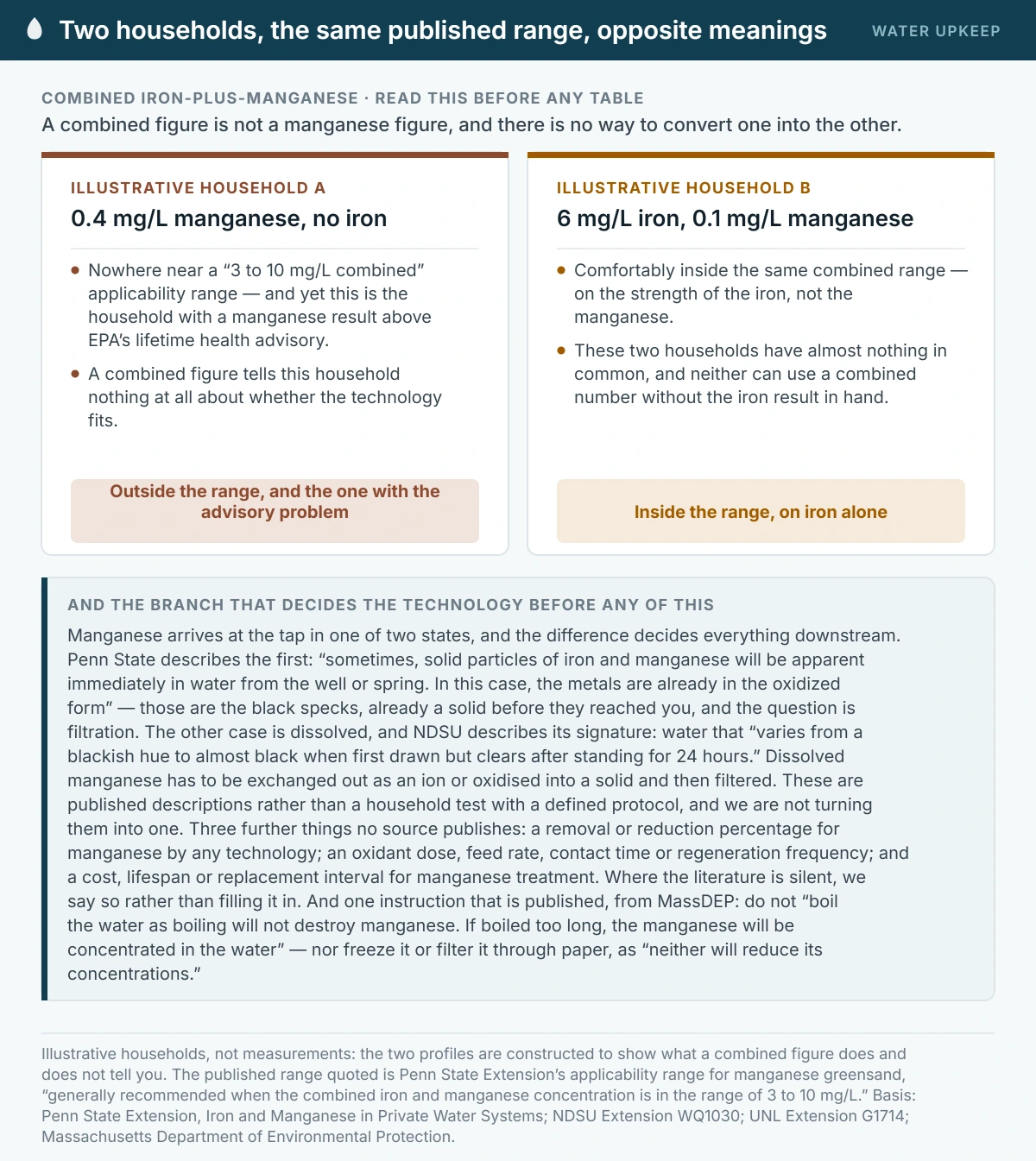
Dissolved or already oxidized — the branch that decides the technology
The two states described earlier lead to two families of response. Dissolved manganese has to be either exchanged out as an ion or oxidized into a solid and then filtered. Manganese that arrives already oxidized is a particle, and the question is filtration. That branch is the same one the iron literature uses, which is one more reason the two subjects travel together — see how to remove iron from well water.
The three published technology lists, side by side
Three bodies publish lists, and we are keeping them separate rather than merging them into a house list, because the differences between them are informative.
- WQA: “Water treatment technologies that have been shown to be capable of removing manganese from drinking water in your home include cation exchange water softening, distillation, filtration, and reverse osmosis.” WQA’s fact sheet names no NSF/ANSI standard and publishes no numeric operating limits — it is a technology list and nothing more.
- Minnesota DOH: aeration and filtration; continuous chlorination and filtration; oxidizing media filtration; ozonation and filtration; water softening by cation exchange. Distillation and reverse osmosis are listed as designed to fully or partially remove manganese.
- MassDEP: a water pitcher filter or home filter unit “capable of removing dissolved metals,” naming cation exchange water softeners and reverse osmosis — and describing activated carbon units alone as having “poor manganese removal capabilities.”
The published conditions, every combined figure labeled
| Approach | Published condition | Manganese-only or COMBINED Fe+Mn | Source |
|---|---|---|---|
| Manganese greensand | “generally recommended when the combined iron and manganese concentration is in the range of 3 to 10 mg/L” | COMBINED | Penn State |
| Greensand, pH floor | “If the pH of the water is lower than 6.8, the greensand will probably not filter out the iron and manganese adequately.” | Applies to both | NDSU WQ1030 |
| Oxidation then filtration | “When combined levels of iron and manganese exceed 10 mg/L, the most effective treatment involves oxidation followed by filtration” | COMBINED | Penn State |
| Chlorination | “The optimum rate of oxidation of iron and manganese by chlorination is at a pH of about 8.0 and 8.5, respectively” — 8.5 for manganese | Manganese-specific pH | NDSU WQ1030 |
| Ion exchange, oxidizing filters, aeration, chemical oxidation | most effective “in water that has an almost neutral pH (approximately 7.0)” | Applies to both | UNL G1714 |
| Cation exchange softening | “some softeners may be able to fully or partially remove copper, iron, manganese, and radium” — “Depending on your water quality” | Manganese named | Minnesota DOH |
| Cation exchange softening | “up to 10 ppm of iron and manganese” (NDSU) / “as much as 5-10 ppm… of iron and manganese” (UNL) — the sources differ | COMBINED, and contested | NDSU WQ1031; UNL G1491 |
| Softener suitability | “pH is greater than 6.7, the water hardness is between 3 and 20 grains per gallon (50- 350 mg/L) and the dissolved iron concentration is less than 5 mg/L” | IRON-only condition | Penn State |
| Point-of-use RO, distillation, carbon filtration | can “remove dissolved manganese”; above 200 µg/L “the effective life of the filter may be significantly shortened” | MANGANESE-only | UNL G1714 |
| Activated carbon alone | “activated carbon units alone have poor manganese removal capabilities” | Manganese-specific | MassDEP |
| Polyphosphate / sequestration | “generally ineffective in treating manganese” | Manganese-specific | Penn State |
| Polyphosphate | should not exceed “a combination of iron and manganese of more than 3 mg/L” | COMBINED | NDSU WQ1030 |
| Boiling | does not destroy manganese; concentrates it if boiled too long | Manganese-specific | MassDEP |
| Freezing; paper filters | neither reduces concentrations | Manganese-specific | MassDEP |
Note the polyphosphate rows. Penn State says sequestration is “generally ineffective in treating manganese.” NDSU publishes a combined 3 mg/L ceiling for it without that qualification. Both are current extension publications and they do not agree; we are printing both rather than picking one.
Softening, and what the sources will and will not say
Minnesota DOH is the only body that points at a study: “An MDH study in Dakota County found that water softeners can be an effective way to reduce the level of manganese in drinking water.” MDH’s own softening fact sheet keeps the hedges: “some softeners may be able to fully or partially remove copper, iron, manganese, and radium,” and “Depending on your water quality.” Those hedges are the source’s and they stay.
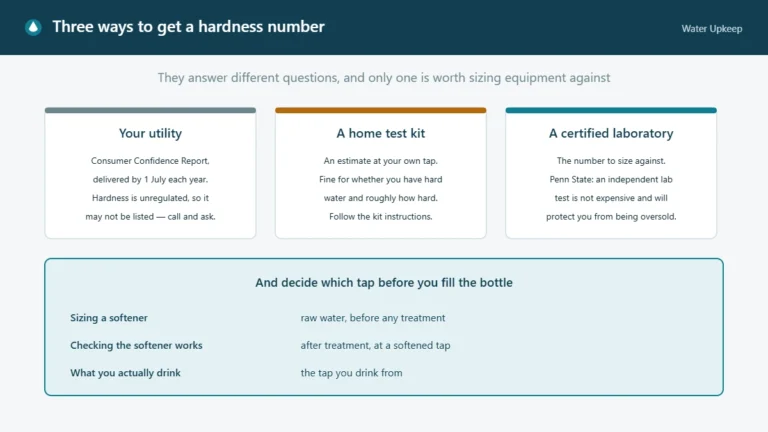
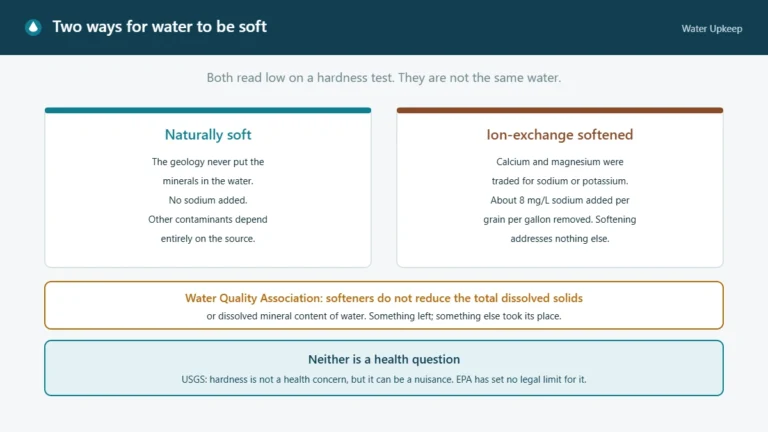
What a softener does mechanically is exchange, not removal — WQA describes “Strong Acid Cation resins (SAC)… that can exchange positive ions, such as calcium and magnesium, for sodium or potassium” — and the same fact sheet notes that “Softeners do not reduce the total dissolved solids (TDS) or dissolved mineral content of water.” A softener bought for manganese is a softener doing something outside its main job, which is treating hard water. If you are setting one up, the hardness number you program into it is its own decision — see what hardness number to program. We publish no manganese compensation figure, because the manufacturers do not agree on one.
What certification does and does not cover here
This is worth stating carefully. Manganese reduction is a claim under NSF/ANSI 42, which covers “systems designed to reduce non-health-related contaminants” — the aesthetic-effects standard, whose claim list is chlorine, taste and odor, chloramine, particulate, iron, manganese, zinc and total dissolved solids. It is not a claim under NSF/ANSI 53, the health-effects standard. NSF’s consumer contaminant-reduction claims guide does not list manganese at all.
So the certification system files manganese as an aesthetic parameter while state health departments publish health guidance for it. Both things are true at once, and a certification to the NSF/ANSI 42 manganese reduction claim is a certification for that claim — it is not a statement about a health advisory. This is exactly why we never write “NSF certified” without naming the standard and the claim. Definitions to go with this are in what filtered water means, and method selection generally in how to filter water at home.
What no source publishes
No source we opened publishes a removal or reduction percentage for manganese by any technology. None publishes an oxidant dose, feed rate, contact time or regeneration frequency — and we would not print one if it did, because those are system-specific and getting them wrong has consequences. None publishes a cost, a lifespan or a replacement interval for manganese treatment. Where the literature is silent, we say so rather than filling it in.
Frequently asked questions
Is manganese in drinking water dangerous?
That question does not have a single published answer, and we are not going to manufacture one. What exists is: an EPA secondary standard at 0.05 mg/L that EPA does not enforce; an EPA lifetime health advisory at 0.3 mg/L that EPA says “is not an enforceable standard for action”; an acute advisory at 1 mg/L; four state and extension frameworks that disagree with each other about the numbers, the ages and the sensitive groups; and one flat disagreement between NDSU and three other bodies about whether manganese presents a general-population health concern at all. The table above is the honest answer. What your number means for your household is a question for your health department.
What level of manganese is safe?
There is no single figure, because the bodies that publish guidance do not agree and several of their values apply only inside one state. Minnesota DOH uses the phrase “safe level” and attaches it to three different household situations at 100 and 300 µg/L — that is Minnesota’s language and Minnesota’s guidance. EPA’s lifetime advisory is 0.3 mg/L, non-enforceable. Massachusetts publishes a concentration with a ten-day-a-year duration limit for infants. Wisconsin publishes triggers for a utility, not levels for a household. Read the table and find the framework that applies where you live.
Can I boil the water to remove manganese?
No. MassDEP puts it in its “Do not” list: “boil the water as boiling will not destroy manganese. If boiled too long, the manganese will be concentrated in the water.” The same list adds that freezing and paper filters do not reduce concentrations either. This is the single most important thing on this page for a household that has just received a result, because boiling is the instinctive first move.
Is it safe to bathe or shower in it?
Two agencies address this and both say the same thing. MassDEP, answering the question directly: “Manganese is poorly absorbed through the skin.” Minnesota DOH: “Drinking water with a level of manganese above the MDH guidance level can be harmful for your health, but taking a bath or a shower in it is not.”
Can I use it to make baby formula?
That is not our call to make, and we are not going to make it. What the agencies published is above: EPA advises the 0.3 mg/L lifetime value for infants under six months even short-term; Minnesota’s guidance for an infant drinking tap water or formula made with tap water is 100 µg/L; Massachusetts limits 0.3 mg/L to a total of ten days a year for infants up to one year, formula included; Wisconsin instructs “Use a different source of water to make baby formula and for babies to drink” at its sensitive-group trigger. Take your laboratory result to your local or state health department and to your child’s clinician. UNL Extension: “Health concerns should be discussed with one’s healthcare provider.”
Will a water softener remove manganese?
Minnesota DOH says “some softeners may be able to fully or partially remove copper, iron, manganese, and radium,” qualified by “Depending on your water quality,” and cites an MDH study in Dakota County finding softeners can be an effective way to reduce manganese. The capacity figures you will find elsewhere — up to 10 ppm from NDSU, 5 to 10 ppm from UNL — are combined iron plus manganese figures, they disagree with each other, and neither can be converted into a manganese-only number. Penn State’s softener suitability conditions include an iron ceiling, not a manganese one.
Will my carbon filter or fridge filter handle it?
MassDEP’s wording is that “activated carbon units alone have poor manganese removal capabilities.” NSF files manganese reduction under NSF/ANSI 42, the aesthetic-effects standard, and NSF’s consumer contaminant-reduction claims guide does not list manganese at all — so a filter’s manganese performance, if it has any, is something to check in its certification listing by name rather than assume. What a fridge filter is actually for is covered in how often to change a refrigerator water filter, and filter ratings generally in what micron rating your filter needs.
Why does the black stain come back so fast?
Because staining begins at 0.05 ppm, per WQA — the same concentration EPA set its secondary standard to prevent, and one-sixth of the level at which iron starts staining. Cleaning removes the deposit; it does not change the water arriving behind it. General technique for mineral deposits is in how to remove hard water stains, though that article is about hardness scale and does not carry a manganese-specific method, because no source we opened publishes one.
Is this the same thing as the rotten-egg smell?
No — different contaminant, different sense, different remedy. Sulfur odor is hydrogen sulfide gas and is covered in why your water smells like rotten eggs. Manganese is a dissolved metal with a stain, a taste, and a set of health advisories that hydrogen sulfide does not have.
Before you act on a result
Water Upkeep tests no water and owns no equipment. This page reports what EPA and four state and university bodies have published, with each number’s type and scope attached. It does not tell you whether your water is safe, does not advise on infant feeding, and makes no health, developmental or neurological claim of its own.
- Any infant question goes to your local or state health department and to your child’s clinician, with the actual laboratory result in hand.
- Any question about whether your specific number is acceptable goes to the same place. It is a judgment about a person, not about plumbing.
- Do not boil. MassDEP: boiling “will not destroy manganese” and, boiled too long, concentrates it.
- Ask for manganese by name when you order a test. It is not on CDC’s four-item annual well panel.
- Test again after treatment — Minnesota DOH: “After installing treatment, test the treated water to make sure the treatment is working.”
One further note on this page’s own limits: state manganese guidance is moving. Minnesota’s page was last updated in November 2025 and Wisconsin’s was revised in February 2026. We check these values against their source pages, and if you are making a decision on one of them, it is worth opening the state page yourself to confirm the current figure.
Sources and Standards
- US Environmental Protection Agency — Drinking Water Health Advisory for Manganese, EPA-822-R-04-003, January 2004 (the lifetime and acute advisory values, the one-day substitution, and the infants-under-six-months provision)
- US Environmental Protection Agency — Secondary Drinking Water Standards: Guidance for Nuisance Chemicals (the 0.05 mg/L SMCL and the non-enforcement statement)
- Agency for Toxic Substances and Disease Registry — ToxFAQs for Manganese, October 2012 (the essential-nutrient statement and the FDA bottled-water figure)
- Centers for Disease Control and Prevention — Guidelines for Testing Well Water
- Minnesota Department of Health — Manganese in Drinking Water (page updated 17 November 2025)
- Minnesota Department of Health — Home Water Treatment
- Minnesota Department of Health — Home Water Softening
- Wisconsin Department of Health Services — Manganese (page revised 24 February 2026)
- Massachusetts Department of Environmental Protection — Manganese in Drinking Water (the boiling, freezing and paper-filter statements, and the infant duration limit)
- Water Quality Association — Manganese technical fact sheet
- Water Quality Association — Staining and Discoloration (the 0.05 ppm staining threshold)
- Water Quality Association — Ion Exchange Fact Sheet
- Penn State Extension — Iron and Manganese in Private Water Systems (Swistock, Sharpe, Robillard; updated 29 May 2025)
- NDSU Extension — Iron and Manganese Removal, WQ1030 (revised December 2025)
- NDSU Extension — Water Softening (Ion Exchange), WQ1031
- University of Nebraska–Lincoln Extension — Drinking Water: Iron and Manganese, G1714 (Dvorak and Schuerman; revised May 2021)
- University of Nebraska–Lincoln Extension — Drinking Water Treatment: Water Softening (Ion Exchange), G1491
- NSF International — NSF/ANSI 42, 53 and 401 Filtration Systems Standards (manganese reduction listed under NSF/ANSI 42)
Certification references on this page name both the standard and the specific claim. Every manganese value is published with its issuing body, its instrument type and its scope, because those three facts change what the number means. Water Upkeep does not test water or equipment, and nothing here is a health assessment.
Last reviewed September 9, 2026.