Is There Such a Thing as a Hard Water Filter?
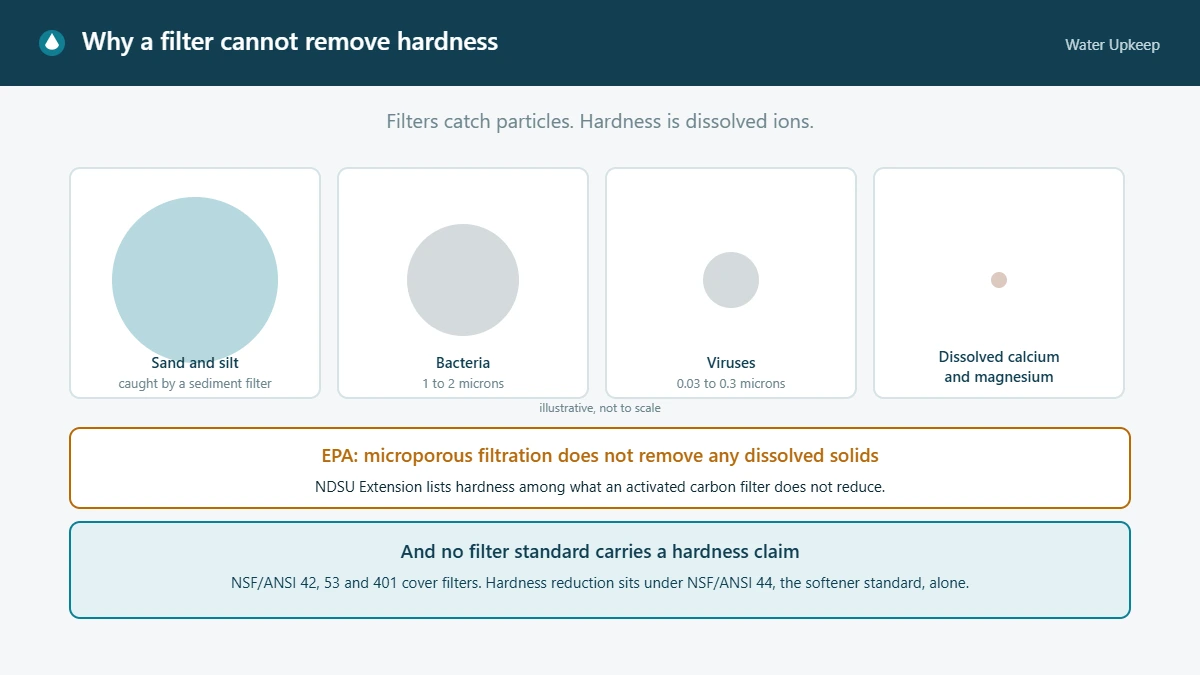
There is no such thing as a hard water filter. Hardness is dissolved calcium and magnesium — individual ions in solution, not particles floating in the water — and a filter works by catching things. There is nothing there to catch. EPA states it directly: microporous filtration does not remove any dissolved solids. NDSU Extension lists hardness explicitly among the things an activated carbon filter does not reduce. And the phrase itself appears on no government, university or standards-body page we could find. If you searched for one, the good news is that the thing you actually need is usually cheaper or simpler than the thing you were about to buy.
Why a filter cannot do it
USGS defines hardness as the amount of dissolved calcium and magnesium in the water. The Water Quality Association describes hardness as dissolved compounds of calcium and magnesium, and notes it is dissolved calcium and magnesium salts that cause most scaling in pipes and water heaters.
Dissolved means at the ionic scale. To put that in context, University of Georgia Extension gives bacteria at 1 to 2 microns and viruses at 0.03 to 0.3 microns; dissolved ions are orders of magnitude smaller than either. A cartridge filter with a pore size fine enough to catch them would not pass water.
So the mechanism simply does not apply. EPA’s technical description: microporous filtration physically removes solid contaminants by capturing them on the surface of the media, typically occurs at low pressures, and does not remove any dissolved solids.
What the filters you can buy actually do
| Filter type | What it removes | Hardness? |
|---|---|---|
| Sediment or mechanical | Sand, silt, clay, rust, loose scale and other suspended material | No — and it does not remove dissolved chemicals or very small particles |
| Activated carbon | Organics affecting taste, odour and colour; chlorine; trihalomethanes; pesticides; industrial solvents; PCBs; radon gas | No — NDSU lists hardness among what it does not remove, alongside microbes, sodium, nitrates and fluoride |
EPA’s own consumer table says the same in one line: filtration does not remove nitrates, bacteria or dissolved minerals.
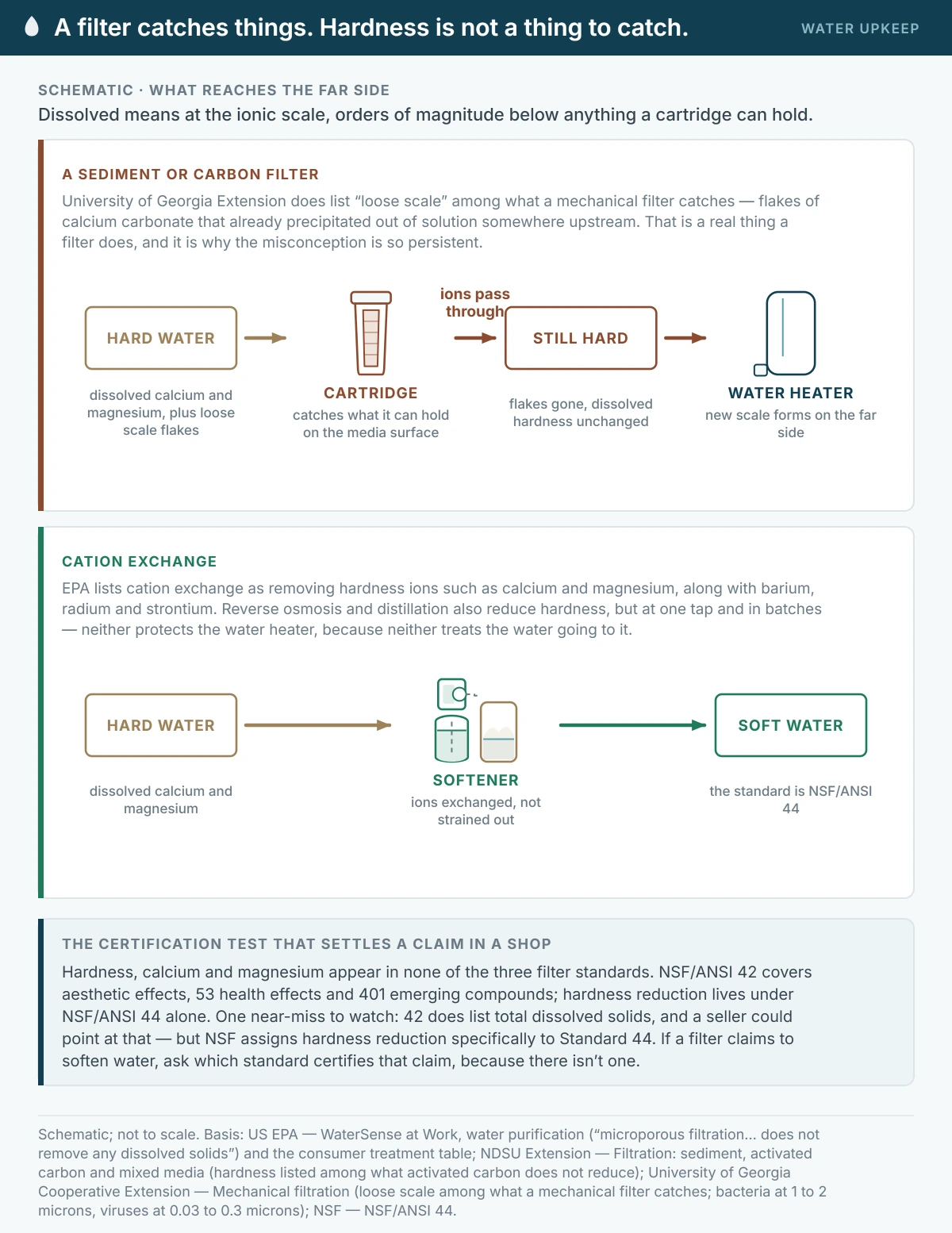
There is one detail that explains why the misconception is so persistent. University of Georgia Extension lists “loose scale” among what a mechanical filter catches. It does — flakes of calcium carbonate that have already precipitated out of solution somewhere upstream. A sediment filter can genuinely stop those flakes reaching your fixtures. It does absolutely nothing to the dissolved calcium and magnesium still in the water, which will go on forming new scale on the other side of the filter.
What does reduce hardness
| Technology | Where it works | Standard |
|---|---|---|
| Cation exchange (a water softener) | Whole house | NSF/ANSI 44 |
| Reverse osmosis | One tap, in batches | NSF/ANSI 58 |
| Distillation | One tap, small batches | NSF/ANSI 62 |
| Nanofiltration | A membrane process, largely municipal | — |
EPA lists cation exchange as removing hardness ions such as calcium and magnesium, along with other positively charged contaminants including barium, radium and strontium. CDC says water softeners remove minerals, primarily calcium and magnesium. EPA lists nanofiltration as removing hardness, colour and odour compounds, synthetic organic chemicals and some disinfection byproduct precursors. Distillation appears on EPA’s technology table with hardness named among what it removes.
Reverse osmosis removes many inorganics and dissolved solids; CDC lists it among filters that may reduce calcium and magnesium alongside arsenic, fluoride and others. EPA notes it potentially produces a large quantity of reject water, with WaterSense labelled models wasting 2.3 gallons or less per gallon treated.
The vocabulary trap
Part of why “hard water filter” sounds plausible is that the word filtration is used at two very different scales.
CDC groups microfiltration, ultrafiltration, nanofiltration and reverse osmosis all under the heading of filtration. EPA’s consumer table treats filtration as its own row, separate from reverse osmosis, and says that row does not remove dissolved minerals. Both are correct. Membrane separation at the nanofiltration and reverse osmosis end genuinely acts on dissolved ions; the cartridge filters sold in hardware shops as filters do not, and they are not the same class of device.
So when a product description says filter, the question worth asking is which of those two things it means.
The certification test that settles it
This is the fastest way to check a claim in a shop. NSF publishes what each drinking water treatment unit standard covers:
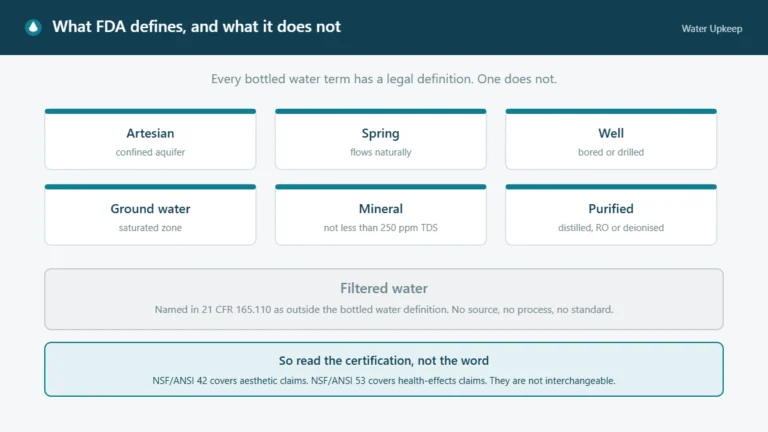
- NSF/ANSI 42, aesthetic effects: chlorine, taste and odour, chloramine, particulate, iron, manganese, zinc and total dissolved solids.
- NSF/ANSI 53, health effects: over fifty contaminant reduction claims, commonly lead, Cryptosporidium, VOCs and chromium.
- NSF/ANSI 401, emerging compounds: up to fifteen contaminants including prescription and over-the-counter drugs, herbicides and pesticides.
- NSF/ANSI 44, residential cation exchange water softeners — the standard whose scope includes reduction of hardness.
Hardness, calcium and magnesium appear in none of the three filter standards. Hardness reduction lives under NSF/ANSI 44 alone. If a filter claims to soften water, ask which standard certifies that claim, because there isn’t one.
One near-miss to watch. NSF/ANSI 42 does list total dissolved solids among its covered contaminants, and a seller could point at that. Hardness is a subset of total dissolved solids, but a TDS claim is a reverse-osmosis-type claim, not a hardness claim, and NSF assigns hardness reduction specifically to Standard 44. Shower filters are a related near-miss: NSF/ANSI 177 covers them for free available chlorine only.
What a whole-house “hard water filter” usually turns out to be
Usually one of two real categories, both described by the Water Quality Association — the water treatment industry’s own trade association. Sacrificial media devices release citric acid or phosphate into the water. Physical water treatment devices use magnetic, electronic, electrostatic or electromagnetic technologies.
The WQA’s own assessment of both, published against its members’ commercial interest, is unambiguous: these do not provide a reduction of total calcium or magnesium content of the treated stream.
That does not make the category worthless. Scale control is a legitimate objective and there is a standard for it — EPA names IAPMO/ANSI Z601, Standard for Scale Reduction Devices, and describes salt-free conditioners as reducing scale buildup without added chemicals or water waste. Note what the standard is called. Scale reduction, not hardness removal. EPA keeps the two paths separate in its own language: softening water with a water softener, or neutralising the scale-forming properties using a water conditioner.
Even a softener does not strain anything out
Worth knowing, because it is the cleanest way to understand why filtration was never the right tool. The Water Quality Association notes that softeners do not reduce the total dissolved solids or dissolved mineral content of water. Ion exchange swaps calcium and magnesium for sodium or potassium; nothing is removed from the water in the sense a filter removes something.
CDC describes softeners as removing minerals and the WQA describes them as not reducing dissolved mineral content. Both are true at different levels: the hardness ions go, other ions take their place, the total stays put. The mechanism is covered in how water softeners work.
What you probably actually want
| If the goal is | Look for |
|---|---|
| Protecting plumbing, the water heater and appliances throughout the house | A cation exchange softener certified to NSF/ANSI 44 |
| Scale control without salt discharge | A scale reduction device under IAPMO/ANSI Z601, understanding hardness is unchanged |
| Better taste, odour or a specific contaminant at the kitchen tap | A filter certified to NSF/ANSI 42, 53, 401 or 58 for that specific claim |
| Reassurance that hardness is not harming anyone | Nothing. USGS: hardness is not a health concern, but it can be a nuisance |
The last row matters. Hardness is a nuisance contaminant, and the certifications that exist for health-effect contaminants have nothing to do with it. Do not let a hardness complaint be converted into a health purchase.
When to call a professional
- You have been quoted for a whole-house “filter” that is said to handle hard water. Ask which standard it is certified to and for which claim.
- You do not have an independent hardness number yet — start with testing water hardness.
- Iron or manganese is present as well as hardness. Oxidised iron fouls softener resin, and the order of equipment matters.
- Your municipality restricts brine discharge, or you are on a septic system.
- Scale is returning despite an installed softener.
The options are laid out in how to treat hard water. More on whole-house equipment in our whole-house filtration hub.
Sources and standards
- US Environmental Protection Agency — WaterSense at Work, water purification, Guide to selecting water treatment systems, Overview of drinking water treatment technologies and Water softener guide
- NDSU Extension — Filtration: sediment, activated carbon and mixed media
- University of Georgia Cooperative Extension — Mechanical filtration methods and devices
- US Geological Survey — Hardness of water
- Centers for Disease Control and Prevention — Home water treatment systems
- NSF — NSF/ANSI 42, 53 and 401, NSF/ANSI 44 technical requirements and Standards for water treatment systems
- Water Quality Association — Scale deposits and Ion exchange fact sheet
Last reviewed September 8, 2026.