UV Water Disinfection: NSF/ANSI 55 Class A vs Class B
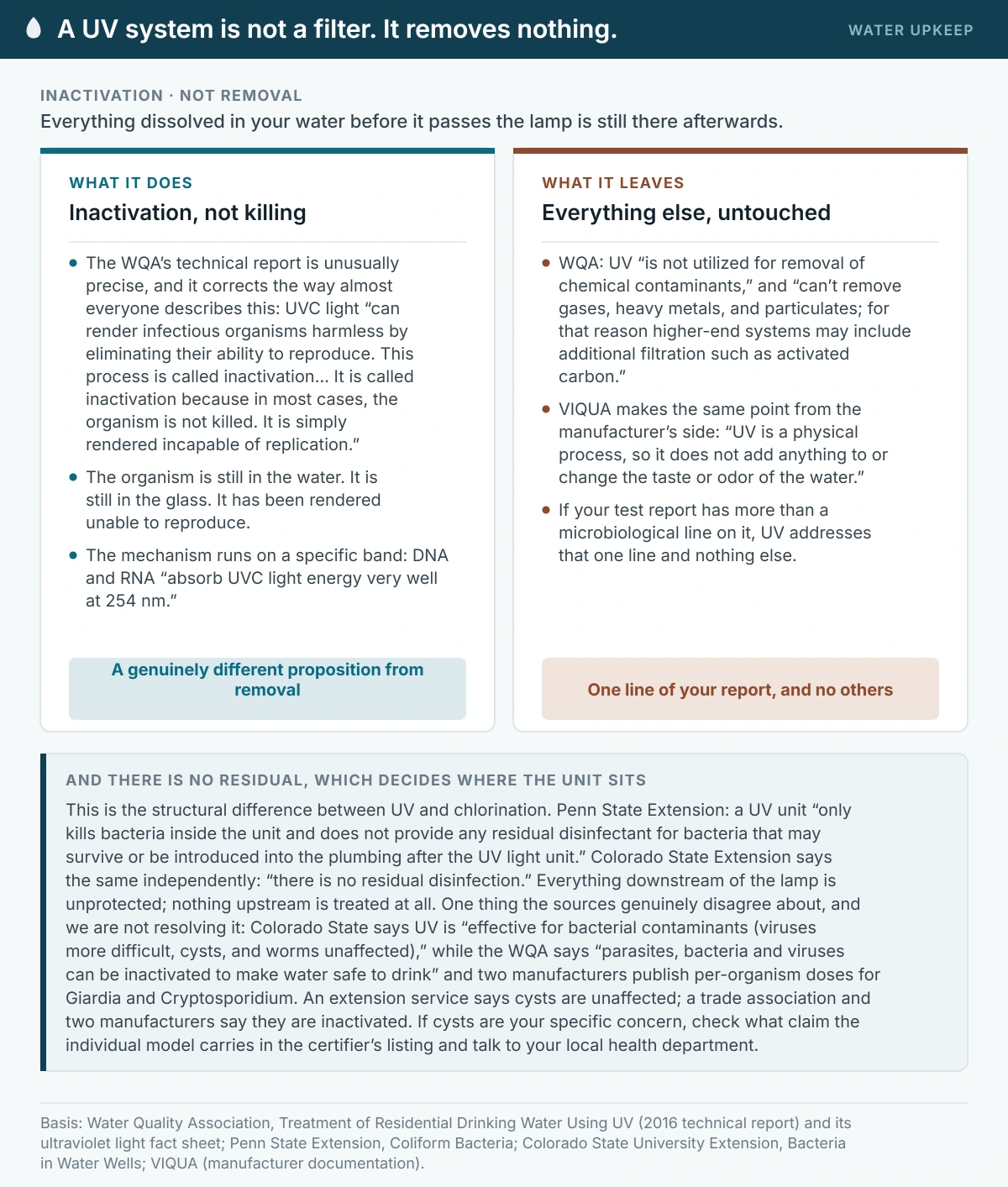
The first thing to fix is the word. A UV system is not a filter — it removes nothing. The Water Quality Association’s own fact sheet says UV “utilizes radiation disrupting cellular DNA to kill microbes” and “is not utilized for removal of chemical contaminants.” Everything dissolved in your water before it passes the lamp is still there afterward.
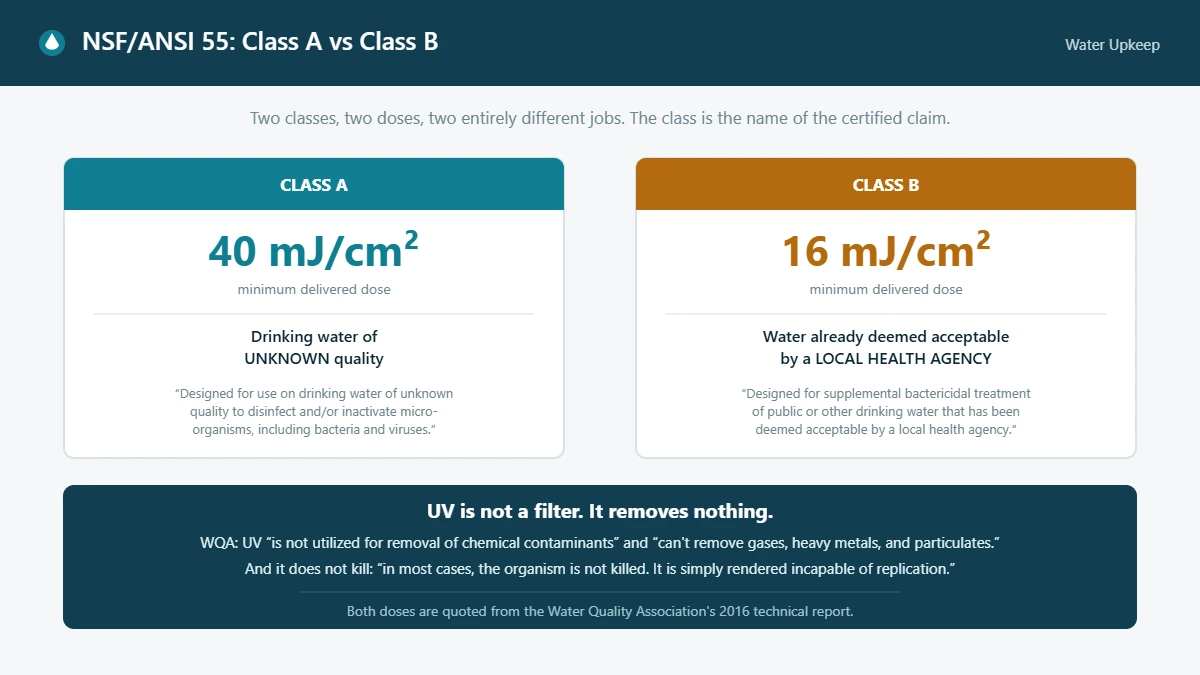
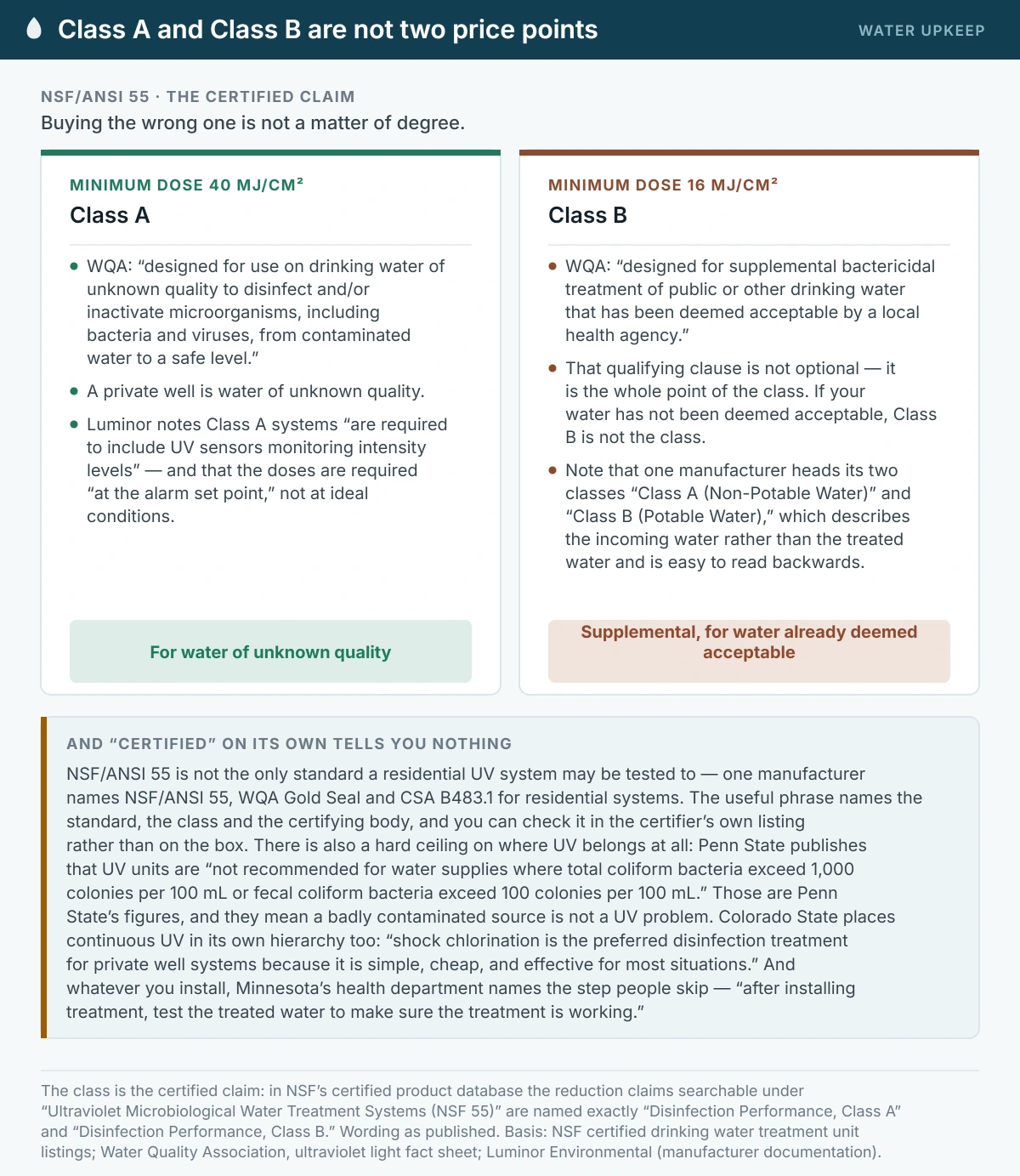
The second thing is the purchasing decision nobody on the first page of results explains. Residential UV systems are certified under NSF/ANSI 55, and that standard has two classes with two different doses and two entirely different jobs. Class A is rated for water of unknown quality. Class B is explicitly supplemental, for water a health agency has already deemed acceptable. Buying the wrong one is not a matter of degree.
Class A and Class B, in the standard’s own terms
These are not marketing labels. In NSF’s certified product database, the reduction claims searchable under “Ultraviolet Microbiological Water Treatment Systems (NSF 55)” are named exactly “Disinfection Performance, Class A” and “Disinfection Performance, Class B.” The class is the certified claim.
| Class A | Class B | |
|---|---|---|
| Minimum dose | 40 mJ/cm² | 16 mJ/cm² |
| What it is for, in WQA’s words | “Designed for use on drinking water of unknown quality to disinfect and/or inactivate microorganisms, including bacteria and viruses, from contaminated water to a safe level.” | “Designed for supplemental bactericidal treatment of public or other drinking water that has been deemed acceptable by a local health agency.” |
| The qualifying condition | — | The water must already have been deemed acceptable by a local health agency. That clause is not optional and it is the whole point of the class. |
A manufacturer, Luminor, adds a detail worth having: those doses are required “at the alarm set point,” not at ideal conditions. Note also that the same manufacturer heads its two classes “Class A (Non-Potable Water)” and “Class B (Potable Water),” which describes the incoming water rather than the treated water and is easy to read backwards. We are using WQA’s wording as the definition, because it states the job rather than the input.
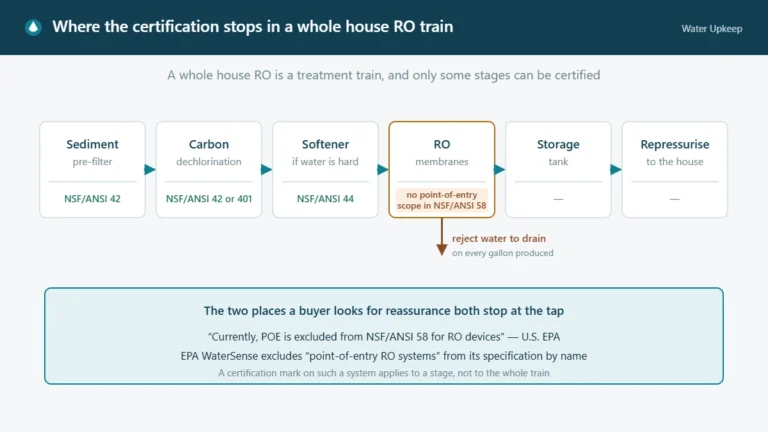
One more thing about certification language. NSF/ANSI 55 is not the only standard a residential UV system may be tested to — Luminor names NSF/ANSI 55, WQA Gold Seal and CSA B483.1 for residential systems. So “certified” on its own tells you nothing. The useful phrase names the standard, the class, and the certifying body, and you can check it in the certifier’s own listing rather than on the box.
What UV actually does: inactivation, not killing
WQA’s technical report is unusually precise about this, and it corrects the way almost everyone describes it:
This absorption characteristic combined with UVC light of the proper energy (intensity) can render infectious organisms harmless by eliminating their ability to reproduce. This process is called inactivation… It is called inactivation because in most cases, the organism is not killed. It is simply rendered incapable of replication.
The organism is still in the water. It is still in the glass. It has been rendered unable to reproduce. That is what a UV system delivers, and it is a genuinely different proposition from removal.
The mechanism runs on a specific band. WQA lists visible light at 400–700 nm, UVA (the tanning rays) at 315–400, UVB (the burning rays) at 280–315, and UVC — which WQA describes as “the cancer causing rays of the sun” — at 200–280 nm. DNA and RNA “absorb UVC light energy very well at 254 nm.”
Dose is the thing being certified, and Luminor gives the definition: “UV dose is the total amount of UV intensity multiplied by the amount of time the water is being exposed to the UV light,” affected by “flow rate, UV Transmittance (UVT) and water quality.” Faster flow means less exposure time means less dose. That relationship is why sizing matters and why we are not going to do any sizing arithmetic on this page.
What is still in the water afterward
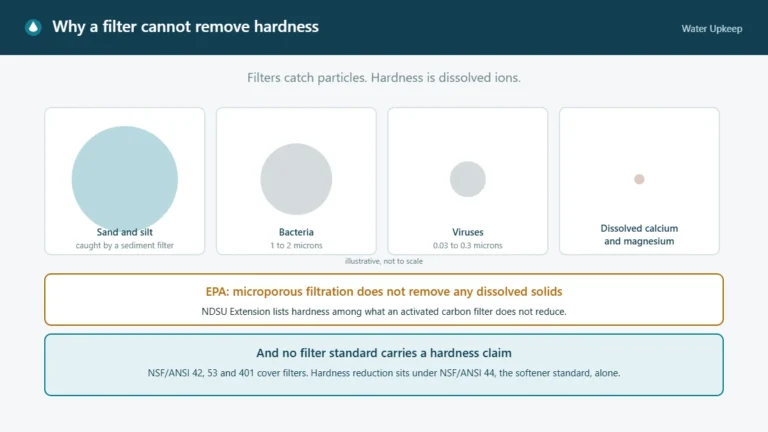
WQA names the categories: “UV light treatment can’t remove gases, heavy metals, and particulates; for that reason higher-end systems may include additional filtration such as activated carbon.” VIQUA’s own FAQ makes the same point from the manufacturer’s side: “UV is a physical process, so it does not add anything to or change the taste or odor of the water.”
If your test report has more than a microbiological line on it, UV addresses that one line and nothing else — see well water filtration systems for how the pieces fit together, and what a water purifier is for a different standard with a different threshold.
There is no residual
This is the structural difference between UV and chlorination and it matters for where the unit sits. Penn State Extension: a UV unit “only kills bacteria inside the unit and does not provide any residual disinfectant for bacteria that may survive or be introduced into the plumbing after the UV light unit.” Colorado State Extension says the same independently: “there is no residual disinfection.”
Everything downstream of the lamp is unprotected. Nothing upstream is treated at all.
What the sources disagree about: cysts
This is a real disagreement and we are not going to resolve it for you.
| Source | Position |
|---|---|
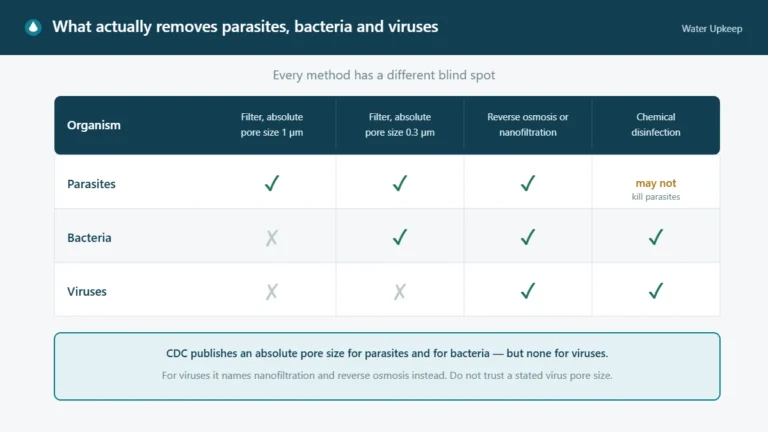
| Colorado State University Extension | UV is “effective for bacterial contaminants (viruses more difficult, cysts, and worms unaffected)” |
| WQA technical report | “Parasites, bacteria and viruses can be inactivated to make water safe to drink” |
| WQA, Bacteria & Virus | UV is “a way to kill bacteria, viruses, fungi, protozoans, and cysts” |
| Luminor (manufacturer) | Publishes per-organism doses including Giardia lamblia at 10 mJ/cm² and Cryptosporidium at 10 mJ/cm² |
| VIQUA (manufacturer) | States UV inactivates “Cryptosporidium and Giardia lamblia,” which are “highly resistant to chlorine disinfection” |
An extension service says cysts are unaffected; a trade association and two manufacturers say they are inactivated. We have no basis for declaring one of them wrong. If cysts are your specific concern, the only defensible move is to check what claim the individual model actually carries in the certifier’s listing, and to talk to your local health department about your water.
A hard ceiling that is not about cysts
Penn State publishes a limit on where UV belongs at all: UV units are “not recommended for water supplies where total coliform bacteria exceed 1,000 colonies per 100 mL or fecal coliform bacteria exceed 100 colonies per 100 mL.” Those are Penn State’s figures, and they mean that a badly contaminated source is not a UV problem. If you have a positive result in hand, start at a positive coliform test on your well.
The water has to be right before it reaches the lamp
UV works by light reaching the organism. Anything that blocks the light defeats it, and WQA is emphatic that you cannot judge this by eye:
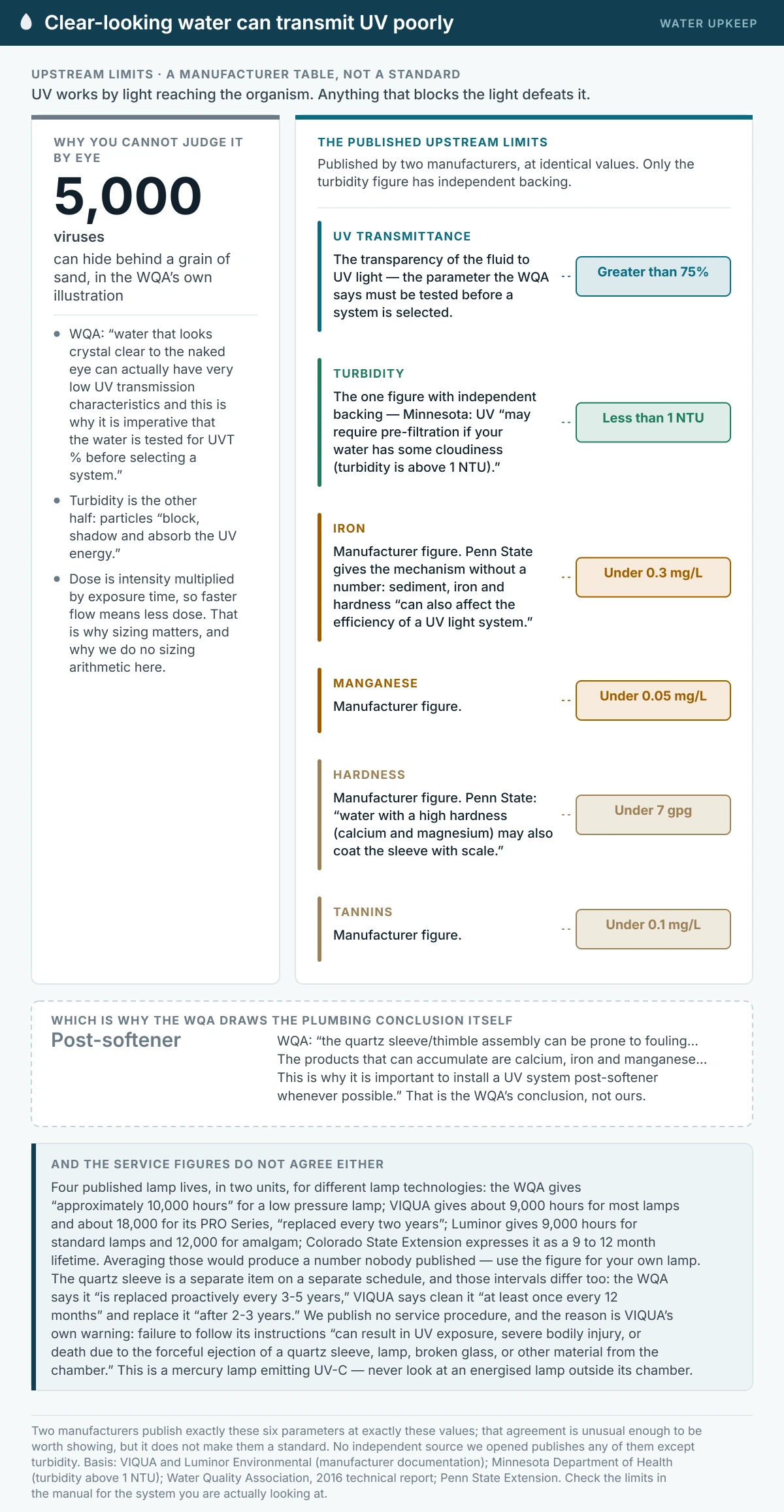
Water that looks crystal clear to the naked eye can actually have very low UV transmission characteristics and this is why it is imperative that the water is tested for UVT % before selecting a system.
UV transmittance — UVT, or T10 — is “the transparency of the fluid to UV light.” Turbidity is the other half: “turbidity is caused by small particles or colloidal material suspended in the water. These particles block, shadow and absorb the UV energy.” WQA’s own illustration of the shadowing problem is worth quoting: “approximately 5,000 viruses can hide behind a grain of sand!”
The upstream limits — a manufacturer table, not a standard
Two manufacturers publish exactly the same six parameters at exactly the same values. That agreement is unusual enough to be worth showing — but it does not make these a standard, and no independent source we opened publishes any of them except turbidity.
| Parameter | Published limit | Who publishes it |
|---|---|---|
| Iron | Less than 0.3 ppm (0.3 mg/L) | VIQUA and Luminor (manufacturers) |
| Manganese | Less than 0.05 ppm (0.05 mg/L) | VIQUA and Luminor (manufacturers) |
| Hardness | Less than 7 gpg | VIQUA and Luminor (manufacturers) |
| Tannins | Less than 0.1 ppm (0.1 mg/L) | VIQUA and Luminor (manufacturers) |
| Turbidity | Less than 1 NTU | VIQUA and Luminor (manufacturers) — and independently the Minnesota Department of Health, which notes UV “may require pre-filtration if your water has some cloudiness (turbidity is above 1 NTU)” |
| UV transmittance | Greater than 75% | VIQUA and Luminor (manufacturers) |
Check the limits in the manual for the system you are actually looking at, rather than these.
The extension services give the same parameters without numbers, which is the honest split — the mechanism has independent backing, the figures do not. Penn State: the untreated water “must be completely clear and free from any suspended sediment or turbidity,” and “water with a high hardness (calcium and magnesium) may also coat the sleeve with scale.” Penn State again, on cysts: “properly sized UV light systems can be effective in treating cysts in water but the sizing of the unit is critical,” and “other water quality parameters like sediment, iron, and hardness can also affect the efficiency of a UV light system and may require pre-treatment.”
Why the softener goes first
WQA explains the fouling mechanism and then draws the plumbing conclusion itself: “the quartz sleeve/thimble assembly can be prone to fouling. Fouling is an accumulation of dissolved solids often found in the water. The products that can accumulate are calcium, iron and manganese… This is why it is important to install a UV system post-softener whenever possible.”
That is WQA’s conclusion, not ours. The two upstream questions it raises have their own pages: sediment and particle size in what micron rating your filter needs, and iron in how to remove iron from well water.
Lamps, sleeves and sensors
A UV system is a maintenance commitment, and the published service figures do not agree — partly because they describe different lamp technologies and partly because they are expressed in different units.
| Source | Lamp life, as published |
|---|---|
| WQA technical report | “Expected useful lamp life for a low pressure UV lamp is approximately 10,000 hours.” |
| VIQUA (manufacturer) | “Most UV lamps have a useful life of approximately 9,000 hours”; its PRO Series lamps “approximately 18,000 hours and must be replaced every two years” |
| Luminor (manufacturer) | Standard lamps “9,000 hours or approximately one year of continuous use”; amalgam lamps “12,000 hours” |
| Colorado State University Extension | “Lamp has 9- to 12-month lifetime” |
Those are four figures for different lamp types in two different units. Averaging them into “about a year” would produce a number nobody published. Use the figure for your own lamp.
The quartz sleeve is a separate item with its own schedule, and the two published intervals also differ: WQA says “typically the sleeve is replaced proactively every 3-5 years,” while VIQUA says to clean it “at least once every 12 months,” more often — every three to six months — on water with high mineral or organic content, and to replace it “after 2-3 years, or if the surface is damaged or scratched or seems cloudy or hazy after cleaning.”
On monitoring, WQA notes that “certification/validation standards typically require an electronic means to monitor the UV lamp performance to ensure adequate disinfection is occurring,” and lists what a system may do when it detects inadequate light: a wiper cleaning cycle, an audible or visual alarm, a shutdown of the lamps, a shutoff of water flow, an automatic ramp-up of lamp power, or an email or text alert. That is a list of possible responses, not a guaranteed feature set — do not assume your system will stop the water. Luminor notes that Class A systems “are required to include UV sensors monitoring intensity levels.”
VIQUA’s guidance on whether to switch it off when away: “the UV system should be left on whether you are using the water or not. By leaving the unit on, you will eliminate the potential problem of having contamination pass through the system while the unit is off.” Worth noting honestly: no source we opened describes what happens to water already sitting in the pipes after a power cut. That is a question for your installer or the manufacturer.
Safety: this is a mercury lamp emitting UV-C
Penn State describes the hardware in four words: UV treatment systems “pass water through a chamber housing a quartz mercury lamp.” EPA lists germicidal bulbs among mercury-containing lamps.
Never look at an energized lamp outside its chamber. OSHA’s technical manual tabulates the effects of UV-C on tissue: photokeratitis for the eye; erythema, or sunburn, and skin cancer for the skin. The same chapter states that ultraviolet radiation from lamps “shall be suitably shielded.” OSHA is writing for workplaces, but what UV-C does to tissue does not change with the setting.
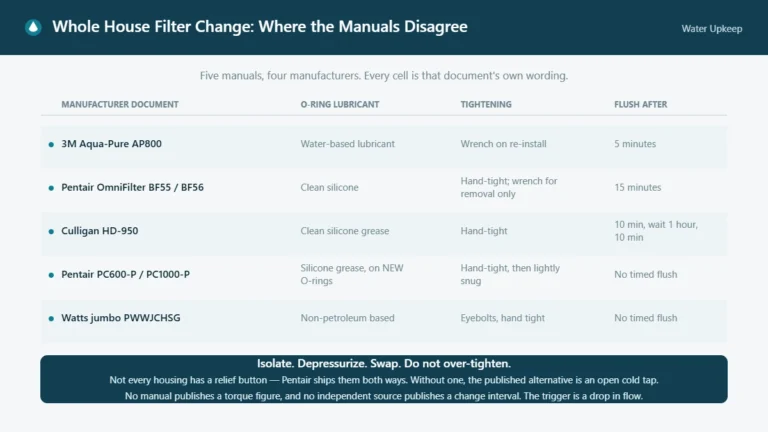
We publish no service procedure for these systems, and the reason is a manufacturer’s own warning. VIQUA: “failure to follow these instructions can result in UV exposure, severe bodily injury, or death due to the forceful ejection of a quartz sleeve, lamp, broken glass, or other material from the chamber.” Before any maintenance — replacing the lamp, cleaning the sensor, cleaning or replacing the sleeve — VIQUA requires disconnecting the power, turning off the water supply upstream of the system, releasing water pressure by opening a downstream faucet, and ensuring there is no closed valve between that faucet and the system. That is the shape of what a manufacturer requires. Follow yours, or have it done.
If a lamp breaks, treat it as a broken mercury-containing lamp. EPA’s guidance, written for compact fluorescents but covering the same hazard, is to have people and pets leave the room, air the room out for five to ten minutes by opening a window or door, not to vacuum unless broken glass remains after all other cleanup steps, and to place all debris and cleanup materials outdoors in a trash container until they can be disposed of. Then follow your manufacturer’s instructions and your local household hazardous waste rules.
UV does not fix a contaminated source
EPA’s three sentences on this belong together, and the third is the one that gets left off:
If a contaminant is found to exceed health standards in your sample, contact your public health department for specific steps to follow and have your well re-tested to confirm the contaminant’s presence and concentrations… For example, high bacteria concentrations can sometimes be controlled by adding disinfection to a well, such as: chlorine, ozone, ultra-violet light, and electronic radiation. However, depending on the contaminant, its concentration, and the condition of the well, you may need a new source of water or to drill a new well.
Note also where continuous UV sits in an extension service’s hierarchy. Colorado State: “shock chlorination is the preferred disinfection treatment for private well systems because it is simple, cheap, and effective for most situations.” That procedure belongs to how to shock a well, and the decision about what to do with a positive result belongs to a positive coliform test on your well and to your health department.
Finally, whatever you install: Minnesota’s health department says to “select a treatment unit certified by NSF, Underwriter’s Laboratory (UL), or Water Quality Association (WQA),” and — the step people skip — “after installing treatment, test the treated water to make sure the treatment is working.”
Frequently asked questions
Is a UV system a water filter?
No. It removes nothing. WQA: UV “is not utilized for removal of chemical contaminants,” and “can’t remove gases, heavy metals, and particulates.” It inactivates microorganisms as the water passes the lamp and leaves everything else exactly as it found it.
What is the difference between Class A and Class B?
Dose and purpose. Class A is a minimum of 40 mJ/cm² and is, in WQA’s words, “designed for use on drinking water of unknown quality.” Class B is 16 mJ/cm² and is “designed for supplemental bactericidal treatment of public or other drinking water that has been deemed acceptable by a local health agency.” If your water has not been deemed acceptable, Class B is not the class.
Does UV kill bacteria?
Usually not, technically. WQA’s own report: “in most cases, the organism is not killed. It is simply rendered incapable of replication.” The word for it is inactivation, and the organism remains in the water.
Does UV handle Giardia and Cryptosporidium?
The sources disagree. Colorado State Extension says cysts are unaffected; WQA and two manufacturers say they are inactivated, with the manufacturers publishing specific doses. Check what claim the individual model carries in the certifier’s listing, and ask your local health department about your water.
Why does my water need to be tested before buying a UV system?
Because UV depends on light reaching the organism, and clear-looking water can transmit UV poorly. WQA: “water that looks crystal clear to the naked eye can actually have very low UV transmission characteristics.” Iron, manganese, hardness, tannins and turbidity all matter, and manufacturers publish limits for each.
How often does the lamp need replacing?
It depends on the lamp. Published figures range from 9,000 hours to 18,000 hours across manufacturers and lamp types, and Colorado State Extension expresses it as 9 to 12 months. Use the figure for your own lamp; there is no general answer.
Can I change the lamp myself?
We publish no procedure, and VIQUA’s own safety page explains why: getting it wrong “can result in UV exposure, severe bodily injury, or death due to the forceful ejection of a quartz sleeve, lamp, broken glass, or other material from the chamber.” Work from your own manufacturer’s instructions, or have it done.
Sources and standards
- NSF — certified drinking water treatment unit listings, the contaminant reduction claims guide, and home water treatment system selection
- Water Quality Association — Treatment of Residential Drinking Water Using UV (2016 technical report), the ultraviolet light fact sheet and bacteria and virus
- US EPA — Protect Your Home’s Water and cleaning up a broken mercury-containing lamp
- OSHA — Technical Manual, non-ionizing radiation (a workplace authority)
- Penn State Extension — Coliform Bacteria and Removing Giardia Cysts from Drinking Water
- Colorado State University Extension — Bacteria in Water Wells
- Minnesota Department of Health — Home Water Treatment
- VIQUA (manufacturer documentation) — frequently asked questions and product safety
- Luminor Environmental (manufacturer documentation) — UV regulations, ultraviolet disinfection 101 and the ultraviolet FAQ
Last reviewed September 9, 2026.