Why Your Tap Water Looks Cloudy
There is a two-minute test that answers this, and it turns on a detail almost nobody publishes: which direction the glass clears.
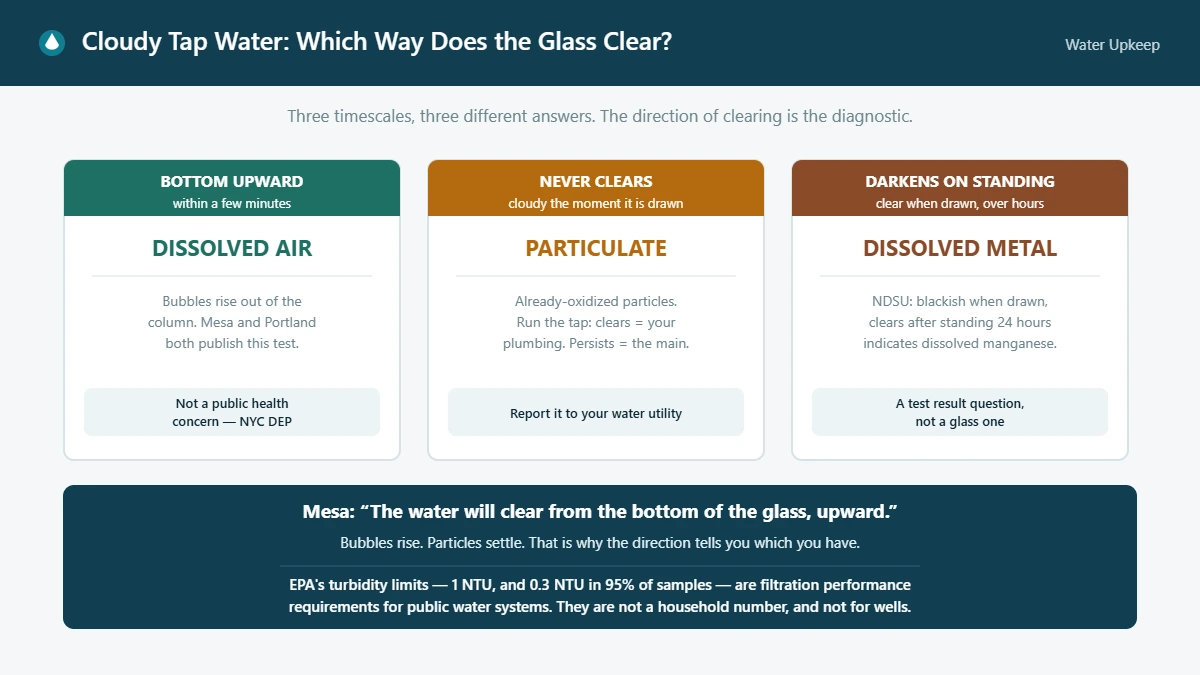
Fill a glass from the cold tap and set it on the counter. If the cloudiness is dissolved air, the water clears from the bottom upward as the bubbles rise out — the City of Mesa’s water utility describes it exactly that way, and Portland’s Water Bureau gives the same test with a three-minute wait. If it clears from the bottom up, you are looking at air, and both utilities say that is harmless.
If it does not clear, or if it clears by settling a deposit rather than rising, you are looking at something else — and the rest of this page is about telling those apart.
The glass test, and what each outcome means
| What happens in the glass | What it indicates | Source |
|---|---|---|
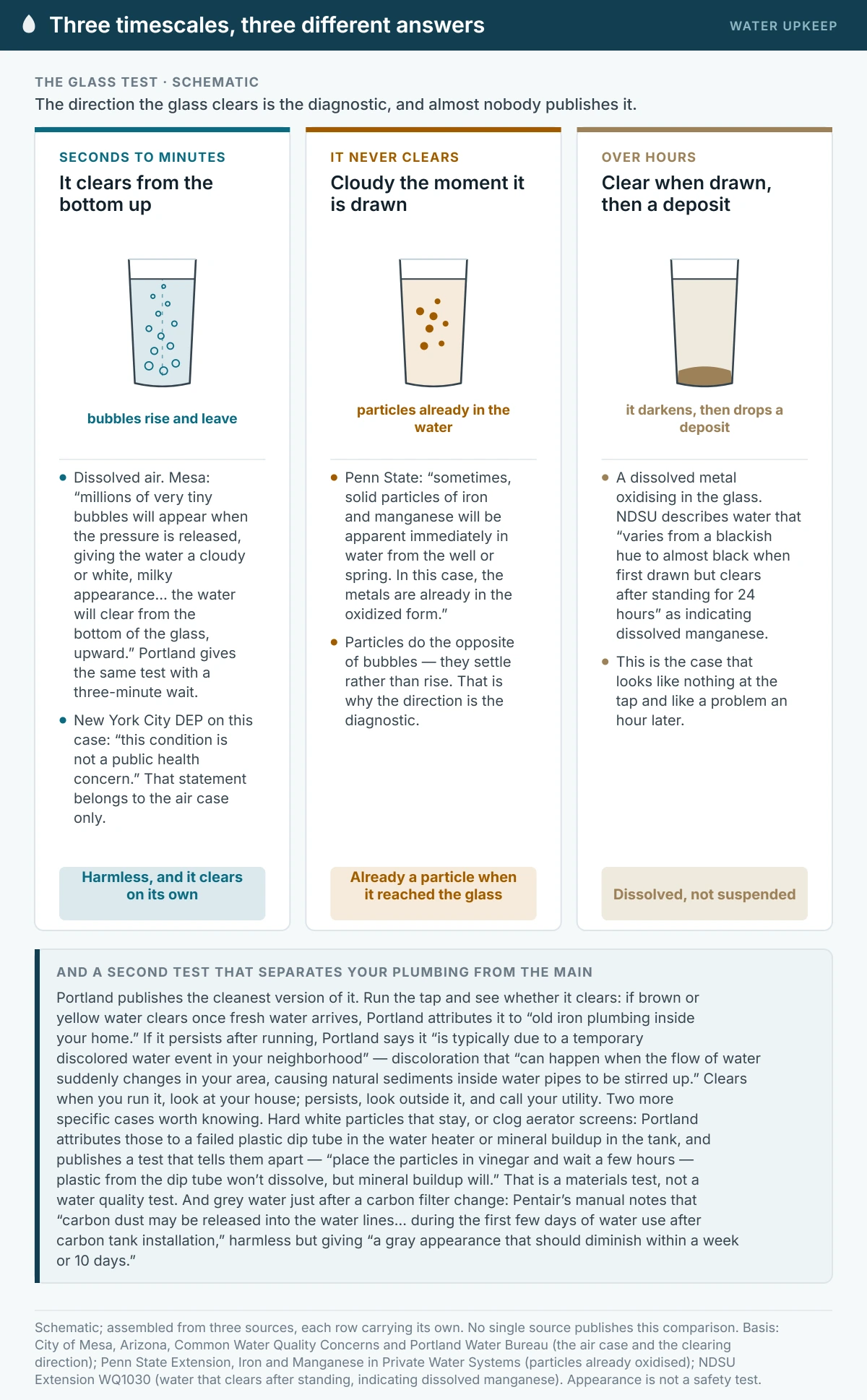
| Clears from the bottom upward within a few minutes | Dissolved air coming out of solution. Mesa: “millions of very tiny bubbles will appear when the pressure is released, giving the water a cloudy or white, milky appearance… the water will clear from the bottom of the glass, upward” | City of Mesa; Portland Water Bureau |
| Cloudy the moment it is drawn, and stays cloudy | Particles already in the water. Penn State: “sometimes, solid particles of iron and manganese will be apparent immediately in water from the well or spring. In this case, the metals are already in the oxidized form” | Penn State Extension |
| Clear when drawn, then darkens or drops a deposit over hours | A dissolved metal oxidizing in the glass. NDSU describes water that “varies from a blackish hue to almost black when first drawn but clears after standing for 24 hours” as indicating dissolved manganese | NDSU Extension WQ1030 |
Three different timescales, three different answers. Seconds to minutes and rising is air. Immediately cloudy and staying that way is particulate. Clear-then-darkening over hours is dissolved metal. No single source publishes that comparison — we have assembled it, and every row carries the source it came from.
Mesa offers a slower confirmation for the air case if you want one: “fill a pitcher with tap water and place it in the refrigerator. The air bubbles will dissipate and the water will be crystal clear and cold when the next glass of water is poured from the pitcher.”
If it is air
New York City’s Department of Environmental Protection states the position for the air case plainly: “this condition is not a public health concern. The cloudiness is temporary and clears quickly after water flows out of the tap and the extra air is released.” Mesa adds that “dissolved air in the water is not harmful to people and will not damage plumbing or appliances.”
That statement belongs to the air case only, and we are not extending it to cloudy water of unknown cause.
Where the air comes from depends on the system, and three utilities name three different drivers — which is worth knowing, because it means there is no single explanation to look for:
- Mesa names pressure release at the tap: water in the distribution system is “under pressure, causing any air present to be dissolved in the water until the pressure is released at the tap.” It also names well conditions — the location of the perforations in the well casing, the depth of the well, static water levels and the quantity pumped — and notes that “air also may enter the distribution system during the pumping process.”
- Portland names temperature: these bubbles “can form when water temperature fluctuates or when there is more air in the water.”
- New York City DEP names transmission: “air becomes trapped in the water as it makes its long trip from the upstate reservoirs to the city.”
Those are three utilities describing whichever mechanism dominates their own system. They are not competing theories and there is no ranked answer.
If it is not air: the second test
Portland’s troubleshooting adds a second-order test that separates your plumbing from the main, and it is the cleanest published version of that distinction.
Run the tap and see whether it clears. If brown or yellow water clears once fresh water arrives, Portland attributes it to “old iron plumbing inside your home,” and lists three options: run the faucet as needed to bring in fresh water from the main, buy a water filter, or consider replacing the pipes. If it persists after running, Portland says it “is typically due to a temporary discolored water event in your neighborhood” — discoloration that “can happen when the flow of water suddenly changes in your area, causing natural sediments inside water pipes to be stirred up.”
In other words: clears when you run it, look at your house. Persists, look outside it — and call your utility. Portland publishes a water quality line for exactly this; NYC DEP routes reports through 311. Your own utility will have an equivalent, and a discolored-water report is useful information to them.
White particles that do not go away
Portland covers this case specifically: “if hard white particles remain, or you find them clogging your aerator screens, the plastic dip tube inside your water heater may have failed, or there’s mineral buildup inside the tank.”
And it publishes a test that tells the two apart: “place the particles in vinegar and wait a few hours — plastic from the dip tube won’t dissolve, but mineral buildup will.” That is a materials-identification test, not a water quality test — it tells you what the particles are made of and nothing about whether the water is safe.
If it turns out to be mineral buildup, that is a hard water consequence with its own maintenance answer — see how to flush a water heater, and how to remove hard water stains for the same deposit on surfaces. A failed dip tube is a plumber’s job.
Gray water after a new filter
One cause that catches people out. Pentair’s manual for its PC600-P and PC1000-P systems: “carbon dust may be released into the water lines of the house/building during the first few days of water use after carbon tank installation. The carbon dust is harmless, but may give the water a gray appearance that should diminish within a week or 10 days depending on water use.”
That is Pentair’s statement about Pentair’s system, and the timescale is theirs. If you have just changed a carbon stage and the water went gray, that is the first thing to consider — see how to change a whole house water filter, which also covers the air that gets trapped in a housing during a service.
What “turbidity” actually means, and why the numbers are not yours
USGS defines it: “turbidity is the measure of relative clarity of a liquid… a measurement of the amount of light that is scattered by material in the water when a light is shined through the water sample.” The materials responsible include “clay, silt, very tiny inorganic and organic matter, algae, dissolved colored organic compounds, and plankton and other microscopic organisms.”
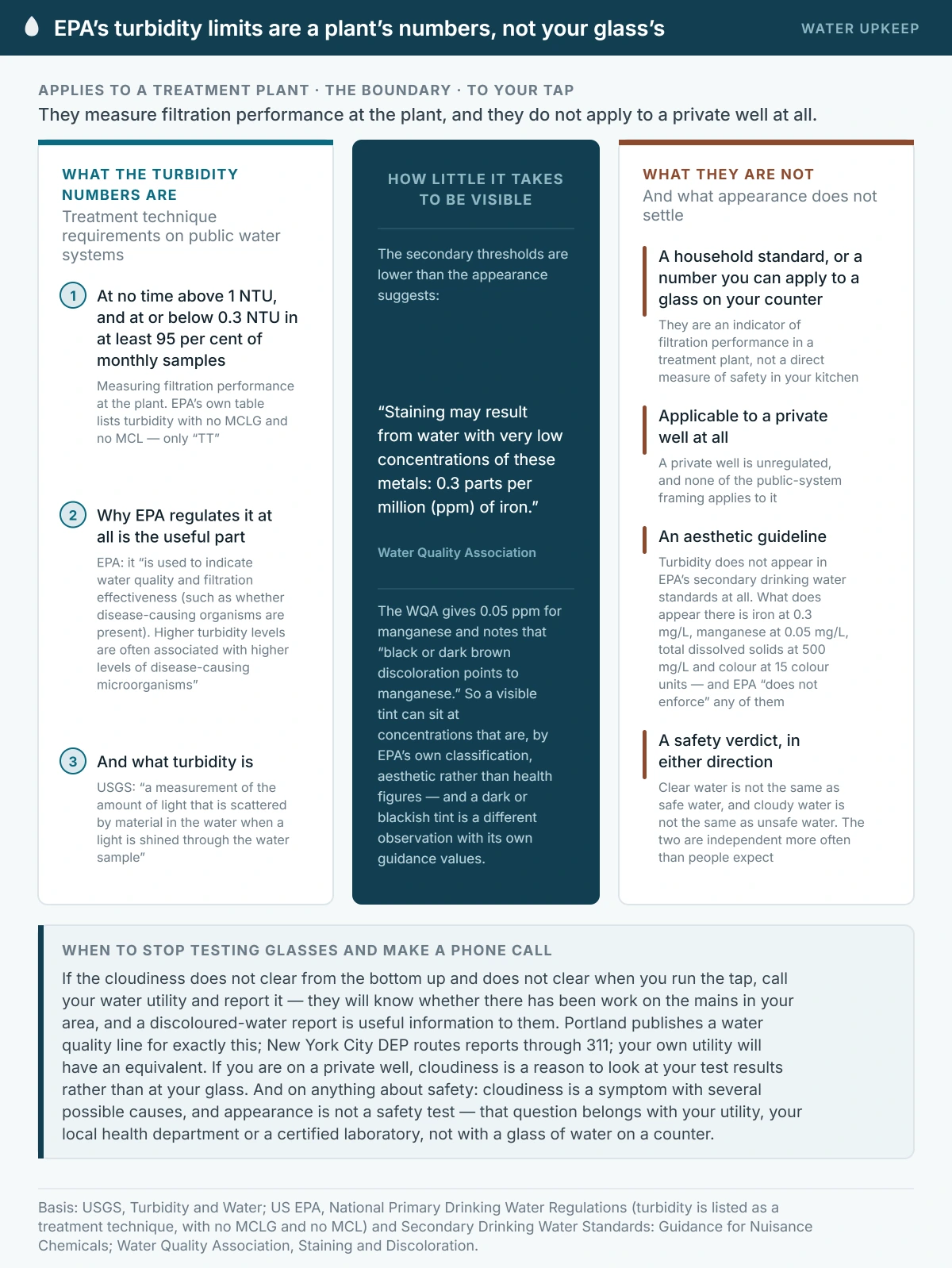
You will find EPA’s turbidity limits while searching — at no time above 1 NTU, and at or below 0.3 NTU in at least 95 percent of monthly samples — and it matters enormously how you read them. These are treatment technique requirements placed on public water systems, measuring filtration performance at the plant. EPA’s own table lists turbidity with no MCLG and no MCL, only “TT.” They are not a household standard, they are not a number you can apply to a glass on your counter, and they do not apply at all to a private well, which is unregulated.
Why EPA regulates it at all is the useful part: “turbidity is a measure of the cloudiness of water. It is used to indicate water quality and filtration effectiveness (such as whether disease-causing organisms are present). Higher turbidity levels are often associated with higher levels of disease-causing microorganisms.” Turbidity is an indicator of filtration performance in a treatment plant, not a direct measure of safety in your kitchen.
Note also what is not regulated. Turbidity does not appear in EPA’s secondary drinking water standards at all — the non-mandatory aesthetic guidelines. What does appear there, and is relevant to discolored water, is iron at 0.3 mg/L (“rusty color; sediment; metallic taste; reddish or orange staining”), manganese at 0.05 mg/L (“black to brown color; black staining; bitter metallic taste”), total dissolved solids at 500 mg/L, and color at 15 color units. EPA is explicit that it “does not enforce these ‘secondary maximum contaminant levels’.”
Those thresholds are lower than the appearance suggests. The Water Quality Association notes that staining may result from as little as 0.3 ppm of iron or 0.05 ppm of manganese, and that “black or dark brown discoloration points to manganese.” Removing either is covered in how to remove iron from well water.
Two adjacent questions come up so often alongside this one that they are worth naming here. A dark or blackish tint, or black specks, is a different observation with its own explanation and its own guidance values — see manganese in drinking water. And a cloudy glass is not a TDS reading: people conflate the two in both directions, and what a TDS number actually measures sets out why an appearance and a conductance reading are not the same evidence.
When to stop testing glasses and make a phone call
- The cloudiness does not clear from the bottom up, and does not clear when you run the tap. Call your water utility and report it. They will know whether there has been work on the mains in your area.
- You are on a private well. None of the public-system framing above applies to you, and cloudiness is a reason to look at your test results rather than your glass. Start with water testing and, for anything bacteriological, a positive coliform test on your well.
- Anything about safety. Cloudiness is a symptom with several possible causes, and appearance is not a safety test. If that is your question, it belongs with your utility, your local health department or a certified laboratory — not with a glass of water on a counter.
One thing worth internalizing whatever the cause: clear water is not the same as safe water, and cloudy water is not the same as unsafe water. The two happen to be independent more often than people expect.
Frequently asked questions
Why is my tap water cloudy or milky white?
Most commonly dissolved air. Mesa’s utility: “millions of very tiny bubbles will appear when the pressure is released, giving the water a cloudy or white, milky appearance.” The test is whether the glass clears from the bottom upward within a few minutes.
Is cloudy water safe to drink?
For the air case, NYC DEP says “this condition is not a public health concern.” That statement applies to air. Cloudiness from another cause is a different question, and appearance does not answer it — that goes to your utility, your health department or a certified laboratory.
Why does my water clear from the bottom up?
Because bubbles rise. Air comes out of solution when the pressure drops at the tap and leaves the column from the bottom upward. Particles do the opposite: they settle. That is why the direction is the diagnostic.
The water is cloudy only from the hot tap. Why?
Hot water holds less dissolved gas, so air can come out of solution as it heats. If instead you are finding hard white particles that persist, Portland attributes those to a failed plastic dip tube in the water heater or to mineral buildup in the tank — and gives the vinegar test to tell them apart.
What is turbidity, and what is a safe number?
Turbidity is a measure of how much light is scattered by material in the water. EPA’s limits — 1 NTU maximum, 0.3 NTU in 95 percent of monthly samples — are filtration performance requirements for public water systems, not household numbers, and they do not apply to private wells.
My water went gray after I changed a filter.
Carbon dust is a documented cause. Pentair’s manual notes that it “may give the water a gray appearance that should diminish within a week or 10 days depending on water use.” Air trapped during the service is the other usual suspect, and it clears bottom-up like any other air.
Sources and standards
- City of Mesa, Arizona — Common Water Quality Concerns
- Portland Water Bureau — Discolored water troubleshooting
- New York City Department of Environmental Protection — Drinking water frequently asked questions
- US EPA — National Primary Drinking Water Regulations and Secondary Drinking Water Standards
- USGS — Turbidity and Water
- NDSU Extension — WQ1030, Iron and Manganese Removal
- Penn State Extension — Iron and Manganese in Private Water Systems
- Water Quality Association — Staining and Discoloration
- Pentair (manufacturer documentation) — PC600-P and PC1000-P installation and owner’s manual
Last reviewed September 9, 2026.