Where a Water Softener Drain Line Can Discharge
A water softener’s drain line carries salty regeneration water away, and where it is allowed to go is decided by your state and local plumbing code. There is no national plumbing code in the United States, so the honest answer to “where can it discharge?” is a matrix, not a rule.
What does not vary is the air gap. Every source that addresses it — EPA’s Cross-Connection Control Manual and three separate manufacturers — requires a physical gap between the end of the drain line and whatever it discharges into, because a line pushed into a waste pipe is a cross-connection and can siphon contaminated water back toward the potable supply. Two things change the answer more than anything else: whether your property is on a public sewer or an on-site septic system, where states genuinely disagree with each other, and which manufacturer built your valve, because the published height, length and diameter limits differ from one manual to the next.
This page is about where the discharge may go. It contains no installation steps — no cutting, joining, soldering, gluing or clamping. If you need the connection actually made, that is how to install a water softener, and in most jurisdictions it is licensed work. If you are not sure why there is a drain line at all, start with how water softeners work.
The one thing that is not negotiable: the air gap
What a cross-connection is, and what backsiphonage does
EPA’s Cross-Connection Control Manual defines the hazard in one sentence: “A cross-connection is the link or channel connecting a source of pollution with a potable water supply.” The mechanism that turns a drain line into one is backsiphonage, which EPA describes precisely:
“Backsiphonage results in fluid flow in an undesirable or reverse direction. It is caused by atmospheric pressure exerted on a pollutant liquid forcing it toward a potable water supply system that is under a vacuum.”
US EPA, Cross-Connection Control Manual, EPA 816-R-03-002
The vacuum arrives from ordinary events. EPA names water main breaks and repairs that reduce system pressure, fire department withdrawals, and heavy fire demand in a service area. And this is not a paperwork hazard: EPA states that cross-connections “have been responsible for contamination of drinking water, and have resulted in the spread of disease,” and its manual documents historical outbreaks to make the point. Those incidents are not water softener incidents, and we are not going to imply otherwise — but they are why the requirement exists.
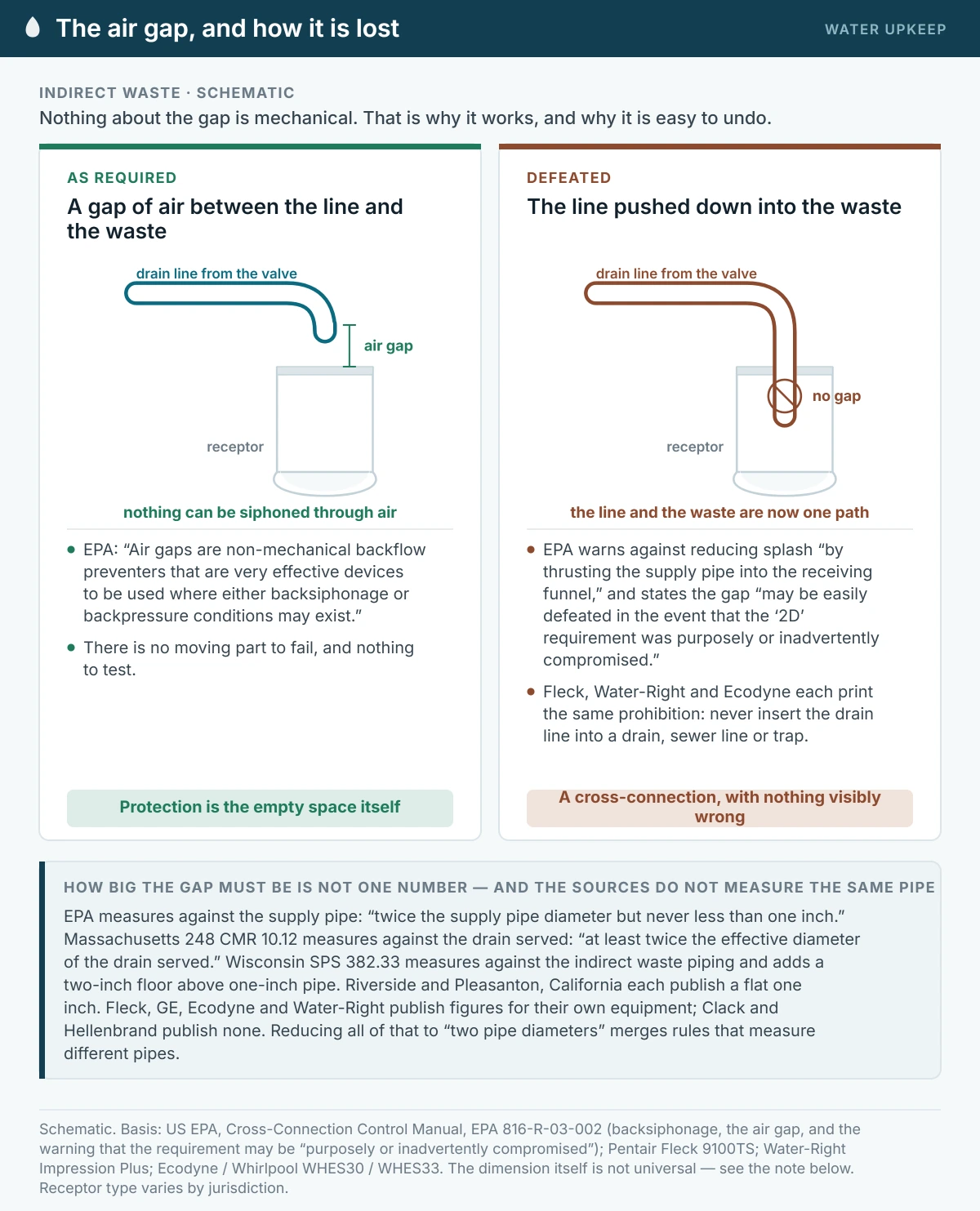
The remedy EPA describes is the air gap: “Air gaps are non-mechanical backflow preventers that are very effective devices to be used where either backsiphonage or backpressure conditions may exist.” There is no moving part to fail. Air simply cannot be siphoned through.
Why the gap is so easy to lose
This is the sentence worth remembering. EPA: “The air gap may be easily defeated in the event that the ‘2D’ requirement was purposely or inadvertently compromised.” The manual specifically warns against reducing splash “by thrusting the supply pipe into the receiving funnel.”
That describes exactly how a correct installation silently becomes an incorrect one. Somebody gets tired of water spraying across the laundry floor during a regeneration, pushes the hose an inch or two further into the standpipe, and the protection is gone — with nothing visibly wrong and nothing to indicate it. EPA also notes that air gaps are “not exempt from an in-depth cross-connection control program requiring periodic inspection of all backflow devices.” They need looking at.
What the manufacturers say about connecting the drain directly
Three manufacturers, independently, print the same prohibition and give the same reason:
- Pentair Fleck 9100TS: “Never insert drain line directly into a drain, sewer line, or trap…Always allow an air gap between the drain line and the wastewater to prevent the possibility of sewage being back-siphoned into the softener.”
- Water-Right: “Never insert a drain line into a drain, sewer line, or trap.” And: “Always allow an air gap of 1-1/2″ or twice the pipe diameter, whichever is greater, between the drain line and the wastewater to prevent the possibility of sewage being back-siphoned into the softener.”
- Ecodyne / Whirlpool: “Do not put the end of the drain hose into the drain.” And: “Leave an air gap of 1-1/2″ between the end of the hose and the drain. This gap is needed to prevent backflow of sewer water.”
Minnesota’s health department gives the same reason for the same fitting: “An air gap prevents wastewater from potentially being siphoned into the water system.” That is federal guidance, three manufacturers and a state health department converging on one point, which is about as close to unanimity as this subject gets.
Why there is no single answer: no national plumbing code
Two model codes, adopted state by state
NSF International sets out the structure. The Uniform Plumbing Code is “Developed by IAPMO (International Association of Plumbing and Mechanical Officials)” and is “Adopted in 14 states, with others using state-specific codes.” The International Plumbing Code is “Developed by the International Code Council (ICC)” and is “Adopted in approximately 35 states.” NSF adds that “While adoption varies by jurisdiction, both codes rely on recognized standards and third-party certification to ensure product compliance.”
Two competing model codes, adopted individually, and — as IAPMO’s own adoption page shows — amended in the process: “Adoptions can include amendments based the State’s need into a convenient single publication.” IAPMO’s list includes city-level adoptions as well as state ones, Seattle and Houston among them. So adoption is not even uniformly at state level.
Four sources, four different air gap dimensions
Here is what that structure produces in practice. Read the second column carefully — these rules do not even measure against the same pipe.
| Source | Jurisdiction or scope | Measured against | The dimension, as printed |
|---|---|---|---|
| EPA, Cross-Connection Control Manual | Federal reference document on protecting the potable supply — not a softener drain rule | the supply pipe | “twice the supply pipe diameter but never less than one inch” |
| 248 CMR 10.12 | Massachusetts only | the drain served | “at least twice the effective diameter of the drain served” |
| SPS 382.33 | Wisconsin only | the indirect waste piping | 2× the piping at 1 inch or less; “not less than 2 inches” above 1 inch |
| City of Riverside building handout | City of Riverside, California | — | “a minimum 1″ air gap” |
| City of Pleasanton requirements | City of Pleasanton, California | — | “a minimum 1″ airgap” |
| Pentair Fleck 5600SXT manual | that equipment | the drain line pipe | “2x the drain line pipe diameter…with a minimum 1″ air gap” |
| Pentair Fleck 9100TS manual | that equipment | pipe diameters | “two pipe diameters or one inch (22 mm) whichever is larger” |
| GE GXSF27E / GXSF31E manual | that equipment | — | “at least 1½″” |
| Ecodyne / Whirlpool WHES30 / WHES33 | that equipment | — | “1-1/2″” |
| Water-Right Impression Plus | that equipment | pipe diameter | “1-1/2″ or twice the pipe diameter, whichever is greater” |
| Clack WS1 / WS1.25 | that equipment | — | none published |
| Hellenbrand ProMate EcoMax | that equipment | — | none published |
Note what has happened here. EPA’s rule is about the supply pipe, in a manual about protecting drinking water from cross-connections, which never mentions water softeners at all. Massachusetts measures against the drain served. Wisconsin measures against the indirect waste piping and adds an absolute two-inch floor above one-inch pipe. Two California cities publish a flat one inch. Anyone who reduces all of that to “the air gap is two pipe diameters” has merged rules that measure different pipes.
One more thing about the Massachusetts and Wisconsin entries: neither regulation was written about water softeners. Massachusetts 248 CMR 10.12 is about indirect waste piping generally, and its named subjects are food service equipment, sterilizers, clear water wastes and safe waste pans. Wisconsin’s SPS 382.33 does name water treatment devices, but only in a materials clause. The rules apply because a softener drain is indirect waste, not because anybody wrote them with a softener in mind.
Discharge destinations, and who names each one
Below is every destination named by a source we opened, with the jurisdiction attached. The last column is the one that matters: whatever this table says, the authority having jurisdiction decides for your property.
| Destination | Who names it | Jurisdiction or scope | What that source actually says |
|---|---|---|---|
| Sanitary sewer | Minnesota DOH; Riverside; Pleasanton; GE | MN; two CA cities; that equipment | Listed as allowable (Minnesota); required (Riverside and Pleasanton). GE names a drain point “that terminates at the sewer.” |
| Floor drain | Ecodyne / Whirlpool; 248 CMR 10.12 receptor list | that equipment; MA | “A floor drain, close to the water softener, is preferred” |
| Standpipe | Ecodyne / Whirlpool | that equipment | “A laundry tub, standpipe, etc. are other drain options” |
| Laundry tub | Ecodyne / Whirlpool; GE; Fleck 9100TS | that equipment | named as an option |
| Sump or sump pump | GE; Michigan EGLE | that equipment; MI | GE: a sump “that terminates at the sewer.” Michigan: a sump connection is a way to keep discharge out of a septic system |
| Overhead sewer line | Water-Right | that equipment | “Where the drain empties into an overhead sewer line, a sink-type trap must be used with appropriate air gap.” |
| Drywell | Rhode Island DEM; Dunstable Board of Health | RI; a Massachusetts town | RI prefers it to surface discharge. Dunstable: must be “properly designed and…approved by the local Board of Health” |
| French drain, infiltration system, stone bed | Michigan EGLE | MI | named as separate-system alternatives to a septic connection |
| The ground surface | Minnesota DOH; Rhode Island DEM | MN; RI | Minnesota lists it as allowable. Rhode Island discourages it — freezing, vegetation damage, exposure |
| Into the soil | Minnesota DOH | MN | listed as an allowable disposal option |
| Septic or other on-site system | MA, MN, RI, MI, UMN, WQA, Missouri Extension | varies | The authorities disagree — see the next section |
| Directly into a drain, sewer or trap | Fleck; Water-Right; Ecodyne | that equipment | “Never insert drain line directly into a drain, sewer line, or trap” — this is the cross-connection |
| Condensate pump | — | — | No source we opened addresses it. That is a genuine gap, not an endorsement — ask your plumber and the authority having jurisdiction |
“Sump” deserves a note, because it is not one destination. GE’s wording qualifies it: a sump that terminates at the sewer. A sump that discharges to a storm drain, or into the yard, is a different destination entirely with different rules, and GE does not endorse that. Michigan proposes a sump connection specifically as a way to keep brine out of a septic system — which is a different reason again, and would not satisfy Riverside’s requirement that discharge go to the sanitary sewer. These are not one rule with local variations. They are genuinely different rules.
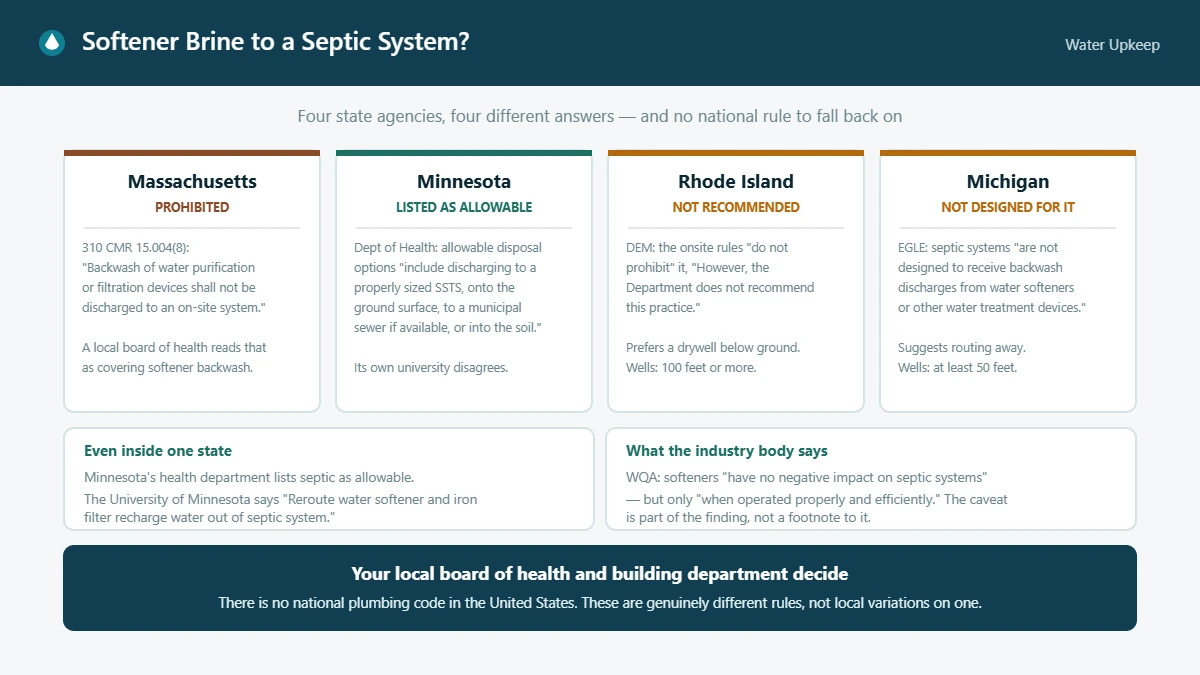
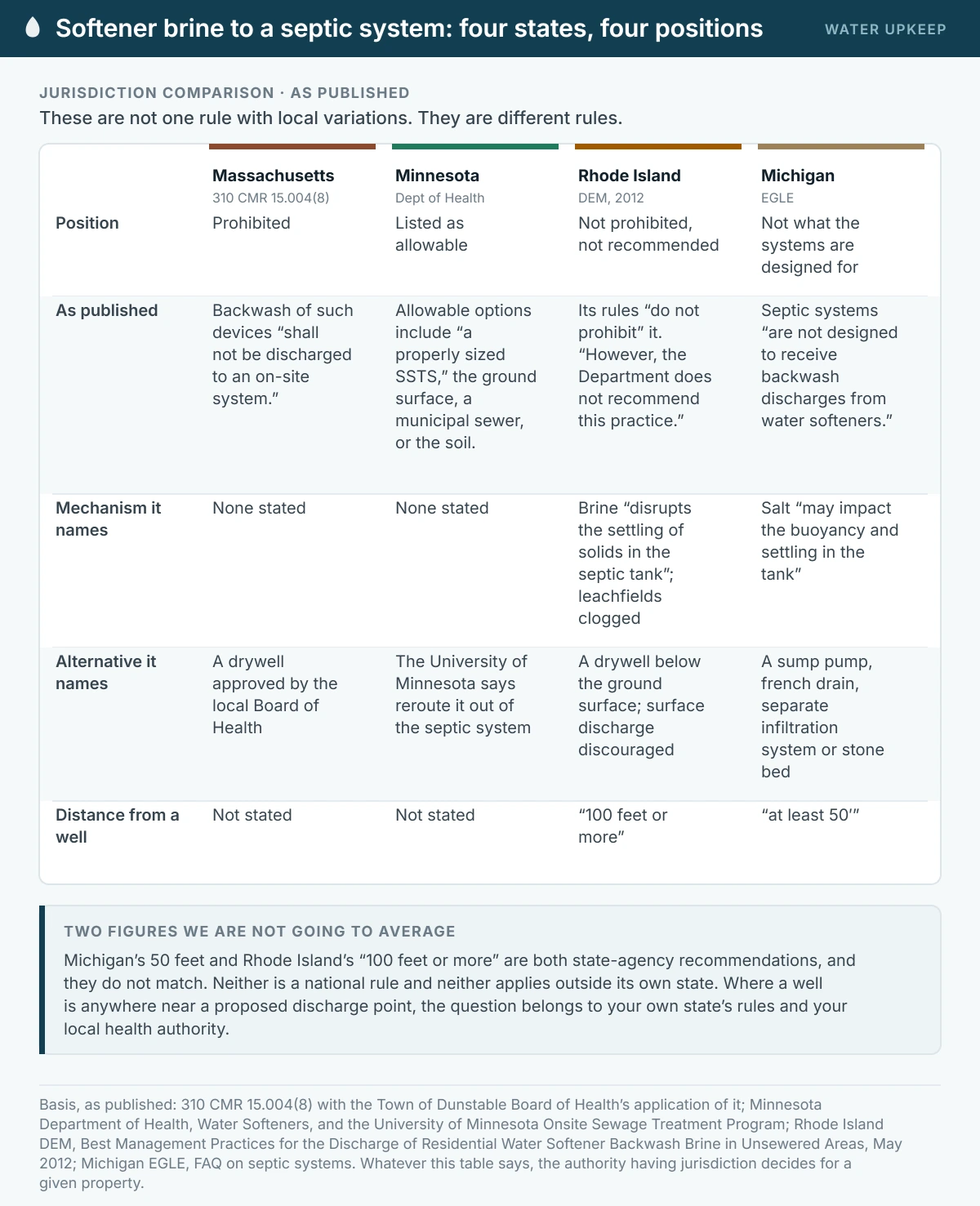
Septic systems: four states, four positions
This is the question with no correct general answer, and it would be dishonest to give you one. Here is what each authority actually published.
Massachusetts: prohibited
310 CMR 15.004(8), part of the State Environmental Code Title 5: “Backwash of water purification or filtration devices shall not be discharged to an on-site system.”
Precision matters here. The regulation says “water purification or filtration devices” and does not use the words “water softener” anywhere. The reading that it covers softener backwash comes from local boards of health applying it — the Town of Dunstable Board of Health states that “Title 5 regulations prohibit water softener backwash or reject waste from going into a septic system (conventional septic system, I/A system, or cesspool) in any amount,” and names the alternative: “the backwash from water softeners or from other water purification or filtration devices can be discharged into a drywell that has been properly designed and is approved by the local Board of Health.” That is a board of health’s application of the regulation, and we are attributing it as one rather than asserting it ourselves.
Minnesota: an allowable option — and its own university says reroute it out
Minnesota Department of Health’s water softeners fact sheet: “During resin bed regeneration, backwash and rinse water must be disposed of. Disposal is often into a subsurface sewage treatment system (SSTS).” And: “Allowable disposal options for softener wastewater include discharging to a properly sized SSTS, onto the ground surface, to a municipal sewer if available, or into the soil.”
A state health department listing as allowable the very discharge another state’s environmental code prohibits. And within Minnesota itself the guidance is not uniform: the University of Minnesota’s Onsite Sewage Treatment Program says “Reroute water softener and iron filter recharge water out of septic system,” adding that “Water softener recharge water does not need to go in the septic system.”
Rhode Island: not prohibited, not recommended
Rhode Island DEM’s 2012 best-practice document is careful about the distinction: its onsite wastewater rules “do not prohibit the discharge of water softener backwash brine to an OWTS. However, the Department does not recommend this practice.”
Its stated mechanism: “Brine disrupts the settling of solids in the septic tank,” because the brine “is heavier than water and will settle to the bottom of the tank”; RIDEM also reports leachfields “being clogged by naturally occurring soil minerals reacting with the brine.” Its preferred alternative is subsurface discharge “below the ground surface to a drywell wherever possible,” with surface discharge discouraged on grounds of freezing, vegetation damage and exposure. On wells: “Maximize the separation distance between the brine discharge point and your well and any wells on neighboring properties, recommend 100 feet or more.” And on the wider consequence: “High levels of chloride in the groundwater used for drinking water can affect water taste and corrode pipes and fixtures.”
RIDEM also states that “Some states, including Massachusetts and Connecticut, have established prohibitions on discharging backwash brine to an OWTS.” We have verified the Massachusetts half of that ourselves; the Connecticut half is Rhode Island’s characterization, and we are reporting it as such rather than stating Connecticut law.
Michigan: not what septic systems are designed for
Michigan EGLE: “Residential septic systems in Michigan are not designed to receive backwash discharges from water softeners or other water treatment devices.” Its mechanism: “Water softener backwash has a high salt content that may impact the buoyancy and settling in the tank. Also, some studies have questioned if the brine may result in premature degradation of the septic tanks.”
Its recommendation: “It is recommended that these discharges are connected away from your septic system. This could be accomplished by connecting to the sump pump or a separate system such as a french drain, a separate infiltration system, or stone bed.” And on wells: “If you have a home drinking water well, locate these discharges at least 50′ from your home’s water supply.”
Note that Michigan’s 50-foot well setback and Rhode Island’s “100 feet or more” are both state-agency recommendations, and they do not match. We are not going to average them into a Water Upkeep figure. If a well is anywhere near a proposed discharge point, that is a question for your own state’s rules and your local health authority — and it belongs in the same conversation as annual well maintenance.
What the research says, and who relies on it
The Water Quality Association’s white paper on softener brine disposal to septic systems, adopted by its board in July 2019, states: “When water softeners are operated properly and efficiently, they have no negative impact on septic systems, and may improve the performance.” The caveat travels with it and should never be dropped: “When a water softener is set very inefficiently, or regeneration wastes are diverted, there could be negative consequences for a septic system.” WQA also notes that “A number of state and local regulatory agencies have from time to time proposed restrictions which would ban or restrict discharges from water softeners to private sewage systems,” and advises that “it is important to be aware of, and adhere to, any local codes and regulations regarding the discharge of water softeners.”
University of Missouri Extension puts three questions and answers all three the same way. The questions: “Is the softener’s salt brine toxic to the septic tank’s bacteria?”; “Does the liquid flow rate produced during the softener’s regeneration cycle upset the septic tank digestion process and carry over solids into the absorption field?”; “Will the sodium in the brine cause some soils to swell and reduce the water percolation rate through the soil?” The answer: “The answers are (1) no, (2) no, and (3) no.” It adds a comparison worth quoting: “An automatic washer would pose a greater threat to the septic tank than a water softener.”
Those positions rest on three named studies: NSF International’s 1978 work on softener waste brines and aerobic treatment plants; Corey and Tyler’s 1978 University of Wisconsin–Madison study on soil absorption; and Novak and Hogan’s 2013 Virginia Tech study on septic tank effluent. We are naming them because WQA’s paper names them and identifies them as its evidence base. We have not read them, so we are not reporting any finding or figure from any of the three.
The two mechanisms are separate, and people conflate them
Salinity and hydraulic load are different arguments and they have different sources.
- Salinity. Montana State University Extension: “In areas with clayey soils, the sodium discharged in the recharging process can increase the risk of septic drainfield failure.” Note the scope — clayey soils specifically. It is not a statement about all septic systems.
- Hydraulic load. NDSU Extension, under disadvantages: water used in recharging “may overload or reduce the effectiveness of small septic or sewer systems.” UNL Extension puts a figure on the volume, about 50 gallons for a regeneration, and describes it as “additional load on a septic system.” That is a volume problem, not a salt problem, and it is a reason the regeneration frequency question matters here.
There is a downstream version of the salinity story too. The University of Minnesota Water Resources Center notes that “The sodium chloride used by the water softener is eventually discharged to wastewater treatment plants or septic systems,” and that “Approximately 100 communities across the state have high chloride levels in their wastewater treatment plant discharge that may exceed state water quality standards.” That is a Minnesota figure, and it is the reason some agencies care about this at all.
How to find out what applies to you
Three phone calls, in this order: your local building department, for which code has been adopted and whether a permit is required; your local board of health, if the property is on an on-site system; and your water utility, if you are sewered and it operates a cross-connection control program. All three of those bodies answer this question for a living, and none of them will charge you for the answer. Readers on private wells face this question disproportionately — well water filtration systems covers the wider planning picture.
California: what AB 1366 actually does, and what it does not
AB 1366 gets described online as a California water softener ban. It is not one, and the misdescription matters because it sends people to the wrong conclusion about their own property.
The bill became Chapter 527, Statutes of 2009, signed on 11 October 2009, and it amended California Water Code section 13148. It is an enabling statute: it authorises certain local agencies, in certain regions, to adopt certain ordinances, and only after a prior finding. Four limiting conditions, all of which come straight out of the section:
- Geography. It applies to the “Central Coast, South Coast, San Joaquin River, Tulare Lake, and the Counties of Butte, Glenn, Placer, Sacramento, Solano, Sutter, and Yolo.” It is not statewide.
- Who may act. “any local agency that owns or operates a community sewer system or water recycling facility and that is subject to a finding made by a regional board.”
- What is covered. “residential water softening equipment or conditioning appliances that discharge brine into a community sewer system.” The statute reaches softeners that discharge to a community sewer. It does not reach a softener on a septic system.
- A prior finding is required. A regional board must have made a finding at a public hearing “that the control of residential salinity input will contribute to the achievement of water quality objectives.”
What a local agency may require
Subdivision (c) lists eight things, and it is worth seeing the whole list rather than the one item that gets quoted: require that self-regenerating softeners “be rated at the highest efficiency commercially available and certified by NSF International”; require plumbing permits before installation; require that they “be plumbed to hook up to hot water only”; enact a voluntary buy-back or exchange program; require removal of previously installed units; prohibit installation; require retrofit of clock control and demand control systems; require replacement of previously installed units. Where removal is required, subdivision (d) obliges the agency to make available a program to compensate owners “for the reasonable value of the removed residential self-regenerating water softener.” Subdivision (g) preserves portable exchange softening appliances.
The other statute, and why we are not resolving it
There is an older section in a different code that says something different. California Health and Safety Code § 116786 provides that “Any ordinance adopted pursuant to this section shall be prospective in nature and may not require the removal” of appliances installed before the ordinance’s effective date, and requires a local agency to find that the limitation is a “necessary means of achieving compliance with waste discharge requirements.” That section became operative on 1 January 2003 and was last amended effective 1 January 2004 — it predates AB 1366 and was not amended by it.
So one statute lists removal among a local agency’s options with a compensation requirement, and an older statute in a different code says an ordinance adopted under that section may not require removal. We are publishing both because publishing either alone would mislead. We are not adjudicating the relationship between them; that is a question for the local agency and for a California attorney or licensed contractor, not for a plumbing article.
A real ordinance exists
The authority is not theoretical. The City of Dixon, California adopted Ordinance 12-004 in November 2008, adding an article to its municipal code providing that “No person shall install or in any manner assist in the installation of a residential brine discharging water softening or conditioning appliance” discharging into the publicly owned treatment works or tributary systems, and requiring property owners to remove installed units by a set date. The ordinance cites Water Code § 13148; its exchange-program section was later repealed.
That is one city’s rule and it applies in that city. It is here as a worked example of what an ordinance under this authority looks like — not as a statement about anywhere else, and certainly not about your own agency. If you have been told your agency restricts brine-discharging appliances, the next question people usually ask is whether a salt-free alternative counts as a softener, which is a separate question with its own answer.
How high, how long, how big: the manufacturer limits
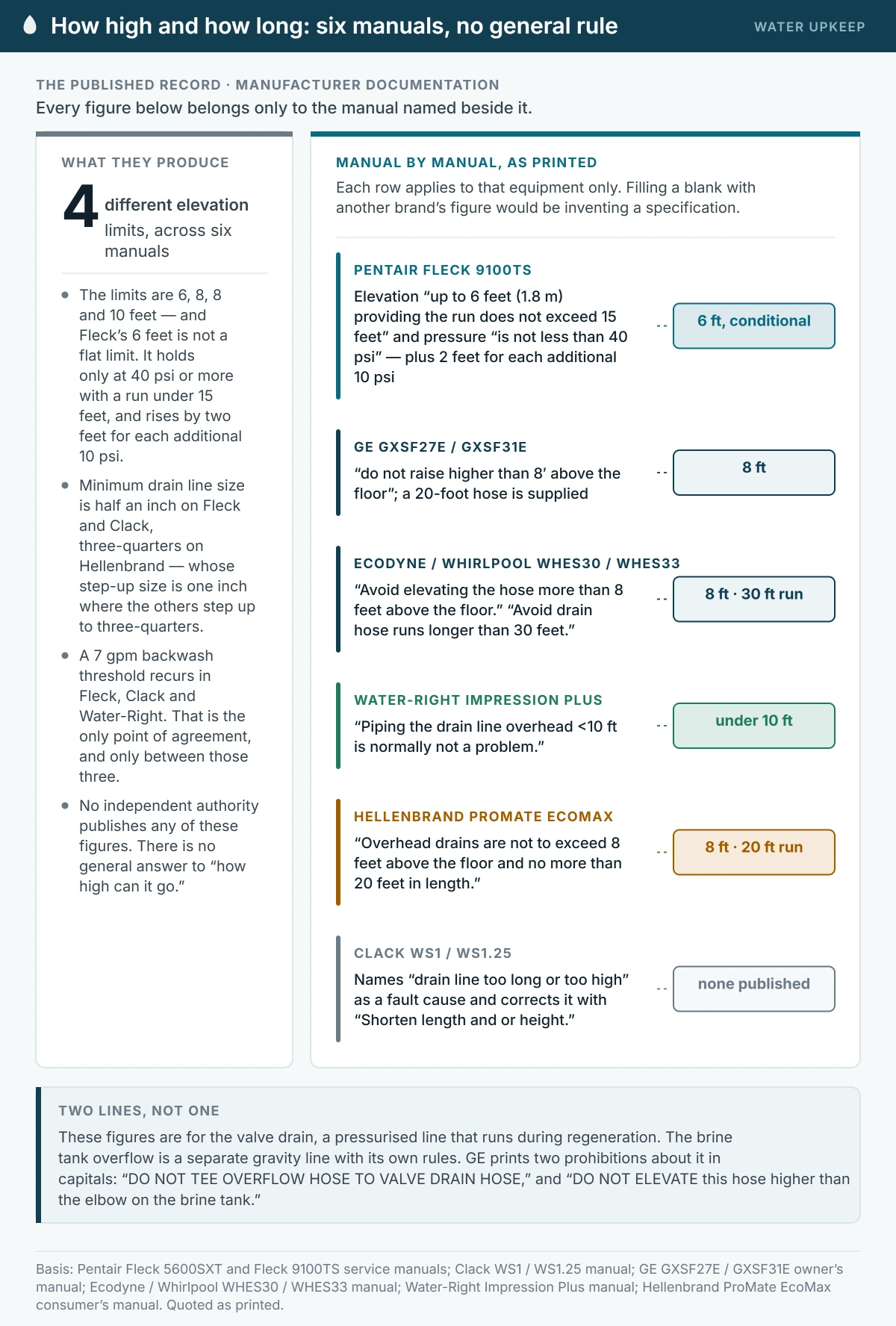
This is where the reader arriving from a fault usually lands — typically from a brine tank full of water, with a control manual saying the drain line may be too long or too high. Every figure below belongs to the manual named beside it. None of them is a general rule, and the differences between them are large.
| Manual | Minimum drain line size | Larger size required when | Maximum elevation | Maximum length |
|---|---|---|---|---|
| Pentair Fleck 5600SXT | “a minimum of 1/2″ (13 mm)” | “Backwash flow rates in excess of 7 gpm (26.5 Lpm) or drain line length in excess of 20′ (6 m) require 3/4″ (19 mm) drain line.” | none published | none published |
| Pentair Fleck 9100TS | “a minimum of 1/2-inch diameter” | “Use 3/4-inch pipe if the pipe length is greater than 20 feet (6 m).” | “may be elevated up to 6 feet (1.8 m) providing the run does not exceed 15 feet (4.6 m) and water pressure at the softener is not less than 40 psi (2.76 bar). Elevation can increase by 2 feet (61 cm) for each additional 10 psi (.69 bar)” | 15 feet, as the condition on that elevation |
| Clack WS1 / WS1.25 | “a minimum of ½”” | “Backwash flow rates in excess of 7 gpm (26.5 lpm) or length in excess of 20′ (6.1m) require ¾” drain line.” | none published — though “drain line too long or too high” is a named fault cause, corrected by “Shorten length and or height” | none published, same caveat |
| GE GXSF27E / GXSF31E | not stated as a diameter; a 20-foot hose is supplied | — | “do not raise higher than 8′ above the floor” | — |
| Ecodyne / Whirlpool WHES30 / WHES33 | — | — | “Avoid elevating the hose more than 8 feet above the floor.” | “Avoid drain hose runs longer than 30 feet.” |
| Water-Right Impression Plus | — | “If the backwash rate is greater than 7 gpm, use a 3/4″ drain line.” | “Piping the drain line overhead <10 ft is normally not a problem.” | — |
| Hellenbrand ProMate EcoMax | “a minimum of 3/4″” | “Backwash flow rates in excess of 7 gpm or length in excess of 20′ require 1″ drain line.” | “Overhead drains are not to exceed 8 feet above the floor and no more than 20 feet in length.” | 20 feet |
Four readings of that table are worth stating out loud.
- The elevation limits are 6, 8, 8 and 10 feet across four manufacturers — and Fleck’s 6 feet is not a flat limit at all. It is conditional on at least 40 psi and a run no longer than 15 feet, with a published increment of two more feet of elevation for each additional 10 psi. There is no general answer to “how high can it go.”
- Minimum drain line size is half an inch on Fleck and Clack, and three-quarters of an inch on Hellenbrand — and Hellenbrand’s step-up size is one inch, where the others step up to three-quarters.
- Clack names drain geometry as a fault cause and publishes no limit at all. Its own troubleshooting says to shorten the length or the height, without saying to what. That blank is real, and filling it with another brand’s figure would be inventing a specification.
- The 7 gpm backwash threshold recurs across Fleck, Clack and Water-Right. That is a genuine point of agreement between those three manuals, and only those three.
The overflow line is not the drain line
These are two separate lines with two separate jobs and two separate sets of rules, and treating “the drain line” as one object is how people get this wrong. The valve drain is a pressurised line that runs during regeneration. The brine tank overflow is a gravity line whose job, in Ecodyne’s words, is that “If the tank overfills with water, the excess water flows to the drain point.”
GE prints two prohibitions specifically about the overflow, both in capitals: “DO NOT TEE OVERFLOW HOSE TO VALVE DRAIN HOSE,” and “DO NOT ELEVATE this hose higher than the elbow on the brine tank.” Ecodyne’s support material says the same about combining lines: “Your drain hose cannot be tee’d together with another hose. It needs to have its own separate path.”
One more mechanical note from the manuals, for the plumber rather than for you: Ecodyne says to secure the drain hose, because that “will prevent ‘whipping’ during regenerations,” and Clack requires at least six inches between the drain line control fitting and any solder joints when pipes connected to that fitting are being soldered. Both are requirements the person doing the work needs to observe.
Freezing
A drain run that leaves conditioned space is exposed, and the manufacturers set their boundaries at different places. Water-Right is the only one of the six we opened that names these lines specifically: “Do not locate unit where it or its connections (including the drain and overflow lines) will ever be subjected to temperatures under 33°F.” That 33°F figure is Water-Right’s, for Water-Right equipment.
The others state it more generally. Fleck: “the unit cannot be subjected to freezing conditions.” Hellenbrand: “The conditioner cannot be subject to freezing conditions.” Ecodyne and GE both tie it to the warranty — GE: “Do not install the softener in a place where it could freeze. Freeze damage is not covered by the warranty.” Clack publishes an operating range with a floor of 40°F, which is a different kind of figure again — an operating range for a component, not a freezing threshold, and it should not be read as one.
Rhode Island DEM’s discouragement of surface discharge rests partly on the same problem from the other end: a discharge point at the surface freezes.
Where this stops and a plumber starts
Choosing where a softener discharges is a code decision. Making the connection is licensed work in many jurisdictions. And the person who decides whether a given installation complies is the authority having jurisdiction — not a manufacturer’s manual, and not this article. The manufacturers say so themselves: Fleck and Clack both print “All plumbing should be done in accordance with local plumbing codes,” and Water-Right prints “Run drain tube to its discharge point in accordance with plumbing codes. Pay special attention to codes for air gaps and anti-siphon devices.”
What you can do yourself
A short list, and none of it puts a tool on a pipe:
- Look at where your drain line currently ends, and whether there is a visible gap between the end of the line and whatever it discharges into.
- Look for a line that has been pushed into a standpipe, taped into a drain, or tee’d into another hose.
- Read your own manual for that manufacturer’s air gap, size, length and elevation figures — and remember those are that manufacturer’s figures, not general ones.
- Un-kink a flexible hose that has been bent or crushed. Nothing beyond that.
- Establish which code your jurisdiction has adopted, and whether a permit is required, by asking the building department or the water utility.
- Establish whether the property is on a public sewer or an on-site system. Nothing else changes the answer as much.
Stop and engage a licensed plumber if
- The drain needs to be shortened, lowered, lengthened, re-routed, re-sized, or moved to a different destination.
- An air gap needs to be created, restored or fitted.
- The discharge currently goes, or would go, to a septic or other on-site system.
- The drain line is currently connected directly into a drain, a sewer line or a trap.
- The route would pass through an unheated space where freezing is possible.
- Your jurisdiction has a softener ordinance, an efficiency requirement, or a discharge restriction.
- Any part of the answer requires knowing which code has been adopted locally — because that question has no national answer.
A permit may well be required. Two of the jurisdictions we opened say so outright: California Water Code 13148(c)(2) authorises a local agency to “Require that plumbing permits be obtained prior to the installation,” and the City of Pleasanton requires an installation certificate signed at final inspection by a contractor holding “a valid Class C-55 water conditioning contractor’s license or Class C-36 plumbing contractor’s license.” Massachusetts’s alternative destination is permissioned too — a drywell approved by the local board of health.
If you need the unit isolated before a plumber attends, that is how to bypass a water softener. If the drain is a symptom of something else — a unit that will not stop draining, or a brine tank that will not empty — start at softener troubleshooting. Where a re-route is unavoidable, the cost drivers are in what a water softener costs, and routine care is in water softener maintenance. This page belongs to our maintenance and repair hub.
One thing we will not do, at any point: tell you whether your installation is compliant. Only the authority having jurisdiction can say that, and it is a question they will answer for free.
Sources and Standards
- US Environmental Protection Agency — Cross-Connection Control Manual, EPA 816-R-03-002, February 2003 (cross-connection and backsiphonage definitions, the air gap, and the “2D requirement…compromised” warning). Chapter 4 is also posted by the New Mexico Environment Department.
- NSF International — Understanding North American Plumbing Codes (the two model codes and their adoption counts)
- IAPMO — State-Adopted Codes
- 248 CMR 10.12, Massachusetts Uniform State Plumbing Code, indirect waste piping — as reproduced by Cornell Legal Information Institute
- Wisconsin Administrative Code SPS 382.33, Indirect and Local Waste Piping — as reproduced by Justia
- City of Riverside, California — Residential Water Softener Guidelines
- City of Pleasanton, California — Water Softener Installation Requirements
- 310 CMR 15.004, Massachusetts State Environmental Code Title 5 — as reproduced by Cornell Legal Information Institute
- Town of Dunstable, Massachusetts, Board of Health — Water Softeners
- Minnesota Department of Health — Water Softeners fact sheet (allowable disposal options and the air gap)
- Rhode Island Department of Environmental Management — Best Management Practices for the Discharge of Residential Water Softener Backwash Brine in Unsewered Areas, May 2012
- Michigan Department of Environment, Great Lakes, and Energy — FAQ on septic systems
- University of Minnesota Onsite Sewage Treatment Program — Care and maintenance
- University of Minnesota Water Resources Center — Water Softening
- University of Missouri Extension — Do water softeners hurt septic tanks?
- Water Quality Association — White Paper on Water Softener Brine Disposal to Septic Systems, adopted 8 July 2019, and the summary page
- Montana State University Extension — Interpreting Your Water Test Results: Hardness (the clayey-soils statement)
- NDSU Extension — Water Softening (Ion Exchange), WQ1031
- University of Nebraska–Lincoln Extension — G1491, Drinking Water Treatment: Water Softening
- California Legislature — AB 1366 (2009), chaptered, and California Water Code § 13148 as codified
- California Health and Safety Code § 116786 — as codified
- Pentair — Fleck 5600SXT service manual and Fleck 9100TS service manual
- Clack Corporation — Water Specialist WS1 and WS1.25 manual
- GE Appliances — GXSF27E and GXSF31E owner’s manual
- Ecodyne Water Systems — Whirlpool WHES30 and WHES33 manual
- Water-Right — Impression Plus Series manual
- Hellenbrand — ProMate EcoMax consumer manual
Every code statement on this page names the jurisdiction that publishes it, and every dimension names the document that prints it. Regulations and ordinances change; check the current text with your building department before acting on anything here. Water Upkeep does not adjudicate code compliance, does not perform plumbing work, and owns no equipment.
Last reviewed September 8, 2026.