Why Your Water Softener Is Full of Water
Water in a water softener’s salt tank is usually supposed to be there. The softener admits a measured charge of water so that salt can dissolve into the brine it will use on its next regeneration, and on some valve families that charge sits in the tank for hours by design.
It becomes a fault when the water stands above the level your own manufacturer publishes, or above the salt. The reason is almost always the same: the softener could not pull the brine back out. The suction that moves brine comes from water flowing to drain, so anything that stops that flow leaves the water sitting where the fill stage put it.
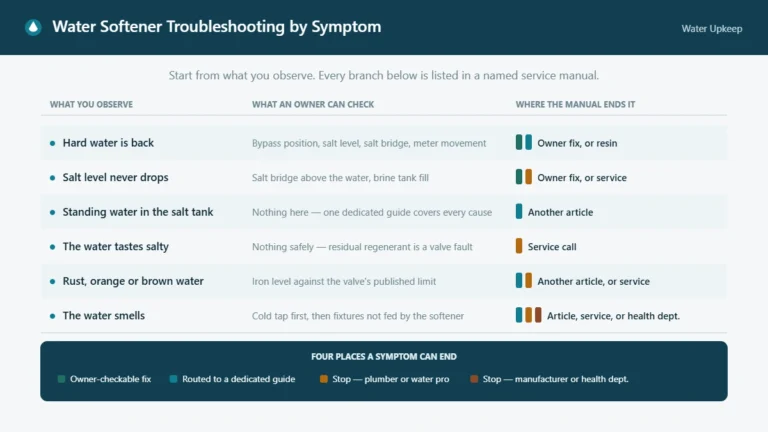
There are four things you can check without tools. Everything past them requires the unit depressurised and opened, or the drain plumbing altered, and belongs to a licensed plumber or the manufacturer’s service network. This page is part of our maintenance and repair hub; if your symptom is actually something else, start at softener troubleshooting by symptom.
First: some water in the salt tank is normal
The softener puts it there on purpose
GE’s owner’s manual lists the stages of a recharge in the order that unit runs them, and the first one explains everything: Fill — “Water flows into the salt storage area during the fill stage.” Then Brining — “Brine travels from the salt storage area into the resin tank.” Then a brine rinse, a backwash, and a fast rinse.
So the appliance deliberately admits water to the salt tank, waits for salt to dissolve into it, and then draws the resulting brine out and uses it. Standing liquid in a salt tank is, in the ordinary case, the softener’s brine supply. It is not a leak, and nothing has failed. If the underlying process is unfamiliar, how water softeners work covers the ion exchange side of it.
The nozzle and venturi: how the brine gets back out
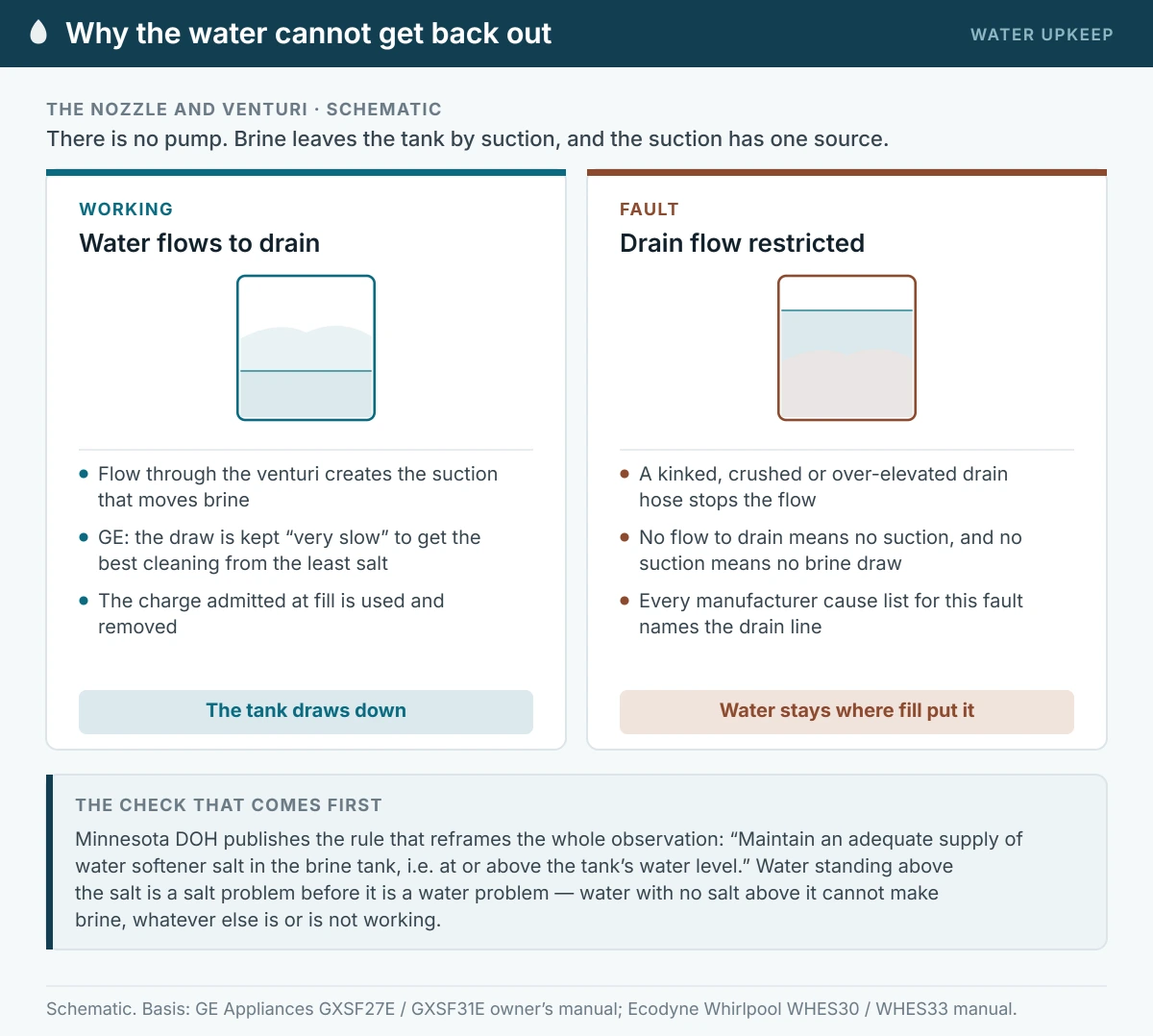
This is the mechanism the whole fault family turns on, and it is worth understanding before you look at any cause list. GE describes the component: “The nozzle and venturi create a suction to move the brine, maintaining a very slow rate to get the best resin cleaning with the least salt.” Ecodyne says the same of its own equivalent part: “This small component creates the suction to move brine from the brine tank, into the resin tank.”
There is no pump. Brine leaves the tank by suction, and the suction exists only because water is flowing through a venturi on its way to the drain. Stop that flow — with a blocked injector, a kinked or over-elevated drain hose, or inlet pressure that is too low — and the suction stops with it. The water admitted at fill has nowhere to go, and it stays.
GE states the consequence in its own troubleshooting table, about a restricted drain hose: “Any restriction in this drain hose may prevent proper operation of the nozzle and venturi and reduce or prevent brine draw during recharge.” That single sentence is the best explanation of this fault published anywhere.
Why “how much is normal right now” depends on your valve and the hour
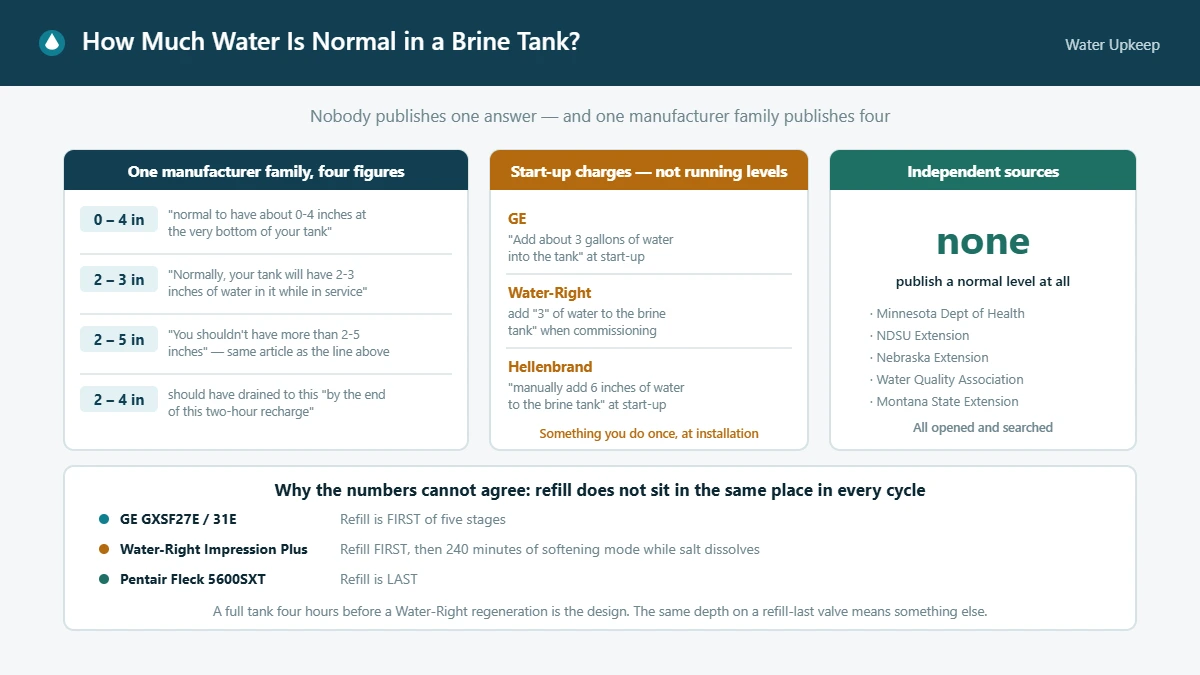
Here is the part that almost nothing else on this subject mentions. Manufacturers do not put the refill stage in the same place in the cycle.
| Manual | Where refill sits | What that means for the tank |
|---|---|---|
| GE GXSF27E / GXSF31E | First of five stages | Water is admitted at the start of the recharge |
| Water-Right Impression Plus, Evolve, CareSoft | First, followed by “4 HOURS (240 minutes) OF SOFTENING MODE WHILE SALT IS DISSOLVING” | The tank holds its full charge for four hours, by design, before anything is drawn |
| Pentair Fleck 5600SXT downflow | Last | The tank is refilled at the end of the cycle and holds the charge until the next one |
Read the Water-Right row again. A homeowner who lifts the lid four hours before that unit’s next regeneration and finds standing brine is looking at a correctly functioning appliance mid-dwell. The identical depth on a refill-last Fleck at the same hour would mean something different.
That is the honest reason no universal “normal inches” figure can exist, and it is why the manufacturers’ own numbers disagree. The full cycle-structure comparison, across more valve families than these three, is in how long regeneration takes.
How much water is normal — what the sources actually publish
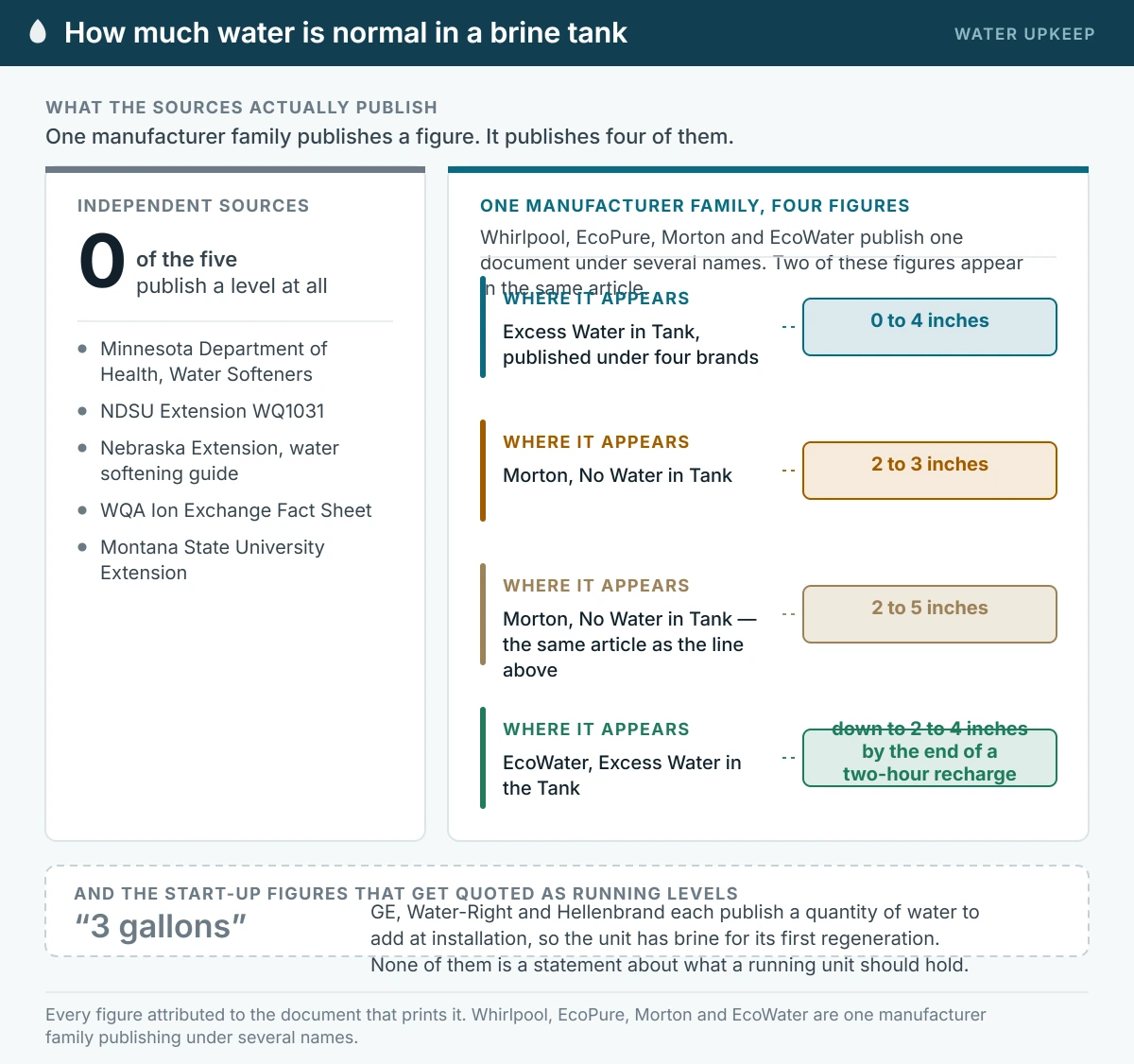
One manufacturer family publishes a figure, and it publishes four of them
Whirlpool Water Solutions, EcoPure, Morton and EcoWater publish support articles on this fault. Those brands are one manufacturer family publishing one document under several names, so what follows is one manufacturer position, not four independent confirmations. Within that one position, four different figures appear — and two of them are in the same article.
| Figure, as printed | Where it appears |
|---|---|
| “It’s normal to have about 0-4 inches of water at the very bottom of your tank but anything above that means something isn’t working right.” | Excess Water in Tank, published under four brands |
| “Normally, your tank will have 2-3 inches of water in it while it’s in service.” | Morton, No Water in Tank |
| “You shouldn’t have more than 2-5 inches.” | Morton, No Water in Tank — the same article as the line above |
| Contact technical support if the tank “does NOT drain down to 2-4 inches of water by the end of this two-hour recharge” | EcoWater, Excess Water in the Tank |
Zero to four, two to three, two to five, two to four. We are printing all of them rather than averaging them, because averaging would manufacture a precision the manufacturer itself does not have. Any page that tells you “there should be about X inches of water in your brine tank” has invented a number.
Start-up charges are not running levels
Three other manufacturers publish a quantity of water to put into the brine tank, and every one of them is a commissioning instruction — something you do once, at installation, so the unit has brine available for its first regeneration.
- GE GXSF27E / GXSF31E, at start-up: “Add about 3 gallons of water into the tank. Do not add into the brinewell.”
- Water-Right Impression Plus, at start-up: add “3” of water to the brine tank.”
- Hellenbrand ProMate EcoMax, at start-up: “manually add 6 inches of water to the brine tank.”
None of those is a statement about what a running unit should hold. If you see “Hellenbrand says 6 inches” quoted as a normal level somewhere, that is a commissioning figure that has lost its context.
No government, standards or university source publishes a level at all
We went looking, and we are reporting the result as a finding rather than leaving it as a silence. Minnesota Department of Health’s water softeners fact sheet, NDSU Extension’s ion exchange publication, Nebraska Extension’s softening guide, WQA’s ion exchange fact sheet and Montana State’s water quality material were all opened and searched for a normal or expected brine tank water depth. None publishes one.
That is why every figure on this page is attributed to the manufacturer that prints it, and why we are not adding one of our own. The number that applies to your unit is in your unit’s manual or its manufacturer’s support site — not in an article.
The more useful test: is the salt above the water?
Minnesota DOH does publish something you can act on, and it reframes the whole observation: “Maintain an adequate supply of water softener salt in the brine tank, i.e. at or above the tank’s water level.” Fleck’s own troubleshooting says the same thing from the other end — its correction for hard water is “Add salt to brine tank and maintain salt level above water level.”
So the alarming sight of water standing above the salt is, in that framing, a salt problem before it is a water problem. Water with no salt above it cannot make brine, whatever else is or is not working. Refilling salt is covered in water softener maintenance, along with the salt bridge check below.
When it is a fault: what stops the brine coming out
Four manufacturers publish cause lists for this fault, and they do not print the same list. Fleck’s 9100TS manual names four causes; GE names two; Clack names seven; Water-Right prints Clack’s seven plus one. These are attributed blocks, not a merged canon, and we are keeping them separate.
Pentair Fleck 9100TS — “Excessive water in brine tank”
| Cause, as printed | Correction, as printed |
|---|---|
| Plugged drain line flow control | Clean flow control |
| Plugged injector system | Clean injector and screen |
| Foreign material in brine valve | Replace brine valve seat and clean valve |
| Foreign material in brine line flow control | Clean brine line flow control |
Fleck’s 5600SXT manual is worth a note of its own, because it treats this fault as a cause as well as a symptom. Under “Unit used too much salt,” one of the listed causes is “Excessive water in brine tank.” Under “Iron in conditioned water,” the same. So if your salt is disappearing faster than it used to, or iron is getting through, a flooded brine tank may be the reason rather than a separate problem.
Clack WS1 and WS1.25 — “Excessive water in regenerant tank”
Seven causes: improper program settings; plugged injector; drive cap not tightened; damaged seal or stack; restricted or kinked drain line; plugged backwash flow controller; missing refill flow controller.
Clack’s adjacent fault, “Fails to draw in regenerant,” is really the same problem seen from the other side, and its causes are: plugged injector; faulty regenerant piston; regenerant line connection leak; drain line restriction or debris causing excess backpressure; drain line too long or too high; low water pressure. Its correction for the geometry cause reads, in full, “Shorten length and or height,” and its pressure correction is “Check pressure—must stay minimum 25 psi.”
One thing worth naming: Clack tells you a drain line can be too long or too high, and prints no maximum length and no maximum height anywhere in the manual. That gap is real. The height and length figures that do exist belong to other manufacturers, and they differ from each other — where a softener drain line can discharge sets them out with each attributed to its own manual.
Water-Right Impression Plus
Water-Right’s troubleshooting entry lists the same seven causes as Clack and adds one more: an improperly inserted brine tube.
GE GXSF27E and GXSF31E
Two causes, and GE’s own mechanism sentence attached to the first. Cause one: “Valve drain hose pinched, plugged, elevated too high or otherwise restricted” — because “Any restriction in this drain hose may prevent proper operation of the nozzle and venturi and reduce or prevent brine draw during recharge.” Cause two: “Nozzle and venturi dirty, incorrectly assembled or damaged.”
Note where GE’s own remedy for the second cause begins: “With water pressure to the water softening system off, take the nozzle assembly apart.” That is the manufacturer of the appliance saying, in its own troubleshooting table, that the fix starts somewhere a bypass valve cannot take you. More on that below.
Pressure, and the fact that the manuals disagree
Low inlet pressure appears on Clack’s list and Fleck’s, because pressure is what drives the flow that makes the suction. But there is no single minimum to publish:
- Pentair Fleck 5600SXT: “A minimum of 20 psi (1.4 bar) of water pressure is required for the regeneration valve to operate effectively,” with the correction for failure to draw brine given as “Increase line pressure to 20 psi.”
- Clack WS1: the specification table prints “Minimum/Maximum Operating Pressures 20 psi (138 kPa) -125 psi (862 kPa)” — but the troubleshooting corrections for two brine-draw faults say pressure “must stay minimum 25 psi.” Clack’s manual disagrees with itself.
- Hellenbrand: “A minimum of 20 pounds of water pressure (psi) is required for regeneration. Maximum 125 psi.”
Use the figure in your own manual. There is no such thing as “the minimum pressure for a water softener.”
What you can check yourself, in order
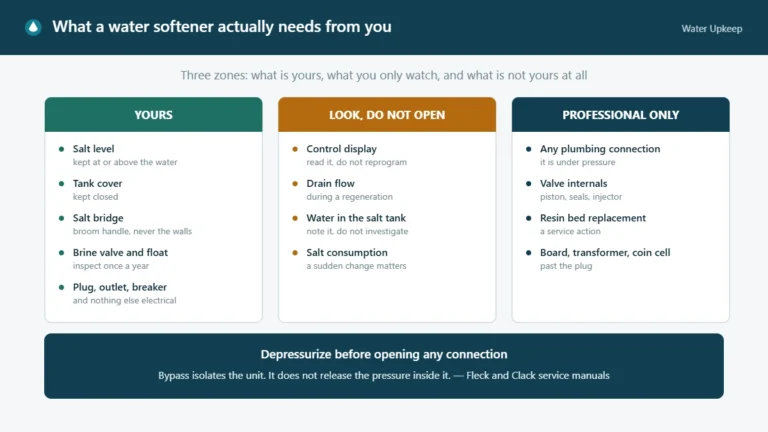
Every item below is an observation or the removal of an external obstruction. None opens a pressurised component, none touches wiring, and none needs a tool on a fitting.
- Look. Lift the lid and shine a light down the brinewell — the black tube inside the salt tank — and note where the liquid sits relative to the salt. Morton’s own first instruction is exactly this.
- Compare against your own manufacturer’s figure, from your manual or its support site. Not against a number from an article, including this one.
- Read the control display and note whether the unit is mid-cycle or has recently regenerated. On a refill-first valve family a full tank mid-dwell is the design, not a fault.
- Is the water above the salt? If so, add salt — Minnesota DOH’s rule is to keep it at or above the water level.
- Check for a salt bridge. A crust can make the tank look dry above while holding brine beneath, or leave water sitting because no salt is reaching it. The visual and blunt-handle method, and GE’s warning about not striking the tank wall, are in water softener maintenance.
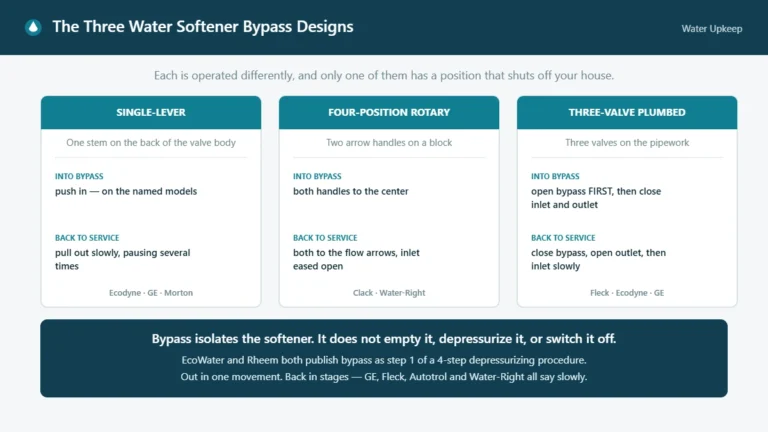
- Check the bypass valve position. A unit sitting in bypass is not regenerating and not drawing brine — see how to bypass a water softener for the handle positions on the common types.
- Look along the drain hose for a kink, a crushed section, a sharp bend, or a length that has been lifted or tied up. Un-kinking a flexible hose is inside the boundary. Nothing else about that hose is.
- Look at the float in the brinewell — visually only. Is it visible, is it obviously crusted with salt, is the brinewell tube cracked or displaced? Looking is fine. Lifting, cleaning, adjusting or removing it is not.
- Check that the unit has power. Transformer plugged in, outlet not switched, no tripped breaker or GFCI. Clack’s own troubleshooting names all three.
If the diagnosis lands on “improper program settings,” the hardness value is the one people get wrong most often — what hardness number to program covers where that number comes from. If it turns out the unit regenerates far more often than it should, that is a sizing question rather than a fault: see what size softener you need and how often one should regenerate.
The safety float and the overflow — what they do, and what they do not
Only one of the manuals we opened explains the float at all. Water-Right: “Your unit is equipped with a brine tank safety float which greatly reduces the chance of an accidental brine overflow.” Read that hedge as written. “Greatly reduces the chance of” is not “prevents.” A safety float is not a guarantee that a flooded tank will not end up on the floor, and nobody should treat it as one. Hellenbrand’s parts diagrams name a safety brine valve, a float assembly and a two-piece overflow, and describe none of them, so there is nothing further to add from that source.
The overflow fitting is a separate, gravity-fed path. Ecodyne describes its purpose plainly: “If the tank overfills with water, the excess water flows to the drain point.” GE prints two prohibitions about it, both in capitals: “DO NOT TEE OVERFLOW HOSE TO VALVE DRAIN HOSE,” and “DO NOT ELEVATE this hose higher than the elbow on the brine tank.” Both exist because tee-ing a gravity line into a pressurised one, or lifting it above the tank’s elbow, defeats it.
Those are manufacturer prohibitions, and we are reporting them as such. If yours is tee’d or elevated, that is something to raise with a plumber — not something to re-route yourself, because that is plumbing work governed by local code.
Where to stop
Bypass does not make it safe to open
Putting the softener into bypass isolates it hydraulically so the house keeps water. It does not depressurise the unit. The softener stays full of water and under pressure, it is usually still energised, and it is not safe to open. This matters here because several of the remaining causes are inside the valve, and the bypass handle is the thing people reach for first.
The manufacturers are explicit. Fleck: “The system must be depressurized before removing any connections for servicing.” Clack: “Pressure hazard; depressurize valve before servicing,” and “Disconnect from electrical power prior to servicing.” GE, in its own remedy for a dirty venturi: “With water pressure to the water softening system off, take the nozzle assembly apart.” The procedure and the reasoning are in how to bypass a water softener.
The electrical boundary
The plug-in transformer takes household voltage from the outlet and delivers low-voltage DC to the control board — Clack’s US specification is 100–120 VAC in, 15 VDC at 500 mA out. Hellenbrand requires “a continuous 110 volt 60 cycle current supply.”
So the boundary is easy to state. Permitted: unplugging the transformer from the wall outlet, checking whether the outlet is switched, resetting a tripped breaker or GFCI at the panel face. Not permitted, and out of scope here: opening the control head, and any work on the low-voltage lead, the outlet, the branch circuit or the panel.
Stop and call a licensed plumber or the manufacturer’s service network if
- The tank is at or near its overflow fitting, or water is already on the floor.
- The looking, the bypass check, the salt-bridge check and the drain-hose kink check have all come back clean, and the water is still above the level your manufacturer publishes.
- The remaining causes on your own manufacturer’s list are the injector or nozzle-and-venturi, the brine valve or float assembly, the drive cap, the seals or the piston, or a drain line that is too long or too high. Every one of those requires the unit depressurised and opened, or plumbing altered.
- You are being asked to shorten, lower, re-route or re-plumb a drain line.
- You are not certain the unit is a softener at all, or you cannot find a manual for it.
That is not our judgment about your competence. It is where the manufacturers themselves stop: the EcoWater and Whirlpool family’s own article ends at “contact Technical Support for additional troubleshooting help,” and Hellenbrand’s manual says, where brine is not being drawn out, “If water is not being drawn out contact your installer for assistance.”
Those manufacturers do publish further owner steps beyond the ones listed above — disconnecting the brine hose to check for internal leaks, initiating a recharge to watch for suction, and taking the brine valve assembly apart. We are telling you they exist and pointing you at the source, and we are not walking you through them. Two of the three open a fitting on a pressurised appliance, and the third deliberately runs a unit that is already misbehaving.
If the answer turns out to be the drain line
A drain line that is kinked, crushed, blocked, run too far, run too high, or connected in a way it should not be appears on every manufacturer’s list for this fault. Un-kinking a flexible hose is a homeowner job. Anything else about that line is not.
The published height and length limits are manufacturer-specific and genuinely different from one another, and where a drain may legally discharge is decided by state and local code — there is no national plumbing code in the United States. All of that lives in where a water softener drain line can discharge, along with the air gap requirement and the septic question. If it turns out the line was run wrong at installation, how to install a water softener covers what a correct installation involves.
Frequently asked questions
How much water is supposed to be in a brine tank?
There is no general answer, and we would rather say so than invent one. No government agency, standards body or university extension service we could open publishes a normal brine tank water level at all. The one manufacturer family that publishes figures publishes four different ones — 0 to 4 inches, 2 to 3, 2 to 5, and 2 to 4 — with two of them in the same article. Check your own manual, and remember that where refill sits in your valve’s cycle changes what “right now” should look like.
Is water in the salt tank normal?
Ordinarily, yes. It is the brine supply. The softener admits water at the fill stage so salt can dissolve into it, and on a refill-first valve family that charge can sit there for hours — Water-Right’s published sequence includes a four-hour softening-mode dwell while the salt dissolves. Water becomes a symptom when it stands above your manufacturer’s published level, or above the salt.
Why is the water above the salt?
Most often because the salt is low or has bridged. Minnesota DOH’s rule is to “Maintain an adequate supply of water softener salt in the brine tank, i.e. at or above the tank’s water level,” and Fleck’s own correction for hard water is to “Add salt to brine tank and maintain salt level above water level.” Start there before assuming a fault — and check for a bridge, which is covered in water softener maintenance.
Will my brine tank overflow onto the floor?
We cannot tell you that, and neither can anyone who has not seen your unit. What is publishable is this: there is an overflow fitting whose job, in Ecodyne’s words, is that “If the tank overfills with water, the excess water flows to the drain point,” and there may be a safety float, which Water-Right describes as something that “greatly reduces the chance of an accidental brine overflow.” Neither is described by its manufacturer as a guarantee. If the water is at or near the overflow fitting, that is on the stop-and-call list above.
Can I just scoop the water out?
No source we opened supports scooping as a fix, and it does not address a single one of the named causes. The manufacturers’ own method for clearing the water is to run a full recharge cycle — which they publish and we are not instructing, for the reasons above. Removing the water does not restore the suction that failed to remove it, so the tank fills again on the next fill stage.
My softener is using far more salt than it used to and the tank is full — same problem?
Possibly, and Fleck says so directly: its 5600SXT manual lists “Excessive water in brine tank” as a cause of “Unit used too much salt,” and also as a cause of “Iron in conditioned water.” So a flooded tank can be the explanation for both rather than a third separate problem. A salt bridge is a separate confounder worth ruling out first.
Does a flooded brine tank mean my water is unsafe?
This page does not address water safety and we are not going to speculate about it. A softener is a hardness appliance, not a treatment for anything you would test for on health grounds. If you have a real concern about your drinking water, that goes to your local health department or your water utility, not to a troubleshooting page.
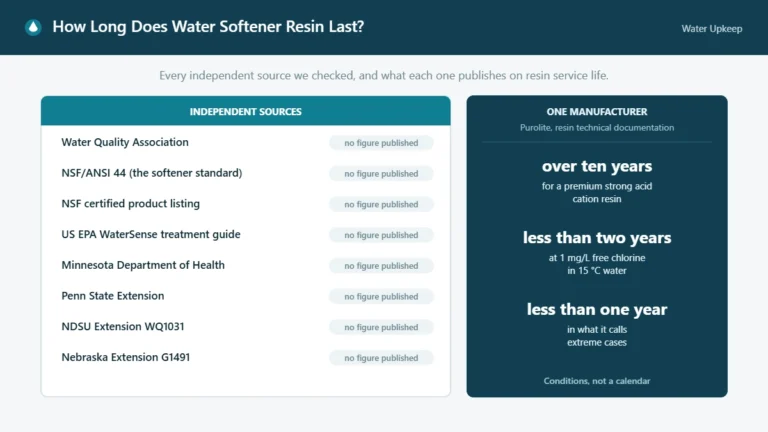
Could this be the resin instead?
A flooded brine tank is a brine-draw problem, not a resin problem, and none of the manufacturer cause lists names resin. If your symptoms have drifted toward hard water getting through despite normal salt use, that is a different diagnosis — see when softener resin needs replacing and the wider symptom index.
Sources and Standards
- Minnesota Department of Health — Water Softeners fact sheet (keep salt at or above the tank’s water level)
- NDSU Extension — Water Softening (Ion Exchange), WQ1031
- Water Quality Association — Ion Exchange Fact Sheet
- GE Appliances — GXSF27E and GXSF31E owner’s manual (the recharge stages, the nozzle-and-venturi description, the drain-restriction mechanism, the start-up water charge, and the overflow prohibitions)
- Pentair — Fleck 9100TS service manual and Fleck 5600SXT downflow service manual
- Clack Corporation — Water Specialist WS1 and WS1.25 drawings and service manual, V3115-99
- Water-Right — Impression Plus Certified Softener manual (the 240-minute dwell, the safety float wording, the start-up charge)
- Ecodyne Water Systems — Whirlpool WHES30 and WHES33 manual
- Hellenbrand — ProMate EcoMax consumer manual
- Whirlpool Water Solutions support — Excess Water in Tank
- EcoPure support — Excess Water in Tank
- Morton Water Softeners support — Excess Water in Tank and No Water in Tank
- EcoWater Systems support — Excess Water in the Tank
Whirlpool, EcoPure, Morton and EcoWater publish this material under separate brands but belong to one manufacturer family, and we count their agreement as one position rather than four. Every water level, pressure figure and cause list on this page is attributed to the manual that prints it, because they differ. Water Upkeep owns no equipment and tests nothing.
Last reviewed September 8, 2026.