How to Remove Iron From Well Water
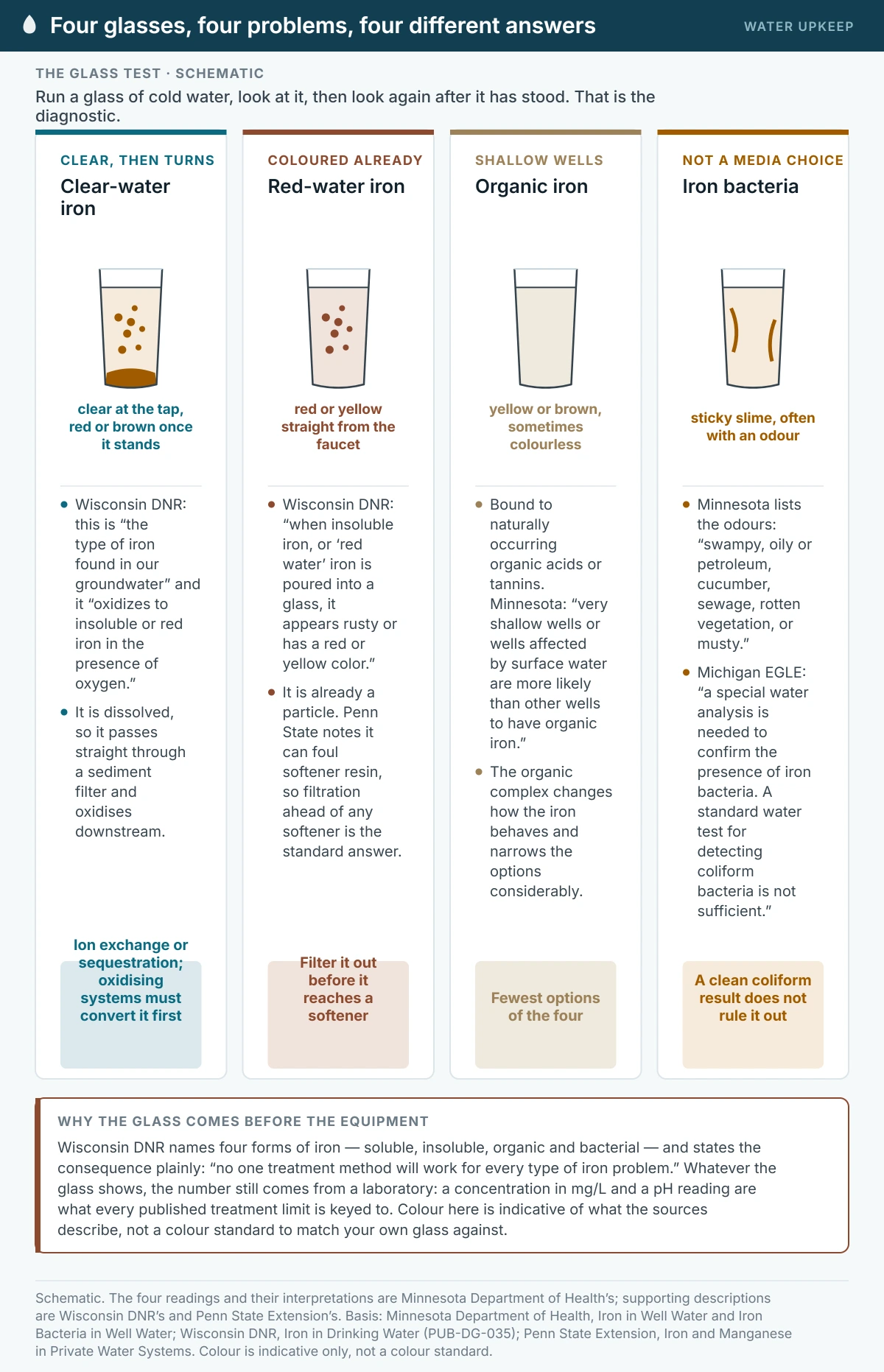
There is no single answer, because there is no single iron. Wisconsin’s Department of Natural Resources names four forms — soluble, insoluble, organic and bacterial — and states the consequence plainly: “no one treatment method will work for every type of iron problem.” So the first job is not choosing equipment. It is finding out which form you have, and there is a glass-of-water test that tells you.
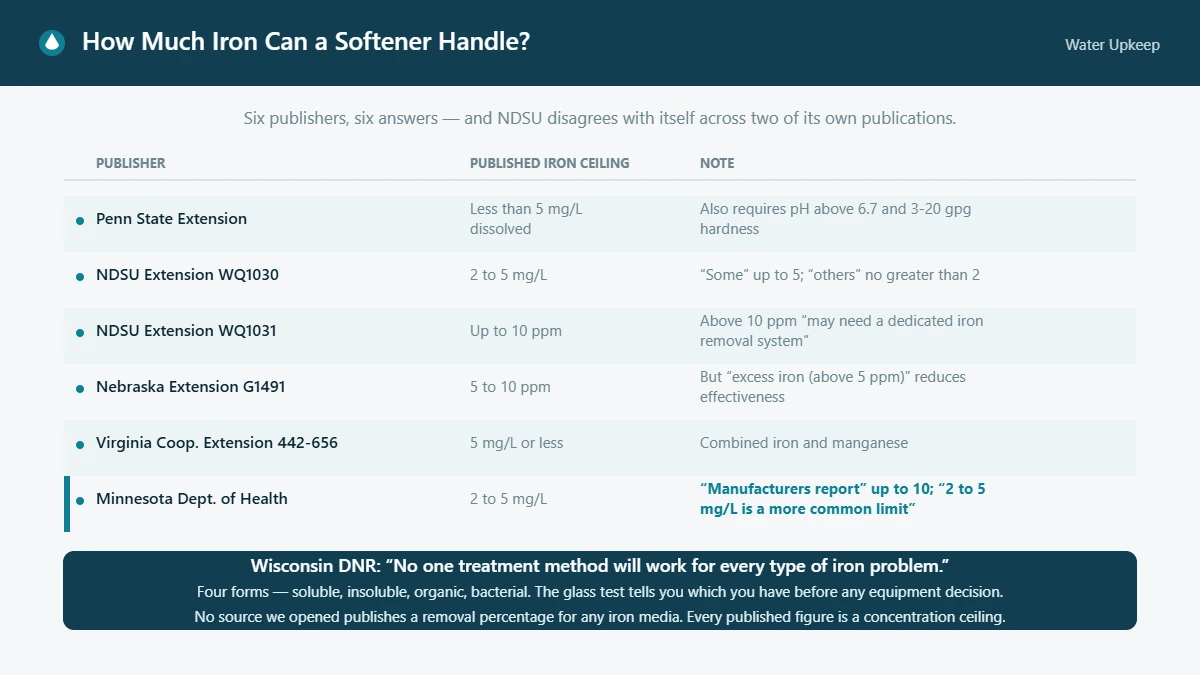
The second thing worth knowing before you spend money: the published limits on what each technology can handle disagree, substantially. Six extension services and health departments give six different ceilings for how much iron a water softener can take — and one of them, NDSU, disagrees with itself across two of its own publications.
First: iron is a nuisance standard, not a health standard
The 0.3 mg/L figure everyone quotes is EPA’s secondary maximum contaminant level, and EPA is explicit about what that means: these are “non-mandatory water quality standards” that “EPA does not enforce,” established “as guidelines to assist public water systems in managing their drinking water for aesthetic considerations, such as taste, color, and odor.” EPA’s listed effects for iron are “rusty color; sediment; metallic taste; reddish or orange staining.”
Three independent sources say the same thing about health. Minnesota’s health department: “iron in water does not usually present a health risk. Your body needs iron to transport oxygen in the blood.” Wisconsin DNR: “the present recommended limit for iron in water, 0.3 mg/l (ppm), is based on taste and appearance rather than on any detrimental health effect.” Virginia Cooperative Extension names the one exception it identifies: “a portion of the population suffering from hemochromatosis (excess iron in the body) may be especially sensitive to iron in drinking water.”
Minnesota adds an indirect concern worth carrying: “iron may present some concern if harmful bacteria have entered a well. Some harmful organisms require iron to grow.” If that is your question rather than staining, it belongs with a positive coliform test on your well and your local health department.
On the scale of the problem: Minnesota notes that “iron levels are usually below 10 mg/L in water,” and that anything above 0.3 mg/L “is usually considered objectionable.” The Water Quality Association points out that staining begins right at the standard — “staining may result from water with very low concentrations of these metals: 0.3 parts per million (ppm) of iron.”
And a note on responsibility, since this is almost always a private-well question. Virginia Cooperative Extension: “private water sources, such as wells and springs, are not regulated by the U.S. Environmental Protection Agency… private water supply owners are responsible for the maintenance of their water systems, for monitoring the quality of their drinking water, and for taking appropriate steps to address problems should they arise.”
Which iron do you have? The glass test
Run a glass of cold water and look at it, then look again after it has stood. Minnesota’s health department gives the three readings in three sentences.
| What you see | What it is | Why it matters |
|---|---|---|
| Clear from the tap, turns red or brown after standing | Clear-water (soluble, ferrous) iron. Wisconsin DNR: it “is the type of iron found in our groundwater and oxidizes to insoluble or red iron in the presence of oxygen” | It is dissolved, so it passes through a sediment filter. Ion exchange and sequestration are options here; oxidation-based systems have to convert it first |
| Red or yellow the moment it leaves the faucet | Red-water (insoluble, ferric) iron. Wisconsin DNR: “when insoluble iron, or ‘red water’ iron is poured into a glass, it appears rusty or has a red or yellow color” | It is already a particle. Penn State notes it can foul softener resin; filtration ahead of any softener is the standard answer |
| Yellow or brown, sometimes colorless, on a shallow well | Organic iron, bound to naturally occurring organic acids or tannins. Minnesota: “very shallow wells or wells affected by surface water are more likely than other wells to have organic iron” | The organic complex changes how the iron behaves and narrows the options considerably |
| Sticky rusty, yellow, brown or grey slime, often with an odor | Iron bacteria — see the section below | Not a treatment-media question at all |
Penn State frames the same test in terms of what dissolves: “if water collected from the well or spring is initially clear but then forms orange-brown or black solid particles over time, the iron and manganese are dissolved in the water.”
Whatever the glass shows, the number comes from a laboratory. A concentration in mg/L, and a pH reading, are what every published treatment limit below is keyed to — see water testing.
Iron bacteria: a different problem with a different test
Minnesota’s health department describes them as “small living organisms that naturally occur in soil, shallow groundwater, and surface waters,” recognizable by “sticky rusty, yellow, brown, or grey slime” and odors it lists as “swampy, oily or petroleum, cucumber, sewage, rotten vegetation, or musty.”
Four sources agree they are a nuisance rather than a pathogen. Minnesota: “iron bacteria are not known to cause disease. However, they can create conditions where other disease-causing organisms may grow.” Penn State: “while these bacteria can be off-putting, they are typically considered more of a nuisance than a health hazard.” Wisconsin DNR lists what they actually cost you: odors, corrosion of plumbing equipment, reduced well yields, and increased infestations of other bacteria. Michigan EGLE: “iron bacteria are not hazardous to health, but in some cases they cause troublesome well problems.”
The correction almost nobody makes
Michigan EGLE states it directly: “a special water analysis is needed to confirm the presence of iron bacteria. A standard water test for detecting coliform bacteria is not sufficient.” A clean coliform result does not rule iron bacteria out.
Penn State adds the practical difficulty: “few labs actually test for iron or sulfur bacteria because there are no health implications or drinking water standards.” Wisconsin DNR notes that where a lab does offer it, samples are collected “early in the morning or when the water system has been inactive for at least several hours.”
On the remedy, Michigan EGLE sets expectations honestly: well owners “should try to control rather than completely ‘cure’ the problem,” with “periodic shock chlorination” to minimize recurrence. Nebraska Extension agrees that shock chlorination is “the most common approach.” Minnesota’s assessment is blunter: “eliminating iron bacteria can be difficult and expensive.”
We publish no shock chlorination dose here. The authorities disagree substantially on concentration, contact time and retest interval, and that procedure — with each source’s figures kept separate — belongs to how to shock a well.
One connection worth noting: NDSU points out that “some types of bacteria derive their energy from feeding on dissolved forms of iron and manganese in water.” The iron problem and the bacteria problem are not independent.
One boundary before the numbers, because it decides how several of them may be read. Much of the treatment literature addresses iron and manganese together, and a number of its published limits are combined iron-plus-manganese figures rather than iron-only ones. A combined figure cannot be converted into an iron figure, in either direction. Manganese also differs from iron in the way that matters most: iron is a nuisance parameter with no federal health advisory, while manganese carries a federal lifetime advisory, acute advisories and infant-specific state guidance. Those two subjects do not share numbers and we do not pool them — see manganese in drinking water for its own values and their scopes.
The softener ceiling: six sources, six numbers
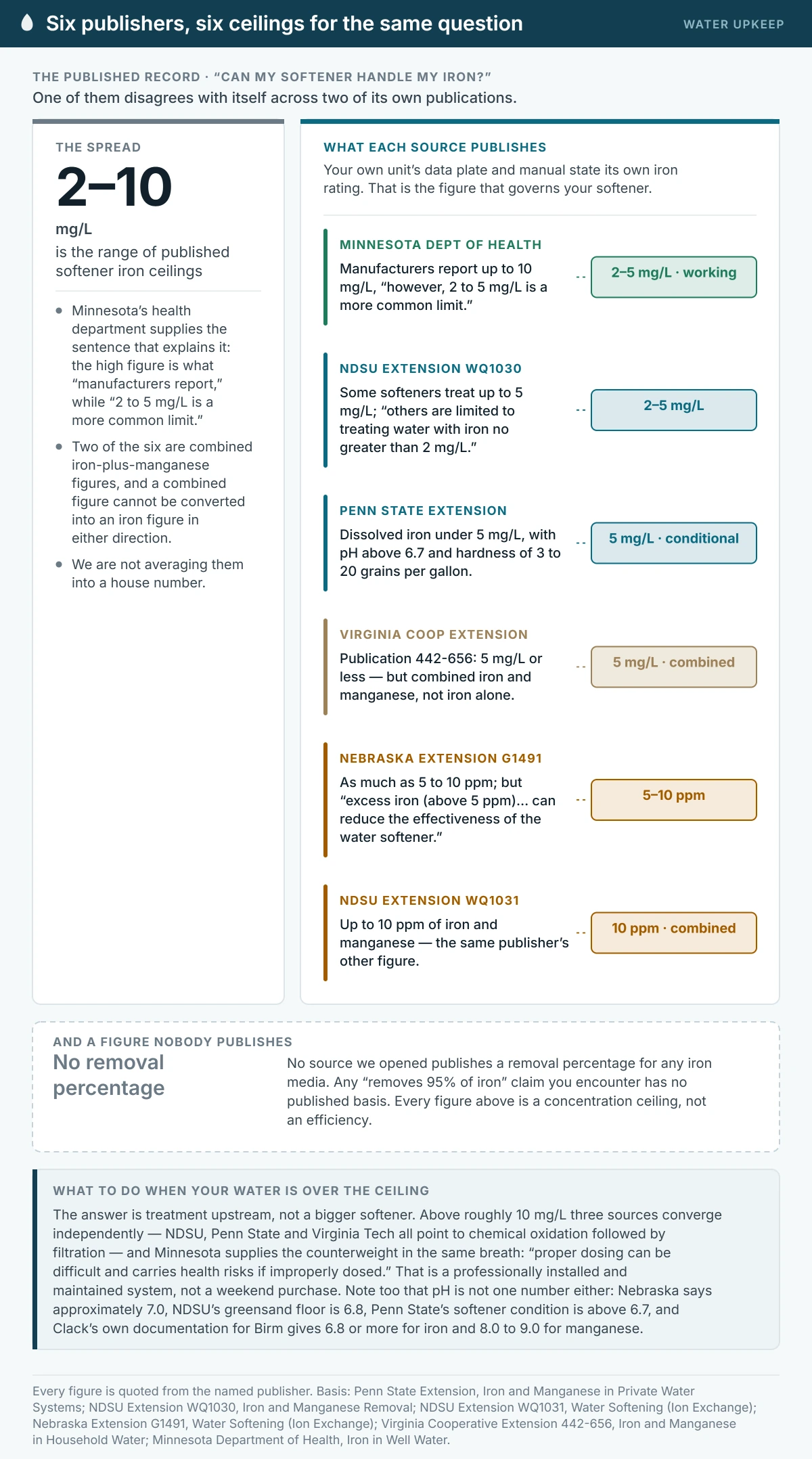
This is the question people actually arrive with — “can my softener handle my iron?” — and the honest answer is that the published limits do not agree.
| Publisher | What it publishes |
|---|---|
| Penn State Extension | Softeners “are generally only recommended when the water pH is greater than 6.7, the water hardness is between 3 and 20 grains per gallon (50-350 mg/L) and the dissolved iron concentration is less than 5 mg/L“ |
| NDSU Extension WQ1030 | “Some water softeners are capable of adequately treating water with iron levels up to 5 mg/L. However, others are limited to treating water with iron no greater than 2 mg/L“ |
| NDSU Extension WQ1031 | “Some softeners will also remove up to 10 ppm of iron and manganese”; supplies above 10 ppm “may need a dedicated iron removal system” |
| Nebraska Extension G1491 | Softeners “may also remove as much as 5-10 ppm“; but “excess iron (above 5 ppm)… can reduce the effectiveness of the water softener” |
| Virginia Cooperative Extension 442-656 | 5 mg/L or less, combined iron and manganese |
| Minnesota Department of Health | “Manufacturers report that some water softeners can remove up to 10 mg/L. However, 2 to 5 mg/L is a more common limit“ |
Two things to take from that table. First, NDSU disagrees with itself — its iron removal publication says 2 to 5 mg/L and its water softening publication says up to 10 ppm. Second, Minnesota’s health department supplies the sentence that explains the whole spread: the high figure is a manufacturer claim, and the extension services’ working figure is lower. That is the single most useful line published on this question.
We are not going to average those into a house number. What is defensible: your own unit’s data plate and manual state its own iron rating, and that is the figure that governs your softener. If your water is over it, the answer is treatment upstream, not a bigger softener.
One more thing that varies by manufacturer: the “compensated hardness” adjustment some manuals ask you to add for clear-water iron when programming the unit. Those factors are published by manufacturers, not by any independent body, and they conflict with each other — that is covered in what hardness number to program. If iron has already fouled the bed, when softener resin needs replacing covers what is and is not recoverable, and the troubleshooting index covers the symptoms.
What each technology is rated for
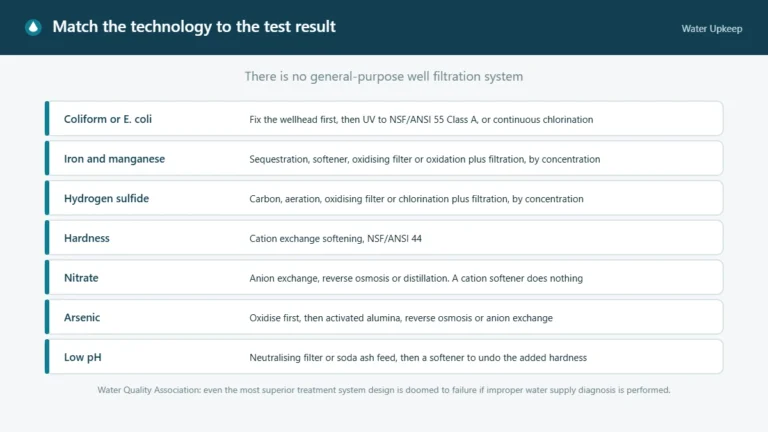
Every figure below is a concentration ceiling published by a named source, not an efficiency. Note that no source we opened publishes a removal percentage for any iron media, so any “removes 95% of iron” claim you encounter has no published basis.
| Approach | Iron form it targets | Published ceiling, and who published it |
|---|---|---|
| Sequestration (polyphosphate) | Dissolved only | Penn State: “water containing dissolved iron concentrations less than 2 mg/L.” Virginia Tech: up to 3 mg/L combined iron and manganese. NDSU describes the mechanism — polyphosphates “surround iron, keeping it ‘sequestered’ or trapped” — without a limit |
| Ion exchange softener | Dissolved | See the six-way disagreement above — 2 to 10 mg/L depending on who you read |
| Manganese greensand filter | Oxidizes then filters | NDSU: “most greensand filters are rated to be effective in treating water with iron concentrations up to 10 mg/L.” Minnesota: “effective for levels that are up to 10 to 15 mg/L.” Virginia Tech: up to 15 mg/L combined. NDSU’s hard condition: “if the pH of the water is lower than 6.8, the greensand will probably not filter out the iron and manganese adequately” |
| Birm and similar catalytic media | Oxidizes then filters | Penn State: similar to greensand “but they do not require regeneration because they utilize oxygen present in the raw water.” Clack’s own product documentation requires dissolved oxygen “at least 15% of the iron content,” a pH of “6.8 or more” for iron, “no oil or hydrogen sulfide,” and organic matter “not to exceed 4-5 ppm” |
| Aeration followed by filtration | Oxidizes then filters | Virginia Tech: 5 to 10 mg/L combined |
| Catalytic carbon | Dissolved | Penn State: “effective for concentrations of dissolved iron less then 1.0 mg/L” [source’s typo] |
| Chemical oxidation followed by filtration | Any | NDSU: “the accepted method of iron and manganese removal when concentrations are greater than 10 mg/L.” Penn State and Virginia Tech both agree at the same threshold |
| Distillation or reverse osmosis | Any form | Minnesota: “can remove any type of iron. If there is a lot of iron in the water, it can quickly plug up the units, so a whole house treatment system may be better” — note this is a point-of-use answer to a whole-house staining problem |
Above roughly 10 mg/L, three sources independently converge: chemical oxidation followed by filtration. NDSU describes what that actually is — “a chlorine solution is injected with a chemical feed pump ahead of a sand filter” — and Minnesota supplies the counterweight in the same breath: “chemical oxidation using chlorine or hydrogen peroxide and filtration is also used. However, proper dosing can be difficult and carries health risks if improperly dosed.” That is a professionally installed and maintained system, not a weekend purchase.
pH is not one number either
Oxidation depends on pH, and the published targets differ by technology. Nebraska Extension: treatment techniques “are most effective for iron and manganese removal in water that has an almost neutral pH (approximately 7.0).” NDSU’s greensand floor is 6.8. Penn State’s softener condition is above 6.7. Clack’s own documentation for Birm gives 6.8 or more for iron and 8.0 to 9.0 for manganese.
Those are four different numbers for four different processes and they cannot be collapsed into “pH 7.” Your test result and the specific media’s own requirements are what matter.
Two other maintenance realities worth knowing before you choose. Penn State on greensand: it requires “significant maintenance including frequent regeneration with a potassium permanganate solution as it is consumed during oxidation of the dissolved metals.” And whatever you install, if a UV system sits downstream, both of the manufacturers we checked publish an iron limit below 0.3 mg/L for it — see UV water disinfection. Sediment ahead of any of this is a micron rating question, and the broader treatment train is well water filtration systems.
Frequently asked questions
Is iron in well water dangerous?
The 0.3 mg/L limit is EPA’s secondary standard — non-mandatory, aesthetic, and not enforced by EPA. Minnesota’s health department says iron in water “does not usually present a health risk,” and Wisconsin DNR says the limit is “based on taste and appearance rather than on any detrimental health effect.” Virginia Cooperative Extension names hemochromatosis as a sensitivity. Any health question about your own water belongs with your local health department or a clinician.
How much iron can a water softener remove?
Six sources give six answers between 2 and 10 mg/L. Minnesota’s health department explains the spread: the 10 mg/L figure is what “manufacturers report,” while “2 to 5 mg/L is a more common limit.” Your own unit’s rating, on its data plate or in its manual, is the figure that governs your softener.
My water is clear from the tap but turns orange in the glass. What is that?
Clear-water iron — dissolved ferrous iron that oxidizes on contact with air. Wisconsin DNR describes it as the form “found in our groundwater” that “oxidizes to insoluble or red iron in the presence of oxygen.” It passes straight through a sediment filter because it is not yet a particle.
Will a sediment filter fix orange staining?
Only if the iron is already a particle when it reaches the filter. Dissolved iron passes through, then oxidizes downstream and stains anyway. That is why the glass test comes before the equipment decision.
Do I have iron bacteria, and will a coliform test tell me?
A coliform test will not tell you. Michigan EGLE: “a special water analysis is needed… a standard water test for detecting coliform bacteria is not sufficient.” Look for sticky slime and the odors Minnesota lists, and expect difficulty finding a lab — Penn State notes few labs test for it, because there are no health implications or drinking water standards.
What if my iron is above 10 mg/L?
NDSU, Penn State and Virginia Tech independently point to chemical oxidation followed by filtration at that level. Minnesota attaches the caution: proper dosing “can be difficult and carries health risks if improperly dosed.” This is a professionally installed and maintained system.
Sources and standards
- US EPA — Secondary Drinking Water Standards: Guidance for Nuisance Chemicals
- Minnesota Department of Health — Iron in Well Water and Iron Bacteria in Well Water
- Wisconsin Department of Natural Resources — Iron in Drinking Water (PUB-DG-035) and Iron Bacteria Problems in Wells (PUB-DG-004)
- Michigan EGLE — Iron Bacteria in Wells
- Penn State Extension — Iron and Manganese in Private Water Systems and Iron and Sulfur Bacteria: a Slimy Problem
- NDSU Extension — WQ1030, Iron and Manganese Removal and WQ1031, Water Softening (Ion Exchange)
- Nebraska Extension — G1491, Water Softening (Ion Exchange) and G1714, Iron and Manganese Bacteria
- Virginia Cooperative Extension — 442-656, Iron and Manganese in Household Water
- Water Quality Association — Staining and Discoloration
- Water Systems Council — wellcare information sheet: Iron and Well Water
- Clack Corporation (manufacturer documentation) — Birm filter media
Last reviewed September 9, 2026.