Choosing a Well Water Filtration System
There is no such thing as a well water filtration system in general. There are perhaps a dozen technologies, each of which addresses a specific finding, and choosing between them without a laboratory result is guesswork with a price tag. The Water Quality Association — the water treatment industry’s own trade body — puts it more bluntly than we would: even the most superior treatment system design is doomed to failure if improper water supply diagnosis is performed. So this guide is organised the way the decision should be: what to test for, then what each finding calls for, then how the pieces have to be ordered.
Test first, and test properly
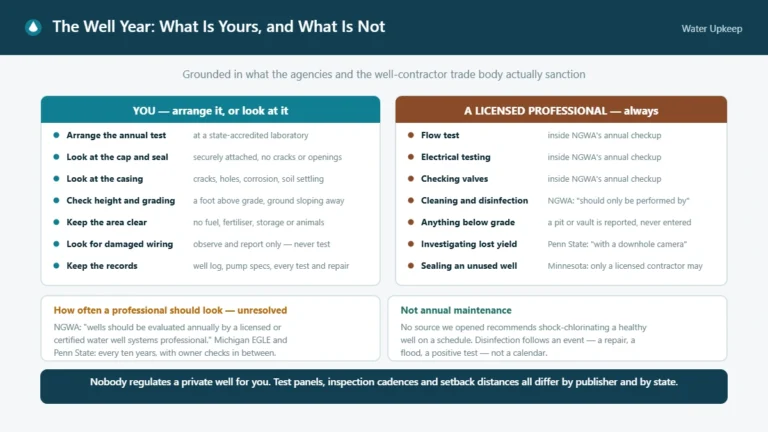
EPA and CDC agree on the annual baseline for a private well: total coliform bacteria, nitrates, total dissolved solids and pH, at least once every year. CDC adds an annual mechanical check of the well itself, separate from the water test.
Both also list triggers for testing sooner. EPA names known problems with groundwater in your area; significant changes near the well such as flooding, land disturbance, new construction or industrial activity; replacing or repairing any part of the well system; and any change in odour, colour or taste. CDC adds two life events: someone in the household becomes pregnant, or a child starts living with you. CDC also suggests asking the local health department which region-specific extras belong on your panel — volatile organic compounds, lead, arsenic, mercury, radium, pesticides.
Use a state-certified laboratory. Penn State Extension is direct about why: some water treatment vendors may use colourful home water tests or other methods to scare or pressure homeowners. It also warns that EPA certification does not ensure equipment will remove particular pollutants — look for NSF and WQA certification instead.
How to collect the sample is covered in testing water hardness, and the same principles apply to the wider panel.
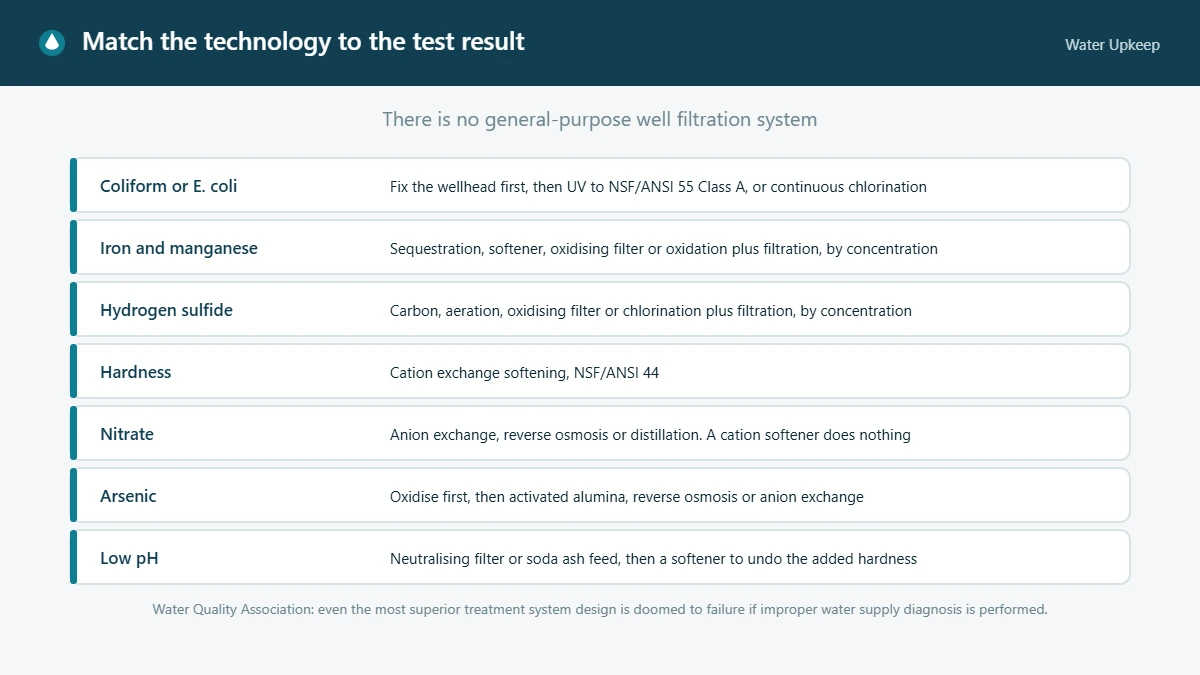
Matching a technology to a finding
| Finding | Technologies that address it |
|---|---|
| Total coliform or E. coli | Fix the wellhead first. Then continuous disinfection: UV to NSF/ANSI 55 Class A, or continuous chlorination followed by filtration |
| Iron and manganese | Depends on concentration and form — sequestration, softener, oxidising filter, or oxidation followed by filtration |
| Hydrogen sulfide | Activated carbon, aeration, oxidising filter, or chlorination plus filtration, by concentration |
| Hardness | Cation exchange softening, NSF/ANSI 44 |
| Nitrate | Anion exchange, reverse osmosis or distillation. A cation softener does nothing |
| Arsenic | Oxidation first, then activated alumina, reverse osmosis or anion exchange |
| Sediment and turbidity | Mechanical filtration — often as pre-treatment for something else |
| Low pH and corrosivity | Neutralising filter or soda ash feed — followed by softening |
Bacteria: the wellhead comes before the equipment
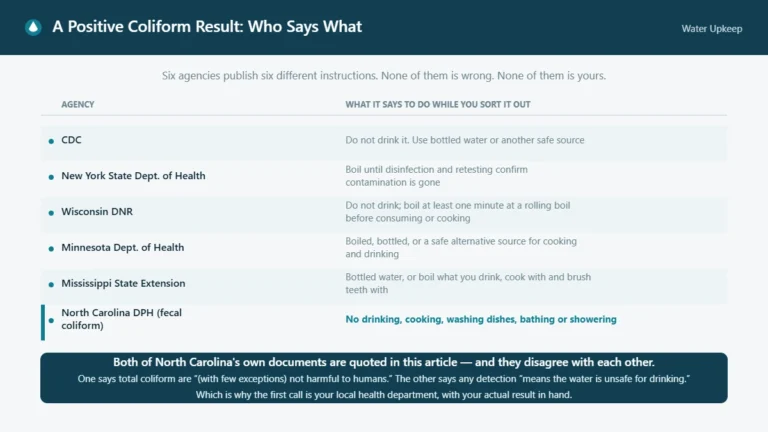
Total coliform indicates the potential presence of disease-causing bacteria; E. coli indicates that human or animal waste is entering the supply. Penn State notes the drinking water standard requires that no coliform bacteria be present, and that faecal coliform and E. coli should be totally absent.
Before buying anything, check the five parts of sanitary well construction Penn State lists: casing extending 12 inches above the ground, ground sloping away from the wellhead, casing to bedrock, a grout seal and a sanitary well cap. Anything on the surface — animal waste, sediment, fertiliser, chemicals — can be washed into a well by runoff after rain. A treatment system installed over an open pathway treats the symptom forever.
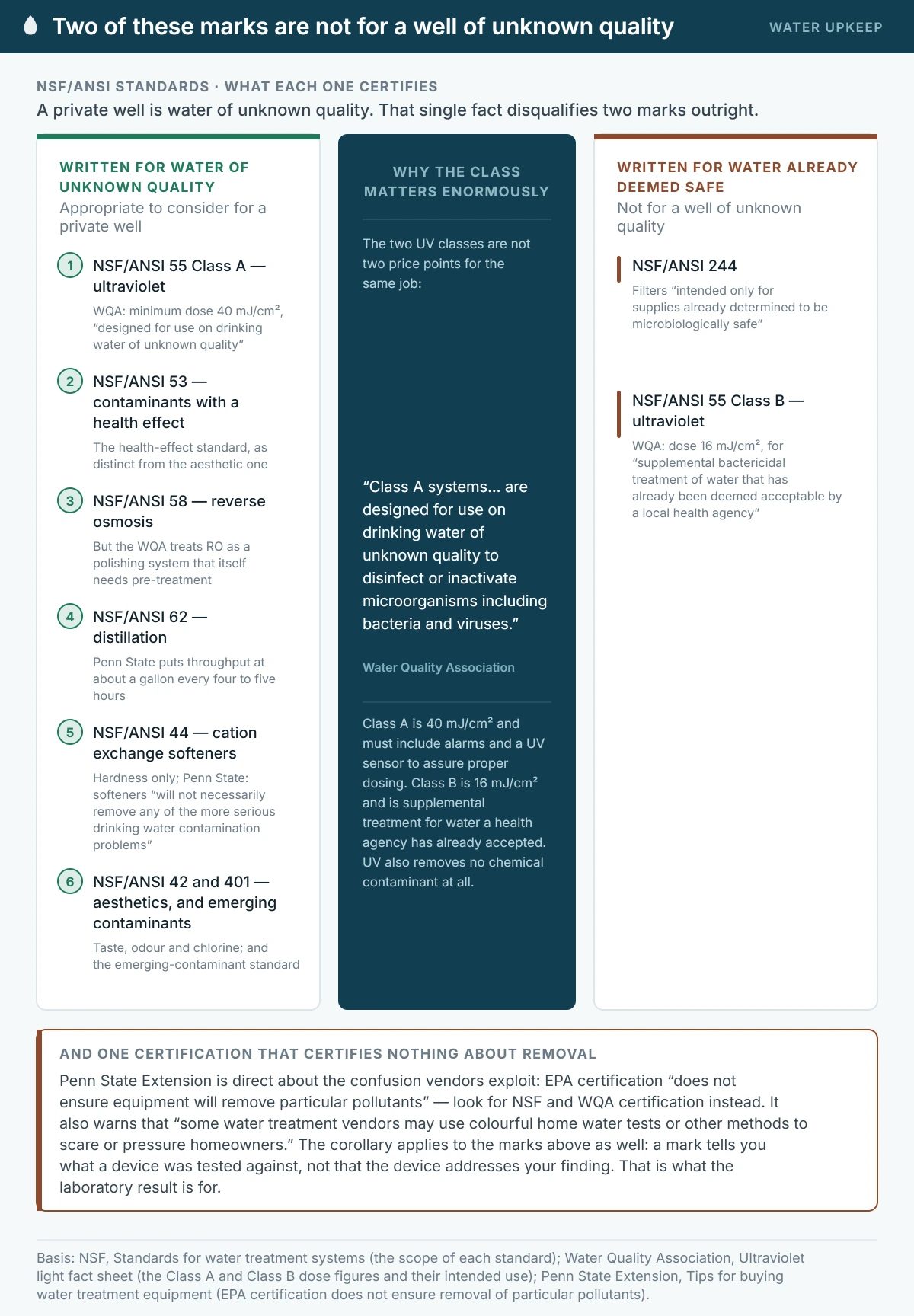
Where disinfection is needed, the standard to look for is NSF/ANSI 55, and the class matters enormously. The Water Quality Association gives both doses: Class A systems, minimum dose 40 mJ/cm², are designed for use on drinking water of unknown quality to disinfect or inactivate microorganisms including bacteria and viruses; Class B systems, dose 16 mJ/cm², are designed for supplemental bactericidal treatment of water that has already been deemed acceptable by a local health agency. A private well is water of unknown quality. That is Class A.
UV has two blind spots worth knowing. It is not used for removal of chemical contaminants at all. And its effectiveness depends on how well UV passes through the water — the WQA notes that water which looks crystal clear to the naked eye can have very low UV transmission, so transmittance has to be measured before sizing. Turbidity, humic acids, metals, nitrates and sulfites all interfere, and Class A systems must include alarms and a UV sensor to assure proper dosing.
Iron and manganese: the concentration decides
Penn State recommends no more than 0.3 mg/L of iron and under 0.05 mg/L of manganese, and notes EPA has a health advisory for manganese at 0.3 mg/L. Those are two different kinds of limit — one aesthetic, one health-based — and they are easy to confuse.
| Approach | Where it fits |
|---|---|
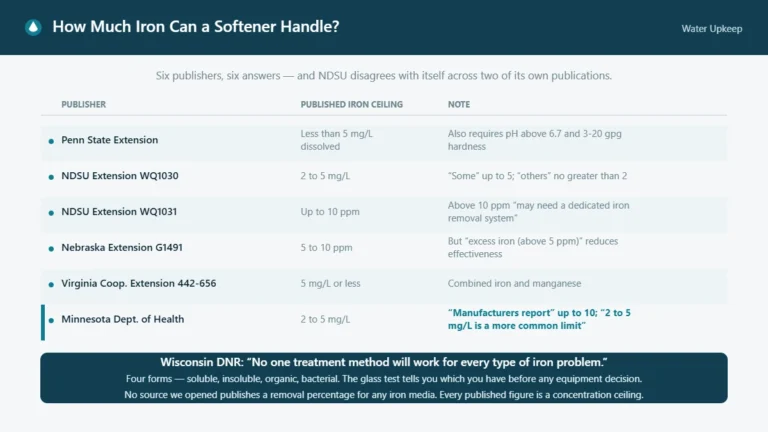
| Polyphosphate sequestration | Dissolved iron under 2 mg/L; generally ineffective for manganese |
| Water softener | Only where pH is above 6.7, hardness is 3 to 20 grains per gallon and dissolved iron is under 5 mg/L |
| Catalytic carbon | Dissolved iron under 1.0 mg/L, with at least 4.0 mg/L dissolved oxygen |
| Oxidising filter (manganese greensand or birm) | Combined iron and manganese in the range of 3 to 10 mg/L. Birm needs dissolved oxygen and pH of at least 6.8 for iron, 7.5 for manganese |
| Oxidation followed by filtration | Above 10 mg/L combined |
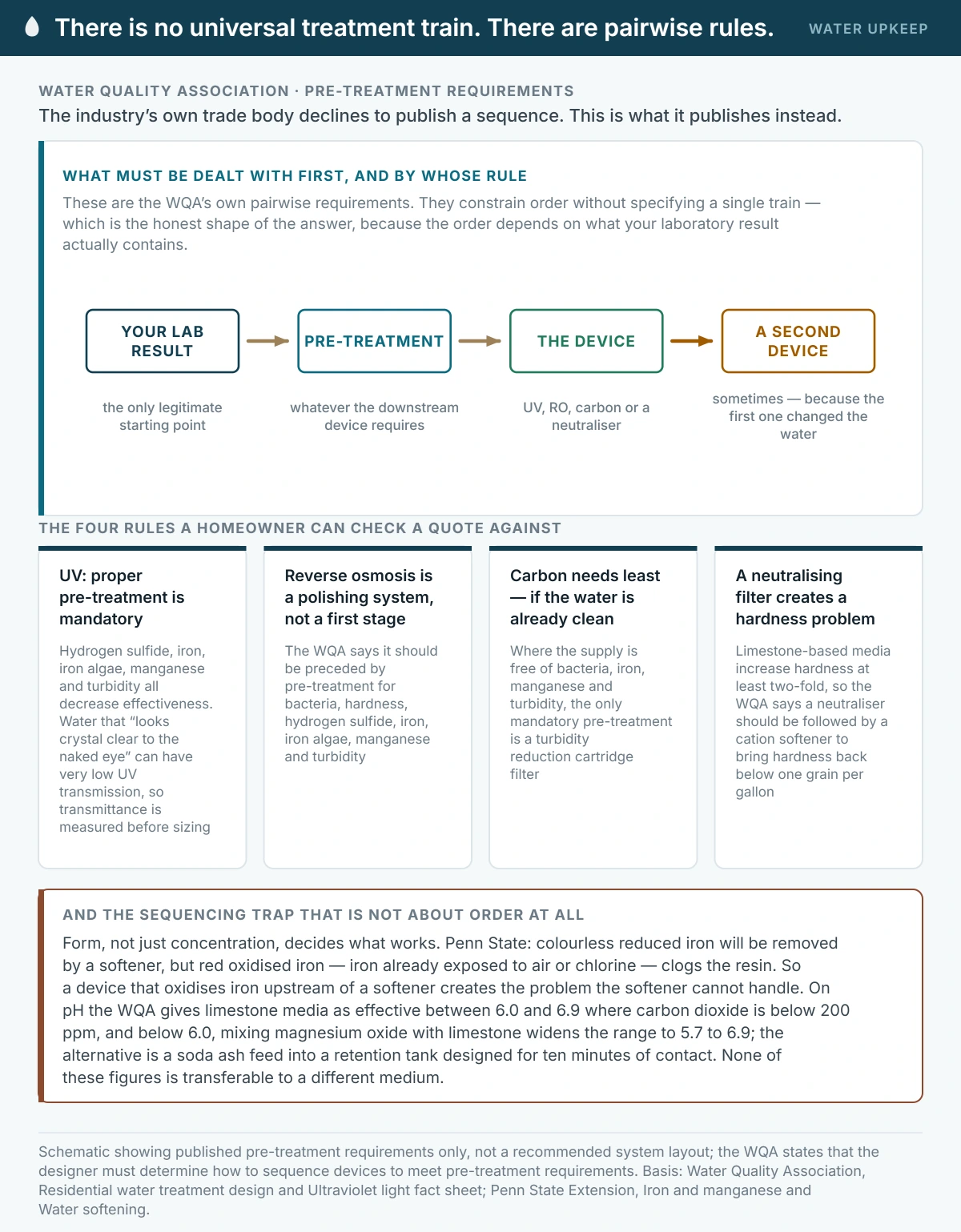
Form matters as much as concentration. Penn State: colourless, reduced iron will be removed by a softener, but red oxidised iron — iron already exposed to air or chlorine — clogs the resin. Which is a sequencing problem, not a product problem.
Hydrogen sulfide, hardness, nitrate and arsenic
Hydrogen sulfide is treated by concentration band: activated carbon below about 1.0 mg/L, aeration up to about 2 mg/L, oxidising filters at 2 to 3 mg/L, and continuous chlorination plus filtration above 6.0 mg/L. Where it is coming from is a separate diagnosis, covered in why water smells like rotten eggs.
Hardness is ion exchange, and Penn State notes levels below 7.0 grains per gallon will probably not cause major scaling and soap film. It also states the limitation that matters here: water softeners will not necessarily remove any of the more serious drinking water contamination problems. A softener is not a treatment system.
Nitrate is where that limitation bites hardest. The standard is no more than 45 mg/L of nitrate, or 10 mg/L of nitrate-nitrogen. Options are anion ion exchange, which loses effectiveness in sulfate-rich water; reverse osmosis, which Penn State reports rejects 83 to 92 per cent of incoming nitrate; and distillation, at about a gallon every four to five hours. A standard cation softener does not touch nitrate.
Arsenic requires knowing which form you have. EPA’s maximum contaminant level is 10 µg/L, set in January 2001, down from 50 µg/L in 1975. Arsenite dominates groundwater and resists removal; arsenate is easier. So Penn State notes arsenic removal often starts by adding an oxidant to convert all the arsenic to the more easily removed arsenate form. After that: activated alumina, with media replacement every one to two years; point-of-use reverse osmosis; or anion exchange, which competes with sulfate and may raise corrosivity. Iron removal systems remove arsenic incidentally, with variable efficiency that requires testing.
Order matters, and there is no universal diagram
The WQA declines to publish a single sequence, saying instead that the designer must determine how to sequence devices in the proper order to meet pre-treatment requirements. What it does publish are pairwise rules, and these are the ones a homeowner can check a quote against:
- UV: proper pre-treatment is mandatory. Hydrogen sulfide, iron, iron algae, manganese and turbidity all decrease effectiveness.
- Reverse osmosis: should be used as a contaminant polishing system, preceded by pre-treatment for bacteria, hardness, hydrogen sulfide, iron, iron algae, manganese and turbidity.
- Carbon: if the supply is free of bacteria, iron, manganese and turbidity, the only mandatory pre-treatment is a turbidity reduction cartridge filter.
- Neutralising filter: limestone-based media increase hardness at least two-fold, so a neutraliser should be followed by a cation softener to bring hardness back below one grain per gallon.
That last one catches people out. Fixing acidic water creates a hardness problem, which then needs its own device.
On pH specifically, the WQA gives limestone media as effective between pH 6.0 and 6.9 where carbon dioxide is below 200 ppm; below pH 6.0, mixing magnesium oxide with limestone widens the correction range to 5.7 to 6.9. The alternative is a soda ash chemical feed into a retention tank designed for ten minutes of contact time.
Whole house or one tap
The WQA gives a decision rule that is easy to apply: point-of-entry treatment is mandatory when the health effect is caused by contaminant inhalation, and point-of-use can be used when the health effect is strictly caused by ingestion.
In practice that means hardness, iron staining and bacteria are whole-house problems, while nitrate and arsenic can often be handled at the kitchen tap. Point-of-use reverse osmosis is a much smaller purchase than a whole-house system, and its cost drivers are covered in what drives the cost of a reverse osmosis system.
Reading the certification marks
| Standard | What it certifies |
|---|---|
| NSF/ANSI 42 | Aesthetic impurities such as chlorine, taste and odour |
| NSF/ANSI 53 | Contaminants with a health effect |
| NSF/ANSI 44 | Cation exchange water softeners |
| NSF/ANSI 55 | Ultraviolet. Class A for contaminated water; Class B only for already-disinfected water |
| NSF/ANSI 58 | Reverse osmosis |
| NSF/ANSI 62 | Distillation |
| NSF/ANSI 401 | Emerging contaminants |
| NSF/ANSI 244 | Filters intended only for supplies already determined to be microbiologically safe |
Note the last row. A 244-certified filter is not for a well of unknown quality, and neither is a Class B UV system. Both exist for supplies that are supposed to be safe already.
Testing does not stop once the system is in
Treatment equipment does not announce that it has stopped working. Penn State states plainly that all water treatment equipment requires routine maintenance; the WQA notes UV units need cleaning, sanitising and lamp or filter changes. CDC’s annual cadence — test the water, check the well mechanically — continues after installation, not instead of it.
After any disinfection, Penn State recommends retesting for total coliform in 10 to 14 days, and if clear, again after two to three months. If bacteria return in either test, a continuous disinfection system will be necessary. That two-stage retest is the difference between knowing a problem is fixed and hoping it is.
When to call a professional
- You have a laboratory result you do not fully understand. Take it to a certified lab or your county health department before taking it to a salesperson.
- Coliform is present. Start with the wellhead and construction, not with equipment.
- You have been quoted for a system without a written analysis, or on the strength of an in-home test the seller performed.
- Two or more findings need addressing. Sequencing them wrongly can destroy the equipment you just bought.
- Arsenic or nitrate is present. Both need speciation or chemistry knowledge that a generic quote will not have.
Our guides to how a well works and what well water is cover the system your treatment sits on. More in our well water hub.
Sources and standards
- US Environmental Protection Agency — Protect your home’s water
- Centers for Disease Control and Prevention — Well testing and Well maintenance
- Water Quality Association — Residential water treatment design, Ultraviolet light fact sheet and Ultraviolet light
- Penn State Extension — Tips for buying water treatment equipment, Iron and manganese, Hydrogen sulfide, Nitrates in drinking water, Water softening, Removal of arsenic from wells, Coliform bacteria and Five parts of sanitary well construction
- NSF — Standards for water treatment systems
- Montana State University Extension Water Quality — Water treatment
Last reviewed September 9, 2026.