How Long Do Water Softeners Last?
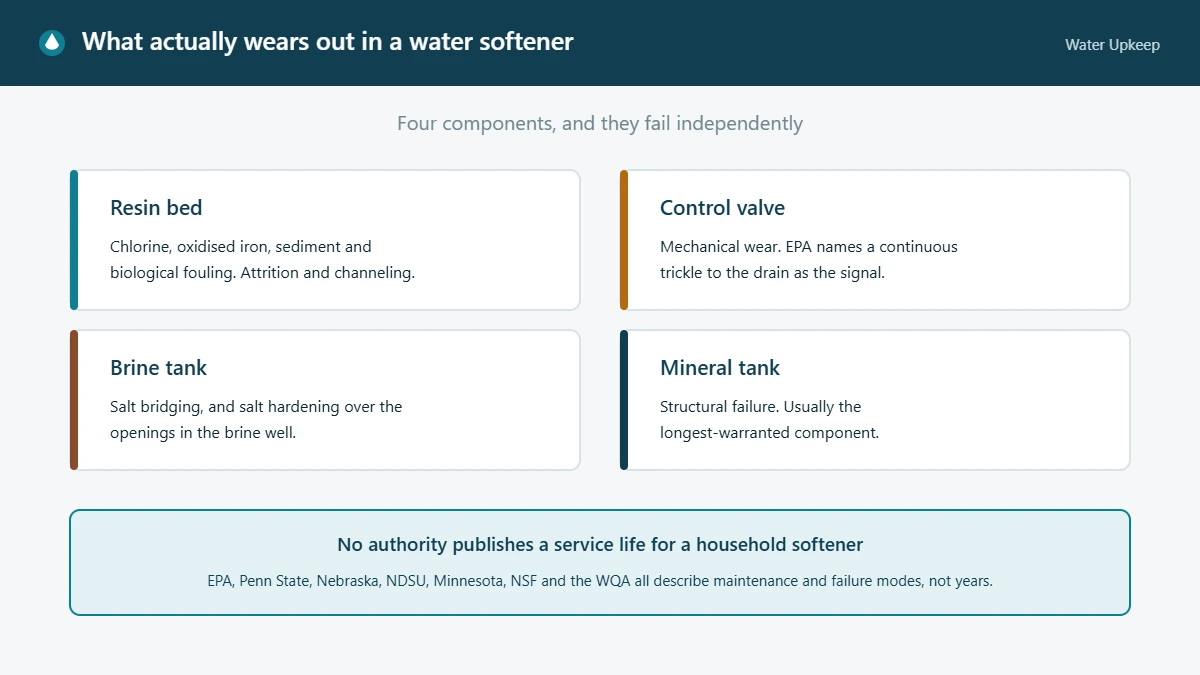
There is no published service life for a household water softener. We checked EPA WaterSense, Penn State Extension, the University of Nebraska–Lincoln, North Dakota State, the University of Minnesota, the Minnesota Department of Health, NSF and the Water Quality Association. Not one of them states how many years a softener should last. The familiar “ten to fifteen years” is a trade figure, not a standard. What those sources do describe, in detail, is which parts wear out, what damages them, and what a homeowner can control. That is a more useful thing to know, because a softener rarely fails all at once — a component goes, or the resin bed stops doing its job, and the two have very different answers.
Why no authority publishes a lifespan
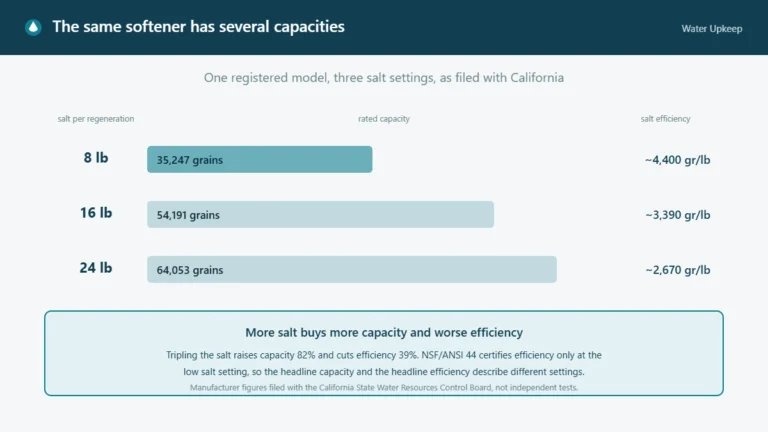
NSF/ANSI 44 is the standard residential softeners are certified against. Its scope covers reduction of hardness and specific contaminants, material safety, structural integrity, pressure drop, softening capacity and rinse effectiveness, accuracy of the brine system, and accuracy of the information given to the end user. Durability over time is not on that list. A certified softener has been tested to perform correctly, not to survive a given number of years.
Extension services take the same approach. They publish maintenance intervals, fouling thresholds and failure mechanisms, and they leave the arithmetic of lifespan alone — because it depends almost entirely on the water going through the unit.
What actually wears out
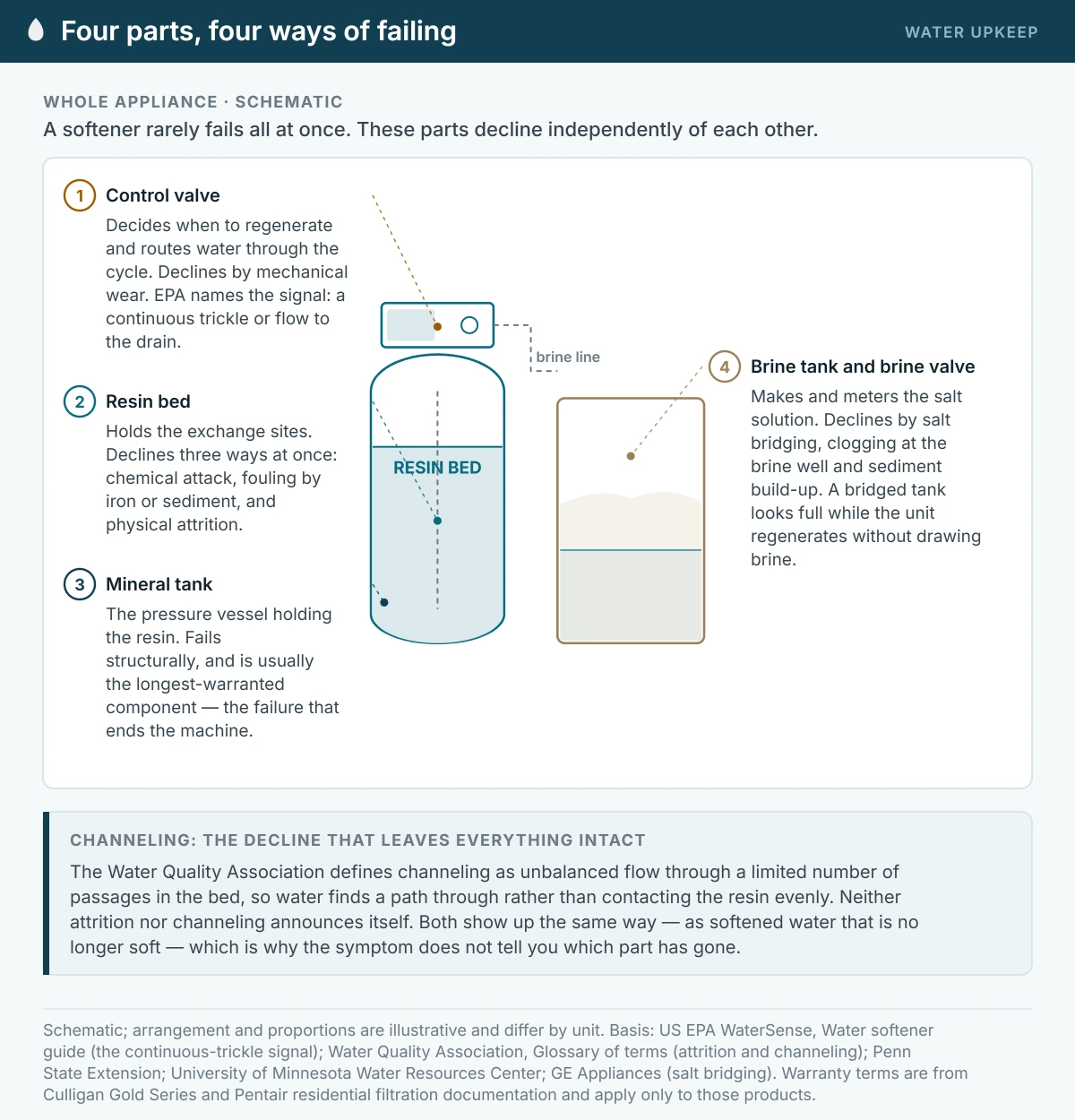
A softener is three things in one cabinet, and they fail independently.
| Part | What it does | How it declines |
|---|---|---|
| Resin bed | Holds the exchange sites that swap calcium and magnesium for sodium | Chemical attack, fouling by iron or sediment, physical attrition |
| Control valve | Decides when to regenerate and routes water through the cycle | Mechanical wear; a continuous trickle to the drain is the signal EPA names |
| Brine tank and brine valve | Makes and meters the salt solution that recharges the resin | Salt bridging, clogging at the brine well, sediment build-up |
| Mineral tank | Pressure vessel holding the resin | Structural failure; usually the longest-warranted component |
The Water Quality Association names two mechanisms of gradual decline in its glossary. Attrition is the lessening of a medium’s capacity through friction, chemical attack or contaminant saturation. Channeling is unbalanced flow through a limited number of passages in the bed, so water finds a path through rather than contacting the resin evenly. Neither announces itself. Both show up as softened water that is no longer soft.
What damages the resin bed
This is where the years are won or lost, and it is the one part of the picture with real numbers behind it.
Chlorine. The University of Minnesota Water Resources Center states that chlorine degrades resin beads, and that a chlorine concentration of 2 parts per million can halve the life of the resin. It suggests a chlorine filter ahead of the softener where chlorine exceeds 1 ppm. If you are on a chlorinated municipal supply, this is the single largest lever you have.
Iron. Penn State Extension is direct about the mechanism: oxidized forms of iron and manganese foul the resin, and using the bed as a mechanical filter can damage it and force much more frequent backwashing. Red, oxidized iron — iron that has already met air or chlorine — clogs the resin, so filtration ahead of the softener matters. The University of Nebraska–Lincoln notes that where iron or manganese is high, the resin may eventually need cleaning or replacement.
How much iron is too much is genuinely contested. The University of Minnesota says a softener may remove up to 3 mg/L; Penn State recommends softeners only where dissolved iron is below 5 mg/L; NDSU says some units handle up to 10 ppm of iron and manganese. That is a three-fold spread between extension services, so treat any single number you are quoted as one opinion among several.
Sediment. Penn State again: turbid raw water can clog the resin with mud and clay, and in some cases resin cannot be washed clean and has to be replaced.
Biological fouling. Bacteria and fungi form mats in the resin that reduce its effectiveness. The Water Quality Association’s sanitizing guidance notes softeners can become fouled with organic matter or bacteria after stagnation, flooding or a main break — and warns in the same document that high chlorine concentrations deteriorate O-rings and ion exchange resins. Over-chlorinating to solve a fouling problem is a way to create a resin problem.
The University of Minnesota also notes that resin itself varies: higher cross-linkage — 10 per cent rather than 8 — increases bead durability, and it states that quality resin can extend softener life by 50 to 100 per cent. That is the university’s own statement rather than a measured result from a cited study, so read it as a directional point about resin quality, not a number to plan around.
What manufacturers actually warrant
Since no authority publishes a lifespan, the only year figures worth anything are the ones manufacturers put in writing about their own products. Two published examples, each applying only to that company’s equipment:
- Culligan’s Gold Series owner’s guide warrants the entire softener for one year, the metering or sensor component for five years, the circuit board, control valve body and salt storage container for ten years, and the softener tank and resin for the life of the unit.
- Pentair’s residential filtration warranty lists five years on Fleck and Autotrol control valves, three years on the Autotrol Magnum series, five years on brine tanks and cabinets, and ten years on US-made fibreglass tanks of 13 inches diameter or less.
Read those as contract terms, not durability measurements. A longer warranty is a commercial decision, not evidence that one machine outlasts another. What they do usefully show is the manufacturers’ own hierarchy: valves and electronics are the short-warranty items, tanks and resin the long ones.
The maintenance that decides the outcome
EPA’s WaterSense guide sets out the routine: clean the resin annually, clean the brine tank at least every few years, keep the brine tank about half full of salt pellets rather than brimming, check salt every four to six weeks, and periodically check connection points, valves and drains for leaks.
Brine tank cleaning is one of those intervals where authorities simply disagree, and it is worth seeing the spread rather than an average:
| Source | Brine tank cleaning interval |
|---|---|
| EPA WaterSense | At least every few years |
| Culligan (own product documentation) | At least every two years, and every six months where iron is present |
| University of Minnesota Water Resources Center | Every five to ten years |
The Minnesota Department of Health adds two practical points: keep salt at or above the water level in the brine tank, and clean and disinfect the tank periodically. It also notes plainly that a typical softener is not designed to remove iron, and that excessive iron will foul the system. The University of Minnesota suggests a professional check every two to five years, and whenever household size changes.
Signs worth acting on — and ones that are folklore
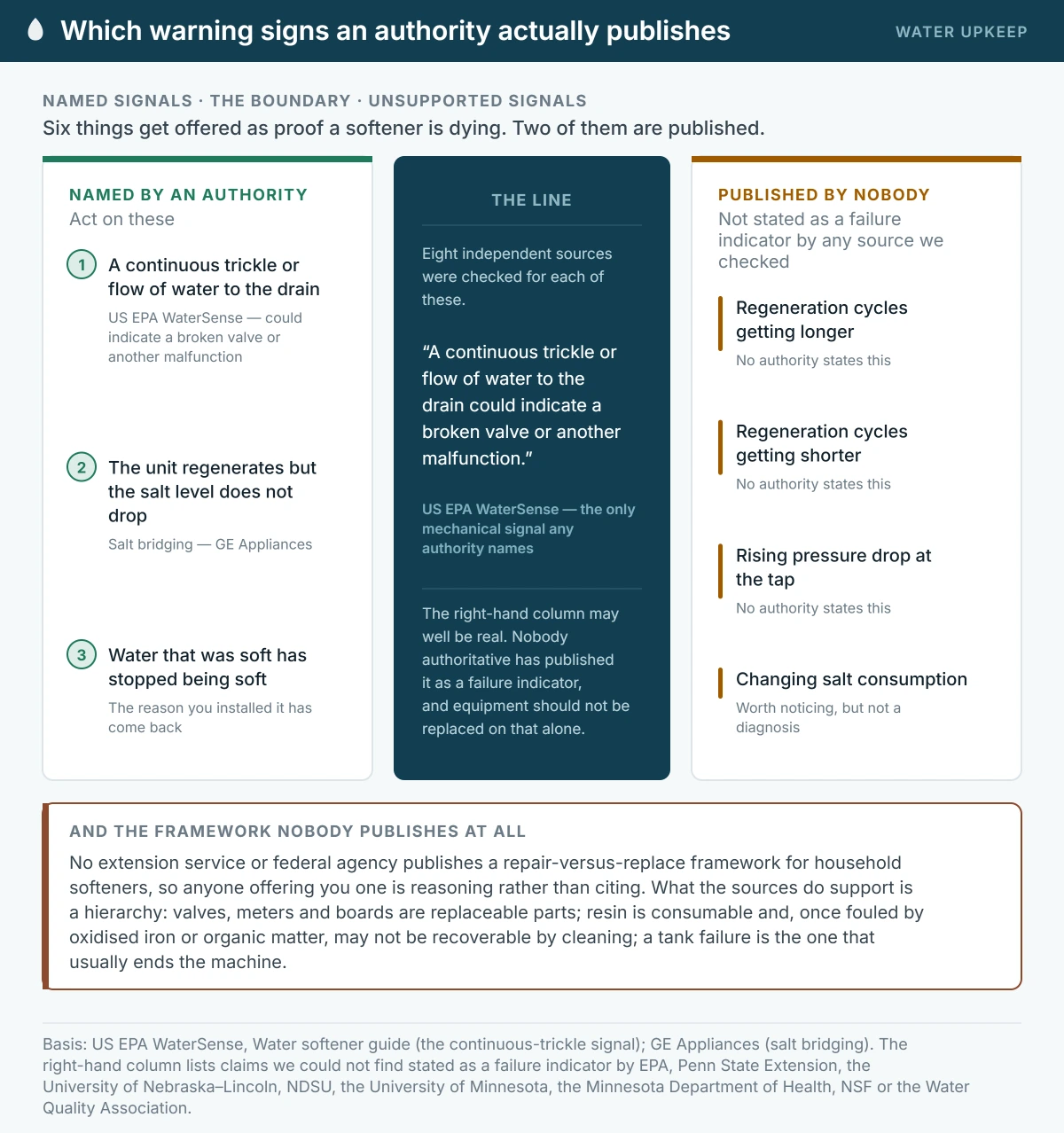
Two signals are named by an authority. EPA states that a continuous trickle or flow of water to the drain could indicate a broken valve or another malfunction. And salt bridging — salt pellets fusing into a crust that spans the tank, or hardening over the openings in the brine well — stops water moving between tanks, so the unit goes through the motions of regenerating without actually drawing brine. If the salt level has not dropped in weeks, that is worth investigating.
Several widely repeated diagnostics have no support from any of the sources above. Regeneration cycles getting longer or shorter, rising pressure drop at the tap, and changing salt consumption are all offered online as signs a softener is dying. None of them is stated as a failure indicator by EPA, any extension service, NSF or the WQA. They may well be real, but nobody authoritative has said so, and you should not replace equipment on the strength of them alone.
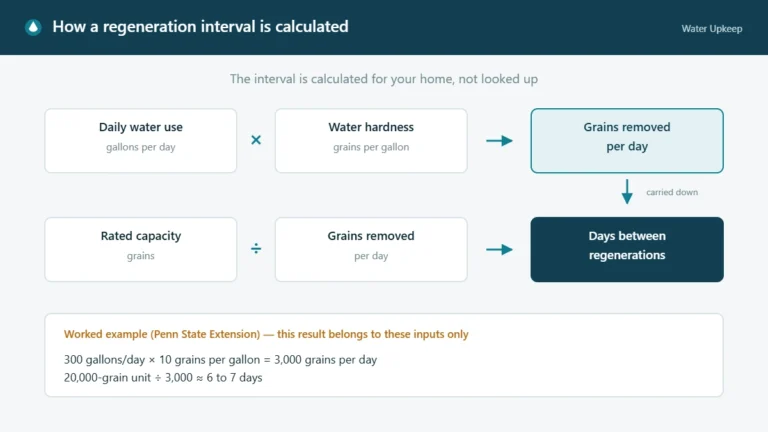
The signal that does matter is the one you noticed first: the reasons you installed a softener have come back. Scale on the kettle, soap that will not lather, spotting on glassware. If your water was soft and now is not, something in the chain has stopped working. Our guide to telling whether you have hard water covers how to confirm that rather than assume it, and how a regeneration interval is calculated explains what the unit is supposed to be doing between those symptoms.
Repair or replace
No extension service or federal agency publishes a repair-versus-replace framework for household softeners, so anyone offering you one is reasoning, not citing. The reasoning that follows from the sources here is straightforward enough. Valves, meters and boards are the short-warranty items and are replaceable parts. Resin is consumable, and where it has been fouled by oxidized iron or organic matter it may not be recoverable by cleaning. A tank failure is the one that usually ends the machine. If you are pricing a replacement, our guide to what actually drives the price of a water softener sets out the six factors that decide the quote.
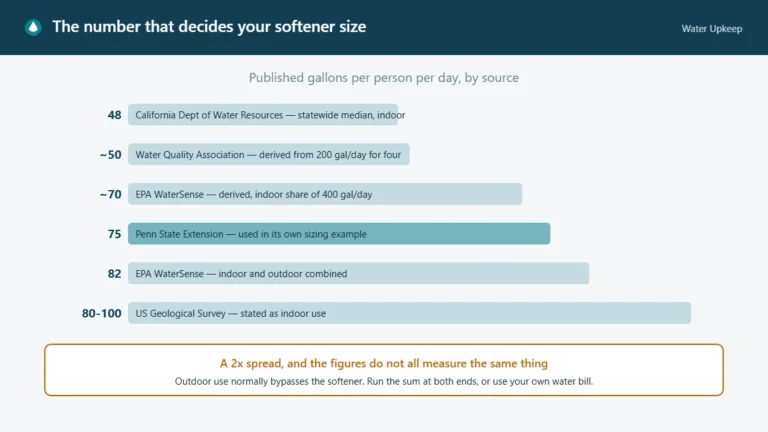
One thing worth checking before you spend anything: if the softener was sized for a household that no longer exists, replacing like for like repeats the mistake.
When to call a professional
- Water runs continuously to the drain, or the unit regenerates without the salt level dropping.
- Softened water has stopped being soft and cleaning the brine tank has not fixed it.
- Your water carries iron, manganese or sediment and you are not sure whether pre-treatment is in place.
- You are considering sanitising the system — dosing is specific, and the WQA warns that too much chlorine damages seals and resin.
- The household has grown or shrunk, or you have moved onto a different water source.
More on equipment and upkeep in our water softeners hub.
Sources and standards
- US Environmental Protection Agency, WaterSense — Water softener guide
- University of Minnesota Water Resources Center — Residential water softening
- Penn State Extension — Water softening and Iron and manganese in private water systems
- University of Nebraska–Lincoln Extension — Drinking water treatment: water softening (ion exchange)
- North Dakota State University Extension — Water softening (ion exchange)
- Minnesota Department of Health — Home water softeners
- Water Quality Association — Glossary of terms and Sanitizing residential water treatment systems
- NSF — NSF/ANSI 44 technical requirements
- Culligan — Gold Series softener owner’s guide (manufacturer documentation, that product only)
- Pentair — Residential filtration limited warranty (manufacturer documentation, those products only)
Last reviewed September 18, 2026.