How to Install a Water Softener
Installing a water softener is regulated plumbing work, and this guide is not a set of steps. Two things make it that way. The drain line has to discharge through an air gap, because a direct connection between a softener drain and the sanitary drainage system is a cross-connection — and under the right pressure conditions a cross-connection runs backwards. And in some places the appliance is not permitted at all, because of what it discharges. What follows is what the job involves, what a permit typically covers, what you need to know before anyone quotes, and where the handoff to a licensed plumber and your local authority belongs.
First: check whether you are allowed to install one
EPA states it plainly: because cation exchange water softeners discharge salt to the wastewater stream, they can impact local water quality or septic system efficacy, and therefore some local jurisdictions prohibit the installation and use of these systems. Its instruction is to check local restrictions before purchasing.
This is not hypothetical. California’s AB 1366, chaptered in 2009, added Water Code section 13148, which defines a residential self-regenerating water softener as equipment that discharges brine into a community sewer system, and authorises a local agency — after a public hearing and a required regional water board finding — to control salinity from these appliances, including prohibiting installation and requiring removal of units already installed.
Septic systems are a separate question. Rhode Island’s Department of Environmental Management notes brine disrupts the settling of solids in the septic tank and reduces the volume available for solids separation, potentially sending solids and grease into the leachfield, and that discharging brine to a more advanced onsite treatment system can disrupt the treatment process and void the manufacturer’s warranty. Its preferred practice is discharge below ground to a drywell wherever possible, and Rhode Island Department of Health rules prohibit all such discharges within 200 feet of drilled, driven or dug public wells, or 400 feet of gravel-packed public wells. Those are Rhode Island figures; yours will differ.
One phone call to your sewer or sanitary district, before you shop, can save the entire purchase.
Second: know your water
NDSU Extension puts it simply: before buying any water treatment equipment, you should know what impurities are in the water supply. Three numbers drive the whole design.
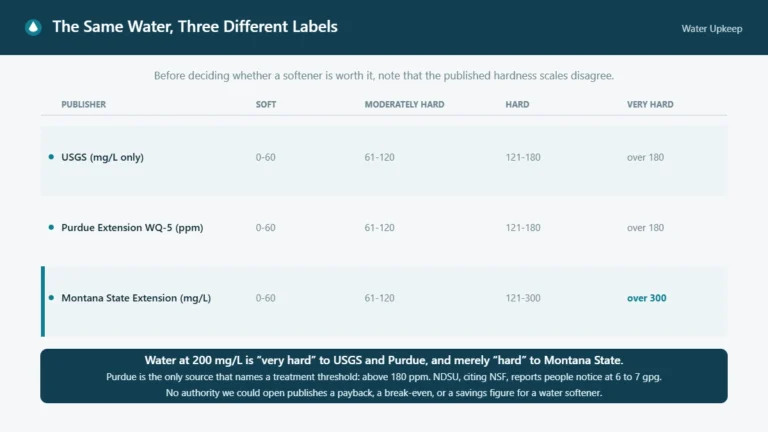
- Hardness, in grains per gallon. EPA notes water above 120 mg/L, or 7 grains per gallon, is generally considered hard and may benefit from softening.
- Iron. Extension services put the workable ceiling somewhere between 5 and 10 ppm — NDSU says softeners will remove up to 10 ppm of iron and manganese and that supplies above that may need a dedicated iron removal system; the University of Nebraska–Lincoln says iron above 5 ppm reduces effectiveness; Penn State recommends softening for iron only below 5 mg/L dissolved iron. Treat any single number you are quoted as one opinion.
- pH. Penn State gives the suitability envelope as pH above 6.7, hardness between 3 and 20 grains per gallon, and dissolved iron under 5 mg/L.
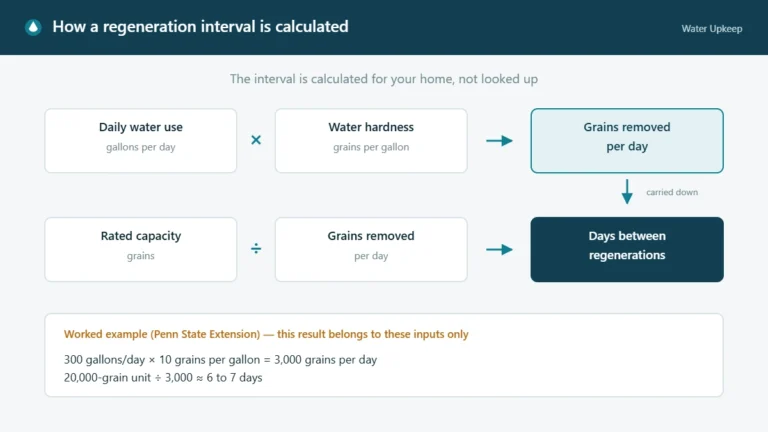
Penn State also warns against relying on a free test from a company selling softeners — get an independent laboratory number. Our guide to testing water hardness covers how, and what size softener you need covers the arithmetic that number feeds.
Pre-treatment usually comes first
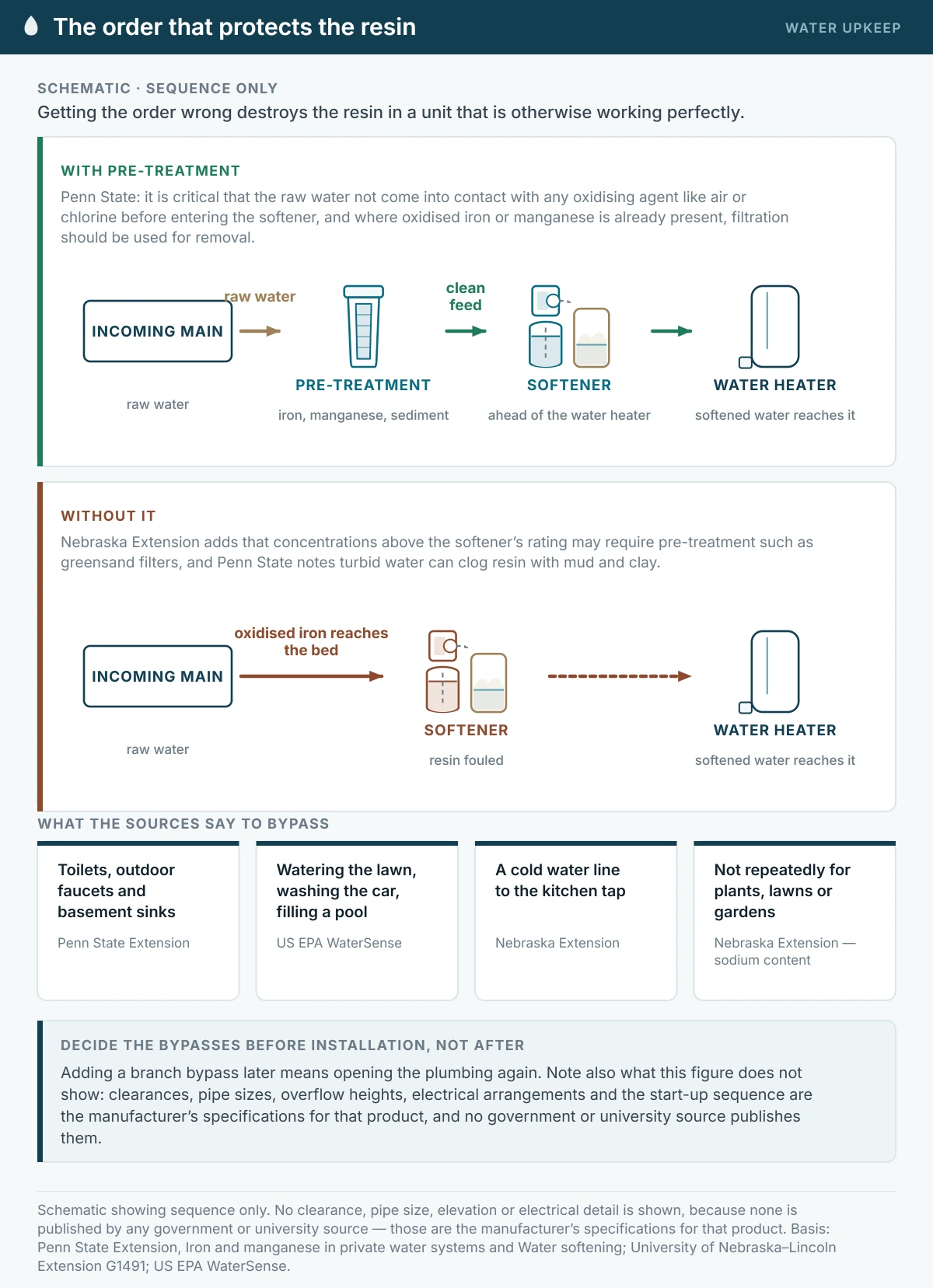
Penn State is precise about the failure mode: oxidised forms of iron and manganese will foul the softener resin, so it is critical that the raw water not come into contact with any oxidising agent like air or chlorine before entering the softener. Where oxidised iron or manganese is already present, filtration should be used for removal — ahead of the unit. Nebraska adds that concentrations above the softener’s rating may require pre-treatment such as greensand filters, and Penn State notes turbid water can clog resin with mud and clay.
Getting the order wrong destroys the resin in a unit that is otherwise working perfectly.
What the installation involves
In outline, and deliberately not as steps:
- A location on the incoming main, ahead of the water heater, with the clearance and access the manufacturer specifies.
- Inlet and outlet connections plus a bypass valve, in piping that meets local code requirements for potable water distribution and is of the size and material the manufacturer recommends.
- A drain line discharging through an air gap, never connected directly to the drainage system.
- A brine tank overflow routed as the manufacturer instructs.
- An electrical supply for the control valve.
- Branch bypasses for the taps that should not receive softened water.
- Programming and start-up, then commissioning checks.
Notice what is missing: dimensions. Clearances, pipe sizes, overflow heights, electrical arrangements and the start-up sequence are the manufacturer’s specifications, not universal standards, and no government or university source publishes them. Anyone giving you a generic number for those is giving you one product’s instructions applied to another.
The air gap, and why it is not optional
EPA’s Cross-Connection Control Manual gives the principle: a cross-connection is the link or channel connecting a source of pollution with a potable water supply, and air gaps are non-mechanical backflow preventers, very effective where either backsiphonage or backpressure conditions may exist. Backsiphonage results in flow in a reverse direction, caused by atmospheric pressure forcing a pollutant liquid toward a potable system under vacuum. EPA’s general dimensional rule is that the air gap must be twice the supply pipe diameter but never less than one inch.
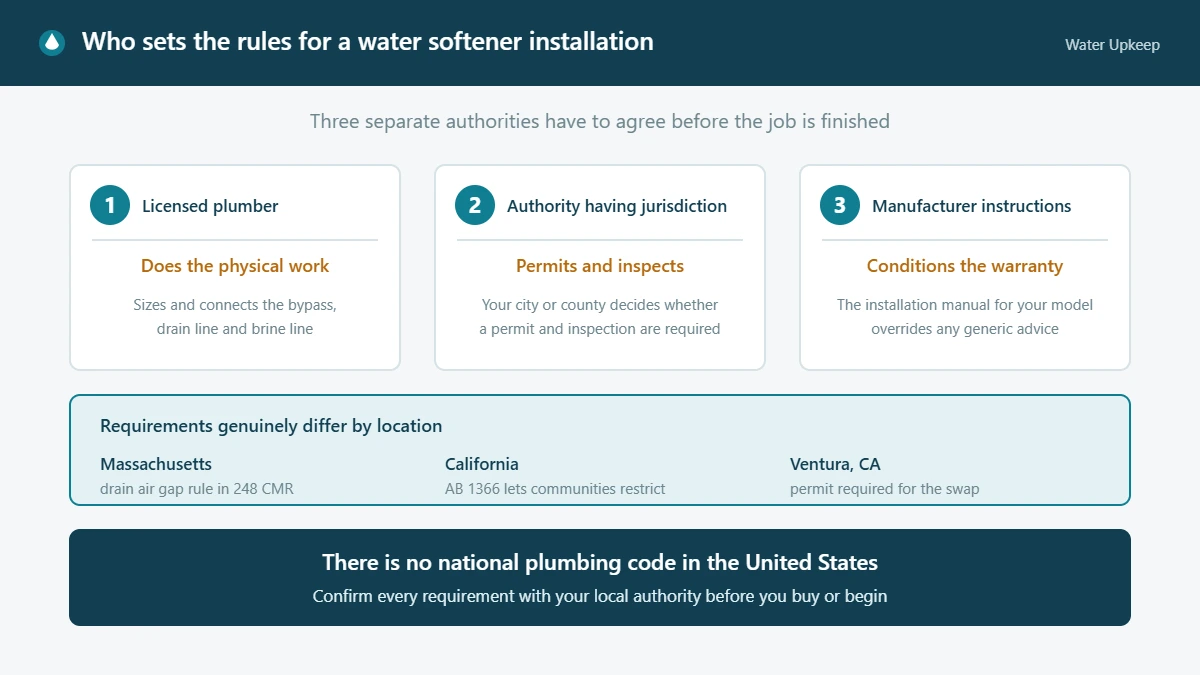
Where the requirement is written down, it is written down locally. The City of Ventura’s water softener inspection checklist requires that the discharge drain line enter the sanitary sewer system through an air gap in accordance with the relevant tables of the California plumbing code, or an air gap device complying with NSF 58 or IAPMO PS 65. Massachusetts’s Uniform State Plumbing Code, 248 CMR, defines a drainage-system air gap as the unobstructed vertical distance between the outlet of a waste pipe and the flood level rim of the receptacle, at least twice the effective diameter of the drain served, and defines an indirect waste pipe as one discharging into a drainage system through an air break or air gap.
Both of those are state documents. Neither is a national code. There is no national plumbing code in the United States — the model codes only have force where a state or local jurisdiction adopts them, which is exactly why the specification for your house has to come from your jurisdiction.
Permits, and who is allowed to do the work
Also local, and also varied. The City of Chaska, Minnesota requires a plumbing permit for any installation, alteration, repair or addition of any plumbing system, explicitly including water softener installation or replacement. It also limits who may do it: for residential new construction, only state-licensed contractors may apply for permits and perform the work; for a remodel, repair or addition, the homeowner may apply and perform the work only if they own and occupy the home as their primary residence.
Ventura’s checklist shows what an inspection covers: that the unit is listed and the installation matches the size, type and location indicated on the permit; that indoor units have proper clearances and access for maintenance per the manufacturer’s instructions; that outdoor units are listed for exterior installation or suitably protected; and that supply and outlet piping meets code requirements and manufacturer recommendations. It notes installations and replacements can generally be inspected in one site visit after completion.
Two jurisdictions, two sets of rules. Yours is a third.
What to bypass
Softening everything is neither necessary nor free. Penn State suggests bypassing toilets, outdoor faucets and basement sinks. EPA recommends the bypass valve when watering the lawn, washing the car or filling a pool. Nebraska notes it is not recommended to repeatedly use softened water for plants, lawns or gardens because of the sodium content, and describes a common configuration: a cold water line to the kitchen tap that bypasses the softener.
Decide this before installation, not after. Adding a bypass later means opening the plumbing again.
Programming and commissioning
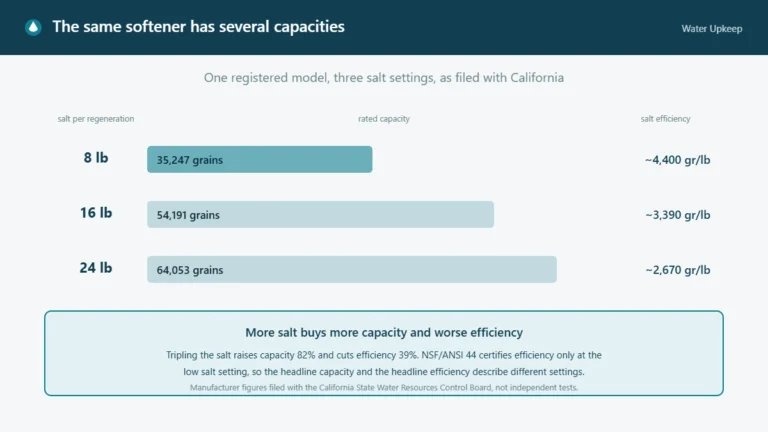
Three settings matter. The hardness figure the unit is programmed with should be your independently measured number, not an estimate. The salt setting determines the capacity you actually get — covered in how water softeners work. And the control type decides everything else.
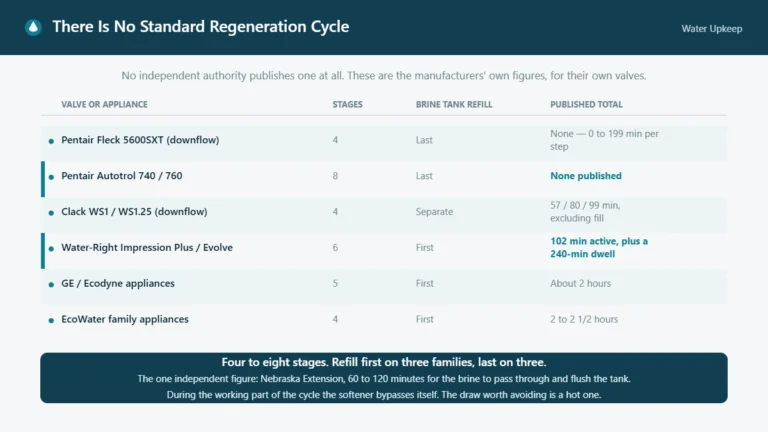
NDSU names four control arrangements: semiautomatic, where the operator initiates only the recharging cycle; automatic, on a programmable timer; demand-initiated regeneration, where all operations respond to water use demand; and off-site exchange-tank regeneration. EPA’s recommendation is unambiguous: avoid time-initiated regeneration systems and choose demand-initiated for a more efficient system. Its efficiency benchmark is greater than 3,350 grains of total hardness exchange per pound of salt, and the appliance standard to look for is NSF/ANSI 44.
EPA also warns against oversizing, which leads to inefficient use of water. Bigger is not a margin of safety here.
Commissioning — purging air, verifying the first regeneration draws brine, checking for leaks, testing hardness at a softened tap — follows the manufacturer’s start-up instructions. Ask your installer to demonstrate that the treated tap actually tests soft before they leave.
What goes wrong when it is done badly
- A drain line connected directly to the drainage system creates a cross-connection, with backsiphonage as the failure mode.
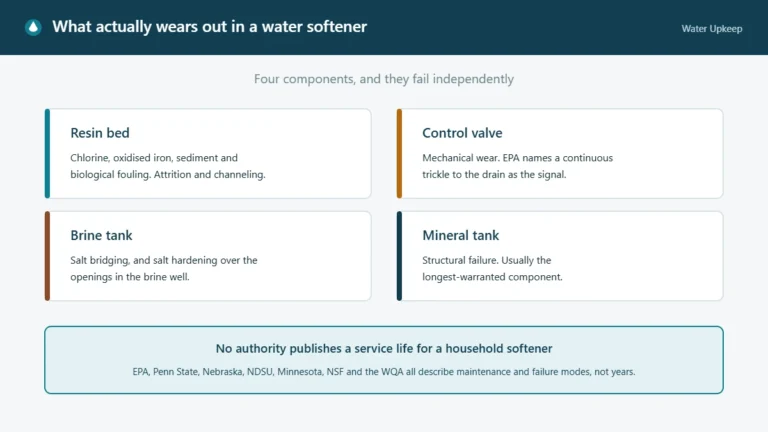
- Oxidised iron reaching un-pre-treated resin fouls the bed.
- Brine discharged to an unsuitable septic or advanced treatment system can clog a leachfield and void the treatment system’s warranty.
- An installation in a jurisdiction that prohibits self-regenerating softeners may have to be removed.
- A time-clock unit or an oversized unit wastes water and salt for its entire service life.
- Work done without the required permit may not pass inspection at resale.
The handoff
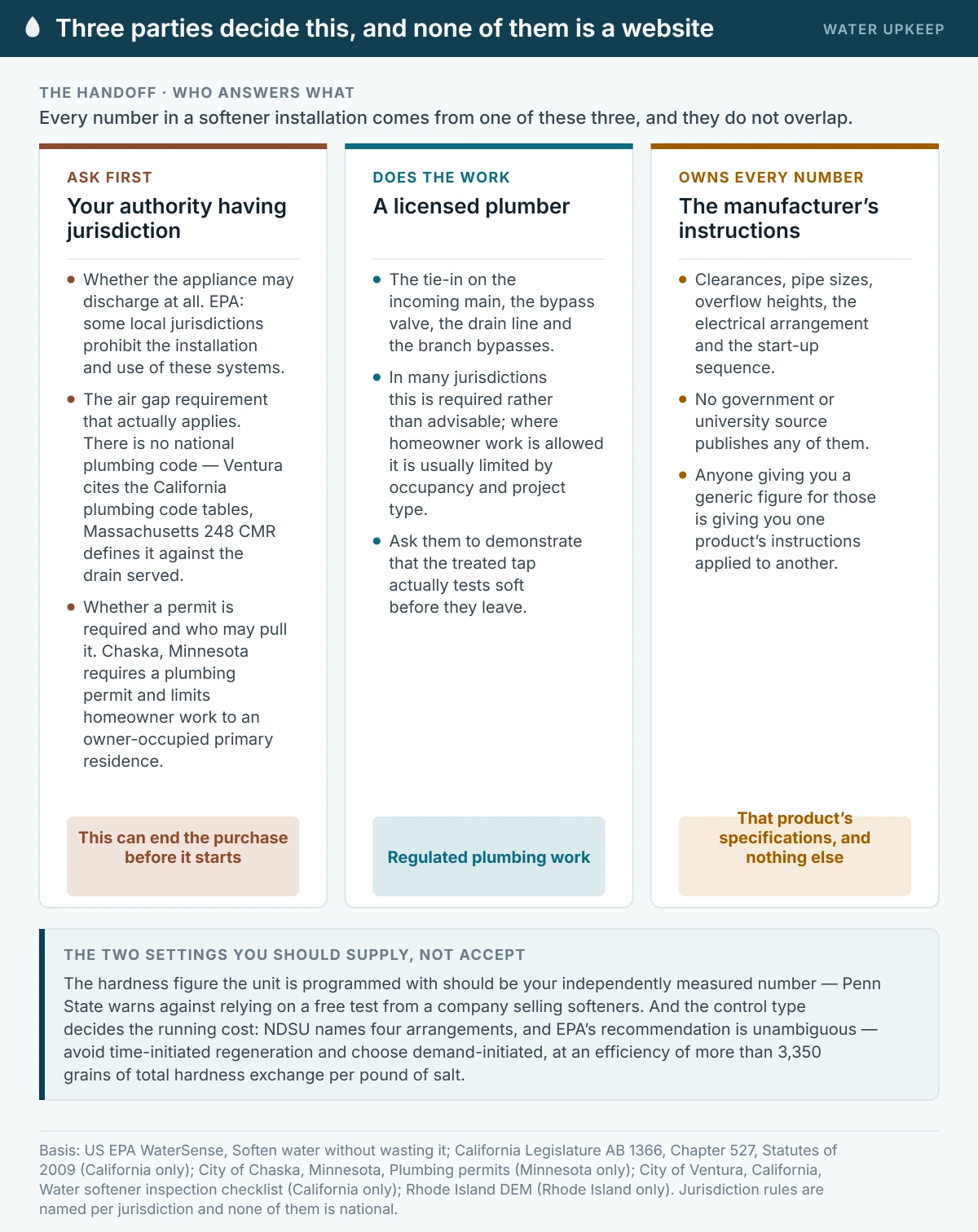
Three parties, and none of them is a website.
- A licensed plumber for the connection work. In many jurisdictions this is required rather than advisable, and where homeowner work is permitted it is usually limited by occupancy and by the type of project.
- Your authority having jurisdiction — the local building or plumbing department for permits, inspection and the air gap requirement that actually applies to you, and your sewer or sanitary district for whether the appliance may discharge at all.
- The manufacturer’s installation instructions for every clearance, pipe size, electrical detail and start-up step, because those are that product’s specifications and nothing else.
One footnote on sodium, since it comes up at installation. Softening adds sodium in proportion to hardness removed — Penn State gives approximately 7.5 mg per quart for each grain per gallon removed. That is a composition fact. Anyone with a dietary question about it should raise it with a clinician, not with an installer.
More equipment guidance in our water softeners hub, and the wider options in how to treat hard water.
Sources and standards
- US Environmental Protection Agency — Soften water without wasting it and Cross-Connection Control Manual, EPA 816-R-03-002
- City of Ventura, California — Water softener inspection checklist (California only)
- Massachusetts Board of State Examiners of Plumbers and Gas Fitters — 248 CMR 10.00, Uniform State Plumbing Code (Massachusetts only)
- City of Chaska, Minnesota — Plumbing permits (Minnesota only)
- California Legislature — AB 1366, Chapter 527, Statutes of 2009 (California only)
- Rhode Island Department of Environmental Management — Best management practices for the discharge of water softener recharge water (Rhode Island only)
- Penn State Extension — Water softening and Iron and manganese in private water systems
- North Dakota State University Extension — Water softening (ion exchange)
- University of Nebraska–Lincoln Extension — Water softening (ion exchange), G1491
- Centers for Disease Control and Prevention — Home water treatment systems
Last reviewed September 8, 2026.