What Is a Salt Free Water Softener?
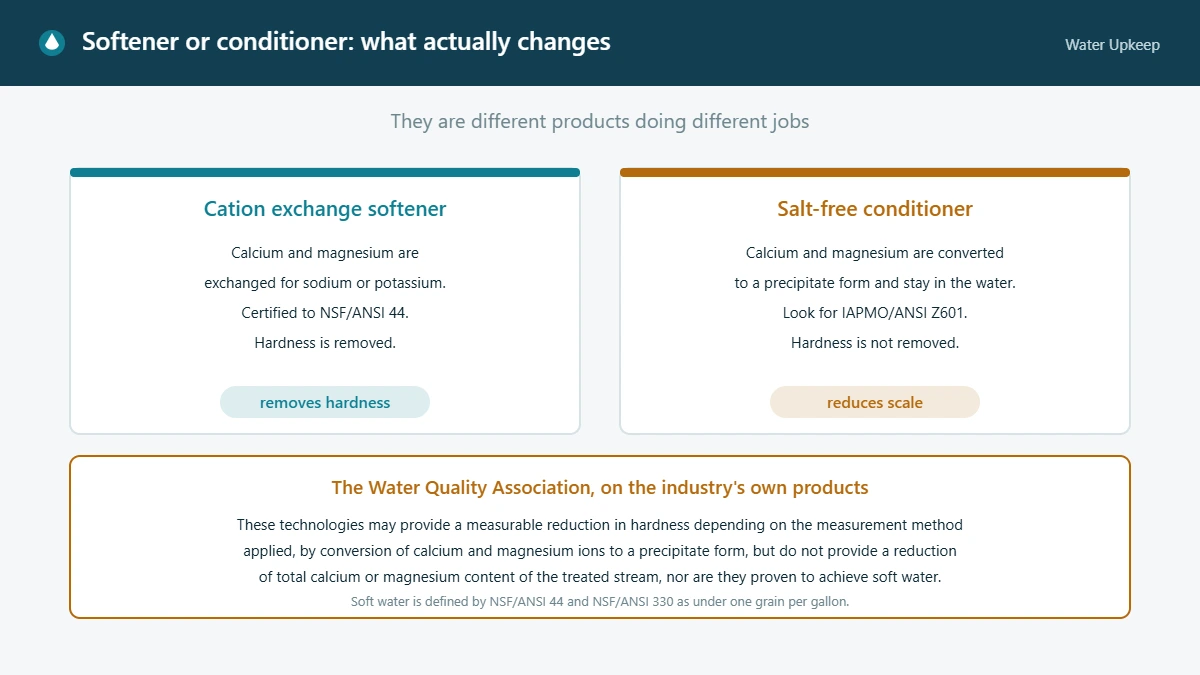
A salt-free water softener is not a softener. The Water Quality Association — the water treatment industry’s own trade body, publishing against its members’ commercial interest — states that these devices do not provide a reduction of total calcium or magnesium content of the treated stream, nor are they proven to achieve soft water, defined as less than one grain per gallon. What they are is a different category of product with a different job: reducing scale. That job is real, there is a certification standard for it, and for some households it is exactly the right purchase. But it is not softening, and the two should never be compared as if they were the same thing.
What softening means, and why the term does not apply
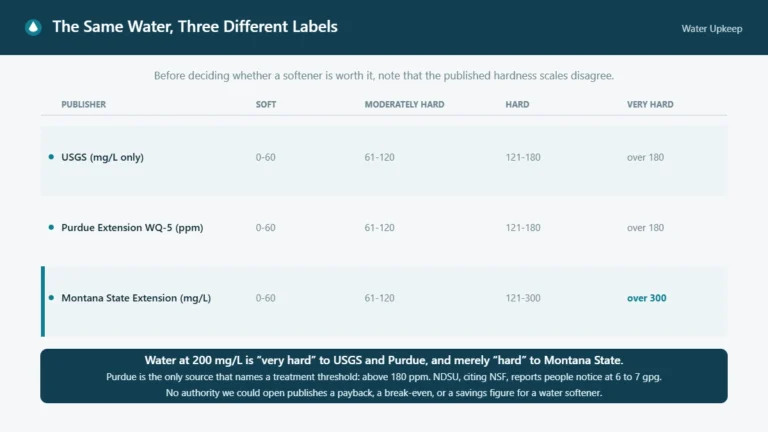
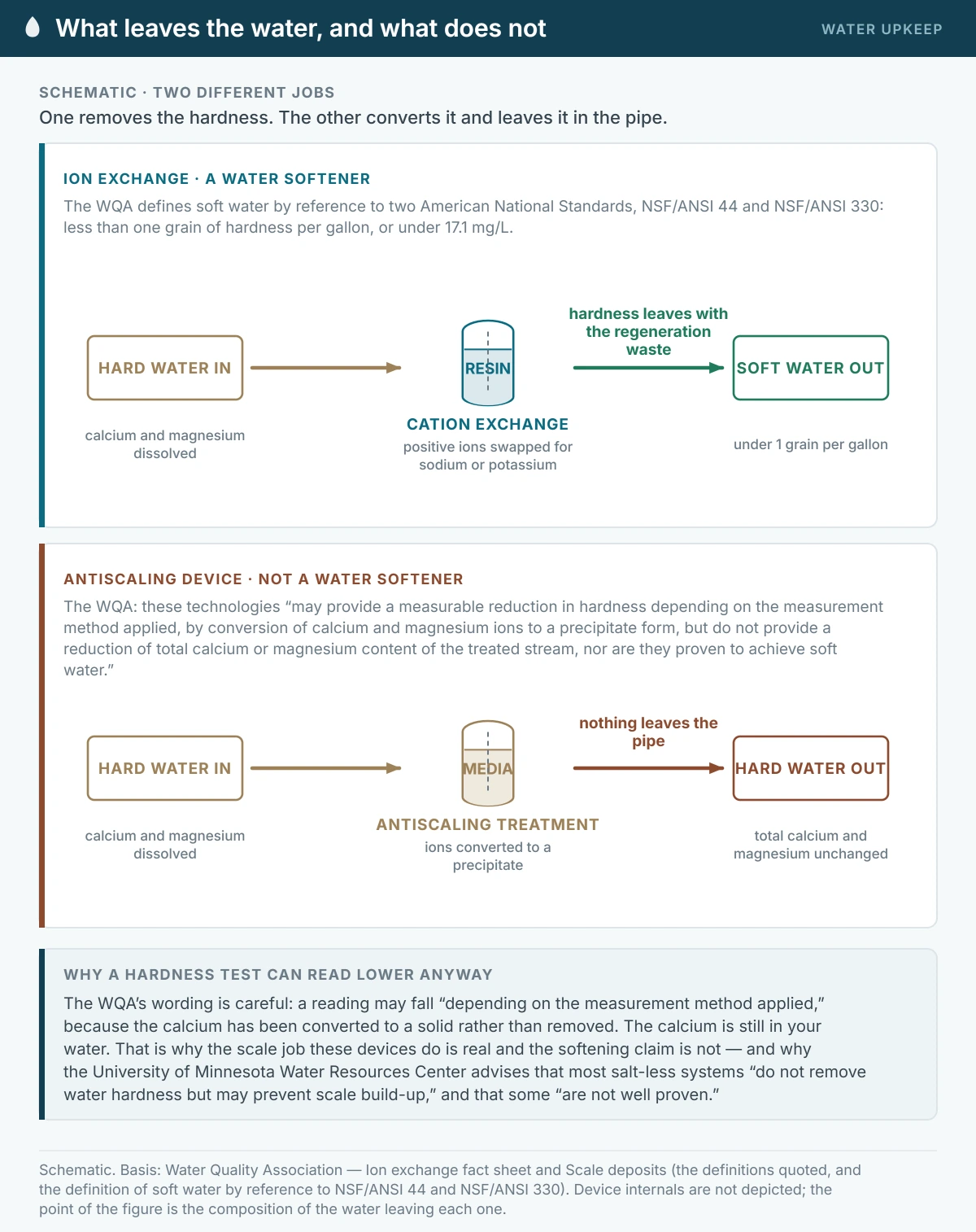
The Water Quality Association defines soft water by reference to two American National Standards, NSF/ANSI 44 and NSF/ANSI 330: water containing less than one grain of hardness per gallon, or under 17.1 mg/L. Softening by cation exchange achieves that by exchanging positive ions — calcium and magnesium — for sodium or potassium.
Salt-free devices do something else entirely. The WQA describes what they aim at: antiscaling treatment devices aim to reduce or prevent certain scale deposits that are normal to hard water behaviour. Its full assessment is worth reading carefully, because it is more precise than either side of the marketing argument:
These technologies may provide a measurable reduction in hardness depending on the measurement method applied, by conversion of calcium and magnesium ions to a precipitate form, but do not provide a reduction of total calcium or magnesium content of the treated stream, nor are they proven to achieve soft water.
So a hardness test might read lower depending on how it is performed, because the calcium has been converted to a solid rather than removed. The calcium is still in your water. Nothing left the pipe.
The three categories, in the sources’ own words
| Category | How it is described |
|---|---|
| Sacrificial media device | WQA: releases a chemical such as citric acid or phosphate into the water to discourage the formation of scale |
| Physical water treatment device | WQA: modifies the properties of water by physical means as opposed to chemical or mechanical means, and does not impart significant levels of any chemical substance. Covers magnetic, electronic, electrostatic and electromagnetic technologies |
| Template-assisted crystallisation | MnTAP: hard water passes through polymeric beads acting as catalytic nucleation sites for the formation of crystals |
Note that EPA’s own description of salt-free conditioners — that they condition water using electricity or another method without added chemicals or water waste — is accurate for physical water treatment devices and inaccurate for the sacrificial media category, which by the WQA’s definition does add a chemical. The two are sold under the same shelf label.
What the allowed sources actually say about each
Template-assisted crystallisation. The Minnesota Technical Assistance Program at the University of Minnesota lists its limitations plainly: hardness is not removed but transformed, with soft scale formation possible; catalyst media replaced every three to four years; ineffective on standing water systems; and the technology still developing, with industrial capabilities uncertain. The University of Minnesota Water Resources Center adds that these systems generally require relatively clean input water, and a filter may be needed to remove iron, manganese and sediment. Iron is a problem for the device, not something it treats.
Magnetic and electromagnetic. MnTAP describes the mechanism — a magnetic field oriented with or against the flow causes cations to move to the centre of the pipe and anions to the wall — and lists the same limitation: hardness is not removed but transformed, and the device cannot be used independently for water conditioning. The University of Minnesota Water Resources Center notes studies show mixed results on the effectiveness of this technology.
Electrically induced precipitation. Hardness ions are precipitated onto an electrode, which is then cleaned. MnTAP lists high capital, operational and maintenance cost, and the same inability to work independently.
The University of Minnesota Water Resources Center summarises the category in one sentence that is worth more than most product pages: salt-less systems are available, most do not remove water hardness but may prevent scale build-up on fixtures and appliances, and some are not well proven, so examine product claims carefully before purchasing.
What the evidence base actually is
Two documents carry almost all of it, and both are less than the marketing suggests.
The WQA Magnetics Task Force report, March 2001. The task force reviewed the literature and found that the thirty-four papers meeting its criteria for scientific validity did not address or answer the question of whether magnetic treatment works. It found indications that physical water treatment does work, that it does not work, and that it may work but only in certain circumstances. It noted that proposed mechanisms sometimes contradict each other — some studies reported calcium carbonate precipitation affected negatively, others reported the opposite. On one confounder it was specific: when pH is controlled, no difference in scaling due to magnetic treatment was shown, whereas uncontrolled-pH testing showed scale reduced by about 48 per cent. Its recommendation was that a standardised protocol be developed so studies could be compared at all.
The California evaluation, 2014. An evaluation of alternatives to domestic ion exchange water softeners, hosted by the California State Water Resources Control Board and published by the WateReuse Research Foundation, is the only allowed source with performance measurements. It matters that you know what it was.
- A laboratory bench study, not a residential field study.
- Two parallel bench systems following the German DVGW-W512 protocol: 1 gallon per minute intermittent flow, 21 days, about 700 gallons per test, a 14-litre water heater, an 8-hour daily rest period to simulate taps being turned on and off.
- One commercial unit per technology.
- Testing predominantly at 80 °C — which the report itself flags as greater than the maximum 60 °C expected in a domestic water heater, and which increases the quantity of scale formed.
- The measured endpoint was the mass of calcium carbonate scale deposited on a heating element. Not hardness in the delivered water. Not appliance life.
Its conclusion on the devices is what should carry across, rather than any percentage: the alternative devices do not remove hardness, whereas ion exchange and capacitive deionisation do. And on verification it makes an observation that no product page will: there is currently no method for assessing whether a physical water treatment device is working, other than observing scale formation.
We are deliberately not publishing the study’s percentage figures as product performance. Single-unit, bench-scale, 21-day results at a temperature above any household water heater are not a claim about what a device will do in your house, and repeating them as one would be exactly the error the study’s own caveats warn against.
The certification question
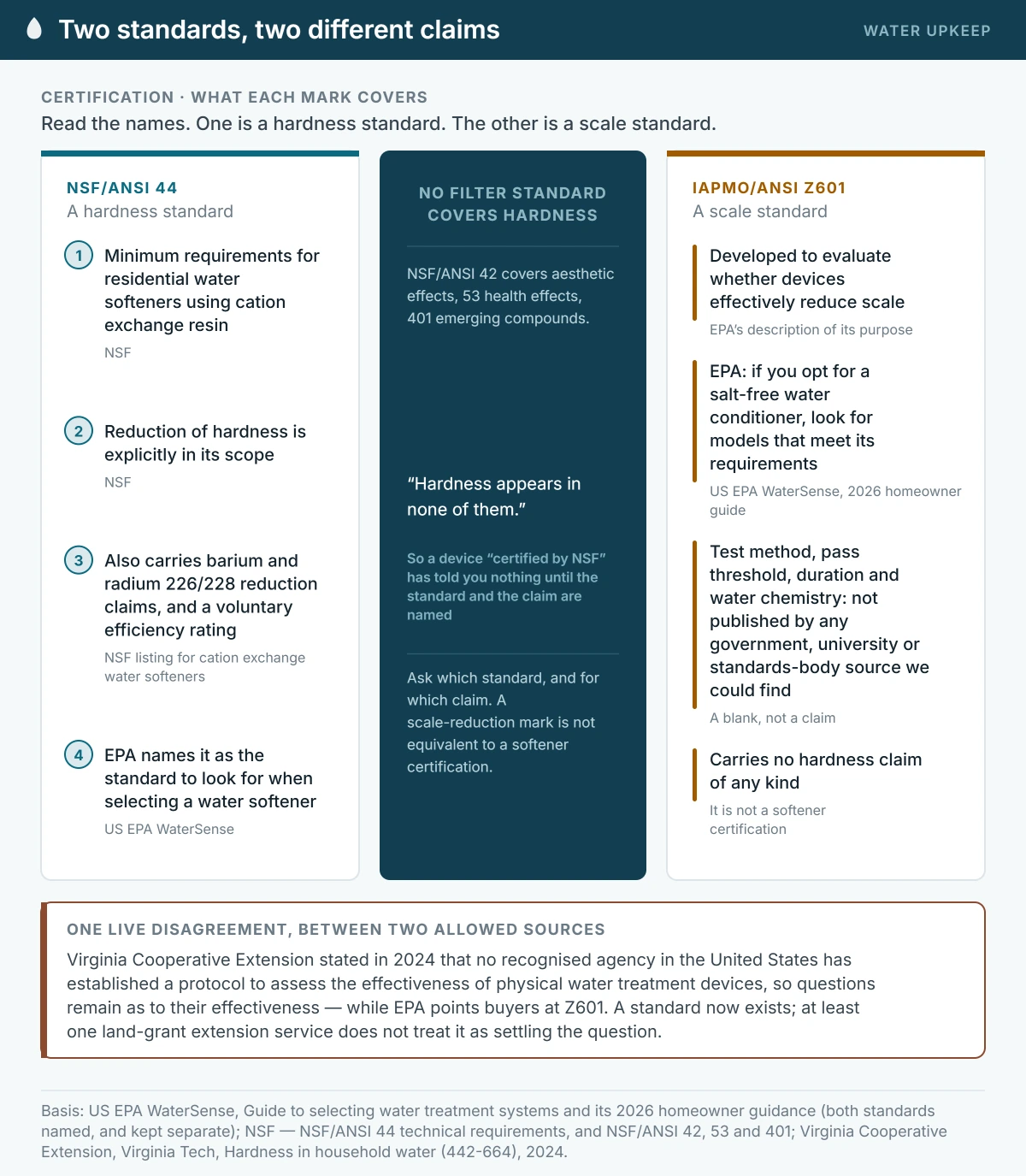
EPA names both relevant standards and keeps them separate: when selecting a water softener or conditioner, choose one certified to NSF/ANSI 44 Requirements for Water Softeners or IAPMO/ANSI Z601 Standard for Scale Reduction Devices. In its 2026 homeowner guide it is more specific — if you opt for a salt-free water conditioner, look for models that meet the requirements of IAPMO/ANSI Z601.
Read the names. One is a hardness standard, the other is a scale standard. NSF describes NSF/ANSI 44 as establishing minimum requirements for residential water softeners using cation exchange resin, which reduces hardness, with reduction of hardness explicitly in its scope. No NSF filter standard carries a hardness claim at all — NSF/ANSI 42 covers aesthetic effects, 53 health effects, 401 emerging compounds, and hardness appears in none of them.
What Z601 actually requires, we cannot tell you. EPA describes only its purpose — it was developed to evaluate whether softening devices or other treatment devices effectively reduce scale — and no government, university or standards-body source we could find publishes its test method, pass threshold, duration or water chemistry. So the honest advice is: look for the mark, understand it is a scale-reduction mark, and do not accept it as equivalent to a softener certification.
There is one live disagreement here worth knowing about. Virginia Cooperative Extension stated in 2024 that no recognised agency in the United States has established a protocol to assess the effectiveness of physical water treatment devices, so questions remain as to their effectiveness — while EPA points buyers at Z601. Both are allowed sources. A standard now exists; at least one land-grant extension service does not treat it as settling the question.
When one of these is genuinely the right choice
There is a real reason this category exists, and it is not consumer confusion. EPA states it directly, under a heading of its own: because cation exchange water softeners discharge salt to the wastewater stream, they can impact local water quality or septic system efficacy, and therefore some local jurisdictions prohibit the installation and use of these systems. Prior to purchasing an ion exchange softener, check local restrictions.
Those restrictions are real. California’s Health and Safety Code section 116786 lets a local agency limit the availability or prohibit the installation of residential water softening appliances that discharge to the community sewer, subject to specified findings substantiated by an independent salinity study, and only prospectively. One district acting under it, Ironhouse Sanitary District in Oakley, California, prohibited self-regenerating softeners discharging to its sewer in 2015 — its findings state up to 27 per cent of salinity entering its water recycling facility came from water softeners — while expressly noting that use of non-brine discharging water softening devices is not prohibited.
So the honest case for a salt-free conditioner is a practical one:
- Your municipality or sanitary district restricts brine discharge, or you are on a septic system where softener backwash is not permitted.
- You want no waste water — the University of Minnesota Water Resources Center notes salt-free devices use no extra water, against the 25 gallons a day or more EPA attributes to regeneration.
- You do not want to carry and store salt.
- Your complaint is scale specifically, rather than soap and lather.
What it will not do
Set expectations from the mechanism, not the packaging. The calcium and magnesium stay in the water. Anything that depends on their absence will not change.
That includes soap behaviour. Hardness is what consumes soap — the reason hard water gives reduced sudsing and cleaning action from soaps and detergents. No allowed source states that a salt-free conditioner improves lathering, and none states it does not; what the sources do establish is that the ions responsible remain present. Treat any lather claim as unevidenced.
It also will not help with iron, staining or odour. As above, iron is something these devices need removed before them, not something they address.
And it is not maintenance-free. MnTAP and the University of Minnesota both put template-assisted crystallisation media replacement at three to four years, and MnTAP notes such systems are ineffective on standing water systems.
When to call a professional
- Before anything else, check whether your municipality or sanitary district restricts brine discharge. That single fact may decide the whole question.
- You are on a septic system — check what your state and local board of health permit.
- Your water carries iron, manganese or sediment, which needs removing ahead of any scale-control device.
- You are being told a device is a salt-free softener, or that it is certified for hardness reduction. Ask which standard, and for which claim.
- Your complaint is soap, lather or spotted glassware rather than scale. That is a hardness problem, and the options are in how to treat hard water.
Our guide to how water softeners work covers the alternative, and the difference between hard and soft water covers what you would actually be changing. More in our water softeners hub.
Sources and standards
- Water Quality Association — Scale deposits, Ion exchange fact sheet, Magnetics Task Force report, March 2001 and Magnetics report
- Minnesota Technical Assistance Program, University of Minnesota — Non-salt conditioning alternatives
- University of Minnesota Water Resources Center — Residential softening
- California State Water Resources Control Board — Evaluation of alternatives to domestic ion exchange water softeners (2014)
- State of California — AB 334, Chapter 172, Statutes of 2003
- Ironhouse Sanitary District — Ordinance No. 57
- US Environmental Protection Agency, WaterSense — Guide to selecting water treatment systems, Water softeners technical sheet and Soften water without wasting it
- NSF — NSF/ANSI 44 technical requirements and NSF/ANSI 42, 53 and 401
- Virginia Cooperative Extension, Virginia Tech — Hardness in household water (442-664)
Last reviewed September 8, 2026.