How to Make Water Taste Better
Before you buy anything, work out what your water actually tastes of. Chlorine, metal, salt, earth and rotten eggs come from different places and have different fixes, and several of them are not in the water at all — they are in your drain, your aerator or your water heater. Most of what follows costs nothing. One taste, though, is not a taste problem: if your water smells of gasoline, solvent or fuel, stop drinking it and call your county or state health department. Everything else on this page is about comfort.
Start with two free tests
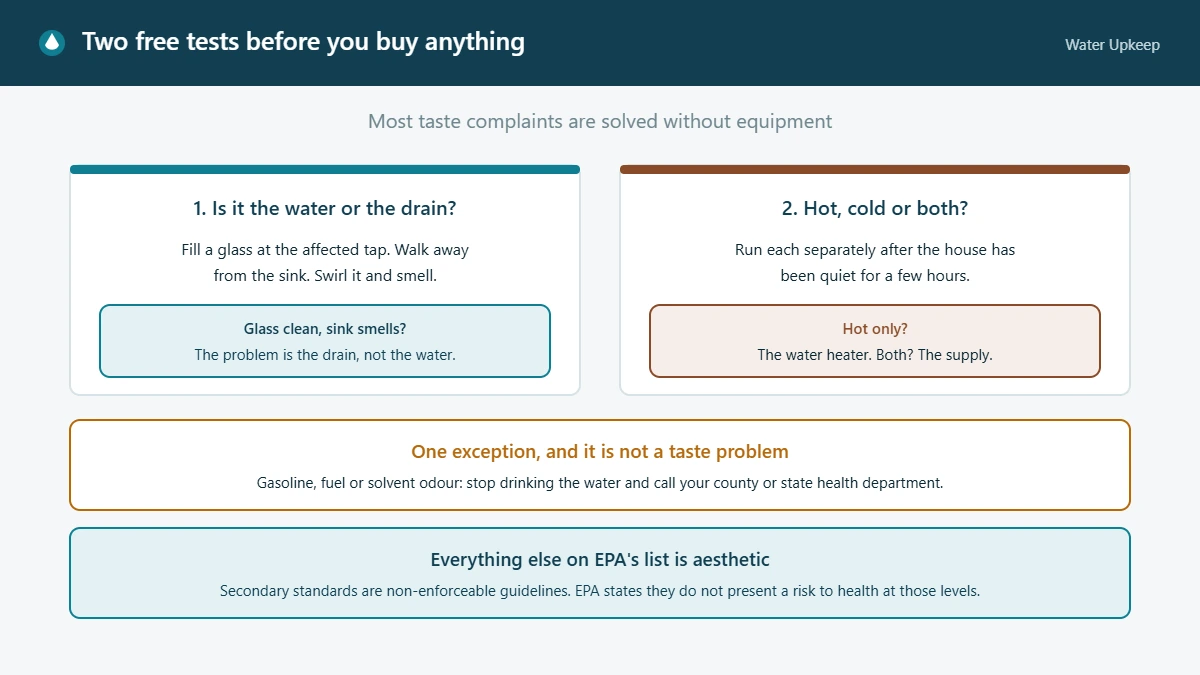
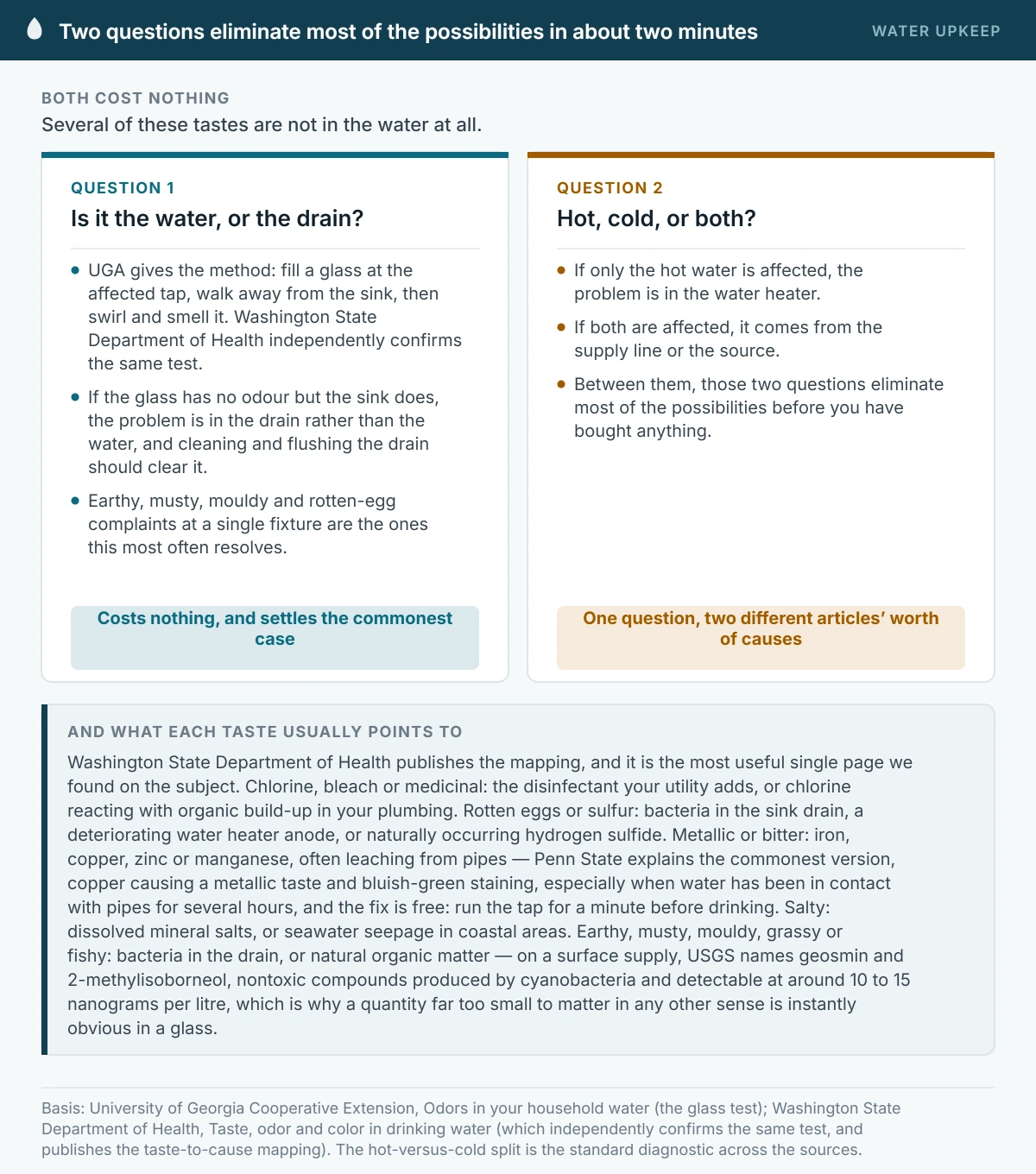
Is it the water or the drain? University of Georgia Extension gives the method: fill a glass at the affected tap, walk away from the sink, then swirl and smell it. If the glass has no odour but the sink does, the problem is in the drain, not the water, and cleaning and flushing the drain should clear it. Washington State Department of Health independently confirms the same test.
Hot, cold or both? If only the hot water is affected, the problem is in the water heater. If both are, it comes from the supply line or the source.
Between them, those two questions eliminate most of the possibilities in about two minutes.
What each taste usually means
| What you taste or smell | Usual cause |
|---|---|
| Chlorine, bleach, medicinal | The disinfectant your utility adds, or chlorine reacting with organic build-up in your plumbing |
| Rotten eggs, sulfur | Bacteria in the sink drain; a deteriorating water heater anode; or naturally occurring hydrogen sulfide |
| Metallic or bitter | Iron, copper, zinc or manganese, often leaching from pipes |
| Salty | Dissolved mineral salts — sodium, magnesium, potassium, chloride or sulfate, or seawater seepage in coastal areas |
| Earthy, musty, mouldy, grassy, fishy | Bacteria in the sink drain, or natural organic matter from lakes and reservoirs |
| Gasoline, petroleum, solvent | Possible contamination, for example from a leaking underground storage tank. Stop drinking the water |
That table is Washington State Department of Health’s, and it is the most useful single page we found on the subject.
The one that is not a taste problem
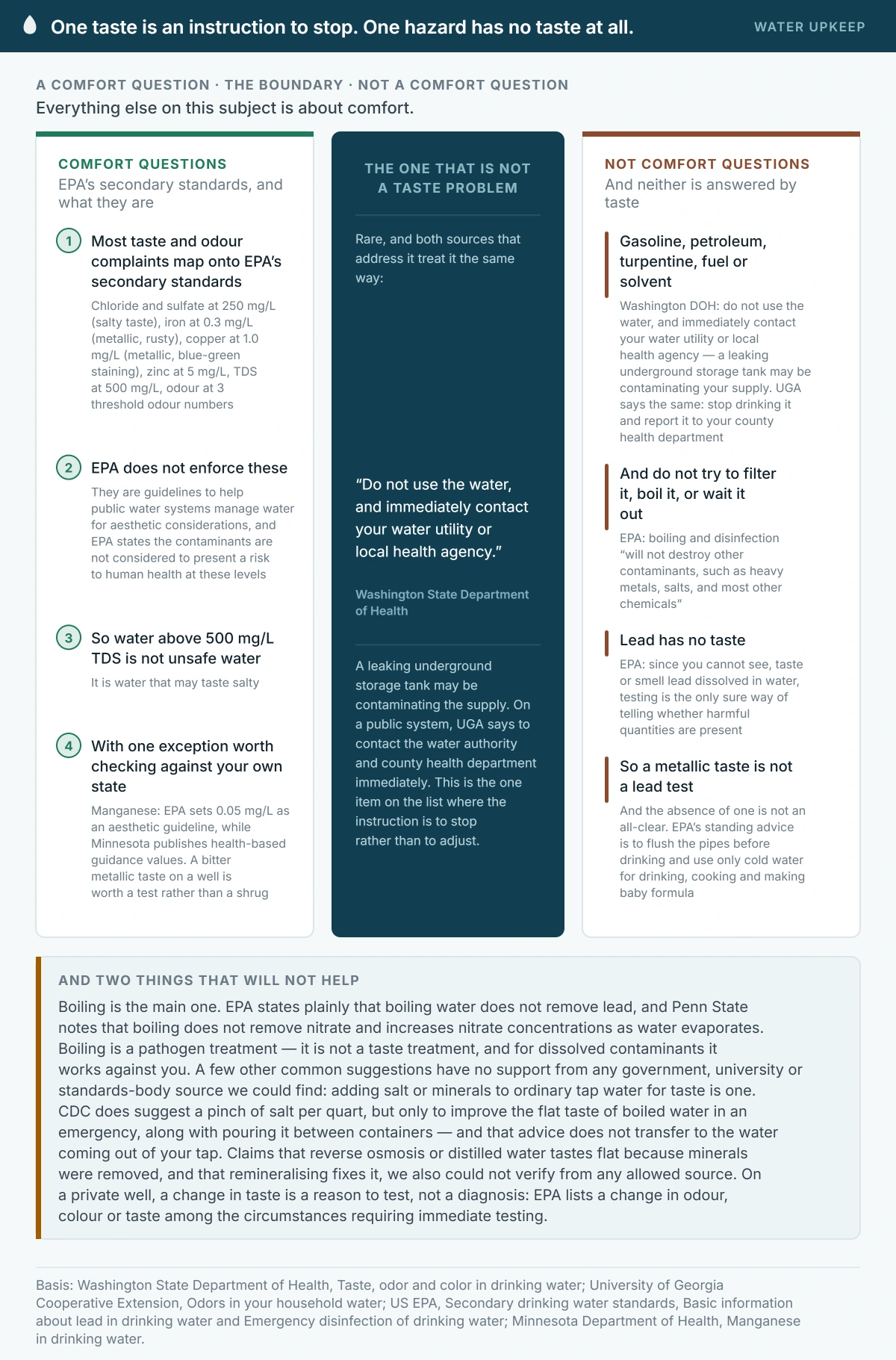
Petroleum, gasoline, turpentine, fuel or solvent odours are rare, and both Washington DOH and University of Georgia Extension treat them the same way. Washington’s wording: do not use the water, and immediately contact your water utility or local health agency, because a leaking underground storage tank may be contaminating your supply. UGA tells readers to stop drinking the water and report the problem to their county health department, and if on a public system to contact the water authority and county health department immediately.
Do not attempt to filter it, boil it or wait it out. EPA notes that boiling and disinfection will not destroy heavy metals, salts and most other chemicals.
Chlorine taste
Utilities add a disinfectant so that water stays microbiologically safe on its way to your tap. CDC states that chlorine or chloramine levels up to 4 mg/L are considered safe in drinking water, and that water containing chlorine can taste and smell different from untreated water or water containing chloramine.
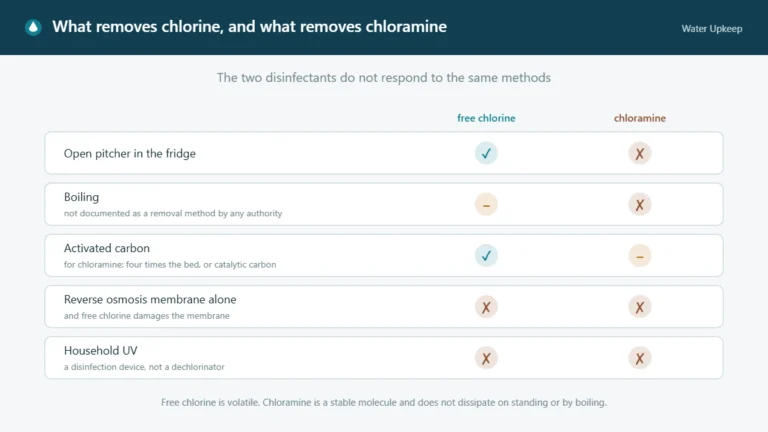
Two fixes have direct support. EPA’s WaterSense guide suggests pouring water into an open pitcher and placing it in the refrigerator for a day or two, so the chlorine evaporates naturally. Minnesota Department of Health gives the shorter version — a pitcher in the fridge, uncovered, for a few hours. The Portland Water Bureau also suggests adding slices of lemon or vitamin C to water in a glass or pitcher, which is one city utility’s advice rather than national guidance, but it is at least advice from a water utility.
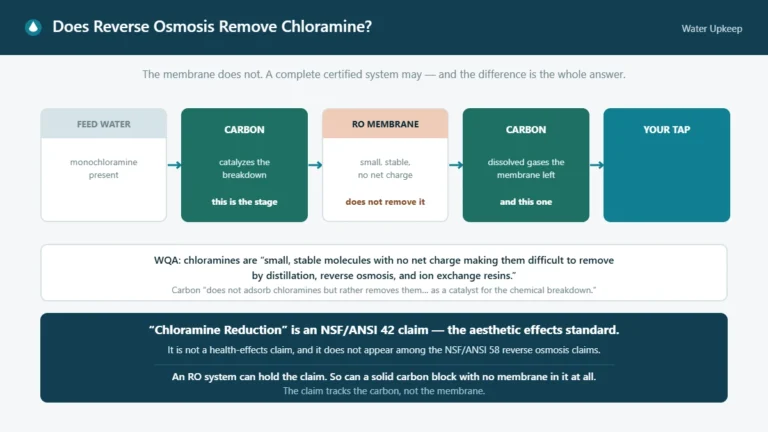
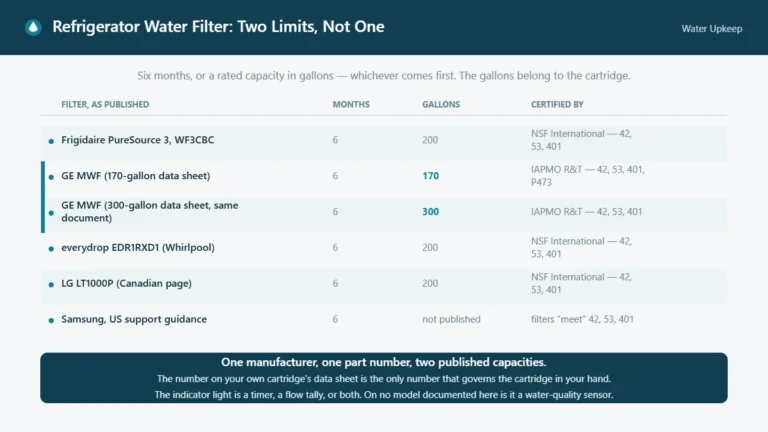
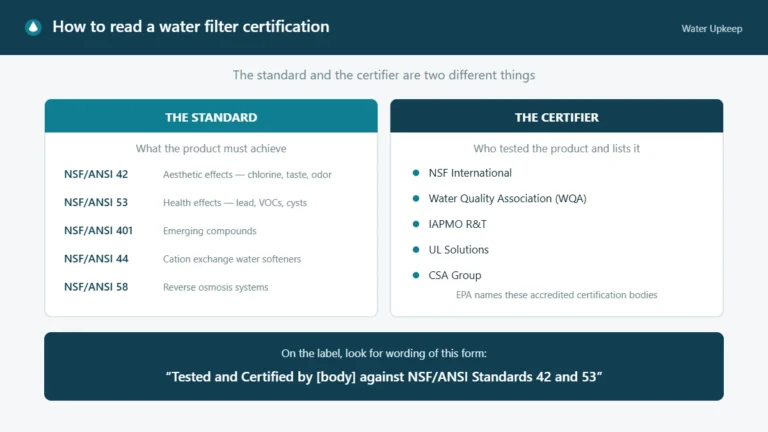
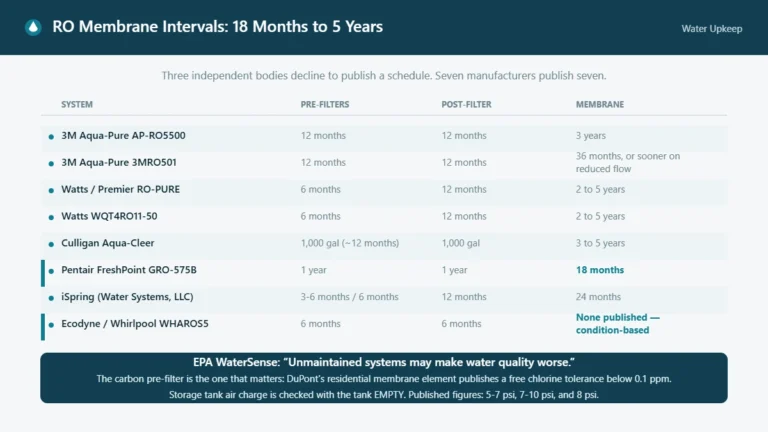
Activated carbon is the equipment answer. CDC notes that pitcher filters and fridge filters commonly use activated carbon, and that their main purpose is to improve the taste and smell rather than the safety of water. The relevant certification is NSF/ANSI 42, which covers aesthetic effects including chlorine, chloramine, taste and odour. Change the cartridge on schedule — CDC warns that failing to do so lets germs grow in the filter.
Note that chlorine and chloramine behave very differently, and standing time works much better on one than the other. Portland is careful about this, saying only that boiling or letting water sit for 24 hours “may help slightly.”
Metallic and bitter
Penn State Extension explains the most common version: copper causes a metallic taste and bluish-green staining, especially when water has been in contact with pipes for several hours. Corrosive water dissolves copper from pipes and fittings, and soft, acidic water below pH 7.0 tends to be more corrosive. The fix is free: run the tap for a minute before drinking, which is only necessary if the water has been sitting in the plumbing for at least an hour.
Portland Water Bureau attributes metallic taste to old iron pipes inside homes, and suggests cleaning faucet aerators and running the tap for one to two minutes. Aerators are worth a mention of their own: Michigan’s lead-safety programme describes them as screens that trap grime and metal flakes, and recommends cleaning the drinking water faucet aerator at least every six months — unscrew it, soak in vinegar, scrub with an old toothbrush, rinse and reassemble.
Two cautions on this one. First, a bitter metallic taste can indicate manganese, and manganese is the one item on EPA’s aesthetic list that some state health agencies treat differently: EPA sets 0.05 mg/L as a secondary, aesthetic guideline, while the Minnesota Department of Health publishes health-based guidance values of 100 micrograms per litre for infants drinking tap water and 300 micrograms per litre for everyone else. If you have a metallic taste and a well, that is worth a test rather than a shrug.
Second, and more important: lead has no taste. EPA states that since you cannot see, taste or smell lead dissolved in water, testing is the only sure way of telling whether there are harmful quantities present. A metallic taste is not a lead test, and the absence of one is not an all-clear. EPA’s standing advice is to flush the pipes before drinking and to use only cold water for drinking, cooking and making baby formula.
Earthy and musty
If the drain test cleared your plumbing and you are on a surface water supply, this is usually two compounds. The US Geological Survey describes geosmin and 2-methylisoborneol as nontoxic organic compounds responsible for musty or earthy taste and odour, produced by cyanobacteria — roughly seventy species are documented geosmin producers. The human detection threshold is around 10 to 15 nanograms per litre, which is why a quantity far too small to matter in any other sense is instantly obvious in a glass.
Seasonality is normal. Portland Water Bureau notes its unfiltered surface supply sees algae populations increase in summer, and that the algae are harmless. Activated carbon is the household answer here too.
Rotten eggs
Run the glass test first — this is the taste most often caused by the drain rather than the water. If it is the water, the pattern of which taps are affected tells you where it is coming from, and the fix differs completely between a water heater problem and a well problem. We cover the full diagnostic in why water smells like rotten eggs.
What the secondary standards actually are
Most taste and odour complaints map onto EPA’s National Secondary Drinking Water Regulations. It is worth understanding what those numbers are before you read one on a test report.
| Contaminant | Guideline level | Noticeable effect |
|---|---|---|
| Total dissolved solids | 500 mg/L | Hardness, deposits, coloured water, staining, salty taste |
| Chloride | 250 mg/L | Salty taste |
| Sulfate | 250 mg/L | Salty taste |
| Iron | 0.3 mg/L | Rusty colour, sediment, metallic taste, reddish staining |
| Manganese | 0.05 mg/L | Black to brown colour, black staining, bitter metallic taste |
| Copper | 1.0 mg/L | Metallic taste, blue-green staining |
| Zinc | 5 mg/L | Metallic taste |
| pH | 6.5 to 8.5 | Low: bitter metallic taste, corrosion. High: slippery feel, soda taste, deposits |
| Odour | 3 threshold odour numbers | Rotten-egg, musty or chemical smell |
| Foaming agents | 0.5 mg/L | Frothy, cloudy, bitter taste, odour |
EPA does not enforce these. They are established only as guidelines to help public water systems manage drinking water for aesthetic considerations, and EPA states that the contaminants are not considered to present a risk to human health at these levels. Water above 500 mg/L total dissolved solids is not unsafe water; it is water that may taste salty. Manganese, as above, is the exception worth checking against your own state’s guidance.
Things that will not help
Boiling is the main one. EPA states plainly that boiling water does not remove lead, and Penn State notes that boiling does not remove nitrate and increases nitrate concentrations as water evaporates. Boiling is a pathogen treatment. It is not a taste treatment, and for dissolved contaminants it works against you.
A few other common suggestions have no support from any government, university or standards-body source we could find. Adding salt or minerals to ordinary tap water for taste is one — CDC does suggest a pinch of salt per quart, but only to improve the flat taste of boiled water in an emergency, along with pouring it between containers. That advice does not transfer to the water coming out of your tap. Claims that reverse osmosis or distilled water tastes flat because minerals were removed, and that remineralising fixes it, we also could not verify from any allowed source.
When a taste change is a reason to test
EPA lists a change in odour, colour or taste among the circumstances requiring immediate testing of a private well, along with flooding, nearby construction or industrial activity, and any repair or replacement of the well system. Its baseline recommendation is an annual test for total coliform bacteria, nitrates, total dissolved solids and pH, and more frequent testing if young children or elderly adults live in the house or if someone is pregnant or nursing.
The general principle for well owners: a change in taste is a reason to test, not a diagnosis. On a municipal supply, your utility’s annual water quality report tells you what is in the water, and a phone call will usually tell you whether a seasonal or maintenance event explains what you are noticing.
When to call a professional
- Gasoline, fuel or solvent odour. Stop drinking the water and contact your county or state health department immediately.
- A sudden change in taste, odour or colour on a private well, or after a main break, flooding or nearby construction.
- Only the hot water is affected and you suspect the anode rod — University of Georgia Extension recommends a licensed plumber, and the heater manufacturer should be consulted first about the warranty.
- A persistent metallic or bitter taste on a well supply, which is worth an iron and manganese test.
- Anyone quoting you for treatment equipment before you have a laboratory result. Match the technology to the finding, not the complaint.
If a filter turns out to be the answer, our guide to what filtered water means covers which technology addresses which problem. More on the water you drink in our drinking water hub.
Sources and standards
- US Environmental Protection Agency — Secondary drinking water standards, Basic information about lead in drinking water, Does boiling water remove lead?, Protect your home’s water, Emergency disinfection of drinking water and Guide to selecting water treatment systems
- Washington State Department of Health — Taste, odor and color in drinking water
- University of Georgia Cooperative Extension — Odors in your household water
- Penn State Extension — Corrosive water problems and Nitrates in drinking water
- Centers for Disease Control and Prevention — Water disinfection with chlorine and chloramine, Choosing home water filters and Making water safe in an emergency
- US Geological Survey — Taste-and-odour compounds in surface water
- Minnesota Department of Health — Chlorination of drinking water and Manganese in drinking water
- Portland Water Bureau — Taste or odor issues
- State of Michigan — Cleaning your aerators
- NSF — NSF/ANSI 42, 53 and 401
- Water Quality Association — Taste and odor technical bulletin
Last reviewed September 9, 2026.