What Size Water Softener Do I Need?
Softener size is a calculation, not a lookup. You need three numbers: how many people live in the house, how much water each of them uses in a day, and how hard your water is in grains per gallon. Multiply them together to get the grains of hardness your household puts through the system daily, then divide the unit’s rated capacity by that figure to see how many days it would run between regenerations. Aim for three to five days. The reason nobody can hand you a chart is that one of those three numbers is genuinely disputed — published per-person daily use ranges from 48 to 100 gallons depending on who you ask, and that spread alone can move you a full size in either direction.
The calculation
Two steps. First, the daily grain load:
- People in the household × gallons per person per day × hardness in grains per gallon = grains removed per day
- Rated capacity in grains ÷ grains removed per day = days between regenerations
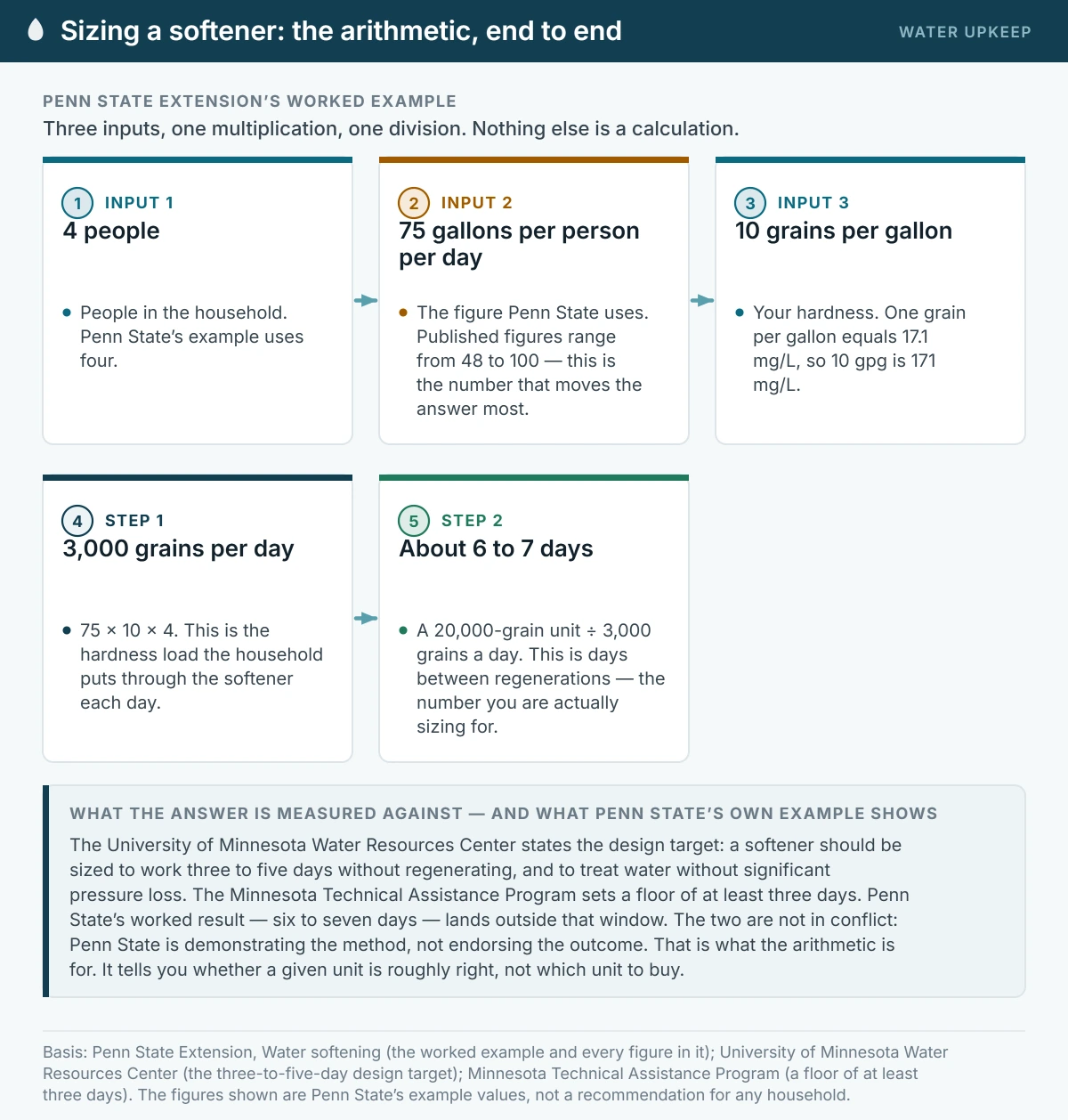
The University of Minnesota Water Resources Center states the design target: softeners should be sized to work three to five days without regenerating, and to treat water without significant pressure loss. The Minnesota Technical Assistance Program sets a floor of at least three days between regenerations.
A worked example
Penn State Extension publishes the arithmetic end to end. A household of four, at 75 gallons per person per day, with water at 10 grains per gallon:
- 75 gallons × 10 grains per gallon × 4 people = 3,000 grains per day
- A 20,000-grain unit ÷ 3,000 = about 6 to 7 days between regenerations
Worth noticing: that result lands outside the three-to-five-day window Minnesota recommends. The two are not in conflict — Penn State is demonstrating the method, not endorsing the outcome — but it shows what the arithmetic is for. It is a starting point that tells you whether a given unit is roughly right, not a verdict.
The number that moves the answer most
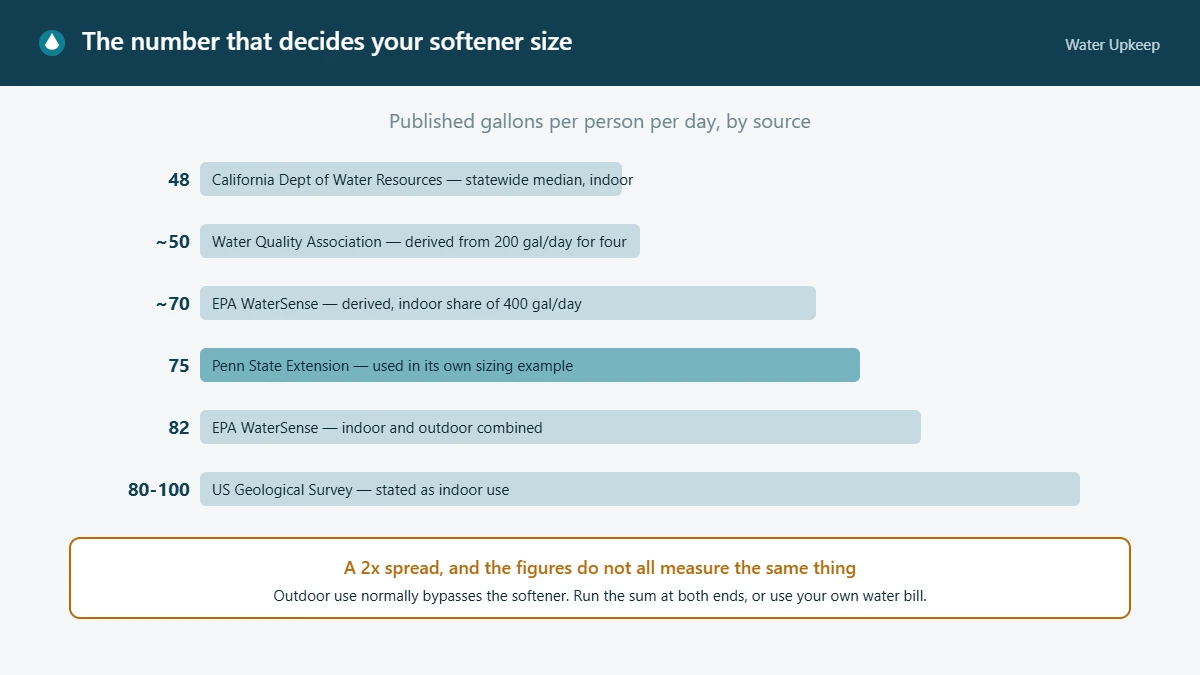
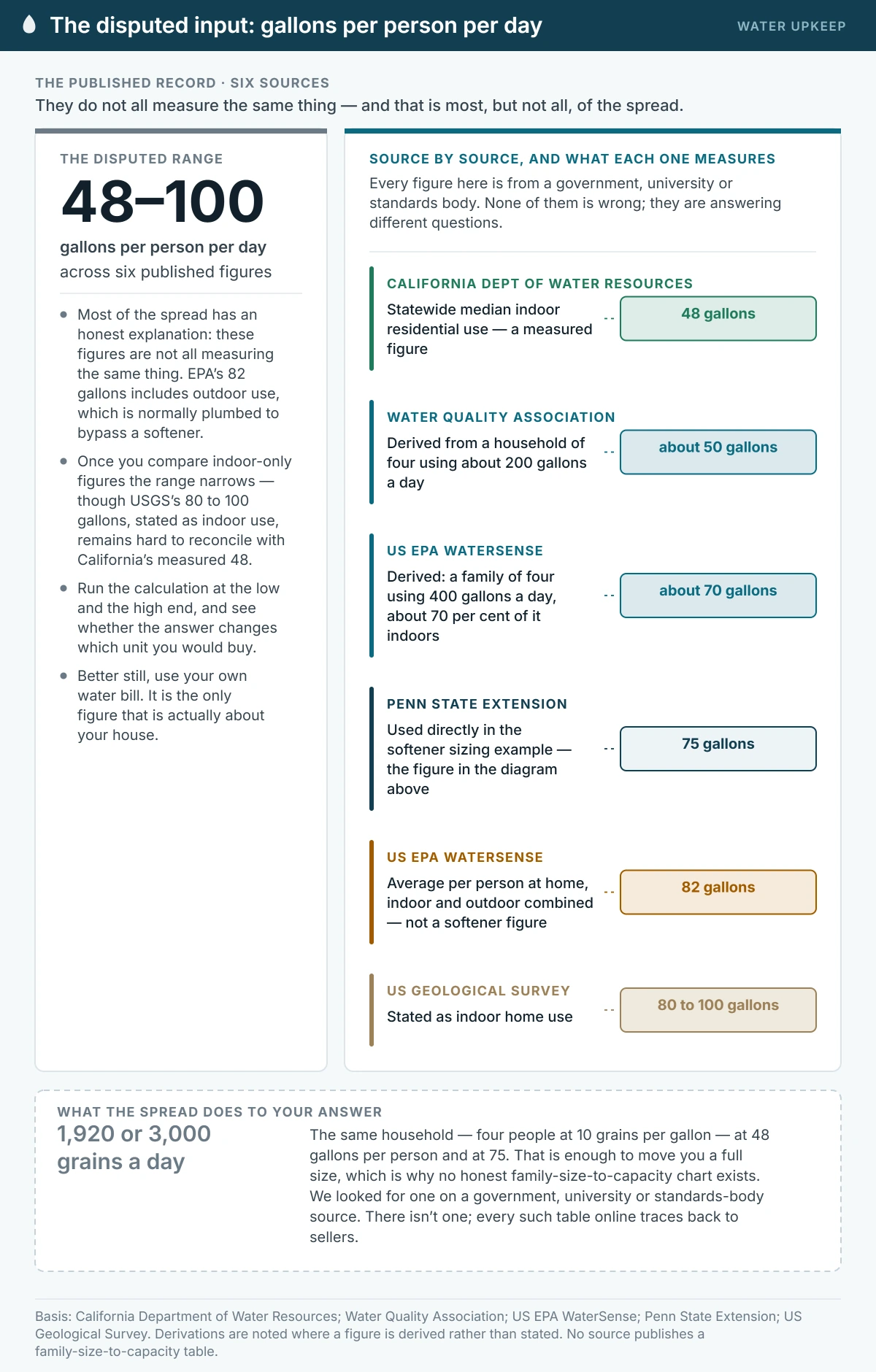
Gallons per person per day is where the estimates fall apart. Here is every figure we could find on a government, university or standards-body source:
| Gallons per person per day | Source | What it measures |
|---|---|---|
| 48 | California Department of Water Resources | Statewide median indoor residential use |
| About 50 | Water Quality Association | Derived from a household of four using about 200 gallons a day |
| About 70 | EPA WaterSense | Derived: a family of four using 400 gallons a day, about 70 per cent of it indoors |
| 75 | Penn State Extension | Used directly in the softener sizing example above |
| 82 | EPA WaterSense | Average per person at home, indoor and outdoor combined |
| 80 to 100 | US Geological Survey | Stated as indoor home use |
Most of that spread has an honest explanation: the figures are not all measuring the same thing. EPA’s 82 gallons includes outdoor use. For sizing a softener, outdoor use is usually irrelevant, because irrigation is normally plumbed to bypass the softener. Once you compare indoor-only figures the range narrows, though USGS’s 80 to 100 gallons stated as indoor use remains hard to reconcile with California’s measured 48.
The practical approach is to run the calculation twice, at the low and high ends, and see whether the answer changes which unit you would buy. For a family of four at 10 grains per gallon, 48 gallons per person gives 1,920 grains a day and 75 gallons gives 3,000 — a difference that matters. Better still, use your own water bill, which is the only figure that is actually about your house.
Converting your hardness number
Laboratory results and utility reports usually give hardness in milligrams per litre or parts per million as calcium carbonate. Softeners are rated in grains. One grain per gallon equals 17.1 mg/L, a figure stated identically by Montana State University Extension, the Water Quality Association and University of Wisconsin Cooperative Extension. Penn State and NDSU round it to 17.
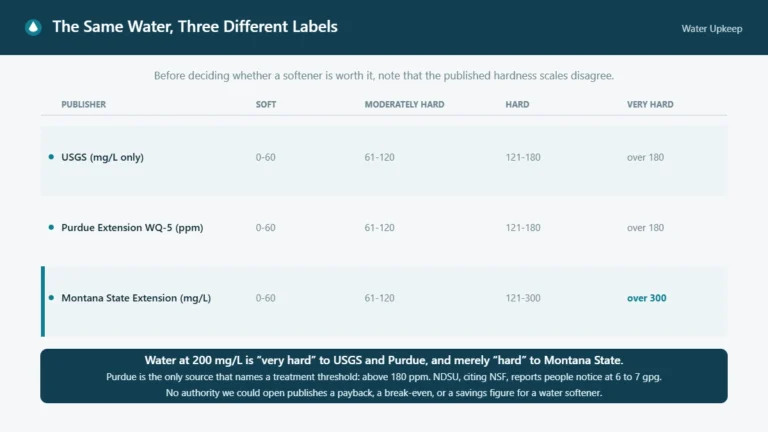
So water at 171 mg/L is 10 grains per gallon. If you do not have a number yet, our guide to telling whether you have hard water covers where to find it and when a laboratory test is worth paying for.
Where iron changes the maths
Iron in the feed water consumes softener capacity out of proportion to its concentration. The University of Minnesota states that removing iron with a softener uses roughly four times more sodium than removing the same amount of hardness.
You will see “add three grains per gallon for every part per million of iron” and similar rules quoted widely. We could not verify any such compensation factor on a government, university or standards-body source. Published factors vary by manufacturer and are not established by any standards body or extension service. Treat a dealer’s number as that dealer’s number.
How much iron a softener can cope with at all is also unsettled, across a five-fold range:
| Iron limit | Source and framing |
|---|---|
| 2 ppm | Water Quality Association — above this, hardness leakage may occur |
| 3 mg/L | University of Minnesota — softeners may remove up to this much iron |
| 5 mg/L | Penn State Extension — softeners generally recommended only below this |
| 10 ppm | NDSU Extension — some softeners will remove up to this much iron and manganese |
The WQA adds a point that matters if efficiency is part of your decision: high-performance systems are typically not capable of achieving salt efficiencies of 4,000 grains or more per pound of salt in the presence of competing compounds such as iron. Penn State frames the whole suitability envelope as pH above 6.7, hardness between 3 and 20 grains per gallon, and dissolved iron under 5 mg/L. Outside that, a softener alone is the wrong tool and pre-treatment comes first.
Too big is a problem too
Undersizing is intuitive: the University of Minnesota states that a softener that is too small will run out of soft water and need to regenerate more frequently. Oversizing is the one people get wrong, because “more capacity” sounds like a margin of safety. The same source states that a softener that is too big may cause channeling, limiting softening capacity — water finds preferential paths through an under-used bed rather than contacting the resin evenly.
You will find institutional building specifications that recommend deliberate oversizing. Michigan State University’s construction standard, for example, says to oversize by at least 20 per cent for longevity. That document is written for campus buildings with a very different duty cycle, and it should not be carried across to a house.
Capacity and flow rate are different constraints
Grains of capacity tell you how much hardness the unit can remove before it needs recharging. They tell you nothing about how fast water can pass through it. The University of Nebraska–Lincoln names water flow rate alongside hardness and daily use as a sizing factor, and Minnesota’s requirement that the system treat water without significant pressure loss is a flow constraint, not a capacity one.
A unit can have plenty of grains and still cause a pressure drop when two showers and a dishwasher run at once. We could not find any government, university or standards-body source that publishes a residential gallons-per-minute target or a peak-demand estimation method, so the common rules of thumb — bathrooms plus one, and so on — are trade convention rather than established guidance. What you can do is raise it explicitly with whoever is quoting, and ask what service flow rate the unit is rated for.
Salt efficiency, and what the standard actually requires
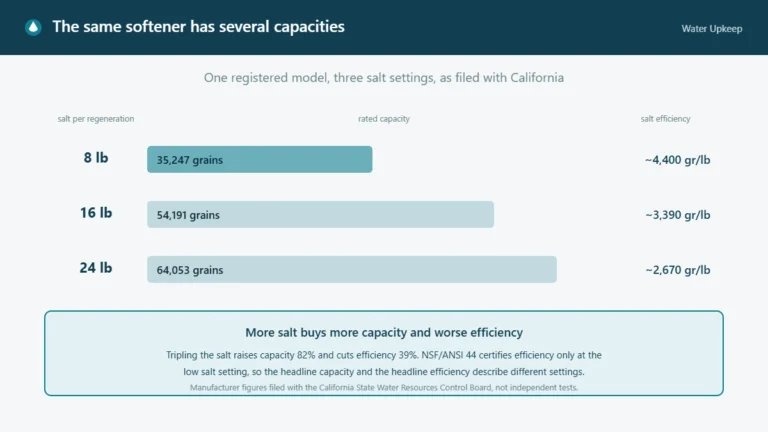
NSF/ANSI 44 contains a voluntary efficiency rating. To carry it, a softener must meet three conditions together: a rated salt efficiency of not less than 3,350 grains of total hardness exchange per pound of salt, no more than 5.0 gallons of water per 1,000 grains of hardness removed during the service cycle, and demand-initiated regeneration. Time-clock units that regenerate on a fixed schedule do not qualify.
EPA defines a demand-initiated unit as one with a flow meter or sensing control that starts regeneration after determining that softening capacity is depleted or about to be. Fixed-schedule units, EPA notes, regenerate typically every four days to weekly regardless of use, which wastes water during quiet periods. How the four control arrangements differ is covered in our guide to how often a softener should regenerate.
Two other efficiency numbers circulate and should not be confused with the standard. The Water Quality Association describes best practice as 4,000 grains per pound of salt with no more than five gallons per 1,000 grains, and California health and safety law uses the same 4,000-grain figure. EPA published a notification of intent to develop a WaterSense specification for softeners, but no such specification exists. There is no WaterSense-labelled water softener. The certifiable mark is NSF/ANSI 44, and its threshold is 3,350.
Why there is no chart
We looked specifically for a family-size-to-capacity table on a government, university or standards-body source, because it would be genuinely useful. There isn’t one. No extension service, no EPA or WaterSense document, no WQA publication and no NSF page publishes one. Every such table online traces back to sellers.
That is not an oversight. The inputs vary too much between households for a table to be honest. Penn State makes a related observation about the market itself, which is worth carrying into any showroom: most softeners are not rated for effectiveness, only for convenience features.
Two things sizing affects that you may not expect
Regeneration discharges water and salt. Penn State puts a regeneration cycle at about 50 gallons of water, and EPA notes some residential softeners consume an average of 25 gallons or more per day during regeneration — 150 to 200 gallons a week. If you are on a septic system, or your area restricts softener discharge, that volume is part of the sizing conversation. EPA notes that some jurisdictions restrict the installation and use of cation exchange softeners because of the salts they discharge.
Softening also adds sodium in proportion to the hardness removed — Penn State gives 7.5 milligrams per quart for each grain per gallon removed, and Nebraska and NDSU both give approximately 8 mg/L per grain per gallon. Harder water means more sodium in the softened output, which is another reason the hardness number belongs at the centre of the decision rather than the household size.
When to call a professional
- You are on a private well and have no laboratory hardness and iron result — without both numbers, sizing is guesswork.
- Iron, manganese or hydrogen sulfide are present, which usually means pre-treatment ahead of the softener.
- Hardness is above 20 grains per gallon or pH is below 6.7, outside the envelope Penn State describes.
- You are on a septic system, or your municipality restricts brine discharge.
- Two quotes differ by a size or more — ask each to show the grains-per-day arithmetic and the per-person figure they used.
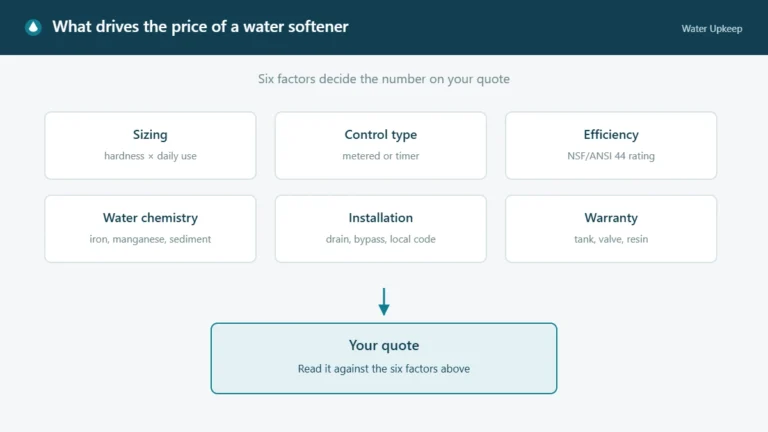
Pricing is a separate question from sizing, and our guide to what drives the price of a water softener sets out the six factors behind a quote. More equipment guidance in our water softeners hub, including whether a softener is worth it.
Sources and standards
- Penn State Extension — Water softening and Iron and manganese in private water systems
- University of Minnesota Water Resources Center — Residential water softening
- University of Nebraska–Lincoln Extension — Water softening (ion exchange)
- North Dakota State University Extension — Water softening (ion exchange)
- Montana State University Extension Water Quality — Hardness
- University of Wisconsin Cooperative Extension — Choosing a water treatment device
- US Environmental Protection Agency, WaterSense — Water softeners technical sheet, Notification of intent, water softeners and Guide to selecting water treatment systems
- Pacific Northwest National Laboratory, Building America Solution Center — Water softeners
- Water Quality Association — Getting smart about softeners and Ion exchange fact sheet
- Minnesota Technical Assistance Program, University of Minnesota — Chloride softener decision flowchart
- Michigan State University — Construction standard, domestic water softeners
- NSF — NSF/ANSI 44 technical requirements
Last reviewed September 18, 2026.