Only the Hot Water Smells Like Sulfur
If the rotten-egg smell is on the hot tap and not the cold, five state and university sources point at the same thing: the sacrificial anode rod inside your water heater, working together with sulfate-reducing bacteria in the tank. The fix the extension services publish is to have a plumber replace that rod with a different metal — not to pull it out, which every manufacturer we checked says in writing will nullify or void your warranty. There is one important caveat before any of that, and it comes from Purdue: heated water releases hydrogen sulfide faster than cold water does, so sulfide that is already in your supply can be far more noticeable hot. Hot-only is a strong indicator. It is not a proof.
First: make sure it really is hot-side only
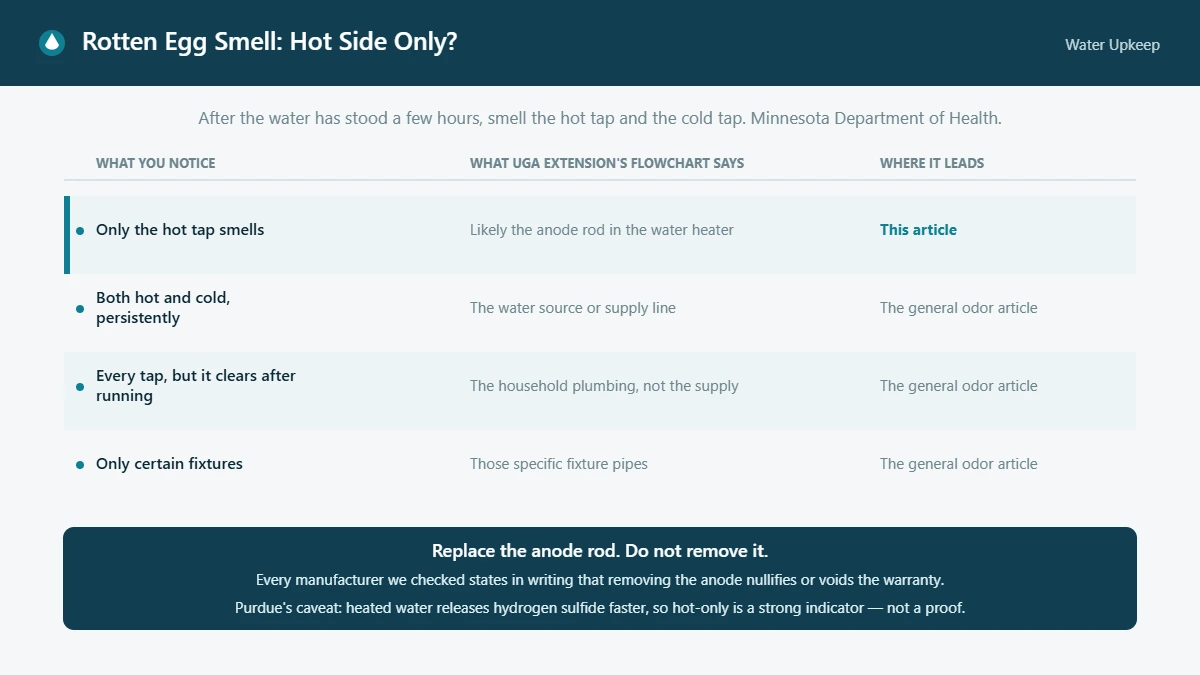
The Minnesota Department of Health publishes the test, and the precondition matters as much as the test itself: “after you have been away from your home for a few hours, smell the water coming out of the hot and cold water faucets. Determine which faucets have the ‘rotten egg’ odor.” The water needs to have been standing. Smelling the taps after a morning of normal use tells you much less.
The University of Georgia Cooperative Extension, in Circular 1016, turns the result into a four-way mapping.
| What you notice | What UGA Extension’s flowchart says | Where to go |
|---|---|---|
| Only the hot tap smells | Likely the anode rod in the water heater | This article |
| Both hot and cold smell, persistently | The problem originates from the water source or supply line | Why your water smells like rotten eggs |
| Every tap smells, but it clears after running the water briefly | The problem is in the household plumbing, not the water supply itself | Why your water smells like rotten eggs |
| Only certain fixtures smell | The issue is localized to those specific fixture pipes | Why your water smells like rotten eggs |
If the smell is on the cold side too, or it does not clear when you run the tap, this is not the article you want — the problem is in your water, not your heater. Start at why your water smells like rotten eggs, which covers the source side, the sulfur bacteria question and the treatment equipment.
The caveat that keeps this honest
Purdue Extension’s WQ-11 publishes a second explanation for a hot-only smell, and almost nothing written on this subject mentions it: “under certain conditions, you may notice hydrogen sulfide when heating water. Heated water releases hydrogen sulfide gas quicker than cold water.”
In other words, a supply that already carries dissolved hydrogen sulfide can smell dramatically worse on the hot side while the heater itself is doing nothing wrong. No source we found publishes any figure for how often hot-only odor is the anode versus the water, and we are not going to guess one. What that means practically: if a new anode does not fix it, the next question is your water, not a second anode.
One more thing worth ruling out early. Minnesota’s health department organizes its guidance by three possible locations — the water heater, the well or plumbing system or water softener, and the groundwater itself. A softener is on that list. If you have one and you suspect it, the routing is the general odor article above and our softener troubleshooting index; we do not cover it here.
What the anode rod is, and why it can make the smell
Every glass-lined tank heater has one. Bradford White’s electric manual: “a sacrificial anode is used to extend tank life.” Rheem describes its rod as protecting “the glass lined tank.” Minnesota’s health department: “many water heaters have a magnesium anode, which is attached to a plug located on top.” Sacrificial is the operative word — the rod is meant to corrode so the tank does not, which means it is a consumable component with a finite life.
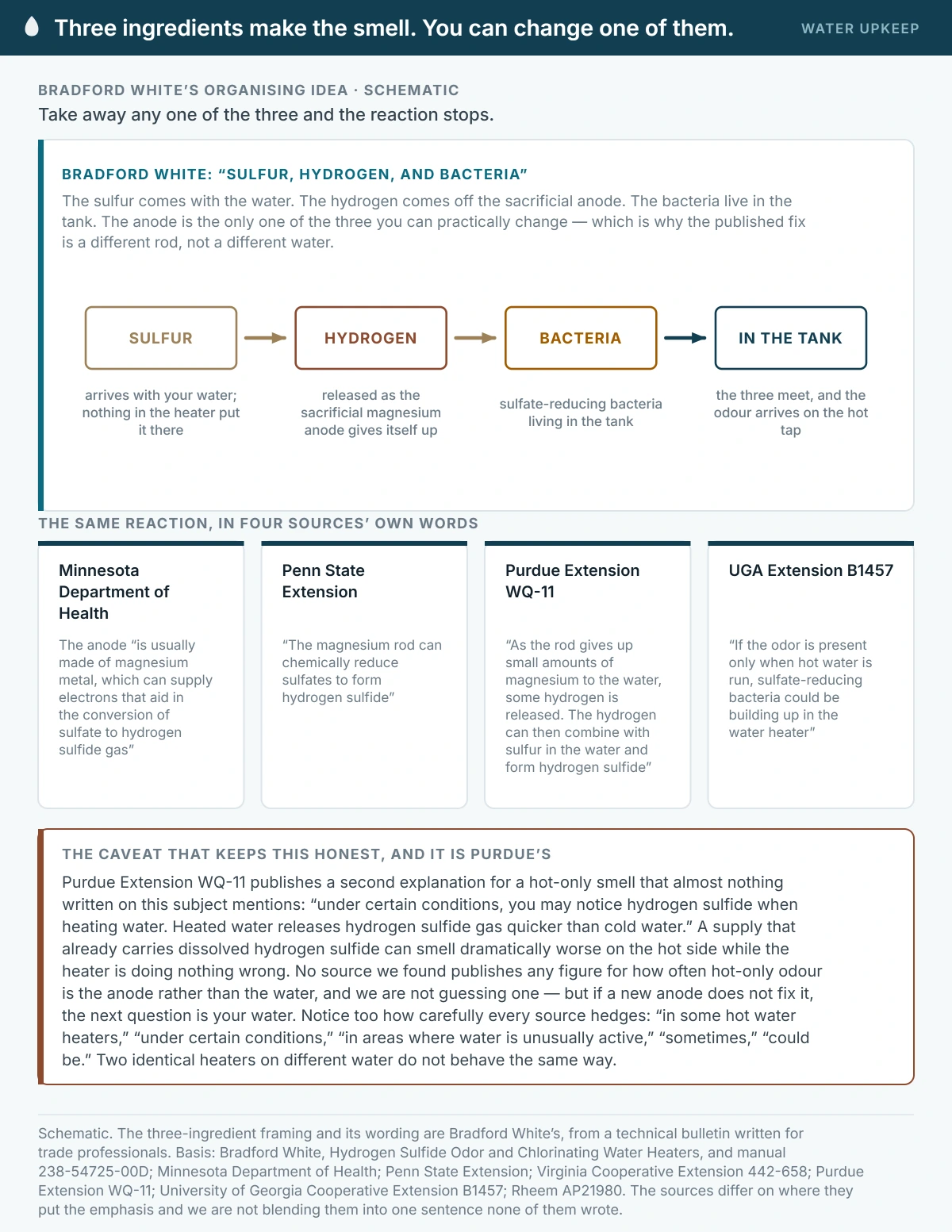
Bradford White’s technical bulletin for trade professionals gives the clearest organizing idea: “three ingredients are required to generate hydrogen sulfide odor that gives water its rotten egg smell: sulfur, hydrogen, and bacteria.” The sulfur comes with the water. The hydrogen comes off the sacrificial anode. The bacteria live in the tank. Take away any one of the three and the reaction stops — and the anode is the only one of the three you can practically change.
The mechanism, in each source’s own words
These sources agree that the anode is involved and differ on where they put the emphasis — some describe a direct chemical reduction by the magnesium, some describe bacteria being fed by what the rod releases. We are showing them rather than blending them into one sentence none of them wrote.
| Source | What it says |
|---|---|
| Minnesota Department of Health | “The anode is usually made of magnesium metal, which can supply electrons that aid in the conversion of sulfate to hydrogen sulfide gas.” |
| Penn State Extension (Bryan Swistock) | “The magnesium rod can chemically reduce sulfates to form hydrogen sulfide.” |
| Virginia Cooperative Extension 442-658 | “Sulfates can be chemically changed to hydrogen sulfide in some hot water heaters due to a chemical reaction with the heater’s magnesium corrosion control rod.” |
| Purdue Extension WQ-11 | “As the rod gives up small amounts of magnesium to the water, some hydrogen is released. The hydrogen can then combine with sulfur in the water and form hydrogen sulfide.” |
| UGA Extension B1457 | “If the odor is present only when hot water is run, sulfate-reducing bacteria could be building up in the water heater.” |
| Bradford White, gas manual 238-54725-00D | “In areas where water is unusually active, an odor may occur at the hot water faucet due to a reaction between the sacrificial anode and impurities in the water.” |
| Rheem, electric manual AP21980 | “Water sometimes contains a high sulfate and/or mineral content and together with cathodic protection process can produce a hydrogen sulfide, or rotten egg odor in the heated water.” |
Notice how carefully every one of them hedges: “in some hot water heaters,” “under certain conditions,” “in areas where water is unusually active,” “sometimes,” “could be.” Two identical heaters on different water do not behave the same way, and none of these sources claims otherwise.
Is it dangerous?
The sources converge, but they do not say quite the same thing, so here is what each of them actually says.
- UGA Circular 1016: the bacteria causing this smell “are not a health threat; however, the taste and odor can be very unpleasant.”
- Minnesota Department of Health: “while sulfur bacteria are not harmful, hydrogen sulfide gas in the air can be harmful at high levels.”
- Virginia Cooperative Extension: “although in very rare circumstances hydrogen sulfide gas released from water into closed spaces can build up to toxic or flammable levels, it generally does not present a health risk.”
- Penn State: hydrogen sulfide “is poisonous and flammable,” but “the human nose can detect it well before it causes health concerns.”
- UGA C858-8: the water becomes unpalatable long before hydrogen sulfide reaches a harmful level.
On the threshold at which people notice it, three sources give three slightly different figures: Penn State says most people detect it “well below 0.5 mg/L”; Virginia Tech says “0.5 to 1.0 mg/L”; UGA says “as low as 0.5 parts per million.” Close, but not the same, and we are not averaging them.
The sources here agree that this is generally an aesthetic problem rather than a health one, and that is as far as we will go. If you have a specific health concern about your water — for yourself, a child, or someone with a health condition — the people to ask are your local health department or a clinician, not a website.
A separate warning, about a different gas. Bradford White’s electric manual notes that “hydrogen gas can be produced in a hot water system served by this water heater that has not been used for a long period of time (generally two weeks or more). Hydrogen gas is extremely flammable.” That is hydrogen, not hydrogen sulfide, and it is about returning to a house after a fortnight away rather than about odor. Different thing entirely — worth knowing, and not to be confused with the rest of this page.
The fix: replace the rod, don’t remove it
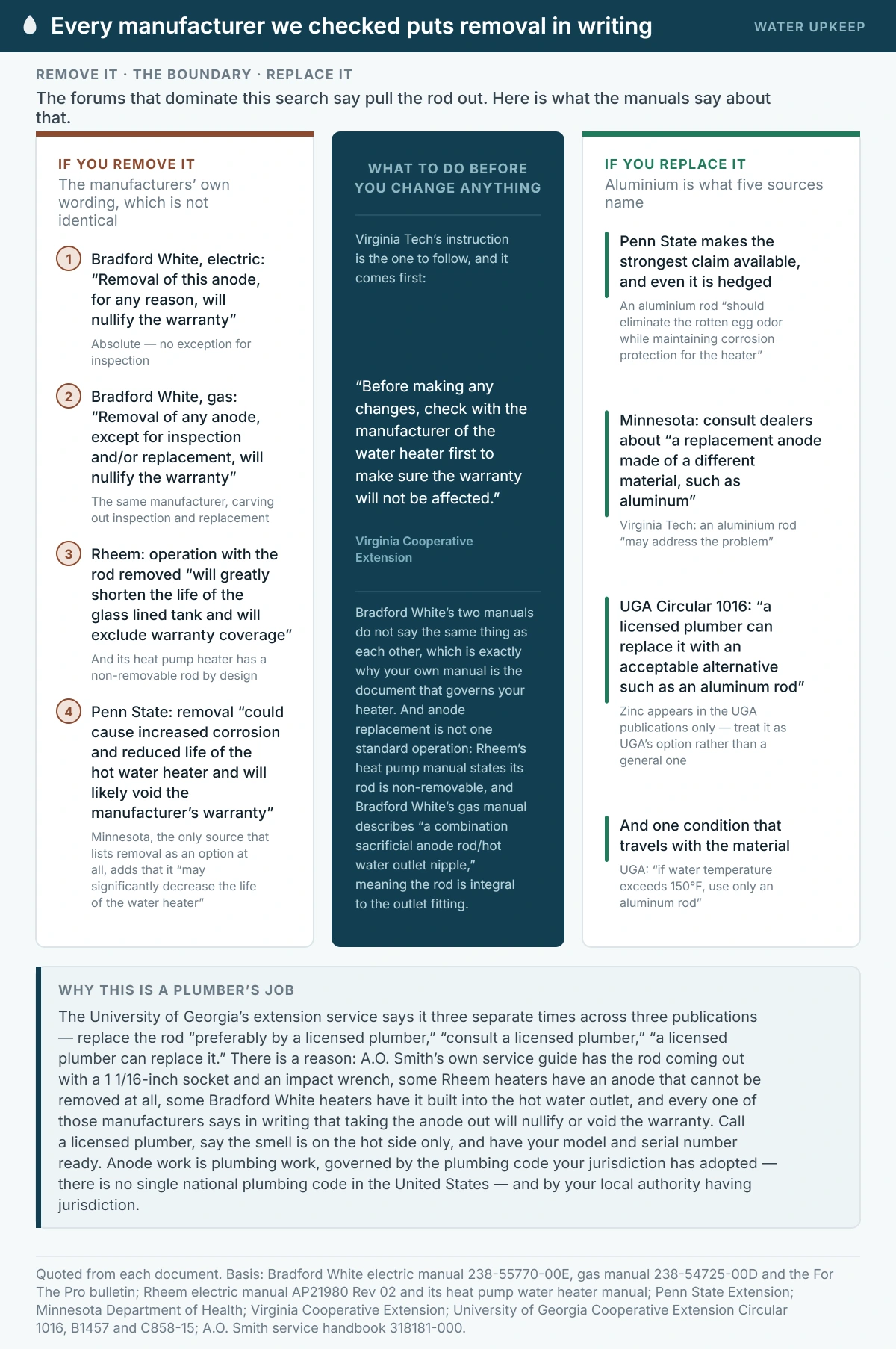
The forums that dominate this search will tell you to take the anode out and be done with it. Here is what the manufacturers say about that, quoted exactly, because their wording is not identical and the differences matter.
| Document | What it says about removing the anode |
|---|---|
| Bradford White electric 238-55770-00E | “Removal of this anode, for any reason, will nullify the warranty.” |
| Bradford White gas 238-54725-00D | “Removal of any anode, except for inspection and/or replacement, will nullify the warranty.” |
| Bradford White, For The Pro bulletin | “Complete removal of the anode (magnesium or aluminum) will void the warranty and shorten tank life.” |
| Rheem electric AP21980 Rev 02 | “DO NOT remove the anode rod from the water heater’s tank, except for inspection and/or replacement, as operation with the anode rod removed will greatly shorten the life of the glass lined tank and will exclude warranty coverage.” |
| Rheem heat pump water heater manual | “This water heater is equipped with a non-removable anode rod designed to prolong the life of the glass lined tank.” |
| Penn State Extension | Removal “could cause increased corrosion and reduced life of the hot water heater and will likely void the manufacturer’s warranty.” |
| Minnesota Department of Health | “Removal of the anode, however, may significantly decrease the life of the water heater.” |
| Virginia Cooperative Extension | “Before making any changes, check with the manufacturer of the water heater first to make sure the warranty will not be affected.” |
Bradford White’s two manuals do not say the same thing — the electric one is absolute, the gas one carves out inspection and replacement — which is exactly why your own manual is the document that governs your heater. Virginia Tech’s instruction is the one to follow: check with your manufacturer before you change anything.
What it gets replaced with
Aluminum is the replacement five Tier 1 sources name. Penn State makes the strongest claim available, and even that one is hedged: “replacement of the magnesium rod with an aluminum rod should eliminate the rotten egg odor while maintaining corrosion protection for the heater.” Minnesota’s health department suggests consulting dealers about “a replacement anode made of a different material, such as aluminum.” Virginia Tech says an aluminum rod “may address the problem.” UGA Circular 1016 says “a licensed plumber can replace it with an acceptable alternative such as an aluminum rod.”
Zinc appears in the UGA publications only — B1457 and C858-15 both name aluminum or zinc — and nowhere else in what we read. Treat it as UGA’s option rather than a general one. UGA also attaches a condition worth carrying: “if water temperature exceeds 150°F, use only an aluminum rod.”
Bradford White’s professional bulletin names its own A420 rod as a replacement that may minimize the problem. We could not establish what that rod is made of from any Bradford White document we opened, so we are not going to tell you.
Powered anodes exist. A.O. Smith’s service handbook describes a “non sacrificial powered anode rod” and says that “unlike conventional magnesium or aluminum anode rods used in water heaters, the powered anode does not deteriorate.” That is documented as a factory fitment on a product line. Nothing we read documents a powered anode as a retrofit remedy for odor, so we are not presenting it as one.
Not every anode can be removed
Rheem’s heat pump water heater manual states plainly that its anode is non-removable. Bradford White’s gas manual describes “a combination sacrificial anode rod/hot water outlet nipple,” meaning the rod is integral to the outlet fitting on those models — a materially different service job. Anode replacement is not one standard operation across all heaters, and anybody who tells you it is has not read the manuals.
Why this is a plumber’s job
Everything past the diagnosis is a plumber’s job. The University of Georgia’s extension service says it three separate times across three publications — replace the rod “preferably by a licensed plumber,” “consult a licensed plumber,” “a licensed plumber can replace it.” There is a reason: A.O. Smith’s own service guide has the rod coming out with a 1 1/16-inch socket and an impact wrench, some Rheem heaters have an anode that cannot be removed at all, some Bradford White heaters have it built into the hot water outlet, and every one of those manufacturers says in writing that taking the anode out will nullify or void your warranty. Call a licensed plumber, tell them the smell is on the hot side only, and have your model and serial number ready.
Anode replacement and any work on the hot water line is plumbing work, governed by the plumbing code your jurisdiction has adopted — and there is no single national plumbing code in the United States — and by your local authority having jurisdiction.
The other remedies, and what each source actually requires
Temporarily raising the temperature
Two sources publish this, they do not agree on the duration, and both attach conditions that have to travel with the number.
- Minnesota Department of Health: “increase the water heater temperature to 160 degrees Fahrenheit (71 degrees Celsius) for several hours. This will destroy the sulfur bacteria.” Its own caution, in full: “CAUTION: Increasing the water heater temperature can be dangerous. Consult with the manufacturer or dealer regarding an operable pressure relief valve.”
- UGA Extension B1457: raise the heater to approximately 160°F for 30 minutes to kill the bacteria, then drain the tank and return to normal settings. Its own condition, in full: “however, you can do this only if the water tank has a pressure relief valve and everyone in the house is warned, to prevent scalding.”
Several hours, or thirty minutes. We are showing both because that is what the two agencies published; we are not synthesizing a range neither of them wrote. In both cases the heater goes back to its normal setting afterwards — this is a temporary treatment, not a new configuration.
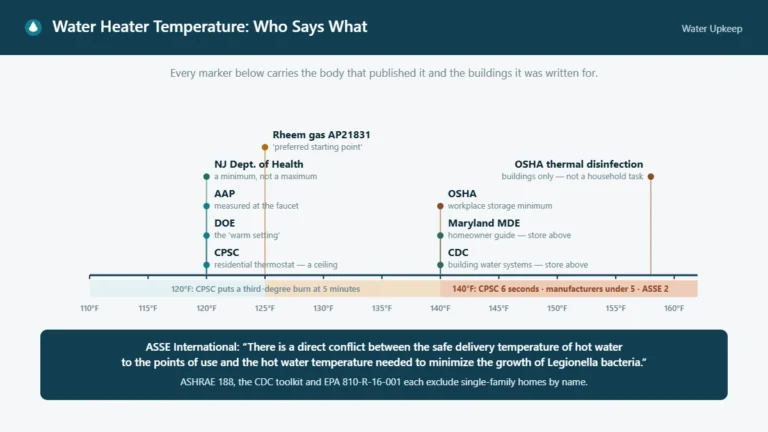
Understand what 160°F is. It is far above every temperature the safety agencies recommend for a household, and the manufacturers’ own published tables put a serious burn at well under two seconds in that region. Before you do anything with this, read what temperature a water heater should be set to, which sets out what water at these temperatures does to skin, how fast, and according to whom. A household with young children, older adults, or anyone who cannot reliably avoid the hot tap should not be running water at this temperature at all — that is the consequence of the scald warnings both of these sources attach to their own advice.
Both sources’ conditions rest on an operable pressure relief valve, and verifying that is a question for your manufacturer, dealer or plumber. We are not going to tell you to test it — lifting the lever releases hot water under pressure, as Bradford White’s own manual warns. UGA’s version also includes draining the tank, which is a separate operation covered in how to flush a water heater, and which has its own gate on who should be doing it.
Chlorinating the heater
No Tier 1 source we read publishes a bleach dose for a water heater. Minnesota’s health department names the option — “disinfect and flush the water heater with a chlorine bleach solution” — and prints no quantity, no concentration and no contact time, on either its web page or its PDF fact sheet. Rheem’s manual says only that “chlorination of the water supply should minimize the problem.” Penn State, Virginia Tech and the UGA publications publish nothing on it.
Bradford White does publish a chlorination procedure, in a technical bulletin written for trade professionals. It requires shutting off water and power or gas, draining several gallons, removing the magnesium anode rod, pouring bleach through the hot water outlet, fitting a replacement rod, reconnecting the hot water line, drawing water at every faucet until chlorine is detected, soaking, and then drawing water at every faucet until the chlorine odor clears. That is plumbing work on a hot pressurized vessel with the fuel or power isolated, and we are not reproducing the quantities or the sequence here.
If chlorinating the heater is the right answer for your situation, the person who does it should be the plumber, working from the manufacturer’s own bulletin for your heater — not from a web page.
Hydrogen peroxide
You will find peroxide dosing recommended all over the forums that rank for this question. No source we would cite — not one health department, extension service or manufacturer document we opened — publishes a hydrogen peroxide dose, concentration, contact time or procedure for a water heater. We are not going to be the first.
What a water softener will not do
Purdue Extension is blunt about the most common misconception here: “ordinary household water softeners do not remove sulfur odors from water.” Nor will a sediment filter — see hard water filters for what those actually do, and salt-free water softeners for a related set of claims worth being careful about. Treatment equipment for hydrogen sulfide in the supply is a real subject, with real concentration limits attached to each method, and it belongs to the general odor article.
How often should the anode be checked anyway?
Four sources, four answers.
| Source | Interval |
|---|---|
| Rheem electric AP21980 Rev 02 | “The anode rod should be removed from the water heater’s tank annually for inspection and replaced when more than 6″ of core wire is exposed at either end of the rod.” |
| Bradford White, both I&O manuals | “The anode rod should be inspected periodically (every 2 years) and replaced when necessary.” |
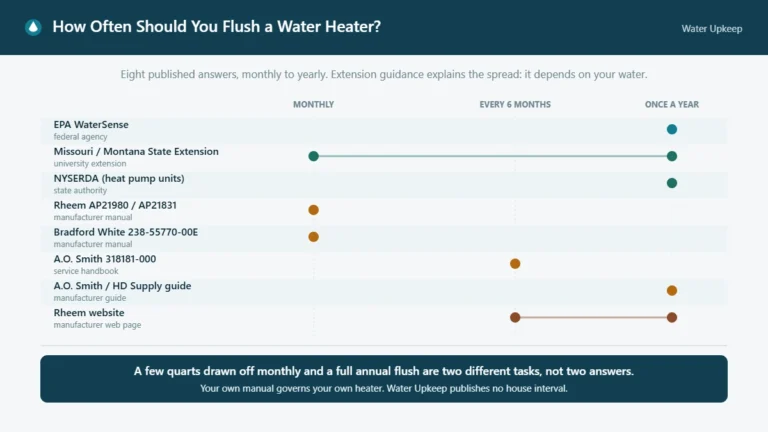
| A.O. Smith / HD Supply maintenance guide | “Check the anode rod at least every three years depending on local water conditions. Units with a water softener should be checked annually.” |
| NYSERDA (heat pump water heaters) | “It’s important to check the condition of the anode rod every 1 to 3 years and replace it as needed.” |
There is no universal anode interval. Your manual governs. Rheem’s six inches of exposed core wire is the only physical replacement criterion we located anywhere, and it is Rheem’s, for Rheem’s rods.
A note on the softener line, because it is easy to over-read: A.O. Smith’s guide says units with a softener should be checked annually. That is an inspection-frequency statement. It gives no mechanism, does not say softened water consumes anodes faster, and does not connect softeners to odor — and nothing else we read makes that connection either. If you have a softener, its own routine is in water softener maintenance.
The anode check normally sits on the same service visit as a flush, which is covered in how to flush a water heater.
Frequently asked questions
Why does only my hot water smell like rotten eggs?
Most likely the sacrificial anode rod in your water heater, working with sulfate-reducing bacteria in the tank — that is what five state and university sources describe. It can also be that hydrogen sulfide already in your supply is simply more noticeable when heated, which is Purdue’s point. The hot-versus-cold test after the water has stood for a few hours is where the diagnosis starts.
Should I just take the anode rod out?
Bradford White’s electric manual: “removal of this anode, for any reason, will nullify the warranty.” Rheem: operation with it removed “will greatly shorten the life of the glass lined tank and will exclude warranty coverage.” Minnesota’s health department, which is the only source we found that lists removal as an option at all, attaches the caveat that removal “may significantly decrease the life of the water heater.” Replace it; do not pull it.
Will an aluminum anode fix it?
Penn State says it “should eliminate the rotten egg odor while maintaining corrosion protection.” That is the strongest claim any source makes, and it is still a “should.” If it does not work, Purdue’s alternative explanation is the next thing to look at — the sulfide may be in your supply.
Can I replace the anode rod myself?
Three UGA publications independently route this to a licensed plumber. A.O. Smith’s service guide has the rod coming out with a 1 1/16-inch socket and an impact wrench; some heaters have a non-removable anode; on some the rod is built into the hot water outlet; and getting it wrong has a written warranty consequence.
Is it safe to drink?
UGA says the bacteria involved “are not a health threat,” though “the taste and odor can be very unpleasant.” Minnesota’s health department says sulfur bacteria are not harmful but that hydrogen sulfide gas in air can be harmful at high levels. That is what the sources say. For a specific health concern, ask your local health department or a clinician.
Can I just turn the water heater up?
Minnesota’s health department publishes 160°F for several hours; UGA publishes approximately 160°F for thirty minutes. Both attach conditions — an operable pressure relief valve, and in UGA’s case everyone in the house being warned to prevent scalding — and both return the heater to its normal setting afterwards. It is a temporary treatment with real risk attached. Read what temperature a water heater should be set to first.
Can I pour bleach or hydrogen peroxide in the tank?
No source we would cite publishes a hydrogen peroxide procedure for a water heater at all. For bleach, no Tier 1 source publishes a dose; Bradford White publishes a procedure in a bulletin written for trade professionals that involves removing the anode and disconnecting the hot water line. That is a plumber’s job, working from your own manufacturer’s document.
Would a water softener or a filter fix this?
Purdue: “ordinary household water softeners do not remove sulfur odors from water.” Equipment that does address hydrogen sulfide in the supply exists, with concentration limits attached to each method, and it is covered in the general odor article.
Sources and standards
- Minnesota Department of Health — Hydrogen Sulfide and Sulfur Bacteria in Well Water (revised June 2023)
- University of Georgia Cooperative Extension — Circular 1016, Odors in Your Household Water and Bulletin 1457, Iron, Manganese and Sulfur Bacteria in Your Well Water
- Penn State Extension — Hydrogen Sulfide (Rotten Egg Odor) in Water Wells (Bryan Swistock, updated December 2024)
- Virginia Cooperative Extension 442-658 — Sulfate and Hydrogen Sulfide in Household Water (Ling and Benham, Virginia Tech)
- Purdue Extension WQ-11 — Sulfur Water Control (Adel L. Pfeil)
- NYSERDA — Heat Pump Water Heater Maintenance Tips
- Bradford White (manufacturer documentation) — electric manual 238-55770-00E, atmospheric vent gas manual 238-54725-00D, and the trade bulletin Hydrogen Sulfide Odor and Chlorinating Water Heaters
- Rheem (manufacturer documentation) — electric residential manual AP21980 Rev 02
- A.O. Smith (manufacturer documentation) — service handbook 318181-000 and the A.O. Smith / HD Supply maintenance guide
Last reviewed September 9, 2026.