Water Softener Maintenance: What Actually Needs Doing
A water softener needs less routine attention than most pages selling service calls imply, and the parts that genuinely need it are the salt supply and the brine tank — not the resin bed and not the valve. Keep salt at or above the water level in the brine tank, keep the tank covered, break up any salt bridge, and inspect and clean the brine valve and float at least once a year. That annual inspection is the one maintenance interval any independent authority actually publishes.
Everything past that — sanitizing doses, resin cleaners, injector cleaning, anything that opens a pressurized connection — is governed by your own unit’s manual or belongs to a professional. It still matters, and EPA says why: “All water treatment systems require some level of ongoing maintenance to ensure they remain effective and efficient, and unmaintained systems may make water quality worse.”
The short answer
On a calendar: check the salt level and keep it at or above the water in the tank; keep the tank covered; inspect and clean the brine valve and float assembly at least once a year.
When something changes: break a salt bridge if one forms; clean the brine tank when you can see scale or sludge; sanitize if the unit has stood unused or smells wrong — using the dose in your own manual.
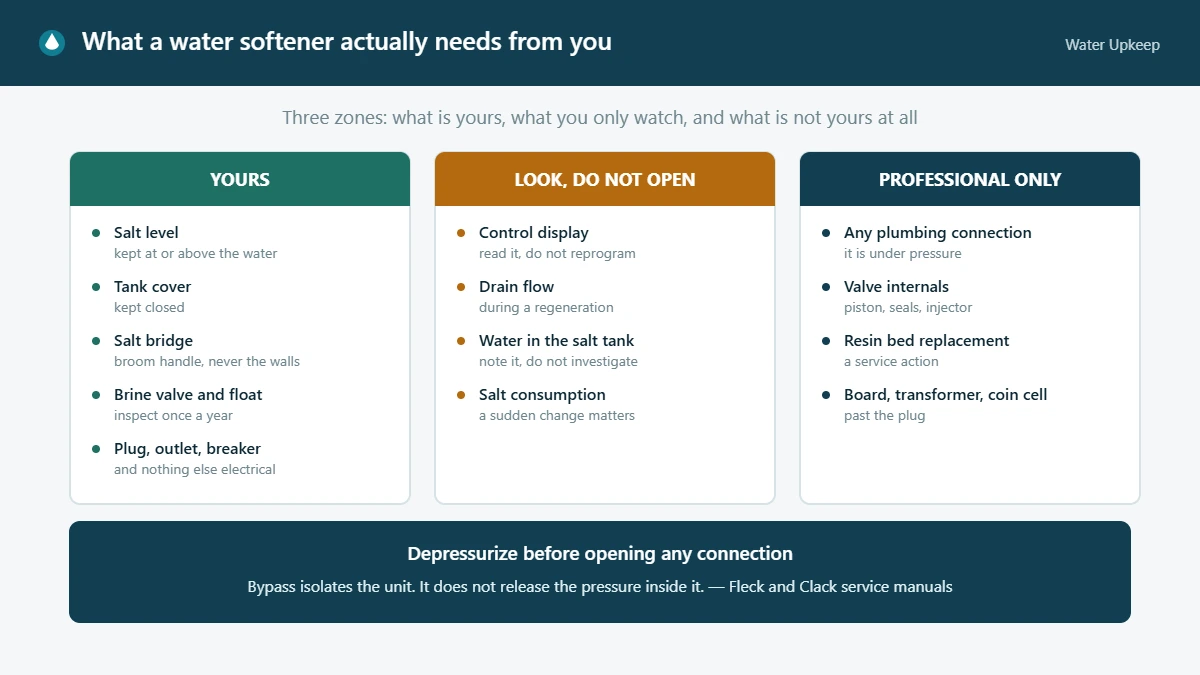
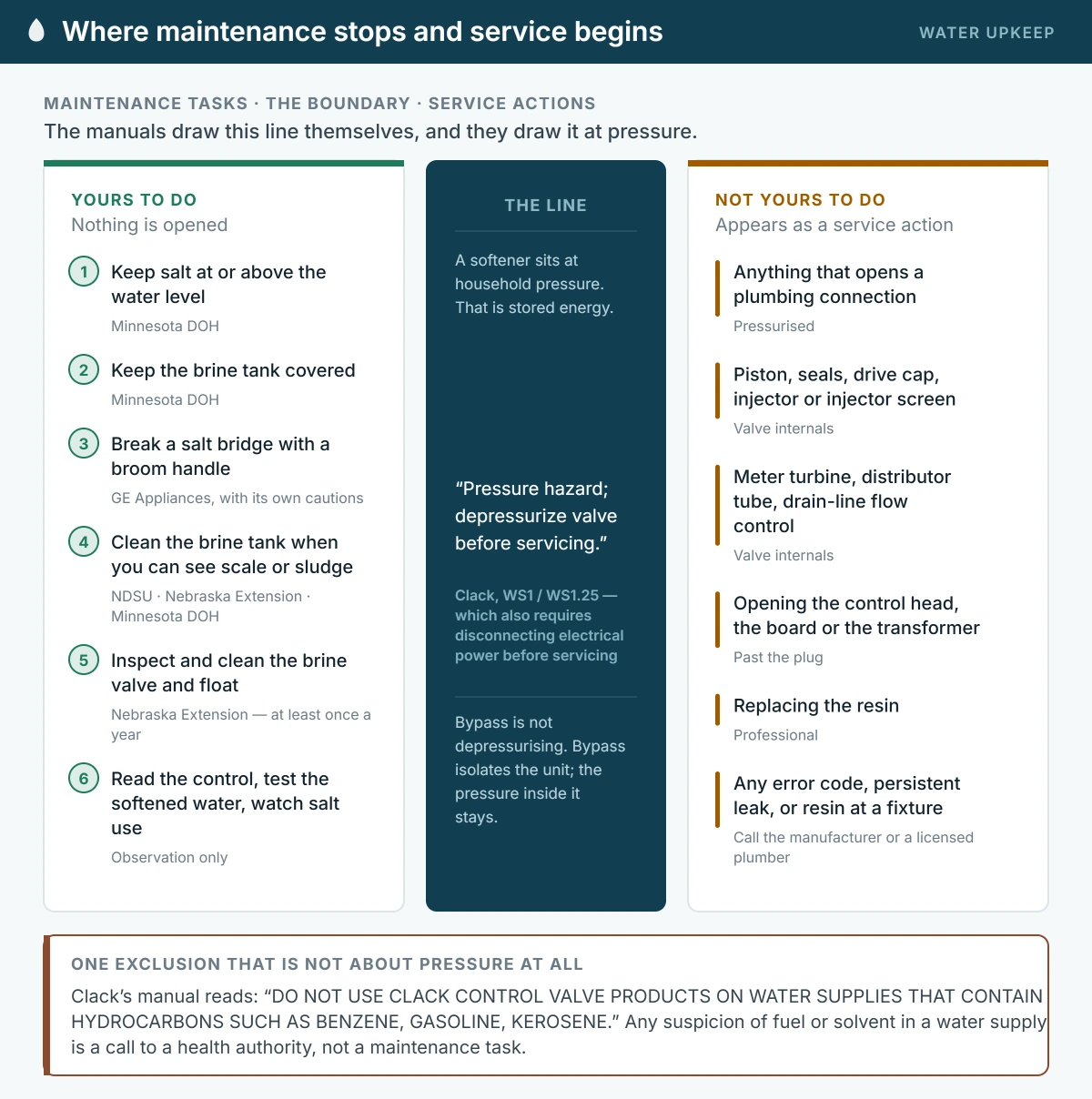
Not yours to do: anything that opens a plumbing connection, anything inside the control valve, anything electrical past the plug, and replacing the resin. This article does not tell you how to do those, and the reason is in the section on where maintenance stops.
Salt: the only truly routine task
North Dakota State University Extension puts the whole job in one sentence: “Maintenance of water softeners is largely confined to restocking the salt supply for the brine solution.” The rule for how much is the one genuinely universal number in softener maintenance, and it is a level, not a quantity. The Minnesota Department of Health states it as: “Maintain an adequate supply of water softener salt in the brine tank, i.e. at or above the tank’s water level.” Pentair’s Fleck 5600SXT manual gives the same instruction from the other direction, as the correction for a softener producing hard water: “Add salt to brine tank and maintain salt level above water level.”
Fill quantities are manufacturer-specific, not general. Hellenbrand’s ProMate EcoMax manual tells its own owners to fill “approximately three-fourths full, with a minimum of 12″ of salt,” and — for households that use little water — not to fill the salt keeper over half full, because bridging may occur. Those are Hellenbrand’s instructions for Hellenbrand units. Use the figure in your manual, not this one.
Salt grades
Nebraska Extension describes compressed salt as “small particles referred to as pellets, nuggets, or beads,” says block salt should be “high-grade evaporated salt without additives,” and sets the expectation for rock salt at “less than 1 percent impurities.” Minnesota DOH adds a handling rule that is easy to skip: obtain salt “from a reputable source” and ensure “the salt bags are clean and stored in a sanitary manner.” One control-specific caution worth knowing exists: Hellenbrand tells ProMate 6.5 owners not to use block salt when the control is programmed with a brine tank prefill. Check your own manual before switching salt form.
Potassium chloride, and what softening adds to your water
Potassium chloride is an available alternative regenerant. Penn State Extension frames the choice plainly: sodium pellets add “a small amount of salt to the water, not so much that it can be tasted, but enough that if a person is following a low salt diet, they may want to choose potassium pallets for system recharge instead.” Nebraska Extension notes potassium chloride “can be more costly and more difficult to obtain.”
What softening adds is a rate, not a total. NDSU: “For every grain of hardness removed from water, about 8 mg/1 (ppm) of sodium is added.” Nebraska Extension gives the same relationship as “about 8 mg/L for each grain per gallon (gpg) of hardness.” Penn State expresses it on a different unit basis — 7.5 milligrams per quart for each gpg removed. Minnesota DOH’s own framing is that “the extra amount of sodium consumed is typically insignificant relative to the total amount of sodium consumed through a normal diet.” If sodium intake is a live medical question in your household, that is a conversation for your clinician, not for a water site.
The brine tank: cover it, watch it, clean it periodically
Three independent authorities tell you to clean the brine tank and none of them tells you how often. NDSU: “The brine tank may require periodic cleaning.” Nebraska Extension: “The brine tank requires periodic checking and cleaning,” including inspection “for scale build-up.” Minnesota DOH: “Periodically clean and disinfect the brine tank,” and “keep the brine tank properly covered.”
We are not going to convert “periodically” into a month count, because none of them did. Watch the tank instead: scale on the walls, sludge in the bottom, or salt that is not going down are all reasons to clean it now regardless of when you last did.
Salt bridging
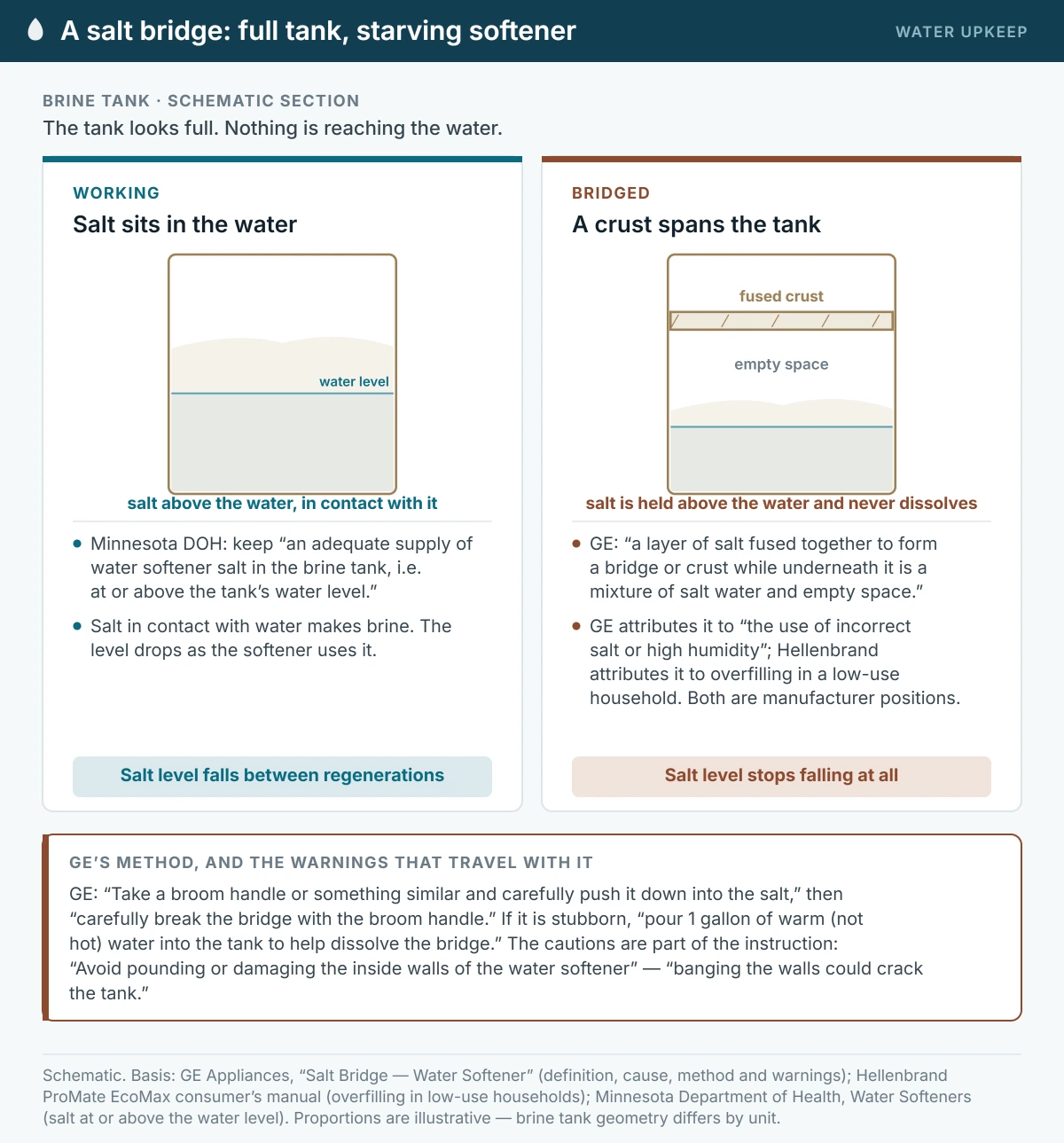
GE Appliances defines a salt bridge as “a layer of salt fused together to form a bridge or crust while underneath it is a mixture of salt water and empty space.” The tank looks full and the softener is starving. GE attributes it to “the use of incorrect salt or high humidity.” Hellenbrand attributes it to overfilling in a low-use household. Both are manufacturer positions and we are not going to pick between them.
GE’s method: “Take a broom handle or something similar and carefully push it down into the salt,” then “carefully break the bridge with the broom handle.” If it is stubborn, GE says to “pour 1 gallon of warm (not hot) water into the tank to help dissolve the bridge.” GE’s warnings travel with the method and are not optional: “Avoid pounding or damaging the inside walls of the water softener” — “banging the walls could crack the tank.”
The brine valve and float: the one annual item
Nebraska Extension publishes the only calendar interval in this entire subject: “The brine valve and float assembly, if used, should also be cleaned and inspected at least once a year.” NDSU says the same without the interval — the assembly “should also be checked and cleaned as often as needed.” That annual check is the one date worth putting in a calendar.
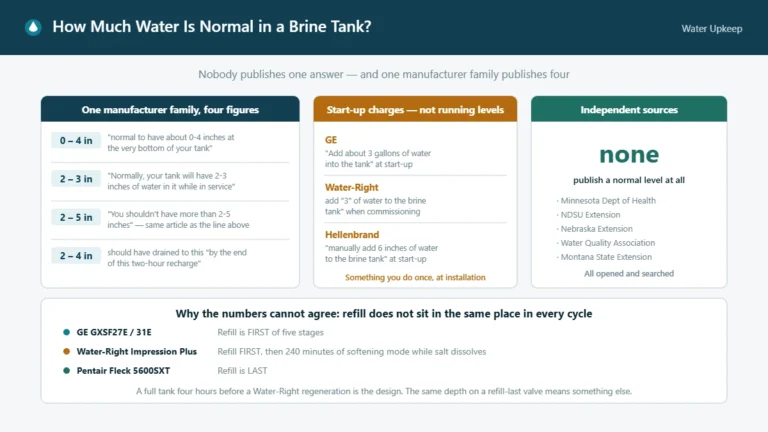
If you find standing water above the salt, stop here and read why your water softener is full of water before you do anything else. Some of that water is normal and some of it is a fault, and the difference is not obvious.
Sanitizing: what is supported, and why we cannot give you a dose
The practice is supported. Penn State Extension states that “bacteria and fungi also form mats in the resin that reduce its effectiveness,” and that “disinfecting the water prior to softening or periodically cleaning the softener with chlorine bleach will eliminate these nuisances.” What Penn State does not publish is a dose.
Two manufacturers do publish doses, and they are not the same kind of number.
| Source | Dose | Basis | Bleach strength specified? | Applies to |
|---|---|---|---|---|
| Morton Water Softeners | 3 fl oz unscented household bleach down the brinewell | Per appliance | No | Morton units |
| Hellenbrand ProMate EcoMax | 1.2 fl oz per cubic foot of resin | Per cubic foot of resin | Yes — 5.25% sodium hypochlorite | Hellenbrand ProMate units |
| Water Upkeep | None | — | — | Use the dose in your own manual |
One is per appliance with no strength stated; the other is per cubic foot of resin at a specified 5.25%. They share no common basis and cannot be converted into one another. That is precisely why we publish no figure of our own: a number that is right for a Morton unit is meaningless for a different tank, and guessing with bleach is not a small error.
If you sanitize, use your manual’s dose, use unscented household bleach only where the manual says so, never mix it with anything else, and flush afterward. Morton’s procedure ends with running “a cold-water faucet downstream of the softener for 20 minutes to clear any left over bleach from the water lines” — and notes something worth knowing generally: “any water used in the home during a recharge cycle will not pass through the softener — it will come straight from the water source.” If you have no manual, get one from the manufacturer or call them. Do not guess.
Iron and fouling: maintenance that is really pretreatment
Penn State Extension draws the distinction that decides whether iron is a maintenance problem or a plumbing problem: “Although colorless, reduced iron will be removed by the unit, red-oxidized iron (iron that has been exposed to air or chlorine) will clog the resin.” The remedy is upstream: “filtration prior to softening insures that oxidized iron is not processed in the softener.”
How much iron is too much depends on which extension service you ask, and they do not agree. Nebraska Extension says softeners “may also remove as much as 5-10 ppm” and that “excess iron (above 5 ppm) or hydrogen sulfide in the water can reduce the effectiveness.” NDSU says “some softeners will also remove up to 10 ppm of iron and manganese” and that supplies “greater than 10 ppm” may need a dedicated iron removal system. Both are Tier 1 sources. We publish both rather than splitting the difference. If your water is above your own unit’s rating, removing iron before the softener is the fix, not more frequent regeneration.
Turbidity fouls resin too — Penn State notes that a turbid raw supply “may clog the resin with mud and clay.” Iron removal additives and resin cleaners exist, and Minnesota DOH’s instruction on them is to “follow the manufacturer’s recommendations.” That is the whole of the sourced guidance. If cleaning no longer restores capacity, the question becomes whether the bed itself is finished, which is a separate decision.
Checks you can make without opening anything
- Read the control. Note the programmed hardness, the salt setting and the days since the last regeneration. Reading is a maintenance check; changing the hardness number is a different job with its own rules.
- Test the softened water. A hardness test on treated water tells you whether the unit is doing its job. The test procedure lives here.
- Watch salt consumption. A unit that suddenly stops using salt, or starts using much more, has changed. Neither is a diagnosis, but both are worth noticing early.
- Look and listen. Drain flow during a regeneration, water standing in the salt tank, an overflow fitting that has run. Note what you see; do not open anything to investigate it.
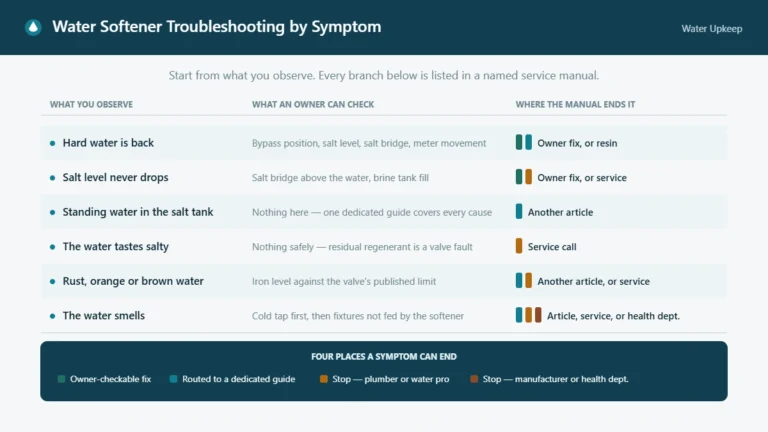
If any of those checks turns up something wrong, the next step is diagnosis, not disassembly. Our symptom-by-symptom troubleshooting guide is where that starts.
Efficiency: the maintenance decision that costs money
NSF/ANSI 44 carries an efficiency rating, and EPA describes it exactly: the standard “includes a voluntary efficiency rating that requires softeners to use 5.0 gallons of water or fewer per 1,000 grains of hardness removed.” The rating also requires at least 3,350 grains removed per pound of salt. Two things about that sentence matter. It is voluntary, so an uncertified unit is not non-compliant — it is simply unrated. And a certification claim means something specific: NSF’s listing for cation exchange water softeners under NSF/ANSI 44 carries three claims — Efficiency Rated Hardness Reduction, Barium Reduction, and Radium 226/228 Reduction. A product described only as “NSF certified,” with no standard and no claim named, has told you nothing.
How much water a regeneration uses is published two incompatible ways. Nebraska Extension and Penn State both give about 50 gallons per regeneration cycle. EPA WaterSense says the process “can use 25 gallons of water or more per day, or up to 10,000 gallons per year.” One is per cycle, the other is per day and per year, and they describe different populations of equipment. They cannot be averaged or converted, so we give you both and neither as a prediction for your unit. If your unit discharges to a septic system, Montana State University Extension notes that in clayey soil areas “the sodium discharged in the recharging process can increase the risk of septic drainfield failure” — a reason to look at where your drain line actually goes before increasing regeneration frequency.
Where maintenance stops and service begins
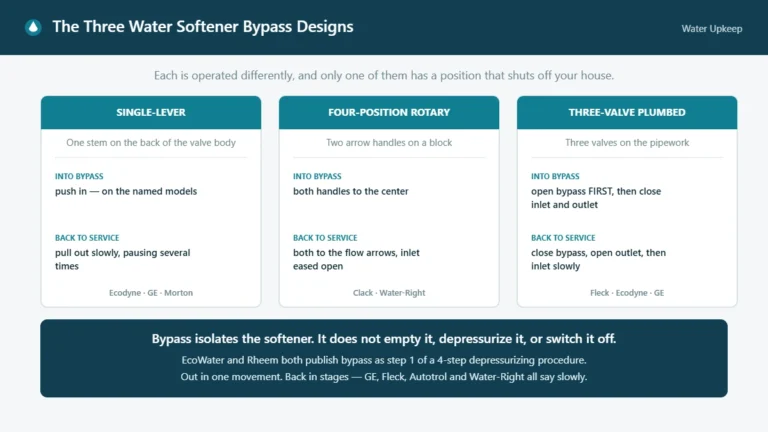
Depressurize first — the hard boundary. Both service manuals we consulted require it. Pentair Fleck: “The system must be depressurized before removing any connections for servicing.” Clack: “Pressure hazard; depressurize valve before servicing,” and “disconnect from electrical power prior to servicing.” A softener tank sitting at normal household pressure is stored energy. Nothing in this article opens a pressurized connection, and putting the unit in bypass is not the same as depressurizing it — bypass isolates the unit, it does not release the pressure inside it. The bypass procedure is here.
The electrical boundary. These controls run from a low-voltage transformer — Clack’s US WS1 specification is 100–120 VAC in, 15 VDC and 500 mA out. What you may do: confirm the adapter is plugged in, confirm the outlet is not switched, reset a tripped breaker. What you may not do, and what we will not describe: open the control head, handle the board, test or replace the transformer, or change the coin cell. Clack’s own warning on that last one is that a swallowed button cell “can cause Internal Chemical Burns in as little as 2 hours.”
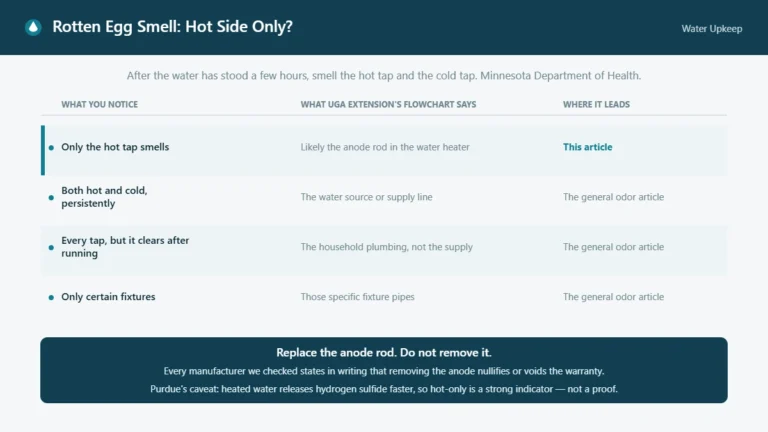
Stop and call a licensed plumber or the manufacturer for any of these: any step that requires opening a plumbing connection; any disassembly of the control valve — piston, seals, drive cap, injector, injector screen, meter turbine, distributor tube or drain-line flow control; persistent leakage from the valve body, tank head or a threaded connection; resin appearing at fixtures or in the drain line; any error code on the control board. For a suspected microbiological problem, a positive bacteria test, or an odor the routine steps do not clear, the call is to your state or county health department.
One hard exclusion worth stating on its own. Clack’s manual reads: “DO NOT USE CLACK CONTROL VALVE PRODUCTS ON WATER SUPPLIES THAT CONTAIN HYDROCARBONS SUCH AS BENZENE, GASOLINE, KEROSENE.” If there is any suspicion of fuel or solvent in your water, that is a public-health call, not a maintenance task.
Published operating limits are per valve, not per industry. They nearly agree, which is exactly why it is worth seeing them side by side rather than treating any one as the specification for your unit.
| Control valve (manufacturer documentation) | Minimum pressure | Maximum pressure | Temperature |
|---|---|---|---|
| Pentair Fleck 5600SXT | 20 psi | 125 psi | Not to exceed 110°F |
| Clack WS1 / WS1.25 | 20 psi | 125 psi | 40–110°F |
| Hellenbrand ProMate EcoMax | 20 psi | 125 psi | Not to exceed 110°F |
A realistic maintenance schedule
Every interval below carries the source that published it. Where the cell says no published interval, that is a finding, not an omission — nobody publishes one.
| Task | Interval | Who publishes that interval | Who does it |
|---|---|---|---|
| Check salt level, keep at or above water level | Whenever you pass it; do not let it fall below the water | Minnesota DOH (the level rule); no published frequency | Homeowner |
| Keep brine tank covered | Continuous | Minnesota DOH | Homeowner |
| Check for a salt bridge | No published interval — check when salt stops going down | — | Homeowner |
| Clean the brine tank | “Periodically” | NDSU, Nebraska Extension, Minnesota DOH — none gives a number | Homeowner |
| Inspect and clean brine valve and float | At least once a year | Nebraska Extension, G1491 | Homeowner |
| Sanitize the unit | No published cadence — at installation and as needed | Morton, for its own units | Homeowner, using their own manual’s dose |
| Resin cleaner / iron additive | Manufacturer’s instructions only | Minnesota DOH defers to the manufacturer | Homeowner, per manual |
| Injector, seals, valve internals | On symptom | Appears as a service action in Fleck and Clack manuals | Professional |
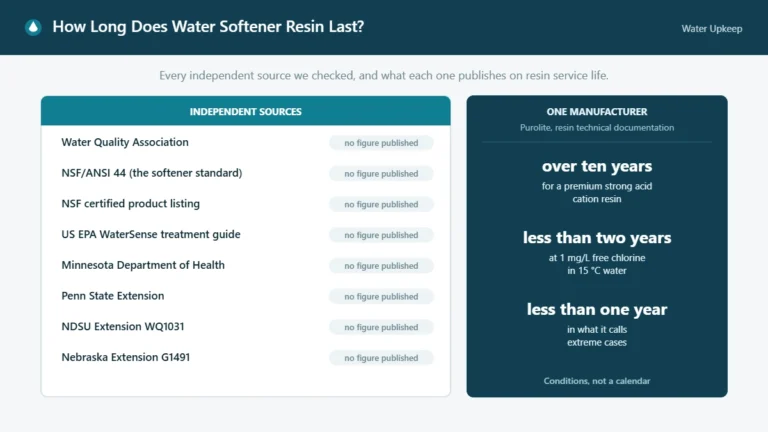
| Resin replacement | No published service life exists | — | Professional |
Questions people actually ask
How often should I clean the brine tank?
No authority we could find publishes a frequency. NDSU, Nebraska Extension and Minnesota DOH all say “periodically” and stop. Use the tank’s condition instead: visible scale on the walls, sludge at the bottom, or salt that stops going down.
Do I need to add anything besides salt?
Not routinely. Resin cleaners and iron removal additives exist for specific water problems, and Minnesota DOH’s guidance on them is to follow the manufacturer’s recommendations. If your water needs an additive every cycle, the real answer is usually pretreatment.
Can I put bleach in my water softener?
Penn State Extension supports periodic cleaning with chlorine bleach, and some manufacturers publish a procedure for their own units. What nobody publishes is a general dose — and the two manufacturer doses we found are not convertible. Use your manual’s figure, never mix bleach with anything, and flush afterward.
Why is there water in my salt tank?
Some water in a brine tank is normal and some of it is a fault, and the manufacturers do not agree on how much is normal. That question has its own answer here.
Should I use potassium chloride instead of salt?
It is a genuine alternative regenerant. Penn State notes it as the option for someone on a low-sodium diet; Nebraska Extension notes it costs more and is harder to find. If the reason is medical, ask your clinician rather than a water site.
Does a softener need sanitizing after a long vacation?
Morton lists a unit that “has been stagnant for a long time” among the situations where it recommends sanitizing its own softeners, alongside bacteria build-up and an unusual smell. No source publishes a cadence for it.
How much water does a regeneration use?
Nebraska Extension and Penn State both say about 50 gallons per cycle. EPA says the process can use 25 gallons a day or more, up to 10,000 gallons a year. Those measure different things and should not be reconciled — and neither is a prediction for your unit.
Does maintenance make the softener last longer?
No allowed source publishes a service life for a softener or its resin, so nobody can honestly tell you how many years maintenance buys. What EPA does say is that unmaintained treatment systems “may make water quality worse” — which is a reason to do it that does not depend on a number.
Sources and standards
- U.S. EPA WaterSense — Guide to Selecting Water Treatment Systems; Cation Exchange Water Softeners
- University of Nebraska–Lincoln Extension — G1491, Drinking Water Treatment: Water Softening (Ion Exchange)
- North Dakota State University Extension — WQ1031, Water Softening (Ion Exchange)
- Penn State Extension — Water Softening
- Minnesota Department of Health — Water Softeners
- Montana State University Extension Water Quality — Hardness in drinking water
- NSF — NSF/ANSI 44 technical requirements; Certified drinking water treatment units listing
- Water Quality Association — Ion Exchange Fact Sheet
- Manufacturer technical documentation — Pentair, Fleck 5600SXT service manual; Clack, WS1/WS1.25 drawings and service manual; Hellenbrand, ProMate EcoMax consumer’s manual; GE Appliances, Salt Bridge — Water Softener; Morton, Sanitizing your Softener
Last reviewed September 8, 2026.