How to Test for Lead in Water
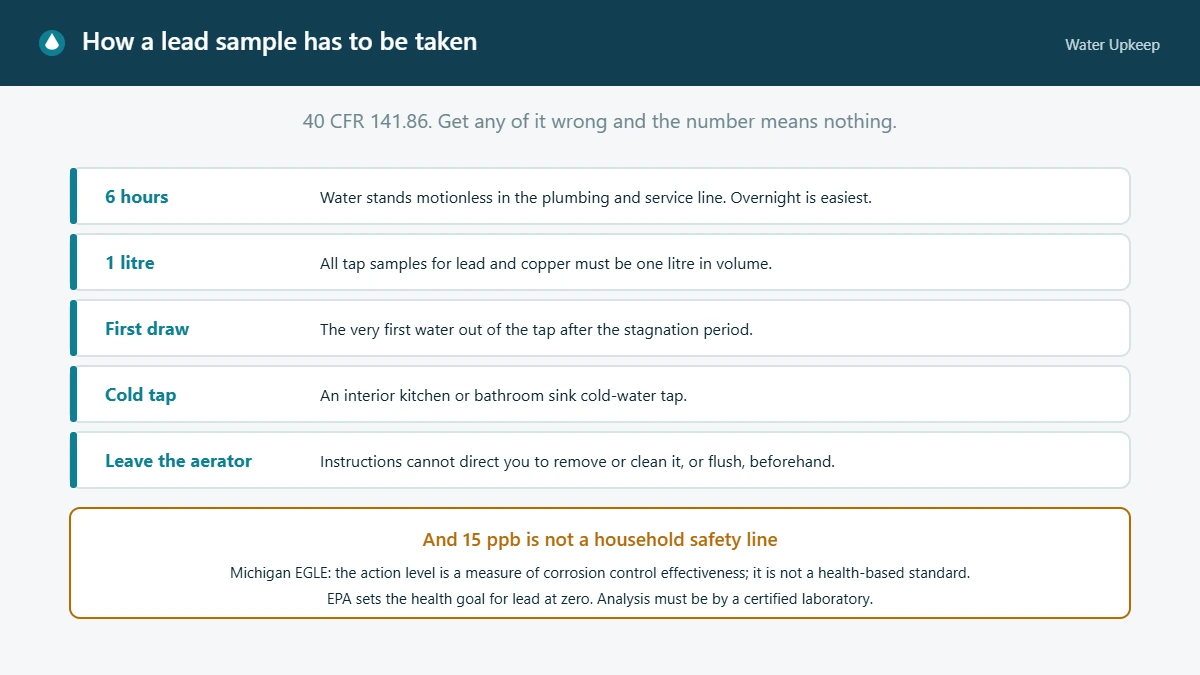
Lead cannot be seen, tasted or smelled, so testing is the only way to know. The protocol is specific: water must sit motionless in the plumbing for at least six hours, then a one-litre first-draw sample is taken from a cold kitchen or bathroom tap and analysed by a certified laboratory. And the number everyone quotes — 15 parts per billion — is not a household safety line. It is a compliance trigger calculated across a water system’s sample pool. Michigan’s environment department puts it better than EPA does: the action level is a measure of corrosion control effectiveness; it is not a health-based standard.
What the action level actually is
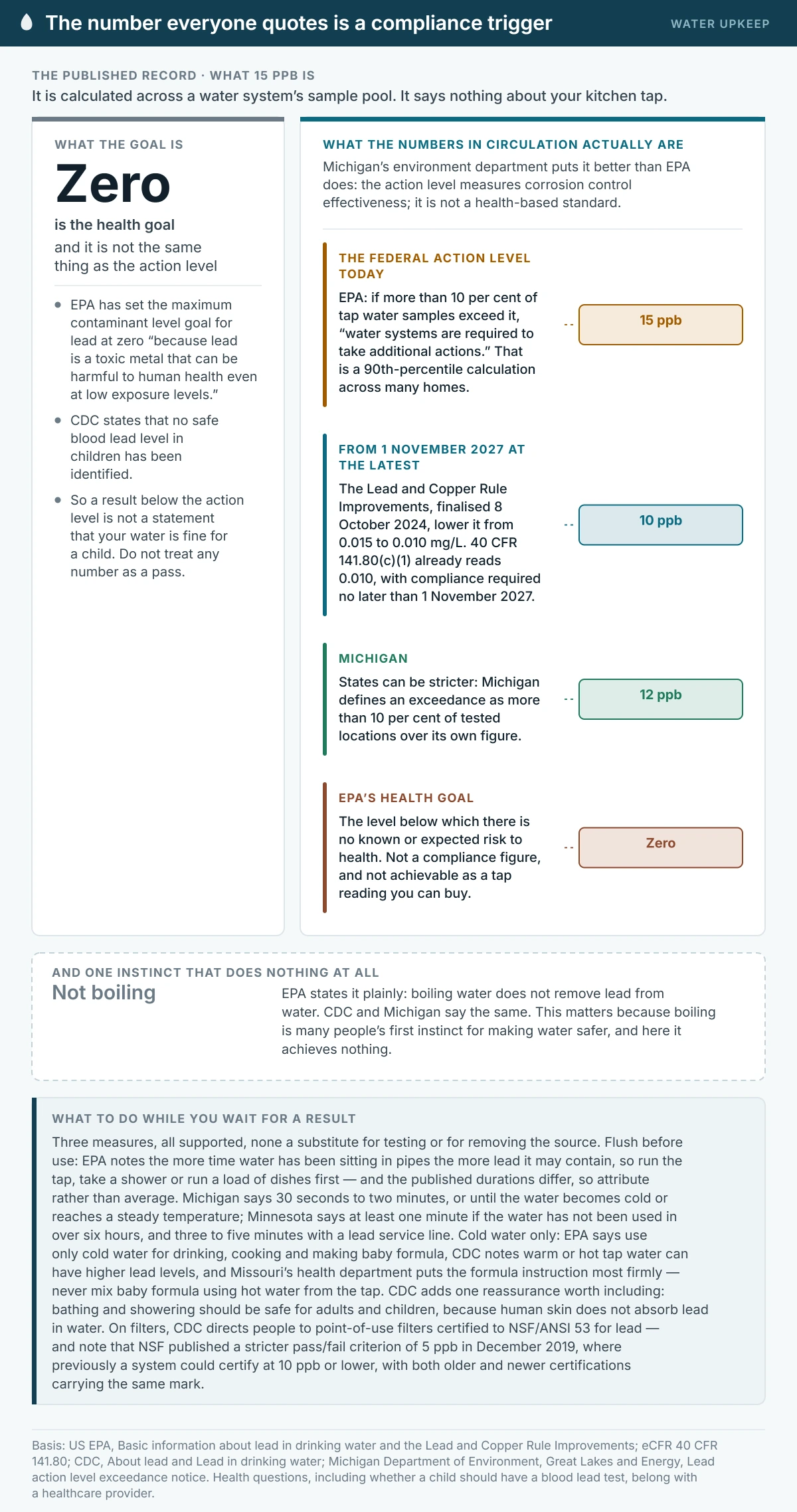
EPA’s own wording: if more than 10 per cent of tap water samples exceed the lead action level of 15 parts per billion, then water systems are required to take additional actions. That is a 90th-percentile calculation across many homes in a system. It says nothing about whether any individual result is acceptable.
The goal is zero. EPA has set the maximum contaminant level goal for lead in drinking water at zero because lead is a toxic metal that can be harmful to human health even at low exposure levels. CDC states that no safe blood lead level in children has been identified.
Two numbers are in circulation, and both are correct depending on the date. The Lead and Copper Rule Improvements, finalised on 8 October 2024, lower the lead action level from 0.015 mg/L to 0.010 mg/L — 15 ppb to 10 ppb. The regulation at 40 CFR 141.80(c)(1) already reads 0.010 mg/L, but 141.80(a) makes that subpart effective 30 December 2024 with compliance required no later than 1 November 2027, and systems follow the earlier codification in the interim. EPA’s own consumer page, last updated 18 June 2026, still states 15 ppb. So: 15 ppb is the operative figure today, 10 ppb takes over no later than 1 November 2027.
States can be stricter. Michigan applies a 12 ppb action level, defining an exceedance as more than 10 per cent of tested locations over 12 ppb. Whatever your utility’s notice says, it is a system-level trigger and not a verdict on your kitchen tap.
The sampling protocol
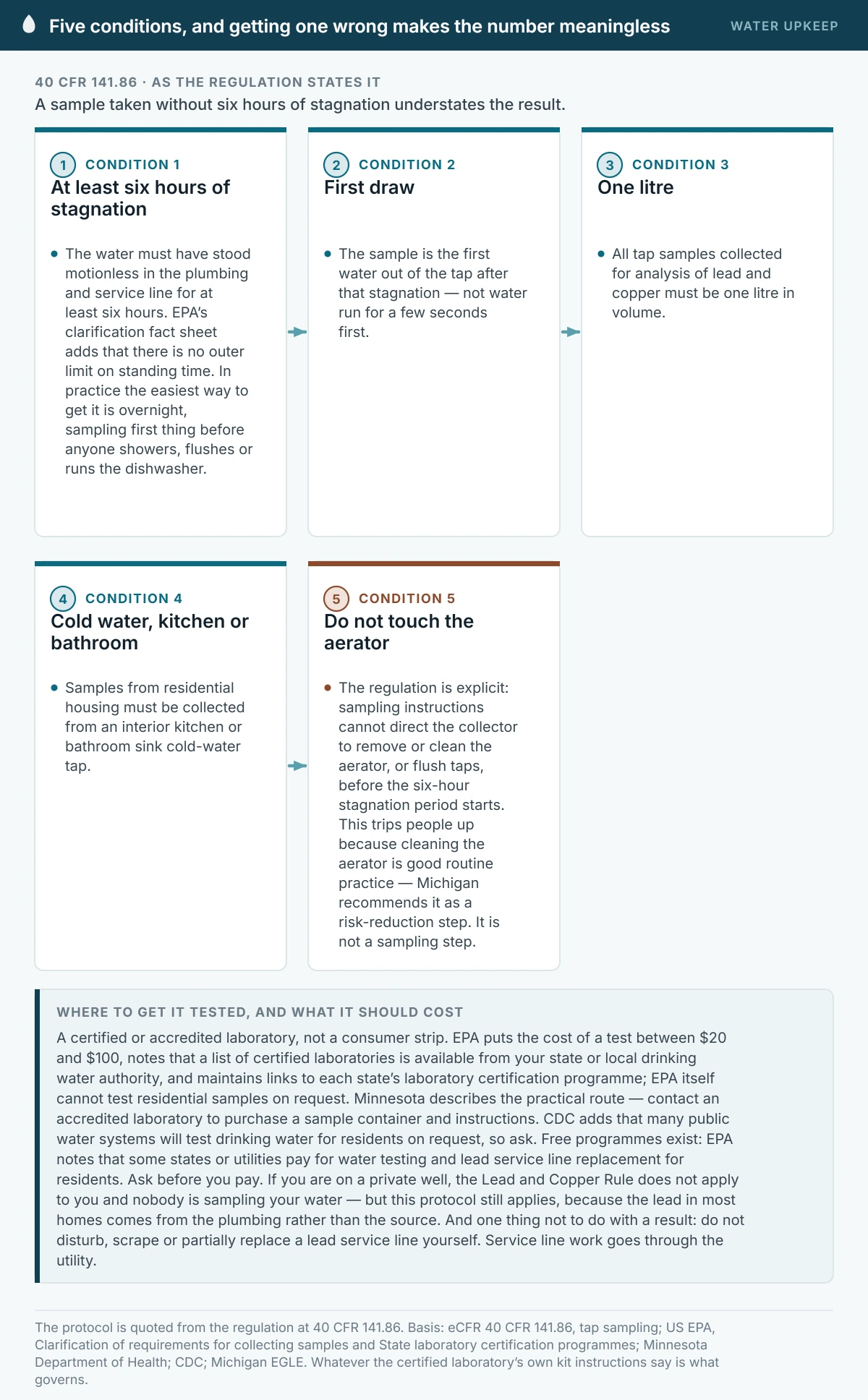
This comes straight from the regulation at 40 CFR 141.86, and getting it wrong makes the result meaningless.
- One litre. All tap samples collected for analysis of lead and copper must be one litre in volume.
- At least six hours of stagnation. The water must have stood motionless in the plumbing and service line for at least six hours. EPA’s clarification fact sheet adds that there is no outer limit on standing time.
- First draw. The sample is the first water out of the tap after that stagnation.
- Cold water, kitchen or bathroom. Samples from residential housing must be collected from an interior kitchen or bathroom sink cold-water tap.
- Do not touch the aerator. The regulation is explicit: sampling instructions cannot direct the sample collector to remove or clean the aerator, or flush taps, before the six-hour stagnation period starts.
That last point trips people up because cleaning the aerator is good routine practice — Michigan recommends it as a risk-reduction step. It is not a sampling step. Whatever the certified laboratory’s kit instructions say is what governs.
In practice the easiest way to get six hours of stagnation is overnight, sampling first thing before anyone showers, flushes or runs the dishwasher.
Where to get it tested
A certified or accredited laboratory, not a consumer strip. EPA puts the cost of a test between $20 and $100, and notes a list of certified laboratories is available from your state or local drinking water authority; it maintains links to each state’s laboratory certification programme. EPA itself cannot test residential samples on request.
The Minnesota Department of Health describes the practical route: contact an accredited laboratory to purchase a sample container and instructions on how to submit a sample. CDC adds that many public water systems will test drinking water for residents on request — ask.
Free programmes exist. EPA notes that some states or utilities offer programmes to pay for water testing and lead service line replacement for residents, and directs people to contact their state or local water company. Minnesota suggests contacting your county or water utility to see whether they have programmes to make testing easier. Ask before you pay.
Finding out whether you have a lead service line
Under the Lead and Copper Rule Improvements, systems must produce an initial baseline service line inventory by 1 November 2027, publicly accessible, with systems serving over 50,000 people posting it online. The rule also requires full replacement of all lead and galvanised-requiring-replacement service lines in ten years or less. Your utility’s inventory is the first place to look.
EPA also publishes a self-check: all you need is a penny (or key) and a magnet, with the step-by-step procedure inside its Protect Your Tap guide.
A more involved technique exists for locating where lead is entering. Indiana’s Department of Environmental Management describes sequential sampling as a series of consecutive samples, typically 500 mL to one litre, collected from an interior tap after a stagnation period of typically six hours or more, with the number of samples depending on the length and diameter of the plumbing from the tap through the premise plumbing and service line. It notes this is relatively invasive to the resident and more complex than other sampling methods. It is a utility technique, not a homeowner one, and no allowed source publishes a rule for reading which bottle corresponds to which section of pipe.
What to do while you wait
Three measures, all supported, none of them a substitute for testing or for removing the source.
Flush before use. EPA: the more time water has been sitting in pipes, the more lead it may contain, so before drinking, flush the pipes by running the tap, taking a shower, doing laundry or a load of dishes. Durations differ by source — Michigan says 30 seconds to two minutes, or until the water becomes cold or reaches a steady temperature; Minnesota says at least one minute if the water has not been used in over six hours, and three to five minutes with a lead service line. Attribute rather than average.
Cold water only. EPA: use only cold water for drinking, cooking and making baby formula. CDC: water that comes out of the tap warm or hot can have higher levels of lead. Minnesota: hot water releases more lead from pipes than cold water. Missouri’s health department puts the formula instruction most firmly — never cook or mix baby formula using hot water from the tap.
Do not boil. EPA states it plainly: boiling water does not remove lead from water. CDC and Michigan say the same. This matters because boiling is many people’s instinct for making water safer, and here it does nothing.
CDC adds one reassurance worth including: bathing and showering should be safe for adults and children, because human skin does not absorb lead in water.
Filters, and the certification detail most people miss
CDC directs people to point-of-use filters certified to NSF/ANSI 53 for lead removal and NSF/ANSI 42 for particulate removal. Missouri’s health department notes filters certified for lead reduction are marked NSF 53 on the package, and that reverse osmosis systems marked NSF 58 are also effective.
Here is the detail worth knowing. NSF published a stricter lead pass/fail criterion of 5 ppb for NSF/ANSI 53 and NSF/ANSI 58 in December 2019; previously a system could certify if it reduced lead to 10 ppb or lower. Challenge water for the test is 150 ppb lead. Both older and newer certifications carry the same NSF/ANSI 53 mark, so the mark alone does not tell you which threshold was applied.
And a filter is only as good as its maintenance. NSF notes most water treatment systems have replaceable filters or media and may require regular maintenance, so follow the manufacturer’s instructions and replace filters at the recommended time. An expired cartridge is not a safeguard. How the certification numbers fit together is covered in what filtered water means.
Reading your result
Do not treat any number as a pass. The action level is a system compliance trigger; EPA’s health goal is zero; CDC has identified no safe blood lead level in children. A result below 15 ppb is not a statement that your water is fine for a child.
What a result does give you is a basis for acting. Take it to your water utility if you are on a public supply, or to your county or state health department. For health questions — including whether a child should have a blood lead test — CDC’s instruction is to talk to a healthcare provider. Minnesota routes health-effects questions to its lead poisoning prevention programme and water questions to its drinking water protection programme, which is the right split.
One thing not to do: do not disturb, scrape or partially replace a lead service line yourself. Service line work goes through the utility.
If you are on a private well
The Lead and Copper Rule does not apply to you, and nobody is sampling your water. EPA notes private well owners may contact their state programme for guidance or directly contact a certified laboratory to pay to have the well tested. The sampling protocol above still applies, because the lead in most homes comes from the plumbing rather than the source. Corrosive water makes it worse, and our guide to making water taste better covers the metallic-taste and flushing side of that — while noting that lead itself has no taste at all.
When to call a professional
- Any detectable lead result, at any level, if there are young children in the house or anyone is pregnant. Call your health department and your healthcare provider.
- Your utility’s inventory shows a lead or galvanised service line at your address.
- You are unsure whether a result was collected to protocol. A sample taken without six hours of stagnation understates the number.
- You are being sold a whole-house system for lead. The certified claim is a point-of-use one under NSF/ANSI 53 or 58; ask which standard and which claim.
- Anyone tells you that a result below the action level means your water is safe. It is a compliance trigger, not a safety line.
More on establishing what is in your water in our water testing hub.
Sources and standards
- US Environmental Protection Agency — Basic information about lead in drinking water, Lead and Copper Rule Improvements, LCRI fact sheet for states and public water systems, Protect your tap, State laboratory certification programmes and Clarification of requirements for collecting samples
- eCFR — 40 CFR 141.80, action levels and 40 CFR 141.86, tap sampling
- Centers for Disease Control and Prevention — About lead and Lead in drinking water
- Michigan Department of Environment, Great Lakes and Energy — Lead action level exceedance notice
- Minnesota Department of Health — Lead in drinking water
- Missouri Department of Health and Senior Services — Lead in drinking water fact sheet
- Indiana Department of Environmental Management — Guidance for developing a lead service line inventory
- NSF — Stricter requirements for lead reduction certification and Lead in drinking water
Last reviewed September 9, 2026.