What Is a Water Purifier?
“Water purifier” has no legal definition for anything you can buy for your kitchen. The phrase appears exactly once in federal regulation — and there it describes a hospital device, not a household one. There is one meaningful technical standard behind the word, NSF Protocol P231, and it is demanding enough that EPA itself notes few water treatment devices can meet it. Everything else sold as a purifier is a filter with a better adjective. That is not a reason to distrust filters; it is a reason to read the certification instead of the word.
Where the word does and does not exist in law
FDA regulates the phrase “purified water” as a bottled water label term, and separately defines a “medical ultraviolet water purifier” in 21 CFR 880.6710 as a device intended for medical purposes that destroys bacteria in water by exposure to ultraviolet radiation. Neither reaches a pitcher, an under-sink unit or a whole-house system.
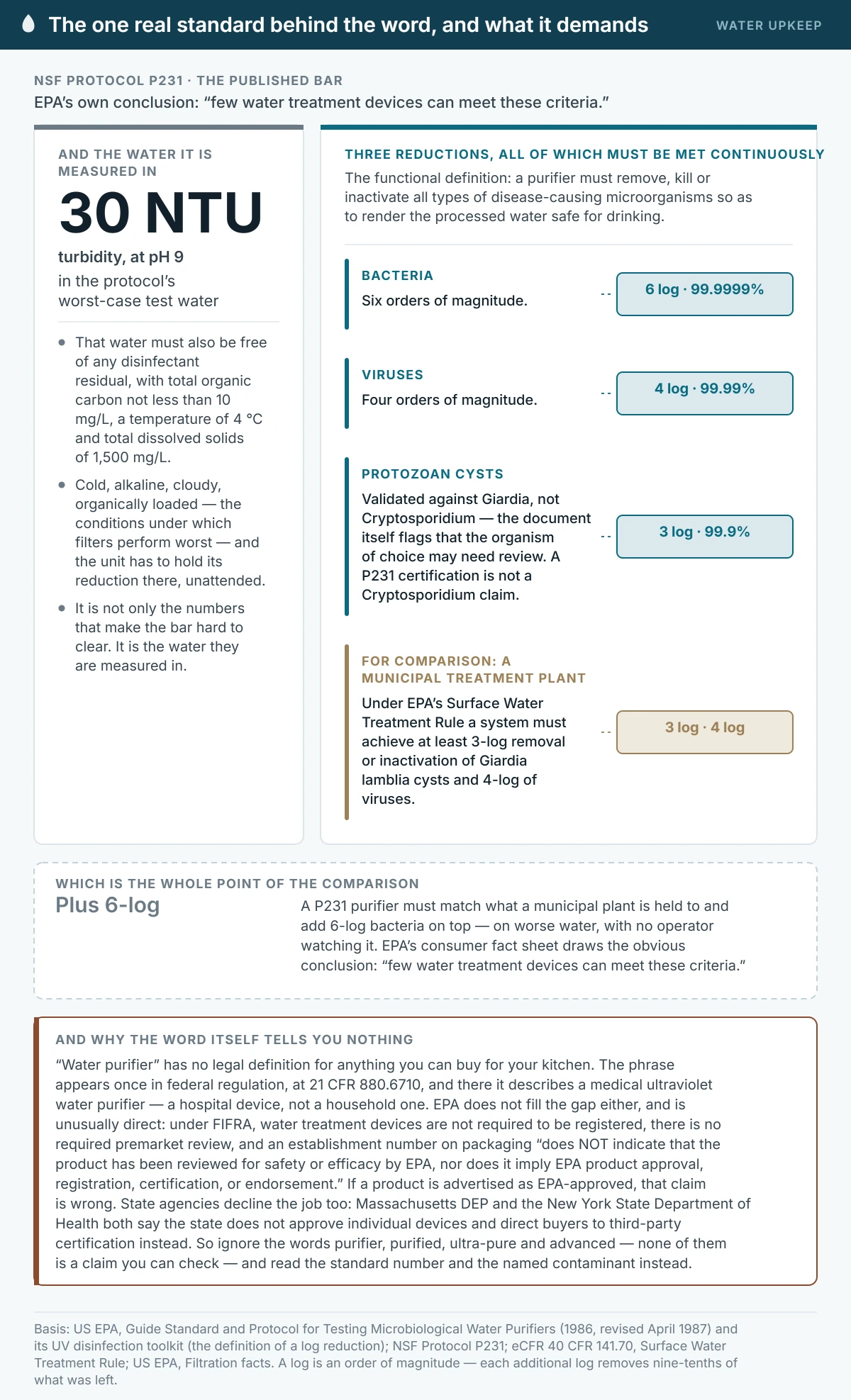
EPA does not fill the gap either, and it is unusually direct about this. Under FIFRA, water treatment devices are not required to be registered, there is no required premarket review, and manufacturers generally do not submit efficacy or safety data to EPA before selling. EPA states that an establishment number on device packaging “does NOT indicate that the product has been reviewed for safety or efficacy by EPA, nor does it imply EPA product approval, registration, certification, or endorsement.” If a product is advertised as EPA-approved, that claim is wrong.
State agencies decline the job too. The Texas Commission on Environmental Quality warns that some companies make claims about water quality that are false, deceptive or misleading in order to sell expensive and unnecessary treatment units, and points consumers to third-party certification instead. Massachusetts DEP and the New York State Department of Health both say the state does not approve individual devices and direct buyers to NSF, UL, WQA, CSA or IAPMO certification.
The one real standard behind the word
In 1986, revised April 1987, an EPA task force published a “Guide Standard and Protocol for Testing Microbiological Water Purifiers.” Its functional definition is the strictest thing in this article: a unit, to be called a microbiological water purifier, must remove, kill or inactivate all types of disease-causing microorganisms from the water, including bacteria, viruses and protozoan cysts, so as to render the processed water safe for drinking.
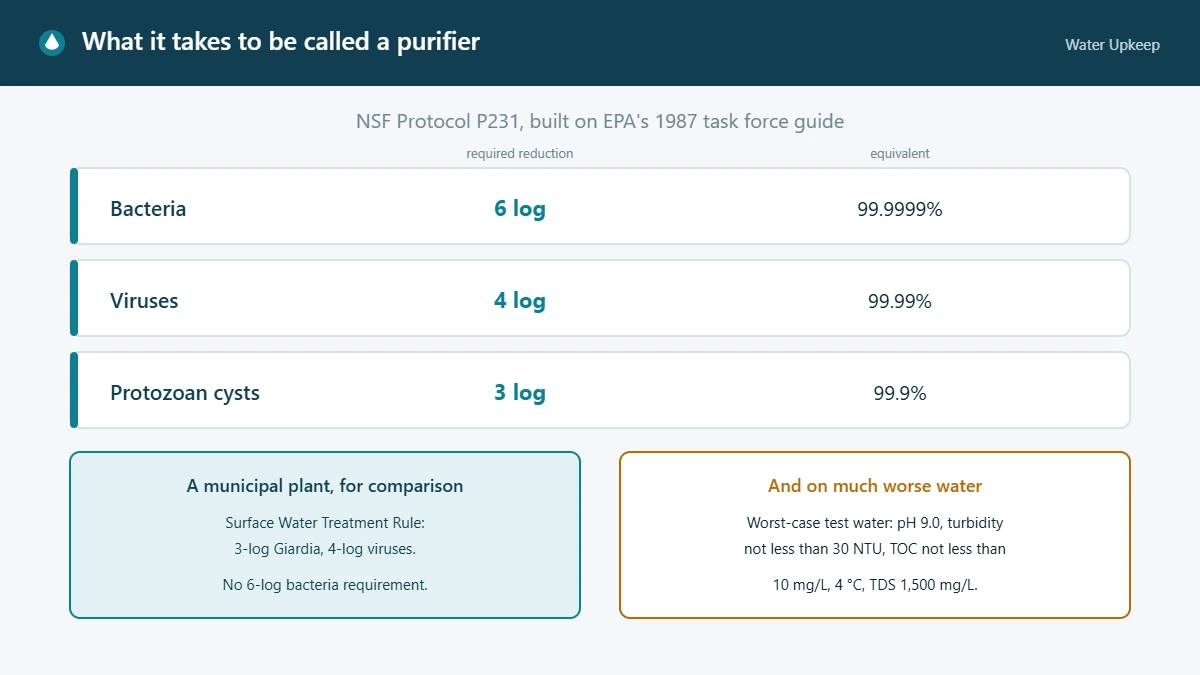
NSF built Protocol P231 by combining that EPA guide with several NSF/ANSI standards covering materials, structural integrity and product literature. The performance bar is three separate log reductions, all of which must be met continuously:
| Organism class | Required reduction | Equivalent |
|---|---|---|
| Bacteria | 6 log | 99.9999 per cent |
| Viruses | 4 log | 99.99 per cent |
| Protozoan cysts | 3 log | 99.9 per cent |
A log is an order of magnitude. EPA’s own definition, from its ultraviolet disinfection toolkit, is that the term means the order of magnitude reduction in concentration — 2-log removal equals a 99 per cent reduction, 3-log equals 99.9 per cent, 4-log equals 99.99 per cent. Each additional log removes nine-tenths of what was left.
What makes the bar so hard to clear
It is not only the numbers. It is the water they are measured in. The protocol specifies several test waters, and the worst case must be free of any disinfectant residual, at pH 9.0, with total organic carbon not less than 10 mg/L, turbidity not less than 30 NTU, temperature 4 °C and total dissolved solids of 1,500 mg/L. That is cold, alkaline, cloudy, organically loaded water — the conditions under which filters perform worst — and the unit has to hold its reduction there, with no operator watching it.
Set that against what a municipal treatment plant is held to. Under EPA’s Surface Water Treatment Rule, a system must achieve at least 99.9 per cent (3-log) removal or inactivation of Giardia lamblia cysts and at least 99.99 per cent (4-log) of viruses. A P231 purifier must match those and add 6-log bacteria on top, on worse water, unattended. EPA’s consumer fact sheet draws the obvious conclusion: “Few water treatment devices can meet these criteria.”
One limitation is worth knowing. The protocol validates cyst reduction against Giardia, not Cryptosporidium. The document itself flags that new data on cysts such as Cryptosporidium may in future require the organism of choice to be reviewed. A P231 certification is not a Cryptosporidium claim; that is a separate cyst-reduction claim under NSF/ANSI 53.
The certification numbers, and what each one actually covers
| Standard | What it covers |
|---|---|
| NSF P231 | Microbiological water purifiers, for water of unknown microbiological quality |
| NSF/ANSI 244 | Supplemental protection against intermittent or accidental microbiological contamination of water that is supposed to already be safe. Eligible technologies are ultrafiltration, microfiltration, nanofiltration, reverse osmosis and ceramic. Products must include an end-of-life indicator |
| NSF/ANSI 55 | Ultraviolet. Class A is for drinking water of unknown quality; Class B only reduces non-disease-causing bacteria in water already deemed acceptable |
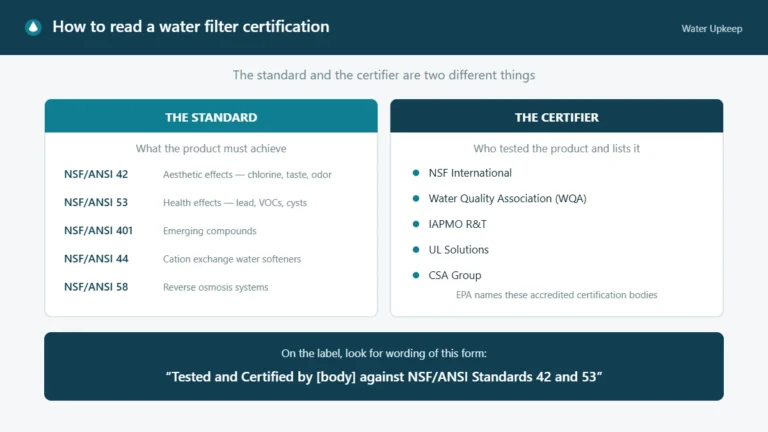
| NSF/ANSI 53 | Health effects — over fifty possible claims for regulated contaminants, commonly lead, Cryptosporidium, VOCs and chromium |
| NSF/ANSI 42 | Aesthetic effects — chlorine, taste and odour, chloramine, particulate, iron, manganese, zinc, total dissolved solids |
The 244 and P231 distinction is the one most likely to be blurred in marketing. NSF describes 244-certified filters as intended only for protection against intermittent microbiological contamination of otherwise safe drinking water. P231 is for water you do not trust in the first place. Those are different products for different situations.
Even NSF uses the word loosely in consumer-facing material, describing certified home treatment products generically as water purifiers and telling buyers to check the standard name and the specific contaminant on the packaging. That advice is the whole point: the standard and the contaminant are the claim. The noun is not.
Which technologies could plausibly qualify
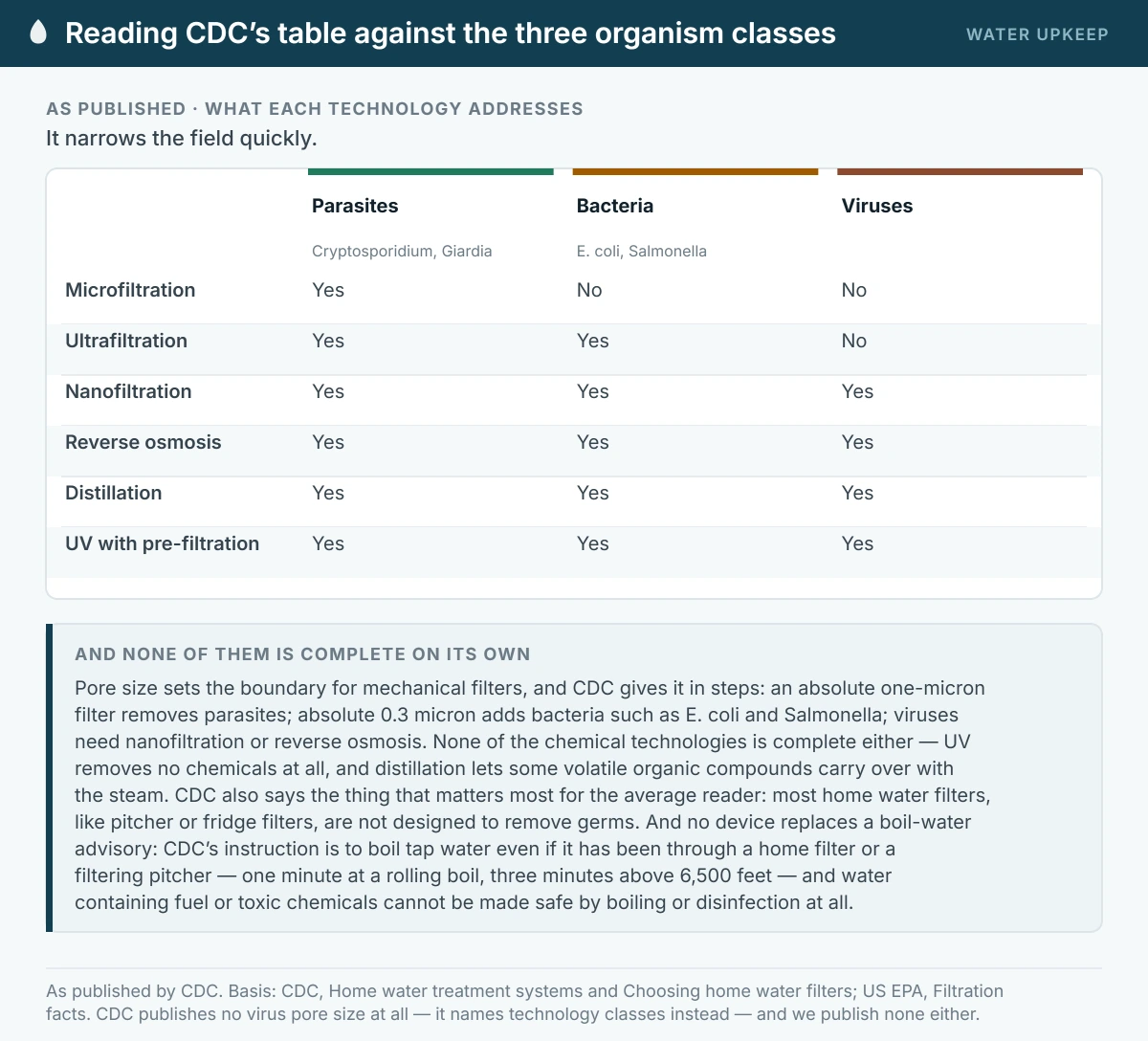
CDC publishes what each home technology removes, and reading it against the three organism classes narrows the field quickly.
| Technology | Parasites | Bacteria | Viruses |
|---|---|---|---|
| Microfiltration | Yes | No | No |
| Ultrafiltration | Yes | Yes | No |
| Nanofiltration | Yes | Yes | Yes |
| Reverse osmosis | Yes | Yes | Yes |
| Distillation | Yes | Yes | Yes |
| UV with pre-filtration | Yes | Yes | Yes |
Pore size sets the boundary for mechanical filters. CDC gives it in steps: an absolute one-micron filter removes parasites; absolute 0.3 micron adds bacteria such as E. coli and Salmonella; viruses need nanofiltration or reverse osmosis. None of the chemical technologies is complete either — UV removes no chemicals at all, and distillation lets some volatile organic compounds carry over with the steam.
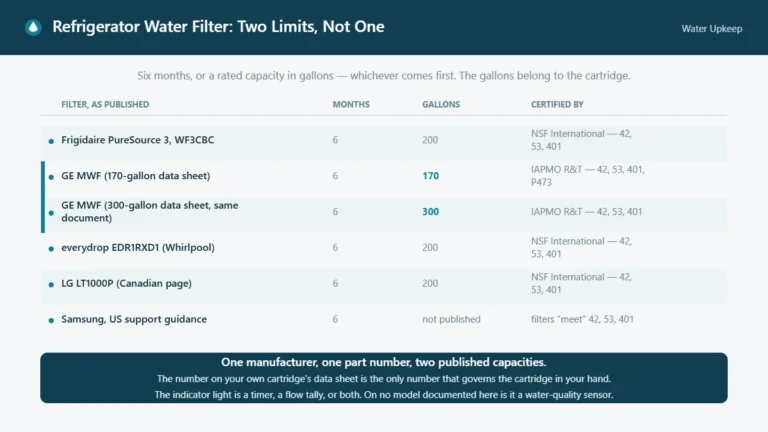
CDC also says the thing that matters most for the average reader: most home water filters, like pitcher or fridge filters, are not designed to remove germs. Our guide to what filtered water actually means covers what those devices are for.
Bottled “purified water” is a different word again
FDA defines purified water as water produced by distillation, deionisation, reverse osmosis or other suitable process that meets the United States Pharmacopeia definition of purified water. It may alternatively be labelled demineralised, deionised, distilled or reverse osmosis water. That definition turns on process and on dissolved solids specifications. It imposes no microbiological purification requirement at all.
Bottled purified water is subject to the general bottled water quality standard, which sets coliform indicator limits — and FDA has a separate, distinct label term, “sterile water,” for water meeting the pharmacopeia sterility test. FDA drew the line itself. Purified and sterile are not interchangeable, and neither is the same thing as a device certified to P231.
No device replaces a boil water advisory
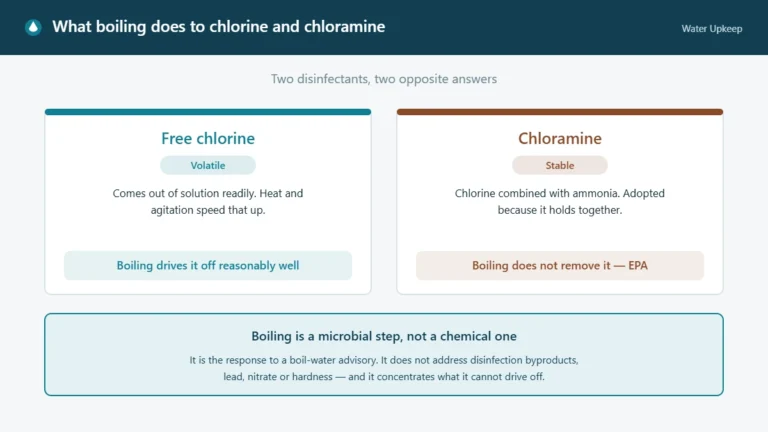
CDC’s instruction during an advisory is to boil tap water even if it has been through a home water filter or a filtering pitcher — one minute at a rolling boil, three minutes above 6,500 feet. CDC also notes that boiling is the best way to kill germs in water, that portable filters must have an absolute pore size of 0.3 micron or smaller to remove bacteria and will not remove viruses, and that water containing fuel or toxic chemicals cannot be made safe by boiling or disinfection at all.
What to do with all this in a shop
- Ignore the words purifier, purified, ultra-pure and advanced. None of them is a claim you can check.
- Find the certification mark and read two things: the standard number and the named contaminant. A certification covers only the contaminants tested.
- NSF/ANSI 42 is a taste-and-odour certification. It is not evidence of health protection.
- If microbiological protection is genuinely what you need — an unreliable private supply, for instance — the relevant marks are P231, NSF/ANSI 244 or NSF/ANSI 55 Class A, and very few products carry them.
- Massachusetts DEP makes a point worth carrying home: keep testing after installing a treatment unit, because there is often no way to know if a treatment system has failed.
When to call a professional
- You are on a private well with a positive coliform result, or a supply you have reason to distrust. Match treatment to a test result, not to a category name. Our guide to how a well works covers what testing well owners are responsible for.
- Anyone in the household needs water for a medical purpose. That is a clinical decision, not a shopping one.
- You have been quoted for a whole-house system on the strength of an in-home water test performed by the seller.
- You have been told a device is EPA-approved or EPA-certified.
More on what is in your water and what to do about it in our drinking water hub.
Sources and standards
- US Environmental Protection Agency — Guide standard and protocol for testing microbiological water purifiers, Pesticide devices: a guide for consumers, Filtration facts, UV disinfection toolkit and Capability of point-of-use and point-of-entry treatment devices
- eCFR — 40 CFR 141.70, Surface Water Treatment Rule, 21 CFR 165.110, bottled water and 21 CFR 880.6710, medical ultraviolet water purifier
- NSF — Standards for water treatment systems, NSF/ANSI 42, 53 and 401 and Public health standards for water purifiers
- Centers for Disease Control and Prevention — Home water treatment systems, Choosing home water filters and Drinking water advisories
- Texas Commission on Environmental Quality — Choosing home water treatment
- Massachusetts Department of Environmental Protection — Home water treatment devices
- New York State Department of Health — Point-of-use treatment devices
Last reviewed September 9, 2026.