How Much Does It Cost to Drill a Water Well?
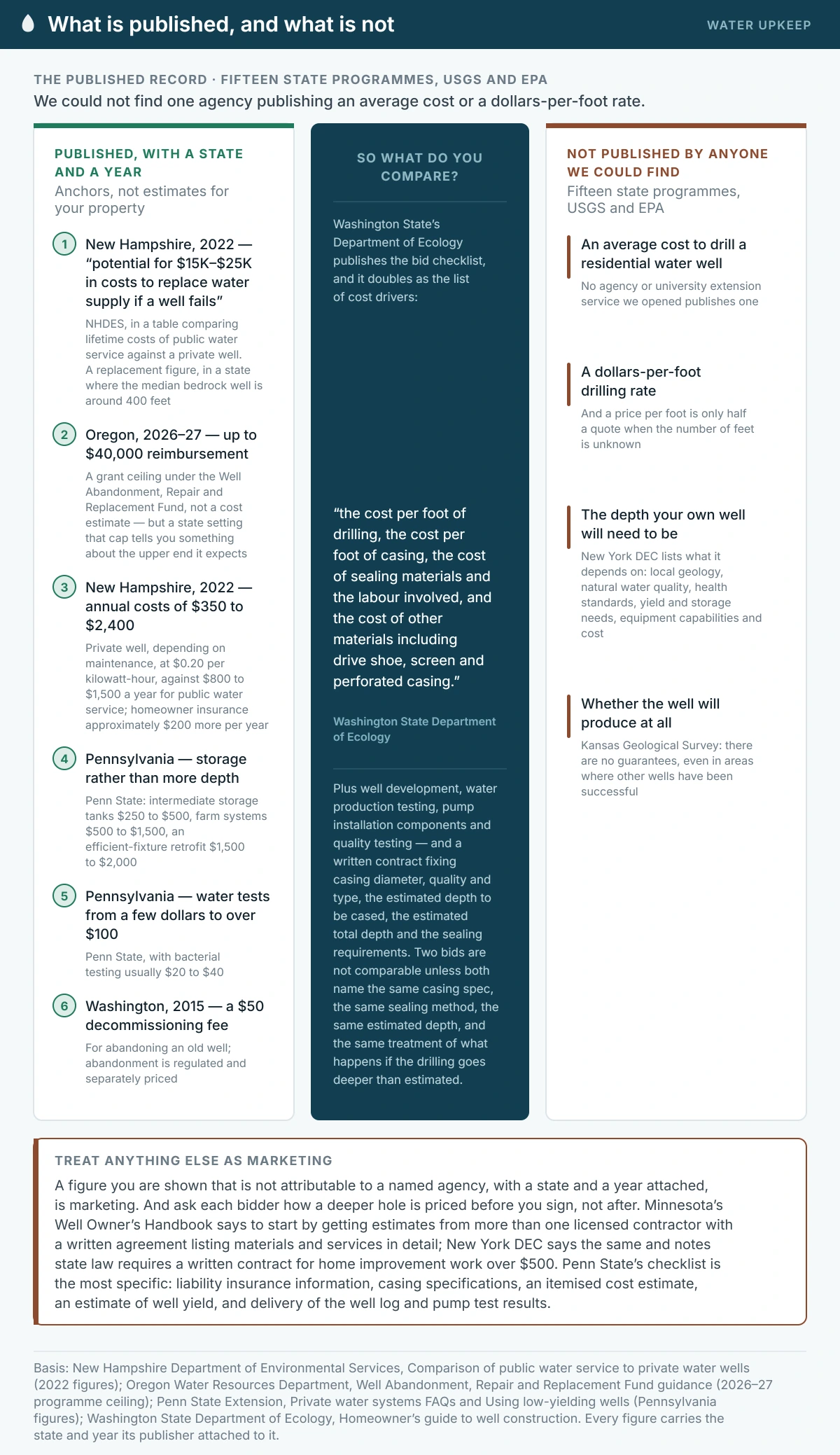
We could not find a single government agency or university extension service in the United States that publishes an average cost to drill a residential water well, or a dollars-per-foot drilling rate. We looked at USGS, EPA and the well programmes of fifteen states. That absence is not an oversight — it is a statement about the thing being priced. Three separate state agencies say, in their own words, that nobody can tell you in advance how deep your well will need to be or whether it will produce. What you can do is understand what goes into a bid, demand it itemised, and compare like with like.
Why nobody publishes a price
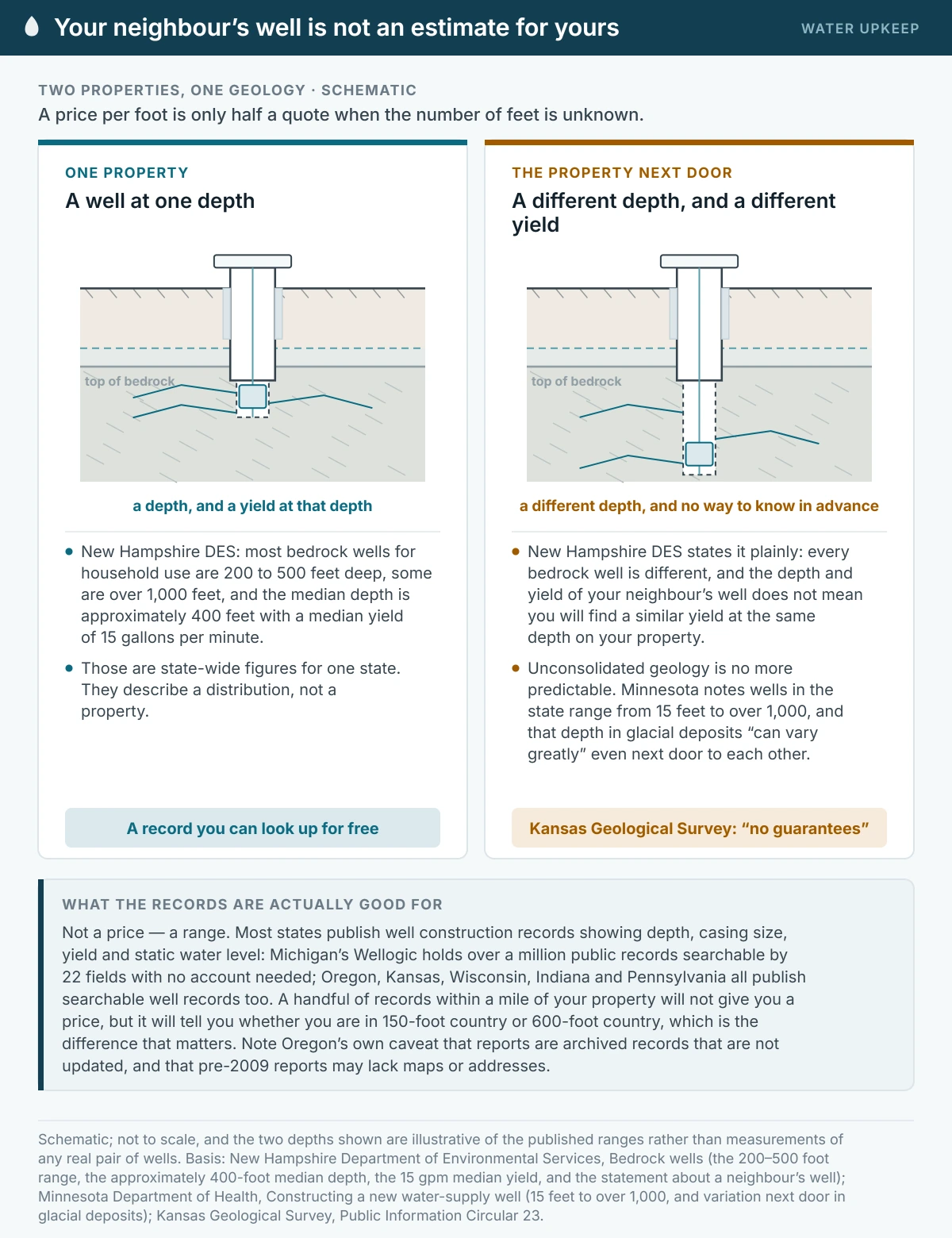
New Hampshire’s Department of Environmental Services puts the core problem plainly: every bedrock well is different, and the depth and yield of your neighbour’s well does not mean you will find a similar yield at the same depth on your property. For context in that state, most bedrock wells for household use are 200 to 500 feet deep, some are over 1,000 feet, and the median depth is approximately 400 feet with a median yield of 15 gallons per minute.
Unconsolidated geology is no more predictable. The Minnesota Department of Health notes wells in the state range from 15 feet to over 1,000, and that the depth of wells in glacial deposits can vary greatly even next door to each other.
New York’s Department of Environmental Conservation lists what depth actually depends on: local geology, natural water quality, health standards, yield and storage needs, drilling equipment capabilities, and cost. And the Kansas Geological Survey adds the part nobody selling you a well will say first — there are no guarantees that you will hit adequate water of good quality, even in areas where other wells have been successful.
A price per foot is only half a quote when the number of feet is unknown.
The only two figures we could verify
Both are regional, both are labelled, and neither is a national average or a drilling rate. They are useful as anchors, not as estimates for your property.
- New Hampshire, 2022. NHDES, comparing lifetime costs of public water service against a private well, lists the “potential for $15K–$25K in costs to replace water supply if a well fails and a new one has to be installed.” That is a replacement figure, in New Hampshire, where the median bedrock well is around 400 feet deep. The same table gives private well annual costs of $350 to $2,400 depending on maintenance, against $800 to $1,500 a year for public water service.
- Oregon, 2026–27. The Oregon Water Resources Department’s Well Abandonment, Repair and Replacement Fund may reimburse qualified homeowners up to $40,000 for work to permanently abandon, replace or repair a household well. That is a grant ceiling, not a cost estimate — but a state setting a $40,000 reimbursement cap tells you something about the upper end of the range it expects to encounter.
Treat any figure you are shown that is not attributable to a named agency, with a state and a year attached, as marketing.
What is actually in the price
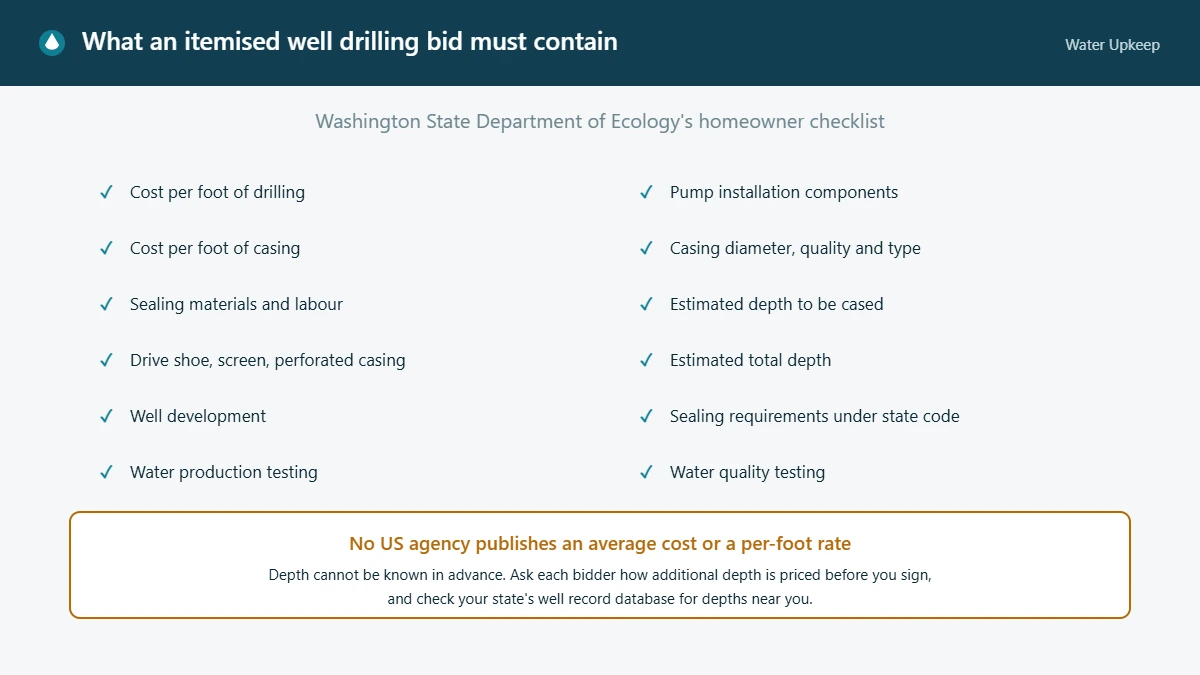
Washington State’s Department of Ecology publishes the best homeowner bid checklist we found, and it doubles as a list of cost drivers. It tells homeowners to get from the driller the cost per foot of drilling, the cost per foot of casing, the cost of sealing materials and the labour involved, and the cost of other materials including drive shoe, screen and perforated casing — plus well development, water production testing, pump installation components and quality testing. It also says the contract should fix casing diameters, casing quality and type, the estimated depth to be cased, the estimated total depth, and the sealing requirements under state code, all under a written contract for mutual protection.
| Cost driver | Why it varies |
|---|---|
| Depth to a productive zone | Unknowable in advance; the single largest variable |
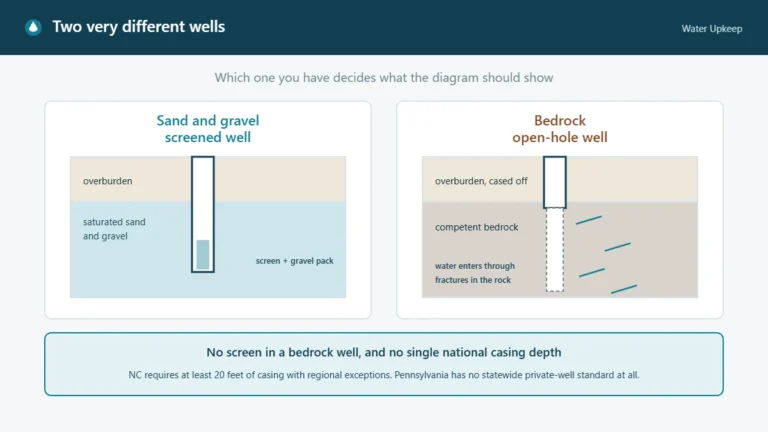
| Geology | Bedrock wells are cased through the overburden and drilled open-hole below; unconsolidated formations need screen and gravel pack |
| Casing length, diameter and material | Set by state code and by how deep the competent rock is. NH: casing seated at least 10 feet into hard bedrock; most residential wells 6 inches in diameter |
| Grouting and sealing | NC requires grout sealing off all aquifers or zones with poorer quality water; a nonshrinking cement grout is recommended |
| Concrete pad and wellhead | NC: a slab extending at least 2 feet from the casing in all directions, sloped to shed water; casing at least 12 inches above ground |
| Pump, pressure tank, pitless adapter, drop pipe | Sized to depth and yield — a deeper well means a different pump |
| Electrical connection | Distance from the house and service capacity |
| Site access and distance | Rig access, and setback rules that may force a less convenient location |
| Permits and notices | Washington requires a notice of intent 72 hours before drilling; Colorado requires a state permit before drilling |
| Well development and yield testing | A separate line item, and the one that tells you whether the well works |
| Disinfection and water testing | Named as its own line by NC State Extension |
| Abandonment of an old well | Regulated and separately priced — Washington charges a $50 decommissioning fee, as published in 2015 |
Setbacks are a real siting constraint with cost consequences. NC State Extension requires a well at least 100 feet from any septic system or drainfield and at least 50 feet from watertight sewer lines, with narrower exceptions for single-family dwellings. Where the compliant spot sits relative to the house affects trenching and electrical runs.
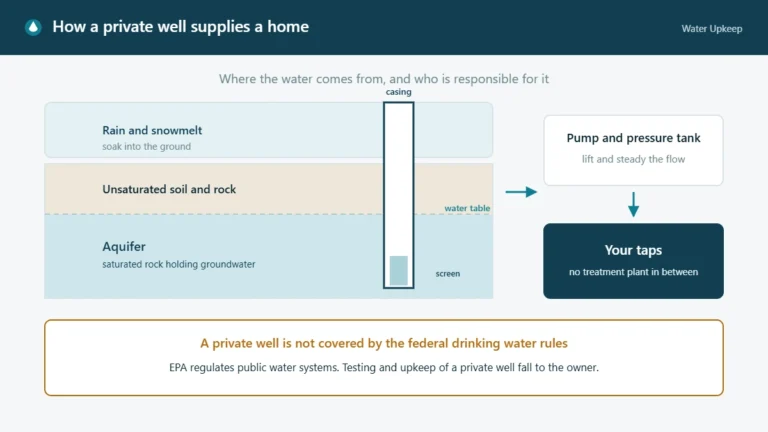
What each of those components does is covered in how a well works.
Look up your neighbours’ wells first
You cannot know your depth in advance, but you can narrow the range for free. Most states publish well construction records, and they typically show depth, casing size, yield and static water level.
- Michigan — Wellogic holds over a million records, all viewable by the public, searchable by 22 different fields, with no account needed.
- Oregon — well reports record who owned the well, what construction was done and how it performed at the time, searchable through Find a Well Report. Note the department’s own caveat that reports are archived records that are not updated, and that pre-2009 reports may lack maps or addresses.
- Kansas — the WWC5 database is searchable by section, township and range.
- Wisconsin and Indiana both publish searchable well construction records.
- Pennsylvania — state law requires drillers to complete a well log for every well, filed with the Bureau of Topographic and Geologic Survey and available through its Groundwater Information System.
A handful of records within a mile of your property will not give you a price, but it will tell you whether you are in 150-foot country or 600-foot country, which is the difference that matters.
Licensing, and why it varies more than you would expect
EPA’s general advice is to make sure any water-well drillers and pump installers you work with are bonded and insured. Beyond that, the rules are genuinely state-specific:
- Washington: licensed well drillers may construct wells in the state.
- Minnesota: all wells must be installed by contractors licensed by the Department of Health, except that an individual may construct a well for personal use on land they own or lease.
- New York: all water well contractors register with the Department of Environmental Conservation every year.
- North Carolina: drillers must be registered with the state, and some counties require registration with them too.
- Alabama: only licensed drillers may drill; they must show two years of experience and score at least 70 per cent on an examination, file a notification of intent before drilling and a certification of completion within 30 days after.
- Oregon: the constructor must hold a current Water Well Constructor’s License with a water supply well endorsement, and be bonded to a minimum of $20,000.
- Pennsylvania: other than a few county or local ordinances, there are no statewide construction standards for private water wells.
That last one is worth pausing on. In a state without construction standards, what is in the contract is what you get.
How to compare bids
Minnesota’s Well Owner’s Handbook gives the starting instruction: begin by getting estimates or bids from more than one licensed well contractor, and have a written agreement listing in detail the materials and services to be provided. New York DEC says the same — obtain more than one estimate, get a written contract, and include any special concerns in it, noting that state law requires a written contract for home improvement work over $500.
Penn State Extension’s contract checklist is the most specific: use a contractor who submits well logs and will supply a written contract, and make sure it carries liability insurance information for the driller, casing specifications (a minimum of 4 inches to bedrock), an itemised cost estimate, an estimate of well yield, and delivery of the well log and pump test results.
Insist on the well record. Washington requires drillers to file well reports within 30 days of construction; New York requires contractors to submit a completion report to you and to DEC; Minnesota requires the contractor to give the owner a copy of the Well and Boring Record documenting depth, depth to groundwater, geology, components and pump information. That document is what a future buyer, a future driller and you will rely on.
Two bids are not comparable unless both name the same casing spec, the same sealing method, the same estimated depth and the same treatment of what happens if the drilling goes deeper than estimated. Ask each bidder how a deeper hole is priced before you sign, not after.
If the well underproduces
The minimum acceptable yield is itself disputed. The Kansas Geological Survey considers at least 4 to 5 gallons per minute the minimum necessary for adequate domestic household use. Colorado State University Extension sets a much lower floor — the well should produce a minimum of half a gallon per minute — and notes that wells producing under 1 gallon per minute often need an additional storage tank. Those are different regional assumptions about storage, not a contradiction to resolve.
That points at the usual remedy. Penn State Extension notes peak household demand runs 30 minutes to two hours, that a family of four may need 300 or more gallons during a two-hour peak, and gives a rule of thumb of 100 gallons of water for every person in the home — while a pressure tank supplies only about 20 per cent of its volume as usable capacity. Its costed remedies are storage rather than more drilling: residential intermediate storage tanks at $250 to $500, farm systems at $500 to $1,500, and a full efficient-fixture retrofit at $1,500 to $2,000, all Pennsylvania figures.
Oregon’s list of options for a failing or dry well is a good summary of the ladder: lower the existing pump, deepen the well, drill a new well to state standards, temporarily use a neighbour’s well, or install portable tanks and arrange water delivery.
The costs that come after
A well is not a one-off purchase. NHDES’s comparison puts private well annual costs at $350 to $400 with no maintenance and $1,200 to $2,400 with maintenance, assuming a $0.20 per kilowatt-hour electricity rate, and notes homeowner insurance costs approximately $200 more per year. Penn State puts individual water tests from a few dollars to over $100, with bacterial testing usually $20 to $40.
And testing is not optional — nobody does it for you, as we cover in what well water is.
When to call a professional
- Before anything else: check your state’s well record database for depths near you, and your state’s licensing and permit requirements.
- You have one bid. Get at least two, itemised on the same basis.
- A bid does not state casing specification, sealing method, estimated depth, yield estimate, or how additional depth is priced.
- There is an old well on the property. Abandonment is regulated and separately costed, and several states fund it.
- The new well underproduces. Storage is usually cheaper than drilling deeper — get that priced before agreeing to more depth.
More on owning a private supply in our well water hub.
Sources and standards
- New Hampshire Department of Environmental Services — Comparison of public water service to private water wells and Bedrock wells
- Oregon Water Resources Department — Well Abandonment, Repair and Replacement Fund guidance, About well reports and Domestic wells and drought
- Washington State Department of Ecology — Homeowner’s guide to well construction and Well construction notice of intent
- Minnesota Department of Health — Well owner’s handbook and Constructing a new water-supply well
- New York State Department of Environmental Conservation — Water well consumer protection guide
- Kansas Geological Survey — Public Information Circular 23 and WWC5 well database
- Michigan Department of Environment, Great Lakes and Energy — Wellogic
- Wisconsin Department of Natural Resources — Private well owners
- Indiana Department of Natural Resources — Water well record database
- Penn State Extension — Drilling a new well, Using low-yielding wells and Private water systems FAQs
- NC State Extension — Well construction and protection
- Alabama Cooperative Extension System — Water well construction
- Colorado State University Extension — Private wells for home use
- US Environmental Protection Agency — Learn about private water wells
- US Geological Survey — Domestic (private) supply wells
Last reviewed September 9, 2026.