How to Treat Hard Water
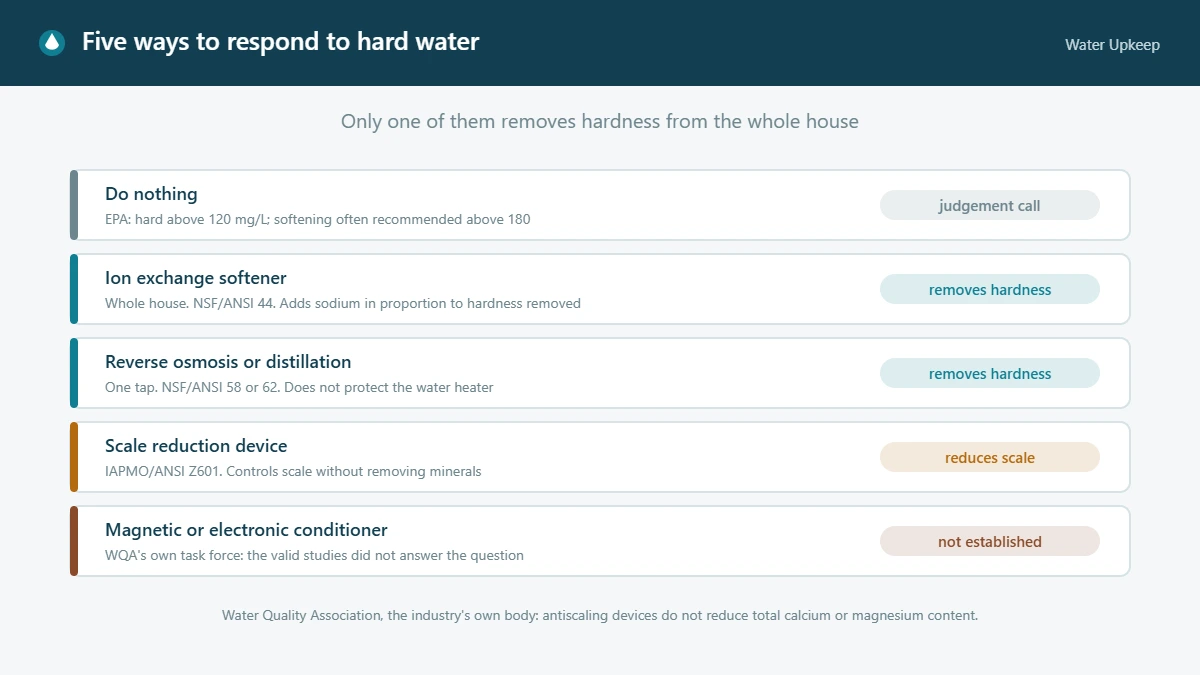
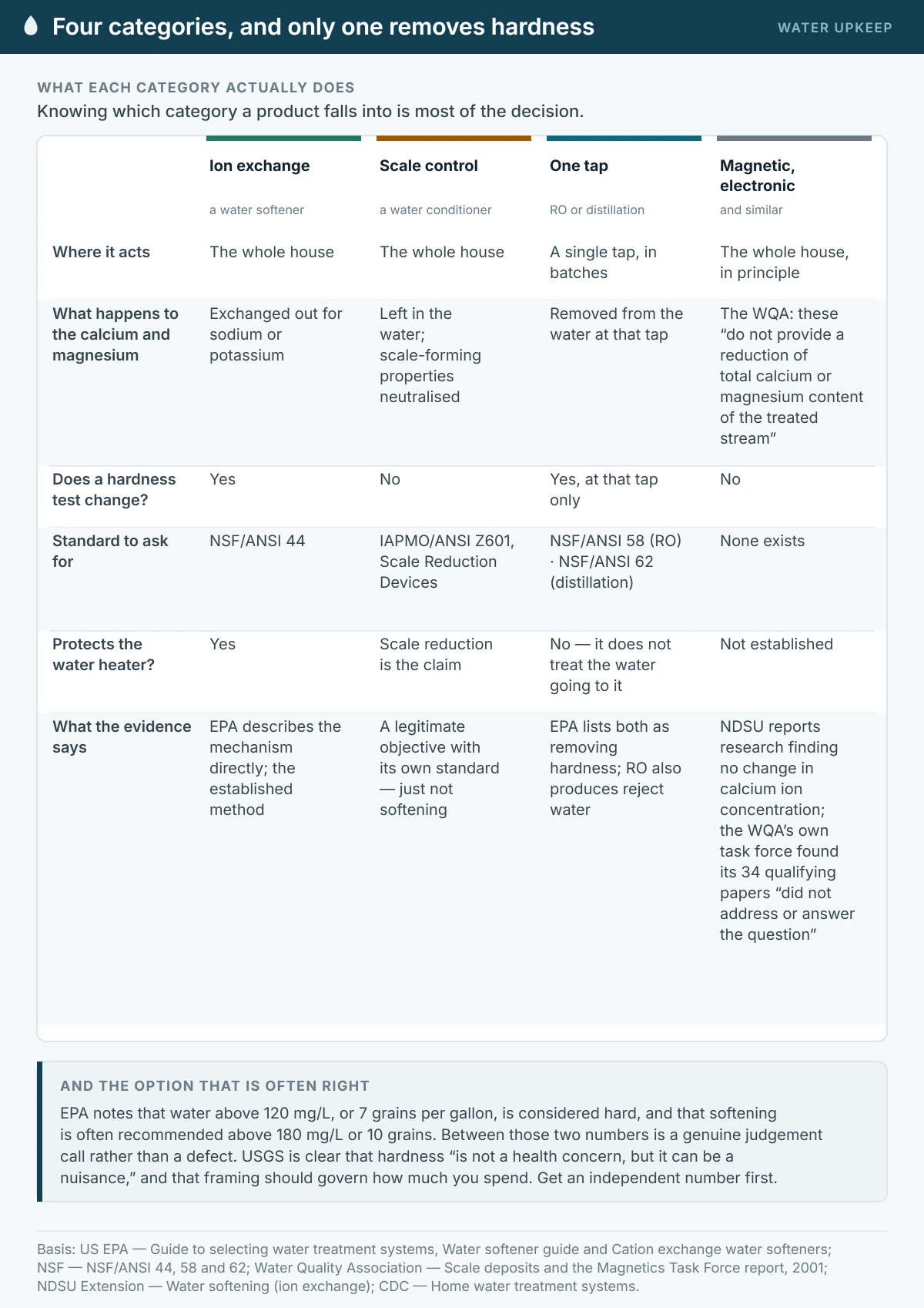
There is exactly one household technology that removes hardness from all the water in a house, and it is ion exchange — a water softener. Everything else on the market does one of three other things: it reduces scale without removing the minerals, it treats one tap rather than the house, or it does nothing measurable at all. Knowing which category a product falls into is most of the decision. And for a lot of homes the right answer is to do nothing, because moderately hard water is a nuisance rather than a problem worth spending on.
What you are actually treating
USGS defines hardness as the amount of dissolved calcium and magnesium in the water, picked up as water moves through soil and rock and dissolves small amounts of naturally occurring minerals. Where those minerals are in the ground around a well, hard water arrives at the tap. USGS notes hard water was prevalent in the east-central and western United States, reflecting the distribution of carbonate aquifers.
USGS is equally clear about what it is not: hardness is a property of water that is not a health concern, but it can be a nuisance. EPA WaterSense says the same — while hard water is not a health concern, it can allow scale buildup on plumbing fixtures and appliances. That framing should govern how much you spend.
What hardness actually costs you
Two consequences, both real.
Scale. USGS: when hard water is heated, as in a home water heater, solid deposits of calcium carbonate form, and this scale can reduce the life of equipment, raise the cost of heating water, lower the efficiency of electric water heaters and clog pipes. Water pipes can gradually close up, reducing flow and pressure. EPA gives the mechanism: scaling impedes the flow of water and decreases heat conductivity, so water heaters operate less efficiently.
Soap. EPA notes hard water reacts with soap to form a sticky coating on skin and reduces soap’s ability to lather, making a shower or washer cycle less productive. USGS describes the same reaction producing soap scum, so more soap or detergent is needed, and visible residue is left on dishes and glassware.
Beyond that, be sceptical. The savings percentages and appliance-lifespan figures that circulate in this niche are not published by any government or university source we could find. The one quantified study we located — water heater testing by Battelle for the Water Quality Research Foundation, the research arm of the water treatment industry’s trade association — found gas storage heater efficiency falling from 70.4 to 67.4 per cent over two years’ equivalent service on unsoftened water, using feed water at 26.2 grains per gallon. That is very hard water, well above the level at which softening is normally suggested, and the study was industry-funded to an industry-approved protocol. Useful, but not a household budget.
Option one: do nothing
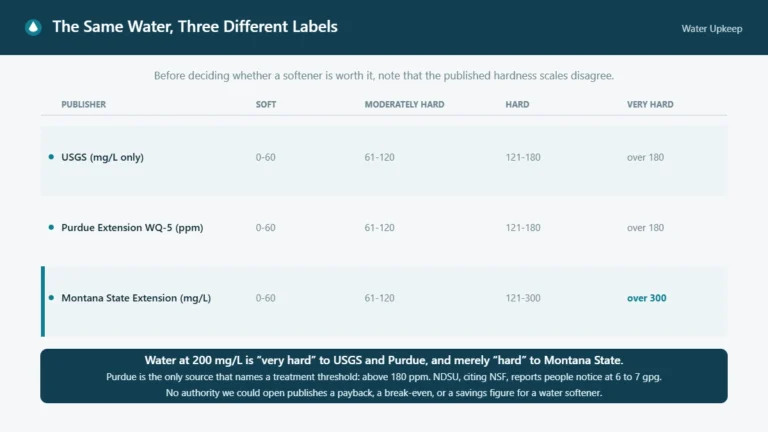
EPA notes that water above 120 mg/L, or 7 grains per gallon, is considered hard, and that softening is often recommended when hardness surpasses 180 mg/L or 10 grains per gallon. Between those two numbers is a genuine judgement call rather than a defect.
Get a number first. Our guide to testing water hardness covers how, and why the seller’s free test is not the one to size against.
Option two: ion exchange softening
This is the established method and the only one that removes hardness throughout the house. EPA describes the mechanism: hard water with positively charged calcium and magnesium ions passes through a mineral tank of resin beads carrying sodium ions, and the calcium and magnesium are exchanged for sodium or potassium. Penn State Extension puts it the same way — the resin releases its sodium ions and readily trades them for calcium and magnesium.
Two costs come with it. The first is water: EPA notes regeneration can use 25 gallons a day or more, up to 10,000 gallons a year. The second is sodium. Penn State gives the rate as 7.5 milligrams per quart for each grain per gallon of hardness removed; NDSU gives about 8 mg/L per grain. NDSU describes two mitigations — substituting potassium chloride, which uses about 10 per cent more salt, and leaving one kitchen tap unsoftened for drinking and cooking. Anyone on a restricted-sodium diet should raise it with a health professional rather than with a salesperson.
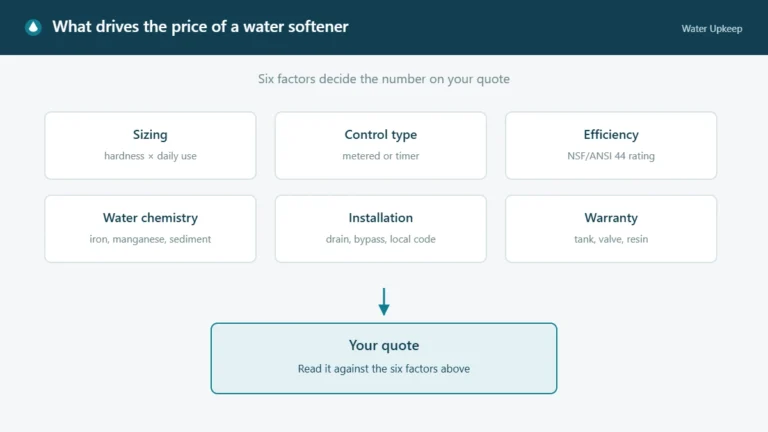
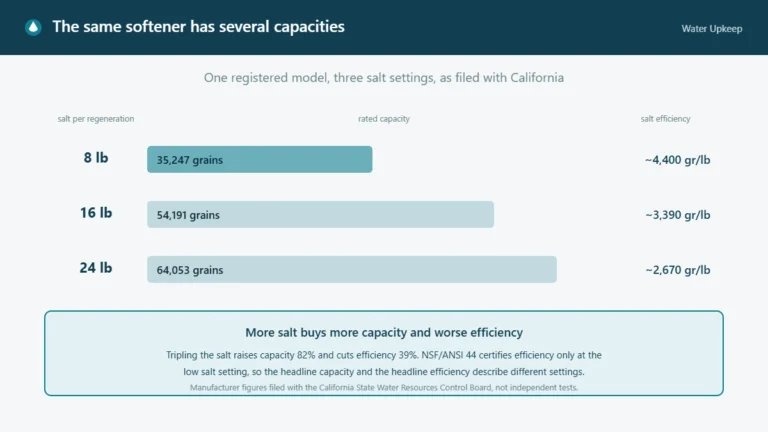
If you go this route, efficiency is worth specifying. EPA notes NSF/ANSI 44 includes a voluntary efficiency rating requiring 5.0 gallons or fewer per 1,000 grains removed, and that efficient models exceed 3,350 grains of hardness per pound of salt. The Water Quality Association advises avoiding time clocks to initiate regeneration. The full mechanism is in how water softeners work, and the arithmetic in what size softener you need.
Option three: soften less of the house
Softening everything is neither necessary nor free. Penn State suggests showers, sinks and laundry hookups probably should be softened, while toilets, outside spigots and basement sinks can be bypassed. EPA recommends the bypass valve when watering the lawn, washing the car or filling a pool. The Water Quality Association advises bypassing outside sill cocks wherever feasible so that softened water is used only inside.
An unsoftened cold tap in the kitchen is the standard version of this, and it is the practical answer to the sodium question for most households.
Option four: treat one tap, not the house
Two point-of-use technologies do reduce hardness in the water you drink.
Reverse osmosis. EPA lists it as removing sodium, dissolved inorganics and organics, some nitrates, pesticides and other compounds, and notes it also removes minerals such as calcium and potentially produces a large quantity of reject water. The relevant standard is NSF/ANSI 58, and WaterSense labelled models waste 2.3 gallons or less per gallon treated. CDC defines point-of-use systems as those treating water in batches and delivering it to a single tap. Reverse osmosis is a drinking-water answer, not a plumbing-protection one.
Distillation. EPA lists it as removing hardness along with nitrates, bacteria, viruses, sodium, dissolved solids, heavy metals and radionuclides, while not removing some volatile organic compounds, pesticides and volatile solvents. Standard: NSF/ANSI 62. Practical in small batches.
Neither protects a water heater, because neither treats the water going to it.
Option five: scale control without removing hardness
EPA draws the distinction cleanly: hardness can be addressed by softening water with a water softener, or by neutralising the scale-forming properties using a water conditioner. Those are different things, and the second does not produce soft water.
The Water Quality Association — the water treatment industry’s own trade association — describes two categories of antiscaling device: sacrificial media devices that release citric acid or phosphate into the water, and physical water treatment devices using magnetic, electronic, electrostatic and electromagnetic technologies. Its verdict on both, published against its own members’ commercial interest, is the sentence to remember: these do not provide a reduction of total calcium or magnesium content of the treated stream.
That does not make them useless. Scale prevention is a legitimate goal, and there is a separate certification standard for it — EPA names IAPMO/ANSI Z601, Standard for Scale Reduction Devices, and describes salt-free conditioners as reducing scale buildup without added chemicals or water waste. If scale is your complaint and salt discharge is a constraint, this is a real category. Just do not expect a hardness test to change.
Sequestration is a related idea: rather than removing minerals, a chemical holds them in solution so they do not precipitate. The Water Quality Association describes sequestration as holding hardness minerals in solution. NDSU describes polyphosphate sequestration in detail for iron and manganese — the metal is not removed, dosing is trial and error, water feels slippery if too much is added, and heat from cooking releases the metal to react and form particles. The same limitation applies conceptually to hardness: nothing has left the water.
Magnetic and electronic conditioners
These deserve their own note because the marketing is confident and the evidence is not.
NDSU Extension reports that several research reports have stated there was no change in the physical and chemical properties or the calcium ion concentration of water treated with these devices, and that the Water Quality Association has not been able to determine standards for these products and reports inconsistent performance to date.
The WQA’s own Magnetics Task Force put it more carefully in its 2001 report: of 106 papers reviewed, thirty-four met the task force’s scientific criteria, and those thirty-four did not address or answer the question. Its recommendation was that a consensus standard should be developed.
So the honest position is not “these do not work” but “no authority has established that they do, the industry’s own body reports inconsistent performance, and the same body confirms such devices do not reduce calcium or magnesium.” That is enough to keep your money in your pocket until a certification exists to point at.
Choosing between them
| If your problem is | The relevant option |
|---|---|
| Scale in the water heater and pipes, soap that will not lather, spotted glassware | Ion exchange softening, whole house, certified to NSF/ANSI 44 |
| Scale only, and salt discharge is restricted where you live | A scale reduction device under IAPMO/ANSI Z601 — understanding hardness is unchanged |
| Taste, or minerals in drinking water specifically | Reverse osmosis at one tap (NSF/ANSI 58) or distillation (NSF/ANSI 62) |
| Hardness between 7 and 10 grains per gallon and no visible complaint | Nothing |
When to call a professional
- You have no independent laboratory hardness number yet.
- Iron, manganese or hydrogen sulfide are present — those change the design and usually need pre-treatment.
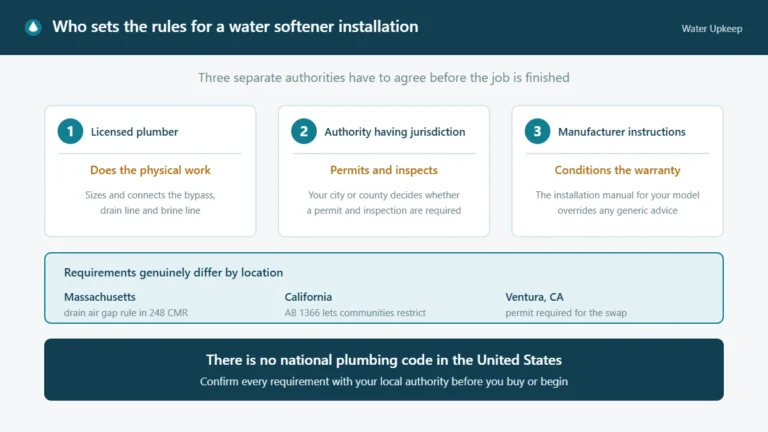
- You are on a septic system, or your municipality restricts brine discharge.
- You are being sold a device described as a salt-free softener. Ask which standard it is certified to, and whether it removes hardness or reduces scale.
- Scale is appearing quickly despite an installed softener, which usually means a sizing, setting or fouling problem rather than a technology problem.
More equipment guidance in our water softeners hub.
Sources and standards
- US Geological Survey — Hardness of water
- US Environmental Protection Agency — Water softener guide, Guide to selecting water treatment systems, Water softeners technical sheet, WaterSense at Work, water purification and Cation exchange water softeners
- Penn State Extension — Water softening and How to interpret a water analysis report
- NDSU Extension — Water softening (ion exchange) and Iron and manganese removal
- Water Quality Association — Scale deposits, Magnetics Task Force report, Getting smart with softeners and Softened water benefits study (industry-funded)
- Centers for Disease Control and Prevention — Home water treatment systems
- University of Georgia Cooperative Extension — Home water quality and treatment
Last reviewed September 8, 2026.